
Sit at a sushi counter in Japan and, somewhere in the middle of the meal, the chef will set down a piece that looks different from the rest. The fish is pale, its skin left on and shining like foil, sometimes dotted with fine black specks, sometimes marked with dark wavy bands. This is hikarimono, "shining things": the silver-skinned fish of the sushi counter. Most of them are small, common and quick to spoil, which is exactly why they matter. A tuna belly is mostly bought; a good piece of gizzard shad is made. There is a saying among regulars that you can judge a sushi shop by its hikarimono. This guide walks through the members of the family, how to tell them apart, and why one of them changes its name four times on its way to adulthood, a habit it shares with a much larger fish that is not hikarimono at all.
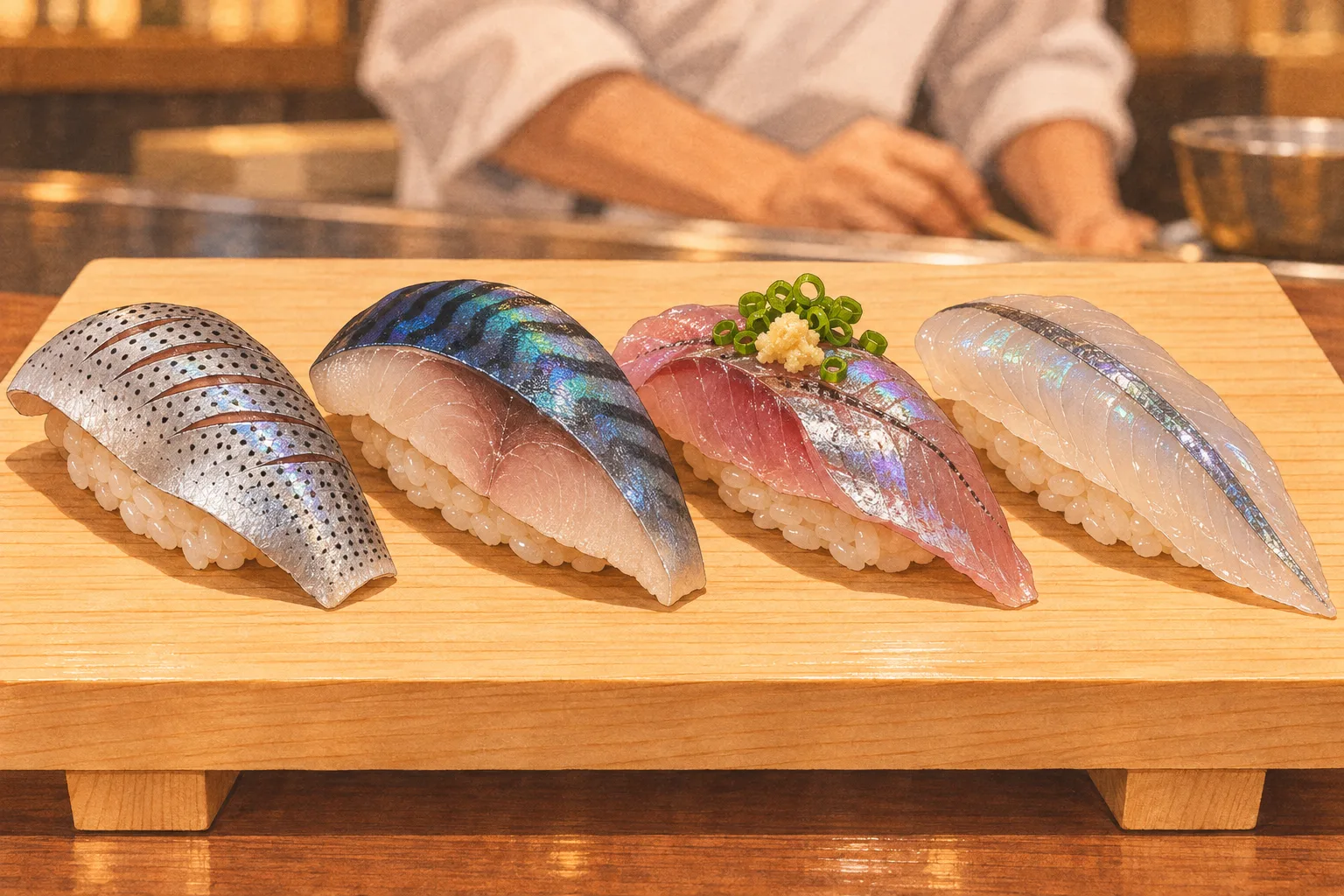
Four hikarimono at the counter, from left: kohada, shime-saba, aji with ginger and scallion, and sayori. The silver skin throws back blue, green and violet under the lights.
01What Counts as Hikarimono
Hikarimono is a counter term, not a scientific one. It covers fish served with their silvery skin intact, usually small, schooling fish from the upper layers of the sea. The core members are kohada (gizzard shad), aji (horse mackerel), saba (mackerel), iwashi (sardine) and sanma (Pacific saury). Around them sits a looser ring: sayori (halfbeak), kisu (Japanese whiting) and kasugo (young sea bream). At the counter they form a third group alongside akami, the red-fleshed fish such as tuna, and shiromi, the white-fleshed fish such as flounder and bream.
The shine is physical. The skin of these fish holds layers of tiny guanine crystals that act like mirrors, throwing back blue, green and violet glints under the counter lights. In open water this is camouflage. Seen from below, a silver belly disappears against the bright surface; seen from above, a dark blue-green back blends into the deep.
What else unites them is a shared problem. These are oily, blue-backed fish whose fats oxidise quickly, so they turn fishy fast once out of the water. In Edo, the city that became Tokyo, there was no refrigeration, and a fish that left the boat in the morning could be unpleasant by evening. Sushi makers learned to salt these fish to draw out water and odour, then rinse and marinate them in vinegar to firm the flesh and slow spoilage. The exact timings are a craft of their own and vary widely from chef to chef; what matters here is that two shops can serve the same fish and it will taste noticeably different.
That is the logic behind judging a shop by its hikarimono. Great tuna is largely a matter of which fish the shop secures at the market. Hikarimono is humble raw material, so nearly everything depends on the cook: too much salt and the flesh turns dry and harsh, too long in vinegar and the fish disappears under the acid, too little of either and the fishiness comes through. Some regulars order kohada first, as a quiet test.
02Kohada: One Fish, Four Names
Kohada is the signature fish of Edo-style sushi. Its proper name is konoshiro, the dotted gizzard shad, a member of the herring family that lives in bays and river mouths. Japanese fishmongers give it different names as it grows. A juvenile in its first summer, up to about 10 cm, is shinko. From roughly 10 to 15 cm it is kohada. At around 15 to 20 cm it becomes nakazumi. Past about 20 cm, fully grown, it is konoshiro. Those figures are one grading used on the Ariake Sea; the boundaries shift by region and by market and are applied loosely these days, but the ladder is the same. A fish that is renamed as it grows is called a shusse-uo, a "promotion fish," and we will come back to that idea.
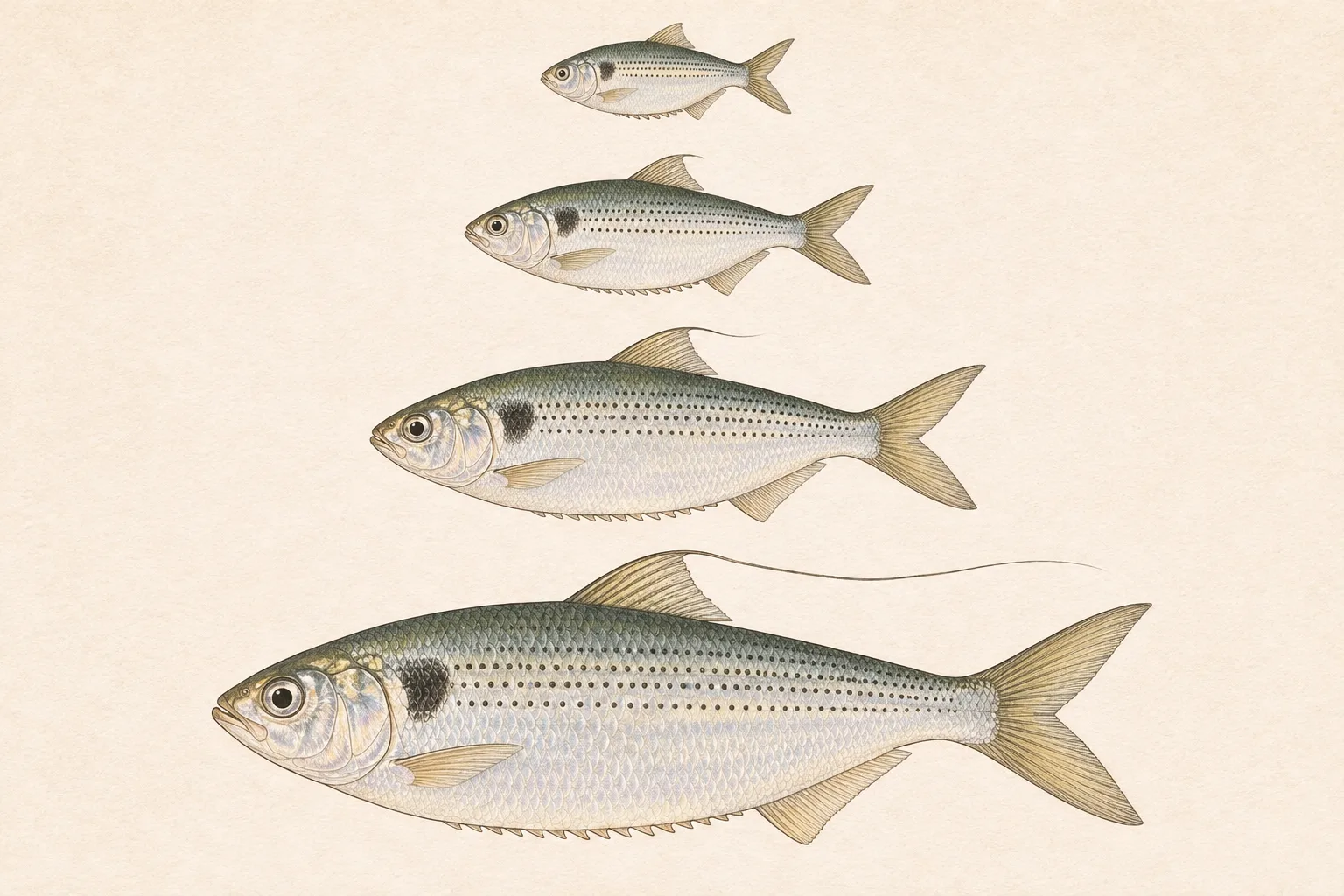
One fish, four names, from top to bottom: shinko, kohada, nakazumi, konoshiro. The shoulder spot and the rows of fine dots stay throughout; the trailing thread of the dorsal fin grows longer with size.
To recognise kohada, look along the back and flank. The back is a grey-blue with a greenish cast; the sides are silver, and the upper flank is crossed lengthwise by several rows of fine black dots that look like dotted lines drawn with a thin pen. Just behind the gill cover, at the shoulder, sits one larger dark spot, the easiest mark to spot. On a whole fish you can also see that the last ray of the dorsal fin is drawn out into a long, trailing thread. On the rice, the skin faces up, and those dotted rows over a blue-silver ground are what people mean by the kohada pattern. Chefs often score the skin with fine cuts or fold the fillet so that the best of the pattern faces outward.
Raw, kohada is bony, thin and strongly flavoured, not an obvious candidate for sushi. Salt and vinegar transform it: the flesh tightens, the small bones soften, and the taste becomes bright and rounded. By the later Edo period, kohada was a common, everyday topping at street sushi stalls.
The adult name carried some baggage. The fish was long said to smell like a cremation when grilled, and folk beliefs gathered around it. Folk stories link konoshiro to ko no shiro, "in place of a child," including a tale of a family who burned the fish in a coffin to fake their daughter’s death. Edo-period samurai reportedly avoided it because konoshiro could be heard as "this castle," so eating it meant eating the castle, and that it was reportedly served at ritual suicide, earning it the nickname "seppuku fish." These are folk beliefs rather than history, but they suggest why the grown fish long had a modest reputation while its younger self became a star.
Today kohada is landed in many places: in Kyushu, the Ariake Sea coasts of Saga and Kumamoto, Amakusa and Izumi in Kagoshima; on Honshu, Shizuoka, Mikawa Bay in Aichi, Osaka Bay, Chiba and Tokyo Bay. Shinko from the Ariake Sea generally go to the Tokyo market. It is available year-round, though many chefs prefer the plumper fish of autumn through early spring for curing.
03Shinko: A Summer Fixation
From early summer into July, fishermen in Shizuoka, Kyushu and elsewhere begin landing the juvenile shad hatched that spring. The first shinko of the season are only about 5 cm long, and once split and boned, a fillet is so thin it is almost translucent. It can take two, three, even four or five fillets layered together to cover a single piece of rice; the counter shorthand counts them, as in "three-fillet shinko." The earliest shinko are the smallest and the hardest to handle, because salt and vinegar penetrate them in seconds.
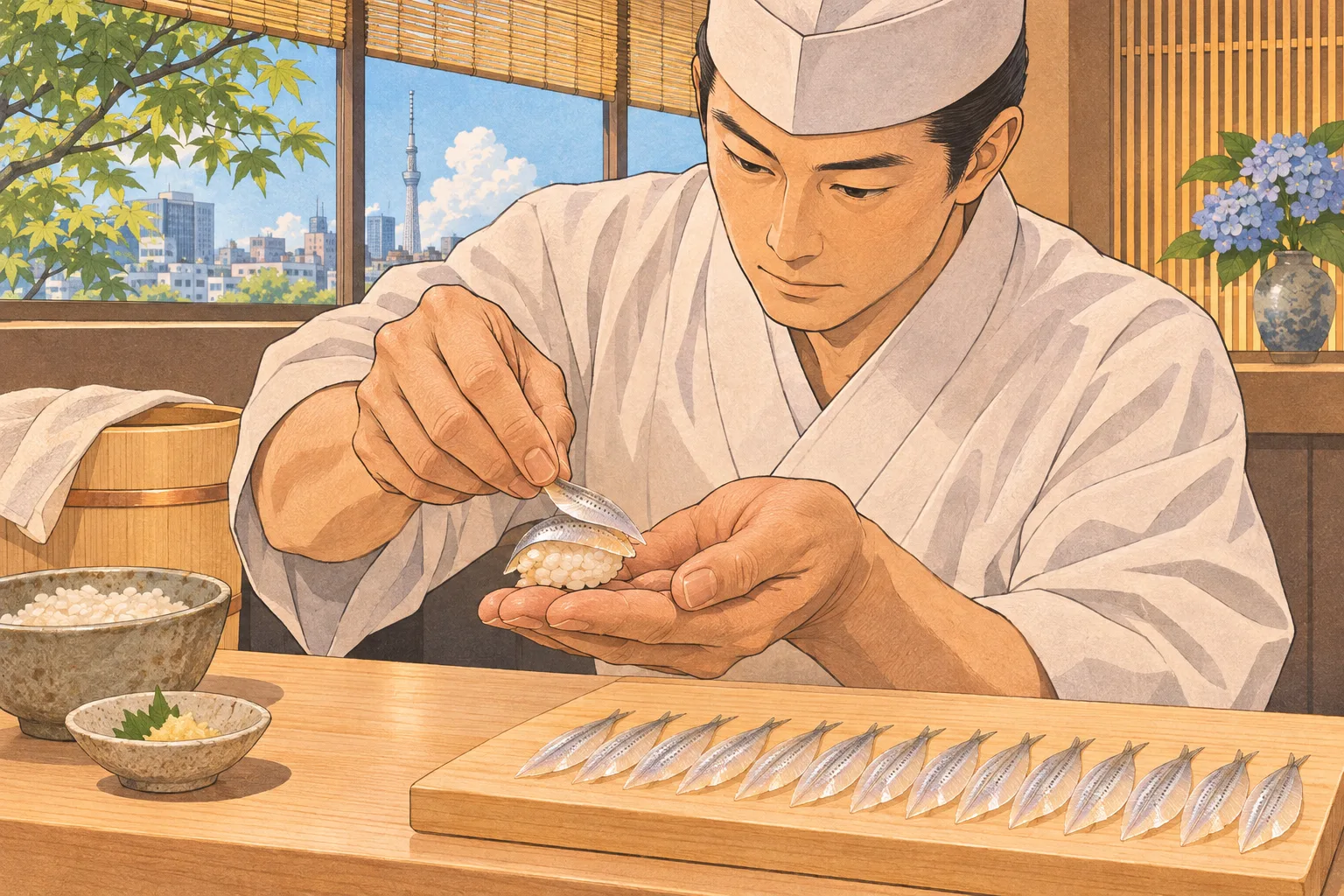
A summer counter: the chef layers thin shinko fillets one by one over a single piece of rice. On the board lies a row of shinko already split, boned and flattened.
The taste is very different from grown kohada: soft, barely fishy, gently acidic, with a fresh, almost grassy note. The season is short, peaking from late July into August; by September the fish have grown into ordinary kohada. In Tokyo there is a friendly competition among chefs to serve the first shinko of the year, and its arrival is announced in shop notices and food columns much as cherry-blossom forecasts are.
Shinko shows both sides of hikarimono at once. The fish itself is the humble shad, yet a tub of them can take an afternoon of splitting, boning and flattening to yield a few dozen pieces. Regulars chase it for the sense of season and for what it says about a chef who is willing to spend that labour on something that lasts only a few weeks.
04Aji: The Saw-Edged Line
Aji, the Japanese horse mackerel, is one of the most familiar fish in Japan: fried in set-meal restaurants, butterflied and dried for breakfast, and served raw at the sushi counter. At sushi shops the fish is usually ma-aji, the common horse mackerel.
The key identifying feature runs along its side. The lateral line starts behind the gills, curves down following the back, then straightens and runs to the base of the tail. Along it lies a row of hard, keeled scales called zeigo or zengo. Run a finger from tail to head and it feels like a small saw. In ma-aji these scutes cover the entire length of the line. One of the first jobs in preparing the fish is to slice this strip away. There is also a small dark spot on the gill cover.
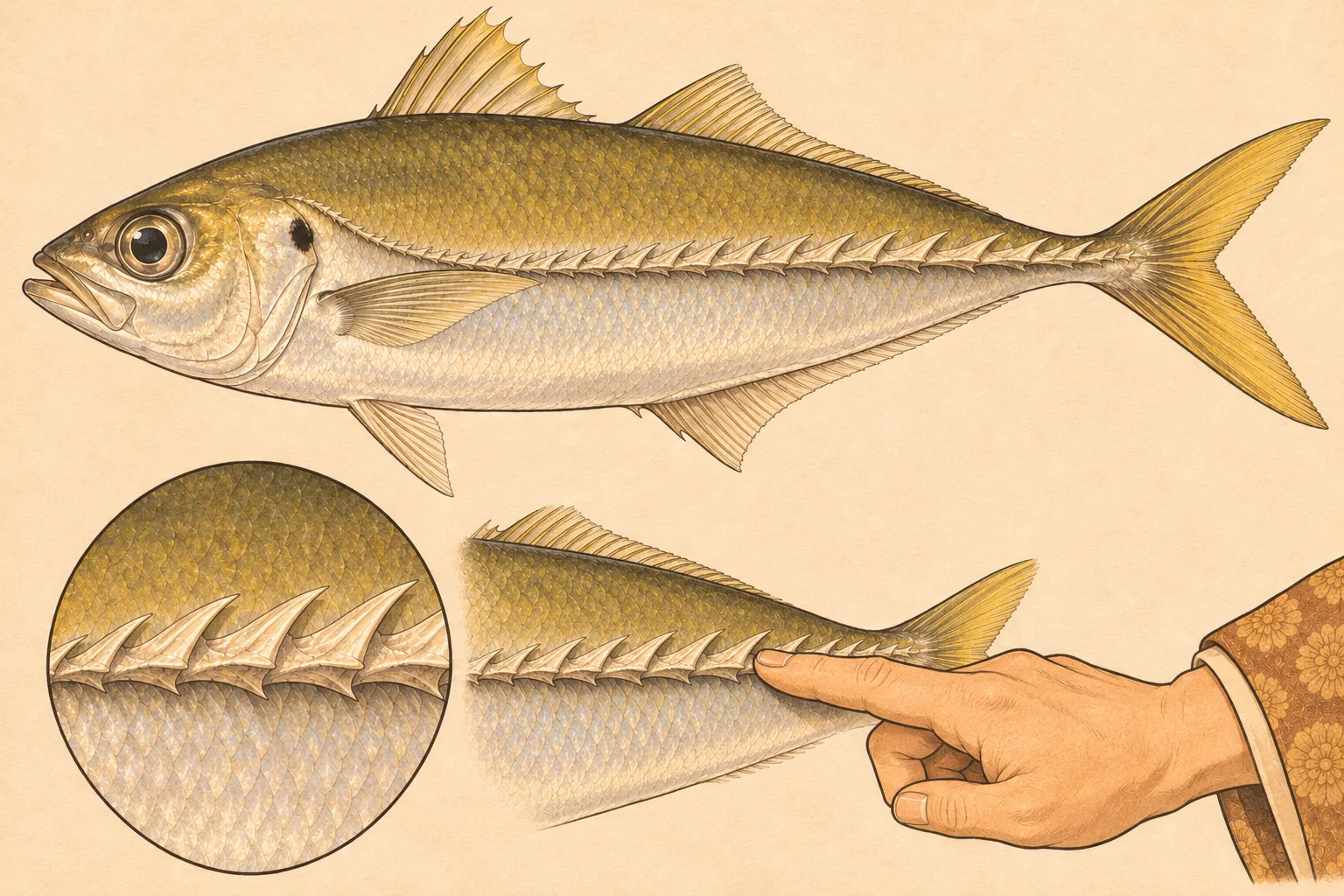
Ma-aji: the lateral line curves down, then runs straight to the tail, covered all along by the keeled scutes called zeigo; note the small dark spot on the gill cover. Lower left, the scutes enlarged; lower right, a finger on the scutes near the tail.
Colour tells a story too. Some horse mackerel settle around coastal reefs and become deeper-bodied and yellowish; fishermen call these yellow aji, and they are prized for their fat. Others roam the open sea and are slimmer and darker. The best-known brand is seki-aji from Saganoseki in Oita Prefecture, caught by hook and line in the fast currents of the Hōyo Strait so the fish are not bruised by nets.
Aji is generally considered best from early summer into summer. A popular folk etymology links the name to aji, meaning "flavour," because the fish tastes so good. Unlike kohada, a very fresh aji is often served raw or only briefly touched with vinegar, topped with a dab of grated ginger and chopped scallion to balance its rich, slightly sweet oil. Many chefs treat it as the bridge between raw and cured hikarimono: the fresher the fish, the lighter the touch.
On the Bōsō Peninsula in Chiba, fishermen used to chop raw aji on board with miso, ginger, scallion and shiso leaf until the mixture turned sticky. They called it namerō, supposedly because it was so good you would lick (nameru) the plate clean; patted into cakes and grilled, it becomes sangayaki. It is fisherman’s food, not sushi, but you will find it in izakaya along Tokyo Bay and Sagami Bay, the same fish in a much rougher coat.
05Saba: Wavy Backs and a Short Life
Mackerel is the biggest and most strongly flavoured of the common hikarimono. Japan has two main species: ma-saba, the chub mackerel, and goma-saba, the blue mackerel. Both have a blue-green back covered with dark, wavy bands, a pattern the Japanese compare to worm tracks in wood. To tell them apart, turn the fish over. Ma-saba has a clean silver belly; goma-saba has a belly scattered with small dark spots like sesame seeds, which is where its name, "sesame mackerel," comes from. Ma-saba is at its fattest in autumn and winter, when it is called kan-saba, "cold-season mackerel"; goma-saba holds its fat more evenly and is often preferred in summer.
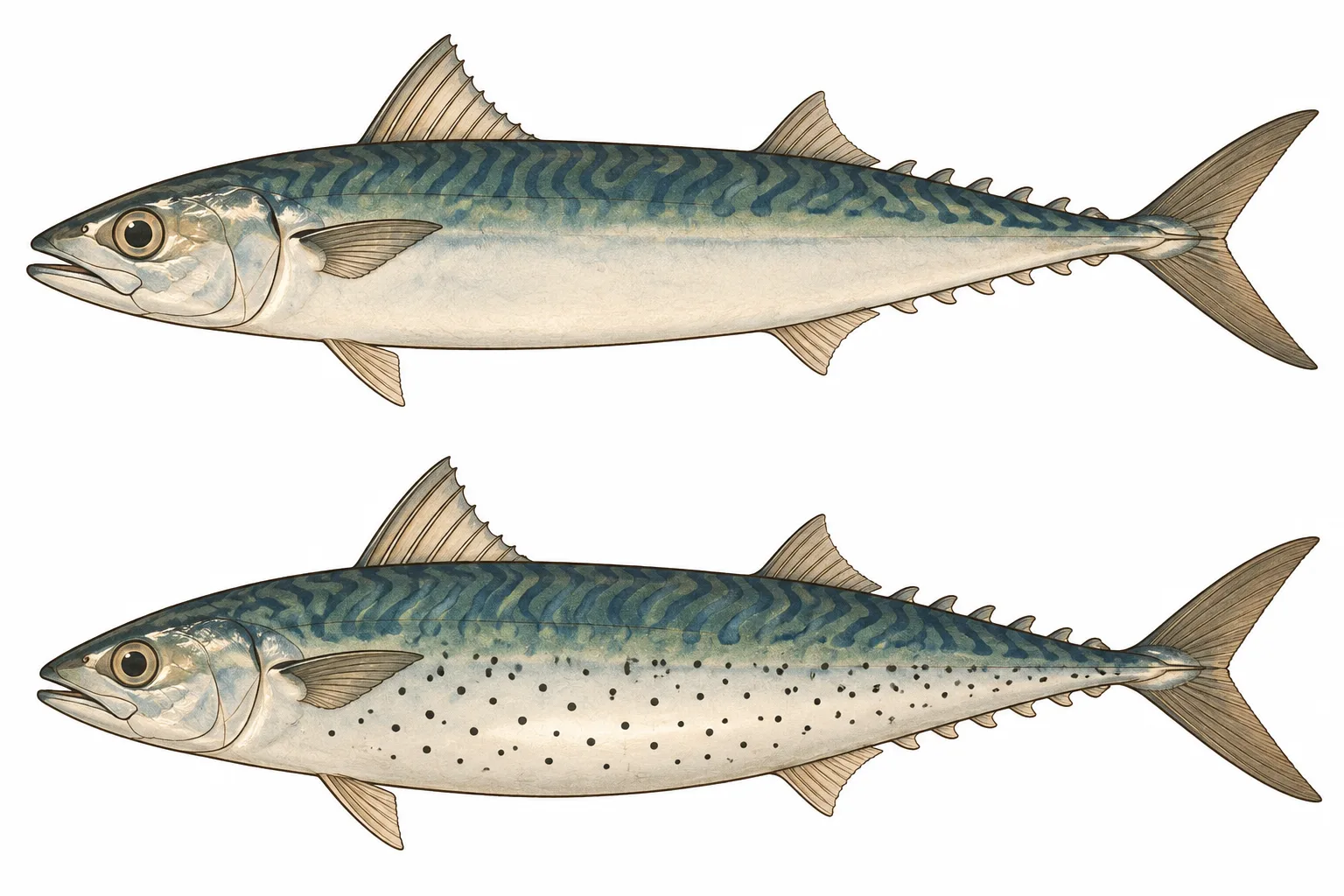
Top: ma-saba, with a clean silver belly. Bottom: goma-saba, its lower flank and belly scattered with sesame-like dots. Both carry the same dark wavy bands on a blue-green back.
Mackerel spoils notoriously fast. An old Japanese phrase, saba no ikigusare, says that mackerel "rots while still alive." Its own enzymes break the flesh down quickly, and mackerel is rich in histidine, which bacteria in fish left at room temperature convert into histamine. Cooking does not destroy histamine, and it causes allergy-like food poisoning in some people. Mackerel also commonly carries anisakis parasites. For these reasons raw mackerel has always been treated with caution in Japan, and the classic sushi form is shime-saba, salted and vinegar-cured.
Its fragility shaped regional sushi. Salted mackerel carried over the mountains from Wakasa Bay to Kyoto along the Mackerel Road arrived just cured enough, and Kyoto’s pressed saba-zushi grew out of that trade. Osaka’s battera is a pressed mackerel sushi too, though it is said to have begun at an Osaka shop in the mid-Meiji period as vinegared gizzard shad: a half fillet with its tail curled up looked like a little boat, so it was named after the Portuguese word for one, bateira. Mackerel replaced the shad later.
At the counter, styles of shime-saba vary. Some chefs cure it lightly so the centre stays rosy and almost raw; others go further for whiter flesh and a sharper tang. A few places land mackerel fresh enough to eat raw, most famously seki-saba from the same Saganoseki waters as seki-aji, along with Matsuwa mackerel from the Miura Peninsula in Kanagawa and Kinka mackerel from Miyagi. Even with these, many chefs still apply a light cure, arguing that a little salt and vinegar lifts the fish’s heavy richness.
Mackerel also left a phrase in everyday Japanese. Saba o yomu, "to count mackerel," means to fudge a number, such as knocking a few years off one’s age. The usual explanation is that mackerel came to market in huge quantities and spoiled so fast that traders counted them in a hurry and the tallies were rarely right. It is one theory among several, but it shows how ordinary the fish was.
06Iwashi and Sanma: The Everyday Pair
The sardine at the sushi counter is usually ma-iwashi, the Japanese sardine. It is easy to recognise: blue-black back, silver sides and often a single row of black spots along the flank, up to about seven, which earned it the market nickname "seven stars" in the Kanto region. The count varies, some fish show a fainter second row and some have hardly any spots at all. Sardine scales fall off at the slightest touch, and fishmongers use the state of the scales as a quick freshness check.
The kanji for iwashi combines the fish radical with the character for "weak," a nod to how quickly it dies and bruises. It has always been the people’s fish: dried, simmered, made into fish balls, even used as fertiliser. In the Kanto region, sardines caught in the June rainy season are called nyūbai iwashi, "rainy-season sardine," and are praised as the fattest, although the best season really varies from coast to coast. Served raw with ginger and scallion it melts on the tongue with a deep, sweet oiliness. Sardine catches in Japan swing dramatically over decades, from glut to scarcity and back, one of the best-known boom-and-bust cycles in Japanese waters.
Sardines even guard the door. On Setsubun, the day before the old start of spring, some households hang a grilled sardine head skewered on a sprig of holly by the entrance, a charm called hiiragi iwashi. The smell of the charred fish and the prickly leaves are said to keep demons out. It is rarer in cities now but still seen in parts of western Japan and at some shrine events.
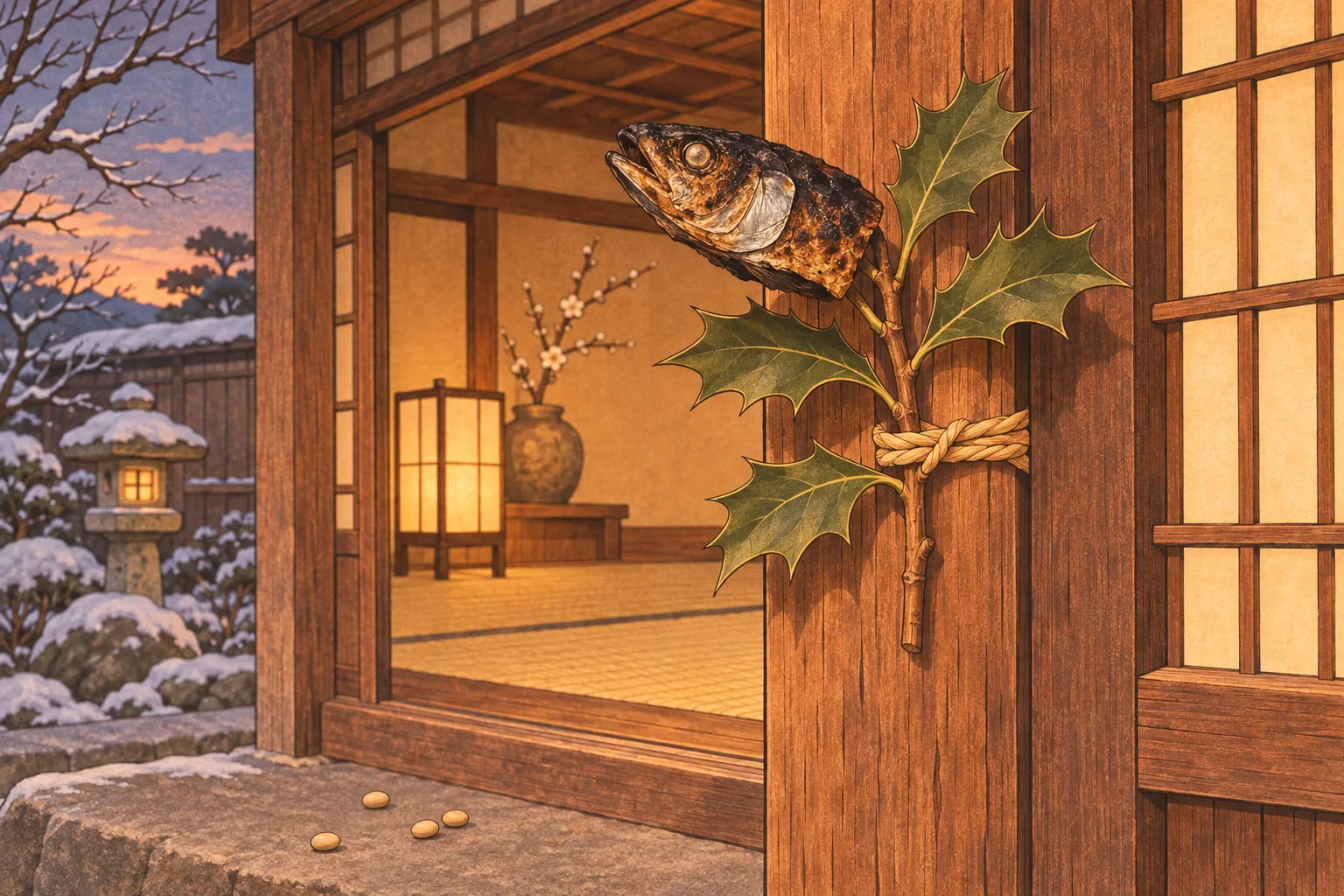
Hiiragi iwashi at Setsubun: a grilled sardine head skewered on a sprig of prickly holly and tied to the doorpost, with a few beans lying on the stone step.
Sanma, the Pacific saury, carries its season and shape in its name: in Japanese characters it is written "autumn-knife-fish." The body is long and narrow like a silver blade, deep blue on the back and silver below, with a pointed snout and a lower jaw that juts slightly past the upper. Fishmongers often say a touch of yellow at the tip of the lower jaw marks a fat fish. Behind the dorsal and anal fins run rows of tiny finlets to the tail. Most Japanese know it salt-grilled with grated daikon and a squeeze of citrus as the taste of autumn.
Japan’s fondness for sanma is best captured in a classic rakugo comic story, Meguro no Sanma. It is told in several versions, some with a shogun at a teahouse; in a common one, a feudal lord out hunting in Meguro, then a rural district outside Edo, gets hungry and is served a farmer’s freshly grilled saury. He has never tasted anything so good. Back at his mansion his retainers try to recreate it, but the fish is steamed, de-oiled and de-boned into something limp and bland. Asked where it came from, they name the best fish market in the city, and the lord sighs that sanma is best from Meguro. Meguro is nowhere near the sea, which is the joke. Today Meguro holds an autumn saury festival where grilled sanma is served to visitors.
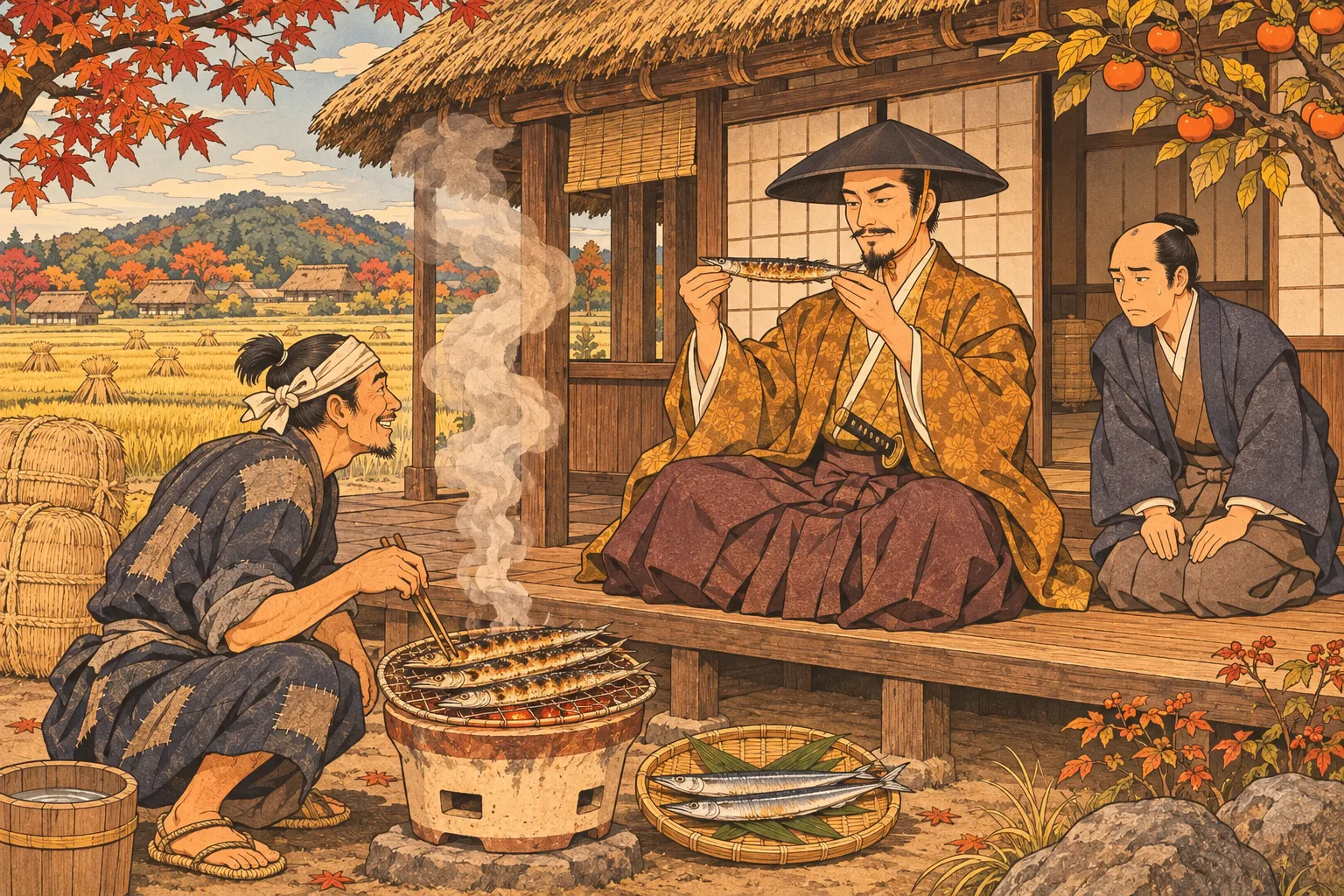
Meguro no Sanma: at a farmhouse in autumn Meguro, a farmer grills saury over charcoal while the lord, out hunting, holds one up on the veranda and his retainer looks on uneasily (artist’s impression).
For sushi, the season is September and October as the fish migrate south past Hokkaido’s Nemuro and the Sanriku coast. Raw sanma on rice is rich like sardine but cleaner, usually with ginger and scallion. Catches have fallen steeply over the past decade or more, and what was once the most everyday autumn fish now appears at sushi counters as a seasonal treat.
07Sayori, Kisu and Kasugo: The Refined Edge
Sayori, the Japanese halfbeak, is treated as a herald of spring at the counter, fattest from winter into early spring before it spawns. It is slender as a silver pencil, and its signature is the lower jaw: a long, needle-like extension, longer than the head, tipped with vermilion. The back is blue-green, the belly white, and the dorsal and anal fins sit far back near the tail. Open the belly and the lining of the body cavity is jet black, which gave rise to a teasing Japanese expression for someone who looks lovely but has a dark heart. The flesh is clear white and delicate. Chefs sometimes cut it into thin strips and tie them into knots, or cure it briefly in kelp before forming it on rice.
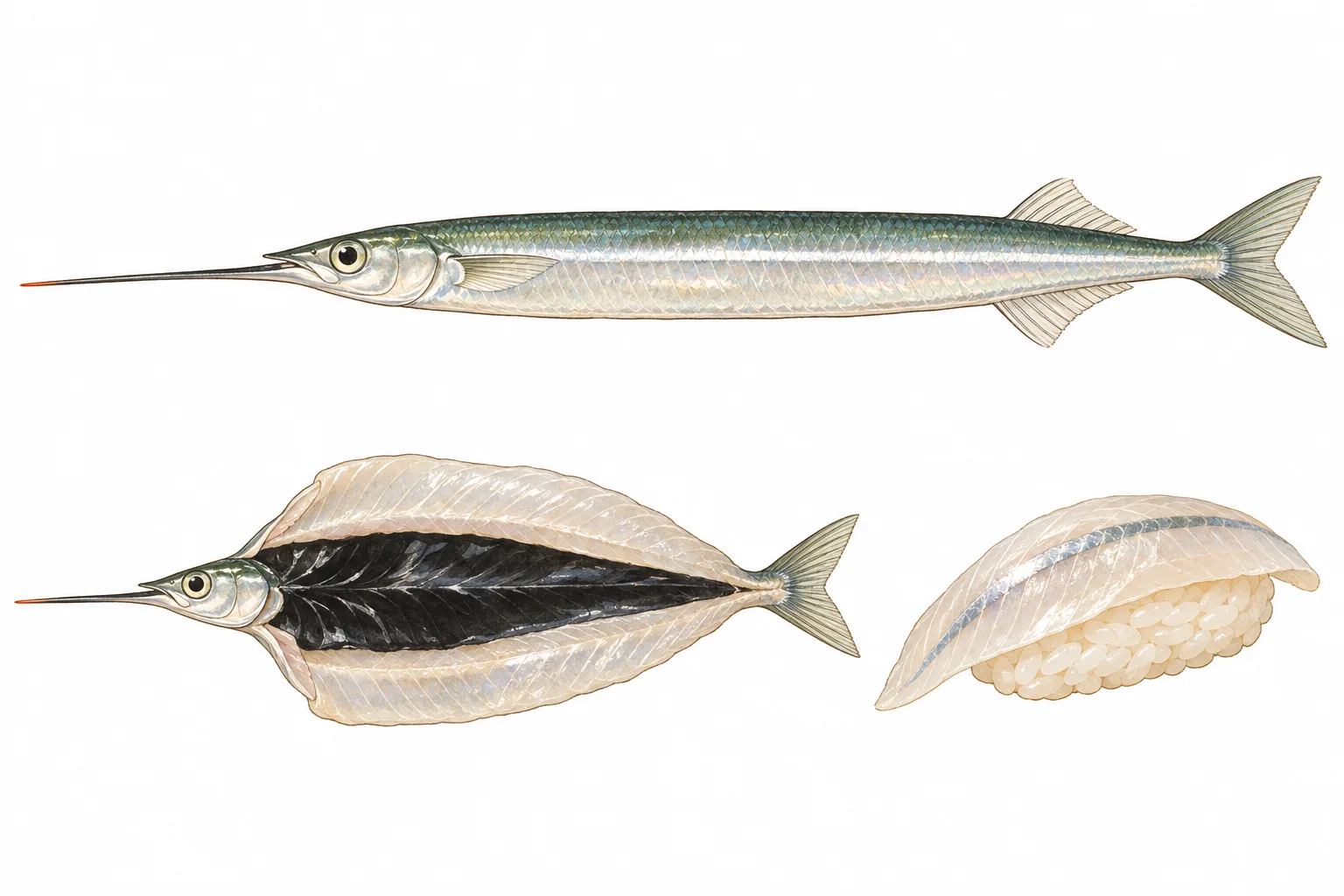
Top: sayori, its lower jaw drawn out into a long needle tipped with vermilion. Lower left: opened, showing the jet-black lining of the belly. Lower right: sayori on rice, a silver line running through the clear white flesh.
Kisu, Japanese whiting, sits at the edge of the group. Fresh, its skin is a translucent pale grey-brown with a faint reddish tinge over silver, the body long and slim, the flesh pure white. In Tokyo it is first and foremost a tempura fish, a summer staple at tempura counters. For sushi, chefs usually cure it lightly with kelp or a little vinegar to sharpen its gentle flavour. It is a fish of spring and summer, found along sandy coasts from Tokyo Bay outward, and catching kisu from the beach is a classic summer pastime.
Kasugo is not a species but a counter name for young sea bream, typically red sea bream, crimson sea bream or yellowback sea bream at around 10 cm, small enough that one boned fillet covers one piece of rice. Its skin is pale pink with a silver sheen, sometimes flecked with tiny blue spots. It is handled much like kohada, salted and then vinegared, sometimes finished with kelp for extra savouriness. The name contains the character for "spring," and it was traditionally a spring fish, although it now appears through much of the year. Kasugo shows that hikarimono is defined by how a fish looks and is prepared on the counter: biologically it is a white-fleshed bream, but its shining skin and its cure put it among the silver fish.
08Side by Side: Telling Them Apart
Start with body shape. Sanma and sayori are the longest and slimmest, like two silver blades; the difference is the mouth. Sanma has a pointed snout with only a slightly longer lower jaw, while sayori’s lower jaw stretches into a long red-tipped needle. Saba is the heaviest, torpedo-shaped with a narrow tail stalk. Aji, iwashi and kohada are mid-sized and streamlined. Kisu is slim with a pointed head. Kasugo has the deep, compressed, high-backed profile of a bream.
Next, the markings on the back and flank. Saba has dark wavy bands on blue-green. Kohada has several rows of fine black dots. Iwashi has a single row of larger, rounder spots near the midline. Aji has no strong pattern, but its saw-edged row of scutes along the lateral line stands out. Sanma is plain deep blue above. Sayori is slender, blue-green above and almost translucent. Kasugo is pink and silver.
Then the small tells. Kohada has a large dark shoulder spot behind the gills; aji has a small spot on the gill cover. To separate the two mackerels, check the belly for sesame dots. On sanma, look for the yellow tip of the lower jaw. On sayori, the black belly lining shows once the fish is opened.
On the rice, where only the skin is visible: blue-silver skin with dotted rows is kohada; blue-green skin with wavy marks and thick flesh showing a white rim of cure is shime-saba; bright silver skin with a trace of the lateral line, rosy flesh and a topping of ginger and scallion is likely aji or iwashi; translucent white flesh with a silver line is sayori; pink skin is kasugo.
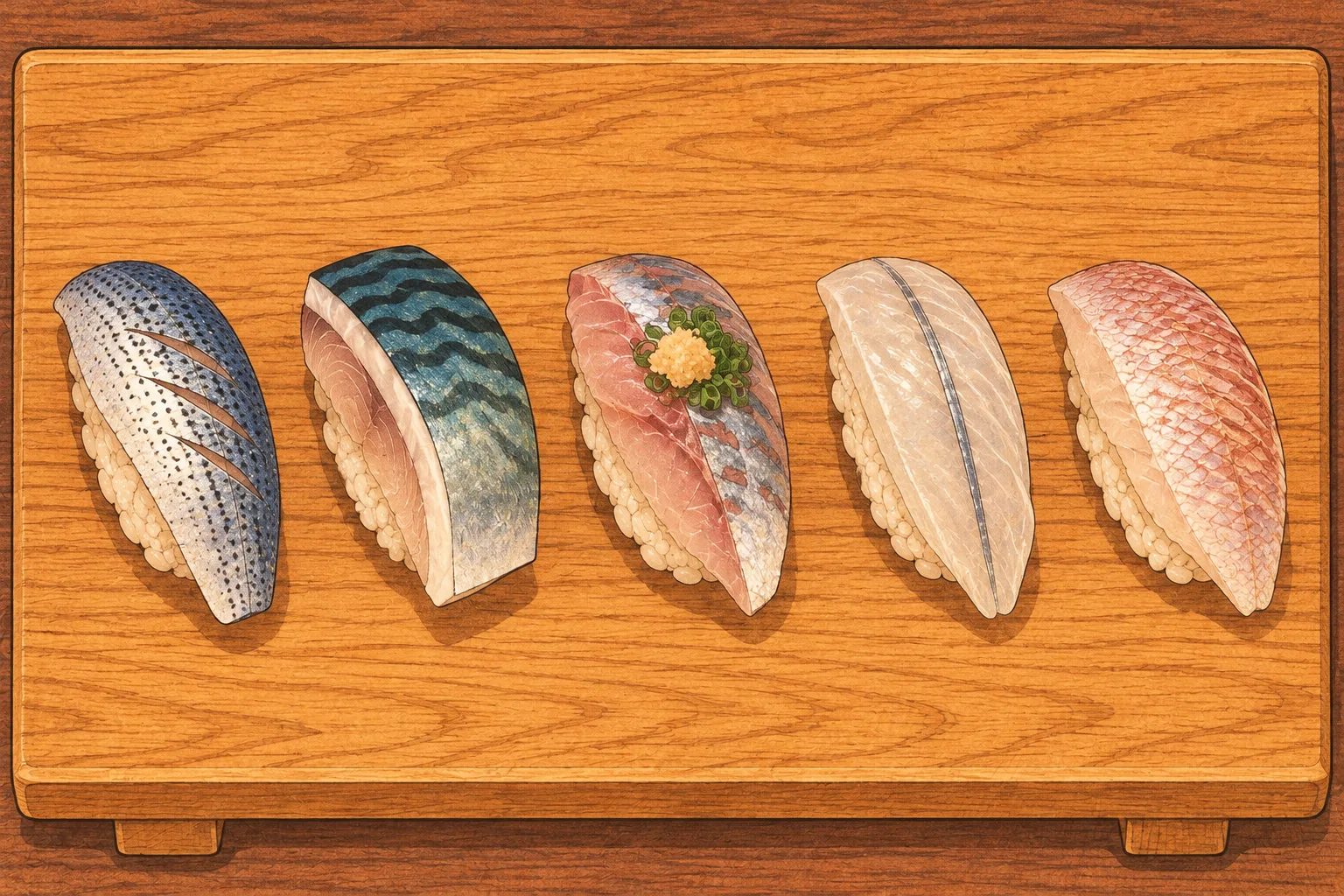
On the rice, read the skin. From left: kohada (blue-silver with dotted rows), shime-saba (wavy blue-green, a white rim of cure), aji (rosy flesh, ginger and scallion), sayori (a silver line on white flesh), kasugo (pink skin).
09Promotion Fish and the Yellowtail
Kohada’s four names are not unusual in Japan. Fish renamed as they grow are called shusse-uo. Shusse, originally a Buddhist word, came to mean rising in the world, getting ahead in one’s career. Samurai and court nobles traditionally changed their names at their coming-of-age ceremony and often again on promotion, so a fish that changes names as it grows was seen as auspicious, and these fish appear at celebrations for promotions, school entrance and the New Year.
In practice the names were coined by fishermen and traders because different sizes of the same fish differ in fat, flavour and use. Names therefore vary from region to region: one size has one name in Tokyo, another in Osaka and others again in Toyama or Kyushu.
The most famous promotion fish is buri, the Japanese amberjack or yellowtail. It is not hikarimono. Although it is a blue-backed, silver-bellied fish, it is large, thick-fleshed and rich, and at the counter it is sliced and served raw as a meaty fish, not cured with its skin on like the silver fish. It is easy to identify by the pale yellow stripe running from the eye to the tail and its yellowish tail fin.
In the Kanto region around Tokyo, its names run roughly wakashi, inada, warasa and buri; in the Kansai region around Osaka, tsubasu, hamachi, mejiro, buri. The size boundaries differ widely between regions and sources, but a fish usually has to pass 70 or 80 cm to be called buri. Hamachi is the name most likely to confuse visitors. In Kansai it originally meant a mid-sized wild fish, but because yellowtail farming developed first in western Japan and fish were shipped at about that size, hamachi came to mean farmed yellowtail across the country. On sushi menus abroad, "hamachi" almost always means farmed yellowtail or a close relative.
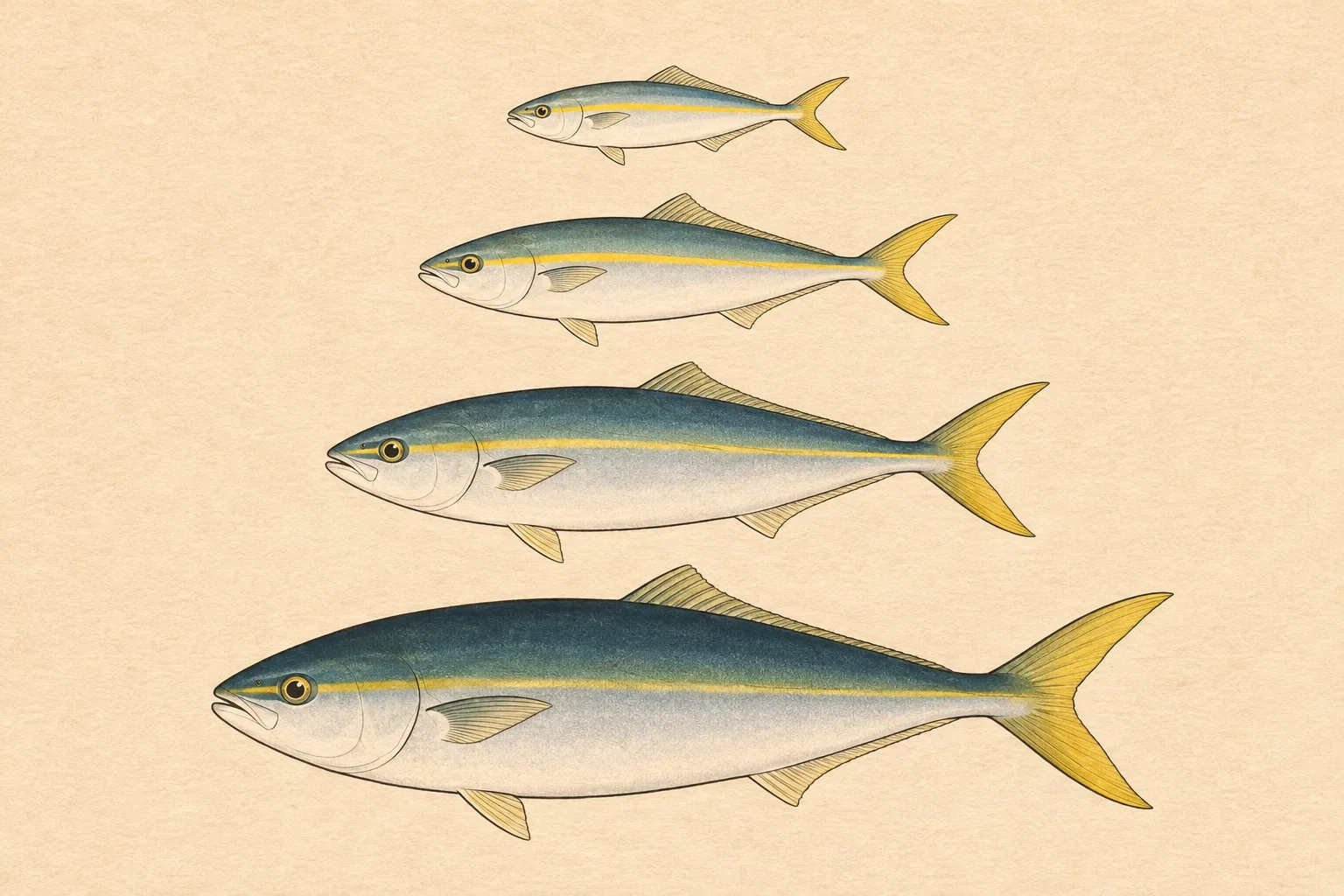
Four stages of the yellowtail, from top to bottom: wakashi, inada, warasa, buri in Kanto; tsubasu, hamachi, mejiro, buri in Kansai. The pale yellow stripe from eye to tail and the yellow tail fin mark the fish at every size.
In Japan the most prized buri is kan-buri, winter yellowtail. On the Sea of Japan coast, the winter catch of Himi in Toyama Prefecture is a famous brand; the thunderstorms of late autumn and early winter there are called buri-okoshi, "yellowtail rousers," because local lore says the fish arrive with the thunder. In Hokuriku, Kansai and much of western Japan, buri is the traditional year-end fish, as salmon is in the east. On the Toyama coast, in the first winter after a wedding, the bride’s family sends a whole buri to the groom’s household, which returns half. The kanji for buri pairs the fish radical with the character for "master" or "teacher"; one explanation ties it to shiwasu, the old name for December, when the fish is best, another to the idea of age and maturity. Both are later interpretations.
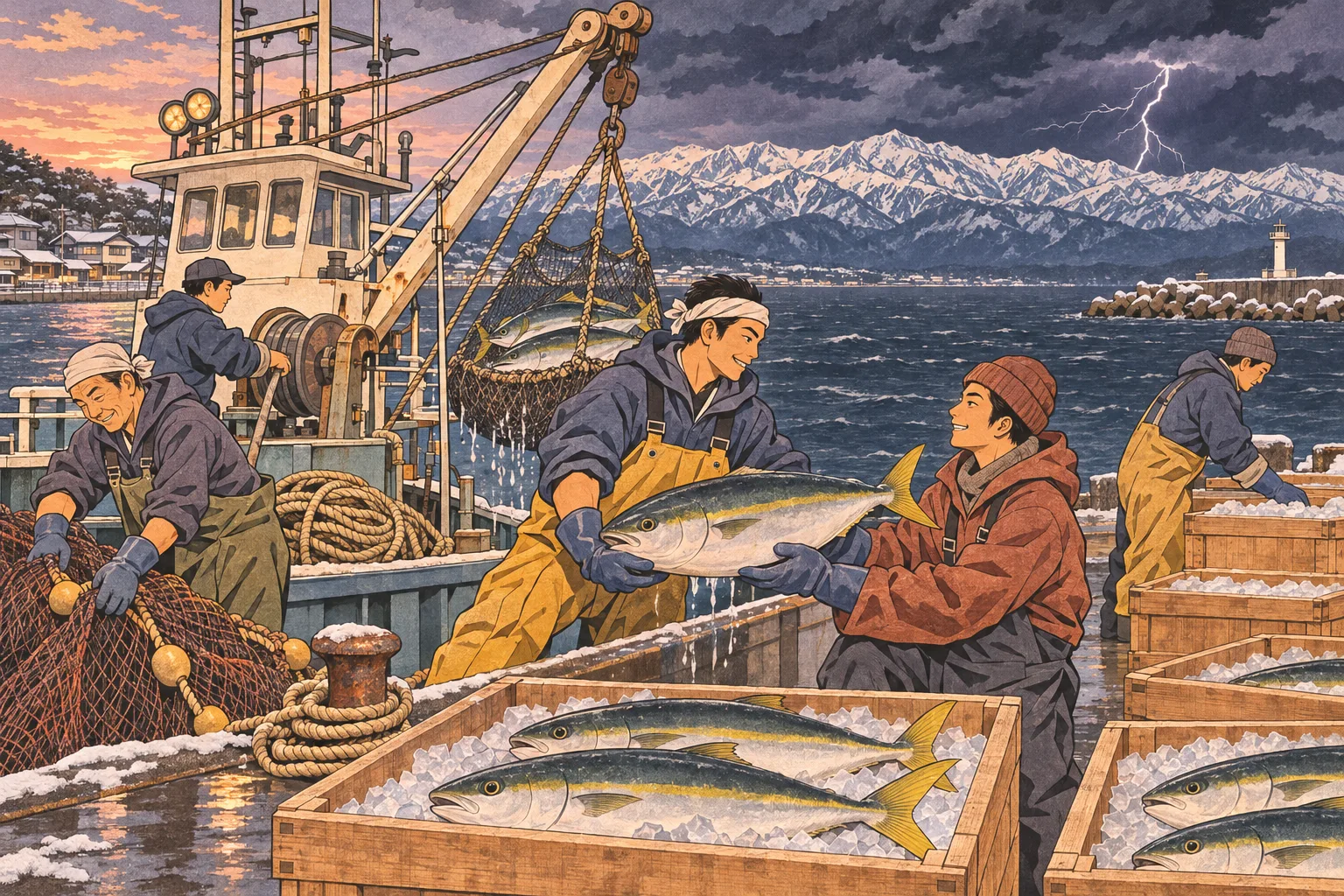
A winter morning at the port of Himi, Toyama: lightning over the snowy mountains as fishermen unload kan-buri into crates of crushed ice. Locals call this thunder buri-okoshi, the yellowtail rouser.
Other promotion fish include the grey mullet, whose names include oboko, ina, bora and finally todo; the common expression todo no tsumari, "in the end," is said to come from that last name. Japanese sea bass climbs from seigo to fukko to suzuki in Kanto. Few people track every step in daily conversation, but at the fish market and the sushi counter these names remain working vocabulary.
More deep dives on this topic
 TunaOrder an omakase in Tokyo and the tuna usually arrives in a sequence: a slice of deep red lean meat, then something pinker and softer, then a pale, marbled piece that seems to…
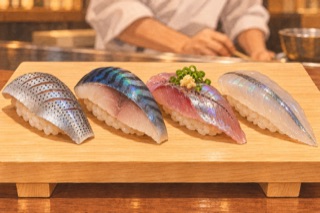 HikarimonoSit at a sushi counter in Japan and, somewhere in the middle of the meal, the chef will set down a piece that looks different from the rest.
 Beyond TunaMost first-time visitors walk into a sushi bar thinking about tuna.
 Edomae ShigotoMost visitors arrive at a Tokyo sushi counter expecting raw fish on rice.
 Shari and Its Supporting CastAt a sushi counter your eyes follow the fish.
 Regional Sushi Beyond TokyoMost visitors meet sushi at a counter: a chef shapes rice in one hand, lays a slice of fish on top and sets it down in front of you, to be eaten within seconds.
 KaitenzushiSit down at a kaitenzushi (conveyor-belt sushi) counter anywhere in Japan and the basic deal is the same.
 Fish MarketsThe piece of sea bream a sushi chef slides across the counter at lunchtime has usually changed hands four or five times since it left the water.
 Words at the Sushi CounterSit at a sushi counter in Japan and the language around you shifts.
 The Sushi ChefFrom a counter seat, a sushi chef looks like a pair of hands and very little else.
- Back to the main article: Sushi →