
Most first-time visitors walk into a sushi bar thinking about tuna. Then the chef sets down a slice of fish so pale it is nearly see-through, dusts it with salt, squeezes a drop of green citrus over it and tells you to eat it as it is. Next comes a fan of orange-red clam that he slapped on the cutting board until it curled, then a block of squid scored so finely it looks carved from jade, then a boat of seaweed piled high with gold. These quieter pieces are where a sushi chef shows his buying eye and his sense of the season. This guide goes through them one by one: the white fish, the shellfish, the raw shrimp and squid, the sea urchin and the roe. It covers how to recognise each one on the counter, where it comes from, when it is at its best, and why it is eaten the way it is.
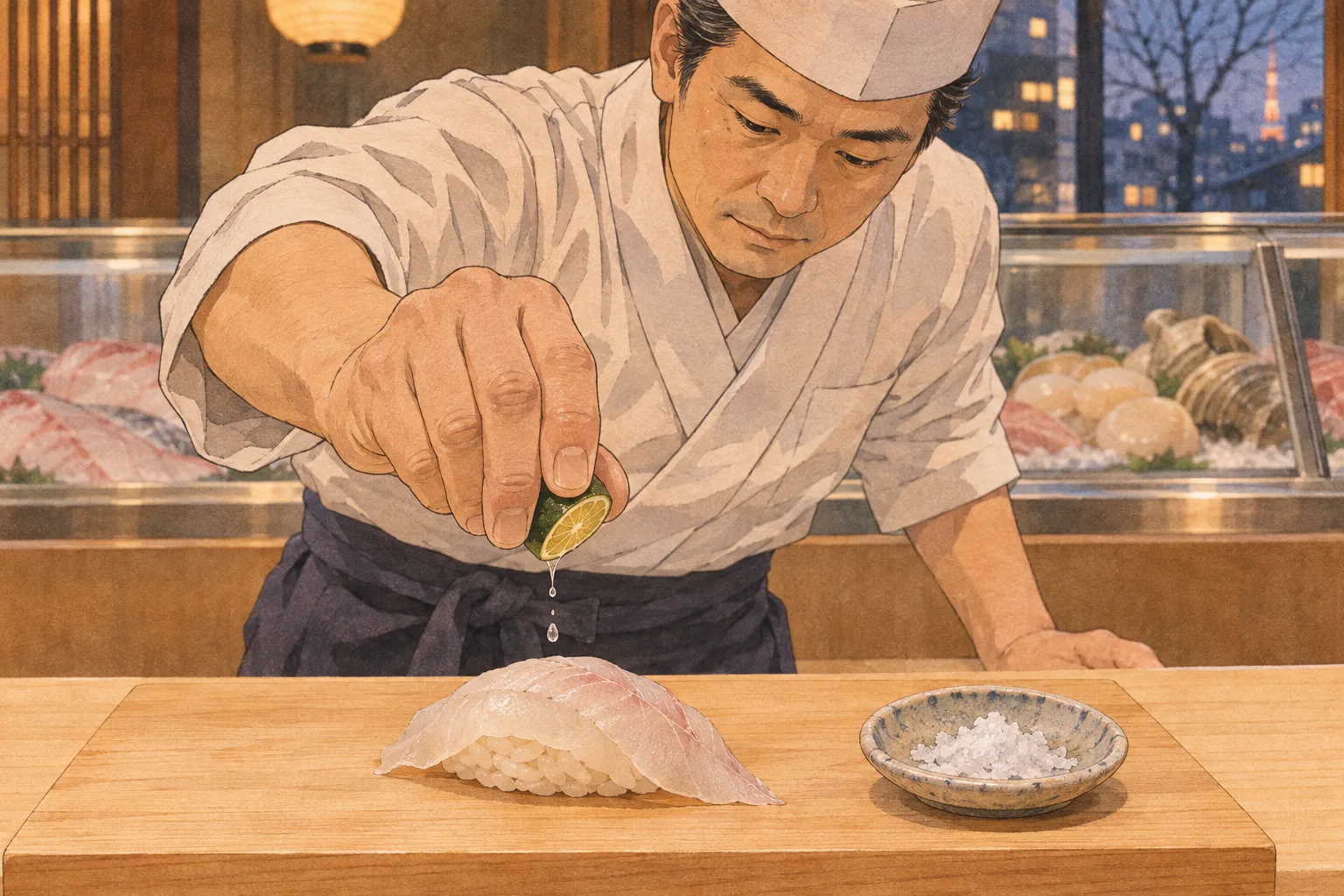
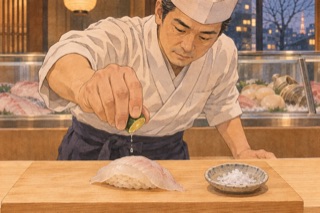
At a Tokyo counter the chef squeezes green citrus over a piece of translucent white fish, with a dish of salt beside it. This piece is eaten as it is, without soy sauce.
01How the Counter Sorts Its Fish
Sushi chefs do not sort their toppings (neta) by biology. They sort them by how they behave in the kitchen. Akami, "red flesh", is tuna and bonito. Shiromi, "white flesh", covers lean, pale fish such as sea bream and flounder. Hikarimono, "shiny things", are the silver-skinned fish like mackerel and gizzard shad. Then come shellfish (kai), shrimp and squid, roe, and the simmered and grilled items. Pieces in the same family are prepared, seasoned and served in roughly the same way.
Many items in this guide are relatively new to sushi. Nineteenth-century Edo, where nigiri was born, had no refrigeration, so its sushi leaned on vinegar, salt, soy marinades and simmering. Eating raw scallop, sweet shrimp, sea urchin and salmon roe on a large scale belongs mostly to the twentieth century, when ice, refrigerated trains and later air freight brought the catch of Hokkaido and the Sanriku coast to Tokyo and Osaka overnight. Half of what a modern visitor thinks of as classic sushi would have puzzled an Edo stall-keeper.
White fish has a special place in the meal. In an omakase (chef’s choice) sequence it usually comes first, because its mild flavour wakes the palate without flattening it. Shellfish often follow close behind, while shrimp and uni tend to come in the middle as changes of texture and sweetness. The main article describes the light-to-rich habit; white fish and shellfish are where that sequence begins.
02Classic White Fish: Sea Bream, Flounder, Flatfish and Sea Bass
Madai (red sea bream). In Japan the sea bream has long been the king of fish. A whole grilled tai sits at the centre of wedding and New Year tables, partly because its name echoes medetai, "auspicious". The live fish is a metallic pink scattered with tiny sky-blue spots. On rice the flesh is translucent white with a pink cast and a fine grain. Many chefs briefly heat the skin side, a style called kawashimo ("skin frost"), so the skin tightens and puckers into a pattern compared to pine bark, leaving a thin pink-and-silver rim along one edge of the slice. The Seto Inland Sea is the classic source. Fish from the fast tidal straits at Akashi and Naruto are thought to have the firmest flesh. Spring bream, flushed red before spawning, are called sakura-dai (cherry-blossom bream), and autumn fish that have fattened again are momiji-dai (maple bream). Much of the madai sold today is farmed, especially in Ehime; farmed fish is darker-skinned and fattier, and a good chef will tell you which you are eating.
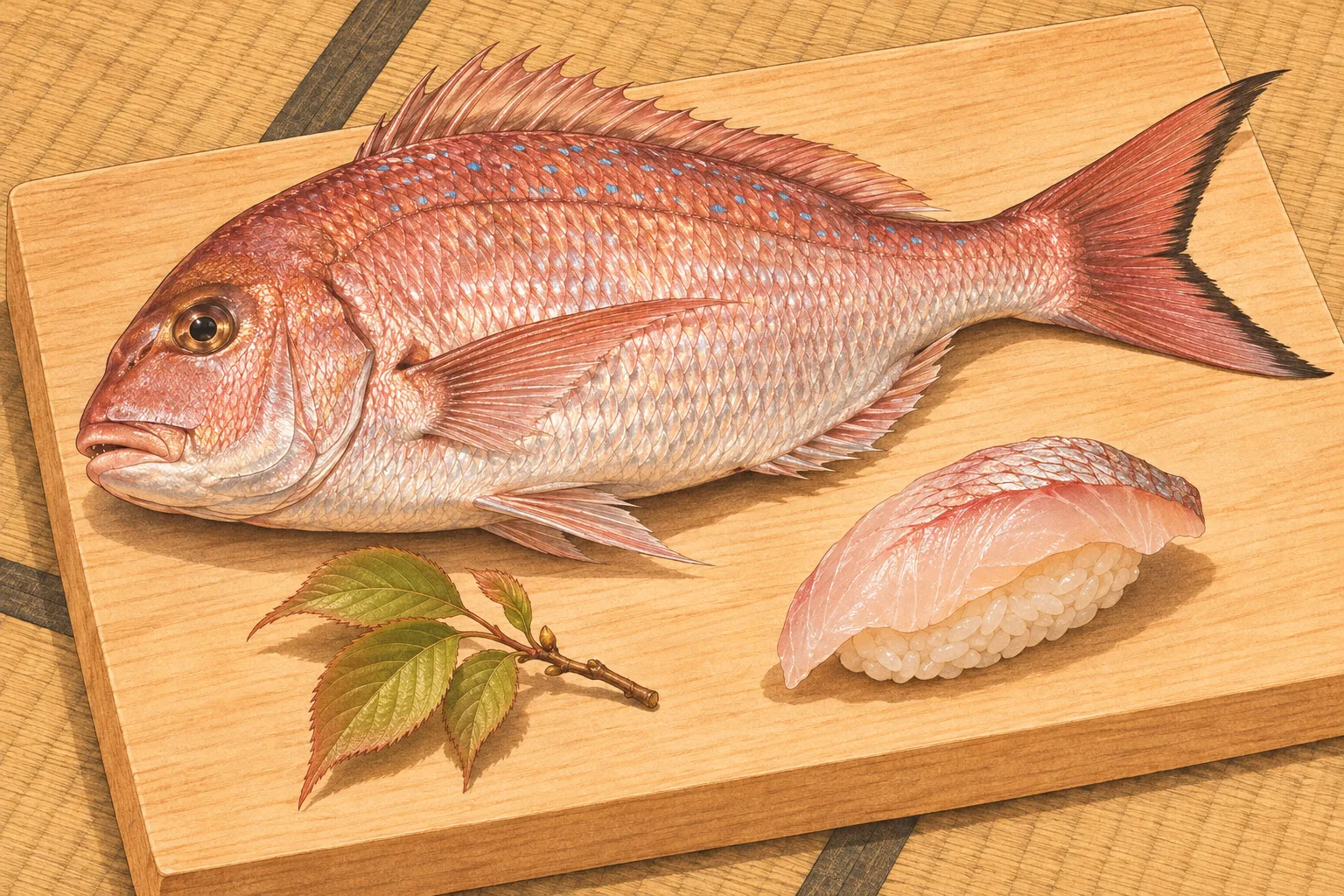
A whole madai: metallic pink, with sky-blue spots on the back and a dark edge to the tail. Beside it, madai nigiri with a rim of kawashimo skin along one side.
Hirame (olive flounder) and engawa. Hirame is the winter white fish. Like all flatfish it lies on the sea floor with both eyes on one side. Japanese fishmongers have a rhyme, hidari hirame ni migi karei: lay the fish dark side up with its belly towards you, and if the eyes are on the left it is hirame, on the right it is karei. Hirame flesh is white and slightly glassy, cut thin, springy, with a clean sweetness that grows as you chew. Cold-water winter fish, kan-birame, are the fattest.
The prized cut is engawa, the band of muscle that runs along the base of the dorsal and anal fins. The fish works these fins all day, so the meat is laced with fine sinew and carries more fat than the body. One flounder gives only four thin strips. On rice, engawa is a short, thick, ivory-to-pale-yellow strip with fine parallel ridges, sometimes lightly torched so the fat glistens. It has a distinct crunch. The engawa at conveyor-belt shops usually comes from much larger fish such as Greenland halibut; it is whiter, oilier, softer and has coarser ridges.
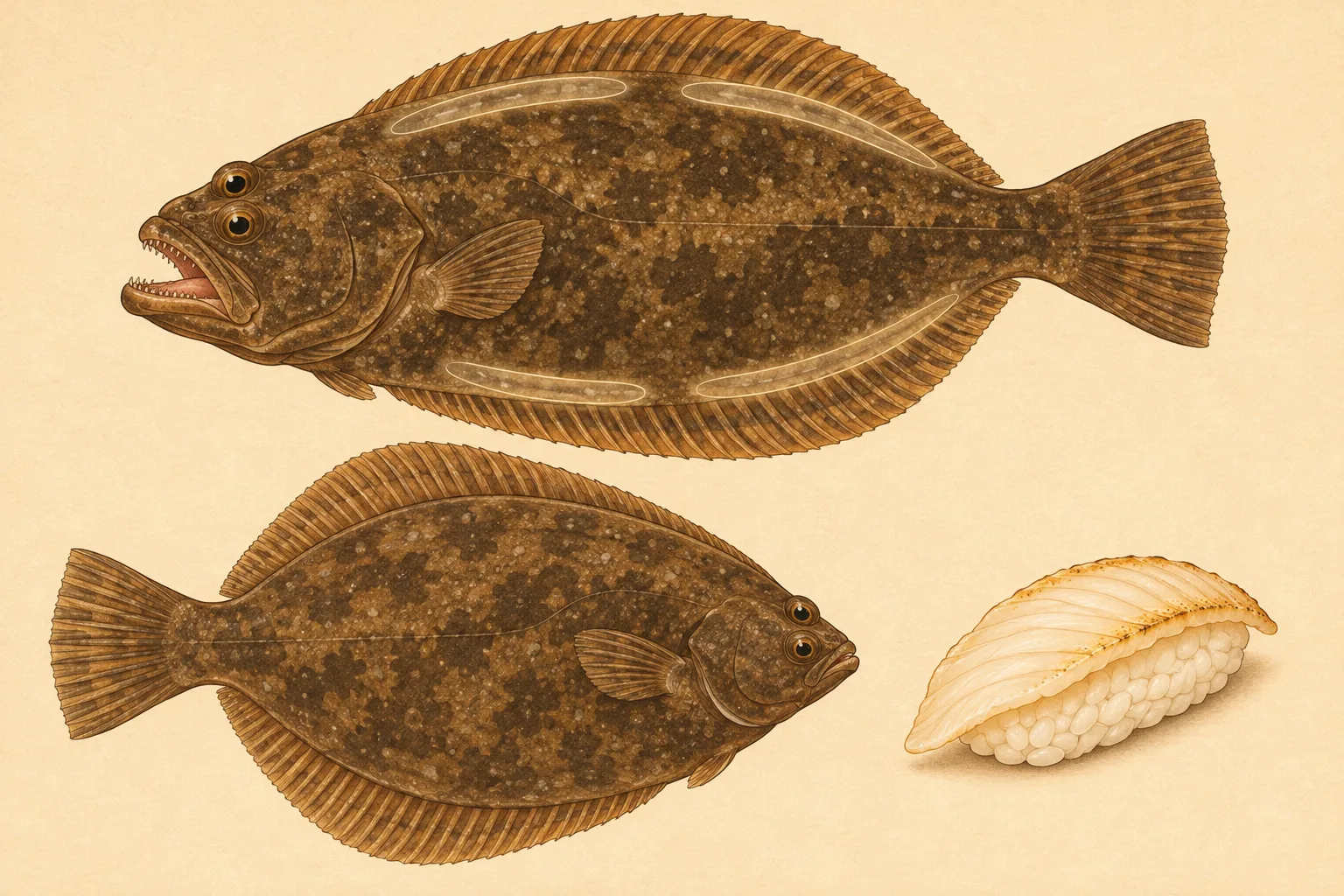
Eyes on the left, hirame; eyes on the right, karei. Top: hirame, with a large toothed mouth; the four pale bands along the fin bases mark the engawa. Bottom: karei, with a small mouth. Lower right: engawa nigiri.
Karei (flatfish). Karei is hirame’s cousin, and marbled flounder takes over in summer, when hirame goes out of season. Sushi bars also prize premium species: hoshigarei (spotted halibut) with star-like black dots on its fins, and matsukawa (barfin flounder) with black bars on its fins. The flesh is firmer and chewier than hirame, with a faint seaweed freshness. The most famous name is shiroshita karei, marbled flounder caught below the castle walls at Hiji in Ōita Prefecture. Local tradition says fresh water welling up from the sea floor there keeps the fish free of muddy taste, and the domain’s lords reserved it as a delicacy. On the plate karei and hirame look almost identical. Regulars tell them apart by texture and the calendar: a pale slice in July is almost certainly karei.
Suzuki (Japanese sea bass). Suzuki is a summer fish and a shusse-uo, a "promotion fish" that changes its name as it grows. Around Tokyo it is seigo when small, then fukko, and only earns the name suzuki at around 60 centimetres. Because the names step up like a career, the fish is considered lucky. The flesh is snow-white with an even layer of fat and a wet shine. The traditional summer treatment is arai: thin slices rinsed in iced water until they curl and turn crisp. As nigiri it is usually served raw, sometimes with the skin lightly seared. Tokyo Bay sea bass was famous in the Edo period, and fish from Chiba and Kanagawa still reach Tokyo counters.
03The Rich Whites: Nodoguro and Kinmedai
White fish is supposed to be delicate. The two white fish that have become most fashionable in recent decades are prized precisely for their fat.
Nodoguro (blackthroat seaperch). The standard name is akamutsu, but everyone calls it nodoguro, "black throat", because inside its mouth the throat is jet black. The fish is bright orange-red with very large eyes and lives on the sea floor at around 100 to 200 metres. The Sea of Japan coast is its home: Shimane, Ishikawa, Toyama and Niigata. Hamada in Shimane has adopted it as the city’s signature fish. The flesh is white with a pink tinge and visibly threaded with fat, which is why people call it "the ōtoro of white fish". Most chefs serve it skin-on and seared with a torch until the orange skin blisters and the fat runs. A pinch of salt and a squeeze of citrus is all it gets. In Kanazawa and Toyama seared nodoguro is often a shop’s showpiece. Its national fame is usually traced to 2014, when tennis player Nishikori Kei, back in Japan after finishing runner-up at the US Open, told a press conference that the food he most wanted was nodoguro.
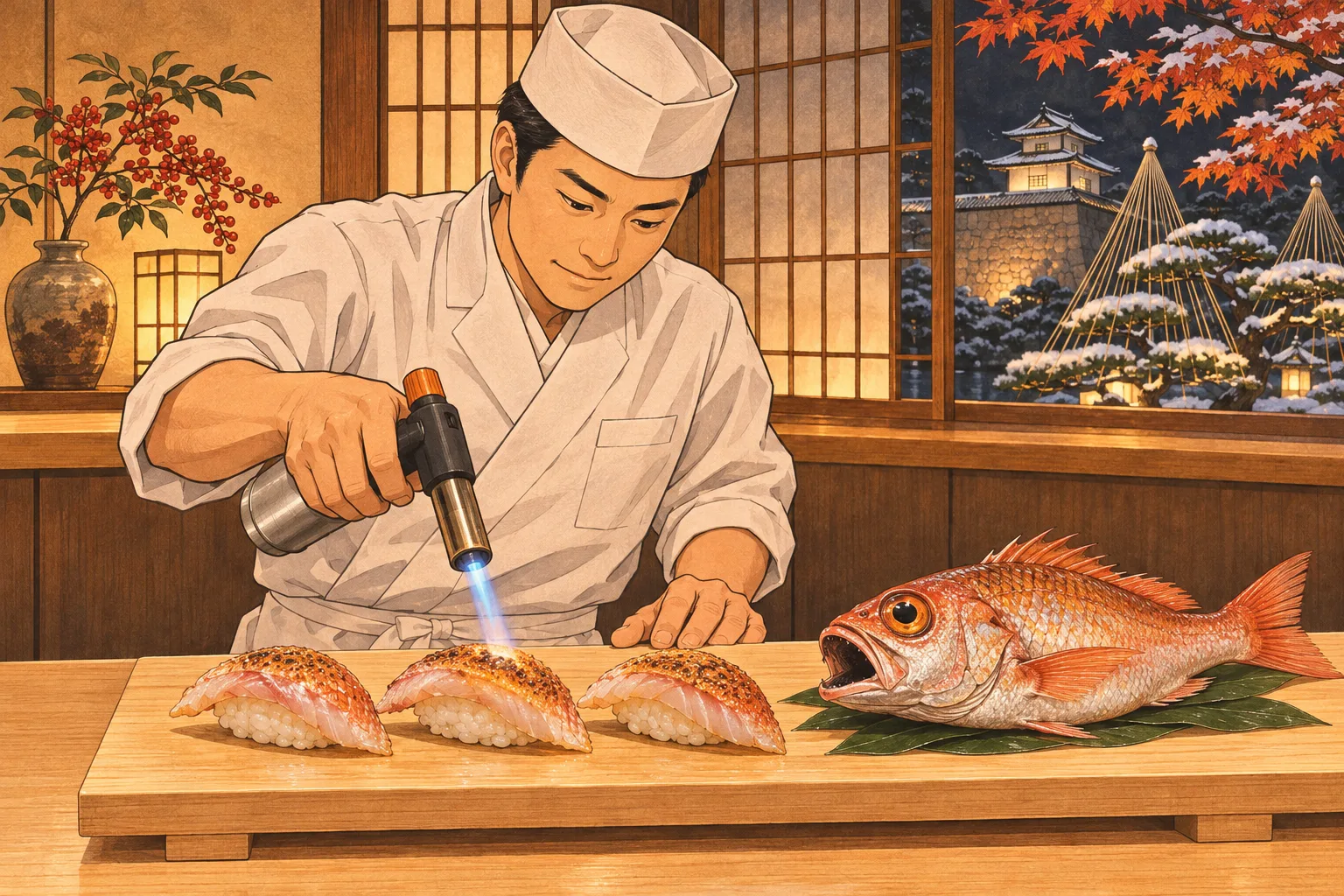
At a Kanazawa counter the chef torches three pieces of skin-on nodoguro until the orange skin blisters. The whole fish on the right shows the black throat that gives it its name.
Kinmedai (splendid alfonsino). Kinmedai lives on the Pacific side, in deep water from a few hundred metres down. It is deep crimson all over, and its huge round eyes flash gold in the light, which gives it its name, "golden-eye bream". The best-known catches come from Chōshi in Chiba, where fish are taken on single lines, from Shimoda on the Izu Peninsula, and from Muroto in Kōchi. Most Japanese eat kinmedai simmered in sweet soy (nitsuke), but around Izu and the Bōsō Peninsula it often appears raw as nigiri. The pale pink flesh comes with a strip of red skin, usually scalded or torched so it is tender, and the red edge against white flesh makes it one of the most photogenic pieces at the counter. It is fattest in winter, softer and milder than nodoguro.
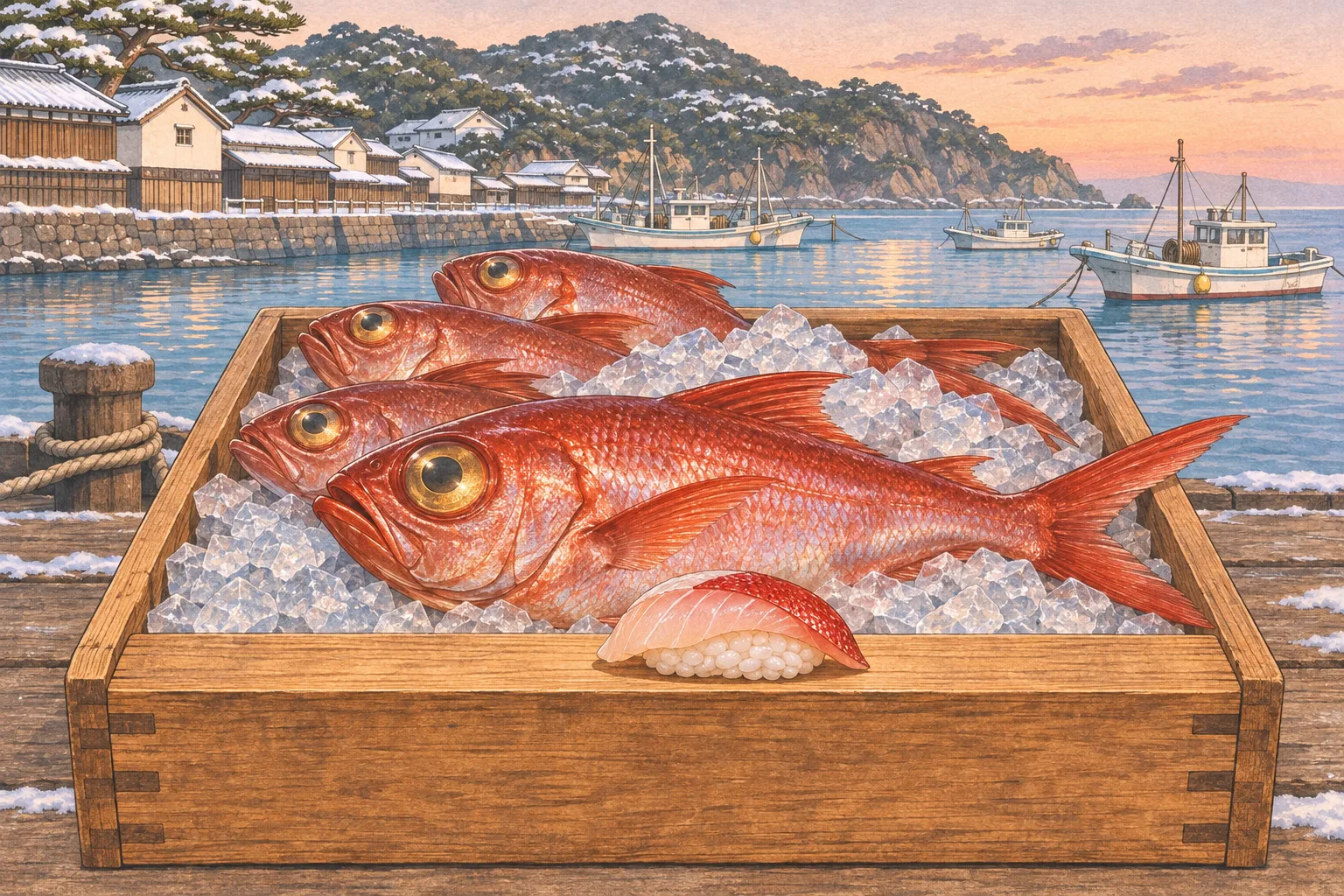
Kinmedai on ice at a winter fishing port: deep crimson all over, with huge round eyes that flash gold. In front, kinmedai nigiri with its strip of red skin.
Both fish rode the same two trends. After the war the craze for fatty tuna made abura no nori ("how well the fat is on") a main way of judging any fish. Meanwhile better cold chains let deep-water fish travel to cities fresh enough to eat raw. Nodoguro and kinmedai offer white-fish delicacy with fatty-tuna richness, and so they moved from local fish to national stars.
04Shellfish: From Ark Shell to Abalone
Shellfish sushi is about texture and sound: crunch, snap, spring, and a burst of sea water and sweetness. Good counters keep shellfish live and open them in front of you.
Akagai (ark shell). The star of the shellfish family. The meat is a vivid orange-red because, unusually for a clam, its blood carries haemoglobin. The chef butterflies it into a frilled fan, scores the surface and then slaps it hard on the cutting board. A fresh akagai flinches and curls up like a petal. It is theatre, but it also proves the clam is alive. The bite is crisp and springy with a mineral, faintly iron-like sea flavour. The darker frill around the edge, himo, is often served separately or rolled with cucumber. Akagai from Yuriage in Natori, Miyagi Prefecture, is the most prized; the Ariake Sea and the Inland Sea also produce it. The season is winter into spring.
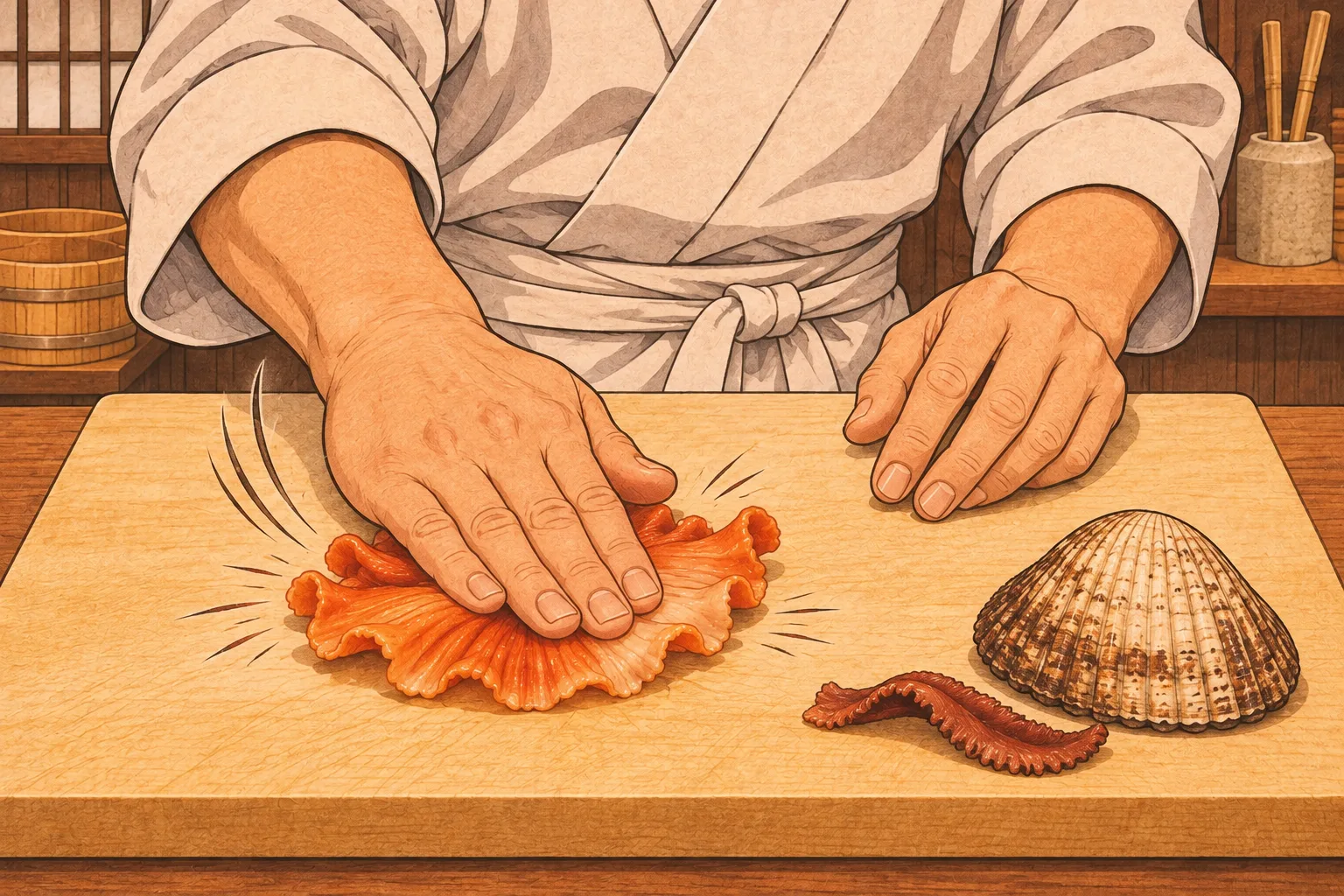
Slapping akagai: the chef strikes the butterflied orange-red meat on the board and its edges curl up at once. On the right are the ribbed shell and a strip of the darker frill, himo.
Torigai (Japanese cockle). The edible part is the cockle’s long, curved foot, shaped like a bird’s beak, which gives it the name "bird shellfish". One side is glossy purple-black, the other cream. On nigiri the black side faces up and the tip droops over the rice. The black coating is so fragile that a fingertip can rub it off, so chefs handle it with care. Torigai is usually dipped briefly in hot water before serving. It is soft yet springy and very sweet. The best-known are Tango torigai, raised for about a year in containers hung from rafts in Maizuru, Miyazu and Kumihama bays in northern Kyoto Prefecture; only shells weighing 100 grams or more earn the name, and they are big and thick. The season is short: spring into early summer.
Hotate (scallop). The easiest shellfish for newcomers. Sushi uses the adductor muscle, a cream-coloured cylinder sliced across into discs with fine vertical fibres, laid flat or cut and opened into a butterfly. Raw scallop is soft, slightly sticky and sweet, with almost no fishiness; some chefs sear the top to concentrate it. Japan’s scallops come mainly from the Okhotsk coast of Hokkaido (Sarufutsu, Monbetsu), where seeded scallops grow on the open seabed, and from Mutsu Bay in Aomori, where they are hung on ropes. They are available all year.
Hokkigai (surf clam). Its standard name is ubagai. This large clam lives along the Pacific coasts of Hokkaido and Tōhoku, and Tomakomai in Hokkaido lands more than any other port. Raw and cooked, it looks like two different animals. Raw, the tip of the meat is greyish brown with a purple tinge over a cream base. Blanched for a few seconds, the tip turns bright pink-red, which is why many people assume hokkigai is naturally red. Hokkaido sushi bars often offer both: raw for crunch and sea-sweetness, blanched for softness and colour. It is best from winter to spring.
Mirugai (gaper clam). The traditional mirugai is hon-miru, "true miru", a big clam that lives buried in the mud of sheltered bays and pushes up a thick siphon. Tokyo Bay and Mikawa Bay were once famous sources. As hon-miru became scarce, shiro-miru (namigai, sometimes called Japanese geoduck) and imported Pacific geoduck from North America filled the gap. Shiro-miru and Pacific geoduck belong to the same genus; hon-miru, despite the resemblance, is in a different family. All three look alike, and in every case it is the siphon you eat. The chef blanches it briefly, peels off the tough brown skin and reveals ivory flesh tipped with purple-brown, then splits it, slices it and scores it. It is the crunchiest of all shellfish sushi and tastes strongly of the sea. Hon-miru is best from winter to spring.
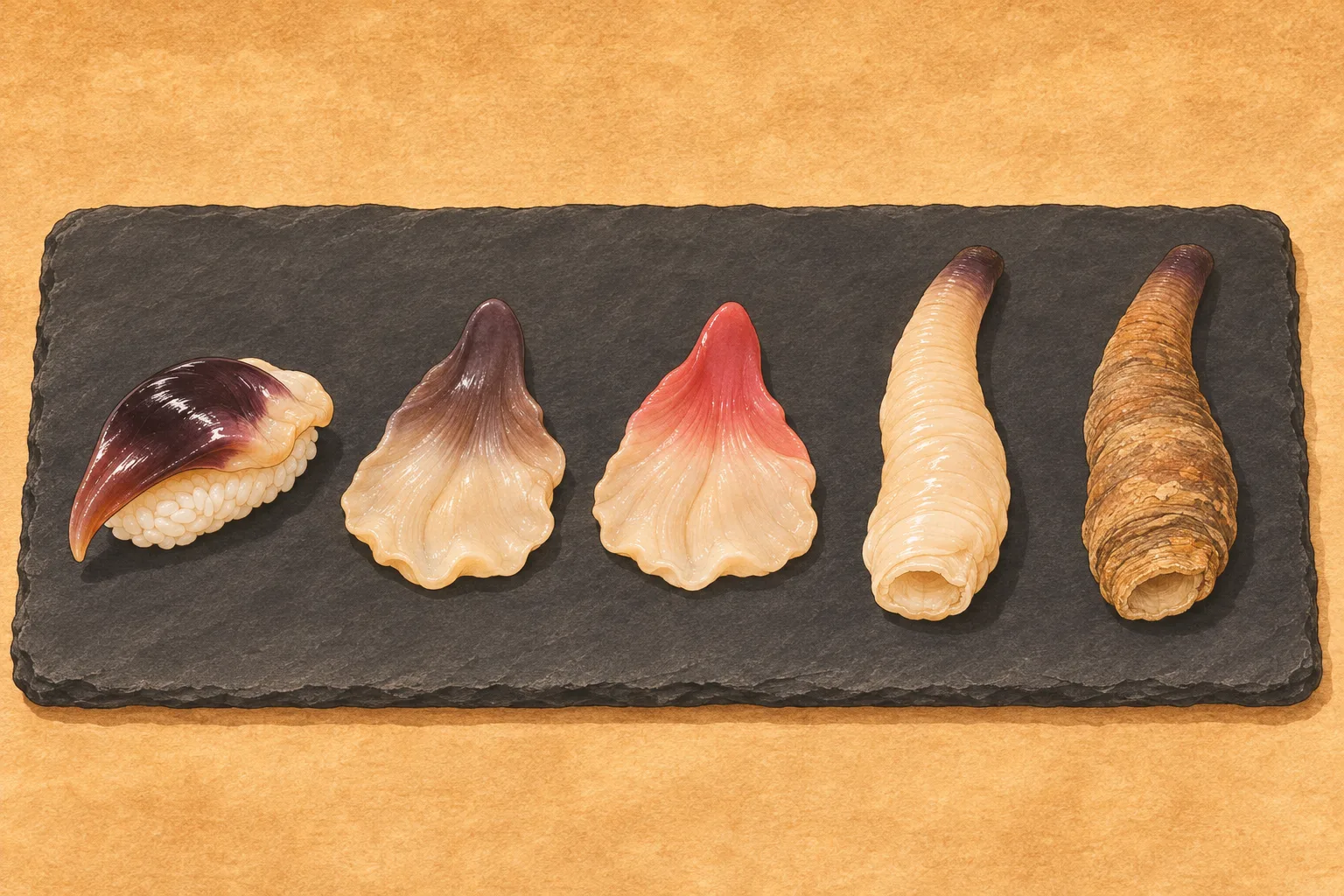
From left: torigai nigiri, black side up; raw hokkigai with a grey-purple tip; blanched hokkigai, its tip turned pink-red; a mirugai siphon peeled to ivory flesh; and a siphon still in its brown skin.
Awabi (abalone). Abalone is one of Japan’s oldest luxury foods. It was sent as tribute to the Nara court, and Ise Shrine still receives offerings of dried abalone stretched into ribbons. The paper noshi symbol printed on Japanese gift wrapping descends from that dried strip. Sushi bars serve abalone either simmered soft or raw. The simmered kind belongs to classic Edo technique. Raw abalone is usually kuro-awabi (black abalone): dark brown with a blue-green tint, cut into slices or chunks that crunch loudly, with a smell of wet rock. The smaller, paler ezo-awabi is common in Hokkaido and Sanriku. Summer is abalone season, and the ama free-divers of Chiba’s outer coast and Shima in Mie, diving for it in white cotton, are a classic image of the Japanese seaside.
05Raw Shrimp and Squid
In Edo-style sushi the proper shrimp was the boiled kuruma-ebi. Raw shrimp came later, with northern seafood. Squid has always been at the counter, but the raw varieties are now chosen with great care.
Amaebi (sweet shrimp). The standard name is hokkoku aka-ebi, "northern red shrimp". It lives deep in the Sea of Japan off Hokkaido and the Hokuriku coast, with Hokkaido and prefectures such as Ishikawa, Fukui and Niigata the main sources; much is also imported from Greenland and Canada. It is translucent orange-red and slimmer than a finger. Raw, the meat is soft and sticky and gets sweeter as you chew, which gives it its name. A piece usually carries two or three peeled tails stacked together, red tail fans sticking out at one end. In winter the females carry clusters of blue-green eggs under the belly, and some chefs leave the eggs on, a bright signal of the season. The heads often end up in miso soup.
Botan-ebi (botan shrimp). Much larger than amaebi, often as long as a palm, thick and plump, with a sticky, springy texture and deep sweetness. The market name covers two closely related species. The true botan-ebi, the species that officially bears the name, comes in small numbers from deep water on the Pacific side, such as Suruga Bay. The other is toyama-ebi, from Uchiura Bay, the Sea of Japan and the Sea of Okhotsk around Hokkaido, orange-red with white dots on the head and bands across the tail; most shrimp sold as "botan-ebi" are this one. One shrimp covers a whole piece of rice. The head sometimes comes back grilled or fried.
Aori-ika (bigfin reef squid). Called "the king of squid". Its fins run the full length of its body, like the aori, the leather mudguards that hung from the sides of a Japanese saddle. The flesh is thick, almost transparent when very fresh, and turns milky white after a day or two of resting, when it also becomes sweeter and stickier. The chef scores it with a fine crosshatch or diagonal cuts, which make the thick flesh easy to bite, help salt or soy cling, and leave the piece looking like carved white jade. Aori-ika spawns near the shore in spring and summer, and young of the year appear in autumn, so it is around for most of the year.
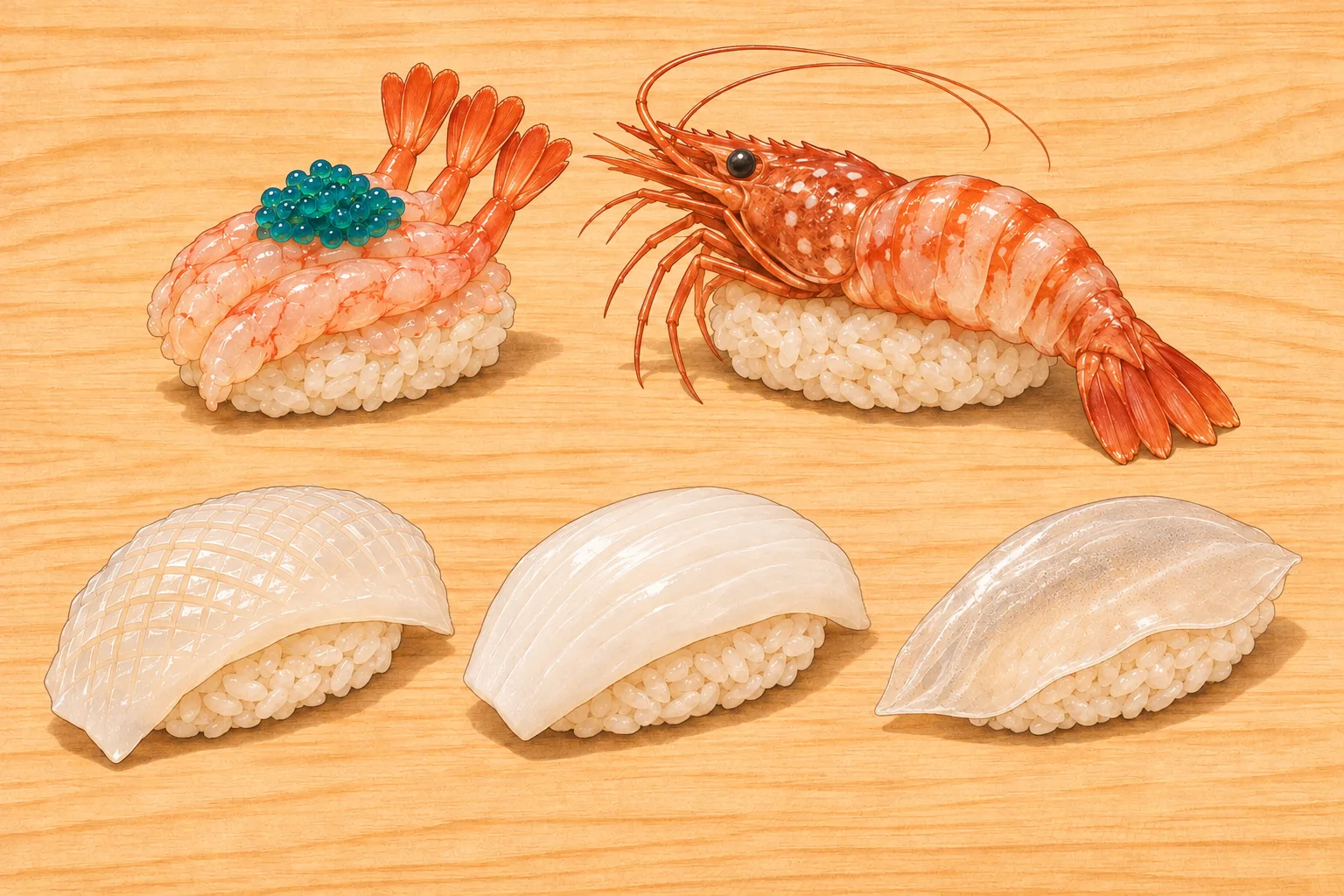
Top row, from left: amaebi, three tails stacked with blue-green eggs; botan-ebi, one shrimp covering the rice, white dots on its head. Bottom row, from left: aori-ika with a fine crosshatch, sumi-ika, and thin, translucent shin-ika.
Sumi-ika (golden cuttlefish). Its standard name is kō-ika, "shell squid", after the white, boat-shaped cuttlebone inside it. It squirts a lot of ink, hence sumi, "ink". This is the traditional Edo-style squid: white, firm and crisper than aori-ika, with a clean, light sweetness. Edo diners went wild for its young, shin-ika. Around August the cuttlefish hatched that spring and summer are only a few centimetres to about ten centimetres long, and one small body makes one piece of sushi, draped whole over the rice, soft and translucent. Shin-ika is greeted like the first tea of spring or the new rice of autumn, and Tokyo sushi bars announce its arrival. By winter the grown cuttlefish is thicker and meatier.
06Sea Urchin and Roe
Uni and roe are soft and grainy and slide off a ball of rice. As the main article explains, the gunkan-maki ("battleship roll"), a band of nori wrapped around rice to make a little wall, was created to hold toppings like these. Most uni and roe now arrive as gunkan, though some purist counters still lay uni directly on the rice.
Uni (sea urchin). What you eat is the gonad. Each urchin has five lobes arranged in a star. Two species dominate Japanese sushi. Bafun-uni, at sushi bars mostly the Hokkaido short-spined sea urchin (ezo-bafun-uni), is small and covered in short, dense spines like a little burr; its name means "horse-dung urchin" for its shape. Its lobes are deep orange to red-orange, rich, sweet and creamy, melting on the tongue. Murasaki-uni, the northern purple urchin, has long spines on a dark purple shell. Its lobes are pale yellow to cream, lighter and cleaner, with a long sweet finish. In the trade the orange kind is "red" and the pale kind is "white". Kyushu and Yamaguchi also have aka-uni, a separate species with darker roe, not to be confused with the trade’s "red". Hokkaido is the largest producer. Urchins off Rishiri and Rebun islands graze on the famous Rishiri kelp, the Shakotan Peninsula opens its season from June to August, and the Sanriku coast of Iwate also harvests in summer.
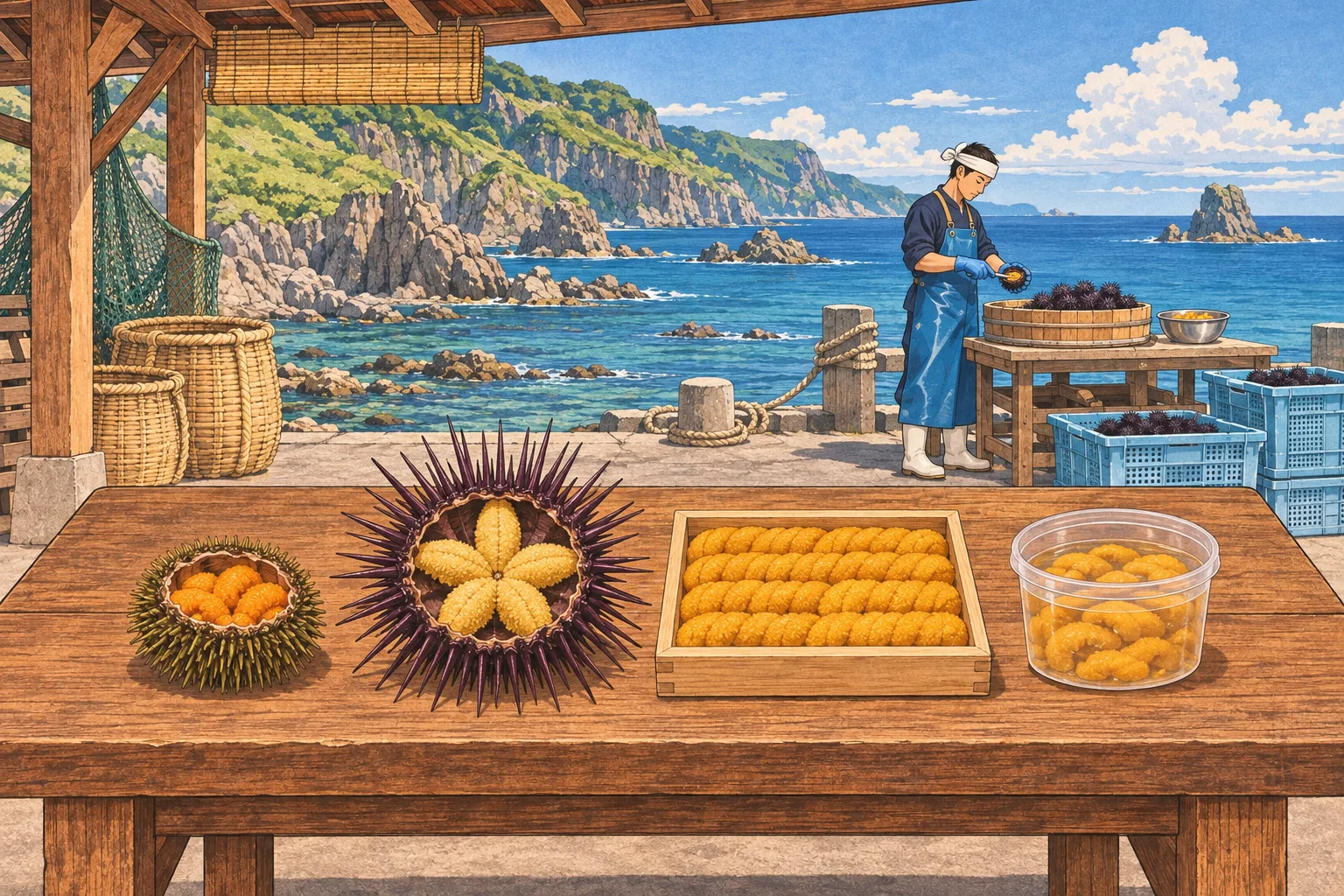
A Hokkaido shore in summer. On the table, from left: an opened bafun-uni, short-spined with deep orange lobes; an opened murasaki-uni, long-spined, its five pale yellow lobes in a star; a wooden tray of uni in neat rows; and a tub of ensui-uni in salt water.
Uni starts to dissolve soon after it leaves the shell. Most uni that travels in the familiar wooden trays is dipped during processing in lightly salted water containing a small amount of alum, which firms the surface and holds the shape. That is how the lobes can be lined up in neat golden rows, but too much alum can leave a faint bitterness. The alternative is ensui-uni, "brine uni": no alum, the lobes packed loose in sea-strength salt water in plastic tubs. It tastes closer to a freshly opened urchin but keeps only a short time. It was once mostly eaten near where it was landed and is now common at top Tokyo counters. At seaside canteens in the producing areas you can still eat uni scooped straight from the shell.
Ikura (salmon roe). The word comes from Russian ikra, "fish roe". Ikura is salmon eggs separated one by one and marinated in soy and sake or in salt. Each egg is about five or six millimetres across, translucent orange-red, and pops with a salty-savoury burst. September and October, when salmon run upriver, bring the fresh roe. The membranes are thin and tender then, and many chefs separate the raw skeins in warm salt water and marinate their own ikura, an autumn ritual at many shops. Later in the season the skins toughen, and most ikura served is frozen. Salmon roe was eaten in Hokkaido and Tōhoku long before it became standard in sushi bars across Japan during the twentieth century.
Sujiko (salmon roe in the skein). The same eggs, left unseparated in their membrane and cured as a whole block in salt or soy. Sujiko is darker, smaller-grained, stickier and saltier than ikura. In Hokkaido and Tōhoku it is everyday rice food and a classic rice-ball filling. It is less common in sushi bars, though some cut it into chunks for gunkan or roll it into thin maki; you are most likely to meet it in the north. Side by side, the difference is clear: ikura is loose pearls, sujiko is a cluster.
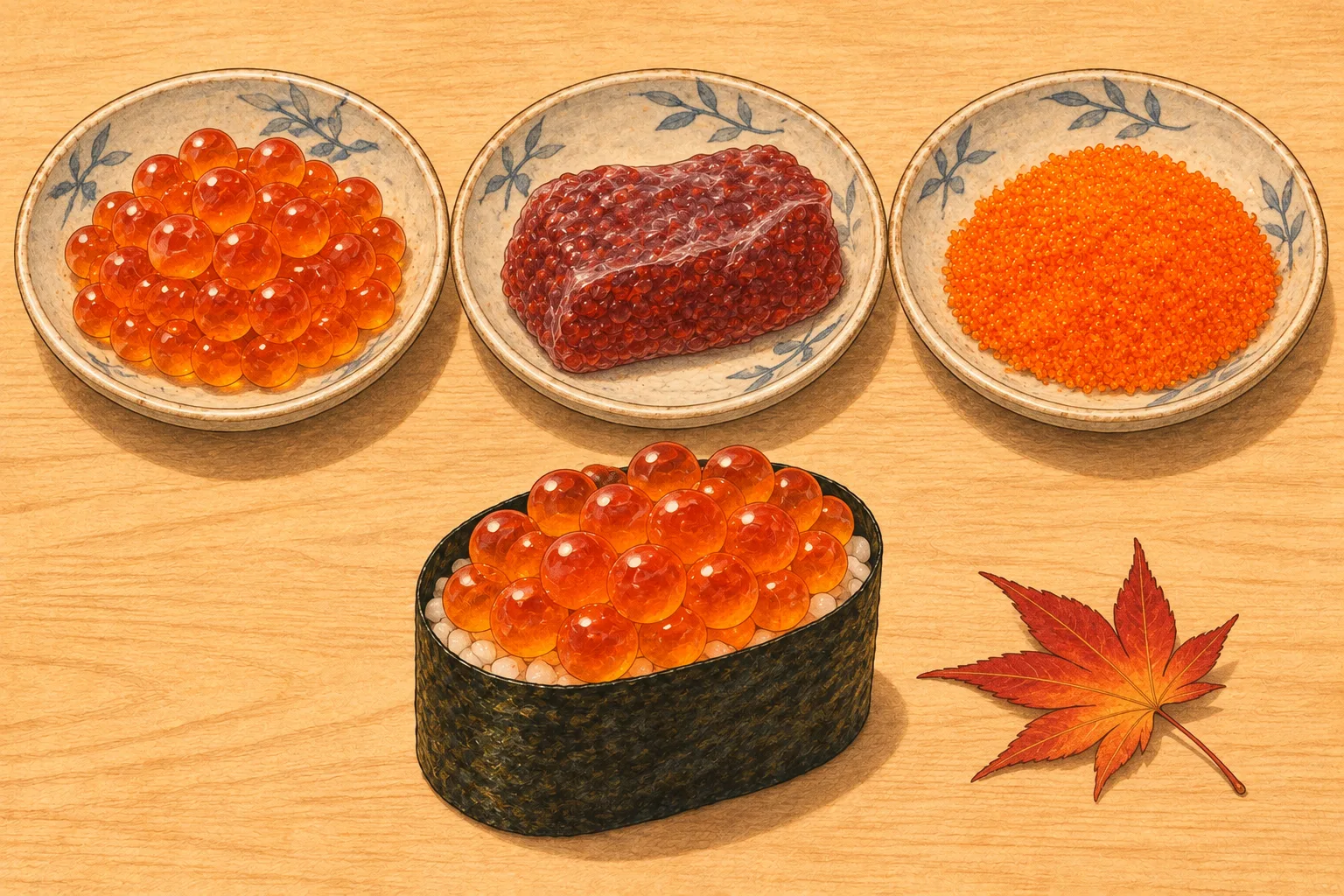
Three dishes, from left: ikura in loose pearls; sujiko, darker and still held together in its membrane; and tiny-grained tobiko. In front, an ikura gunkan.
Tobiko (flying-fish roe). Tiny eggs of a millimetre or two that crackle between the teeth; the crunch is the point, as the flavour is mild. The natural colour is pale yellow. The bright orange you usually see is dyed, and there are green versions coloured with wasabi and black ones with squid ink. Tobiko is mostly found on conveyor-belt gunkan and on the outside of California rolls and other inside-out rolls; serious Edo-style counters rarely use it. Much of it is imported. It is often confused with masago, capelin roe, which is smaller and softer and used as a stand-in.
07Side by Side: Telling Them Apart
White fish. All white fish nigiri look pale at first, but colour, grain and edge give them away. Madai has a soft pink cast, medium translucency, fine grain, and often a narrow pink-and-silver rim of puckered skin. Hirame is whiter and more glassy, sliced thin enough to show the rice beneath, and skinless. Engawa is a short, thick strip, ivory to pale yellow, with fine parallel ridges. Karei looks like hirame with a faint grey cast and denser flesh; the season is the best clue. Suzuki is snow-white with a wet shine and a slightly coarser grain than bream. Nodoguro is white flushed with pink, with visible fat threads, and its skin is orange and blistered when seared. Kinmedai has a deep crimson skin edge, darker than nodoguro’s orange, over soft pinkish flesh.
Shellfish. Colours make shellfish easier. Akagai is an orange-red fan with curled edges and knife scoring. Torigai is a drooping beak, black-purple on top. Hotate is a cream-coloured disc with vertical fibres, the softest of the group. Hokkigai is a butterflied, tongue-shaped piece with a pink (blanched) or grey-purple (raw) tip and a cream base. Mirugai is a stiff ivory strip with a purple-brown tip and scoring. Raw awabi is a thick dark slice, brown with a blue-green tint and a darker frill at the edge.
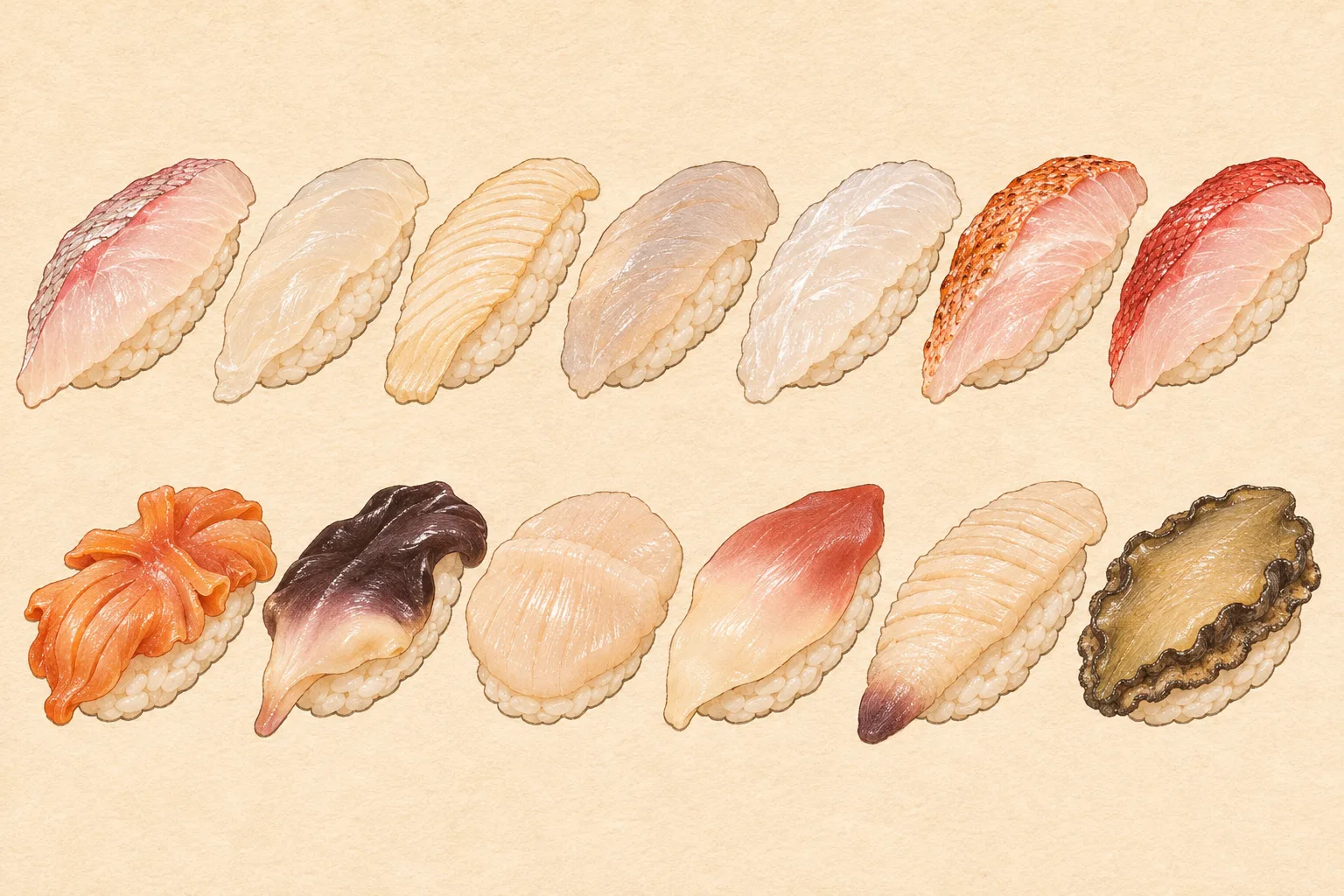
Top row, from left: madai (skin-on), hirame, engawa, karei, suzuki, seared nodoguro, kinmedai (with red skin). Bottom row, from left: akagai, torigai, hotate, hokkigai (blanched), mirugai, raw awabi.
Shrimp and squid. Amaebi comes two or three to a piece, thin, translucent orange, tails raised, sometimes with blue-green eggs. Botan-ebi is one big shrimp covering the rice; the common toyama-ebi type shows white dots and bands on orange-red. Aori-ika is thick, milky white and glossy, with fine scoring; sumi-ika is whiter and stiffer, almost like porcelain; shin-ika is a whole tiny body, thin and soft.
Uni and roe. Bafun-uni is deep orange with small, dense lobes; murasaki-uni is pale yellow with larger lobes. Ikura is big, shining orange pearls; sujiko is a darker clumped mass; tobiko is fine, evenly coloured grains like coloured sand.
08Seasons, Salt and Citrus
These toppings are where the Japanese idea of shun, the peak season, is easiest to taste. Spring brings sakura-dai, akagai, torigai, mirugai and hokkigai. Summer brings karei, suzuki, abalone, uni and shin-ika. Autumn brings momiji-dai, fresh ikura and the year’s young aori-ika. Winter brings hirame, kinmedai, nodoguro, amaebi and akagai again. Scallops and many farmed fish are available year-round, but good counters still change their line-up with the season, and the wooden name tags behind the bar work as a calendar of the sea.
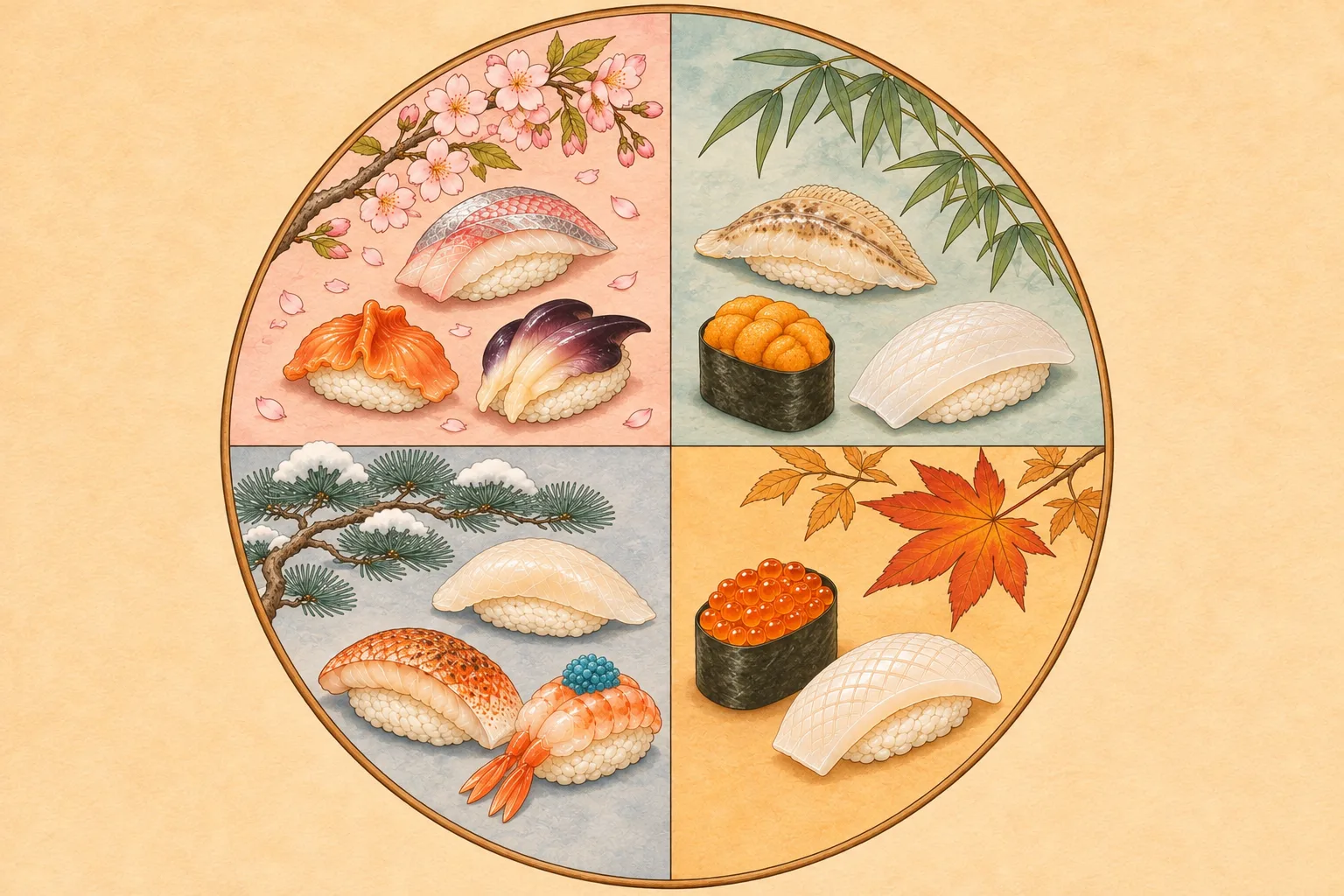
A year at the counter, clockwise from top left. Spring: sakura-dai, akagai, torigai. Summer: karei, uni gunkan, shin-ika. Autumn: ikura gunkan, aori-ika. Winter: hirame, seared nodoguro, amaebi with eggs.
White fish is often eaten with salt and citrus instead of soy sauce. Its flavour is delicate, and a dip in dark soy can drown it. A few grains of salt lift its sweetness, and a little acid makes any fat taste clean. The citrus is usually small and green: sudachi from Tokushima, kabosu from Ōita, or fragrant yuzu, often just a few drops of juice or a grating of zest. Some chefs use sea salt, others roasted seaweed salt, and the grain size changes the first impression on the tongue.
At many Edo-style counters most pieces arrive already brushed with nikiri soy glaze, and the chef switches to salt and citrus for white fish, shellfish and squid. How he divides them varies. Some give every madai and hirame salt but brush karei with nikiri. Others reserve salt for seared, fatty whites like nodoguro and engawa, where it sharpens the toasted fat. In Hokkaido, raw scallop or hokkigai with a pinch of salt and a drop of sudachi is common, and it brings the shellfish’s sweetness right forward. Curing in kelp and the simmered toppings are a separate craft, covered elsewhere.
There is also a long-running argument about freshness. Kansai diners have traditionally preferred white fish killed moments before, prized for its crunchy spring. Many Tokyo chefs prefer to rest fish for a time, letting savoury compounds develop and the flesh soften. The same flounder can be crisp in Osaka and softer and deeper in Tokyo. Japan has never settled the question; each counter has its preference.
If you are unsure how to eat a piece, look at it when it lands: salt and citrus mean eat it as it is; a bare piece gets a light touch of soy on the fish side, as the main article explains.
More deep dives on this topic
 TunaOrder an omakase in Tokyo and the tuna usually arrives in a sequence: a slice of deep red lean meat, then something pinker and softer, then a pale, marbled piece that seems to…
 HikarimonoSit at a sushi counter in Japan and, somewhere in the middle of the meal, the chef will set down a piece that looks different from the rest.
 Beyond TunaMost first-time visitors walk into a sushi bar thinking about tuna.
 Edomae ShigotoMost visitors arrive at a Tokyo sushi counter expecting raw fish on rice.
 Shari and Its Supporting CastAt a sushi counter your eyes follow the fish.
 Regional Sushi Beyond TokyoMost visitors meet sushi at a counter: a chef shapes rice in one hand, lays a slice of fish on top and sets it down in front of you, to be eaten within seconds.
 KaitenzushiSit down at a kaitenzushi (conveyor-belt sushi) counter anywhere in Japan and the basic deal is the same.
 Fish MarketsThe piece of sea bream a sushi chef slides across the counter at lunchtime has usually changed hands four or five times since it left the water.
 Words at the Sushi CounterSit at a sushi counter in Japan and the language around you shifts.
 The Sushi ChefFrom a counter seat, a sushi chef looks like a pair of hands and very little else.
- Back to the main article: Sushi →