
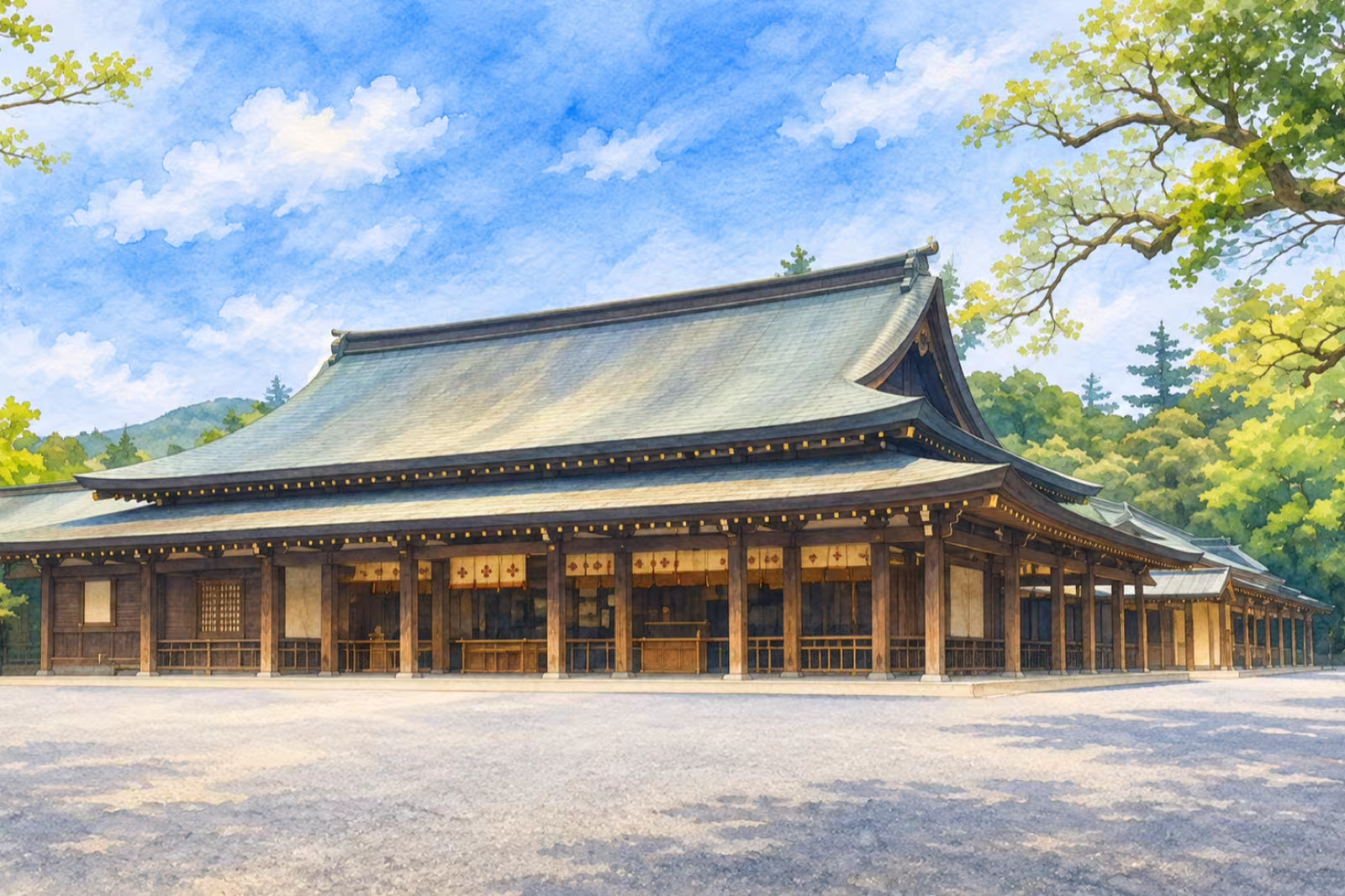
The Naikū, formally Kōtai Jingū, is the Inner Shrine of Ise, set beside the Isuzu River in the southern part of Ise City, Mie Prefecture. It enshrines Amaterasu Ōmikami, the sun goddess regarded as the ancestral deity of the imperial house. Ise Jingū — officially just "Jingū" — is a network of 125 shrines centered on the Inner and Outer Shrines, and the Naikū ranks highest among them. Every 20 years its sanctuaries are rebuilt in identical form on an adjacent plot, a practice called Shikinen Sengū that has continued, with interruptions, for some 1,300 years.
01Origins and the ancient shrine
According to the Nihon shoki, in the reign of Emperor Suinin the princess Yamatohime-no-mikoto carried Amaterasu’s sacred mirror from place to place in search of a permanent home, finally settling on the upper Isuzu River. Scholars generally place the shrine’s actual formation somewhere between the 5th and 7th centuries, and opinions differ. Under the ritsuryō state the shrine was managed directly by the court. An unmarried imperial princess, the Saiō, was sent to live at the Saikū and serve the shrine on the emperor’s behalf. Records date the first Shikinen Sengū at the Naikū to 690, in the reign of Empress Jitō.
02From the medieval period to modern times
As the court’s finances declined, the rebuilding cycle broke down, and during the Warring States period it lapsed for about 120 years. Buddhist nuns of Keikō-in and other temples raised funds across the country, and the ceremony was restored around 1585, afterward supported by the Toyotomi and Tokugawa regimes. In the Edo period, shrine agents called oshi organized pilgrimage associations (Ise-kō), turning the journey to Ise into a mass movement; roughly every 60 years came okage mairi surges in which millions of people set out for Ise. The Meiji government abolished the oshi and placed the shrine at the summit of State Shinto. After World War II it became a private religious corporation.
03The Naikū today
Visitors enter by the Uji Bridge over the Isuzu River, itself replaced on the rebuilding cycle, then follow gravel paths through forest, stopping to purify their hands at the riverside Mitarashi. The main sanctuary is built in the yuitsu shinmei-zukuri style — unpainted cypress, thatched roof, posts set directly in the ground, and crossed chigi and katsuogi on the ridge. Four wooden fences surround it, and worshippers pray at the outermost gate; the sanctuary itself is mostly hidden. Beside it lies the empty plot for the next rebuilding. Subsidiary shrines such as Aramatsuri-no-miya and Kazahinomi-no-miya stand nearby.
As of 2026 the most recent Shikinen Sengū was the 62nd, in 2013; the 63rd is planned for 2033. Because its buildings are periodically renewed, the shrine is not designated a National Treasure or Important Cultural Property, nor is it a World Heritage Site. Its age lies in continuity of form and ritual rather than in the timber.
Ise Jingū Naikū (Inner Shrine)
01Where You Are Standing
Ise Jingū, the Grand Shrine of Ise, is not one shrine but a network of 125 shrines in and around the city of Ise in Mie Prefecture. Its official name is simply Jingū, "the Shrine." At its heart are two main sanctuaries about five kilometers apart. The Naikū, or Inner Shrine, formally called Kōtai Jingū, is dedicated to Amaterasu Ōmikami, the sun goddess of Japanese myth and the ancestral deity of the imperial family. The Gekū, or Outer Shrine, formally Toyouke Daijingū, enshrines Toyouke Ōmikami, the goddess who provides Amaterasu’s food.
The Inner Shrine stands beside the Isuzu River, backed by the forested slopes of Mount Kamiji and Mount Shimaji. You cross the river by the Uji Bridge, walk a long gravel path under huge cryptomeria cedars, and climb a short stone stair to a gate. Beyond it, behind four layers of fencing, is the main sanctuary. Most visitors never see more than its thatched roof and the crossed timbers on its ridge. A white curtain hangs in the gateway, and when the wind lifts it you catch a glimpse of the inner court.
What makes this building remarkable is not its age. The sanctuary in front of you was completed in 2013. Every twenty years, in a ritual called the Shikinen Sengū, the shrine is rebuilt from new timber on an adjacent plot, and the deity is moved into the new building at night. The empty plot of white stones next to the current sanctuary is where the previous building stood and where the next one will rise. The practice began at the end of the seventh century and, with interruptions, has continued for some 1,300 years.
02The Wandering Princess
The traditional account of the shrine’s founding comes from the Nihon shoki (Chronicles of Japan, 720), one of Japan’s two oldest official histories. It says that Amaterasu was once worshiped inside the emperor’s own palace, in the form of the sacred mirror she had given her grandson when he descended to rule the earth. Emperor Sujin, fearing the power of the deity living under his roof, moved her to a separate site and placed her in the care of his daughter, Toyosukiirihime.
In the next reign, that of Emperor Suinin, the task passed to his daughter Yamatohime. She set out with the mirror to find a permanent home for the goddess, traveling through the provinces of Ōmi and Mino before reaching Ise. There, the chronicle says, Amaterasu spoke to her: Ise, land of the divine wind, where the waves of the eternal world break against the shore, was a secluded and lovely country, and here she wished to stay. A shrine was built on the Isuzu River; the chronicle places this in the 25th year of Suinin’s reign, while the shrine’s own tradition gives the 26th. Later Shinto texts, especially the medieval Yamatohime no mikoto seiki, list every stop on Yamatohime’s journey, and dozens of shrines across central Japan still call themselves moto-Ise, "former Ise," on the strength of this story.
These are legends. Sujin and Suinin belong to a stretch of the imperial genealogy that historians cannot date, and the chronicle’s chronology cannot be converted into real years. Scholars generally think that Ise had long been a place of sun worship, and that the shrine took shape as the state’s central sanctuary between the late fifth and the late seventh centuries. The decisive period seems to have been the reigns of Emperor Tenmu (r. 673–686) and his widow and successor, Empress Jitō (r. 690–697).
The object at the center of the Inner Shrine is said to be the Yata no Kagami, the mirror that is one of the three imperial regalia. No one outside the priesthood has seen it, and nothing is publicly known of it beyond descriptions in old ceremonial records.
03A Shrine for the Emperor Alone
Tenmu came to power through a civil war, the Jinshin War of 672, and the Nihon shoki records that during his campaign he paused to worship Amaterasu from afar in Ise. After his victory he sent his daughter, Princess Ōku, to serve the shrine. She was the first historically reliable saiō, an unmarried princess chosen by divination at the start of each reign to represent the emperor at Ise. The saiō lived in a walled compound called the Saikū, in what is now the town of Meiwa, some fifteen kilometers from the shrines, and traveled to them for the great festivals. The institution lasted until the 1330s, in the reign of Emperor Go-Daigo; over some 660 years more than sixty women served as saiō.
Under the law codes of the eighth century, Ise held a unique position. It was the emperor’s shrine in the most literal sense: private offerings were forbidden. Only the emperor could present offerings to Amaterasu, and even other members of the imperial family needed his permission. Ordinary people had no role at Ise at all.
The great annual rite is the Kannamesai in October, when the year’s new rice is offered to Amaterasu. Together with the Tsukinamisai festivals of June and December, these make up the three principal rites of the shrine calendar. They are still held today, largely following procedures written down in the Kōtai Jingū gishikichō, a ceremonial record submitted to the court in 804.
04Rebuilding Forever
According to the shrine’s own records, the Shikinen Sengū was instituted by Tenmu, and the first rebuilding of the Inner Shrine took place in 690, the year of Jitō’s enthronement. The Outer Shrine followed two years later. Each time, not only the sanctuary but every robe, weapon, textile and ritual object inside it is made anew by craftsmen working to the old patterns.
Why twenty years? The question has been asked for centuries and has no documented answer. Some point out that buildings with posts sunk straight into the ground and thatched roofs do not last much longer. Others argue that twenty years allows a master craftsman to pass skills to an apprentice who will one day lead the next rebuilding. Whatever the original reason, the effect has been that Ise preserves an ancient design not by keeping an old building but by copying it again and again.
A Sengū takes about eight years from start to finish. The cycle opens with the Yamaguchi-sai, rites to the mountain deities at the entrance to the shrine forests, continues with felling hinoki cypress for the main pillars, the okihiki festival in which townspeople haul the timber into the shrine on carts and sleds, the purification of the new site, the raising of the ridge pole, and the shiraishi-mochi, when local people carry white stones from the river and spread them around the new sanctuary. The climax is the sengyo, the transfer of the deity, held after dark. Priests carry the sacred object from the old sanctuary to the new under a moving screen of white silk, while a priest imitates the cry of a rooster three times, recalling the myth in which crowing birds helped draw the sun goddess out of her cave. Since the Edo period most of the cypress has come from the Kiso mountains in central Japan.
05Inner and Outer
Pilgrims traditionally visit the Outer Shrine first and the Inner Shrine second, and the shrine’s festivals always begin at the Gekū. The reason lies in the relationship between the two.
The Toyukegū gishikichō, also submitted in 804, says that in the reign of Emperor Yūryaku, Amaterasu appeared in the emperor’s dream and complained that she was lonely and could not eat in peace. She asked that Toyouke, a food goddess from Tanba Province, be brought to serve her. The Outer Shrine was built for this purpose. Ever since, in a hall at the Gekū, priests have prepared and offered meals to Amaterasu and the other deities twice every day, morning and evening, with fire made by friction.
The two shrines were not always on good terms. In the Kamakura period (1185–1333) the Watarai family, hereditary priests of the Outer Shrine, developed a body of theology now called Ise Shinto or Watarai Shinto, which presented Toyouke as a primordial deity of creation, equal to Amaterasu. The Arakida family of the Inner Shrine objected, and the two sides took their quarrels, including disputes over titles, to the court. In the fifteenth century the towns that grew up around each shrine, Uji around the Inner Shrine and Yamada around the Outer, fought each other in armed clashes, and at the end of 1486 a quarrel with Uji brought troops of the provincial governor, the Kitabatake, into Yamada; the town was set on fire and the Outer Shrine’s main sanctuary burned. The two separate towns, each with its own approach and its own identity, are still visible in Ise’s geography.
06Kamikaze and Collapse
The warrior governments of the Middle Ages treated Ise with respect. When the Mongols invaded Japan in 1274 and 1281, both court and shogunate sent prayers to Ise, and the storm that wrecked the second invasion fleet was credited to the wind deities worshiped there. In 1293 the small shrines to those deities, the Kazahinomi-no-miya at the Inner Shrine and the Kaze-no-miya at the Outer Shrine, were raised in rank to betsugū, "detached shrines," the highest grade below the main sanctuaries. This is one origin of the word kamikaze, "divine wind."
But the shrine depended on revenue from estates and on the court’s purse, and both were draining away. After the Ōnin War (1467–1477) plunged the country into a century of fighting, nobody could pay for rebuilding. The Outer Shrine’s last Sengū for well over a century took place in 1434, the Inner Shrine’s in 1462. For more than 120 years the Inner Shrine was not rebuilt, and its buildings decayed.
The revival came from an unexpected direction: Buddhist nuns. The abbesses of Keikō-in, a convent at Uji, traveled the country as fundraisers. One of them, Shuetsu, raised money to rebuild the Uji Bridge in the 1490s. A later abbess, Seijun, petitioned the court repeatedly and in 1563 saw the Outer Shrine rebuilt for the first time in 129 years. The next abbess, Shūyō, won the support of Oda Nobunaga and then Toyotomi Hideyoshi, and in 1585 both shrines held their Sengū in the same year. They have been rebuilt together ever since. It may seem strange that Buddhist nuns rescued the most important Shinto shrine in Japan, but in an age when Buddhist and native worship were closely intertwined it was not so odd. In 1869, as the new Meiji government separated Shinto from Buddhism, the convent was abolished along with more than a hundred other temples in Ise.
07The Oshi and the Ise Confraternities
With the emperor’s monopoly long broken and the court’s money gone, the shrines turned to warriors and commoners, and the people who made this possible were the oshi. Originally minor priests who offered prayers on behalf of clients, the oshi became something between pastors, travel agents and innkeepers. Each had a territory of affiliated households across Japan. Every year their agents went out to distribute paper amulets from the shrine, called taima, together with almanacs, and to collect donations. When pilgrims came to Ise, their oshi met them, housed and fed them in large mansions, staged sacred kagura dances, and guided them around both shrines.
Ordinary people formed confraternities called Ise-kō. Members saved money together and chose representatives by lot to make the trip on behalf of the group. By the Edo period (1603–1868) Uji and Yamada had hundreds of oshi houses, and according to the shrine, the registers of the Outer Shrine’s oshi alone counted about 4.2 million affiliated households, close to nine in ten households in the country. "Once in a lifetime, to Ise" became a common saying. For a farmer or shop clerk, the pilgrimage was a legitimate reason to travel far from home, and many combined it with sightseeing in Kyoto and Ōsaka, or with a night in the pleasure quarter of Furuichi, which sat on the road between the two shrines.
08The Okage Mairi
The most extraordinary chapter in Ise’s history is the okage mairi, "pilgrimages of thanksgiving," mass movements that erupted roughly every sixty years during the Edo period. The major waves are usually dated to 1650, 1705, 1771 and 1830. Rumors would spread that amulets from Ise had fallen from the sky, and suddenly crowds would take to the roads: servants who left without their masters’ permission, apprentices, women, and children. Slipping away like this was called nuke-mairi, "sneaking off on pilgrimage," and those who did so were usually forgiven when they came home. Along the way, wealthy households and villages handed out rice balls, straw sandals, and lodging as acts of merit.
The numbers were enormous. Records kept in Ise put the 1705 pilgrimage at about 3.6 million people in some fifty days, and the 1830 pilgrimage at about 4.27 million people crossing the Miyagawa River ferries, at a time when Japan’s population was around thirty million.
Some of the pilgrims were dogs. There are records and pictures of dogs sent to Ise in place of owners who could not travel, with a pouch around their necks holding the owner’s name and coins for their keep, passed along from traveler to traveler. These "okage dogs" are a favorite motif in the shopping streets outside the Inner Shrine today.
In 1867, as the shogunate was collapsing, another rumor of falling amulets set off a wave of frenzied dancing across central Japan, with crowds chanting Ee ja nai ka, "Isn’t it great?" The ee ja nai ka movement drew directly on the okage mairi tradition.
09State Shrine and After
The new Meiji government placed Ise at the summit of a national system of shrines. In 1869 Emperor Meiji visited the shrine in person, the first reigning emperor to worship there. In 1871 the government reorganized the shrine, abolished the oshi, some seven hundred houses at the time, and had the shrine office take over the distribution of amulets. The great oshi mansions disappeared within a few years.
Until 1945 Ise was the spiritual center of State Shinto, and school trips to the shrine were a standard part of education. After Japan’s defeat, the occupation authorities’ Shinto Directive separated shrines from the state, and Ise became a private religious corporation. The Sengū due in 1949 was postponed because of the postwar economic crisis; funded by public donations, it was finally held in 1953. Rebuildings followed on schedule in 1973, 1993 and 2013. The 2013 Sengū, the 62nd, had a reported budget of around 55 billion yen, raised largely through donations, and that year the two shrines received about 14.2 million visitors, a record. The 63rd is scheduled for 2033, and its preparatory rites began in 2025.
10Reading the Buildings
The main sanctuary is built in a style called yuitsu shinmei-zukuri, "the unique shinmei style," which is reserved for the two main sanctuaries at Ise. The building is unpainted hinoki cypress, raised on posts set directly in the earth, with a heavy roof of miscanthus thatch. Along the ridge lie short logs called katsuogi, and at each end the bargeboards extend upward and cross to form chigi. The entrance is on the long side, and the whole form is generally thought to derive from ancient raised granaries. There are ten katsuogi on the Inner Shrine’s sanctuary and nine at the Outer Shrine; at the Inner Shrine the tips of the chigi are cut horizontally, at the Outer Shrine vertically.
Four fences surround the sanctuary, and two treasure houses, east and west, stand behind it. Beneath the center of the floor is the shin no mihashira, the "heart pillar," a short post that is among the most secret elements of the shrine. When the deity moves to the new building, a small hut is left on the old site to cover the spot where the heart pillar stood, and twenty years later the new sanctuary will be built over it.
Because everything is renewed, no building at Ise is designated a National Treasure or Important Cultural Property. The age of the place lies in the design, the rituals and the craft skills, and in the treasures and documents kept in the shrine’s museums on Kurata-yama, between the two shrines.
11A Walk Through the Inner Shrine
Start at the Uji Bridge, just over a hundred meters long. It was once repaired only when it wore out, but since 1889 it too has been rebuilt every twenty years. When the Sengū was postponed after the war, people wanted at least a new bridge on the original schedule, and since then the bridge has been renewed four years before each Sengū; the current one opened in 2009. The large torii gates at each end are made from timber of the previous sanctuaries: the shrine says the inner torii reuses the ridge-supporting pillar of the old Inner Shrine sanctuary, and the outer torii that of the Outer Shrine. After twenty years they move on again, to the old entrances to Ise Province at Seki-juku and at the Shichiri no Watashi ferry landing in Kuwana. Many visitors bow before crossing; beyond the river lies the sacred precinct.
On the far side, the path turns right past a broad garden of raked gravel and pines. There is a purification basin, but the older custom is to walk down to the Mitarashi, a stone-paved landing on the bank of the Isuzu, and rinse your hands in the river itself. The paving, laid in 1692, is traditionally said to have been donated by Keishōin, the mother of the fifth shogun, Tokugawa Tsunayoshi.
Pass through the first and second torii to the Kaguraden, where prayers and sacred dances are offered and amulets are sold. Further on, among enormous cedars, are buildings used by the priests for purification and for ceremonies.
At the end of the path a stone stairway rises to the south gate of the outer fence of the main sanctuary. This is as far as visitors go. Photography is not permitted at the top of the steps. Tradition holds that at the main sanctuary one offers thanks rather than personal requests.
Walk north from the sanctuary and climb another set of steps to the Aramatsuri-no-miya, the most important of the Inner Shrine’s detached shrines, which honors the aramitama, the active, forceful spirit of Amaterasu. This is where many visitors make their personal wishes. On the way back you can pass the Kazahinomi-no-miya, the wind shrine promoted after the Mongol invasions, and cross its small bridge toward the garden.
Leave by the Uji Bridge and turn right into Oharai-machi, the street along the Isuzu River where the oshi of Uji once had their houses. Halfway along is Okage Yokochō, a district built by the Akafuku company in 1993, a Sengū year, to recreate the townscape of the late Edo and Meiji periods, named after the okage pilgrimages. The local sweet, Akafuku, rice cake under sweet bean paste, gives 1707 as its founding year, just after the great pilgrimage of 1705. It is a good place to imagine the end of a walk of several hundred kilometers, and the first sight of the bridge.