
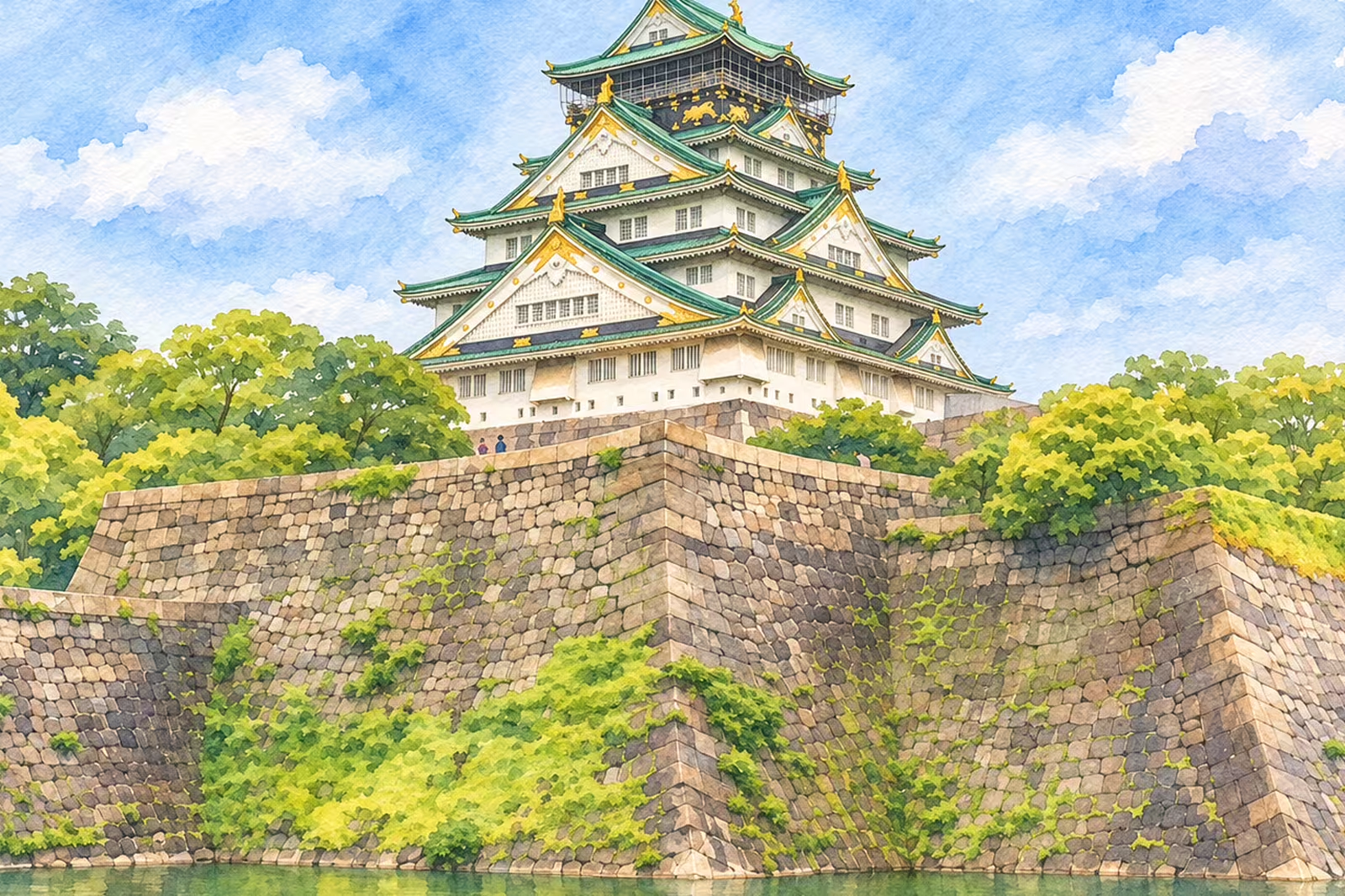
Ōsaka Castle stands at the northern end of the Uemachi Plateau in Chūō Ward, Ōsaka. It was Toyotomi Hideyoshi’s base as he unified Japan, and the place where the Toyotomi house was destroyed in 1615. What visitors see today is several periods stacked together: Hideyoshi’s castle lies buried underground, the stone walls, moats and gates above it belong to the Tokugawa shogunate, and the main keep (tenshu) was rebuilt in 1931.
01Hideyoshi’s castle and the Tokugawa castle
The site was formerly occupied by Ishiyama Hongan-ji. In 1583 Hideyoshi began building a castle on the old temple grounds, assigning the work to the daimyo who now served him. The keep was finished about two years later; it had five roofs on the outside and was decorated with gold leaf. Late in life Hideyoshi added a third enclosure and an outer perimeter (sōgamae) that took in the castle town. After his death his son Hideyori lived in the castle with his mother, Yodo-dono. Tokugawa Ieyasu besieged it in the Winter Campaign of 1614 and the Summer Campaign of 1615; the castle fell, Hideyori and Yodo-dono took their own lives, and the Toyotomi line ended.
The Tokugawa shogunate then covered the ruins with fill and, from 1620, ordered daimyo from western Japan to build a new castle on top, largely complete by about 1629. Its stone walls were larger than Hideyoshi’s. The Tokugawa keep was struck by lightning and burned in 1665 and was never rebuilt; for more than two centuries the castle was run by a shogunal official, the Ōsaka jōdai. Most of the remaining buildings burned in the confusion at the start of the Boshin War in 1868. After the Meiji Restoration the grounds housed an army arsenal and a divisional headquarters.
02What can be seen today
The present keep was built in 1931 with donations from Ōsaka citizens. It is made of reinforced concrete, modeled on paintings of Hideyoshi’s keep, and stands on the Tokugawa-period keep base; inside is a museum. It survived the air raids of 1945 and was registered as a national Tangible Cultural Property in 1997. Thirteen Tokugawa-period structures, including the Ōtemon Gate, the Sengan and Inui turrets, the Kinzō treasury and the Enshōgura powder magazine, are designated Important Cultural Properties, and the castle site is a Special Historic Site. Among the huge wall stones is the Tako-ishi ("octopus stone"), said to be the largest in the castle.
Most of Hideyoshi’s castle remains underground. A survey in the late 1950s confirmed Toyotomi-period stone walls beneath the Tokugawa ground level, and another section was excavated in 1984. As of 2025, that section is open to the public in a newly built display facility.
Ōsaka Castle
01A Castle in Layers
Most visitors arrive at Ōsaka Castle expecting to see the fortress of Toyotomi Hideyoshi, the warlord who unified Japan in the late sixteenth century. The tower in front of them, with its white walls, green-tiled roofs and gilded tigers and fish ornaments, certainly invites that belief. But what stands on this hill is a stack of different periods. At the bottom lies Ishiyama Hongan-ji, the fortified headquarters of a Buddhist sect that fought Oda Nobunaga for ten years. Above it was Hideyoshi’s castle, burned in 1615. On top of that, the Tokugawa shogunate built an entirely new castle, burying the Toyotomi walls under meters of fill. The main tower you see today belongs to yet another layer: it was built of reinforced concrete in 1931, designed after paintings of Hideyoshi’s keep but set on the Tokugawa stone base.
The stone walls, the moats, the main gate and the surviving turrets are nearly all Tokugawa work of the 1620s and later. Hideyoshi’s castle is almost entirely underground. Knowing this changes how the place looks.
A note on spelling: before the late nineteenth century the city’s name was usually written with characters read "Ōsaka" meaning "great slope" (大坂); the now-standard form 大阪 became official in the early Meiji period.
02The Temple Fortress of Ishiyama
The castle stands at the northern tip of the Uemachi Plateau, a ridge of high ground running north–south through the flat Ōsaka plain. To the north and east, rivers and marshes once made the approach difficult; to the west lay the sea and the port. The site was easily defended and well connected by water to Kyoto and to western Japan.
In 1496 Rennyo, the eighth head of the Hongan-ji, the main temple of the Jōdo Shinshū (True Pure Land) school of Buddhism, built a retirement chapel here. When the sect’s headquarters at Yamashina near Kyoto was destroyed in 1532, its tenth head, Shōnyo, made Ōsaka the new head temple. Known to later generations as Ishiyama Hongan-ji, it became the center of a large and powerful religious community. Around it grew a temple town protected by moats and earthworks, filled with merchants and craftsmen.
From 1570 the temple’s leader, Kennyo, was at war with Oda Nobunaga, the warlord then bringing central Japan under his control. Followers rose across the country, and the Mōri clan of western Japan shipped supplies to the besieged temple by sea. The struggle, known as the Ishiyama War, lasted until 1580, when a settlement brokered through the imperial court led Kennyo to leave. His son Kyōnyo held out a few months longer; after he too departed, the temple burned. Nobunaga was killed two years later in the Honnō-ji Incident and never built on the site.
Nothing of the temple survives above ground, and its exact footprint is still debated, though it is generally placed within the area of the later castle’s central enclosure. A stone marker inside the castle grounds records the presumed site.
03Hideyoshi Builds
After Nobunaga’s death, his general Hashiba Hideyoshi (later Toyotomi Hideyoshi) defeated the assassin Akechi Mitsuhide and then his rival Shibata Katsuie at the Battle of Shizugatake in 1583. That same year he took control of Ōsaka and began building on the ruins of the temple.
The project was enormous. Hideyoshi ordered the regional lords (daimyo) to supply labor and materials. Stone came from the Ikoma hills, the Rokkō mountains and islands in the Inland Sea such as Shōdoshima. Jesuit missionaries reported tens of thousands of laborers at work. The main tower, or tenshu, was ready within about two years. The inner enclosures followed, and in the last year of Hideyoshi’s life, 1598, work began on an outer enclosure and a great perimeter defense, the sōgamae, that wrapped the castle town itself inside a ring of moats. Building in one form or another went on for some fifteen years.
Hideyoshi also built the city. Merchants from Sakai and Hirano were moved to the new castle town west of the castle, laying the commercial foundations of what would become Japan’s great mercantile city.
04The Keep of the Ruler of the Realm
Hideyoshi’s tower rose five stories on the outside and is said to have had eight levels inside. Unlike today’s white-walled tower, it was dark, its walls finished in black lacquer and its roof tiles and ornaments heavily covered in gold leaf. This is how it appears in later paintings such as the Ōsaka Summer Campaign Screen.
Hideyoshi treated the castle as a display piece. In 1586 the Christian lord Ōtomo Sōrin of Bungo in Kyūshū came to ask for help against the Shimazu clan, and Hideyoshi personally guided him through the tower. According to Sōrin’s letter home, the tower’s floors were stocked with treasures and objects of gold and silver. The Jesuit Luís Fróis also wrote admiringly of the castle’s scale. The famous Golden Tea Room, a portable tea room whose walls, ceiling and utensils were covered in gold, is associated with Hideyoshi’s court; it was carried to the imperial palace to serve tea to the emperor.
Yet Hideyoshi did not rule from Ōsaka alone. In the later 1580s he built the Jurakudai palace in Kyoto, and in his last years he built Fushimi Castle south of Kyoto, where he spent much of his time. Ōsaka became above all the seat of the Toyotomi house and of its heir.
05Hideyori and the Uneasy Peace
In 1593 Hideyoshi’s consort Yodo-dono gave birth to a son, Hideyori, at Ōsaka Castle. Yodo-dono, born Chacha, was the eldest daughter of the warlord Azai Nagamasa and of Oichi, Nobunaga’s sister. Hideyoshi was sixty-two by Japanese reckoning when he died at Fushimi in 1598, leaving a five-year-old heir and a council of five senior lords and five commissioners sworn to protect him.
Hideyori moved into Ōsaka Castle in 1599. The death of Maeda Toshiie, his guardian, that same year removed the strongest check on Tokugawa Ieyasu, the most powerful of the senior lords. Ieyasu moved into the castle’s western enclosure and, according to contemporary records, even added a tower there. The Battle of Sekigahara in 1600 was fought in the name of the Toyotomi house on both sides, while Hideyori and his mother stayed inside the castle. Afterwards Ieyasu redistributed the losers’ lands, and the Toyotomi were left with about 650,000 koku (a measure of rice yield) in the three provinces around Ōsaka.
In 1603 Ieyasu became shogun and opened his government in Edo, and in 1605 he passed the title to his son Hidetada, signaling that it would stay in his family. For more than a decade the Toyotomi in Ōsaka, wealthy and still revered as the heirs of the great Taikō, coexisted uneasily with the Tokugawa. In 1611 Hideyori met Ieyasu at Nijō Castle in Kyoto. A popular later account holds that the sight of the poised young man made Ieyasu resolve to destroy him.
06A Temple Bell and the Winter Campaign
The pretext came in 1614. Hideyori had sponsored the rebuilding of the Great Buddha Hall at Hōkō-ji in Kyoto, and a new bell was cast with an inscription that included the phrases "may the state be peaceful and prosperous" (kokka ankō) and "lord and vassal will enjoy abundance" (kunshin hōraku). The Tokugawa side objected that the first phrase split the characters of Ieyasu’s name and the second implied that the Toyotomi were the lords. Negotiations collapsed. Katagiri Katsumoto, the Toyotomi official who had tried to mediate, was suspected of treachery and left the castle.
The Toyotomi used their vast reserves of gold to hire masterless samurai, many of them men who had lost everything after Sekigahara. Among them were Sanada Nobushige, better known by the later popular name Yukimura, Gotō Mototsugu, Mōri Katsunaga, Chōsokabe Morichika and Akashi Takenori. Their numbers are said to have reached around 100,000. Almost no established lord joined them.
In the winter of 1614 Ieyasu and Hidetada surrounded Ōsaka with an army often put at 200,000. The castle’s defenses were formidable, and its weakest side was the flat ground to the south. There Sanada built a crescent-shaped outwork beyond the outer defenses, later known as the Sanada-maru. On January 3, 1615 (the fourth day of the twelfth month of 1614 in the Japanese calendar), Tokugawa troops attacked it and were beaten back with heavy losses.
Ieyasu then turned to bombardment, firing cannon into the castle; one story has a shot striking near Yodo-dono’s quarters. Peace was agreed late in the twelfth month: the second and third enclosures were to be demolished and the outer moats filled, leaving only the central enclosure. A famous story holds that the Tokugawa had promised to fill only the outer moat and then treacherously filled the inner moats too, but it appears only in later books, and many historians now think the demolition was agreed by both sides. Either way, the castle was reduced to its central enclosure and stripped of most of its defenses.
07The Summer Campaign and the Fall
In the spring of 1615 the Toyotomi began re-digging the moats and gathering more soldiers. Ieyasu demanded that Hideyori leave Ōsaka or dismiss his men. He refused, and war resumed.
With no moats the castle could not withstand a siege, so the Toyotomi forces fought in the open. On the sixth day of the fifth month, Gotō Mototsugu was killed near Dōmyō-ji and Kimura Shigenari fell at Yao and Wakae. The next day the decisive battle was fought south of the castle around Tennōji and Okayama. Sanada Nobushige led a charge at Ieyasu’s headquarters and, according to accounts on the Tokugawa side, scattered Ieyasu’s guard, before being overwhelmed. He is traditionally said to have died at the Yasui Shrine, though documents found in recent years place his death on nearby high ground. Fire broke out inside the castle, and the tower burned.
On the eighth day of the fifth month (June 4, 1615), Hideyori and Yodo-dono, sheltering in a storehouse in the Yamazato enclosure north of the tower, took their own lives (one record places the deaths elsewhere in the castle). Hideyori was twenty-three by Japanese reckoning. His wife Senhime, Hidetada’s daughter and Ieyasu’s granddaughter, was sent out of the castle before the end and returned to her family. Hideyori’s young son Kunimatsu was later captured and executed. The Toyotomi line was finished. A stone marks the site of the suicides in the Yamazato area today.
The era name was changed to Genna, and the end of the Ōsaka campaigns came to be remembered as the beginning of a long peace, the "cessation of arms."
08Burying Hideyoshi: The Tokugawa Rebuild
After the war Ieyasu’s grandson Matsudaira Tadaakira was made lord of Ōsaka and set about clearing the ruins and reviving the town. In 1619 the shogunate took Ōsaka under direct control, and in 1620 the second shogun, Hidetada, ordered the castle rebuilt.
This was not a restoration. Lords from western and northern Japan were assigned sections of the work, in three phases that ran to 1629. The builders spread a thick layer of fill across the Toyotomi site, burying its walls and ground surface, then raised new stone walls that were taller than Hideyoshi’s and dug moats that were wider and deeper. The layout of the inner enclosure was changed, and the new tower stood in a different spot from the old one. Whatever the precise motives, the effect was to replace the Toyotomi castle with a larger Tokugawa one.
The walls you see around you are the product of this campaign. Different lords were responsible for different stretches, and many stones bear carved marks identifying the domain that supplied them. The giant stones that impress visitors date from this rebuild too. The Tako-ishi ("octopus stone") inside the Sakura-mon gate is considered the largest in the castle, with a face of about 36 tatami mats (some 60 square meters) and an estimated weight of over 100 tons; it was brought from Inujima island in Bizen by Ikeda Tadakatsu, lord of Okayama. The Higo-ishi at the Kyōbashi gate takes its name from a tradition that it was brought by Katō Kiyomasa, lord of Higo; in fact Kiyomasa had died before the rebuild began, and the stone, the second largest in the castle, was also the responsibility of Ikeda Tadakatsu.
The Tokugawa tower was completed in 1626. It too had five external stories, with white plastered walls, and was larger than Hideyoshi’s. It stood for less than forty years. In 1665 lightning struck it and it burned down. It was never rebuilt, and for the rest of the Edo period the tower base stood empty.
09Two Centuries Without a Tower
Through the Edo period (1603–1868) Ōsaka Castle was the shogunate’s main military base in western Japan. The shogun was nominally lord of the castle, but it was run by the Ōsaka jōdai, the keeper, a post held by a trusted hereditary daimyo, with guard units stationed under him. Civic affairs in the city were handled separately by town magistrates.
The city below flourished as "the kitchen of the nation." Domain warehouses lined the canals, rice from across Japan was sold here, and the Dōjima rice exchange set prices for the whole country. In 1837 Ōshio Heihachirō, a former police official of the town magistrate’s office, led an uprising over famine relief that burned much of the city before it was crushed.
At the end of the Edo period the castle returned briefly to center stage. The fourteenth shogun, Tokugawa Iemochi, stayed here repeatedly while dealing with the rebellious Chōshū domain and died in the castle in 1866. His successor, Tokugawa Yoshinobu, withdrew to Ōsaka after returning governing authority to the emperor in late 1867. When his forces were defeated at Toba-Fushimi in January 1868, he slipped out of the castle by night and sailed for Edo aboard the warship Kaiyō Maru. In the confusion that followed, fire destroyed most of the castle’s buildings, including the palace in the inner enclosure.
10An Army Castle and the 1931 Tower
After the Meiji Restoration the castle became army land. The Ōsaka Army Arsenal grew up on its eastern side and became one of the largest munitions works in Asia, and the inner castle served as a garrison, later the headquarters of the Fourth Division. Ordinary citizens had little access.
In 1928 Ōsaka’s mayor, Seki Hajime, proposed rebuilding the tower to commemorate the enthronement of the Shōwa emperor. Citizens donated 1.5 million yen within months. Part of the arrangement with the army was that the city would build a new headquarters for the Fourth Division inside the inner enclosure. The new tower opened in 1931. Built of steel-framed reinforced concrete, five stories outside and eight floors within, it was modeled chiefly on Hideyoshi’s tower as shown in the Ōsaka Summer Campaign Screen, but it stood on the Tokugawa base. The lower stories were finished white; the top story was black with gold ornament. Inside were a museum and an elevator.
In the closing months of the Second World War the arsenal was a major bombing target. On August 14, 1945, the day before Japan’s surrender was announced, a heavy raid nearly obliterated it. Some castle buildings and walls were damaged, and scars from the bombing can still be seen on certain stones, but the tower survived. After the occupation the grounds were gradually turned into Ōsaka Castle Park, and the arsenal site later became parkland, a concert hall and an arena.
11Finding the Toyotomi Castle
For centuries people assumed the visible walls were Hideyoshi’s. In 1959 a scholarly survey of the castle found a stone wall about seven meters below the surface of the inner enclosure. Compared the next year with a surviving Toyotomi-era plan, it was identified as a Toyotomi-period wall, confirming that the Tokugawa had buried the old castle rather than reused it. A plan of the Toyotomi inner enclosure, preserved through the Edo period, allowed scholars to reconstruct its layout, and in 1984 work for a water main east of the shogunate’s treasury exposed another Toyotomi wall about six meters high, the edge of the topmost level of Hideyoshi’s inner enclosure. Both finds were reburied to protect them.
The difference between the two periods is visible in the stones themselves. Toyotomi walls were built mostly of rough, unshaped stones piled at a gentler slope. The Tokugawa walls use larger, more carefully cut and fitted blocks, with crisp corners and steeper faces. The city later re-excavated the 1984 wall and built a display facility over it, the Toyotomi Ishigaki-kan (Toyotomi Stone Wall Museum), which opened in 2025; from its underground gallery you can look directly at stones buried for nearly four centuries.
12Walking the Castle
The castle grounds are a Special Historic Site, and thirteen historic structures, most of them from the Edo period, are Important Cultural Properties, including the Ōte-mon main gate, several turrets, a gunpowder magazine, a treasury, the Sakura-mon gate and a well house. The 1931 tower was registered as a Tangible Cultural Property in 1997, after a major renovation.
The traditional approach is from the west through the Ōte-mon, the formal front gate, built in 1628. Inside its square stone forecourt, a defensive trap known as a masugata, sits another giant stone, and over the forecourt’s inner exit stands the long Tamon Yagura turret, rebuilt in 1848. Beside it, the Sengan Yagura turret and, at the northwest corner of the western enclosure, the Inui Yagura date from 1620 and are the oldest buildings in the castle. The Nishinomaru Garden nearby occupies the area where Hideyoshi’s widow Kita-no-Mandokoro once lived and where Ieyasu later stayed.
Walking south and east around the inner moat brings you to the Sakura-mon, the gate into the inner enclosure, rebuilt in 1887, with the Tako-ishi facing you as you pass through. Inside rises the tower on its high stone base. On the smaller platform just north of the tower base stands the Kinmeisui well house, built in 1626, the same year as the Tokugawa tower; nearby are the treasury where the shogunate kept gold and silver and the Toyotomi Stone Wall Museum. North of the tower, below the walls, lies the Yamazato enclosure where Hideyori and Yodo-dono died. The red-brown, European-style building in the inner enclosure is the former Fourth Division headquarters of 1931, later the city museum and now a commercial complex.
From the inner enclosure you can circle the outer moats, looking up at the high Tokugawa walls reflected in the water, and find the Higo-ishi at the Kyōbashi gate. Beneath your feet lie the temple and Hideyoshi’s castle; around you stand the Tokugawa stones; above you is the tower of 1931.