
At a glance
What legally counts as wagyu, how centuries of draft cattle became marbled beef, what stands behind Kōbe and Matsusaka, and how to eat it well in Japan.
- Only four breeds can be called wagyu: Japanese Black, Japanese Brown, Japanese Shorthorn and Japanese Polled, plus their crosses.
- Japanese Black makes up over 90 percent of wagyu, and nearly all of it traces back to Tajiri, a bull born in 1939.
- Since 2003 every cow has had a 10-digit ID number that shows its breed, birthplace and where it was raised.
- "A5" means a high meat yield (A) and the top quality grade (5); it is a wholesale grade, not a promise of better taste.
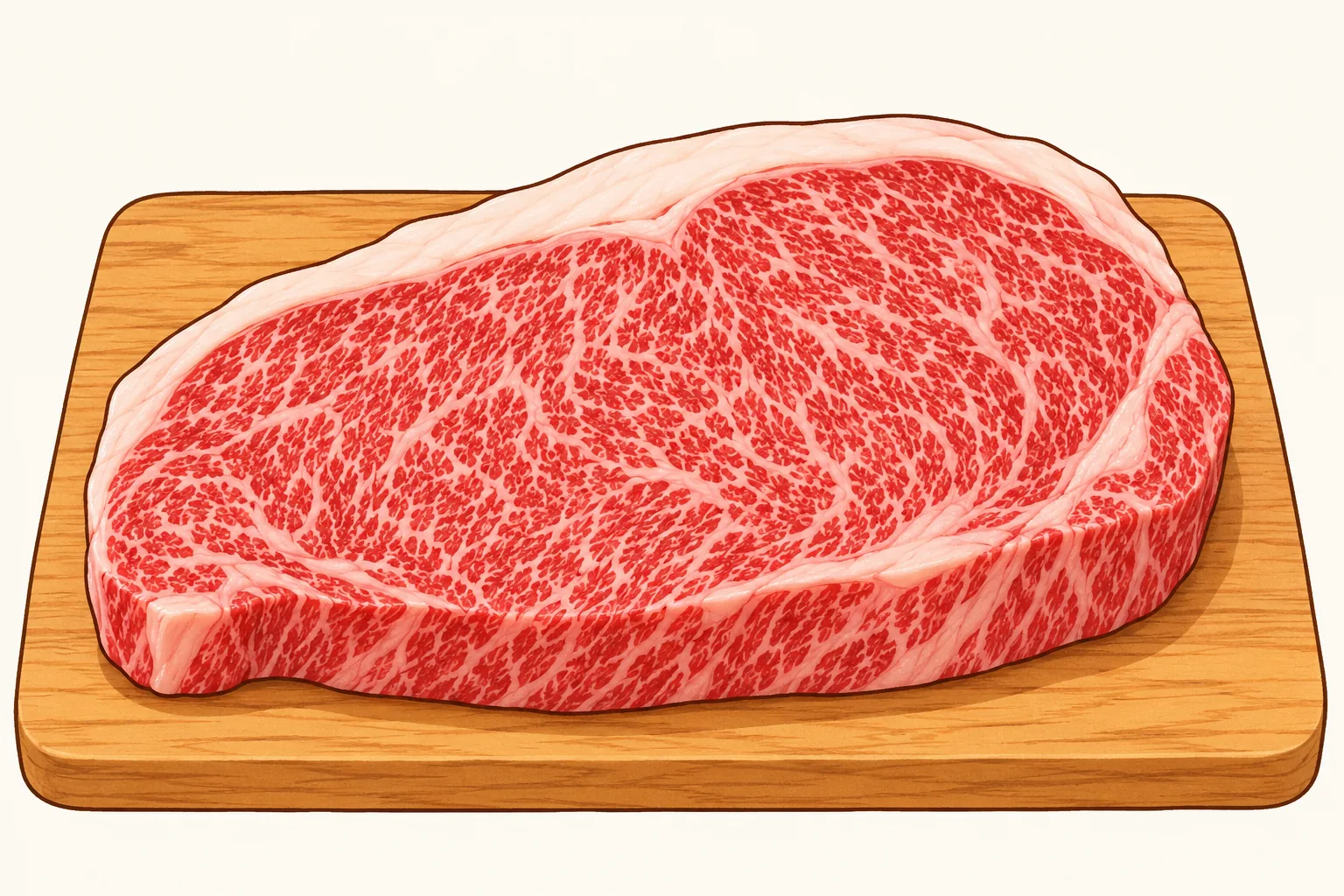
- Wagyu fat is rich in oleic acid and starts to melt near body temperature, hence the melt-in-the-mouth feel.
Hold a slice of top-grade wagyu up to the light and it looks more like white lace laid over red than like meat. Rest it on your palm and the fat starts to soften and shine from the warmth of your hand. Today this beef is one of Japan’s most expensive foods and one of its best-known exports, yet a century and a half ago most Japanese people did not eat beef at all, and cattle were animals that pulled plows. This piece explains what the word wagyu actually means, where the texture comes from, what lies behind names like Kōbe and Matsusaka, and how to eat it well when you are in Japan.
01What Counts as Wagyu
Wagyū simply means "Japanese cattle," but in Japan it is not a loose term for any cow raised in the country. Under Japanese labeling rules, only four breeds and crosses among them qualify: Japanese Black (kuroge washu), Japanese Brown (akage washu), Japanese Shorthorn (nihon tankakushu), and Japanese Polled (mukaku washu). The animal must also be born and raised in Japan and traceable through the national cattle registry. A separate label you will see in every supermarket, kokusan-gyū ("domestic beef"), is far broader. It covers any animal raised mainly in Japan, which in practice means a great many Holstein steers from the dairy industry and first-generation crosses between Holsteins and Japanese Black. It is good everyday beef, and noticeably cheaper.
The four breeds are not equal partners. Japanese Black makes up more than 90 percent of all wagyu, and almost everything people mean by the word, including Kōbe and Matsusaka beef, comes from it. Japanese Brown, raised mostly in Kumamoto and Kōchi, is known locally as akaushi, "red cattle," and gives leaner meat. Japanese Shorthorn comes from Iwate and the rest of the cold northeast; it is hardy, often grazes on mountain pasture in summer, and has a clean, beefy flavor. Japanese Polled survives only in small numbers in Yamaguchi Prefecture and is almost never seen on a menu.
| Breed | Share and region | Notes |
|---|---|---|
| Japanese Black | More than 90% of all wagyu | Kobe and Matsusaka beef come from it |
| Japanese Brown (akaushi) | Mostly Kumamoto and Kōchi | Leaner meat |
| Japanese Shorthorn | Iwate and the northeast | Hardy; summer mountain pasture |
| Japanese Polled | Only small numbers, in Yamaguchi | Almost never on a menu |
The four breeds are not equal partners: Japanese Black alone makes up more than 90 percent of all wagyu.
Since 2003, every animal born in Japan has carried a ten-digit identification number that follows it from birth through every sale and on to slaughter. Butchers and restaurants often print that number on labels or certificates. Type it into the government’s lookup site and you can see the breed, sex, birthplace, and the farms where the animal was raised. Before wagyu is a taste, it is a pedigree on file.
02A Thousand Years Without Beef
In 675, Emperor Tenmu banned the eating of cattle, horses, dogs, monkeys, and chickens, a ban usually read as covering the farming months, the fourth through the ninth of the lunar calendar. Combined with Buddhist teaching against taking life, and with plain economic sense, that edict set the tone for more than a millennium. A cow was a farm family’s most valuable possession. In the hill country of western Japan it pulled the plow, trampled paddy fields, and hauled charcoal and iron sand. Eating it would have been like eating your tractor.
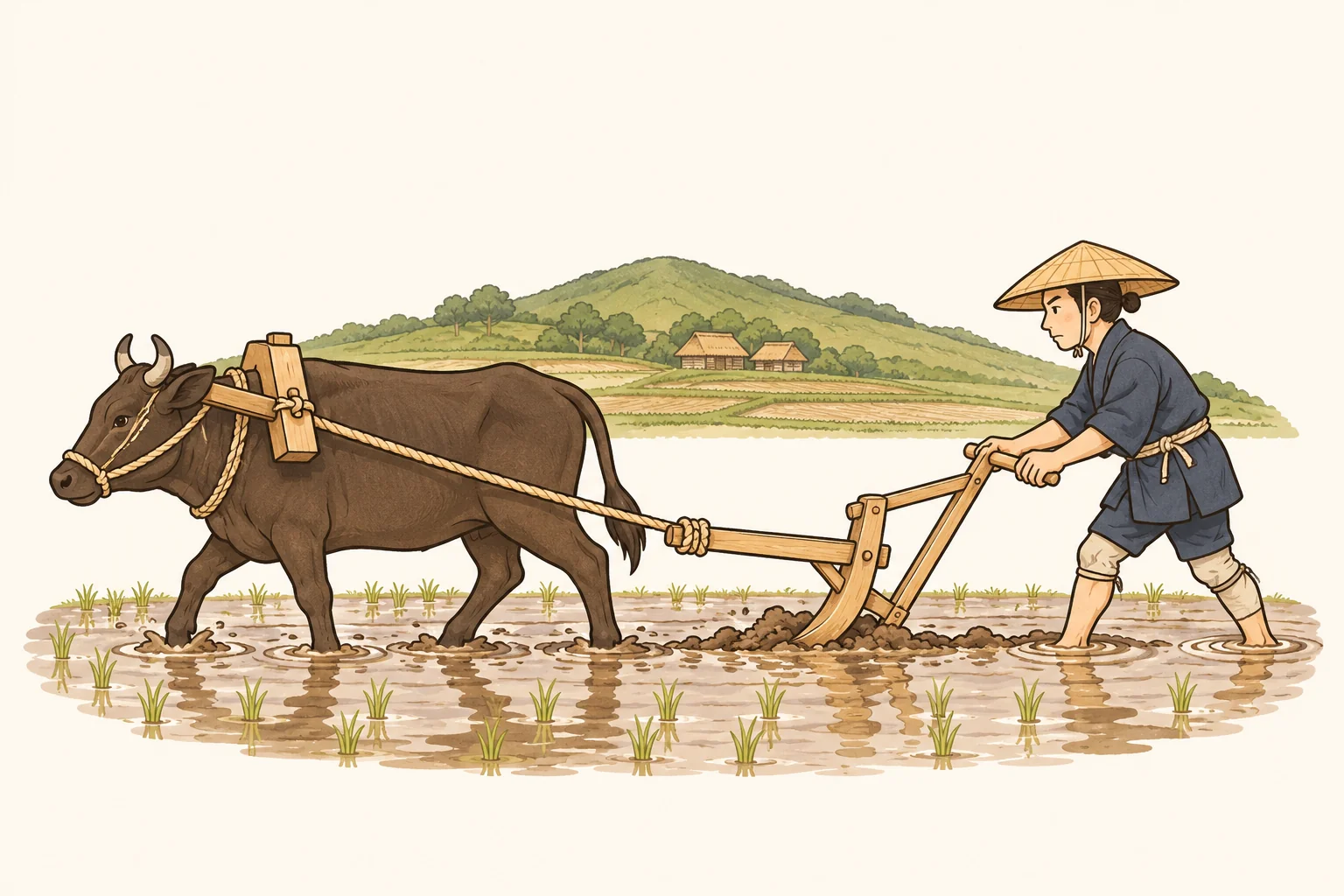
Before wagyu was beef it was a draft animal: an Edo-period cow pulling the plow, a farm family’s most valuable possession.
The taboo had gaps. In the Edo period (1603–1868), the Hikone domain on the shores of Lake Biwa is said to have been one of the few places allowed to slaughter cattle, and it sent beef pickled in miso to the shogun and other lords as a restorative "medicine." Townspeople, for their part, ate wild boar and venison under the euphemism of kusuri-gui, "eating for medicine."
The real break came after Japan opened its ports. Foreign residents in Yokohama and Kōbe wanted beef, and the Meiji government, eager to look modern, encouraged Japanese to eat it too. In 1872 the court let it be known that Emperor Meiji had eaten beef. In Tokyo, shops serving gyūnabe, beef simmered with green onions in an iron pot with soy sauce or miso, became the fashionable place to be seen. The writer Kanagaki Robun built a comic novel, Aguranabe (1871–72), around the customers of one such shop, and a popular saying of the day held that anyone who did not eat gyūnabe was hopelessly backward. Gyūnabe later developed into the Kantō style of sukiyaki.
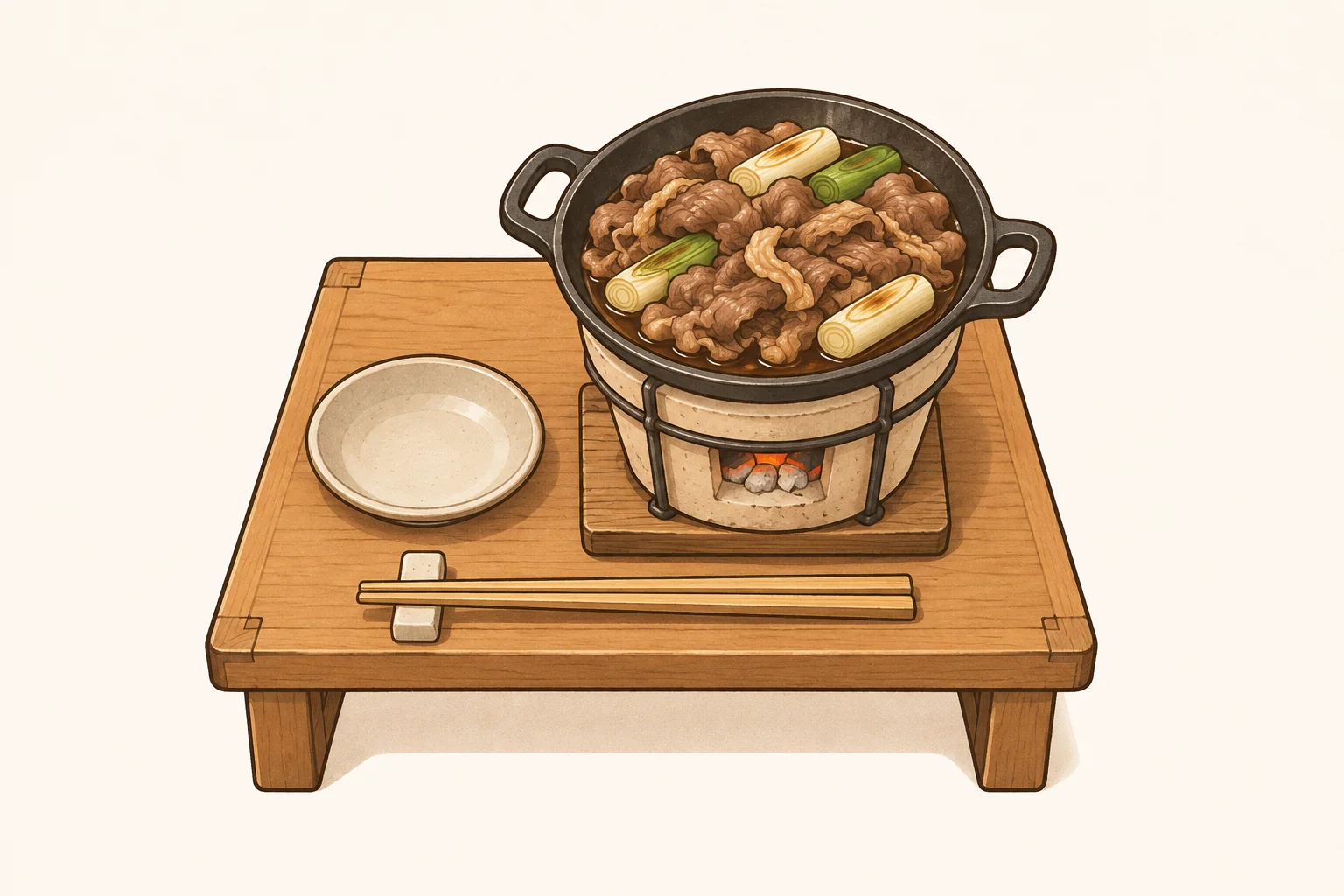
Gyūnabe in early Meiji Tokyo: beef simmered with green onions in a small iron pot with soy sauce or miso.
03Tajima Cattle and One Famous Bull
Kōbe beef’s reputation began with the foreigners at the Kōbe docks, who noticed that cattle brought down from the Tajima region in northern Hyōgo gave unusually tender meat. Tajima is steep, isolated country. For generations, farmers in each valley bred their cattle with local stock, producing small, distinct bloodlines called tsuru, which were recorded and prized much like family lineages.
In the late Meiji period, the government tried to make Japanese cattle bigger by crossing them with imported breeds: Shorthorn, Devon, Brown Swiss, Simmental and others. The crosses grew larger, but buyers disliked their meat and temperament, prices fell, and the experiment faded within about a decade, by around 1910. Breeders in each region then worked to stabilize their own types, and in 1944 Japanese Black, Japanese Brown, and Japanese Polled were formally recognized as breeds. Japanese Shorthorn followed in 1957.
Tajima breeders had always been wary of outside blood, and Hyōgo kept its cattle largely pure. In 1939 a bull named Tajiri was born in Mikata District. His offspring had exceptional meat, he was used heavily for breeding, and today almost every Japanese Black animal in the country traces back to him. That shared ancestry helps explain why the breed’s meat is so consistent, and it has also left breeders with a long-running worry about inbreeding.
After the Second World War, small tractors spread through the countryside and cattle lost their jobs in the fields. By the 1960s wagyu had become a beef animal and nothing else. Then, in 1991, Japan liberalized beef imports, and American and Australian beef arrived at a fraction of the price. Japanese producers survived by moving in the one direction their competitors could not follow: finer marbling, softer texture, higher prices. Much of what the world now thinks of as wagyu was shaped by that decision.
04Where the Marbling Comes From
The Japanese word for marbling is shimofuri, "falling frost." In most cattle, fat collects under the skin and around the outside of the muscles. Japanese Black has an inherited tendency to lay down fat inside the muscle, between the fibers, the result of generations of selection.
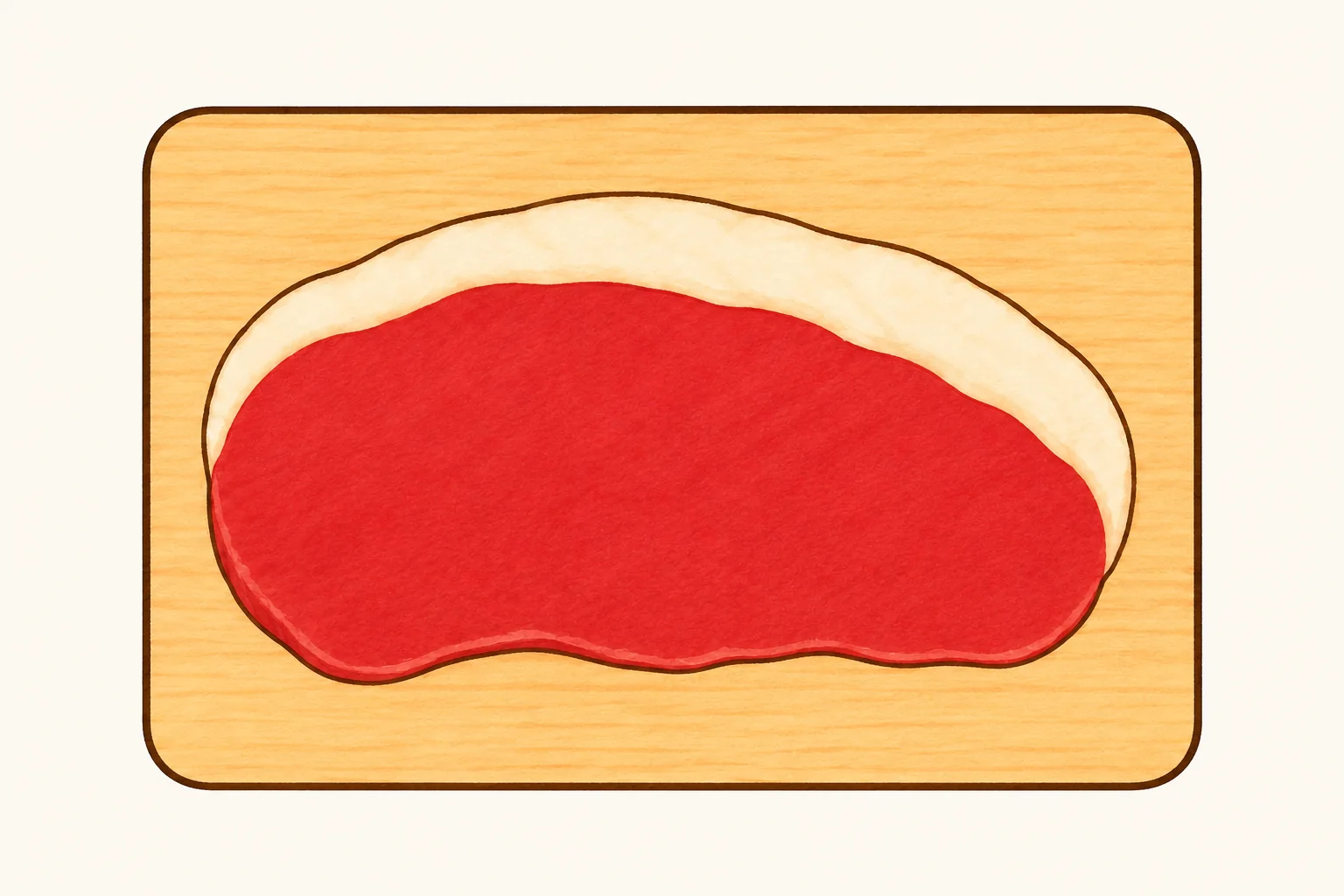
In most cattle the fat sits around the outside of the muscle, as on this ordinary sirloin, not inside it.
Genetics is only part of it. Wagyu are fattened for a long time and usually go to slaughter at around 28 to 30 months, considerably older than typical feedlot cattle in the United States. Through the fattening period they eat concentrated grain-based feed with rice straw, and many farmers restrict vitamin A in the feed for a stretch of months, which encourages intramuscular fat. The stories about beer, classical music, and massages with shochu are real in the sense that some farmers have done these things, with the Matsusaka area the usual setting, but they are publicity rather than standard practice.
The fat itself is different. It is rich in oleic acid and has a low melting point, close to human body temperature, which is why the meat seems to dissolve on the tongue and why it softens in your hand. When warmed gently it gives off a sweet aroma that Japanese call wagyū-kō, "wagyu fragrance," often compared to coconut or peaches; researchers link it to lactone compounds in the fat. You notice it most in sukiyaki or in meat cooked slowly at low heat.
At wholesale, carcasses are graded by the Japan Meat Grading Association. A letter, A, B, or C, indicates yield, how much usable meat the carcass gives. A number from 1 to 5 indicates quality, judged on marbling, meat color, firmness and texture, and the color and luster of the fat. Marbling alone is scored on a 12-point scale. "A5" means high yield and the top quality grade. It is a market grade, not a guarantee of pleasure, and in recent years many Japanese diners have turned toward leaner akami (red meat) cuts. National competitions have started to score fat quality, including oleic acid content, rather than marbling alone.
| Scale | Grades | What it measures |
|---|---|---|
| Yield | A, B, C | How much usable meat the carcass gives |
| Quality | 1 to 5 | Marbling, meat color, firmness and texture, fat color and luster |
| Marbling | 12-point scale | One of the quality criteria |
| A5 | High yield, top quality grade | A market grade, not a guarantee of pleasure |
The letter grades yield and the number grades quality; A5 means high yield and the top quality grade.
05Kōbe, Matsusaka, and the Regional Brands
Japan has hundreds of branded beefs, usually named for the place where the cattle were finished. The so-called three great wagyu are Matsusaka and Kōbe, with the third place claimed by either Ōmi or Yonezawa depending on whom you ask.
Kōbe beef has strict rules set by a producers’ and distributors’ association. It must come from purebred Tajima cattle born and raised in Hyōgo Prefecture, be processed at designated slaughterhouses there, and meet minimum grades for quality and marbling, with a cap on carcass weight. Qualifying meat is stamped with a chrysanthemum-shaped seal, and authorized shops receive a certificate and a small bronze statue of a bull, which you will often see by the door or on the counter.
Matsusaka beef, from around the city of Matsusaka in Mie Prefecture, uses only heifers that have never calved. Most are bought as calves from other prefectures (the top-tier tokusan Matsusaka beef uses calves from Hyōgo) and fattened locally for a long time. Producers say the heifers’ fat melts at an even lower temperature, giving the beef its fine texture. At the annual Matsusaka beef fair in autumn, the champion animal can sell for tens of millions of yen, a figure that reliably makes the evening news. Ōmi beef, from Shiga Prefecture, claims the Hikone domain’s miso-pickled beef as its ancestor and is often called the oldest brand of all.
Other names worth knowing include Yonezawa in Yamagata, Hida in Gifu, Maesawa in Iwate, Miyazaki, and Kagoshima Black. In fact Kagoshima and Miyazaki, in southern Kyūshū, are Japan’s largest wagyu producers (by 2024–2025 figures, Kagoshima ranked first and Miyazaki second by number of Japanese Black cattle), and many famous brands buy their calves at Kyūshū auctions. Every five years the National Wagyu Show, nicknamed the "Wagyu Olympics," brings each prefecture’s best breeding stock and beef cattle together for judging, and the results move the market value of an entire region.
06Wagyu Abroad
Beginning in the 1970s, a handful of live wagyu and some semen were exported to the United States, and from there the genetics reached Australia. Australia now has a large wagyu industry, mostly crosses of wagyu with Angus and other breeds, sold internationally simply as "wagyu." Much of the "American wagyu" in US shops is likewise crossbred.
Many in Japan regret this, feeling that genetics built over generations were let go too easily. Japan later stopped exporting live wagyu and genetic material, and in 2020 it passed a law treating wagyu genetic resources almost like intellectual property, with penalties for unauthorized transfer of semen and embryos. At the same time the government pushes hard to export the beef itself, with the United States, Taiwan, Hong Kong, and Southeast Asia among the main markets as of 2025, when beef exports reached 73.1 billion yen. For a diner outside Japan, the word on a menu may mean purebred Japanese Black raised in Japan or a foreign steer with a quarter wagyu ancestry. In Japan, it can only mean the first.
07Eating Wagyu in Japan
Because the fat is so abundant and so fragrant, the Japanese way with wagyu is small portions, thin slices, and quick heat. The most familiar dishes at home are sukiyaki and shabu-shabu, where thin slices are cooked for seconds and dipped in raw egg or sesame sauce. At a yakiniku restaurant, bite-sized pieces go over charcoal and come off almost at once.
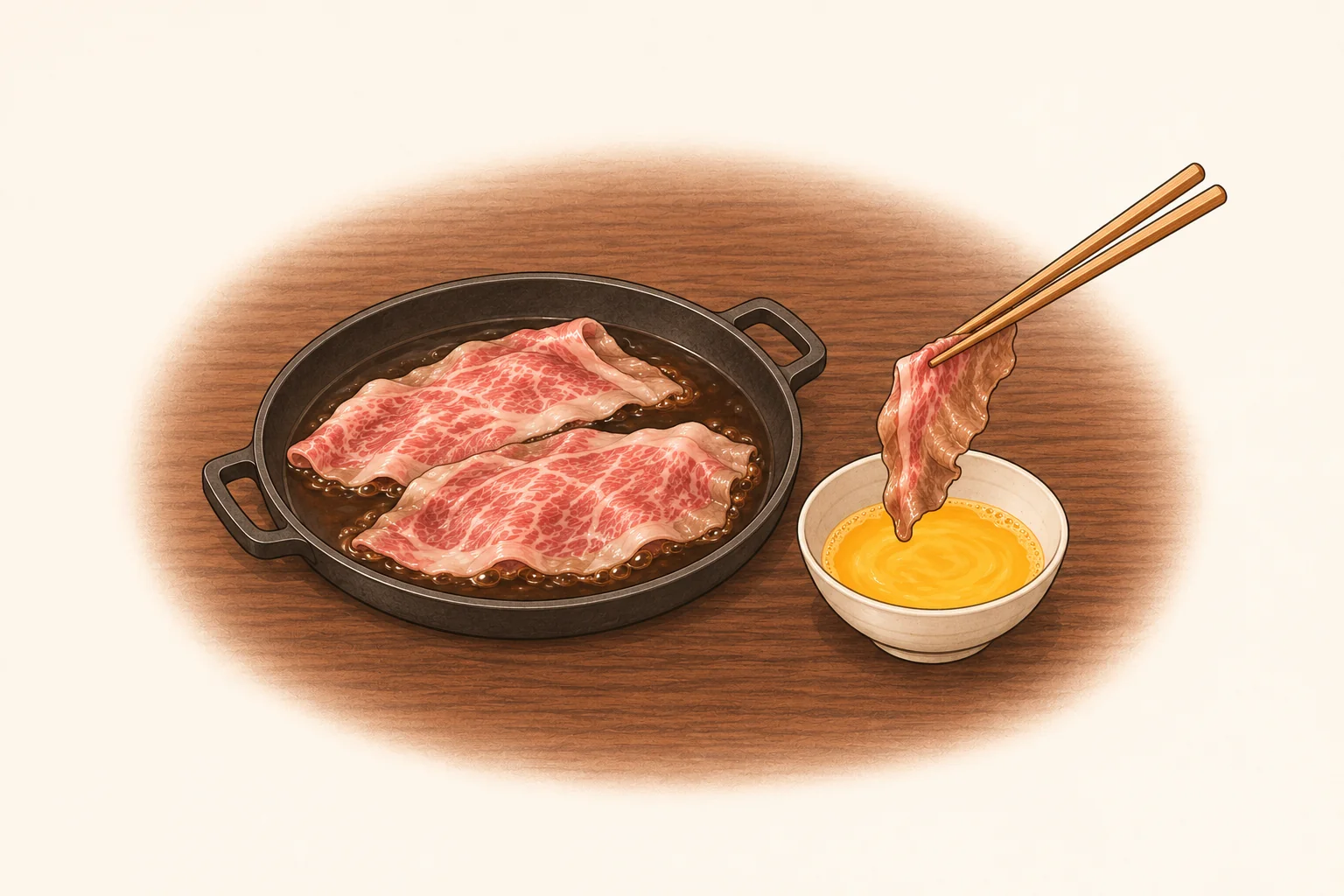
Sukiyaki: thin slices cooked for seconds in a shallow iron pan and dipped in raw egg.
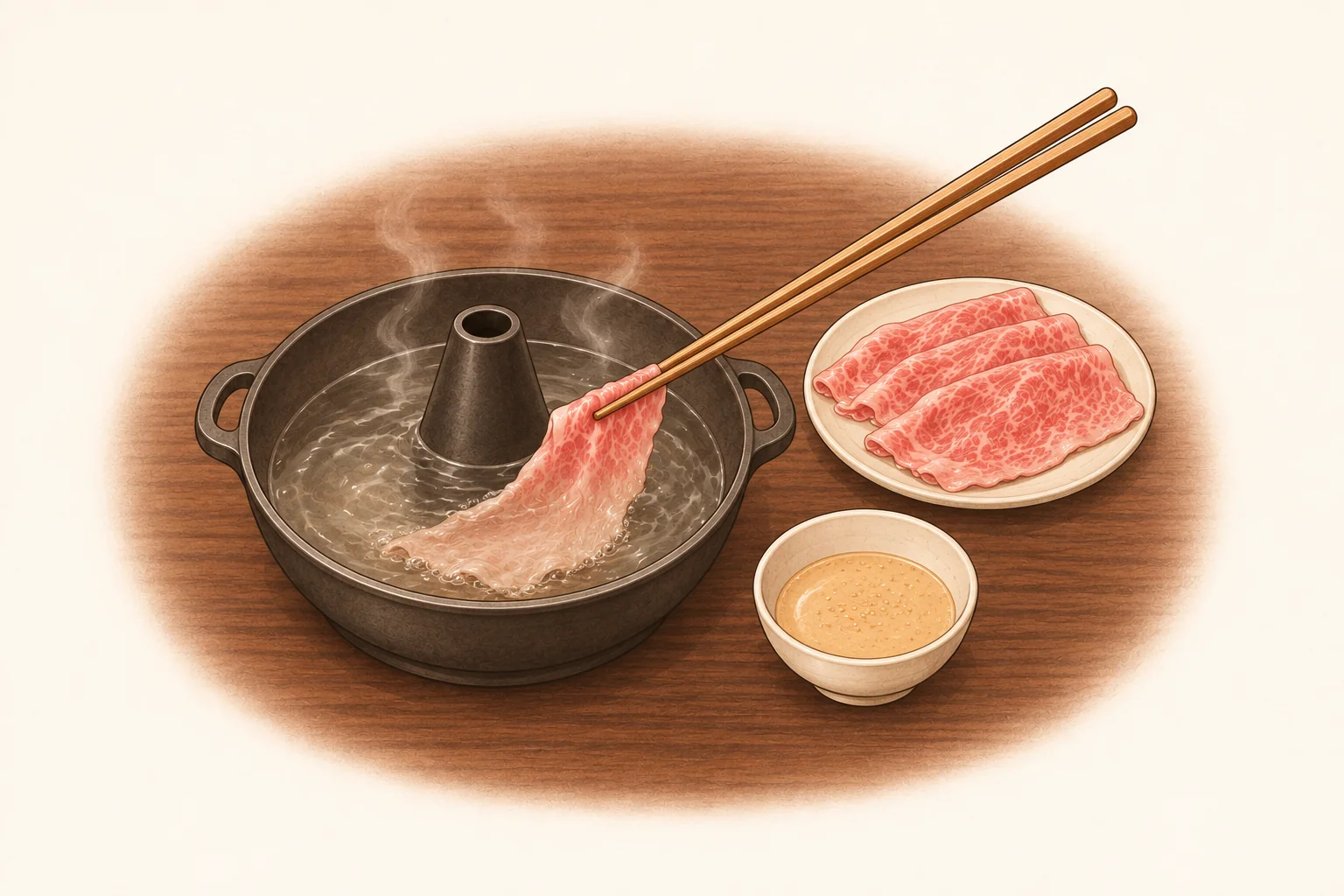
Shabu-shabu: thin slices swished through clear broth and dipped in sesame sauce.
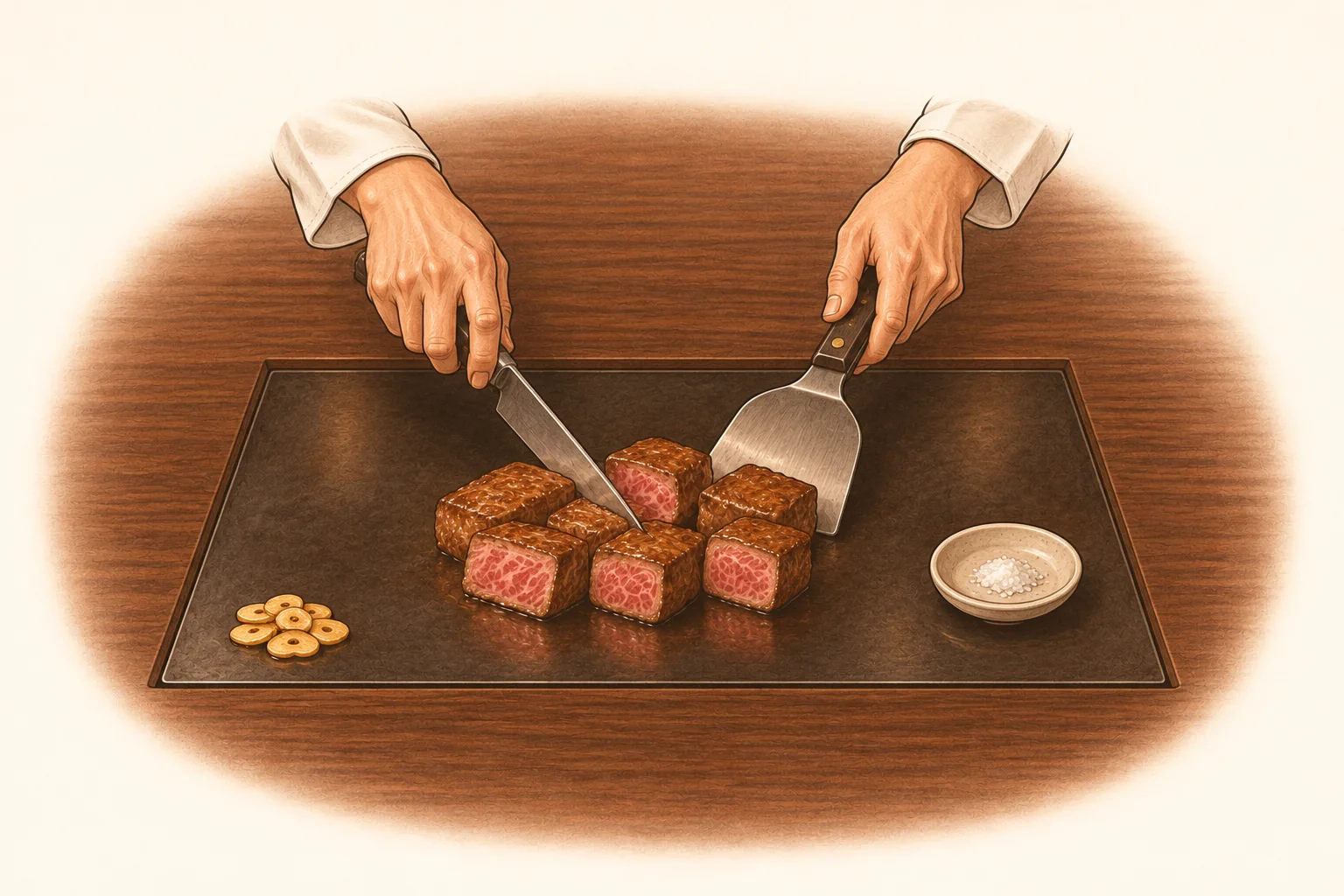
Teppanyaki steak: cooked on an iron griddle in front of the guest, cut into pieces, served with fried garlic chips and salt.
What many visitors want most is a teppanyaki steak. Around Sannomiya in Kōbe there are dozens of places where a chef cooks the beef on an iron griddle in front of you, cuts it into a few pieces, and serves it with fried garlic chips, salt, and mustard. A Kōbe restaurant founded in 1945 bills itself as the originator of the style. As of 2026, a dinner course with Kōbe sirloin often runs 20,000 to 30,000 yen, lunch can cost much less, and the cut and weight make a big difference. Japanese diners generally find about 100 grams of well-marbled steak plenty, so portions look small by American standards. They are not small once you start eating.
The cut matters. Sirloin and ribeye are the usual choices; hire (tenderloin) is the most tender and the most expensive. Yakiniku menus add cuts most Westerners have never heard of: sankaku bara, a richly marbled triangle of short plate; zabuton, "the cushion," from the chuck; and misuji, a small, finely marbled cut from the front leg. Rare cuts that yield only a few hundred grams per animal are often priced separately.
You do not have to spend a fortune. In the old streets of Matsusaka, Kōbe, and Hida-Takayama, butcher shops sell wagyu croquettes and meat buns for a few hundred yen (as of the mid-2020s), and department store food halls sell wagyu bento and sukiyaki boxes. Within Japanese family life, wagyu is first of all celebration meat: a year-end gift, a family gathering, a child passing an entrance exam, an occasion for a box of marbled slices and a sukiyaki pot. As of the mid-2020s, it is also one of the most popular thank-you gifts in the furusato nōzei hometown tax donation system. The beef in a bowl of gyūdon, or on the bargain shelf at the supermarket, is almost always imported or domestic crossbred beef. Look for the word 和牛 and the ten-digit number on the label, and you will know which one you are getting.