
At a glance
Japanese tabletop grilling grew from postwar Korean offal stalls into a national celebration meal; this covers the cuts, the ordering rules and how to eat it.
- Yakiniku means grilling bite-size slices yourself over a burner set in the table, mostly beef, with a sweet-salty sauce and rice.
- Its direct roots are the grilled meat and offal of Koreans in Japan; Shokudōen in Ōsaka and Meigetsukan in Tokyo opened around 1946.
- The neutral word yakiniku replaced "Korean cuisine" and "Korean grill," and was in common use by the late 1960s.
- Order salted cuts before sauced ones and lean before fatty; the first plate is almost always salted tongue, tan-shio.
- After beef imports were liberalized in 1991, prices fell and yakiniku became an affordable meal out for ordinary families.
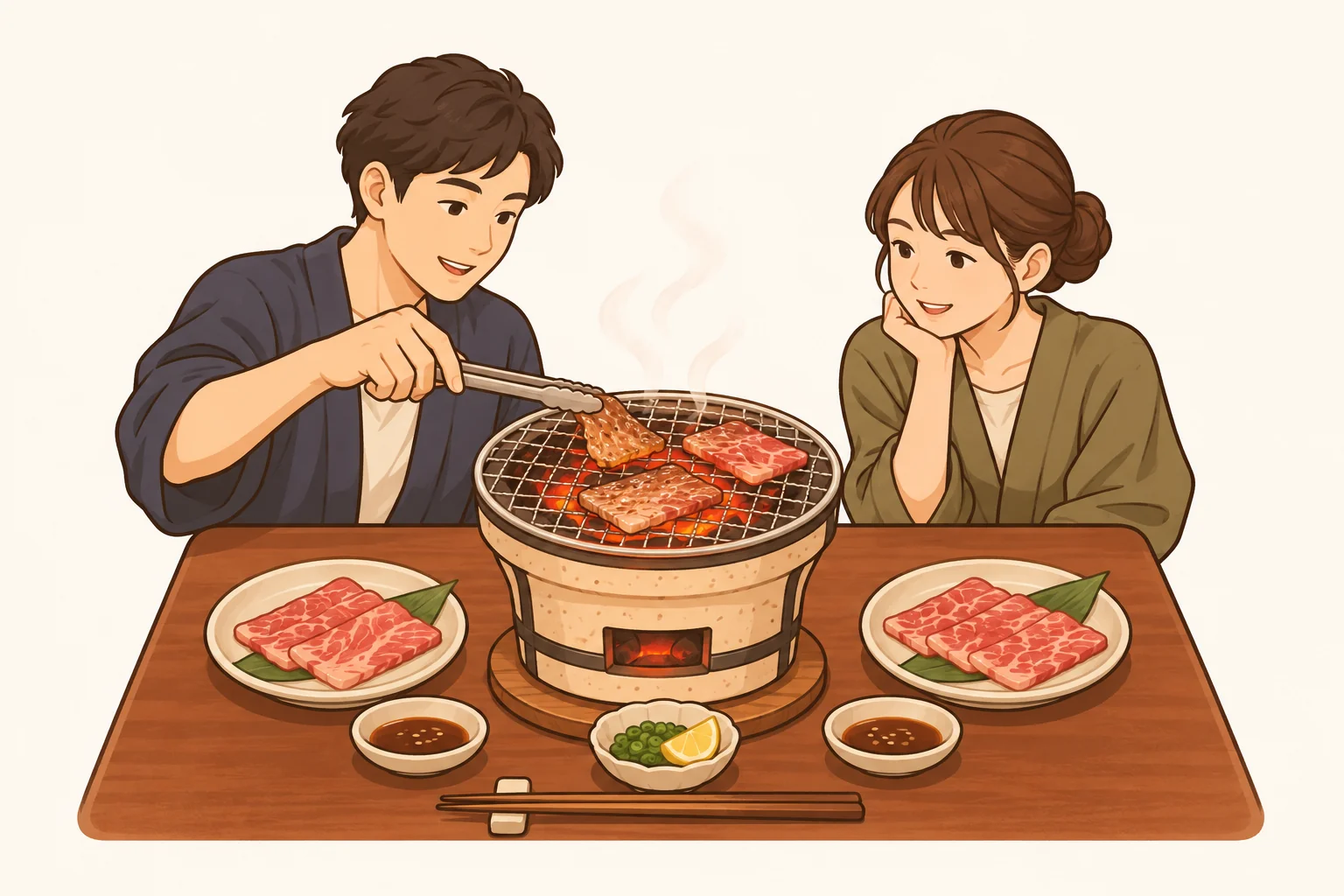
Ask a Japanese office worker how they celebrated a bonus, a finished exam or a reunion with old friends, and there is a good chance the answer is yakiniku: an evening around a table with a grill set into its center, plates of thin-sliced beef arriving from the kitchen, and everyone cooking their own. Yakiniku, literally "grilled meat," looks simple, but it has its own vocabulary of cuts, its own sauces and its own unspoken order of service. It also has an unusual history. A country that avoided eating beef for more than a thousand years learned to love this dish largely through Korean immigrants who, in the years after World War II, grilled the offal that most Japanese would not eat. This guide explains what yakiniku is, where it came from, and how to enjoy it when you sit down at a grill in Japan.
01A Meal You Cook Yourself
The first thing you notice in a yakiniku restaurant is the grill. Old-fashioned places still use a shichirin, a squat clay charcoal brazier that a server carries to the table glowing red. Far more common today is a gas or electric burner built flush into the tabletop, topped with a wire mesh or a ridged iron plate, with a ventilation duct either hanging overhead or hidden beneath the table. The kitchen does the butchering, slicing and marinating. What reaches you is a series of small plates, each holding a few slices of a single cut, which you lay on the grill with tongs or long chopsticks, turn once or twice, and eat within a minute.
Yakiniku is a close cousin of Korean barbecue, and visitors from Seoul will recognize much of it. Still, the Japanese version has its own character. The meat is cut into bite-sized slices before it reaches the table, rather than grilled as a large piece and cut up with scissors. Beef is the star; pork, chicken and offal play supporting roles. The flavor depends on tare, a sweet-savory sauce built on soy sauce with sugar or grated fruit, garlic, sesame oil and toasted sesame seeds. Tare can be used as a marinade, as a dipping sauce, or both. And there is almost always a bowl of white rice. A slice of fatty short rib, dripping and slightly charred, dipped in tare and laid on rice, is close to the platonic idea of a good meal for many Japanese people.
Why make the customer do the cooking? Partly because thin slices cook in seconds, and only the person about to eat can catch the right moment. Partly because the grill turns dinner into a shared activity. In many groups one person ends up taking charge of the grill, deciding what goes on when, flipping, and making sure no one is left out. The Japanese jokingly call this person the yakiniku bugyō, borrowing the title of a feudal magistrate. The joke works because everyone has met one.
02Reading the Menu
Yakiniku menus are organized by cut, and a handful of words will carry you through most of them.
Karubi, from the Korean galbi, is the most popular item. In Japan it usually means well-marbled meat from around the ribs or the belly, rich enough to stand up to tare and rice. Rōsu, derived from the English "roast," refers to leaner cuts from the loin and shoulder, with a cleaner beef flavor. Harami, the outer skirt from the diaphragm, is technically offal but eats like tender, juicy red meat, and its popularity has risen steadily over the past two decades. Tan, beef tongue, is sliced thin, seasoned with salt and eaten with a squeeze of lemon. Ordered this way it is called tan-shio, "salted tongue," and it is the classic first plate.
The world of offal is called horumon. Maruchō is small intestine and shimachō (called tecchan in the Kansai region) is large intestine; mino is the first stomach, chewy and pale; senmai, the third stomach, has a striking many-leaved texture; hatsu is heart and rebā is liver. Offal is cheaper than prime cuts, and in Ōsaka, in the old working-class districts of Tokyo and in many provincial cities there are horumon-yaki places devoted to it, smoky and loud, where people stop after work for beer and a few plates.
- 1Tan-shiosalted tongue with lemon
- 2Salted lean beef or chicken
- 3Tare-marinated karubi and rōsu
- 4Offalsaved for later
- 5Close with cold noodles or rice soup
Salt before tare, lighter before richer: tare contains sugar and burns, so salt-seasoned meat goes on the grill first.
There is a widely shared logic to the order in which things are eaten. Salt-seasoned meats come before sauced ones, and lighter cuts come before richer ones. So a typical meal starts with tan-shio, moves through salted lean beef or chicken, then to tare-marinated karubi and rōsu, and saves the offal for later. The reasoning is practical. Tare contains sugar, which burns and blackens the grill. Cooking the salt-seasoned meat first keeps the grill clean and the flavors distinct. When the mesh does get charred, you ask the staff to replace it, which they will do as many times as needed without any fuss.
The side dishes tell their own story. Almost every yakiniku menu carries Korean food: namul (seasoned vegetables), kimchi, bibimbap, kuppa (rice in soup) and cold noodles. Kimchi cuts through the fat in the middle of the meal; a bowl of cold noodles or rice soup closes it. That a Japanese restaurant genre still ends this way says a lot about where it came from.
03A Country That Didn’t Eat Beef
For most of its history Japan kept meat at a distance. In 675 Emperor Tenmu issued an edict banning the eating of cattle, horses, dogs, monkeys and chickens during part of the year. Over the following centuries, Buddhist teaching against killing and Shinto concern with ritual impurity reinforced the habit, and cattle and horses, valued as working animals, were rarely eaten. The avoidance was never absolute. Wild boar and venison were eaten, sometimes under the polite label of "medicinal food." But beef did not become ordinary food until the Meiji period, when the new government promoted Western-style eating as a way to build stronger citizens. In 1872 newspapers reported that the Meiji Emperor himself had eaten meat, and beef hotpot, gyūnabe, became fashionable in Tokyo. That was simmered meat, though, not grilled, and it led toward sukiyaki rather than yakiniku.
The grilled tradition came from the Korean Peninsula. During Japan’s colonial rule of Korea, from 1910 to 1945, large numbers of Koreans moved to Japan for work, settling in Ōsaka, Tokyo, Kyoto, Kawasaki and the industrial cities of northern Kyūshū. The best-known community formed in Ōsaka’s Ikaino district, today part of Ikuno Ward. They brought with them the practice of marinating meat before grilling it, and a taste for offal. Japanese consumers at the time generally did not eat beef or pork innards, so these parts were cheap, and in Korean neighborhoods they became an affordable, nourishing staple.
The name horumon has a famous folk etymology. In Ōsaka dialect hōru mon means "things you throw away," and many people will tell you that is where the word comes from. It is a good story, but most food historians regard it as a later invention. Before the war, Japan already had a fashion for horumon ryōri, "hormone cuisine," meaning offal and other animal foods thought to boost vitality, a name taken from the German word for hormone. Both explanations are still told, and if a restaurant owner offers you the "thrown-away things" version, take it as part of the local lore.
04From Black-Market Stalls to a National Habit
The years after 1945 were hungry ones. Black markets sprang up around railway stations, and among the stalls selling whatever could be found were grills turning out offal and scraps of meat, many of them run by Koreans. Out of this world came the first restaurants of the modern type. Around 1946, Shokudōen opened in Ōsaka’s Sennichimae entertainment district and Meigetsukan opened in Shinjuku, Tokyo. Both are often called the founders of the yakiniku restaurant, and which came first is still a matter of friendly dispute.
At the start these places described their food as "Korean cuisine" or Chōsen-yaki, "Korean grill." The division of the peninsula in 1948 and the Korean War that followed in 1950 changed that. The Korean community in Japan split along the same line, between those aligned with the North and those aligned with the South, and calling the food either Chōsen or Kankoku risked alienating half your customers. The neutral word yakiniku, which names a cooking method rather than a country, gradually took over, and by the late 1960s it was the usual term. This is how the industry itself usually tells the story, and it explains why a dish so plainly Korean in origin carries a name that says nothing about Korea.
For decades yakiniku kept a rough image: smoky rooms, heavy drinking, a mostly male crowd, and clothes that smelled of grease for a day afterward. Technology softened that. From around the 1980s, "smokeless roasters," grills that pull smoke downward through a duct below the grate, spread through the industry. Restaurants became brighter and cleaner, and women, couples and families with children began to come in numbers. The standard kit of a modern yakiniku restaurant, the duct under the table, the paper bib handed out at the start, the plastic bag for your coat, dates from this shift.
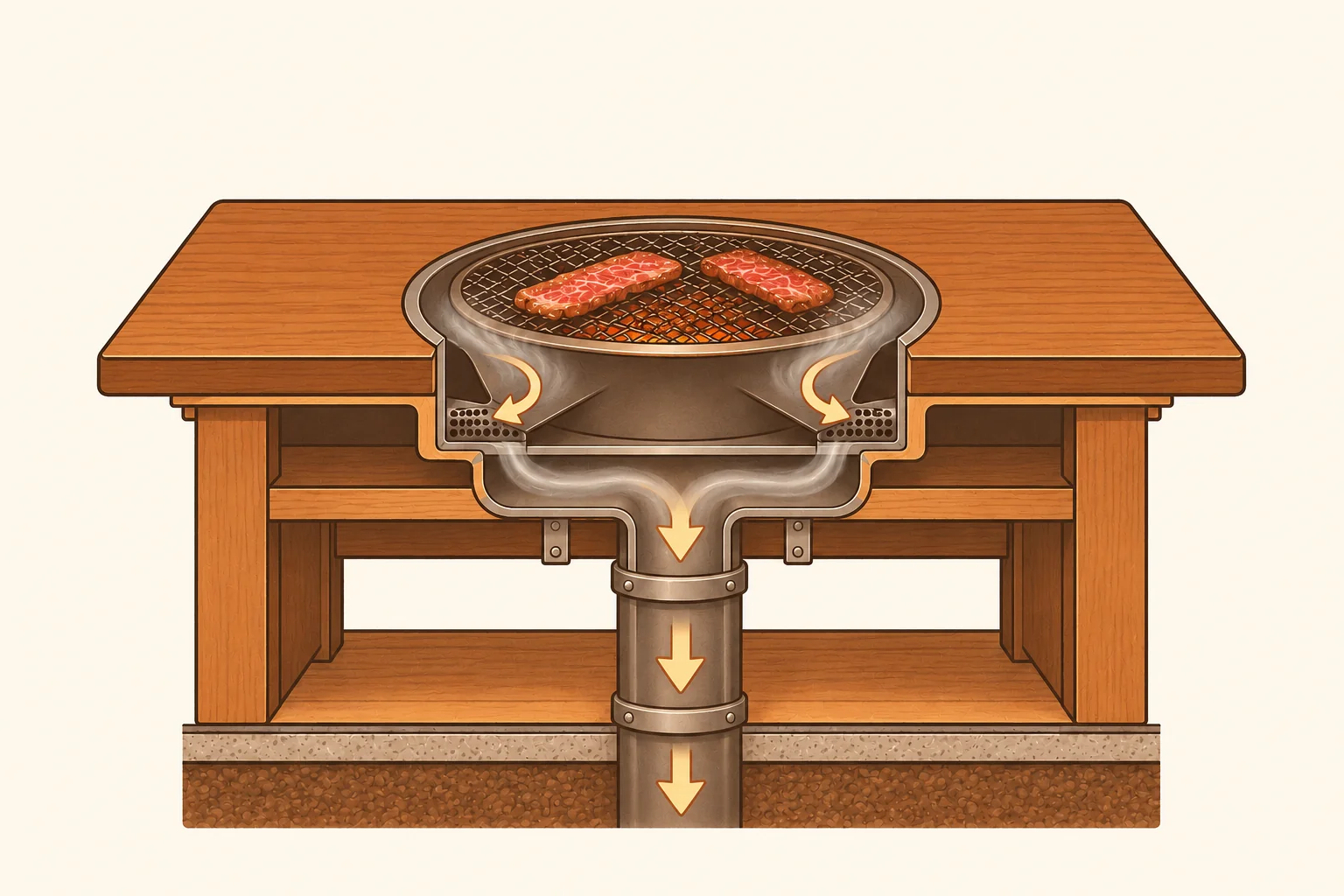
A smokeless roaster in cross-section: smoke is pulled downward through a duct below the grate instead of rising over the table.
The other turning point was economic. In 1991 Japan lifted its quotas on imported beef, and American and Australian beef flooded in at lower prices. Yakiniku went from an occasional splurge to something an ordinary family could afford regularly. In the late 1990s budget chains led by Gyū-Kaku expanded rapidly into the suburbs, with low prices and clear set menus, later adding tabehōdai, all-you-can-eat deals with a time limit. At the other end of the market, upscale restaurants such as Jojoen in Tokyo turned yakiniku into a place for business entertaining and dates, with wagyu on the menu and bills easily passing ten thousand yen a person.
Today the whole range exists side by side: station-front restaurants with karubi for a few hundred yen a plate (as of the mid-2020s); family-run offal joints in regional towns with handwritten menus on the wall; and specialist restaurants in Tokyo and Ōsaka that buy whole Japanese Black cattle and divide them into rare cuts, each served as its own plate and grilled slice by slice. Since the late 2010s there has also been a wave of solo yakiniku restaurants, with a small grill for every seat, where a salaryman can eat a yakiniku lunch set alone in twenty minutes.
Yakiniku also moved into the home. Supermarkets sell beef pre-sliced "for yakiniku," and shelves carry a row of bottled tare; Ebara’s Ōgon no Aji ("Golden Taste"), launched in 1978, is a fixture in many refrigerators. Grilling on an electric hot plate at the dining table is a familiar weekend and New Year scene. The industry has even claimed August 29 as Yakiniku Day, because the numbers 8-2-9 can be read as ya-ki-niku, and supermarkets run promotions accordingly.
Two regional relatives are worth knowing. In Hokkaidō, Jingisukan, named after Genghis Khan, is mutton and vegetables grilled on a domed iron pan. In Morioka, in Iwate Prefecture, Morioka reimen, chewy cold noodles in a beef broth with kimchi, was developed in the 1950s by a Korean-born restaurateur at his yakiniku restaurant and is now one of the city’s signature dishes.
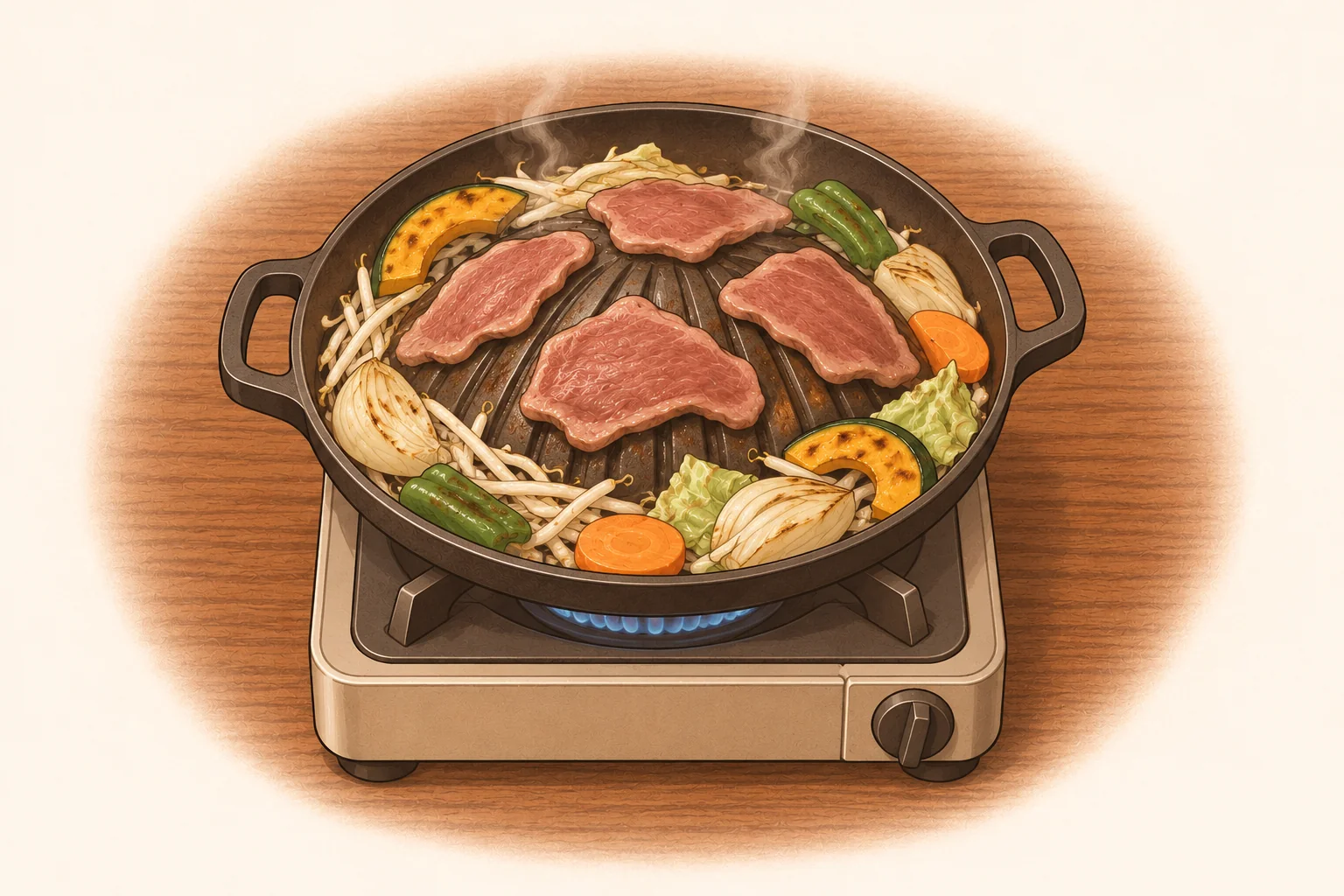
Hokkaidō’s Jingisukan: mutton and vegetables grilled on a domed iron pan.
05Sitting Down at the Grill
Yakiniku restaurants near stations are busiest from about six or seven in the evening. Once you are seated, the server lights the grill and brings hot towels and menus. Most groups order drinks first, beer, oolong tea or a lemon sour, then a first round of basics: tan-shio, karubi, rōsu, rice, and kimchi or namul. Portions are small on purpose, so the table can try several cuts and reorder favorites.
Don’t cover the whole grill at once. Lay a few slices down, wait until the surface beads with moisture and the edges begin to curl, then flip and give them a few seconds more. Tongue needs only one side cooked well; turn it, touch it to the heat, and it is done. Many people fold a slice of tongue around chopped green onion before adding lemon. Karubi drips fat that makes the flames jump, so move it to the edge of the grill if it flares. Use the tongs provided for raw meat rather than your own chopsticks. When the grill turns black, ask for a new one: "Ami kōkan onegaishimasu."
- 1
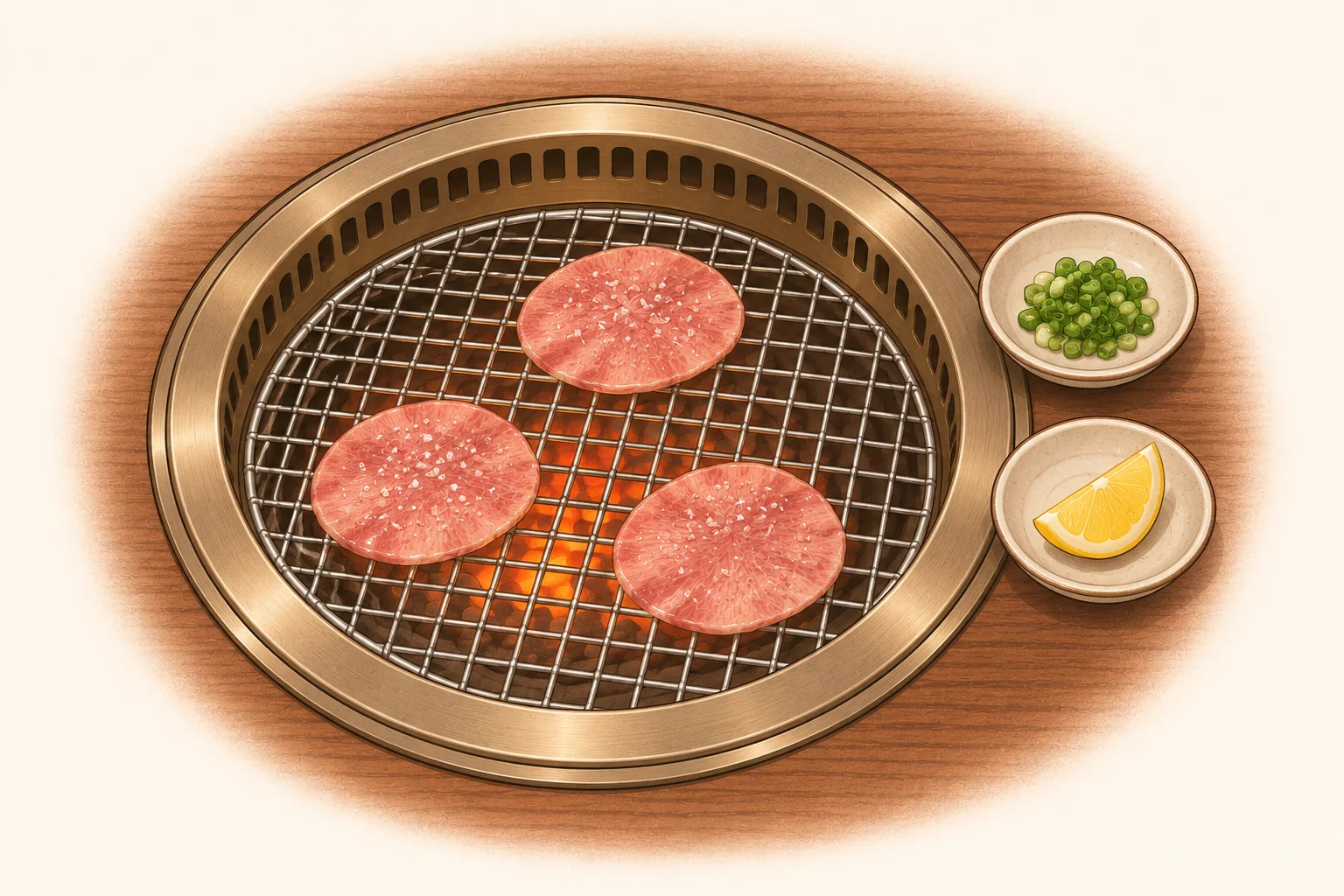 Thin slices of tongue go on the grill; only one side needs cooking well.
- 2
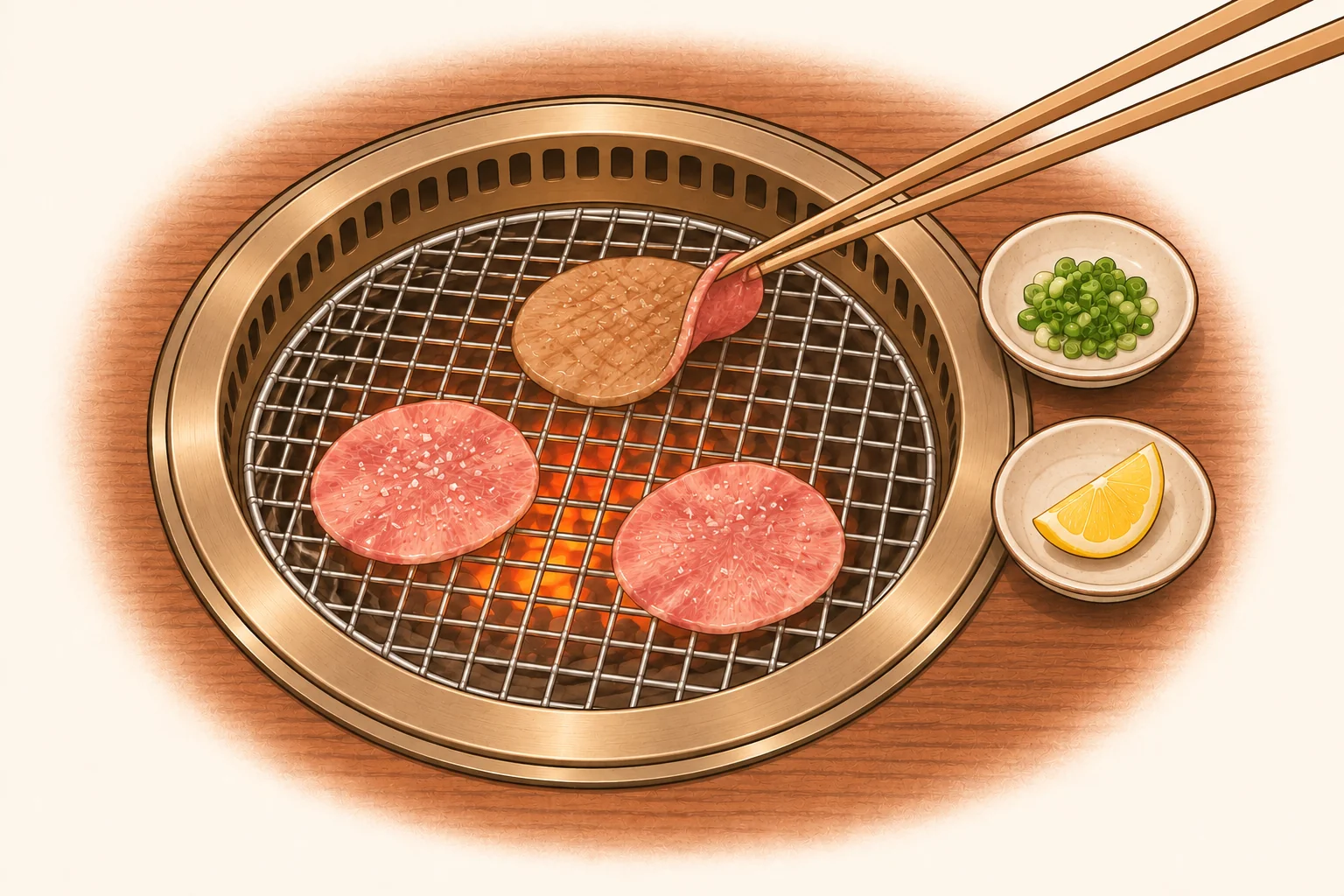 Each slice is turned and the second side just touched to the heat.
- 3
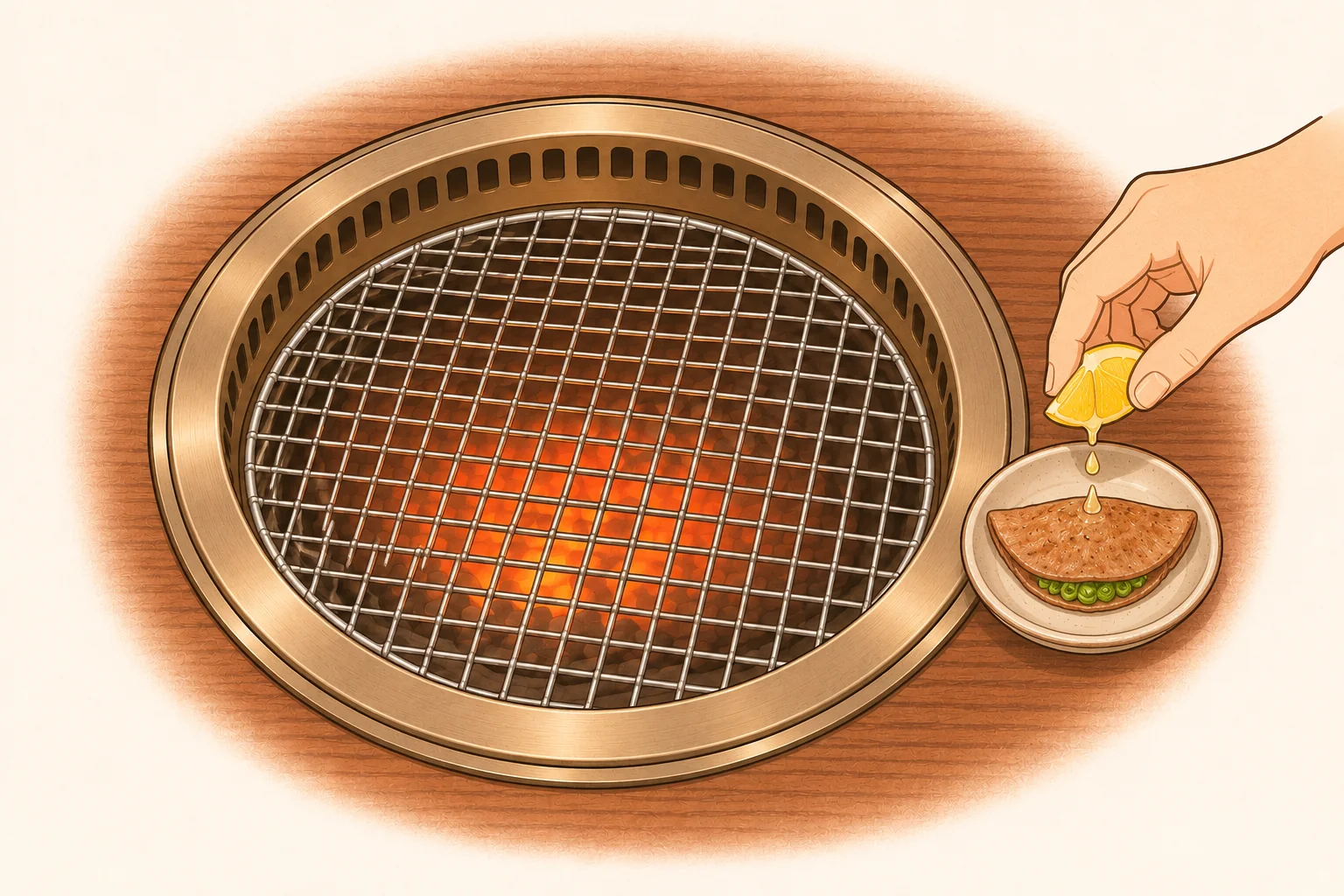 The slice is folded around chopped green onion and finished with a squeeze of lemon.
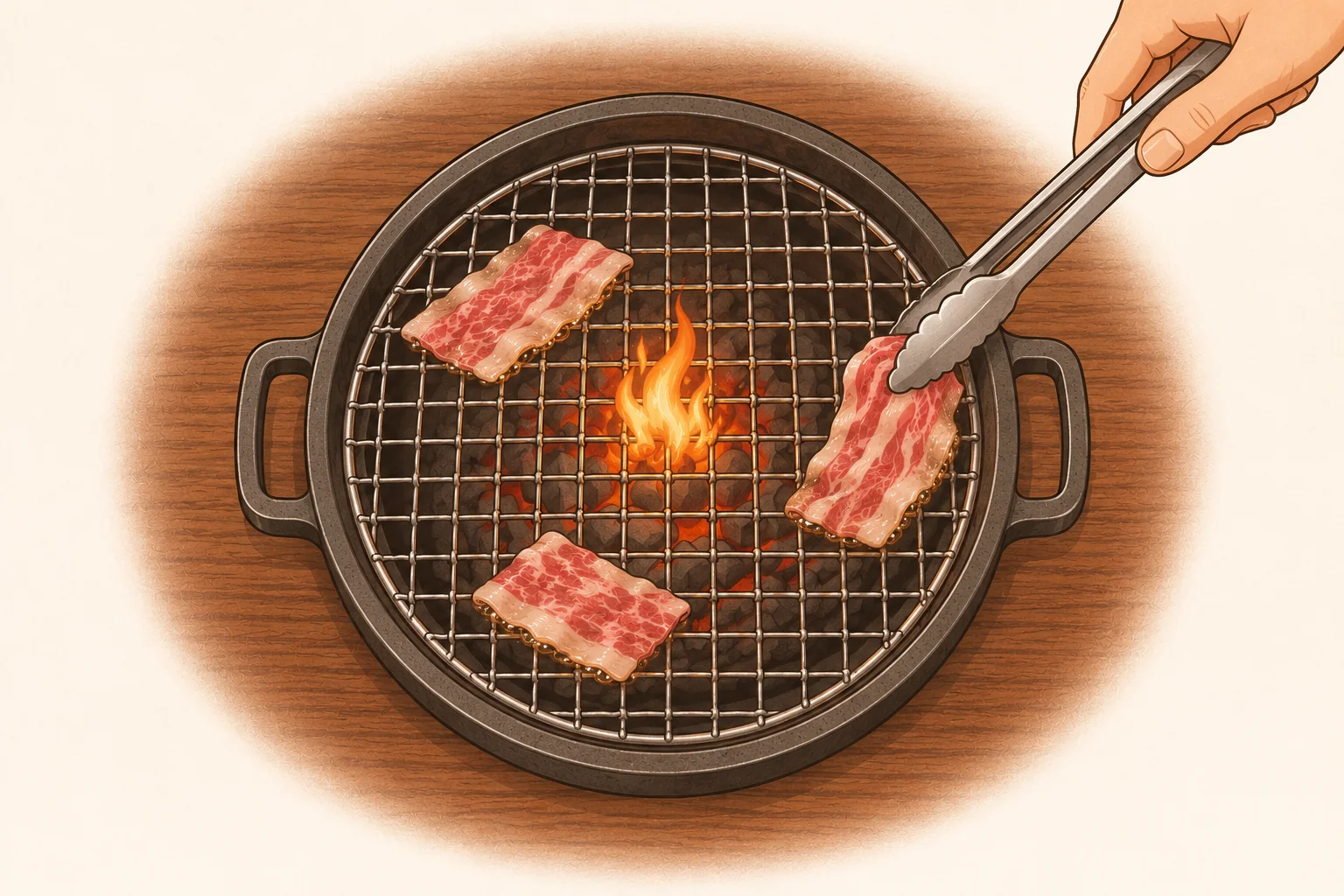
Only a few slices go on at once; fatty karubi that makes the flames jump is moved to the grill’s edge.
All-you-can-eat courses usually run 90 or 120 minutes, and a server will announce last orders before time is up; some places charge for large amounts of food left uneaten. High-end restaurants tend to serve set courses, and staff may grill the first slices for you and tell you when to turn the rest. As of the mid-2020s, at a neighborhood place, three to four thousand yen a person buys a very full evening. At a top wagyu restaurant, ten to twenty thousand yen is not unusual.
You will leave smelling faintly of smoke. Nobody in Japan minds. Some people even say that catching the scent of yakiniku on their coat on the train the next morning is how they remember what a good night it was.