
At a glance
How Meiji meat-eating, a Ginza pork cutlet, hotel kitchens and department-store dining halls turned European dishes into Japanese food eaten with rice.
- Yōshoku means dishes such as omurice, pork cutlet, korokke and hamburg steak: European in origin, Japanese in practice, and eaten with rice.
- Its flavor rests mainly on three sauces: demi-glace, ketchup and Worcestershire-style sauce.
- In 1872 the court made public that the emperor ate beef, and eating meat became part of "civilization and enlightenment."
- Rengatei in Ginza opened in 1895; the restaurant says it introduced its deep-fried pork cutlet in 1899.
- In 1930 the dining hall of Mitsukoshi in Nihonbashi introduced a children’s Western plate, the start of the okosama lunch.
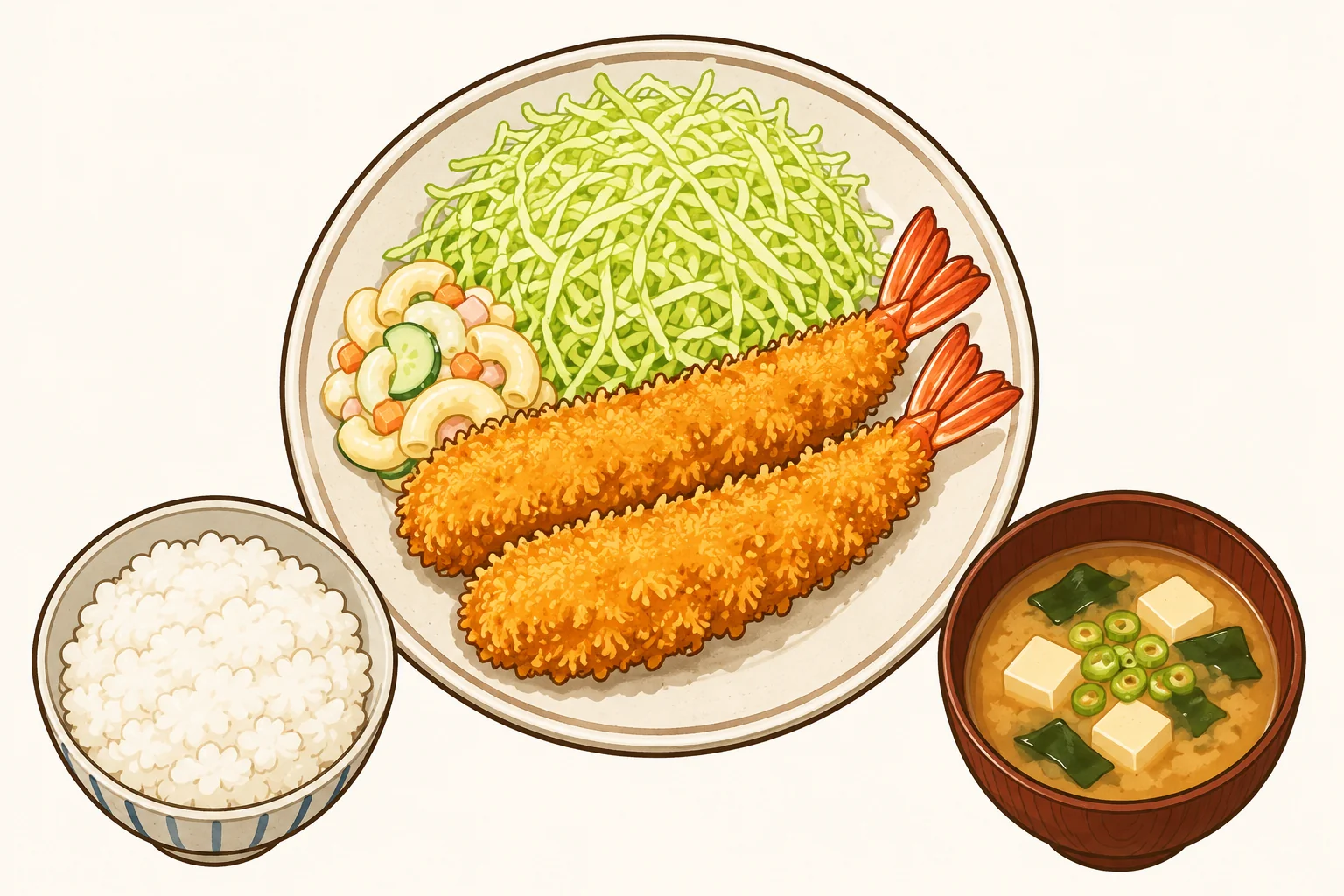
Walk down a shopping street in Tokyo, Yokohama or Ōsaka and you will pass small restaurants with a plastic display case out front: an omelette wrapped around red rice, a glossy hamburger steak in brown sauce, a plate of fried shrimp with a mound of shredded cabbage. These are yōshoku-ya, restaurants serving yōshoku, "Western food." Yet almost nothing in that window would be recognized in Paris or Naples. Yōshoku is a cuisine Japan built over 150 years out of European dishes, reshaped to go with rice, chopsticks and Japanese ideas of what a meal should be. It is one of the easiest and most rewarding things a visitor can eat in Japan, and it says a great deal about how the country absorbed the modern world.
01Not Quite Western Food
Japanese has two words where English has one. Seiyō ryōri means Western cuisine proper: French or Italian cooking, served in courses with bread and wine. Yōshoku means something else, a family of dishes that came from Europe but long ago became Japanese. The core repertoire includes omuraisu (omelette rice), hambāgu (hamburger steak, served without a bun), korokke (croquettes), ebi furai (breaded fried shrimp), hayashi raisu (beef and onions stewed in brown sauce, poured over rice), Napolitan spaghetti, doria (a rice gratin) and the cutlet that became tonkatsu. Curry rice belongs in the family too, though it has grown big enough to be a cuisine of its own.
The surest sign that you are eating yōshoku is what sits beside the main dish. A plate of fried shrimp comes with a heap of raw cabbage shredded as fine as hair, a spoonful of macaroni salad, and a separate serving of white rice, often with miso soup and pickles. The food is designed to be eaten with rice, so the sauces are thick, slightly sweet and strongly savory. In older restaurants the rice may arrive flat on a plate, a relic of the days when diners were taught to eat it Western-style by pressing it onto the back of a fork. Most places will hand you chopsticks without being asked.
Three sauces carry most of the flavor. The first is demi-glace, a dark brown sauce simmered for days from roasted flour, stock, tomato and vegetables. Many old restaurants describe theirs as a continuous pot, topped up each day and never emptied. The second is ketchup, which colors the chicken rice inside an omelette and coats Napolitan spaghetti. The third is Worcestershire-style sauce, called simply sōsu, "sauce," thicker and fruitier than the British original and poured over anything fried.
02Learning to Eat Meat
Yōshoku begins with meat. For most of the Edo period (1603–1868), eating the flesh of four-legged animals was discouraged by Buddhist teaching and by the practical value of draft cattle. People did eat wild boar and venison, sold under polite euphemisms as "medicine," but beef was largely off the table. When Japan opened its ports in the 1850s and 1860s, foreign residents in Yokohama and Kōbe wanted beef, and butchers and meat shops followed them.
The Meiji government, determined to modernize the country, treated meat as part of bunmei kaika, "civilization and enlightenment." In 1872 the court let it be known that the emperor had eaten beef. The writer and educator Fukuzawa Yukichi urged his readers to eat meat and drink milk to build stronger bodies. In Tokyo the fashion was gyūnabe, beef and leeks simmered in a shallow iron pot with miso or soy sauce. The humorist Kanagaki Robun wrote a popular sketch set in a gyūnabe shop, full of young men showing off their new ideas, and a saying circulated that a man who did not eat beef was behind the times. Gyūnabe went on to become sukiyaki. Yōshoku came from a different kitchen.
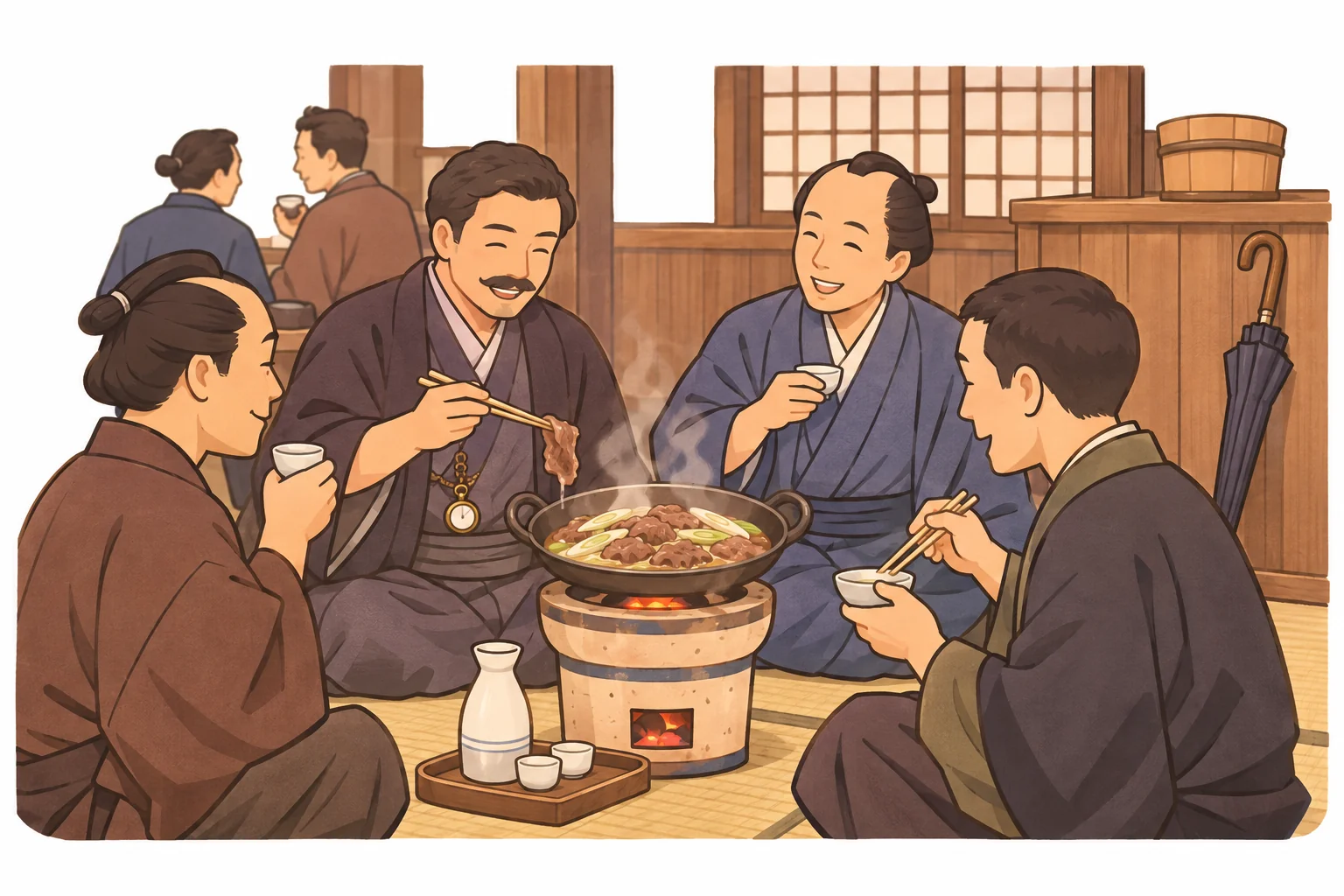
An early Meiji gyūnabe shop: customers seated around charcoal braziers, beef and leeks in shallow iron pans (illustration).
Western cooking in the strict sense first appeared in the foreign settlements and in a handful of restaurants for officials and diplomats. Seiyōken, opened in Tokyo in 1872 and later given a branch in Ueno Park, was the best known. In the 1880s, at the Rokumeikan, a government-built hall for balls and receptions, the elite practiced knives and forks over French menus. This food was expensive, unfamiliar and mostly a display of status.
03Rengatei and the Cutlet
The turn from Western cuisine to yōshoku happened in modest restaurants that wanted ordinary customers. The most famous is Rengatei in Ginza, founded in 1895 and named for the new red-brick streets of the district. According to the restaurant’s own story, its founder found the French côtelette too slow and too costly to make: veal sautéed in butter in a shallow pan. In 1899, by the restaurant’s account, he switched to pork, coated it in fine breadcrumbs, and deep-fried it in plenty of oil, the way tempura cooks worked. He called it pōku katsuretsu, pork cutlet. At first it came with warm vegetables in the Western manner; the restaurant says that during the Russo-Japanese War of 1904, when its cooks were drafted, it began serving raw cabbage instead, later shredding it fine. The format of crisp cutlet, cold cabbage and rice became the template for tonkatsu and for most Japanese fried food since.
Rengatei is also said to have been one of the first places to serve Western dishes with rice and to offer chopsticks, and some accounts link it to the origin of hayashi rice as well. That decision mattered more than any recipe. A Western meal moves course by course, with bread in a supporting role. A Japanese meal is built around rice, with everything else there to accompany it. Once European dishes were placed in that framework, they had to change: sauces grew richer to stand up to plain rice, food was cut into pieces chopsticks could manage, and fried dishes needed something fresh and crunchy alongside.
By the Taishō period (1912–1926), people spoke of the "three great yōshoku": curry rice, tonkatsu and korokke. The croquette shows how far the transformation went. The French version is bound with béchamel; the Japanese one is mostly mashed potato with a little minced meat, cheap enough to sell for pocket change. A comic song from around 1917, the "Korokke Song," joked about a newlywed couple eating croquettes every single day. Neighborhood butchers still fry them to order and sell them over the counter, wrapped in paper.
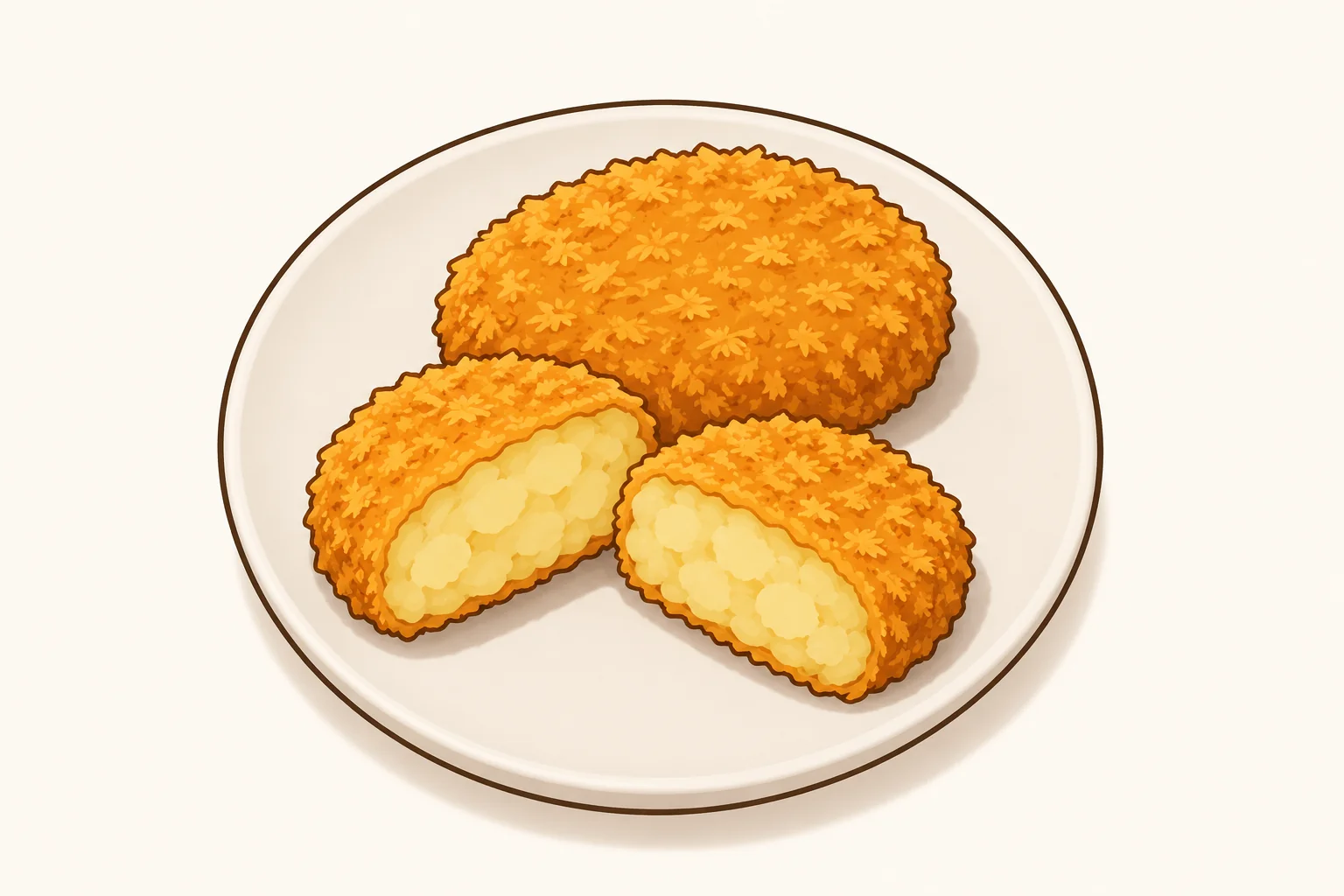
Korokke, the Japanese croquette, is mostly mashed potato in place of béchamel, breaded and fried.
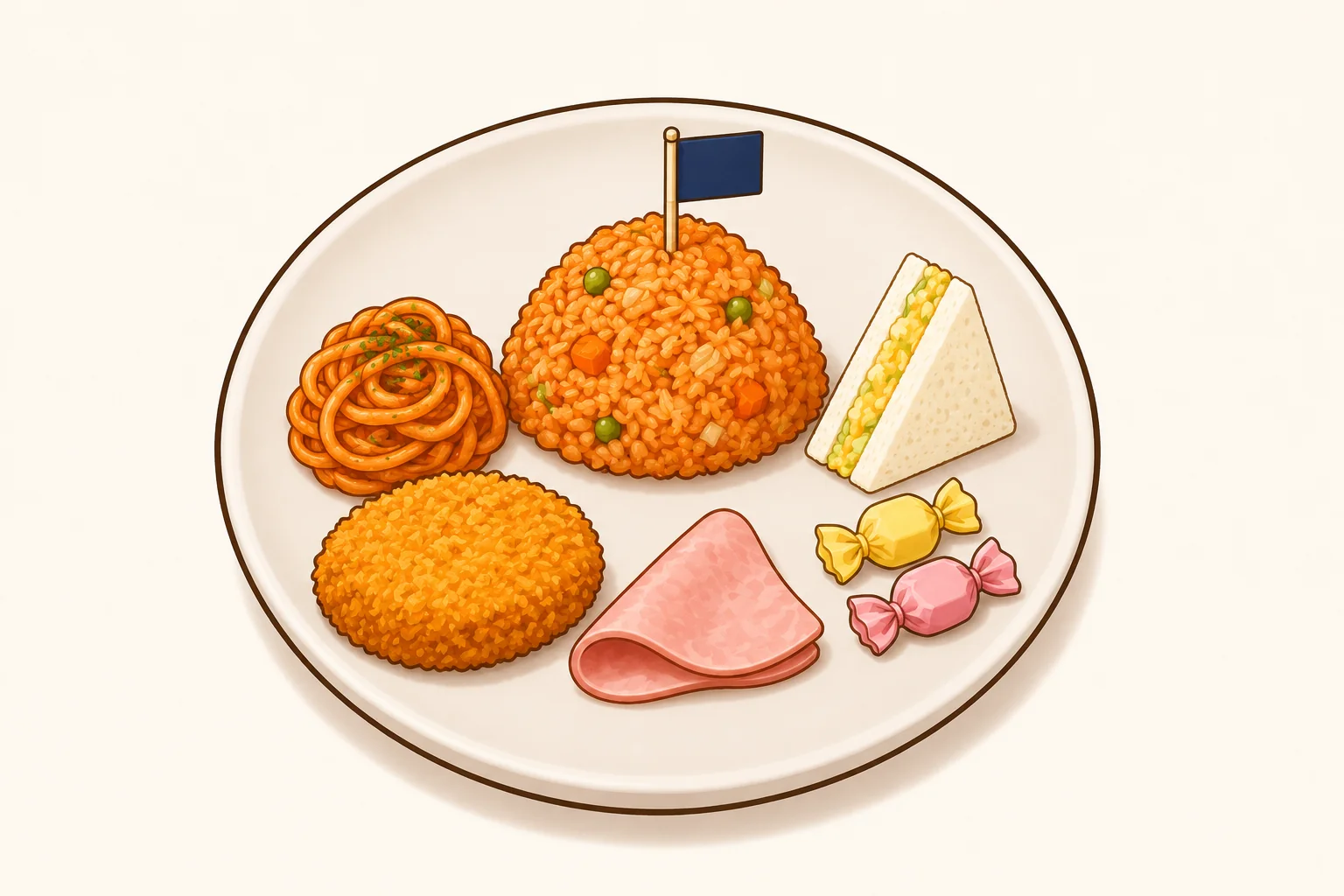
The okosama lunch puts several small dishes on one plate, with ketchup rice shaped like a mountain and a flag on top.
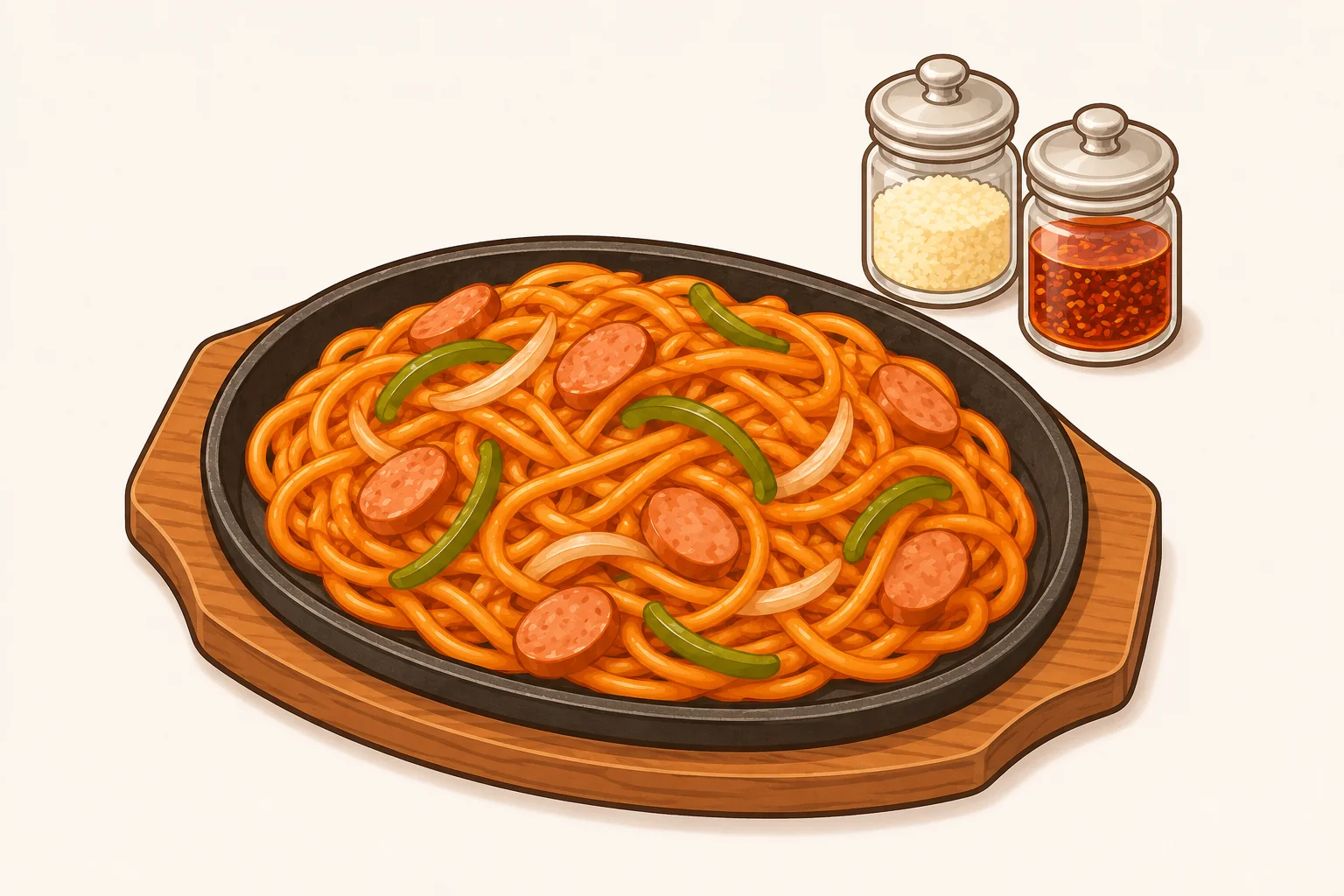
Napolitan spaghetti is thick noodles fried with ketchup, green pepper, onion and sausage, often served on an iron plate.
Omuraisu has two competing origin stories. One says Rengatei created it around 1900 as a staff meal, mixing rice and egg, reportedly so that busy cooks could eat it with a spoon in one hand. The other places it in Ōsaka around 1925, at a restaurant that later became Hokkyokusei, where the owner noticed a regular who always ordered a plain omelette with white rice, and wrapped ketchup-fried rice in egg for him instead. Both restaurants are still in business and both tell their version proudly.
04Hotels, Department Stores and Coffee Shops
In the Shōwa era (1926–1989) yōshoku spread through new kinds of places, and each left a signature dish.
The Hotel New Grand in Yokohama opened in 1927 with a Swiss chef, Saly Weil, brought from Paris. He broke with formal custom by letting guests order à la carte instead of fixed courses. The hotel’s story is that he improvised a dish for an unwell guest: buttered rice topped with shrimp in cream sauce, covered with cheese and baked. That was doria, now on menus all over Japan. After 1945, when the hotel was requisitioned by the American occupation, the kitchen watched GIs eating pasta with ketchup and the second head chef, Irie Shigetada, produced a proper version with tomato, onion, ham and mushrooms. Center Grill, a Yokohama restaurant opened in 1946, made it with cheaper ketchup instead, and the ketchup version is the one that spread. The towering pudding à la mode, a custard pudding surrounded by fruit and whipped cream, is said to have been created there for officers’ wives. Cooks trained under Weil went on to lead kitchens across Tokyo.
Department stores made yōshoku a family outing. In the early Shōwa years, Mitsukoshi, Matsuzakaya, Shirokiya and others opened large dining halls on their upper floors, where families ate after a day of shopping. In 1930 the Mitsukoshi store in Nihonbashi introduced a children’s plate: ketchup rice shaped like a small Mount Fuji, with spaghetti, croquettes, ham, sandwiches and sweets, all on one dish, and a little flag planted on the summit, said to have been inspired by climbers planting flags on mountaintops. This was the first okosama ranchi, the kids’ lunch, and for generations of Japanese it was the grandest meal of childhood.
After the war, yōshoku moved into the home. School lunches introduced bread and fried fish; supermarkets began selling frozen croquettes, canned demi-glace and curry roux; women’s magazines taught readers to make hamburger steak. In the coffee shops called kissaten, Napolitan spaghetti became a standard: thick noodles fried with ketchup, green pepper, onion and sliced sausage, often served sizzling on an iron plate with a shaker of powdered Parmesan and a bottle of Tabasco. It has nothing to do with Naples; the name simply sounded European. From the 1970s, suburban family restaurant chains made the hamburger steak set a fixture of weekend dinners.
05Where the Craft Lies
It is easy to dismiss yōshoku as simplified Western food. The skill in a good yōshoku-ya is mostly invisible.
Demi-glace is the clearest example. The Japanese version is darker, sweeter and glossier than its French ancestor because it has to work with rice. Long-established restaurants may spend a week or more on a batch, reheating, straining and adding to it every day, and when an owner retires the sauce passes to the next generation along with the recipe. Two plates of hayashi rice from two old restaurants will differ mainly in that pot.
Hambāgu is minced beef and pork mixed with sautéed onion, breadcrumbs and egg, shaped into an oval, seared on both sides and finished with a lid on so it stays juicy. When you cut it, juices should run. It might be topped with demi-glace, with grated daikon and soy sauce, with a fried egg, or stuffed with cheese. It comes with rice, never in a bun.
- 1
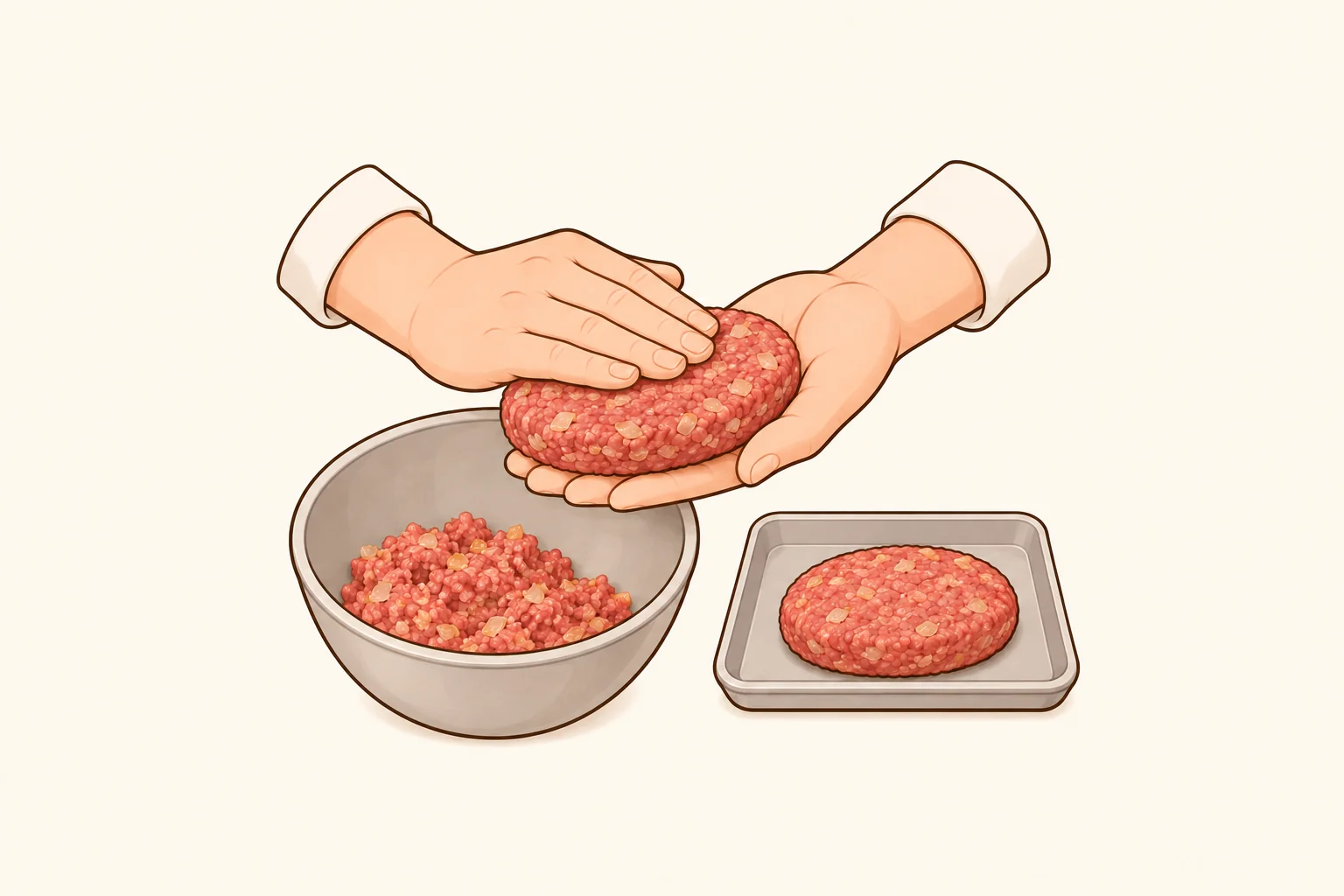 Minced beef and pork, mixed with sautéed onion, breadcrumbs and egg, is shaped into an oval.
- 2
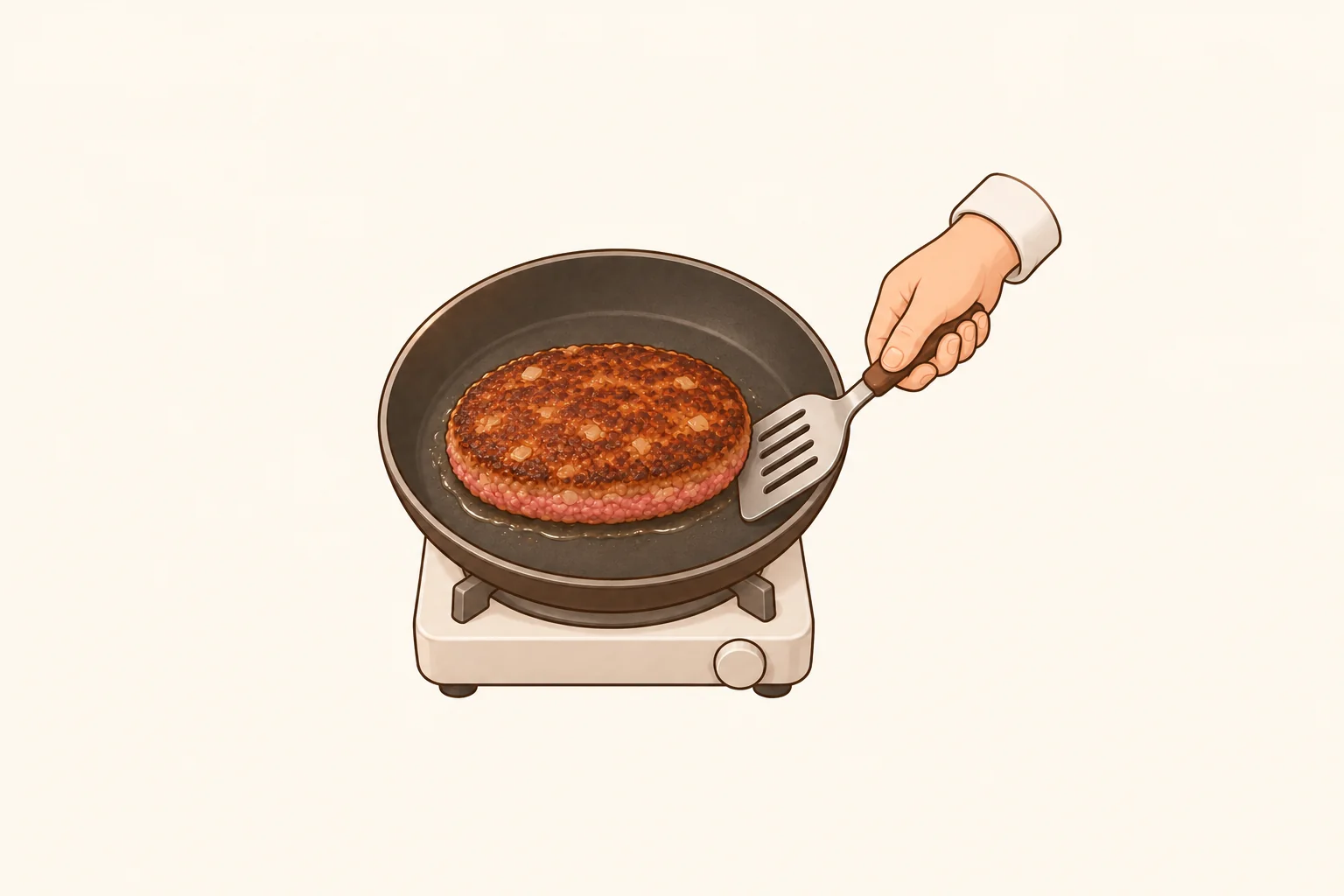 The patty is seared on both sides, then finished with a lid on.
- 3
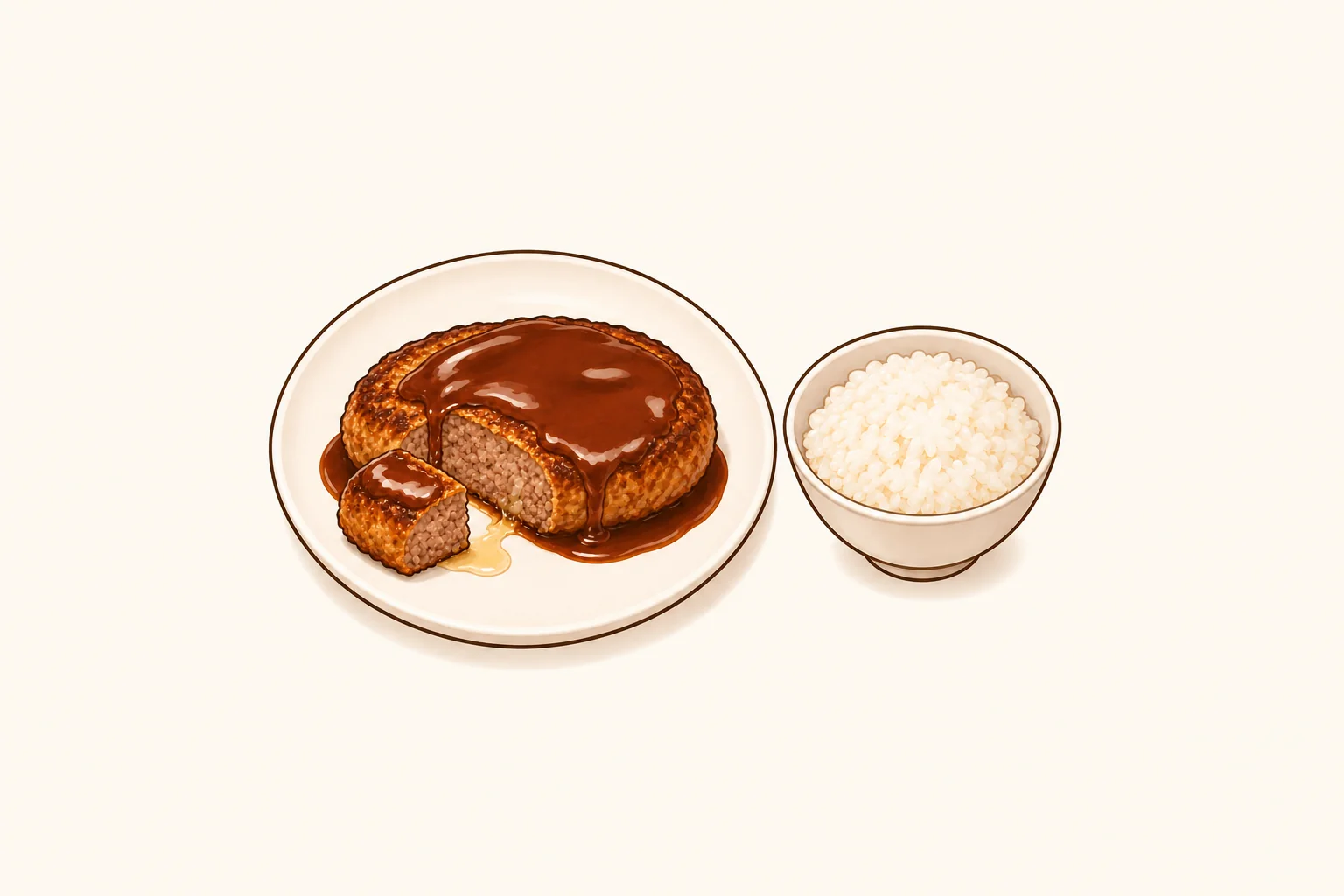 Cut open, it runs with juice; it comes with rice, never in a bun.
Omuraisu shows a cook’s hands most clearly. The classic version wraps a thin sheet of egg around ketchup-fried chicken rice, folded into a neat football shape and finished with a line of ketchup. A newer style places a soft, barely set omelette on top of the rice; the diner slices it open and the egg spills down over both sides. That style became famous through Itami Jūzō’s 1985 film Tampopo, and Taimeiken in Nihonbashi, Tokyo, still serves an omelette rice named after the director.
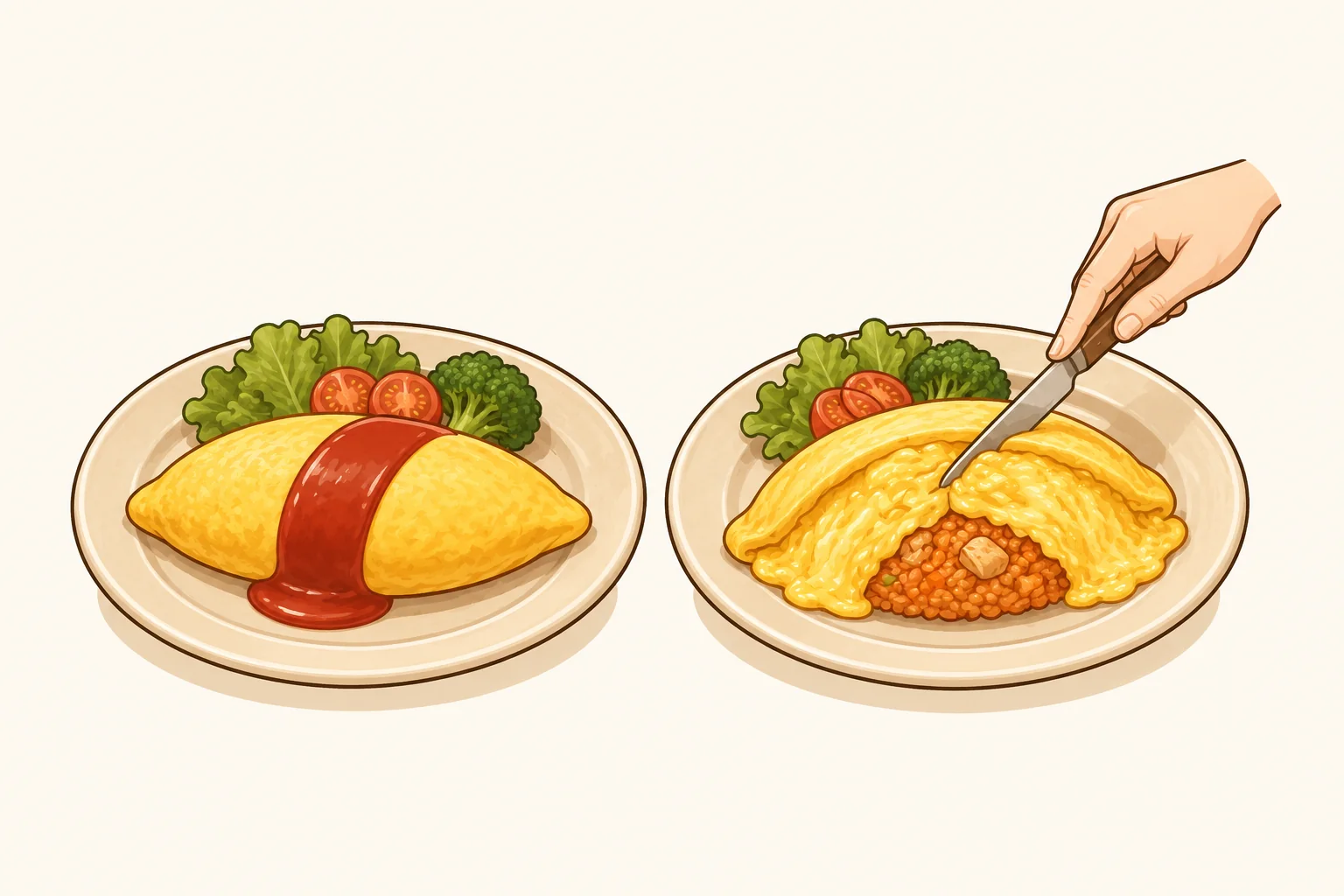
Two kinds of omuraisu: thin egg wrapped in a football shape, and a soft omelette sliced open over the rice.
The supporting parts get the same attention. The cabbage is cut whisper-thin and soaked in ice water so it is crisp without bitterness. The breadcrumbs are coarse and fresh, so they fry up into a spiky crust. A cream croquette hides scalding béchamel, and regulars know to bite carefully.
06Eating Yōshoku in Japan
The best way to try yōshoku is at a restaurant that has been doing it for decades. Tokyo’s older districts are full of them: Ginza has Rengatei and Shiseido Parlour, Asakusa has Yoshikami, and Kanda and Ningyōchō have many more. In Yokohama the café of the Hotel New Grand still serves doria and Napolitan. Ōsaka has Hokkyokusei, and Kōbe, with its long history as a foreign port, and Kyoto each have their own cluster of prewar restaurants. Inside, many keep a Shōwa look: white or red-checked tablecloths, bentwood chairs, framed menus gone yellow, cooks in tall white hats.
Ordering is straightforward. The display case and the pictures on the menu tell you what you need to know. Lunch sets usually bring a main dish with rice or bread and soup for roughly 1,000 to 2,000 yen (as of 2026); signature dishes such as beef stew or hayashi rice cost more. You may be asked "rice or bread?" If you cannot decide, look for a mixed fry plate or a combination plate, which might put fried shrimp, a croquette and a small hamburger steak together.
Nobody expects formality. Use a knife and fork, chopsticks, or both; cutlet and rice eaten with chopsticks is the most natural way. Sauce and mustard sit on the table for you to add as you like. Many regulars order the same dish every visit for decades.
Outside the restaurants, yōshoku is everywhere: omelette rice in convenience-store boxed lunches, croquettes from the butcher, Napolitan in a coffee shop, fried food in department-store basements. Japanese people do not think of any of it as foreign. To them it is simply dinner.