
At a glance
How yakitori breaks one chicken into twenty-odd cuts, why binchōtan charcoal matters, how street stalls led to Michelin counters, and how to order.
- Yakitori is chicken threaded on bamboo skewers and grilled over charcoal; one bird can be broken down into more than twenty cuts.
- It is seasoned either with salt or with tare sauce; old shops never discard their tare pot, only topping it up each day.
- Serious shops use binchōtan charcoal, the best known being Kishū binchōtan from around Wakayama.
- After broiler chickens were farmed on a large scale from the 1960s, yakitori and beer became the office worker’s after-work routine.
- As of 2026, prices range from just over 100 yen a skewer to 10,000–20,000 yen for a set course.
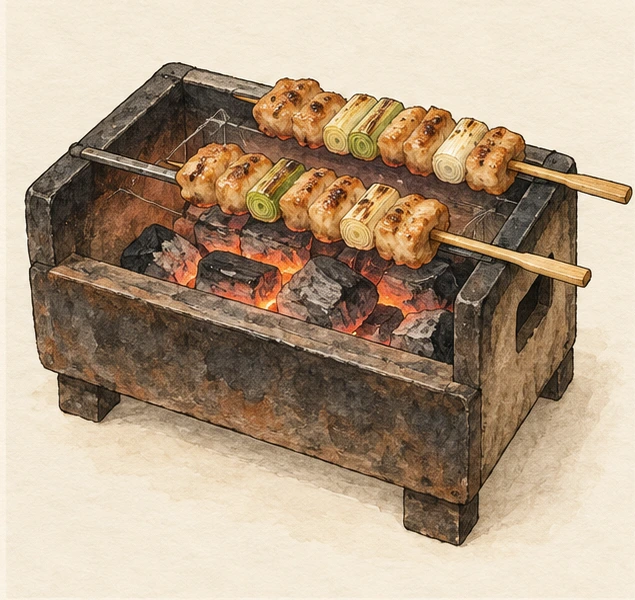
In the early evening, in the lanes that run beside almost any Japanese train station, you will often smell yakitori before you see it: a drift of charcoal smoke and caramelizing soy from a grill no wider than a bench. Yakitori, literally "grilled bird," is chicken threaded onto bamboo skewers and cooked over charcoal, seasoned with salt or a sweet soy glaze. That description makes it sound simple, and in one sense it is. But a good yakitori cook breaks a single bird into twenty or more cuts, each with its own size, timing and seasoning, and the same dish runs from a 150-yen skewer eaten under a railway bridge to chef-led tasting courses. This piece explains what you are eating, why the fire matters so much, how a street snack became a national habit, and how to sit down at a grill counter and order with confidence.
01Reading the Menu Like a Butcher’s Chart
A yakitori menu is a map of the chicken. Most items are simply named for the part of the bird they come from, and once you know a dozen words you can read almost any menu in the country.
The foundation is momo, thigh meat: juicy, forgiving, and the skewer by which many regulars judge a shop. Alternate pieces of thigh with lengths of Japanese leek and you have negima, probably the single most ordered skewer in Japan. The leek softens and sweetens over the coals and cuts through the richness of the meat. Tsukune are chicken meatballs or logs, often bulked out with chopped cartilage for crunch, and the better shops serve them with a raw egg yolk for dipping. Kawa, skin, is grilled slowly and repeatedly so the fat renders out, leaving something crisp at the edges and chewy in the middle. Sasami, the tender strip of breast meat known in English as the tenderloin, is often seared only on the outside and served pink in the center with a dab of wasabi or pickled plum paste.
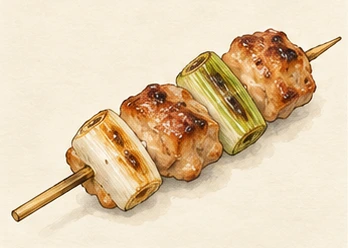
Negima: thigh meat and leek sections threaded alternately on one skewer.
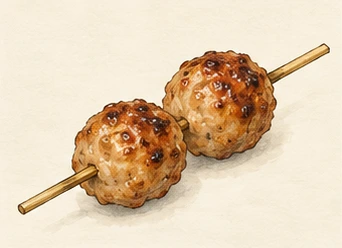
Tsukune: minced chicken shaped into balls and grilled on a skewer.
Then come the organs and the small cuts, which is where yakitori becomes interesting to anyone who has only eaten chicken breast. Sunagimo (gizzard, called zuri in much of western Japan) is crunchy and clean-tasting. Rebā, liver, should be just set on the outside and soft as custard within. Hatsu, heart, is springy with a faint mineral edge. Seseri is neck meat, dense and fatty because the muscle works constantly. Bonjiri is the small fatty knob at the base of the tail, rich and almost buttery, and each bird has only one. Nankotsu is cartilage, either from the knee or the tip of the breastbone, eaten for its crackle. The rarest item on many menus is chōchin, "lantern": the unlaid yolk of a hen still attached to a length of oviduct, which looks like a small paper lantern on the skewer and bursts in the mouth. A shop may have only a handful each night.
The reason for all this variety is thrift. A chicken is expensive to waste, and a yakitori shop that buys whole birds has every incentive to find a use for every part. Much of a cook’s day is spent before opening, breaking down birds and threading skewers. That threading, kushi-uchi, is a skill in itself. Pieces must be the same size, with thicker pieces in the middle of the skewer and thinner ones at the ends, so that everything finishes cooking at the same moment. Cooks quote a saying: three years to learn skewering, a lifetime to learn grilling.
02Salt or Sauce, and the Charcoal Underneath
When you order, the staff will usually ask one question: shio ka tare ka, salt or sauce? Shio means the skewer is seasoned with salt alone, which lets the flavor of the chicken stand on its own and suits lean or delicate cuts such as neck, tenderloin and gizzard. Tare is a glaze of soy sauce, mirin, sugar and sake reduced to a syrup. Partway through grilling, the cook dips the skewer into a deep pot of tare and returns it to the fire, repeating the process two or three times until the surface turns glossy and dark. Meatballs, liver and skin are classic tare skewers.
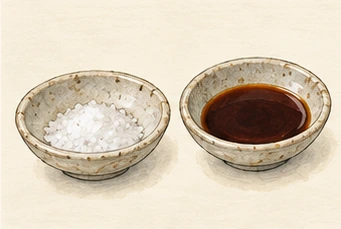
Left, salt; right, tare simmered from soy sauce, mirin, sugar and sake.
In older shops the tare pot is a point of pride. The sauce is never thrown out; each day the cook tops it up, and every dipped skewer returns a little chicken fat and smoky flavor to the pot, so the sauce deepens over years. Owners like to say their tare has been continuous since the day they opened, and there are well-worn stories of cooks carrying the pot out first when fire or earthquake struck. Some of these tales have grown in the telling, but the practice of keeping and inheriting a single, unbroken pot is real and widespread.
The fuel matters even more. Serious yakitori shops burn binchōtan, a dense white charcoal made from hardwoods, especially ubame oak, fired at very high temperatures. The best known is Kishū binchōtan from Wakayama Prefecture. Pieces ring almost like metal when knocked together. Once lit, binchōtan burns with little smoke or flame, giving off steady, intense heat with a large share of infrared radiation. That kind of heat sears the outside of the chicken quickly, holding in the juices while the inside cooks through. When fat drips onto the coals, the brief puff of smoke that rises gives the meat a light smokiness that a gas grill cannot reproduce.
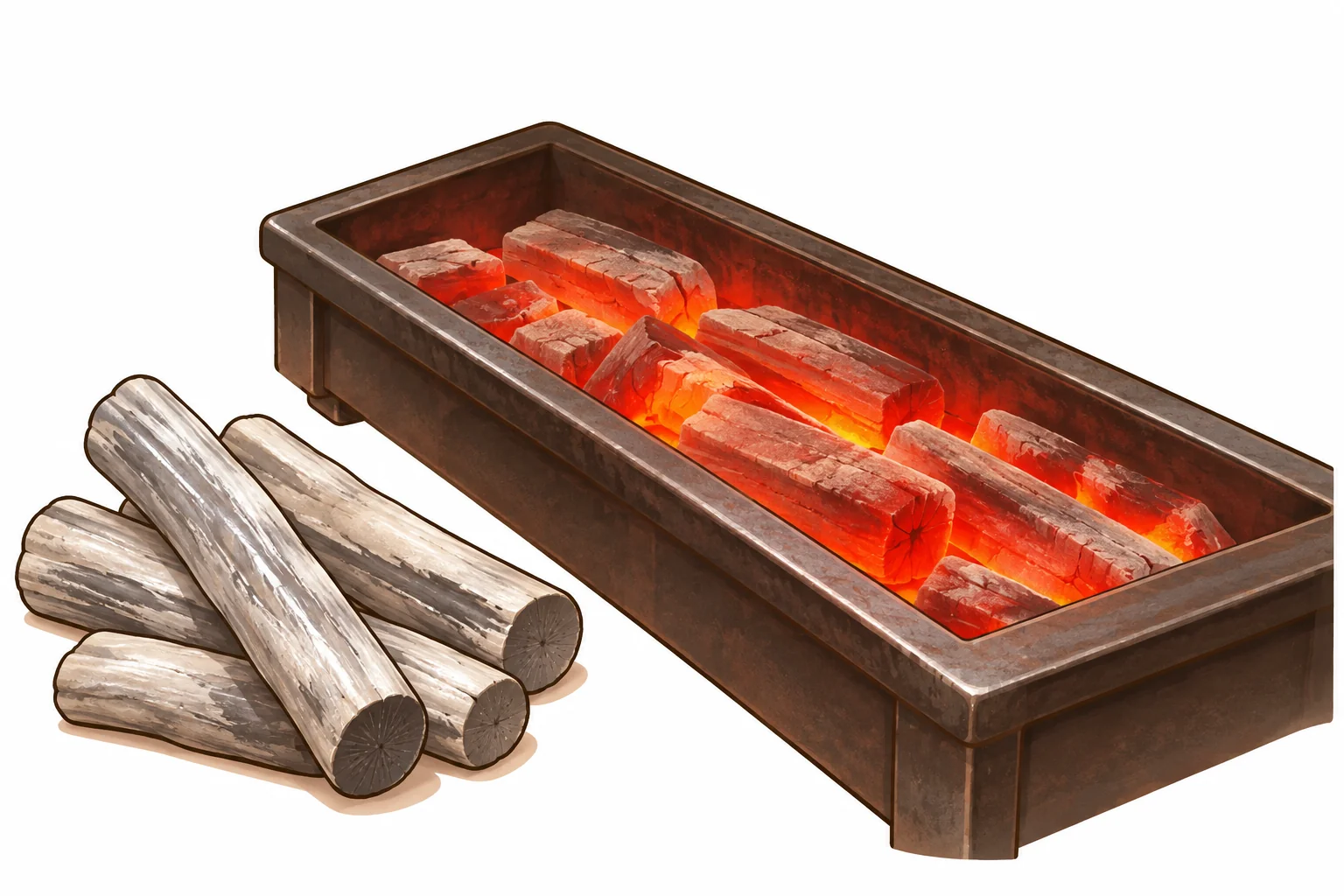
Pale grey Kishū binchōtan beside a grill bed of glowing coals with almost no smoke (illustration).
This is why yakitori grills are long and narrow troughs, and why the cook behind them never stops moving. Skewers that need fierce heat go to the center; those that need gentle cooking go to the edges. A flat fan, the uchiwa, is used to coax the coals hotter or to drive smoke away. An experienced cook can manage dozens of skewers at once, judging doneness by color and by the sound of the sizzling fat. If you can get a seat at the counter facing the grill, watching that work is half the meal.
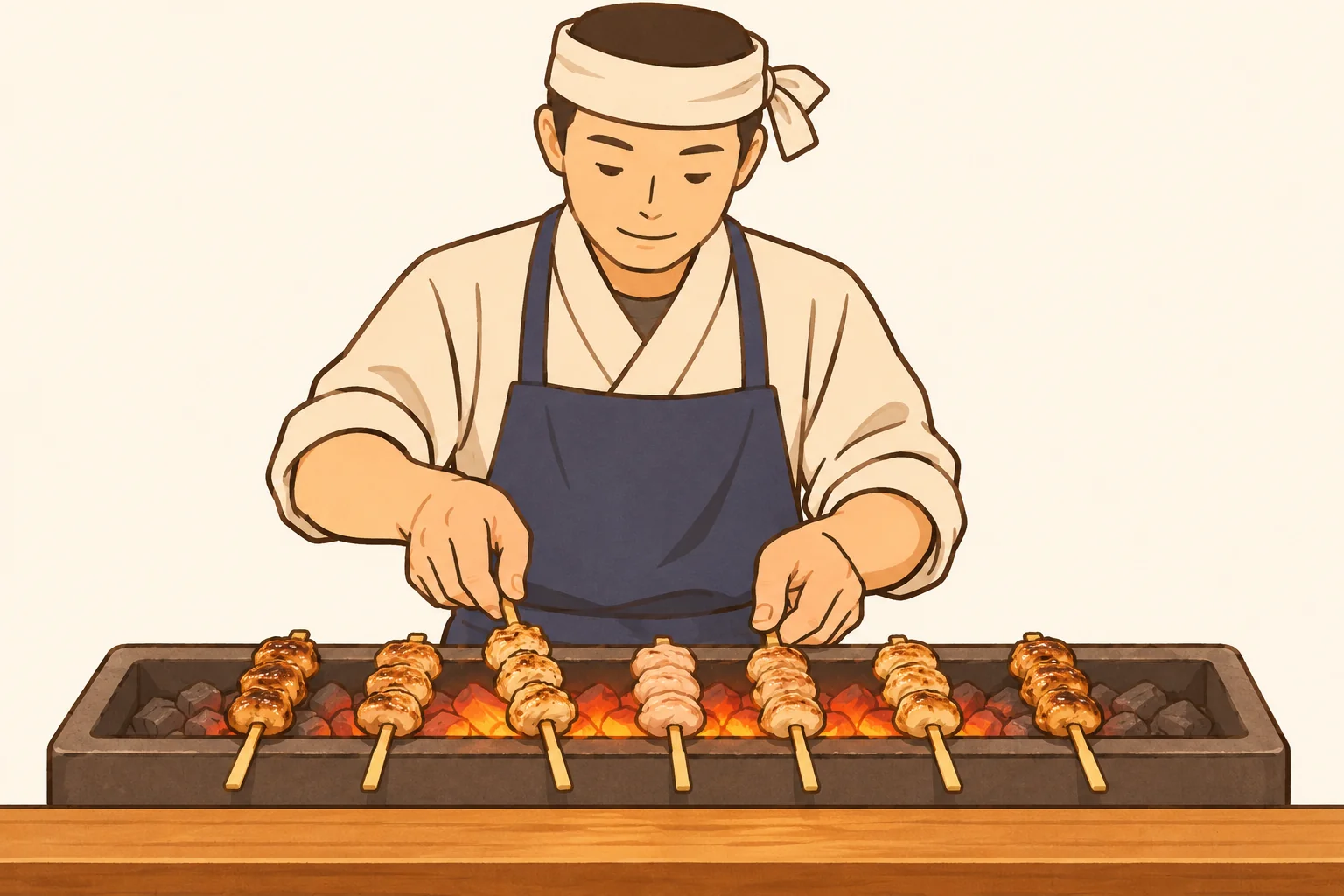
A yakitori cook at the long charcoal trough, moving fierce-heat skewers to the center and gentle ones to the edges.
03From Wild Birds to Broiler Chickens
Chicken has not always been everyday food in Japan. In 675 the emperor Tenmu issued an edict forbidding the eating of cattle, horses, dogs, monkeys and chickens; the edict as recorded names the fourth to the ninth month, and it is usually read as applying only in that part of the year. Over the following centuries, Buddhist prohibitions on taking life and Shinto concerns about impurity kept meat off the tables of the elite for long stretches of Japanese history. Chickens were valued as timekeepers and for their association with the gods: in myth, roosters crowed to lure the sun goddess Amaterasu out of her cave, and the Grand Shrine of Ise still keeps sacred fowl.
Birds, though, never vanished from the Japanese diet. In the Edo period (1603–1868) people ate wild birds such as ducks, geese, quail, sparrows and skylarks (and, by some accounts, pigeons), and grilled birds were sold at street stalls, a trade often described as the ancestor of modern yakitori. The cookbook Ryōri monogatari, published in 1643, already gives recipes for skewer-grilled wild fowl. Hot pots made with shamo, a breed raised for cockfighting, also became an Edo specialty, by some accounts most popular in the late Edo period, and eating chicken was gradually becoming ordinary.
After the Meiji Restoration of 1868, the government openly encouraged meat eating as part of modernization, and poultry farming grew. Chicken was still a costly ingredient, served whole or in hot pots at proper restaurants. What those restaurants did not use, the offal and scraps, found its way to street stalls, and the yakitori sold from Meiji-era carts was mostly this: cheap bits of bird on a stick, eaten with a drink by laborers.
The real turning point came after the Second World War. In the black markets and station-front stalls of the late 1940s, chicken was scarce, and much of what was sold as yakitori was actually pork or beef offal. This is generally taken to be the origin of yakiton, grilled pork skewers, which remain a fixture of Tokyo drinking culture and are often found under the same lanterns as yakitori. From the 1960s, industrial broiler farming made chicken cheap and plentiful, and yakitori with beer became the standard way for office workers to unwind on the way home. Some of the alleys of that era survive: Omoide Yokochō beside Shinjuku Station, and the bars tucked under the elevated tracks at Yūrakuchō, where trains rumble overhead while the grills smoke below.
04Three Kinds of Yakitori Shop
Yakitori today comes in roughly three forms, and knowing which one you have walked into tells you what to expect.
The first is the chain. Torikizoku, the best known, charges a single flat price for everything on the menu, and its branches are full of students and young office workers sharing pitchers of beer and plates of skewers ordered from a tablet. Chains are loud, cheap and easy, and for many Japanese people they are where yakitori begins.
The second, and the heart of yakitori culture, is the neighborhood shop. A couple or a single veteran cook works a single grill; the menu is written on wooden tags along the wall; skewers cost, as of 2026, a couple of hundred yen each; regulars get a cold beer the moment they sit down. These places overlap with the broader world of the izakaya, the Japanese pub, but they are more focused. People go to a particular shop because of its tare, its liver, its way with skin.
The third is the high-end counter, a form that has flourished over the past two or three decades. Shops such as Torishiki in Meguro and Birdland in Ginza buy named breeds from specific producers, such as Date-dori from Fukushima at Torishiki and Okukuji shamo from Ibaraki at Birdland; other shops favor Japan’s "big three" heritage breeds, Hinai-jidori from Akita, Nagoya Cochin, and Satsuma-jidori from Kagoshima. These restaurants serve a set sequence of skewers at the counter, much as a sushi chef serves a course. A typical progression moves from lighter cuts such as tenderloin and neck to thigh and organs, interspersed with grilled ginkgo nuts, shiitake, small green peppers and quail eggs, and ends with chicken soup, a bowl of oyakodon (chicken and egg over rice) or rice with broth poured over it. Several of these restaurants have earned Michelin stars, and as of 2026 courses commonly cost around ten thousand yen or more.
Japan’s regions have their own ideas about what yakitori is, and some of them involve no chicken at all. Kurume in Fukuoka Prefecture claims one of the highest numbers of yakitori shops per person in Japan; its menus include pork belly, pork intestine (known locally as darumu), beef and even horse, and counters set out raw cabbage with a vinegar dressing to eat between skewers. In Muroran, Hokkaidō, "yakitori" means pork skewered with onion rather than leek and eaten with mustard. In Higashimatsuyama, Saitama, it means pork cheek and jowl with a spicy miso dip. In Imabari, Ehime, the local style is cooked on an iron griddle, with chicken skin pressed flat under a weight until it is crisp as a cracker. The word has stretched to mean almost anything skewered, grilled and eaten with a drink.
05At the Counter
Small yakitori shops have few seats, so arriving early is the easiest way to get in without a wait. Order a drink first. Beer is the classic match, and highballs (whisky and soda) and lemon sours are common; sake or shochu go especially well with salt-grilled skewers.
Many shops offer an omakase set, five or seven skewers chosen by the cook, which is the best way to begin if you are unsure. It gives you a balanced run of cuts and seasonings and shows you what the shop does best. If you order à la carte, skewers are counted by the hon, and the usual rhythm is to ask for three or four kinds at a time and order more as you go, so that each arrives straight from the grill. Ordering everything at once means the last skewers sit and cool. Limited cuts such as chōchin, bonjiri or abura (chicken fat) sell out, so if you see them, ask early.
On the counter you will usually find shichimi, a seven-spice chili blend, and powdered sanshō, the citrusy, numbing Japanese pepper. Sanshō is lovely with skin and liver; shichimi suits negima and tsukune. Salt-grilled skewers have already been seasoned by the cook, so taste before adding anything. Finished skewers go into the cup or canister on the counter, and in some shops the bill is reckoned by counting them.
A common question is whether to slide the meat off the skewer with chopsticks. In casual groups people do, to share. But most cooks would rather you ate straight from the skewer, because the skewer was built and grilled as a unit: the pieces were sized to cook together, and once they are separated they cool quickly and lose their juices. At a serious counter, eating from the stick is the polite choice.
Leave room for something at the end. Most shops offer a rice dish or soup built from the same birds: a chicken rice bowl, oyakodon, chicken ramen or a simple cup of clear broth. By then you will have eaten your way across most of a chicken, from neck to tail, which is exactly what a yakitori shop sets out to give you.