
At a glance
Starting from the set-meal tray, this explains dashi, the history behind rice, fish and soy, and how to read an everyday Japanese meal.
- In December 2013 washoku, the traditional dietary culture of the Japanese, was added to UNESCO’s intangible heritage list.
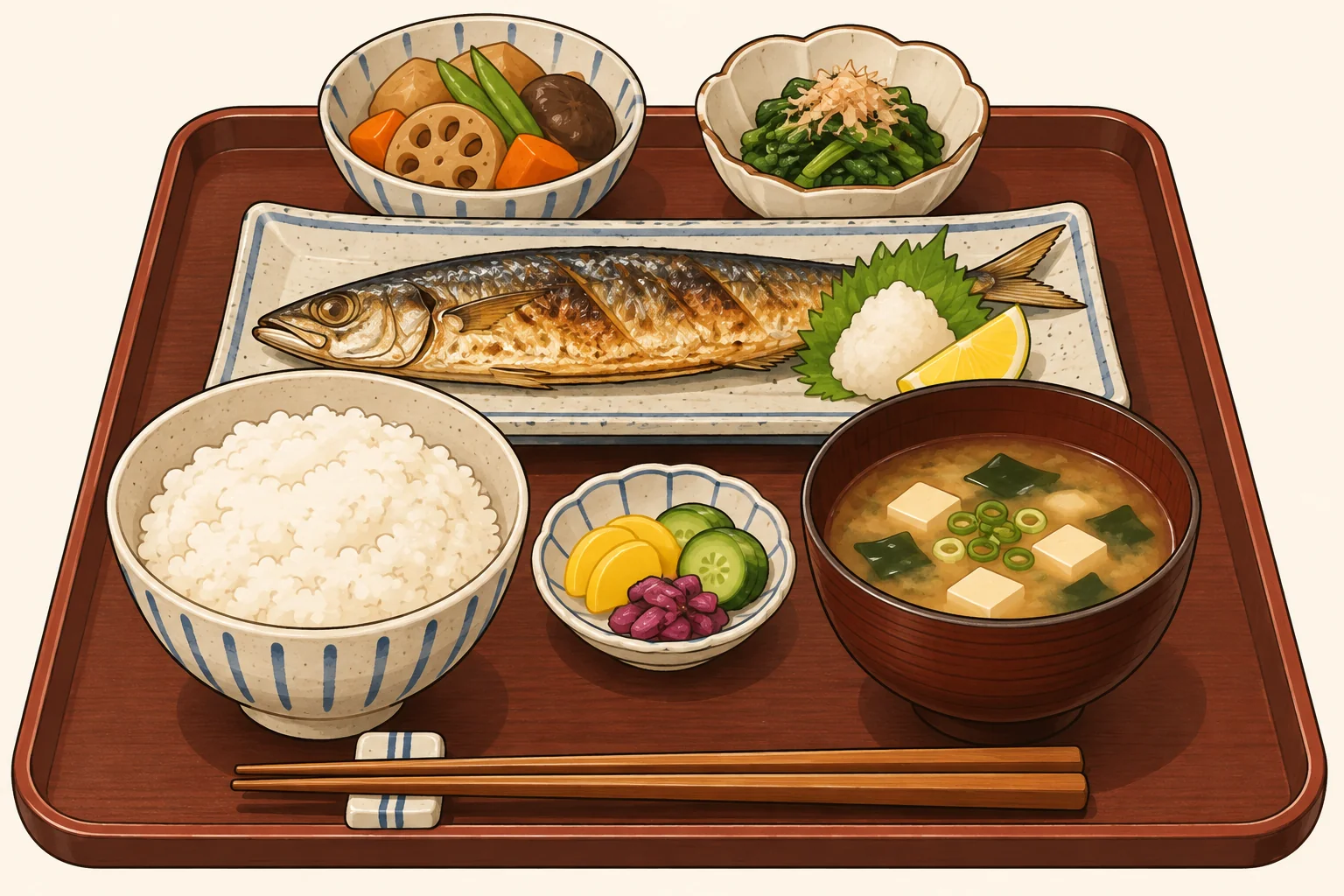
- Its core structure is ichijū sansai: one soup, one main dish and two side dishes, plus rice and pickles.
- Dashi made from kombu and katsuobushi underlies most washoku; the synergy of umami compounds makes it savory.
- Meat-eating was long suppressed, so fish and soybeans became the main protein and shaped washoku.
- The everyday version is the teishoku: a main dish with rice, miso soup, pickles and small sides on one tray.
Ask a Japanese office worker what they had for lunch and the answer is rarely sushi. More likely it was a tray: a bowl of rice, a bowl of miso soup, a piece of grilled mackerel, a little dish of simmered vegetables and a few slices of pickle. That tray is the everyday face of washoku, "Japanese food," the cuisine UNESCO added to its list of the Intangible Cultural Heritage of Humanity in 2013. What UNESCO recognized was not a dish but a way of eating: a meal built around rice and soup, flavors built on a clear stock called dashi, and a table that changes with the seasons. This article explains how that system works, where it came from, how Japanese people eat it today, and how to read the meal in front of you when you sit down at a set-meal restaurant in Japan.
01What "Washoku" Means
The word itself is younger than the food. Before the late nineteenth century there was no need to say a meal was "Japanese"; it was simply food. When beef hotpots, breaded cutlets and curry rice arrived after Japan opened to the West in the Meiji period (1868–1912), people needed words to tell old from new. Western cooking became seiyō ryōri or yōshoku, set against Nihon ryōri, "Japanese cuisine." The word washoku, with wa being an old name for Japan, is younger still; no one can say exactly when it began, but it is generally thought to have come into common use in the twentieth century as the opposite of yōshoku. From the start, then, washoku was defined against something else.
When Japanese people use the word now, they mean a recognizable family of things: plain white rice; miso soup; fish that is grilled, simmered or raw; simmered vegetables; small salads dressed with sesame or vinegar; tofu and other soybean foods; pickles; and a light seasoning that rests on dashi, soy sauce and miso. Sushi, tempura, soba noodles and grilled eel belong to washoku too, but they are its specialist and celebratory side. The core is domestic: the food of home kitchens and neighborhood diners.
The UNESCO listing of December 2013 carries the full title "Washoku, traditional dietary cultures of the Japanese, notably for the celebration of New Year." In its nomination, the Japanese government summed up washoku in four points: a wide variety of fresh ingredients used in ways that respect their natural flavors; a nutritionally balanced diet; the expression of nature’s beauty and the changing seasons at the table; and close ties to annual events, above all the New Year. None of the four names a dish. They describe habits and attitudes.
The motive behind the nomination is worth knowing. By the 2000s fewer families were cooking traditional meals at home, and rice consumption had been falling for decades. The people behind the bid were worried less about prestige than about transmission: the fear that this way of eating would quietly stop being passed from parents to children.
Many foods that dominate modern Japanese life sit outside washoku in the narrow sense. Ramen and gyoza count as Chinese-derived; curry rice, tonkatsu and hamburg steak are yōshoku. The line is fuzzy and Japanese people argue about it, but it explains a common remark: "I feel like washoku tonight." It usually means rice, soup and something light, a meal that settles the stomach.
02One Soup, Three Dishes
The basic grammar of a washoku meal is captured in the phrase ichijū sansai, "one soup, three dishes." The soup is usually miso soup or a clear broth. The three dishes are one main and two sides. What the phrase leaves unsaid is the rice and the pickles, because they are assumed. A complete meal is rice, soup, three dishes and a small plate of tsukemono, pickled vegetables.
Language makes the priorities clear. The Japanese word gohan means cooked rice, and it also means a meal; breakfast is asagohan, "morning rice," and dinner is bangohan. The word for side dishes, okazu, carries the sense of "things to eat with rice." Rice is the center and everything else exists to help you eat it. That is why many washoku dishes taste quite salty on their own: they are seasoned to be eaten with a mouthful of plain rice.
The layout follows rules. Rice goes nearest you on the left, soup nearest you on the right. The main dish sits at the back right, the sides at the back left and middle left, and the pickles in the middle between rice and soup. Chopsticks lie horizontally at the front, tips pointing left. The left side is traditionally the place of honor, so rice takes it; it is also practical, since a right-handed diner holds chopsticks in the right hand and lifts the rice bowl with the left. Modern set-meal trays keep this arrangement almost unchanged. Home tables are looser, but many Japanese adults remember being corrected as children for putting the soup on the wrong side.
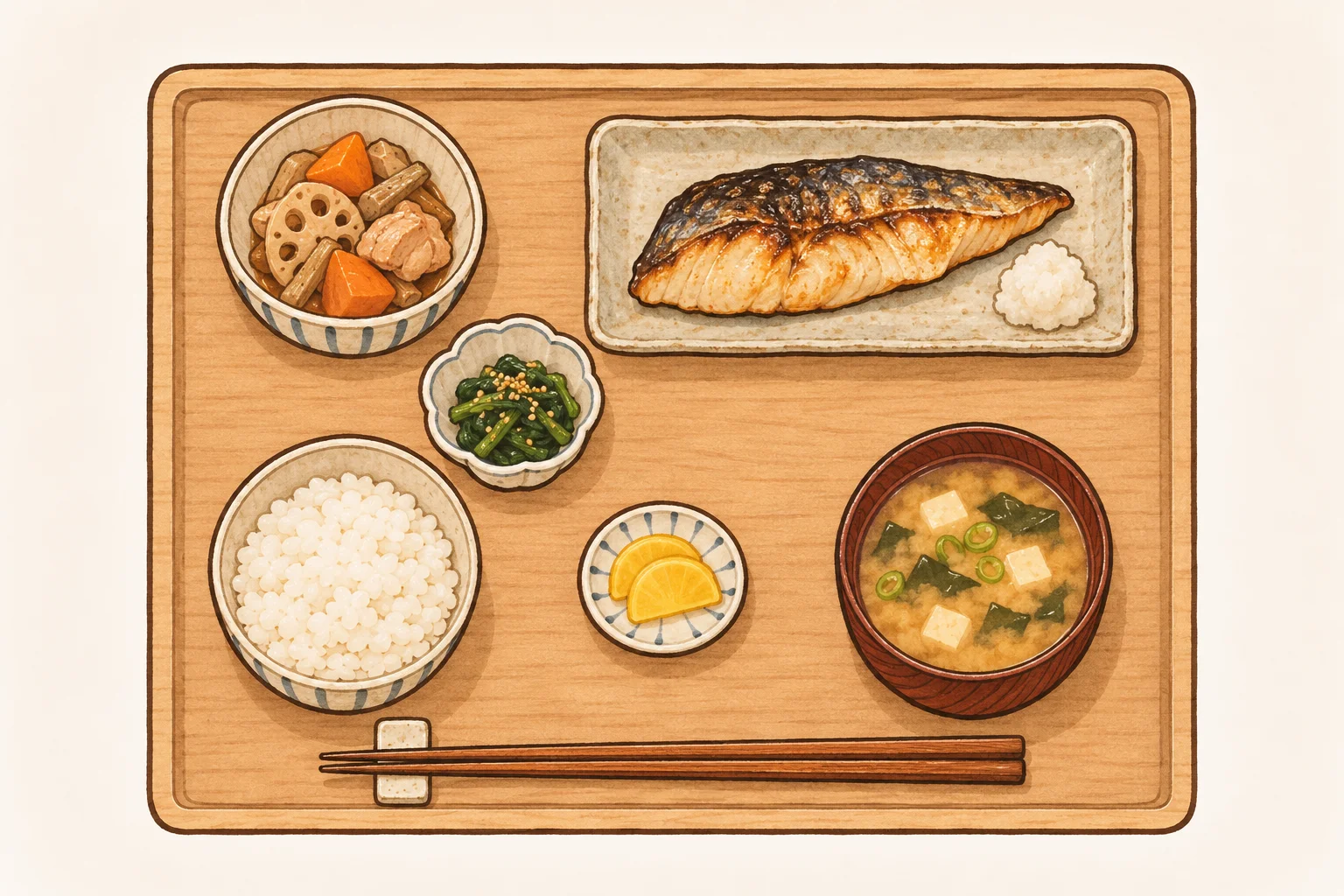
Rice front left, soup front right, main dish back right, two sides on the left, pickles in the middle; rice and pickles are not among the three dishes.
The three dishes are chosen to contrast. The main is often fish or meat, grilled, simmered or fried. One side is commonly a nimono, a simmered dish such as chikuzen-ni, in which chicken, burdock, carrot, taro, lotus root and konnyaku are first stir-fried in oil, then simmered slowly in dashi, soy sauce and mirin (sweet rice wine). Another might be spinach dressed with ground sesame (goma-ae) or cucumber and wakame seaweed in vinegar (sunomono). Grilled, simmered and raw; salty, sweet and sour; hot and cold. The variety keeps the meal interesting and, almost incidentally, nutritionally balanced.
This structure descends from honzen ryōri, the formal banquet cuisine of the samurai elite in the Muromachi period (1336–1573). Each guest received a series of small legged trays. The first, the honzen or "main tray," held rice, soup and several dishes, and further trays followed. Grand banquets ran to "two soups, five dishes" or "three soups, seven dishes" and beyond. Over time this elaborate system was simplified, and one soup and three dishes survived as the smallest complete unit. Ordinary farming households, for most of history, ate much more simply still: a bowl of rice stretched with barley or millet, a bowl of soup, a few pickles. Ichijū issai, "one soup, one dish," was the real everyday standard. One soup and three dishes was the shape of a proper meal.
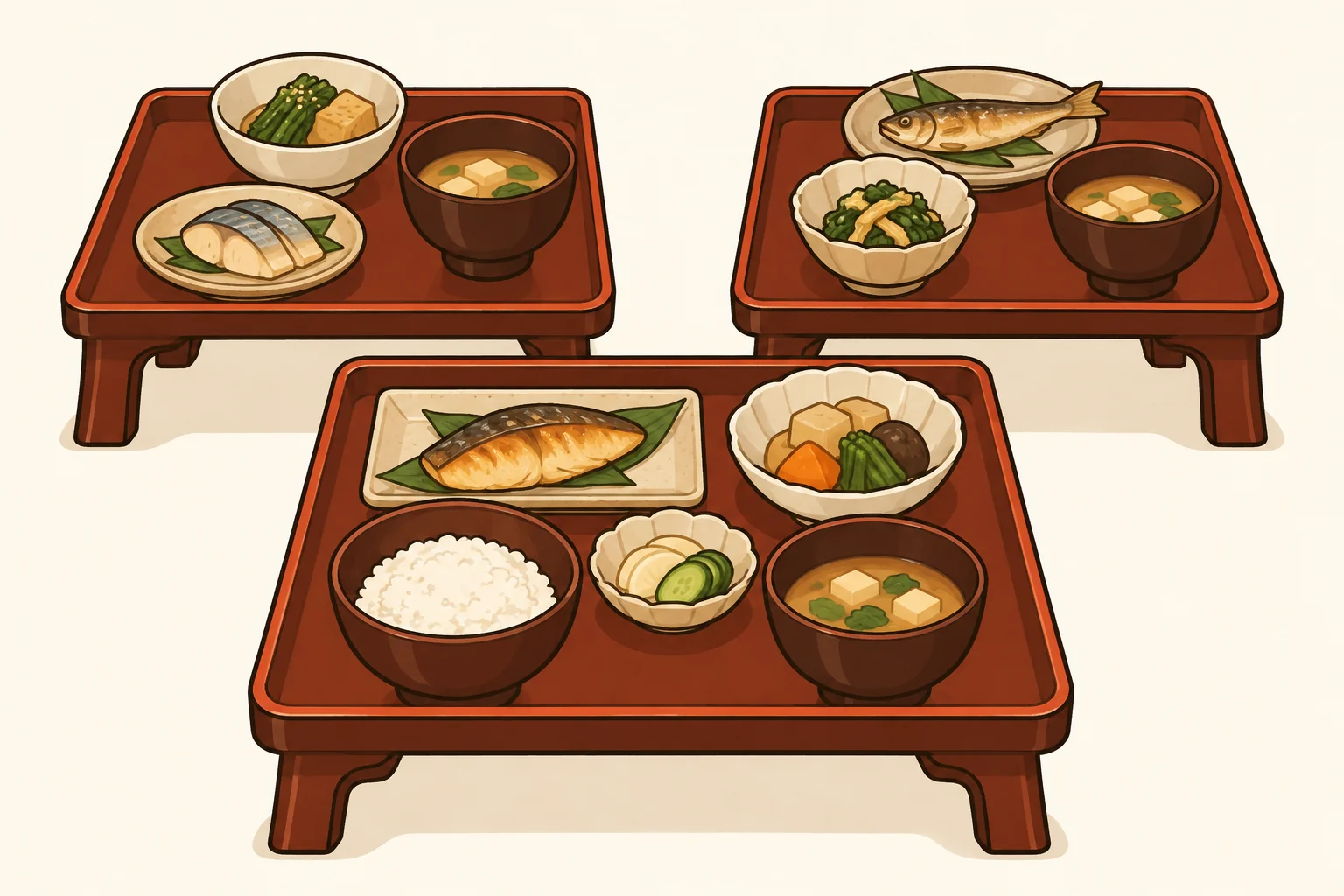
A guest's series of small legged trays at a Muromachi-period honzen ryōri banquet (illustration).
03Dashi and Umami
If one thing defines how washoku tastes, it is dashi. Dashi is a stock made by steeping dried ingredients in water: kelp (kombu), shaved dried bonito (katsuobushi), small dried sardines (niboshi) or dried shiitake mushrooms. It is pale, nearly clear and light on the tongue, yet it underlies miso soup, simmered dishes, noodle broths, savory egg custard (chawanmushi), rolled omelette (tamagoyaki) and much else.
The classic dashi combines kombu and katsuobushi. The kelp soaks in cold water and is heated slowly, then lifted out just before the water boils. A handful of bonito flakes goes in, simmers briefly, and the pot comes off the heat; once the flakes sink, the stock is strained. This first extraction, ichiban dashi, has the finest aroma and is used for clear soups. Simmering the spent kelp and flakes again yields niban dashi, used for miso soup and simmered dishes. Katsuobushi itself is a remarkable product: skipjack tuna fillets that are boiled, smoked dry, and repeatedly cultured with mold and sun-dried until they are as hard as wood, then shaved with a special plane. Japanese supermarkets sell bags of ready-shaved flakes and cut kombu, along with instant granules and dashi tea bags, which is what most busy households actually use.
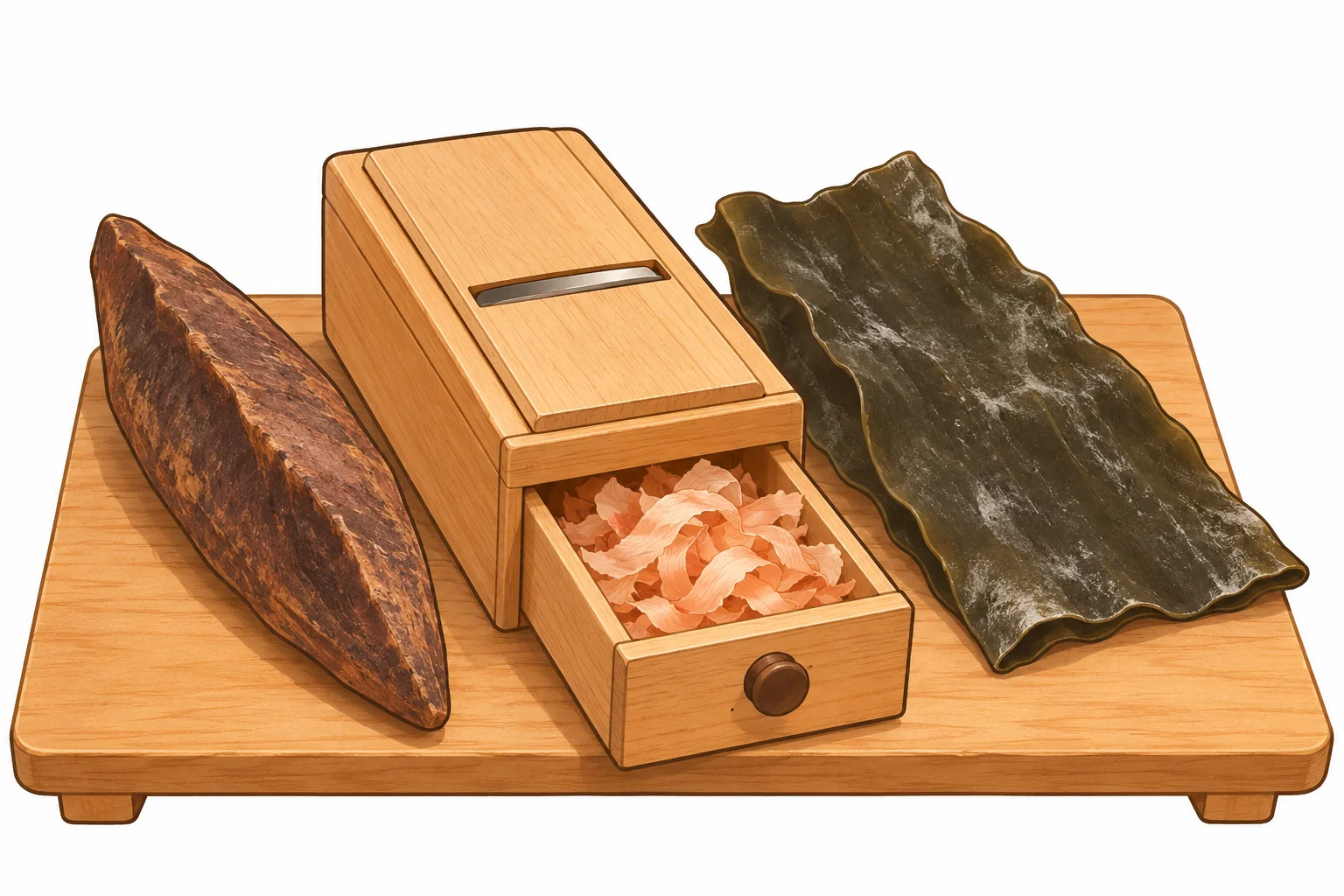
A whole katsuobushi hard as wood, a wooden shaver with its shavings, and a piece of dried kombu (illustration).
Dashi’s power comes from umami. In 1908 the chemist Ikeda Kikunae of Tokyo Imperial University isolated glutamic acid from kombu broth and argued that it produced a basic taste distinct from sweet, salty, sour and bitter. He named it umami, roughly "deliciousness." He then partnered with the businessman Suzuki Saburōsuke to sell monosodium glutamate as a seasoning under the brand Ajinomoto. A few years later Ikeda’s student Kodama Shintarō identified inosinate as the umami compound in katsuobushi. After the Second World War, Kuninaka Akira identified the umami of guanylate, later confirmed as the key compound in dried shiitake, and he is generally credited with showing that umami compounds work synergistically: glutamate combined with inosinate or guanylate tastes far stronger than either alone. That is the chemistry behind pairing kombu with bonito. Cooks had relied on the combination for centuries before science explained it.
Umami allows washoku to be satisfying with little fat, and it lets ingredients taste of themselves. A chunk of daikon radish simmered in dashi still tastes of daikon, only softer and rounder; a cube of tofu in broth tastes more clearly of soybeans. Japanese cooks talk constantly about bringing out the flavor of the ingredient (sozai no aji o ikasu), and dashi is the tool for doing it. On top of dashi come soy sauce, miso, mirin, sake and a little sugar, and these few seasonings generate most of the flavors in the cuisine.
Regional differences start here. Kyoto and Ōsaka favor kombu, lighter seasoning and a pale soy sauce; Tokyo favors bonito, bolder flavor and a darker soy sauce. The easiest way to see it is a bowl of udon: in Ōsaka the broth is a translucent gold, in Tokyo a deep brown.
04How the Cuisine Took Shape
The story begins with rice. Wet-rice farming reached the Japanese archipelago from the continent around the end of the Jōmon period and spread in the Yayoi period, and from then on rice held a unique place. It was the unit of taxation, an offering to the gods and a measure of wealth; samurai stipends were counted in it. Yet for most of history many people could not eat their fill of white rice. Farmers mixed it with barley, millet and other grains, and polished white rice was food for festivals and for the well-off. Only in the twentieth century did a bowl of white rice at every meal become normal for almost everyone.
The second thread is meat. In 675 Emperor Tenmu issued an edict forbidding the eating of cattle, horses, dogs, monkeys and chickens; the edict as recorded names the fourth to the ninth month, and it is usually read as applying only in that part of the year. Over the following centuries, Buddhist teaching against killing and Shinto concerns about ritual pollution combined to push meat, especially the flesh of large domestic animals, to the margins of the diet. The avoidance was never total. Wild boar, deer and game birds were eaten, and in the Edo period shops sold boar as "medicine" and nicknamed it yama kujira, "mountain whale." But for over a thousand years the main sources of animal protein were fish and, in effect, soybeans. That is why washoku revolves around fish, tofu, miso and soy sauce.
The third thread runs through Buddhist temples. Zen arrived from China in the Kamakura period (1185–1333), and with it shōjin ryōri, the vegetarian cooking of monasteries. The monk Dōgen, who brought the Sōtō school of Zen to Japan, wrote Instructions for the Cook (Tenzo kyōkun), which treats washing rice and cutting vegetables as spiritual practice. To make food satisfying without fish or meat, temple kitchens developed tofu, yuba (tofu skin), wheat gluten, sesame tofu and dried ingredients, and refined stocks of kombu and shiitake. Many home-style techniques can be traced back to these kitchens.
The fourth thread is ceremony. The samurai banquets of the Muromachi period established the pattern of individual portions on individual trays. Then, in the sixteenth century, the tea ceremony produced the light meal served to guests before tea, later known as kaiseki. It rejected banquet excess in favor of seasonal ingredients, food served hot at the right moment, and careful matching of dish to vessel, course by course. Much of washoku’s aesthetic sense comes from tea kaiseki. A separate tradition, kaiseki written with different characters, grew up in the restaurants of the Edo period as banquet food to accompany sake; today the two are often confused (see also: Kaiseki: How a Bowl of Rice and a Bowl of Soup Became Japan’s Most Refined Meal).
The fifth thread is Edo, today’s Tokyo. By the eighteenth century the city held around a million people, many of them single male laborers, and street stalls flourished. Nigiri sushi, tempura, soba noodles and grilled eel all became urban fast food there. Eating three meals a day, rather than two, became common during the Edo period. By the early nineteenth century soy sauce brewed at Chōshi and Noda, in what is now Chiba Prefecture, supplied most of the capital’s needs, and mirin, originally a sweet drink, moved into the kitchen. By the late Edo period the seasoning system of modern washoku was more or less complete.
The Meiji period opened the door to meat. In 1872 the court let it be known that the emperor ate beef, and gyūnabe, beef hotpot, became fashionable in Tokyo. Western dishes such as breaded cutlets, croquettes and curry were adapted into yōshoku. In the twentieth century school lunches, nutrition science and eventually the electric rice cooker turned white rice into a universal staple. After the war, bread, dairy and meat surged. Annual rice consumption per person peaked around 1962 at roughly 118 kilograms and has since fallen to about 53 kilograms as of fiscal 2024 (provisional figure), less than half. The UNESCO bid was made against that downward line.
05Seasons and Vessels
Washoku has a word, shun, for the moment when an ingredient is at its best. Spring brings bamboo shoots, rape blossoms and cherry salmon; early summer, the first bonito; summer, eel and sweetfish; autumn, Pacific saury, matsutake mushrooms and new-crop rice; winter, yellowtail, pufferfish and daikon. Japanese sensitivity to shun is easy to underestimate. Supermarket displays, TV cooking segments, convenience-store lunch boxes and even soft-drink cans change with the season.
Cooks divide an ingredient’s year into three phases. Hashiri is the first arrival, prized for its novelty; shun is the peak; nagori is the lingering end, eaten with a sense of farewell. People in Edo paid absurd prices for the first bonito of the year, and a joke of the time held that a man would pawn his wife to eat it. The last matsutake of late autumn are savored for the opposite reason. The feeling is the same one that drives the seasonal words in haiku.
The season also appears on the plate. Washoku is often said to be eaten "with the eyes." In summer a dish might come on glass or pale celadon to look cool; in winter on thick, warm-toned stoneware. A leaf placed under the food, called kaishiki, is commonly said to be bamboo in spring and red maple in autumn. A grilled fish is served head to the left, belly toward the diner; sashimi is arranged in heights and hollows like a small landscape. Home cooks may ignore all this, but in good restaurants it is everywhere.
The sheer variety of tableware sets washoku apart. In one meal the rice bowl may be porcelain, the soup bowl lacquer, the plates round or square, the small bowls deep or shallow, each with its own shape, color and texture. Japanese kitchen cupboards often hold dozens of different dishes. Rice bowls and chopsticks are frequently personal: each family member has their own. Soup bowls are lacquered wood because wood insulates, so the bowl can be held comfortably, and because you lift it to your lips. Picking up your bowl is correct manners in Japan, and the tableware is designed for it.
06Teishoku: The Set Meal
If you want to eat everyday washoku in Japan, the place to go is not an expensive ryōtei but a teishoku-ya, a set-meal diner. Teishoku means "fixed meal": one main dish served with rice, miso soup and pickles, usually with one or two small side bowls (kobachi), all brought together on a tray. It is ichijū sansai in compact modern form.
Menus are organized by main dish. Shōgayaki teishoku is thinly sliced pork stir-fried with soy sauce, ginger and mirin, served beside a heap of finely shredded raw cabbage. A grilled-fish set usually means salted mackerel, salmon or butterflied, half-dried horse mackerel. Saba no misoni is mackerel simmered sweet and savory in miso and ginger. Karaage teishoku is Japanese fried chicken. There are also fried horse mackerel, tonkatsu, hamburg steak and stir-fried vegetables with pork. Several of these are yōshoku in origin, but set beside rice, soup and pickles on a tray they become part of the washoku structure. The set meal is one of the ways Japanese food absorbs foreign dishes.
As of 2026 a typical set costs between about 800 and 1,300 yen, and many chains have raised prices in recent years as ingredient costs climbed. In Tokyo’s office districts the queue outside a good teishoku-ya at noon is made of people in suits. Many places offer a larger portion of rice (ōmori) at no extra charge, and some offer free refills of rice and cabbage. Ordering works in one of two ways. Either you sit down and order from a menu on the wall or table, or you buy a ticket from a vending machine (shokkenki) at the door and hand it to the staff. The buttons usually have photos, so you can manage without reading Japanese.
The set-meal diner grew out of the cheap eateries of modern Japanese cities, the taishū shokudō ("people’s dining halls") and ichizen meshiya ("one-tray rice shops") that fed workers, students and clerks from the Meiji period into the early Shōwa period. The term teishoku spread during the Shōwa era (1926–1989). Today, alongside old family-run diners, chains such as Ootoya and Yayoiken serve teishoku nationwide, and restaurants in department stores and stations lean on set meals at lunch. Many upscale restaurants offer a lunch set at a fraction of their dinner price, which makes lunch one of the best-value ways to eat well in Japan.
The logic of teishoku is the logic of ichijū sansai. A single tray holds a staple, soup, protein, vegetables and pickles; the portion is filling and reasonably balanced; and the whole meal belongs to one person. Japanese dining has long favored individual portions, a habit that goes back to the one-person trays of honzen ryōri and differs sharply from the shared dishes of a Chinese table. Teishoku fits that habit to the pace of a modern city, and it is why eating alone in Japan feels so ordinary.
The breakfast at a traditional inn, or ryokan, is a set meal too, and often the most classic one you will meet: a piece of grilled salmon, miso soup, a slice of rolled omelette, a small bowl of natto or a soft-cooked hot-spring egg, sheets of toasted nori, a few pickles and rice in a small wooden tub. For many visitors, the first time they really pay attention to washoku is a ryokan morning.
07Washoku at Home Today
Few Japanese households now produce a full one-soup-three-dishes dinner every night. With both parents working, dinner is often one main dish with rice and soup, plus a ready-made side or two from the supermarket. Many people eat toast and coffee for breakfast and a set meal, a bento or a convenience-store rice ball for lunch. Worry that washoku is disappearing from homes is a recurring theme in Japanese media.
In 2016 the cooking authority Doi Yoshiharu published a book whose title translates as A Proposal: One Soup, One Dish Is Enough. His argument was that an everyday meal needs only rice, a generous bowl of miso soup and pickles. Fill the soup with vegetables, tofu or a little meat and it is the main dish. The book struck a chord with people exhausted by the expectation of cooking several dishes a night, and it pointed back to the way ordinary households had eaten for centuries. The heart of washoku, in this view, is not the number of dishes but the pairing of rice and soup.
Washoku also has a festive calendar. At New Year families eat osechi ryōri, an assortment packed into stacked lacquer boxes (jūbako), where each item carries a wish: black beans for diligence and health, herring roe for many descendants, tiny dried sardines for a good harvest, shrimp for long life. On New Year’s morning comes ozōni, a soup with rice cakes, which varies by region and household: in the Tokyo area typically a clear broth with square grilled cakes, around Kyoto a white-miso soup with round ones. There is scattered sushi and clam soup for the Girls’ Festival in March, pumpkin at the winter solstice, and soba on New Year’s Eve. UNESCO’s title singled out the New Year because these meals show most clearly how food ties together family, season and hope.
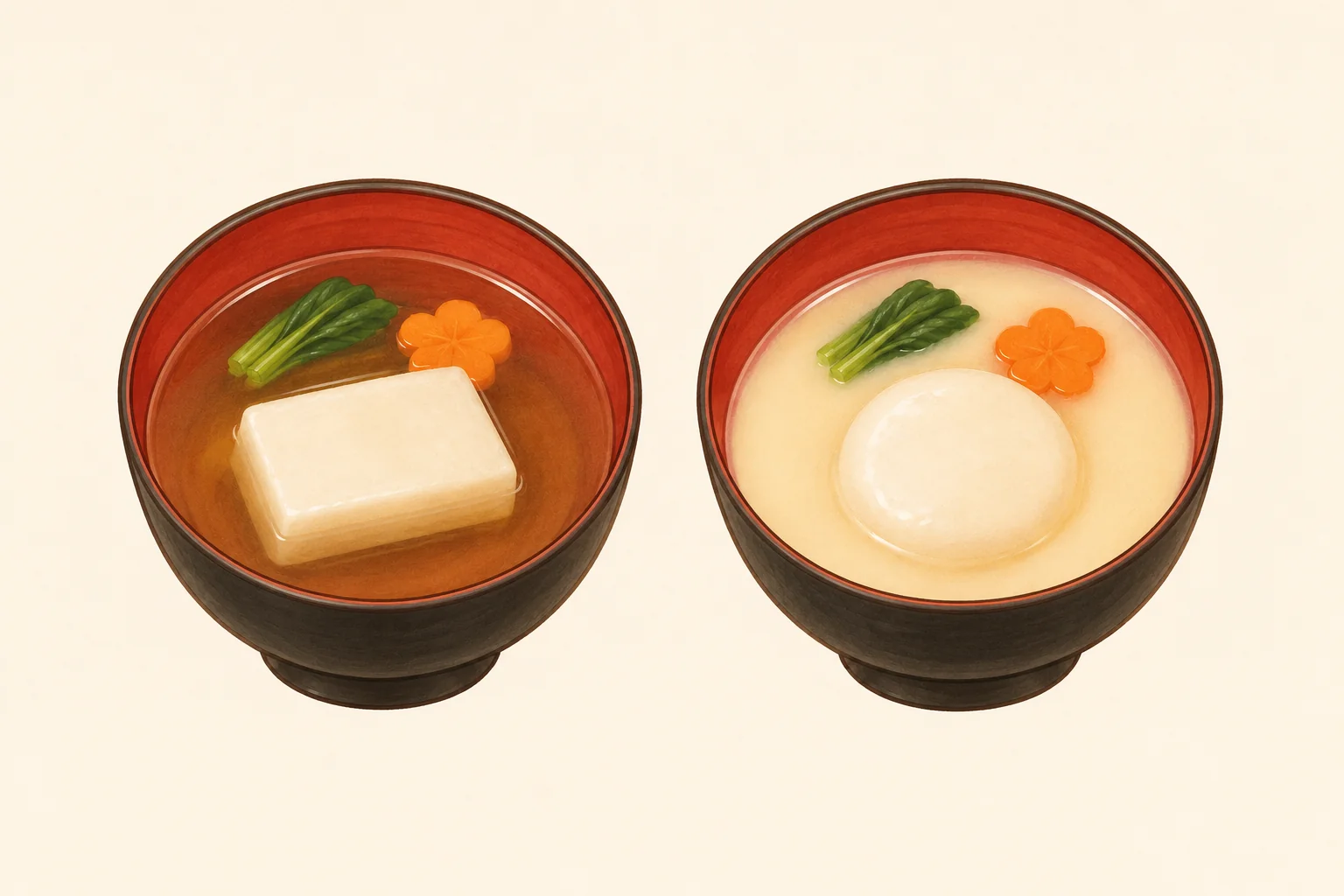
New Year ozōni: typically clear broth with square rice cakes around Tokyo, white-miso soup with round ones around Kyoto.
Japan’s long life expectancy is often credited to washoku, with some reason: plenty of fish, soy and vegetables, little fat, and fixed individual portions. But the traditional diet has a clear weakness, which is salt. Soy sauce, miso, pickles and salted fish add up, and Japanese salt intake has long exceeded World Health Organization recommendations; high rates of stroke in the northeast in the twentieth century were linked to it. Public health advice in Japan now promotes washoku and salt reduction at the same time, and low-sodium soy sauce and miso are standard supermarket items.
08Sitting Down to a Washoku Meal
A Japanese meal opens and closes with a phrase. Before eating, people put their palms together or bow slightly and say itadakimasu, literally "I humbly receive," today usually explained as thanks to the food, the cook and the lives in the ingredients. Afterward they say gochisōsama deshita, which thanks whoever ran around preparing the meal. Say it at a diner and the staff will usually answer with a cheerful thank-you.
You are expected to lift your rice bowl and soup bowl while eating; bending your face down to a bowl left on the table looks sloppy. Miso soup comes without a spoon. Drink from the bowl and pick out the tofu and seaweed with chopsticks. Large plates and platters stay on the table. Many Japanese schools teach children sankaku tabe, "triangle eating": rotating among rice, soup and dishes rather than finishing one item before starting the next. If your soup bowl came with a lid, put it back on when you finish, right side up. Rest your chopsticks on the chopstick rest. Never stand them upright in rice, which resembles an offering to the dead, and never pass food from your chopsticks to someone else’s, which recalls the handling of bones after cremation.
At a teishoku-ya, the tray arrives quickly after you order. No one waits for companions, and eating alone is entirely normal; counter seats exist for exactly that. Soy sauce, shichimi pepper and a pot of tea or water are usually on the table, and you help yourself. When you finish, leave the tray where it is and pay at the register by the door. There is no tipping.
A good way to explore washoku on a trip is to try it at several levels. Eat a ginger-pork or grilled-fish set at a diner near a station, the most ordinary meal there is. Stay one night at a ryokan for dinner and breakfast and see the same structure in a formal setting. Book a lunch course at a kappō or ryōtei restaurant to watch the season arranged on plates. Then walk through a supermarket or a department-store food hall and look at what Japanese families actually buy: prepared side dishes, bonito flakes, kombu, dozens of kinds of miso. Sushi, tempura, soba and sake each reward exploration in their own right. Underneath them all is the same tray, with rice on the left, soup on the right and a few seasonal dishes behind.