
At a glance
Two kinds of kaiseki share one sound: the tea meal that serves rice first and the sake banquet that ends with it, plus how to eat one.
- Kaiseki written 懐石 and kaiseki written 会席 sound the same: the first comes from the tea gathering, the second from the banquet.
- Tea kaiseki is a meal eaten for the tea, so rice and soup come first; banquet kaiseki is eaten for the sake, so rice comes last.
- The basic form of tea kaiseki is one soup and three dishes, plus rice and pickles.
- The most formal noon tea gathering lasts about four hours for usually three to five guests, and the meal only prepares them for the thick tea.
- A banquet kaiseki runs to about ten courses, from the starter, hassun and clear soup through to rice, the closing miso soup and pickles.
Kaiseki is the meal people have in mind when they speak of Japanese fine dining: a long sequence of small, seasonal courses, each arriving in its own lacquer bowl or ceramic dish, served in a quiet room with a scroll on the wall. What few visitors realize is that the word covers two different traditions written with two different pairs of characters. One, 懐石, is the meal served at a tea gathering before the tea itself. The other, 会席, is the banquet meal of restaurants and inns, built around sake. This piece explains where each came from, why a kaiseki meal is ordered and plated the way it is, what Japanese cooks and diners value in it, and how to enjoy one on your first visit to a ryōtei, a traditional Japanese restaurant.
01Two Words, One Sound
In Japanese, 懐石 and 会席 are both pronounced kaiseki. Restaurants, inns and even many Japanese diners use them loosely, but they mean different things.
懐石, often called cha-kaiseki or "tea kaiseki" to avoid confusion, is the meal that a host serves to guests at a formal tea gathering, a chaji. Its purpose is modest: to give the guests something in their stomachs before they drink thick tea, which is strong and can be hard on an empty stomach. The portions are restrained, sake is a courtesy rather than the point, and rice and soup appear at the very beginning.
会席, banquet kaiseki, grew out of gatherings of poets and connoisseurs in the Edo period (1603–1868) and became the set menu of restaurants and inns. It is organized around drinking. Courses come one at a time so that guests can eat, drink and talk, and rice arrives at the end, to close the meal after the sake is done.
A simple way to remember the difference: tea kaiseki is food for tea, banquet kaiseki is food for sake. That is why one serves rice first and the other serves it last.
Tea kaiseki: a meal for the tea
- Oshiki tray: rice, miso soup, mukōzuke
- Nimonowan, the simmered dish
- Yakimono, grilled fish (perhaps a further dish)
- Hashiarai, the chopstick rinse
- Hassun
- Hot water over toasted rice, with pickles
- A moist sweet
- Thick tea, then thin tea
Banquet kaiseki: a meal for the sake
- Sakizuke
- Hassun
- Wanmono (suimono), clear soup
- Otsukuri, sashimi
- Yakimono, grilled dishes
- Takiawase, simmered dishes
- Shokuji: rice, tomewan soup, pickles
- Mizumono, fruit or a sweet
- Matcha or roasted tea
Banquet menus vary; the right column is the usual skeleton, sometimes with fried or vinegared courses added. Yellow marks where the rice comes.
In practice the lines blur. Many high-end restaurants call their tasting menus kaiseki ryōri using the tea characters, because 懐石 sounds more elegant and carries the prestige of the tea tradition. What arrives on the table, though, is usually the banquet sequence, cooked in the spirit of tea. When a traveler eats "kaiseki" in Kyoto, this hybrid is almost always what they are eating. Tea kaiseki in its strict form is found at actual tea gatherings and at a handful of specialist caterers and restaurants.
02Against the Samurai Banquet
Kaiseki’s simplicity makes sense only against what came before it.
In the Muromachi period (1336–1573), warrior households entertained important guests with honzen ryōri, literally "main-tray cuisine." Each guest sat before a series of small lacquered tables on legs. The first was the main tray; a second, third, and sometimes many more followed for grand occasions, each laden with soups and dishes. Much of the food was ceremonial and meant to be displayed rather than eaten, and the meal was wrapped in formal rounds of drinking. Honzen was about rank and spectacle. By the time a guest reached a dish, it was often cold.
The tea culture that flourished in the merchant city of Sakai and in Kyoto during the sixteenth century wanted something else. Practitioners of wabi-cha, the austere style of tea associated with Murata Jukō, Takeno Jōō and above all Sen no Rikyū (1522–1591), received guests in tiny thatched tearooms and prized ordinary objects used with care. The meal at a tea gathering was pared down to a form usually summarized as ichijū sansai: one soup and three dishes, with rice and pickles. Hot food was to be served hot, cold food cold, nothing excessive, nothing to leave the guest overstuffed.
The tea masters did not invent the phrase, which already appears in a Zen temple diary of the 1540s, but they made it the core of their meal, and the formula outlived the tearoom. "One soup, three dishes" is still how Japanese home economics textbooks and cookbooks describe a balanced everyday meal.
The name kaiseki is usually explained through a Zen story. Monks in training ate only in the morning and at midday, and at night, cold and hungry, they are said to have tucked a warmed stone into the fold of their robes to ease the pangs. That stone was called onjaku, and "a stone held in the bosom" is what 懐石 literally means. Tea people adopted the word to say that the meal before tea was only something to take the edge off hunger, not a feast. The story is widely repeated, but the term itself appears relatively late. Records from Rikyū’s own time do not call the tea meal kaiseki in this spelling; by some accounts they mostly write 会席 or give the meal no name at all, and it is generally thought to share its origin with 会席, the banquet word. The tea spelling spread with the Nanpōroku, a text claiming to record Rikyū’s teachings that surfaced in the late seventeenth century through Tachibana Jitsuzan, a retainer of the Fukuoka domain. Most scholars today consider it a later compilation attributed to Rikyū. The elegant name, in other words, is itself part of how later generations imagined Rikyū.
03A Meal Inside a Tea Gathering
Tea kaiseki is best understood in its setting. The most formal type of gathering, the noon chaji, lasts about four hours for three to five guests.
The guests assemble in a waiting shelter, walk the dewy garden path, rinse their hands and mouths at a low stone basin, and crawl into the tearoom through a small entrance. They admire the scroll in the alcove. In the cold months, when the sunken hearth is in use, the host lays the charcoal fire before the meal; in the warm months, with a portable brazier, the meal comes first and the charcoal after. The host brings out the first tray, a square lacquered oshiki, carrying three things. On the left is a rice bowl holding only a mouthful of freshly cooked rice, sometimes pressed into a neat bar with the paddle. It is served this little on purpose: rice is at its best the moment it comes out of the pot, and more will follow. On the right is a bowl of miso soup, its miso chosen for the season; in winter it is often the thick, sweet white miso of Kyoto. Across the tray, in the far position, sits the mukōzuke, literally "the thing placed opposite," usually raw or vinegared fish.
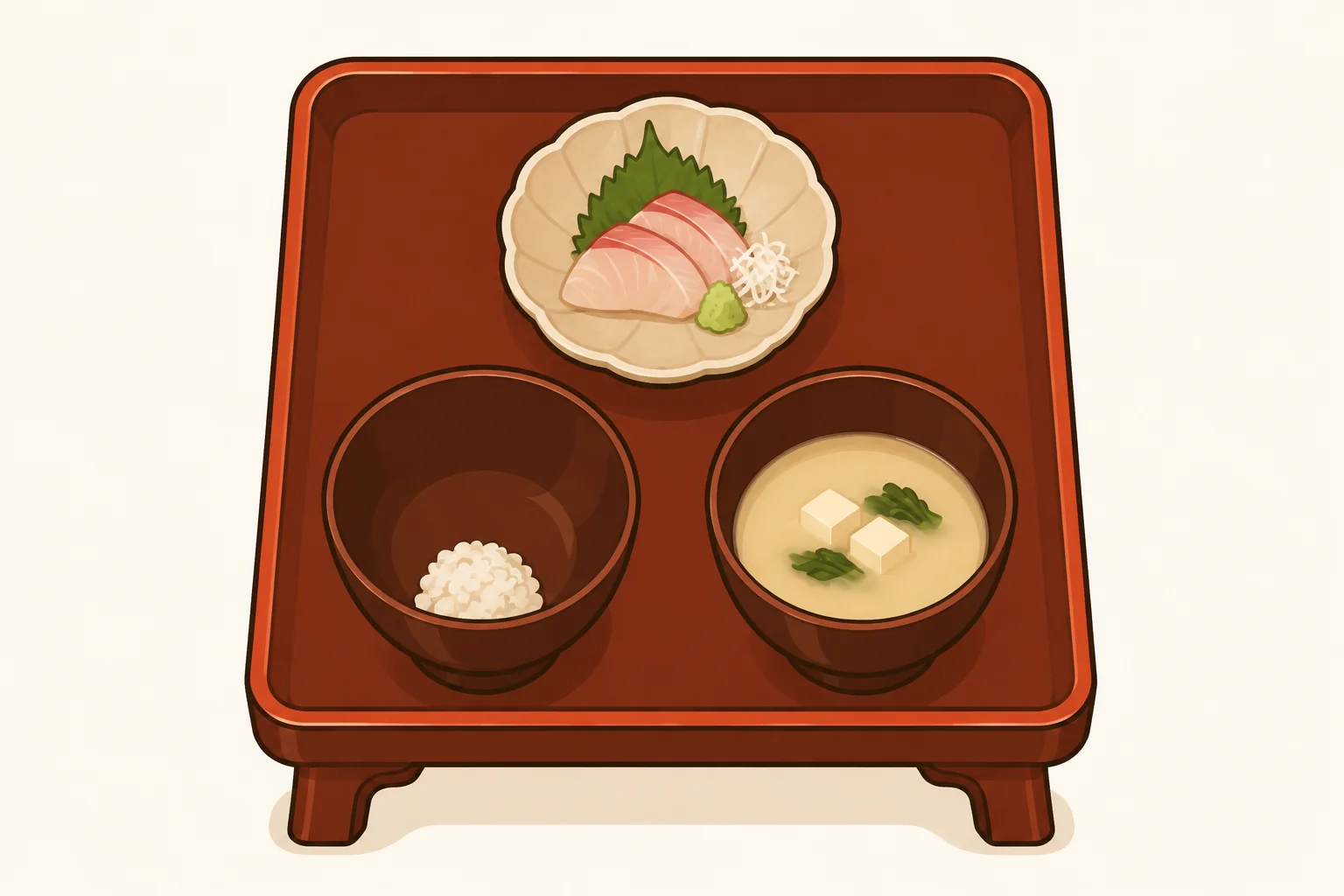
The first tray of a tea-gathering meal: rice on the left, miso soup on the right, mukōzuke across the oshiki.
The guests lift the lids, take a bite of rice and a sip of soup, and only after the host offers sake do they touch the mukōzuke. That order says everything about the meal. Rice comes first because rice is what the meal is for.
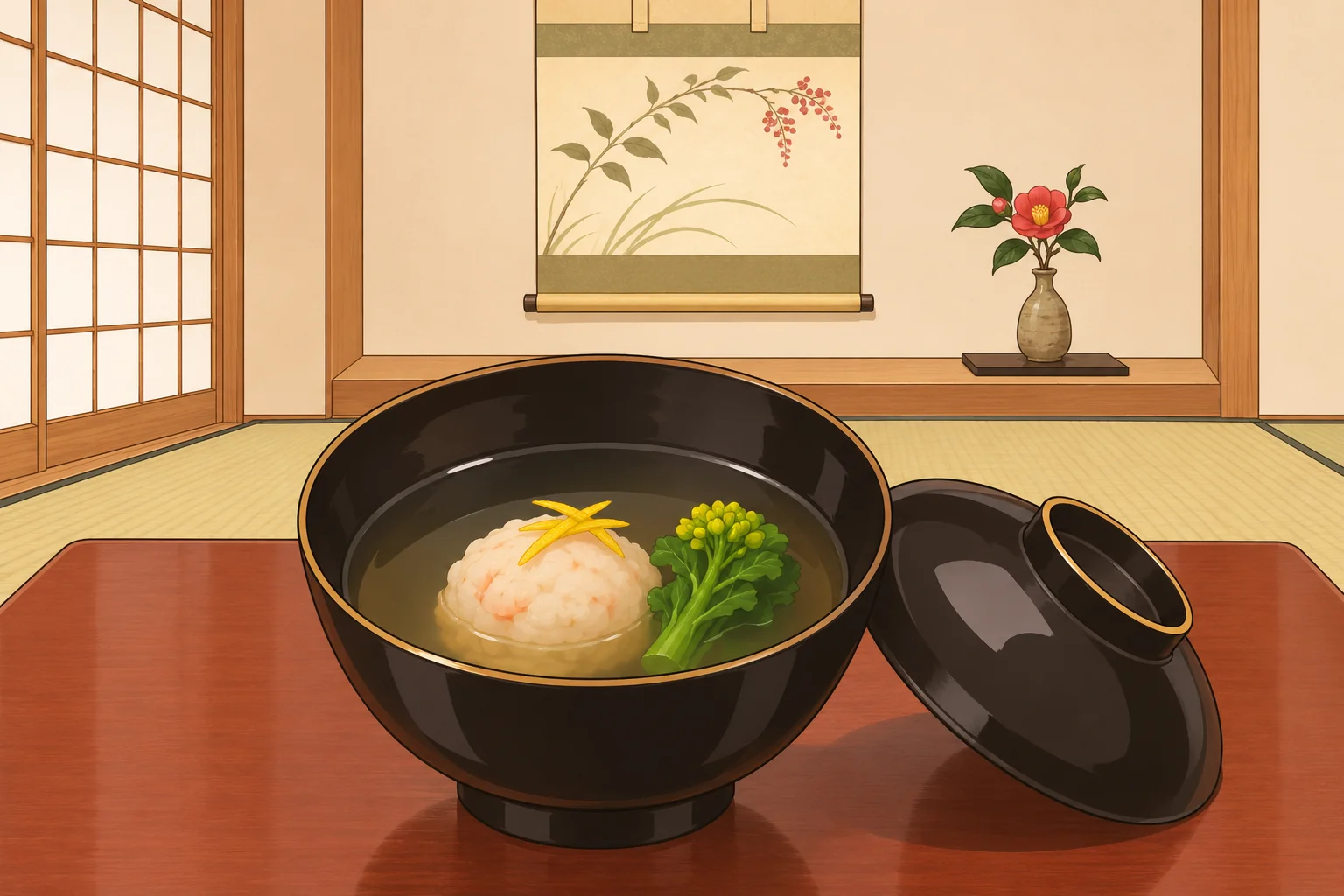
Next comes the nimonowan, the simmered dish in a lidded lacquer bowl, which is the heart of tea kaiseki. When the guest lifts the lid, steam and fragrance rise together. The broth is a clear dashi of kelp and dried bonito; in it sits a single main element, perhaps a piece of sea bream or a delicate fish dumpling, with a seasonal vegetable and a sliver of yuzu peel or a sprig of young sanshō leaf. A host’s effort goes into this bowl more than any other, and guests judge the meal by it.
Then the yakimono, usually grilled fish, arrives in a single large bowl from which each guest serves themselves before passing it on. The host may add one or two further dishes, known as shiizakana, "urged dishes," or azukebachi, a bowl "entrusted" to the guests. Along the way the host returns with the rice container and the soup pot to offer more. By now the rice has steamed longer and is softer than the first mouthful, a deliberate contrast.
A tiny bowl of almost transparent broth follows, the hashiarai or "chopstick rinse," clearing the palate. Then comes the hassun, named for the cedar tray about eight sun (roughly 24 centimeters) square on which it is served: two morsels, one from the mountains and one from the sea, perhaps a slice of dried mullet roe and a curl of bracken. With the hassun, host and guests exchange cups of sake in a sequence called chidori no sakazuki, "the plovers’ cup," after the shorebirds that dart back and forth along the water’s edge. It is the one convivial moment in an otherwise hushed meal.
To finish, the host brings a pitcher of hot water poured over the lightly toasted rice from the bottom of the pot, along with pickles. The guests use it to rinse their rice bowls clean and drink it, wipe the bowls with the folded paper they carry, and set their chopsticks down on their trays together. The small clatter tells the host, waiting outside the door, that the meal is over.
Only then does the gathering move toward its purpose. The host serves a moist sweet, the guests step out into the garden for a short break, and when they return the host prepares thick tea, which the guests share from a single bowl. More charcoal, thin tea, and the gathering ends. The meal took over an hour, and all of it was preparation for that bowl of tea.
The rules can look severe from the outside. Utensils must suit the season and the theme of the day and should not repeat; hot dishes must reach the guest hot, which means the host times every step from kitchen to tearoom; guests leave nothing, saving a slice of pickle to wipe the last grains from the bowl. Behind all of it is a plain idea. The host has spent weeks or months preparing for this single meeting, and the guests honor that by receiving the hospitality whole. The phrase tea people use for this is ichigo ichie, "one time, one meeting": this exact gathering will never happen again.
04From Poetry Parties to Restaurants
The banquet word, 会席, originally meant simply "a gathering’s seats." From the medieval period on it named the meetings of poets composing linked verse, renga and later haikai, which ended with food and drink. In the Edo period, prosperous townspeople in the big cities had money and leisure, and poetry circles, painting and calligraphy gatherings and hobby societies multiplied. The meals that followed them grew more elaborate, and kaiseki ryōri in this sense, "gathering cuisine," took shape.
The places that hosted these meals were ryōri-jaya, restaurant teahouses, which appeared in the middle to late Edo period. Unlike food stalls and cookshops, they had gardens and tatami rooms, took reservations and served complete menus. In the late eighteenth century the Masuya in Fukagawa Suzaki was famous for its luxury cooking. By the early nineteenth century the most celebrated restaurant in Edo was Yaozen in Sanya, near Asakusa, which published Ryōri tsū, a book of its dishes illustrated by leading artists of the day.
Because it centers on drinking, banquet kaiseki is shaped differently from the tea meal. Courses come slowly; portions and variety can be more generous; rice, soup and pickles wait until the sake is finished. At the same time it borrowed heavily from tea: the obsession with season, the care for tableware, hot food served hot, dishes presented one at a time rather than all at once. Modern kaiseki can be thought of as the social function of the samurai banquet, the aesthetics of the tea meal and the business model of the Edo restaurant fused into one.
After the Meiji Restoration of 1868, ryōtei became the meeting rooms of politicians and businessmen, so much so that Japanese coined the phrase ryōtei seiji, "ryōtei politics," for deals struck over sake behind sliding doors. Banquet kaiseki also spread to hot-spring inns across the country. Today the dinner served at a ryokan, with its appetizers, sashimi, a small pot bubbling over a fuel cube, grilled fish, tempura, and finally rice and miso soup, is the kaiseki most Japanese and most visitors actually know.
05The Shape of a Banquet Kaiseki
There is no fixed banquet menu; every restaurant and region has its own sequence. But the skeleton is consistent enough that knowing it lets you understand where each dish sits.
The meal opens with sakizuke, a bite or two served with the first drink, which wakes the appetite and announces the season. Many restaurants follow with a hassun, which in banquet kaiseki is not the two-morsel tray of the tea meal but a seasonal arrangement of five or six tiny things: a cube of grilled eel, a ginkgo nut, a carrot cut into a maple leaf, a few beans skewered on a pine needle. It is often the most beautiful plate of the evening, a little landscape.
Then comes the wanmono or suimono, a clear soup in a lidded bowl. As in tea kaiseki, this is the measure of the cook. The dashi must be clear and fragrant, the salt exactly right, the main ingredient cooked to the right texture. Japanese chefs say you can tell a restaurant’s level from its soup.
Otsukuri, sashimi, follows: two or three fish in season, garnished with shredded daikon, shiso and seaweed, with fresh wasabi and soy sauce. Then yakimono, grilled dishes: cherry salmon in spring, sweetfish (ayu) in early summer, served whole with a small dish of green water-pepper vinegar, Pacific saury or matsutake mushrooms in autumn, yellowtail or tilefish in winter.
Takiawase is a "simmered together" dish in which several ingredients, such as taro, pumpkin, freeze-dried tofu and butterbur, are each cooked separately in their own broth and then arranged in one bowl, keeping their own colors and flavors. Depending on the restaurant, there may also be agemono, fried food such as tempura; sunomono, a vinegared dish to refresh the mouth; or a steamed course such as autumn’s dobin-mushi, a little clay teapot of matsutake and pike conger broth that you pour into a tiny cup and sip.
The meal ends with shokuji, "the meal" proper: rice, sometimes cooked with seasonal ingredients such as bamboo shoots in spring or chestnuts or matsutake in autumn; a miso soup called tomewan, "the closing bowl"; and pickles, kō no mono. Dessert, mizumono, is seasonal fruit or a small sweet, followed by matcha or roasted tea.
- 1
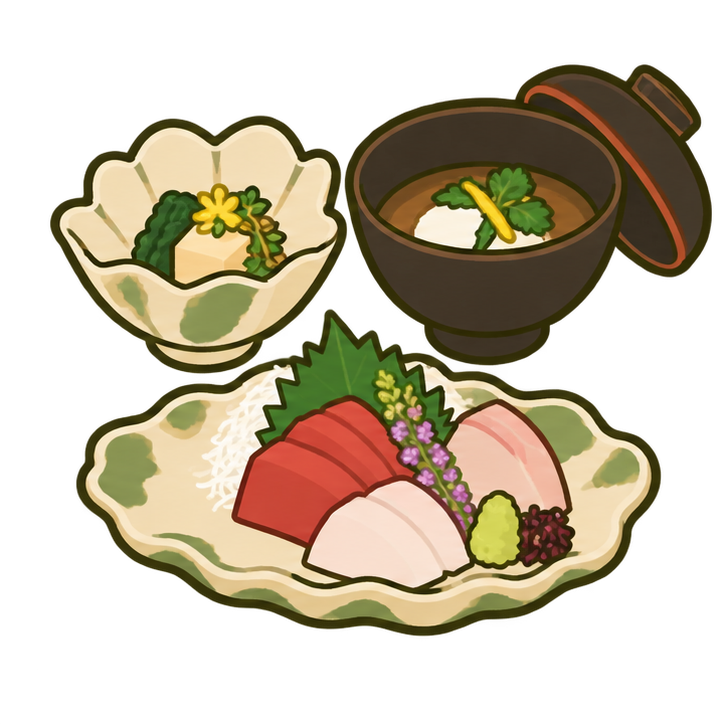 Opening: a small starter, a bowl of clear soup, then sashimi.
- 2
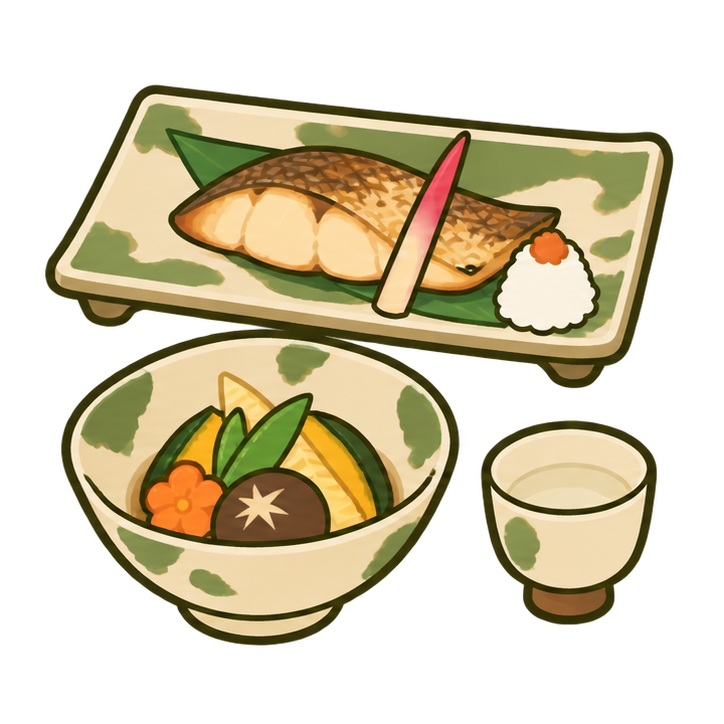 Middle: grilled fish and simmered dishes, eaten slowly with sake.
- 3
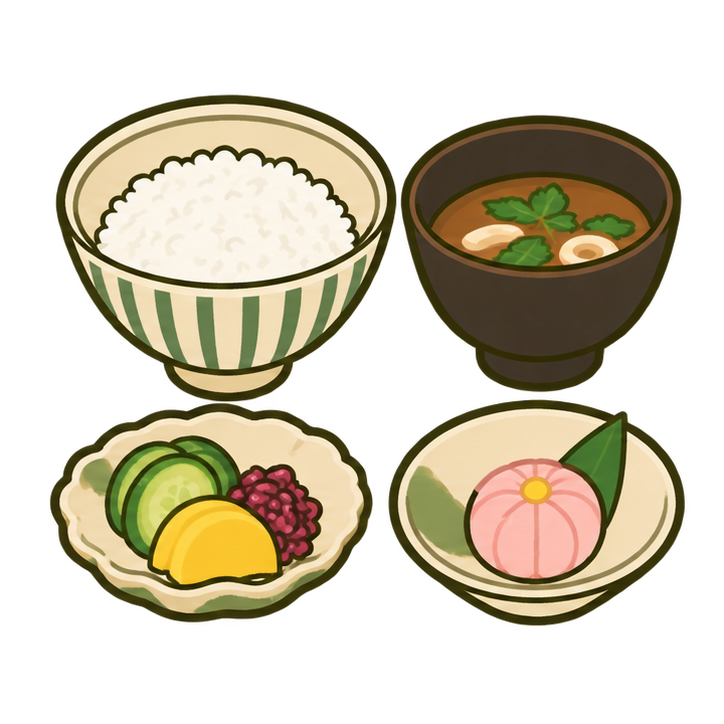 Close: rice, the closing miso soup and pickles, then fruit or a small sweet.
Ten or so courses, each small, add up to a satisfying meal. The rhythm has a shape: light at first, richer in the middle, a refreshing pause, and a quiet landing on rice and soup. A good banquet kaiseki is structured like a piece of music, and the season runs through all of it.
06Season, Vessels and a Bowl of Soup
If one word sums up what kaiseki values, it is shun, the moment when an ingredient is at its seasonal peak. Japanese cooks divide each season’s arc into three phases: hashiri, the first arrivals; shun, the peak; and nagori, the lingering last of it. Placing a hashiri ingredient beside a nagori one on the same plate lets a diner taste the season turning. Bamboo shoots in spring, sweetfish in early summer, pike conger during the rainy season, matsutake in autumn, pufferfish and snow crab in winter form the backbone of kaiseki menus through the year.
Season also lives in shapes, colors and vessels. Carrots become cherry blossoms in spring and maple leaves in autumn. Summer brings glass, celadon and pale bamboo, which look cool; winter brings heavy stoneware and lidded bowls that hold in the heat. A real maple leaf, a sprig of pine or a bamboo leaf is laid under the food, or a small flower set beside it; such a leaf or paper liner is called kaishiki. Nobody eats it. It tells the guest what time of year it is, sometimes to within a week or two.
Tableware matters almost as much as food. A single banquet kaiseki may use twenty or thirty different vessels: lacquer, porcelain from Imari and Kyoto, unglazed stoneware from Bizen and Shigaraki, glass, bamboo and wood. The best-known expression of this comes from Kitaōji Rosanjin (1883–1959), the gourmet and potter, who said that tableware is the kimono of food. At the Hoshigaoka Saryō, the members-only restaurant he helped open in Tokyo in 1925 and ran as head cook, much of the tableware was his own work. The old ryōtei of Kyoto still keep collections of vessels, some handed down for generations and brought out only for a particular season or occasion.
Of all the courses, the one cooks care about most is the clear soup, because nothing in it can be hidden. The dashi, drawn from kelp and dried bonito, betrays the water, the timing and the heat. A bowl contains one main ingredient, a garnish or two and a breath of citrus, and what you taste is the ingredient itself and the clarity of the broth. Kaiseki’s aesthetic is subtractive: no heavy seasoning to cover the food, no piling on of quantity to impress, effort spent where the guest may never notice it.
This restraint comes straight from tea. In tea kaiseki the host cooks and serves in person and offers the meal as a gesture of regard. Banquet kaiseki is commercial, but good restaurants keep the same attitude. Japanese call it omotenashi, hospitality that anticipates what a guest needs. At a kaiseki meal you notice it in the temperature of a dish when it reaches you, in the rush of aroma when you lift a lid, and in the server who kneels outside the room and slides the paper door open before entering.
07Kyoto and the Modern Kaiseki Restaurant
For most people kaiseki means Kyoto. The city has centuries of court, temple and tea culture behind it, soft water, vegetables from the surrounding hills and the Tanba region, sea fish carried in from Wakasa Bay along the old "mackerel road," and cooks deeply proud of Kyō-ryōri, Kyoto cuisine.
Hyōtei, near Nanzen-ji temple, is among the oldest restaurants in the city. It is said to have begun as a teahouse serving pilgrims on their way to the temple. Its best-known dish is the Hyōtei tamago, a boiled egg with a yolk that is set at the edges and soft at the center, served with the restaurant’s breakfast rice porridge, asagayu. Kikunoi in Higashiyama and the many ryōtei around Gion are what most visitors picture as Kyoto kaiseki.
One of the key figures in modern kaiseki was Yuki Teiichi, founder of Kitchō, who opened his restaurant in the Shinmachi district of Ōsaka in 1930. He brought the seasonal sense and love of tableware of the tea meal into restaurant banquet cooking and is often credited with creating kaiseki as it is known today. Kitchō later divided into several separate businesses; the branch in Arashiyama, on Kyoto’s western edge, opened in 1948 and remains one of the city’s most exclusive restaurants. A different lineage is that of specialist tea-kaiseki caterers such as Tsujitome, founded in Kyoto in 1902 with close ties to the Urasenke school of tea, whose core business is cooking for tea hosts on location. Its second-generation head, Tsuji Kaichi, wrote widely read books that opened tea kaiseki to general readers.
The twenty-first century brought change. Murata Yoshihiro of Kikunoi and other Kyoto chefs worked to take Japanese cuisine abroad, inviting foreign chefs to learn about dashi and seasonality; they were among the advocates behind UNESCO’s 2013 listing of washoku, traditional Japanese food culture, as intangible cultural heritage. The first Michelin guide to Kyoto and Ōsaka in 2009 introduced many old ryōtei to foreign diners. Meanwhile younger chefs have opened tiny counter restaurants with eight or ten seats, where guests watch the chef slice fish and ladle soup in front of them, turning kaiseki into something more intimate than a private tatami room.
08Your First Kaiseki
The easiest way in is lunch. As a rough guide to prices around 2025, many renowned restaurants in Kyoto and Tokyo offer lunch for around 10,000 yen, and simplified menus can be found for 5,000 or 6,000. Dinner usually starts at 20,000 to 30,000 yen, and at the top restaurants 40,000 to 50,000 or more, before drinks and service charges. You will usually be asked about allergies and dietary restrictions in advance; say so then, and the kitchen will adjust the whole menu around you.
Ryōtei seating is often in private tatami rooms, so you will take off your shoes; clean socks matter. Dress need not be formal, but avoid anything too casual, and skip strong perfume, which competes with the food and the tea. The alcove in the room will hold a seasonal scroll and a simple flower arrangement. Pausing to look at it before you sit is a courtesy. Never put your bag or belongings in the alcove.
When a dish arrives, take a moment to look at it. To open a lidded bowl, steady it with your left hand, hold the knob with your right and twist slightly to break the seal, then turn the lid upside down and set it beside the bowl; replace it when you are finished. Small bowls may be lifted to your mouth; large plates stay on the table. Drink soup directly from the bowl and pick up the solids with chopsticks. Put a little wasabi directly on a slice of sashimi and dip it lightly in soy sauce rather than stirring the wasabi into the dish. If you are not sure what something is or how to eat it, ask. Servers are usually glad to explain an ingredient and why it belongs to the season.
Let the restaurant set the pace. Each course is prepared as you finish the previous one; eat too fast and the kitchen has to rush, too slowly and hot food goes cold. Sake is the natural pairing, and staff will often suggest something seasonal, though beer is perfectly acceptable. Ask before taking photos; some places forbid them, others only ask you to skip the flash and keep your voice down when other guests are nearby.
If you think you will be too full for the rice at the end, ask at the start for a smaller portion. Some restaurants will shape leftover seasonal rice into rice balls for you to take away. As you leave, the proprietress, the okami, may see you to the door and keep bowing until you have disappeared down the street. It is then that a first-time guest tends to understand what they have been served: a set of dishes, and also a span of time someone has arranged with great care.
To see tea kaiseki itself, look for tea ceremony experiences or restaurants that offer a cha-kaiseki menu, in which rice, soup and mukōzuke arrive together at the start and the meal ends with a sweet and a bowl of tea. Even one such meal changes how you see a ryokan dinner. The rice and miso soup that arrive last, and the clear soup with its lifted lid, will look familiar, because you will know where they came from.