
At a glance
From Edo sake shops to red-lantern bars: where the izakaya came from, what to order and drink, and how a first-timer can settle in comfortably.
- Izakaya literally means a sake shop where you can stay and drink, from Edo shops that let customers drink on the premises.
- An 1811 survey counted 7,603 eateries in Edo, 1,808 of them izakaya, about a quarter.
- The small dish served as you sit down, otōshi, is charged, about 300 to 500 yen a person as of the mid-2020s.
- The first order is usually “a draft beer for now”; the evening starts with a toast once everyone’s drink arrives.
- Dishes are small and shared from the middle of the table, ordered a few at a time, with a rice or noodle dish, shime, to finish.
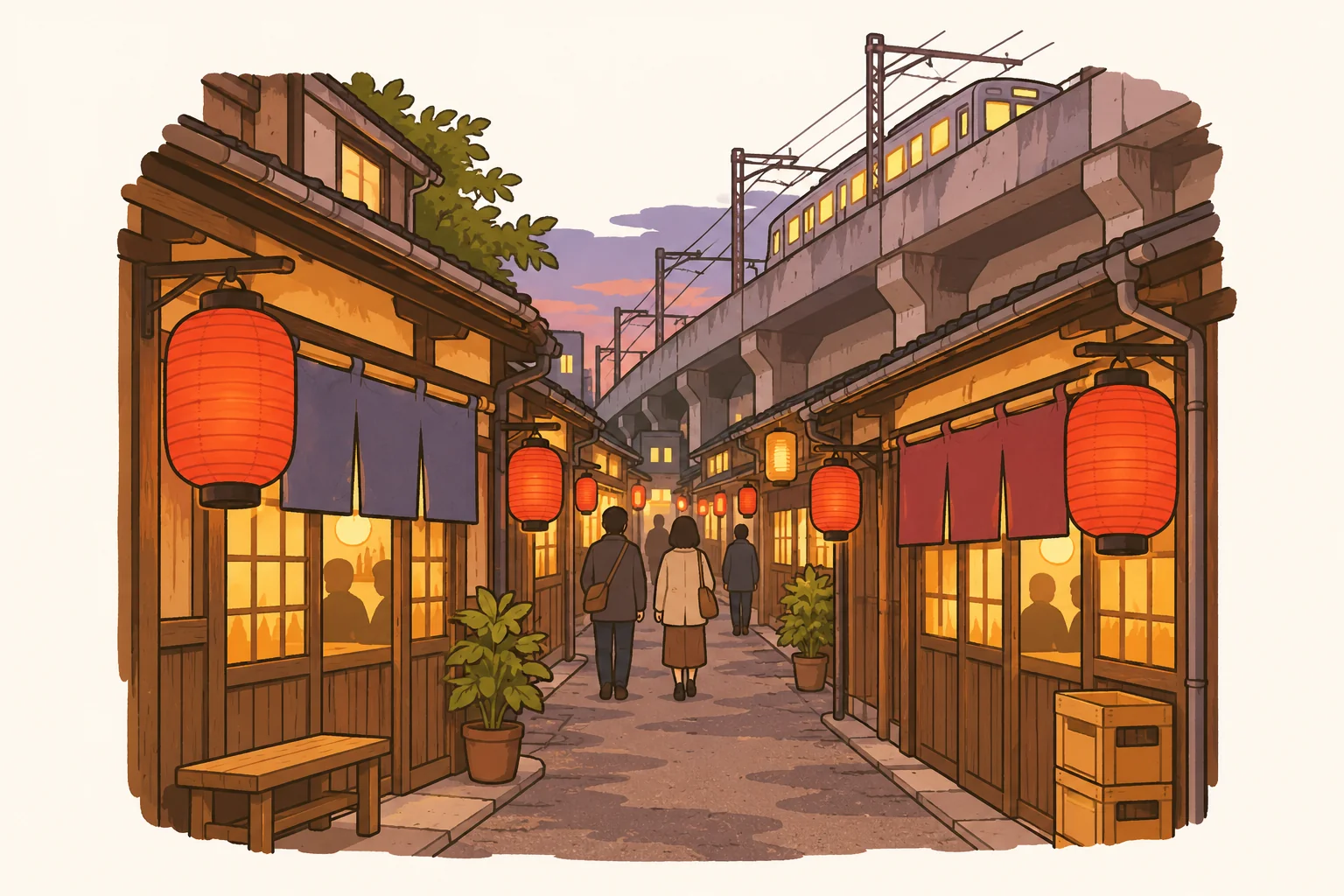
Walk out of almost any train station in Japan after dark and you will see them: red paper lanterns, short cloth curtains hung over sliding doors, and steam and laughter spilling out whenever someone steps inside. These are izakaya, the drinking-and-eating places where much of Japanese social life happens after work. An izakaya is not quite a bar and not quite a restaurant. It is a place built around drink, where food arrives in small plates and an evening is spent ordering a little at a time. This introduction explains what an izakaya is, where it came from, what people eat and drink there, why it matters so much in Japan, and how to walk into one with confidence.
01A Sake Shop Where You Stay
The word izakaya is made of two parts. I (居) means to stay or to be somewhere, and sakaya (酒屋) is a sake shop. An izakaya, literally, is a sake shop where you can stay and drink.
The name preserves the history. In the Edo period (1603–1868), sake shops mostly sold drink to take away. Customers brought their own bottles or small casks, had them filled, and carried them home. Some shops began letting people drink a cup on the spot, and the practice of drinking on the premises was called izake. Shops that offered it became izakaya.
That origin still shapes the experience. At an izakaya, the drink comes first and the food exists to go with it. In most restaurants a drink accompanies a meal; in an izakaya, the dishes accompany the drinks. This is why the food comes in small portions, why it tends to be salty, savory and satisfying with alcohol, and why there is no set order of courses. People order a few dishes, drink, talk, order a few more, and keep going until they are done. Everything goes in the middle of the table and everyone shares.
English speakers often call the izakaya a "Japanese pub," and the comparison catches something real: the neighborhood feel, the regulars, the after-work crowd. But a British pub is mainly about standing at the bar with a pint, and food is often secondary. An izakaya menu may run to dozens of dishes, from sashimi to fried chicken to potato salad, and most customers sit down and eat steadily all evening. As of the mid-2020s, a few drinks and several dishes typically cost somewhere between 3,000 and 5,000 yen per person at an ordinary place, which is part of why the izakaya is so central to everyday life. It is affordable enough to visit often.
02From Edo Sake Shops to Postwar Alleys
The izakaya grew up in Edo, the city that became Tokyo. From the seventeenth century, Edo was the seat of the shogun and one of the largest cities in the world. It was full of samurai posted from the provinces, artisans, merchants and laborers, a high proportion of them single men living in cramped row houses. Many did not cook. They ate at street stalls selling soba, tempura and sushi, and at niuriya, shops that sold simmered food ready to eat. The best sake came by ship from the Kansai region, especially from Itami and Nada near Ōsaka, and Edo drinkers prized this "downbound" sake, kudarizake.
One shop is often named as the first izakaya: Toshimaya in Kanda, which by its own account was founded in 1596 at Kamakura-gashi, the riverside landing where timber and stone for Edo Castle were unloaded, and which later became famous for the sweet white sake sold for the Doll Festival in spring. According to a well-known story, Toshimaya sold its sake at cost, made its profit by reselling the empty casks, and served grilled tofu with miso, dengaku, so that customers would linger and drink. Toshimaya is still in business. It stopped serving drinks on the premises after the Great Kantō Earthquake of 1923 and only reopened a small izakaya in Kanda in 2020. Whether or not the old story is true in every detail, it captures what happened across the city during the eighteenth century. The word izakaya appears in print by the middle of that century. Sake shops began to offer something to eat, food shops began to sell sake, and the izakaya took shape somewhere in between. When the city magistrates had Edo’s eating places counted in 1811, the survey found 7,603 of them, and 1,808 were izakaya, nearly a quarter of the total and, as the survey is commonly cited, more than the soba shops.
Woodblock prints and comic verse from the period show what they looked like. A curtain of thick ropes, the nawanoren, hung over the doorway. Inside were casks of sake, and customers sat on benches or upturned barrels, drinking from small bowls or square wooden boxes called masu, eating simmered taro, tofu, fish and shellfish. The rope curtain became so closely tied to cheap drinking places that the word nawanoren is still used to mean a humble tavern.
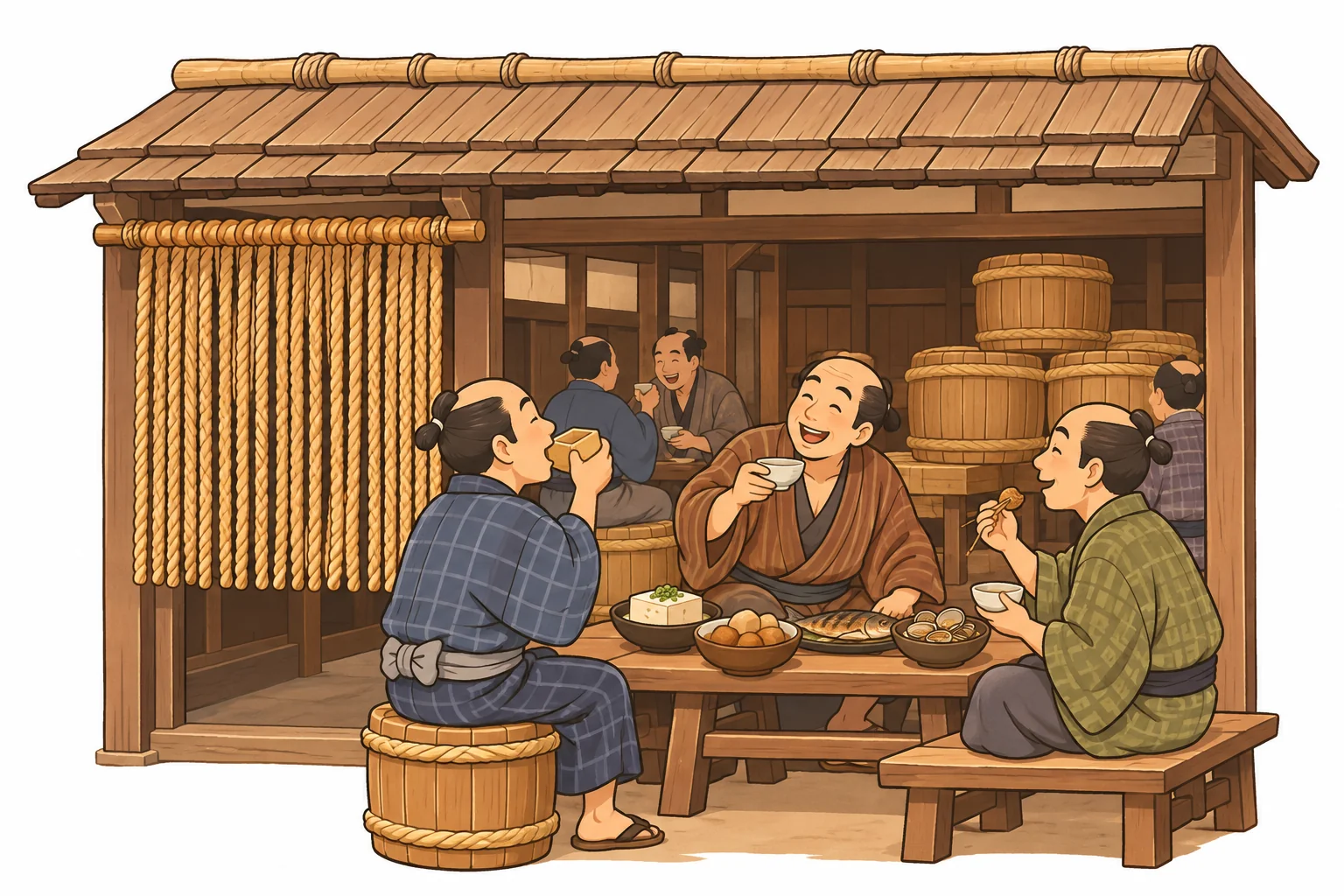
A late-Edo izakaya: a rope curtain at the door, sake casks inside, townspeople drinking on empty casks (illustration).
After the Meiji Restoration of 1868, beer arrived, and with it Western-style beer halls. But the izakaya as most people picture it today was really shaped after the Second World War. In the shortages of the late 1940s, black markets sprang up around train stations and under elevated railway tracks, with makeshift stalls of wood and corrugated iron selling grilled offal on skewers, stews and rough liquor. As the economy recovered, many of these clusters hardened into narrow alleys of tiny bars called yokochō. Omoide Yokochō beside Shinjuku Station and the row of bars under the tracks at Yūrakuchō both descend from this era. The red lantern, akachōchin, became the symbol of the cheap, friendly drinking spot, and "going to an akachōchin" still means going for an unpretentious drink.
During Japan’s high-growth decades, the salaryman became the izakaya’s core customer. In 1950 Amae Tomiya, from a local sake-brewing family, opened a place called Robata in Sendai, where fish and vegetables were laid out around a hearth and grilled in front of the customers; the custom of passing dishes across on a long wooden paddle is said to have started there. This robatayaki style spread, notably to Kushiro in Hokkaidō, which also claims to be its birthplace. In the 1970s and 1980s, chain izakaya expanded fast. Yōrō no Taki, which had opened its first izakaya in Yokohama in 1956, Murasaki and Tsubohachi were known as the "big three," and later Shirokiya and Watami joined them. They opened branches in front of station after station. They offered long, cheap, predictable menus and large rooms that suited office parties and student clubs. For a generation, "going for a drink" usually meant going to one of these.
03Sitting Down: Towels, a Small Dish and "Beer for Now"
When you step through the curtain, the staff will shout irasshaimase, "welcome," and in many places the whole crew calls it out together. After you are seated, someone brings a damp hand towel, an oshibori, hot in winter and often chilled in summer. You wipe your hands with it. Some middle-aged men also wipe their faces, a habit so familiar that it has become a comic shorthand for being an oyaji, an old guy.
Then, before you have ordered any food, a small dish appears in front of each person. It might be spinach dressed with sesame, a few slices of simmered daikon radish, pickled baby fish, or a bowl of edamame. This is the otōshi, called tsukidashi in the Kansai region. The name is usually explained as a sign that your order has been "passed through," tōsu, to the kitchen. It is not free. It is added to the bill, as of the mid-2020s usually at around 300 to 500 yen a head, and works as a kind of table charge. Visitors are sometimes surprised to find it on the receipt. For Japanese customers it makes sense: it means there is something to eat with the first drink while the kitchen gets going, and it is the first chance for the cook to show what the place can do. Good izakaya take the otōshi seriously and change it with the seasons. In most places you cannot decline it.
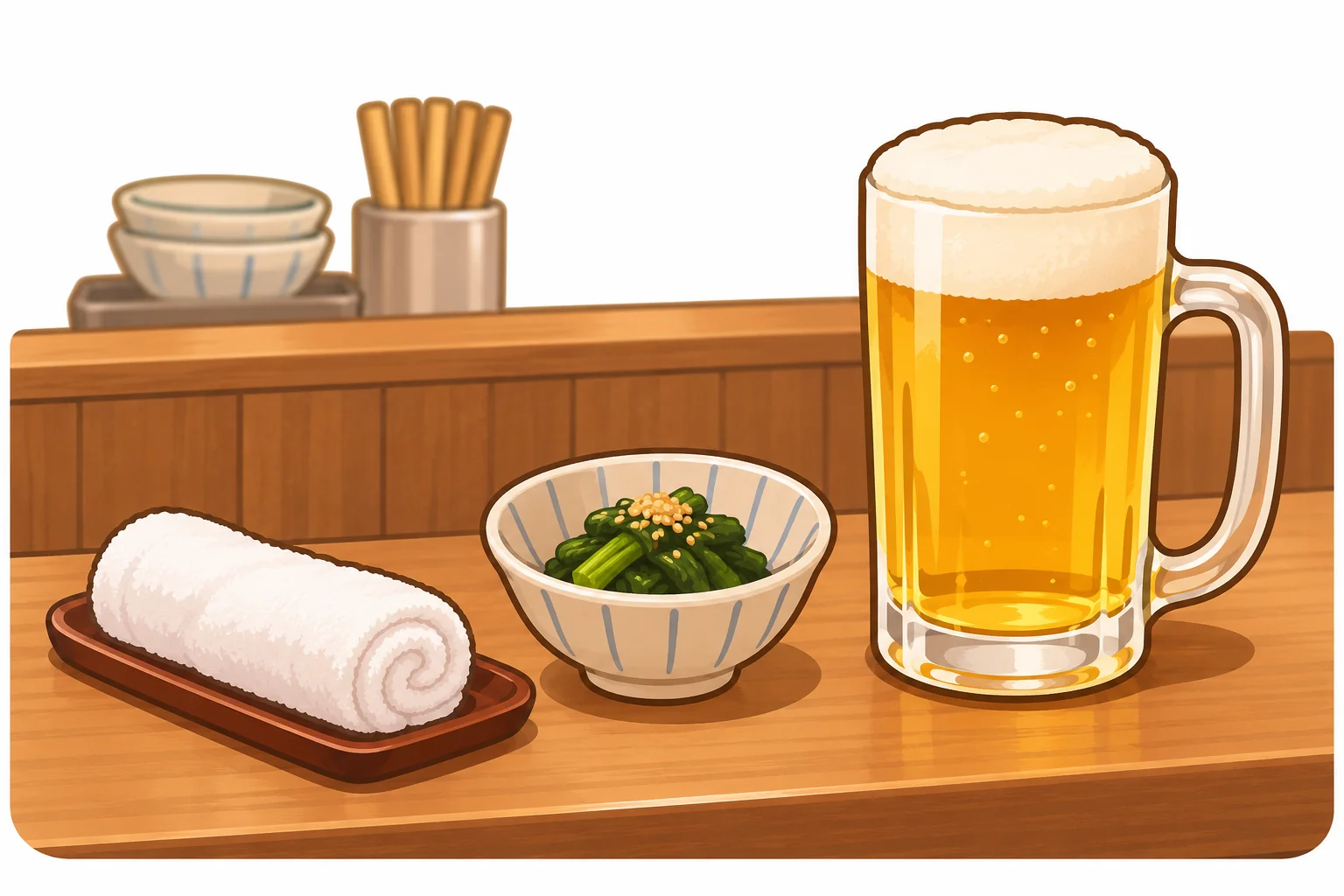
At an izakaya counter: a rolled oshibori, a small dish of otōshi and a mug of draught beer (illustration).
Drinks are ordered first. The classic opening line is toriaezu nama, "a draft beer for now." Nama bīru is draft beer, served in a heavy glass mug with a handle, called a jokki, under a thick white head of foam. Nobody drinks until everyone’s first glass has arrived. Then the table raises their glasses and says kanpai, "cheers," and the evening has officially begun. At company gatherings a senior person or the organizer often says a few words first. Starting to drink before the kanpai is mildly rude.
After the drinks come, people look at the menu and start ordering food, usually a few cold dishes that come out quickly, then something grilled or fried, and later, perhaps, a rice or noodle dish to finish. To call a server, raise a hand and say sumimasen, "excuse me." Many tables have a call button, and newer chains have switched to tablets or QR codes for ordering.
04What’s on the Menu
An izakaya menu is a catalog of Japanese comfort food. Every place has its own character, but certain dishes appear almost everywhere, and a first-time visitor can order from this core list without going wrong.
Edamame, young soybeans boiled in the pod and salted, are usually the first thing on the table. You squeeze the beans straight from the pod into your mouth; they are made for beer. Hiyayakko is a cold block of soft tofu topped with sliced green onion, grated ginger and bonito flakes, with a splash of soy sauce. Potato salad is a fixture, mashed but still chunky, mixed with mayonnaise, cucumber, carrot and sometimes ham, and many regulars judge a new place by it. Dashimaki tamago is a rolled omelet made with dashi stock, cooked in layers in a rectangular pan, so soft and juicy that it glistens when you cut it.
Fried food is a whole section of its own. Karaage, Japanese fried chicken, is probably the most ordered dish in all izakaya. Pieces of chicken thigh are marinated in soy sauce, ginger and garlic, coated with starch and fried until crisp outside and juicy inside, then served with a wedge of lemon. Whether to squeeze lemon over the shared plate has become a minor etiquette debate in Japan, and the polite move is to ask first. There is also agedashi dōfu, fried tofu sitting in a warm, savory broth, along with fries, fried squid and small fried fish.
Places near the sea, or ones that care about fish, offer a sashimi platter, with tuna, sea bream, yellowtail and squid depending on the season. The most izakaya-like grilled fish is hokke, Atka mackerel, a fish best known from Hokkaidō, split open, half-dried and grilled whole until the skin crackles. One fish is enough for several people, eaten with grated daikon. In colder months, the old red-lantern places are known for motsu nikomi, pork intestines stewed for hours in miso with daikon, konnyaku and tofu, finished with green onion and a shake of seven-spice pepper.
Many izakaya grill yakitori, chicken on skewers, though yakitori specialists form a world of their own. In the same way, oden, tempura and sashimi each have dedicated restaurants, and the izakaya offers simpler versions of all of them side by side. That variety is the point. One table can have a little of everything.
Near the end of the night, people often order a shime, a dish to close the meal: ochazuke, rice with green tea or broth poured over it; yaki onigiri, grilled rice balls brushed with soy sauce; fried udon; or a bowl of noodles. Some people find this is still not enough and head to a ramen shop after the izakaya, and the late-night "closing ramen" is a familiar part of city life.
The rhythm of ordering matters as much as the dishes. You don’t order everything at once. You start with three or four plates, see how things go, and add another round. Food goes in the middle, and each person takes from the shared plates onto a small dish of their own.
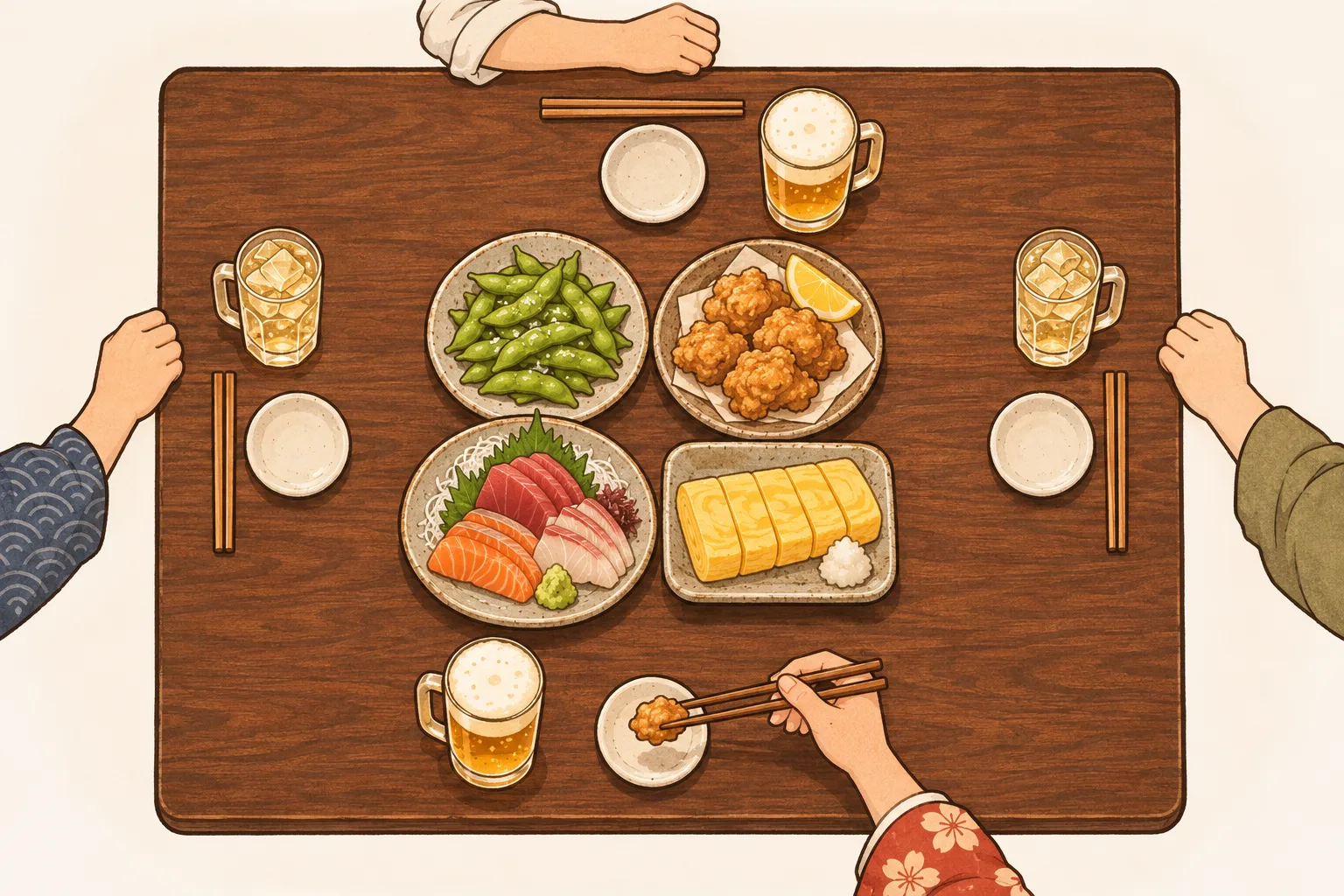
Edamame, karaage and other dishes sit in the middle; each person takes food onto a small plate of their own, with a drink at hand.
05What’s in the Glass
Beer is still the best-selling drink in izakaya, but what people drink there has changed a great deal over the last twenty years.
The highball, whisky and soda, is a good example. It was a popular drink in the postwar decades but had come to seem old-fashioned. Around 2008, Suntory launched a major campaign for highballs made with its Kakubin whisky, served in a tall mug over plenty of ice and topped with soda, priced close to a draft beer. Light and refreshing, it went perfectly with fried chicken. The campaign worked. The highball became a standard izakaya drink again and helped spark the wider boom in Japanese whisky.
Another big category is the chūhai and the sour: shochu or another spirit mixed with soda and fruit juice or flavoring. Lemon, grapefruit, oolong tea and green tea are all common. The lemon sour has been especially fashionable in recent years, and some places build their reputation on a house version, using frozen lemon slices in place of ice. In older Tokyo bars you may also meet Hoppy, a low-alcohol, beer-flavored drink that customers mix themselves with a glass of shochu. When the shochu runs out you can order more of just that, called naka, "inside," and when the Hoppy runs out you order soto, "outside."
Sake is usually sold by the gō, about 180 milliliters, served in a small flask called a tokkuri with tiny cups. In winter you can order it hot, atsukan. Some places set a glass inside a wooden masu and pour until the sake overflows into the box, a gesture of generosity called mokkiri. Izakaya that specialize in regional sake, jizake, may list dozens of bottles on a chalkboard. Shochu and umeshu, plum liqueur, are also common, served on the rocks, with water or with hot water.
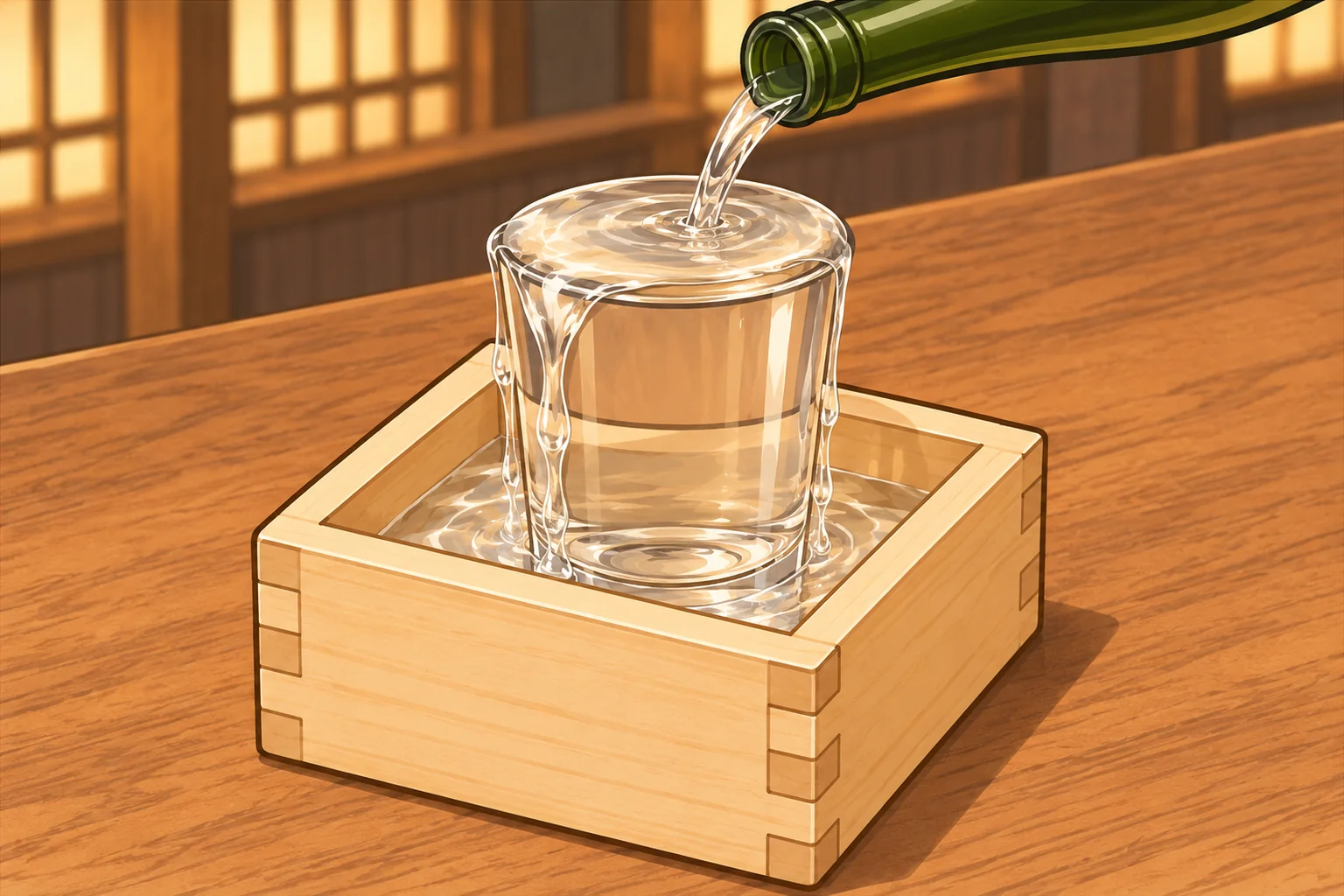
Some places set a glass inside a wooden masu and pour until the sake overflows into the box, a gesture called mokkiri.
If you don’t drink alcohol, you won’t stand out. Oolong tea is on every menu, along with soft drinks, juice and a growing range of non-alcoholic beers. Japanese people who are driving or not feeling well often order these and join the kanpai anyway.
For groups, the usual arrangement is nomihōdai, "all you can drink," for a fixed price and a fixed time, usually ninety minutes or two hours. It is often bundled with a set menu, a kōsu, at around 4,000 to 5,000 yen per person as of the mid-2020s, which saves anyone from having to order. This is the standard format for office parties.
06Many Kinds of Izakaya
"Izakaya" covers a wide range, from a few stools at a counter to sleek restaurants full of private rooms.
The most beloved is the old red-lantern place: a single lantern outside, a long counter and a few tables inside, the walls covered in handwritten menu strips, and an owner couple or a proprietress, the okami, running the whole thing. Tokyo neighborhoods like Shinbashi, Ueno and Akabane, and Ōsaka’s Tenma and Kyōbashi, are famous for them. These working-class places are often called taishū sakaba, "popular taverns."
Simpler still is the tachinomi, the standing bar. There are no seats. You stand at the counter, drinks cost a few hundred yen, snacks even less, and many people stay for fifteen minutes on their way home. In northern Kyūshū, especially around Kitakyūshū, there is also the custom of kakuuchi, drinking at a counter in the corner of a liquor shop. This is the closest thing today to the original Edo practice: having a cup right where the sake is sold.
In front of big stations, the most common type is the chain izakaya. Menus are long, prices are clear, and there are plenty of seats and rooms for groups. Chains are also the most approachable for visitors, often with picture menus and sometimes English ones. A related category is the koshitsu izakaya, which is built around private rooms, often with stylish décor, and is popular for dates and for groups of friends.
At the other end of the scale are the koryōriya, small restaurants usually built around a counter, where the owner writes a menu each day based on the fish and vegetables that came in that morning. The cooking is more refined and the prices higher, somewhere between an izakaya and a formal ryōtei. Robatayaki restaurants have their own theater: customers sit around the grill, point at the fish, shellfish and vegetables arranged in front of them, and the cook hands the finished dish across on a long wooden paddle.
07Why the Izakaya Matters
The izakaya is important in Japan not just because the food and drink are good but because it does a social job that nothing else does as well.
Japanese workplaces tend to be formal and hierarchical, and many things go unsaid during office hours. The izakaya offers a space where people can loosen up a little. There is even a word for it, nominication, a blend of nomi, drinking, and the English "communication," meaning getting to know one another over drinks. Welcome parties for new employees, farewell parties for colleagues being transferred, the year-end bōnenkai, celebrations at the end of a project: almost all happen at izakaya. The person in charge, the kanji, books the place, collects the money, arranges seating and makes the opening remarks. By tradition, juniors pour drinks for their seniors and leave it to others to fill their own glasses. People sometimes declare a bureikō, an evening where rank is set aside, though anyone who takes it too literally may regret it the next morning.
When the first party ends, there is often a nijikai, a second round at another bar or at karaoke. The bill is usually split evenly, warikan, though sometimes the boss pays a little more.
The izakaya also stands in for the living room. Homes in Japanese cities are small, and inviting friends over for dinner is less common than in many countries, so reunions, family get-togethers, school alumni meetings and hometown associations often take place at izakaya. For people who live alone, a regular place can be a second home: the owner remembers your drink, and the regulars at the counter will chat about the weather or baseball. Japanese television and manga return again and again to the scene of someone walking alone into a small place late at night, ordering a flask of sake and a couple of dishes, and exchanging a few words with the person behind the counter. It is a picture of comfort.
The izakaya is changing, though. Young Japanese drink less than their parents did, and many resent being dragged out with the boss after work; in surveys, many say nominication is unnecessary. During the Covid-19 pandemic from 2020, local governments repeatedly asked restaurants to close early and stop serving alcohol. Many izakaya closed for good, and the big chains shut branches or converted them into other kinds of restaurants. Since then, big office parties have not fully come back. Instead there are shorter, smaller outings, choi-nomi or "a quick drink," and more people drinking on their own. Meanwhile the izakaya has become one of the experiences foreign visitors most want to have in Japan, and in Tokyo and Ōsaka the old alleys are now crowded with travelers.
08Your First Izakaya
For a first-timer, the hardest part is often opening the door. A few things make it much easier.
When you enter, a server will ask how many are in your party; holding up fingers is fine. A small place may turn you away if all its seats are reserved, and it is nothing personal. Since April 2020, a revised Health Promotion Act has banned smoking indoors in principle, but small, older establishments can be exempt, so as of 2026 some izakaya still allow smoking. Look for a sign by the door if it matters to you.
Once seated, wipe your hands and order drinks first. The otōshi will arrive on its own; remember that it will be charged. If you can’t read the menu, many places have photos, and you can always point at what the next table is eating and say onaji mono o, "the same, please." Order a few dishes at a time and keep adding. Shared plates go in the center, and you use your own chopsticks to take food onto your small plate. Never pass food from your chopsticks directly to someone else’s.
Drinking with Japanese companions, keep an eye on other people’s glasses and top them up when they are getting low; they will do the same for you. If you don’t want any more, leave your glass a little full. When clinking glasses with someone senior, it is polite to hold yours slightly lower.
Most izakaya stay open until late. About thirty minutes before closing, staff will announce rasuto ōdā, last orders. To ask for the bill, say okaikei onegaishimasu. Some customers instead catch a server’s eye and make a small X in the air with two fingers, though by some accounts the gesture is not especially polite, and saying it is safer. Some places bring the check to the table; at others you pay at the register by the door. There is no tipping in Japan, but some places add a seat charge or a late-night surcharge, which will appear on the bill alongside the otōshi. You may hear the word oaiso used for the bill, but it was originally staff jargon, and the plain phrase is better.
On the way out, say gochisōsama deshita, "thank you for the meal," and the staff will call back arigatō gozaimashita. Outside, the lanterns are still lit, and the next place is probably just a few doors down.