
At a glance
How kombu and bonito become Japan’s basic stock, how a Tokyo chemist named umami, and why Tokyo’s noodle broth is darker than Ōsaka’s.
- Dashi is a stock made by briefly steeping dried ingredients in water, most often kombu and katsuobushi.
- First dashi is quick: lift the kombu out just before the boil, add bonito flakes, strain a minute or two later.
- In 1908 Ikeda Kikunae isolated glutamic acid from kombu broth and named the taste umami the following year.
- Glutamate from kombu and inosinate from bonito multiply each other’s savoriness, the so-called synergy effect.
- Broadly, Kansai leans on kombu for a pale broth; Kantō leans on bonito for a darker one.
If you have eaten miso soup, a bowl of udon, a plate of oden or a slice of rolled omelet in Japan, you have tasted dashi. It is a stock, but an unusual one: it takes twenty or thirty minutes to make, contains almost no fat, and looks like little more than tinted water. Its two classic ingredients are a dried sea vegetable and a smoked fish so hard it is shaved with a plane. This piece explains what dashi is and how it is made, how a Tokyo chemist turned its flavor into the scientific idea of umami, how kelp from Hokkaidō and bonito from the southern coast came together in every Japanese kitchen, and where a visitor can taste and buy the real thing.
01A Stock That Is Mostly Water
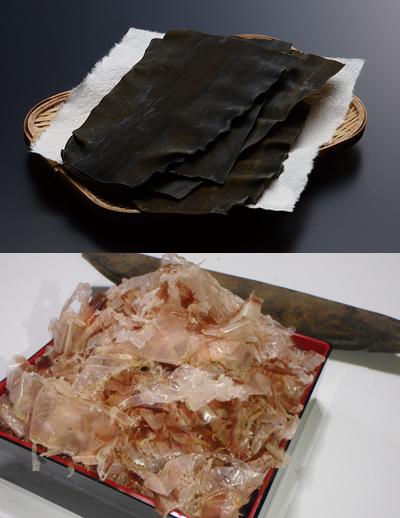
Dashi is made by steeping dried ingredients in water for a short time and straining them out. The standard pairing is kombu, a dried kelp harvested mainly off Hokkaidō, and katsuobushi, skipjack tuna (bonito) that has been filleted, simmered, smoked and dried until it looks and feels like a piece of driftwood. Shaved into thin, translucent flakes, katsuobushi gives dashi its smoky aroma. There are other versions too: niboshi dashi from small dried sardines, a homely, slightly bitter stock common in miso soup and in many ramen shops; shiitake dashi from dried mushrooms; ago dashi from grilled dried flying fish, a specialty of Kyūshū; and the vegetarian shōjin dashi of Buddhist temple cooking, which uses only kombu and shiitake.
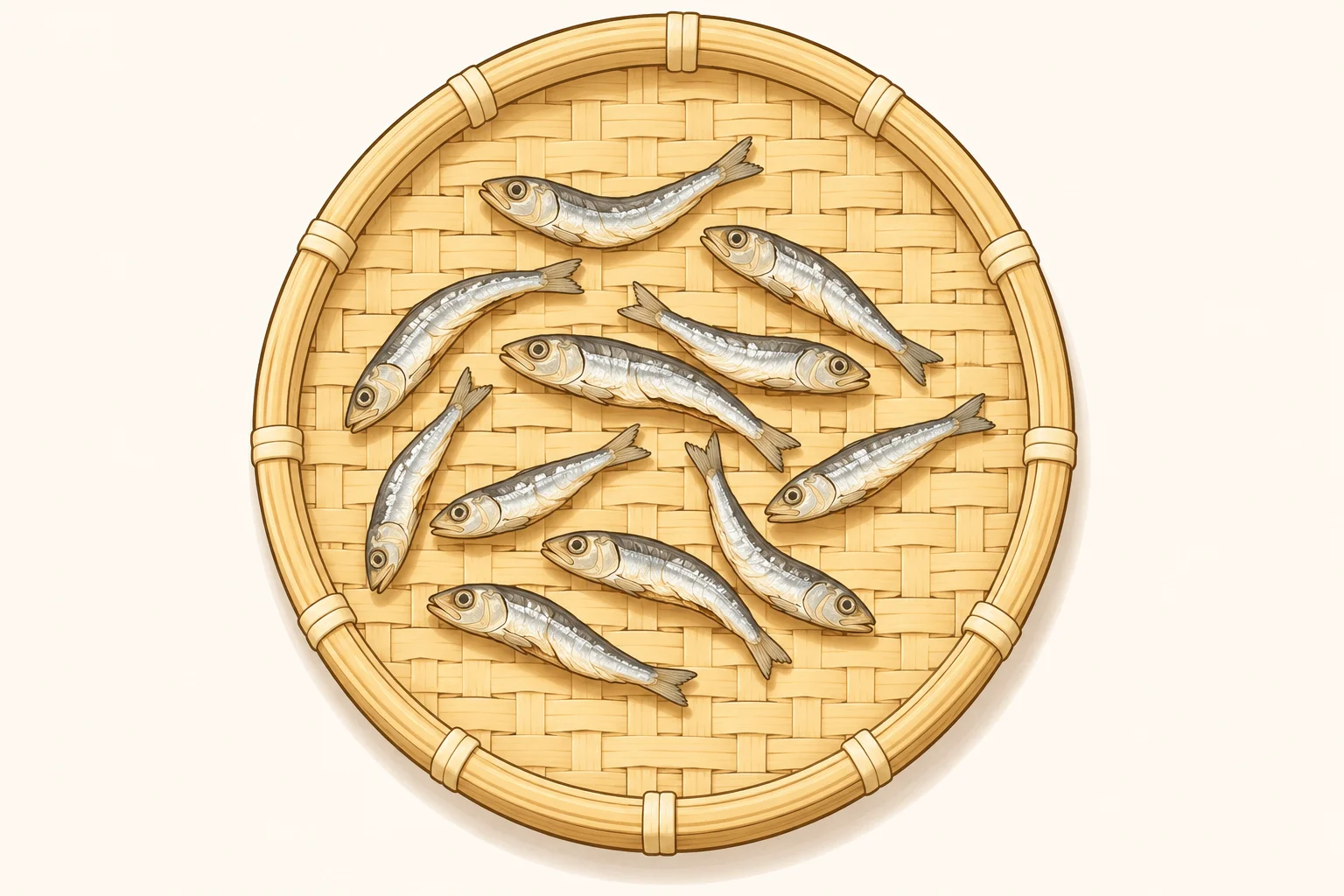
Small dried sardines, the base of niboshi dashi.
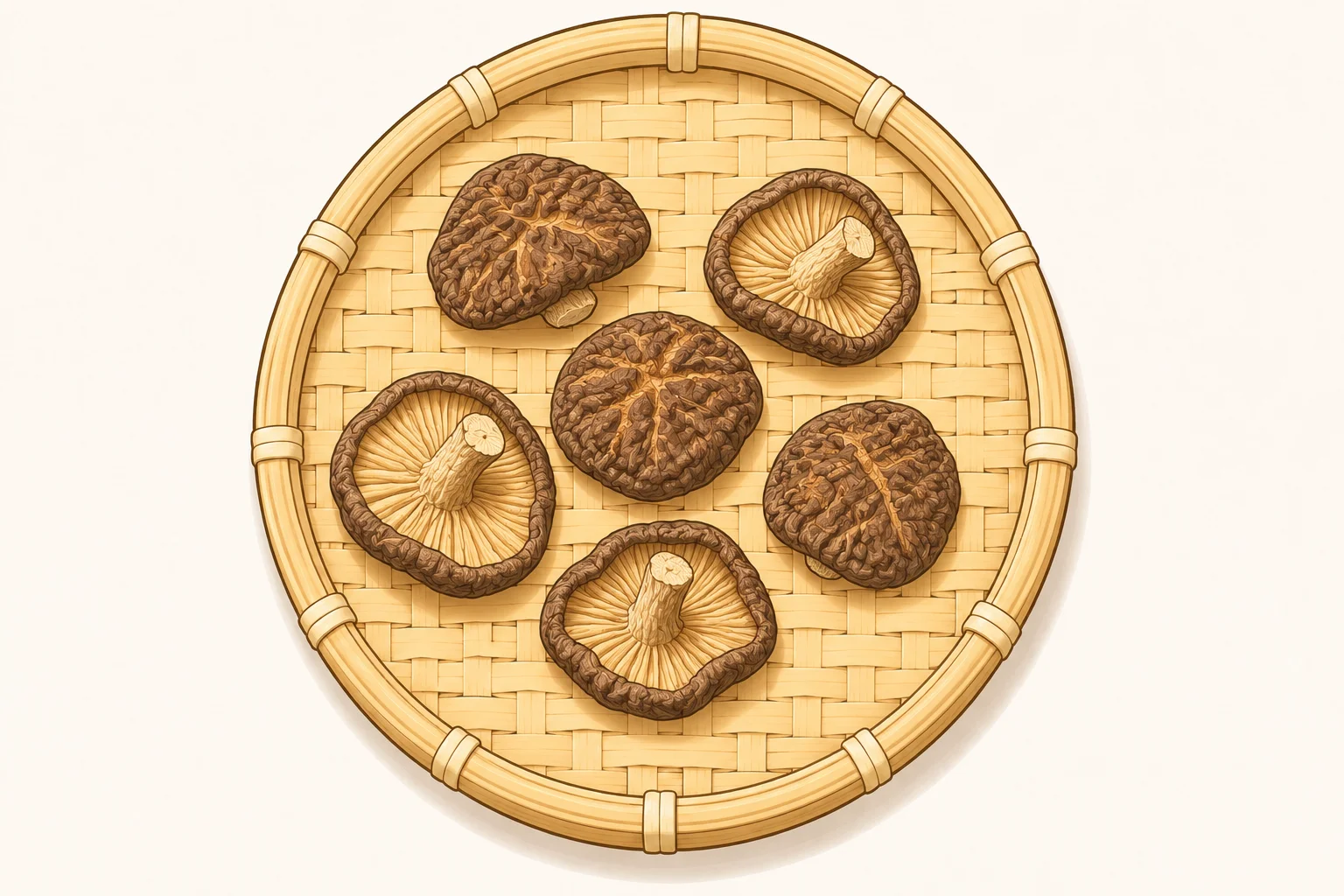
Dried shiitake, used with kombu alone in the vegetarian shōjin dashi of temple cooking.
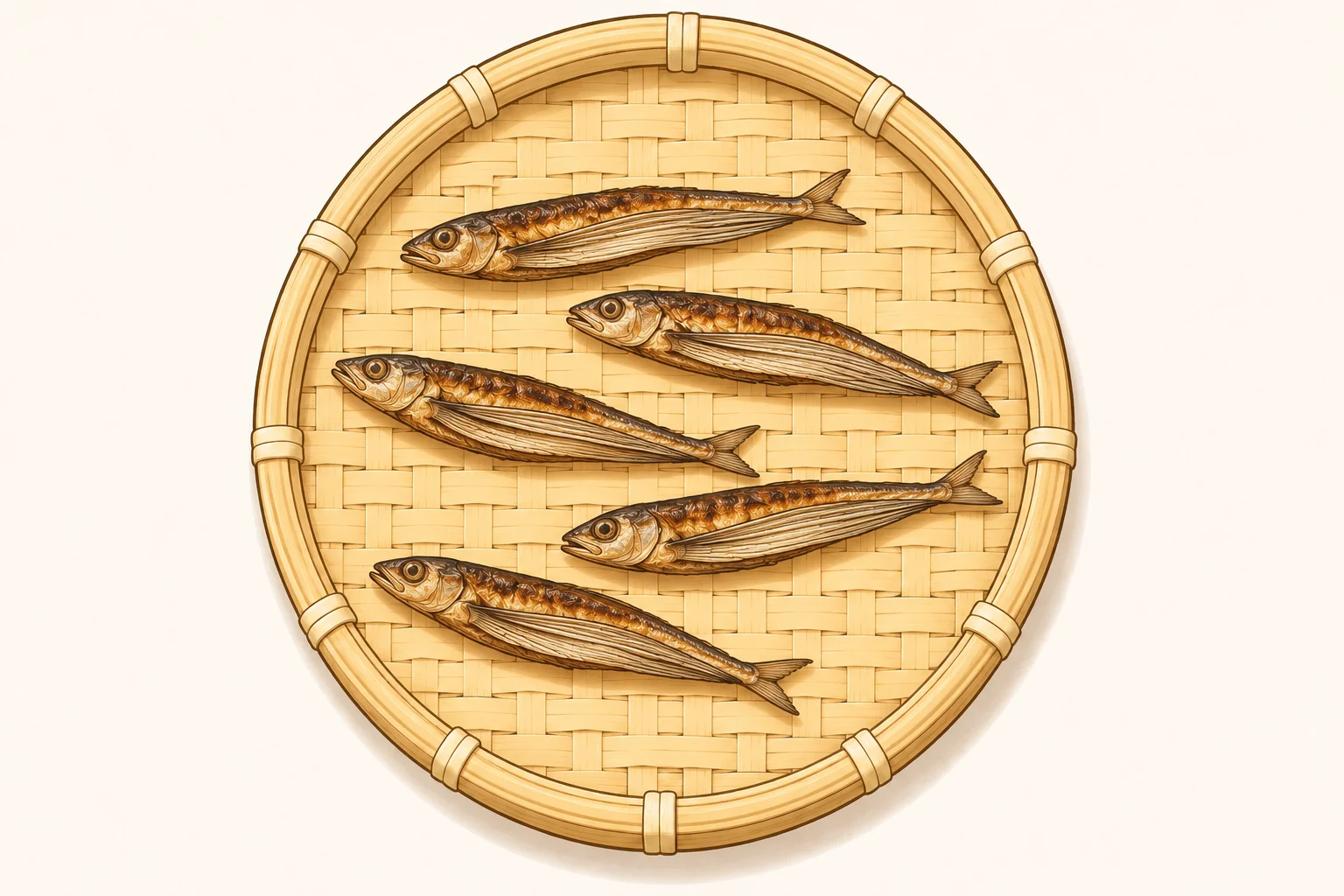
Grilled dried flying fish, the base of ago dashi, a specialty of Kyūshū.
Compared with a French veal stock or a Chinese pork-bone broth, dashi is fast and lean. Those stocks extract gelatin and fat over hours and are valued for body. Dashi aims for clarity. A good one is pale gold, transparent to the bottom of the bowl, and tastes of almost nothing on first contact, then fills the mouth with a savory depth that makes you want another sip.
Japanese cooks rarely serve dashi on its own; it is a foundation. Whisk in miso and you have miso soup. Season it lightly with salt and light soy sauce and it becomes suimono, a clear soup. Add soy sauce and mirin and it is the dipping sauce for cold soba or the hot broth for udon. Beat it into eggs and steam them for chawanmushi, or roll it into layers of omelet for dashimaki tamago. Simmered dishes, the nimono of home cooking, usually start with dashi before soy sauce and sugar go in. A Japanese person who eats rice, miso soup and a simmered side dish is consuming dashi at nearly every meal.
02First Dashi, Second Dashi
Restaurant kitchens make ichiban dashi, "first dashi," for dishes where the stock itself is on display. The method is simple and unforgiving. Wipe a piece of kombu with a damp cloth, soak it in cold water, and heat it slowly. Just before the water boils, lift the kombu out; if it boils, it releases slime and a sea-weedy smell. Lower the heat or add a splash of cold water, drop in a generous handful of katsuobushi flakes, and let them sink. After a minute or two, strain the liquid through cloth without pressing the flakes, which would cloud the stock and draw out bitterness. The result is clear, fragrant and delicate.
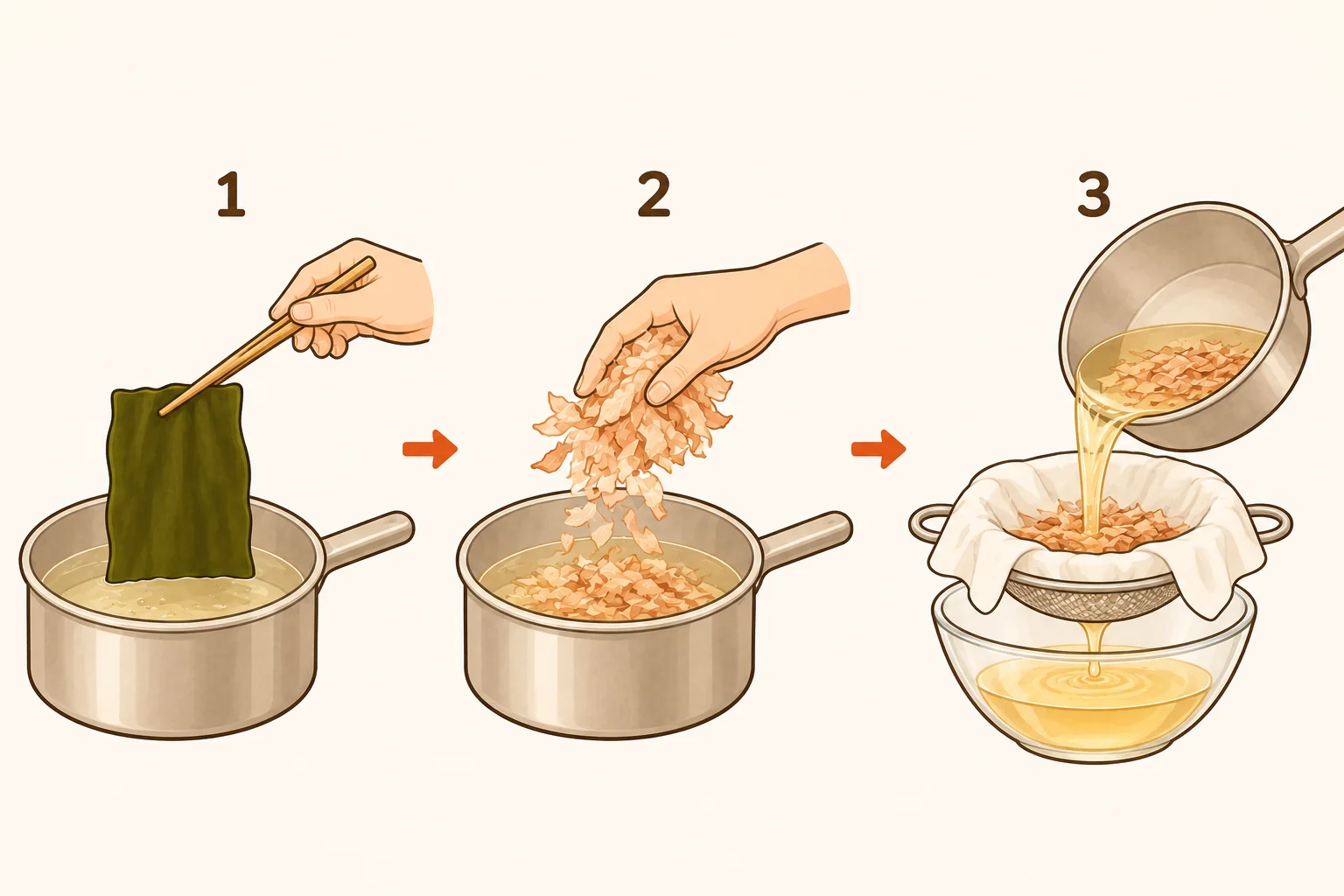
Ichiban dashi in three steps: lift out the kombu before the boil, add katsuobushi, strain through cloth once it sinks.
The spent kombu and bonito still have flavor in them. Simmered again in fresh water for ten minutes or so, often with a few extra flakes, they produce niban dashi, "second dashi." It has less aroma but more body, and it is the workhorse for miso soup and simmered vegetables. The two-stage method sums up the logic of the stock: the first pass is for fragrance, the second for taste.
Kyoto chefs tend to be the most particular about kombu. Some hold it in water at around 60°C for a long, slow steep, reportedly for about an hour, to draw out only its clean sweetness. Many home cooks make mizudashi, cold-brew dashi, by leaving kombu in a jug of water in the refrigerator overnight.
Katsuobushi comes in grades. The everyday kind, arabushi, has only been smoked and dried and has a dark, rough surface. The top grade, honkarebushi, is inoculated with a mold and alternately sunned and stored over a period of months; the mold-curing stage alone takes four to six months. The mold draws out moisture and breaks down fats, so the finished fillet shaves into pale pink flakes with a rounder, less fishy aroma. A good honkarebushi rings like wood when two pieces are knocked together, and it is often described as the hardest food in the world.
03Ikeda Kikunae and the Discovery of Umami
Why dashi tastes so good was not explained until the early twentieth century. In 1908 Ikeda Kikunae, a chemist at Tokyo Imperial University, isolated glutamic acid from a kombu broth. He argued that its taste was not a combination of sweet, sour, salty and bitter but a fifth basic taste, and in a paper the following year he named it umami, from the Japanese word for "delicious." By his own account, the spark was a bundle of stock kombu his wife brought home; a more popular version of the story credits a pot of yudōfu, tofu simmered in kombu broth.
Ikeda patented a method of producing monosodium glutamate, and in 1909 the businessman Suzuki Saburōsuke began selling it under the name Ajinomoto, "essence of taste." MSG went on to become one of the most widely used seasonings in East Asia.
Two more discoveries followed. In 1913 Ikeda’s student Kodama Shintarō identified inosinic acid as the savory compound in katsuobushi. In 1957 Kuninaka Akira, a researcher at the soy sauce maker Yamasa, showed that guanylic acid also tastes of umami, and it was later identified as the savory compound in dried shiitake. Researchers then showed that glutamate and these nucleotides work together: combined, they produce an umami far stronger than either alone. Kombu supplies glutamate; bonito supplies inosinate. Japanese cooks had arrived at the pairing by taste centuries before chemistry explained it.
For decades, Western scientists treated umami as a Japanese curiosity rather than a real taste. In 1985 the first international symposium on umami, held in Hawaii, adopted the word as the scientific term, and the case was settled around 2000, when researchers identified taste receptors on the tongue that respond specifically to glutamate. Since then "umami" has become an ordinary English word, used by chefs talking about tomatoes, parmesan, anchovies and soy sauce. Its origin is a pot of kelp stock.
Umami also explains why dashi matters so much in Japanese cooking. Traditional Japanese food uses little animal fat, and for long stretches of history meat-eating was restricted. Savory depth had to come from somewhere else. A well-made dashi lets a dish feel satisfying with less salt and almost no oil.
04The Kelp Road and the Bonito Coast
Neither of dashi’s main ingredients comes from Japan’s historic heartland. Kombu grows in the cold waters around Hokkaidō; skipjack tuna is caught in the warm Kuroshio current off the Pacific coast and further south. Bringing them together in the kitchens of Kyoto, Ōsaka and Edo (old Tokyo) was a feat of trade.
Kombu first appears in the court chronicle Shoku Nihongi, in an entry for 715, as a tribute sent from the north. It became an everyday ingredient in the Edo period (1603–1868) thanks to the kitamaebune, cargo ships that sailed from Ōsaka through the Inland Sea and up the Japan Sea coast to Hokkaidō, then called Ezo. They carried rice, salt and goods north and came back with herring and kombu, selling cargo at ports along the way. Historians call this route the "kombu road." Kombu was unloaded at Tsuruga, Toyama and Ōsaka, and some of it continued south through the Satsuma domain to the Ryūkyū Kingdom (Okinawa) and on to China. The legacy is still visible. Households in Toyama City spent more on kombu than those in any other Japanese city in 2022–2024 on average, Okinawa once topped the country in kombu purchases, and in Okinawan stews kombu is eaten in thick knotted pieces as a vegetable rather than discarded. Ōsaka became the center of kombu processing and wholesaling, and old kombu merchants still trade there.
- 1Hokkaido (Ezo)herring and kombu loaded
- 2Tsuruga, Toyama, Osakakombu unloaded
- 3Satsuma
- 4Ryukyu Kingdom (Okinawa)
- 5China
Kitamaebune carried Hokkaido kombu to the Japan Sea ports and Osaka; some continued through Satsuma and Ryukyu to China.
Hokkaidō kombu varies by coast, and cooks choose accordingly. Rishiri kombu gives a clear, refined stock and is the favorite of Kyoto restaurants. Ma-kombu, from the area around Hakodate, is sweet and full-flavored, the traditional choice in Ōsaka. Rausu kombu, from the Shiretoko Peninsula, yields a strong, darker stock. Hidaka kombu is softer and is often eaten simmered as well as used for stock. Some merchants age kombu in storehouses for a year or more, a practice called kuragakoi, which is said to mellow its flavor.
Bonito has its own long history. Dried skipjack, written with characters meaning "hard fish," appears among the taxes paid to the ancient court, though that product was simply boiled or sun-dried. The smoked katsuobushi of today is generally thought to have taken shape in the seventeenth century. According to tradition, a fisherman named Jintarō from Inami in Kishū (today’s Wakayama) refined a method of drying bonito over smoke in Tosa (Kōchi), and Tosa katsuobushi became famous. Mold-curing developed later and spread to other regions. Today almost all katsuobushi comes from two prefectures: Makurazaki and Ibusuki (Yamakawa) in Kagoshima, and Yaizu in Shizuoka, where frozen skipjack from southern fishing grounds is processed.
In Edo the bonito trade clustered in Nihonbashi. Ninben, a katsuobushi merchant founded in 1699, still does business there. The shop was originally called Iseya Ihei; its emblem joined the "person" radical from the character 伊 with a carpenter’s square standing for steady, sound business, and Edo townspeople started calling the shop by the name of that radical, ninben. Katsuobushi could be stored for a long time, was expensive, and its name could be read as a pun on "victorious man," so it became a standard auspicious gift for weddings and celebrations, a custom that survives in traditional betrothal gift sets.
05East Versus West
Ask a Japanese person about dashi and the conversation will soon turn to the difference between Kantō, the Tokyo region, and Kansai, the Ōsaka–Kyoto region. The short version is that Kansai cooking leans on kombu and light-colored usukuchi soy sauce, giving a pale, gentle broth, while Tokyo leans on katsuobushi and dark koikuchi soy sauce, giving a deeper color and a sharper aroma. The clearest place to see it is a bowl of noodles. Tokyo soba broth is nearly black; you cannot see the bottom of the bowl. In Ōsaka or Kyoto, udon broth is a transparent amber, and to many palates it tastes richer for being lighter. Since its launch in 1976, Nissin’s Donbei instant udon has been sold with two broths, a dark bonito one in the east and a pale kombu one in the west, with the line drawn near Sekigahara in Gifu Prefecture.
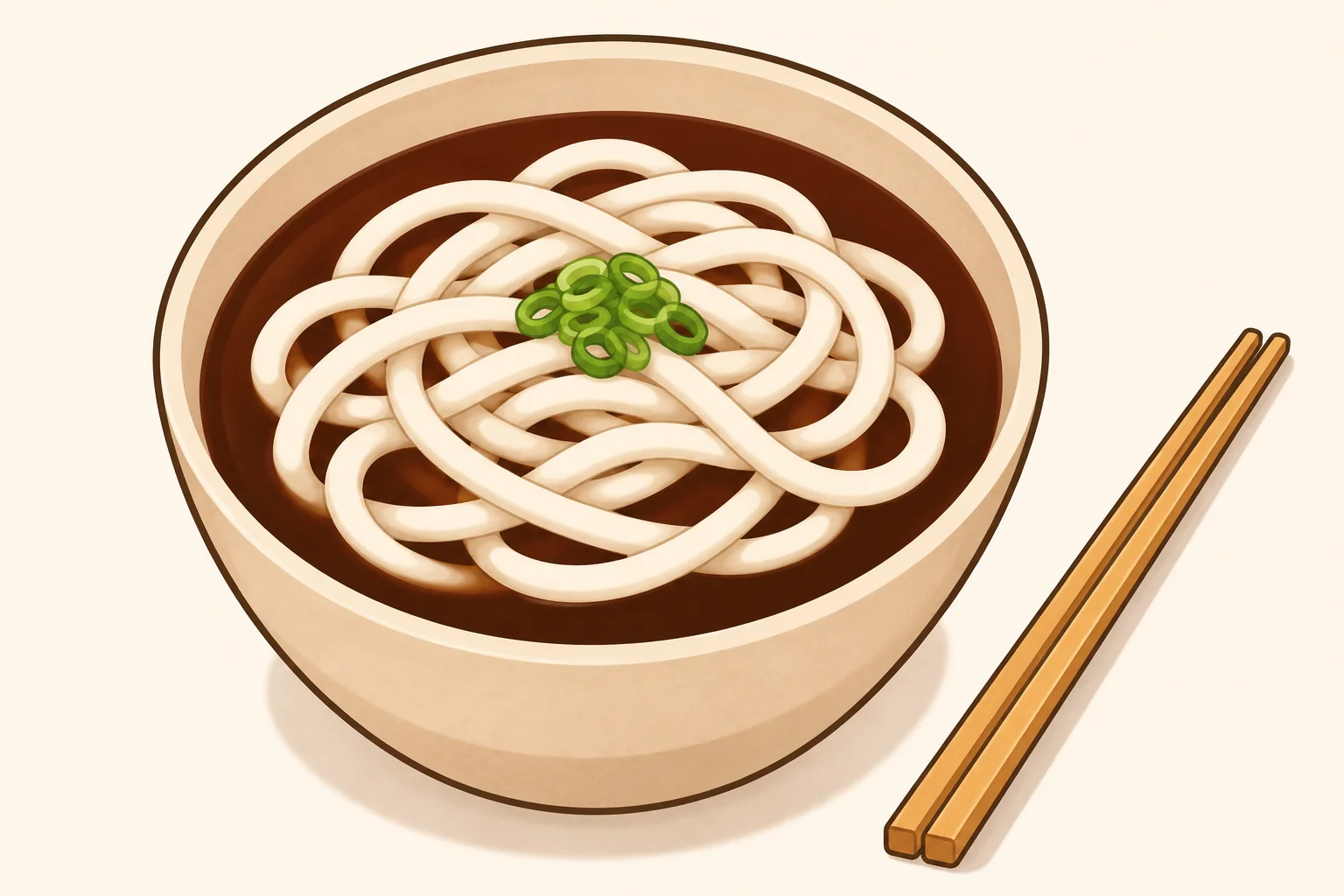
Tokyo leans on katsuobushi and dark koikuchi soy sauce; the broth is so dark it hides the bottom of the bowl.
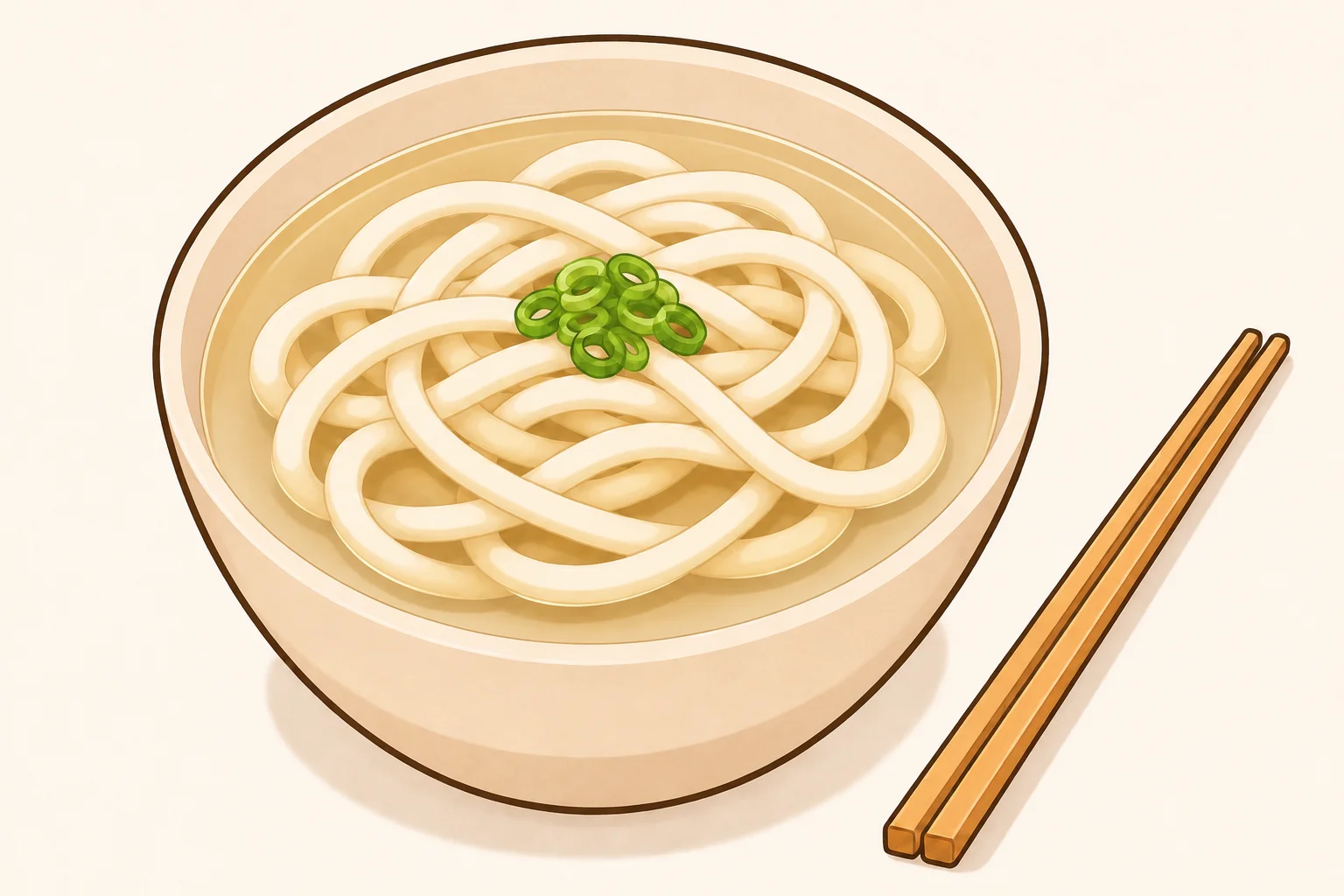
Ōsaka and Kyoto lean on kombu and light usukuchi soy sauce; the broth is a transparent amber.
Three explanations are usually given. One is supply: kombu arrived in Ōsaka on the kitamaebune, while bonito came from the Pacific side, closer to Edo. Another is water: the popular theory holds that Kansai’s softer water extracts kombu flavor more easily than the harder water around Tokyo, though how much this matters is debated. The third is taste culture: Kyoto’s cuisine descends from court and temple cooking that prized the natural color of ingredients, while Edo was a city of artisans and laborers who liked strong flavors that went well with rice.
In practice, Tokyo restaurants use kombu and Ōsaka households use bonito; the differences lie in proportions, choice of soy sauce and color. But "dark in the east, pale in the west" remains one of Japan’s favorite food debates.
06From the Shaving Box to the Dashi Bag
A few generations ago, many Japanese kitchens had a katsuobushi kezuriki, a wooden box with a plane blade set into its lid and a drawer underneath to catch the flakes. The scrape of bonito across the blade before breakfast is a childhood memory for many older Japanese.
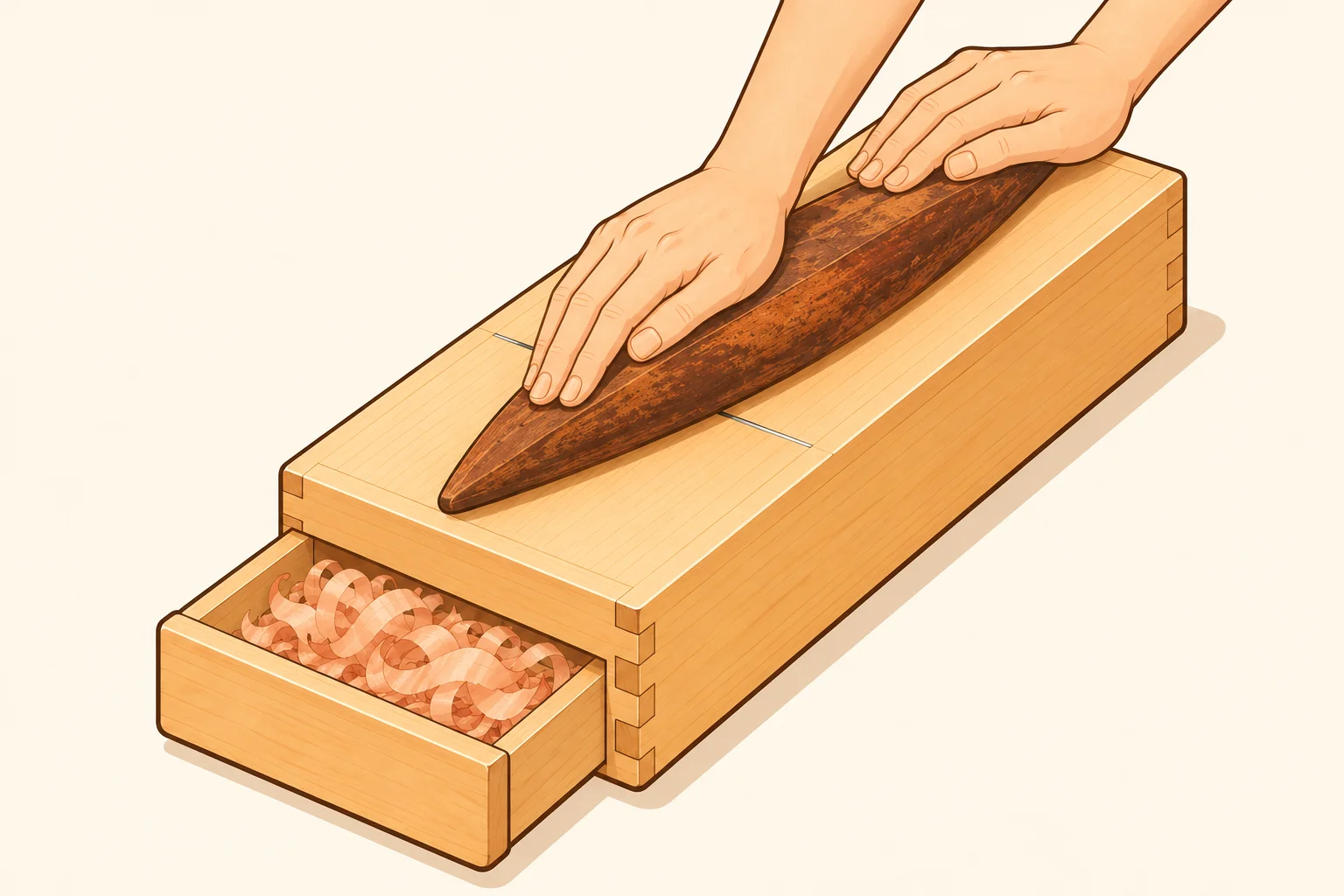
A katsuobushi kezuriki: a wooden box with a plane blade set into its lid and a drawer underneath to catch the flakes.
After World War II, that sound faded. Pre-shaved flakes in sealed packets became common, followed by granulated instant dashi. Ajinomoto’s Hondashi, launched in 1970, made bonito-flavored stock as simple as adding hot water, and it is still a fixture in home kitchens. Bottled mentsuyu, a concentrate of dashi, soy sauce and mirin, and shiro-dashi, a pale seasoned stock, followed. In a Japanese supermarket today the dashi section can fill an entire shelf.
The past two decades have brought a middle path: the dashi pack, a tea-bag-like pouch of ground bonito, kombu, shiitake or flying fish that is simmered for a few minutes. Kayanoya, a brand from Fukuoka, built its reputation on these packs and has counters in department stores across Tokyo and Ōsaka; they make a popular souvenir. At the same time, some home cooks have returned to whole fillets and the shaving box, or keep a jug of cold-brew kombu water in the fridge. When UNESCO inscribed washoku, traditional Japanese food culture, on its list of intangible cultural heritage in 2013, dashi was widely presented as its foundation.
Dashi has also moved beyond traditional cuisine. Many ramen shops blend a seafood dashi into pork or chicken broth to make a "double soup," and its flavor shows up in oden, Japanese curry and the soups of yōshoku, Japan’s Western-style cooking.
07Tasting and Buying Dashi in Japan
The purest taste of dashi is usually the owanmono, the lidded soup course in a kaiseki or kaiseki-style banquet meal. When you lift the lid, the aroma arrives first. Inside there may be only a dumpling of fish paste, a few vegetables and a sliver of yuzu peel. Many chefs regard this bowl as the hardest test of the meal, since nothing in it can hide a mediocre stock. Smell it first, then sip; the solid ingredients can wait.
Everyday dashi is just as instructive. In Ōsaka, order kitsune udon, noodles topped with sweet fried tofu, and taste the clear golden broth before anything else. Back in Tokyo, stand at a station soba counter and compare the dark, bonito-forward broth. The miso soup at a ryokan breakfast and the oden simmering by the register of a convenience store in winter are also good, cheap lessons.
To take dashi home, start in Nihonbashi, Tokyo. Ninben runs a dashi bar near its flagship where you can drink a freshly made cup of bonito stock for 150 yen (as of 2026), and buy whole fillets, flakes and dashi packs. The shops of Tsukiji Outer Market sell katsuobushi and kombu, and some will shave flakes to order. Ōsaka is the kombu city: old merchants in the Semba business district, and reportedly near Kuromon Market as well, display Rishiri, ma-kombu and Rausu kombu by grade, alongside tsukudani, kombu simmered in soy sauce, and shio-kombu, salted kombu strips. In Tsuruga, on the Japan Sea coast in Fukui, craftsmen still hand-shave kombu into tissue-thin sheets called oboro kombu, a skill now kept up by only a small number of craftsmen.
At home, the simplest dashi needs a hand-sized piece of kombu in a liter of water, soaked for a few hours, then heated gently and removed just before boiling, followed by a handful of katsuobushi, steeped for a minute or two and strained. The first sip tends to explain what Japanese cooks mean when they praise a flavor as clean yet full.