
At a glance
What Japan’s neighborhood penny-candy shops sold, why their prize tickets kept children coming back, how most disappeared, and where to find one today.
- A dagashiya is a corner shop selling cheap snacks and small toys, mostly to children after school.
- Umaibō appeared in 1979 and cost 10 yen for over forty years; it rose to 15 yen in October 2024 and was still that price as of 2025.
- Many snacks are printed with atari ('winner'), and shops hang boards of prize tickets at 10 or 20 yen a pull.
- Edo commoners ate cheap 'one-mon sweets’; the shops’ golden age came in the postwar high-growth years.
- Kamikawaguchiya, in the grounds of Zōshigaya Kishimojin, reputedly dates from 1781 and is called Japan’s oldest dagashiya.
A dagashiya is a tiny neighborhood shop that sells cheap sweets, snacks and toys to children. For generations of Japanese kids it was the first place they ever spent their own money: a ten-yen coin bought a corn puff stick, a strip of vinegared squid, or a lottery ticket that might win a plastic water pistol. Thousands of these shops once stood near schools and shrines across the country, usually run by an elderly woman from the front room of her house. Most have now closed, but the snacks survive, and the shops themselves have become one of the most affectionate symbols of a Shōwa-era childhood. This is a guide to what a dagashiya is, why the Japanese remember it so fondly, where it came from, and how you can still walk into one.
01A Room Full of Ten-Yen Treasures
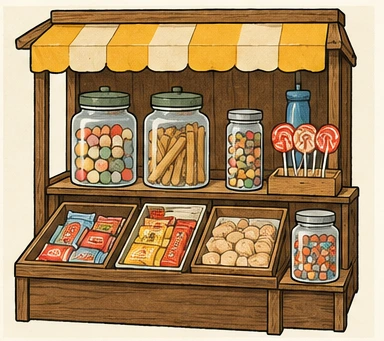
Picture a narrow lane in a residential neighborhood, a few minutes’ walk from an elementary school. On the corner is a wooden house whose ground floor has been turned into a shop. You slide open a glass door and step into a dim room crammed with low shelves. Clear plastic jars hold bundles of snack sticks standing upright like pencils. Cardboard trays are heaped with individually wrapped candies, chewing gum and tiny packets of crackers. From the ceiling hang strips of toys: paper balloons, rubber-band gliders, cheap masks of cartoon heroes, sheets of stickers. Out front there may be a capsule-toy machine or a battered arcade cabinet.
Behind a little table, or perched on the edge of a raised tatami room at the back, sits the shopkeeper. In the popular imagination she is always the dagashiya no obāchan, the dagashiya grandma. She knows every child in the neighborhood by name, does the arithmetic in her head, and keeps the change in a tin box. She will tell you off for touching everything and then slip you an extra candy when you come up five yen short.
The word itself explains the shop. Kashi means sweets or confectionery, and da is a prefix meaning worthless or common. Dagashi are "humble sweets," the opposite of jōgashi, the refined confections made with white sugar for tea ceremonies, temple offerings and guests. A dagashiya is simply a shop that sells them. The prices were set for a child’s pocket: through the 1960s and 1970s most items are remembered as costing about 5 to 30 yen. A child with a hundred-yen coin could spend a whole afternoon working out the best way to divide it.
02What’s on the Shelves
The most famous dagashi of all is Umaibō, literally "delicious stick." It is a hollow, puffed corn rod about the length of a hand, sold by the Yaokin company (made for it by Riska) since 1979 in an enormous range of flavors: corn potage, mentaiko (spicy cod roe), cheese, teriyaki burger, salami, and many more. For more than four decades an Umaibō cost exactly ten yen, and the fixed price became a point of national pride. When the price finally rose to twelve yen in April 2022, blamed on rising costs for ingredients and transport, it made the evening news. A second rise, to fifteen yen, followed in October 2024, and that was still the price as of 2025.
Seafood snacks are another pillar of the dagashiya shelf. Yotchan Ika is shredded squid marinated in vinegar, sour and salty enough to make you pucker, sold in little packets that leave your fingers smelling of the sea. Big Katsu looks like a breaded pork cutlet but is actually a thin slab of fish paste coated in batter and brushed with sweet sauce, a "cutlet" that cost a fraction of the real thing. Cabbage Tarō is a bag of puffed corn balls dusted with green laver and sauce flavor; despite the name, it contains no cabbage; the name is said to come from the balls looking like tiny cabbages.
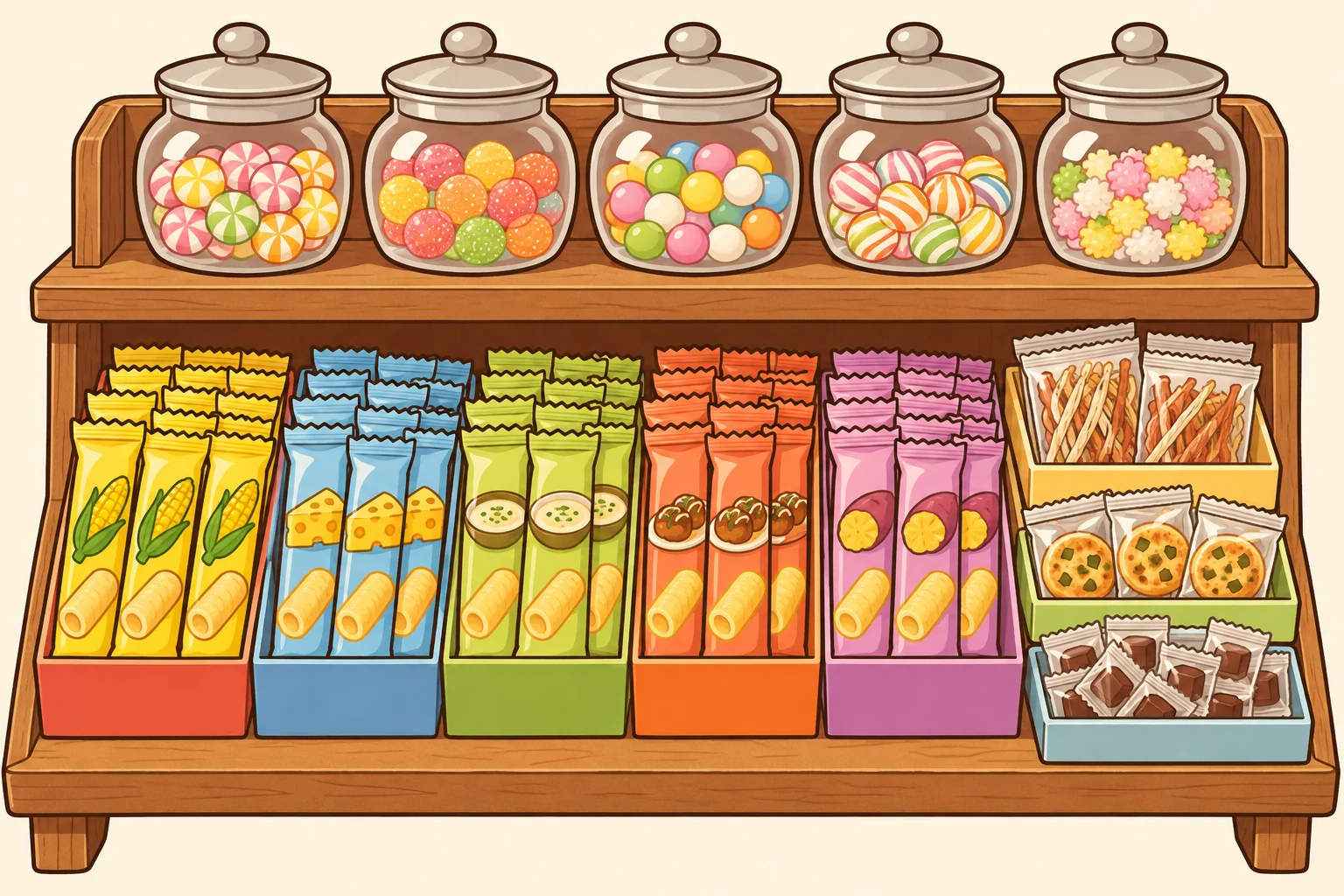
A dagashiya shelf with rows of Umaibō in every flavour and other cheap snacks beside them (illustration).
Sweets range from the simple to the theatrical. Go-en Choco is a chocolate disc wrapped to look like a five-yen coin, a pun on go-en, which also means "good fortune in relationships." Tirol Choco is a small square of chocolate that once sold for ten yen. Kinako-bō is a stick of soft candy rolled in roasted soybean flour; if the tip of your toothpick is painted red, you have won another one. Yogul is a tiny tub of sweet-sour cream eaten with a wooden spatula. There are candy cigarettes, sour powders you pour into water to make fizzy soda, and gummies shaped like cola bottles.
To wash it all down there is ramune, a lemon-lime soda in a glass bottle sealed with a marble. You open it by pressing the marble down into the neck with a plastic plunger; it drops with a pop and a rush of foam, then rattles in the bottle’s waist as you drink. Generations of children have tried to smash or unscrew the bottle to get the marble out.
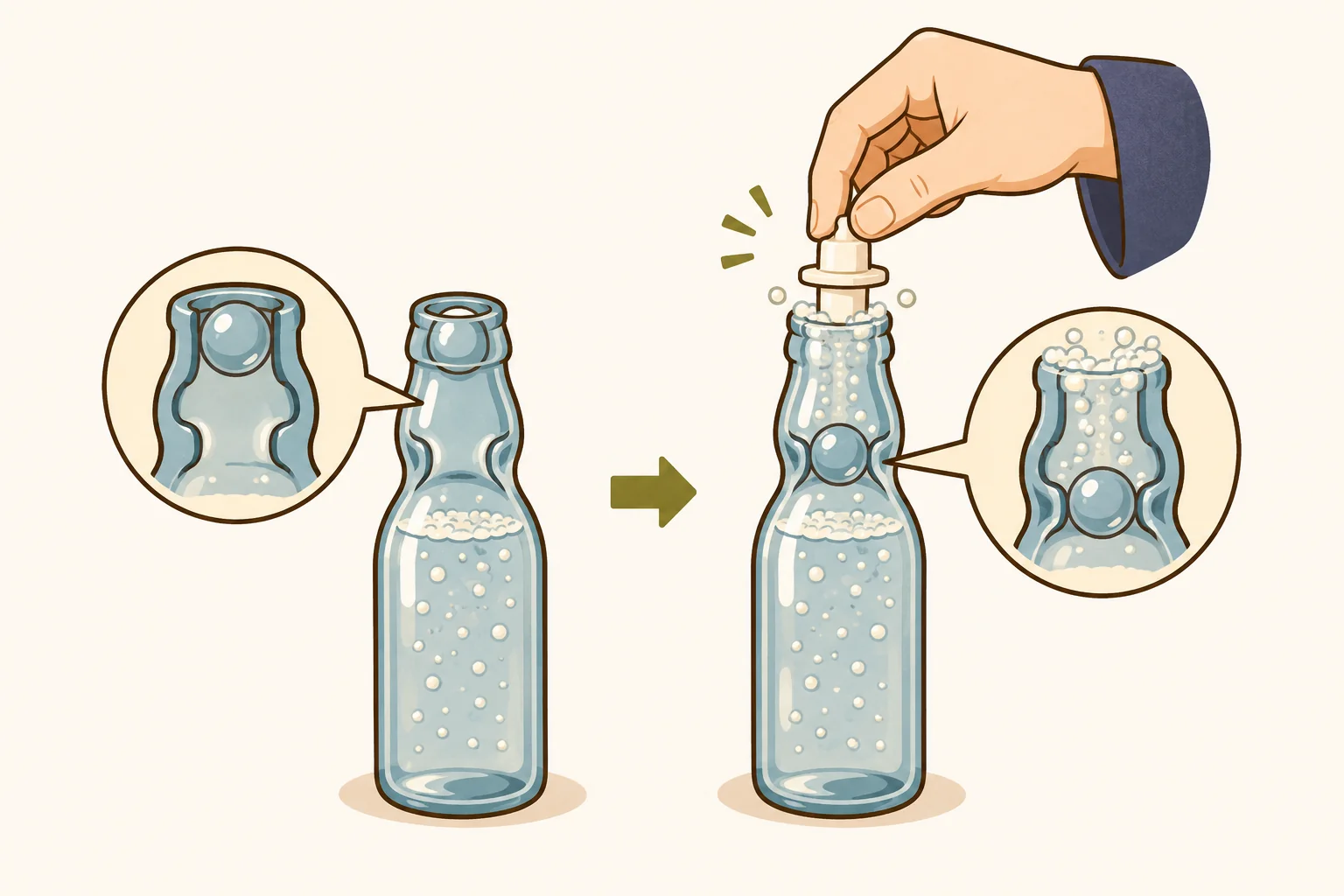
Opening ramune: a plunger presses the marble down into the neck, releasing a rush of foam.
The other half of the shop is toys. Menko are thick cardboard cards printed with sumo wrestlers, baseball players and anime characters; you slap your card down on the ground to try to flip your opponent’s, and if it turns over, you keep it. There are marbles, bamboo-copter toys, bouncy balls, paper balloons you inflate by blowing, and stickers by the sheet.
03The Thrill of Atari
What made the dagashiya addictive was not only the snacks but the gambling built into nearly everything. Many wrappers and sticks are printed with atari, "hit" or "winner," which you can trade for a free one. On the wall hang boards of kuji, paper lottery tickets: you pay ten or twenty yen, tear one off, and peel it open to see what you have won. The top prize might be a large toy or a big bag of sweets. Most tickets win a single small candy.
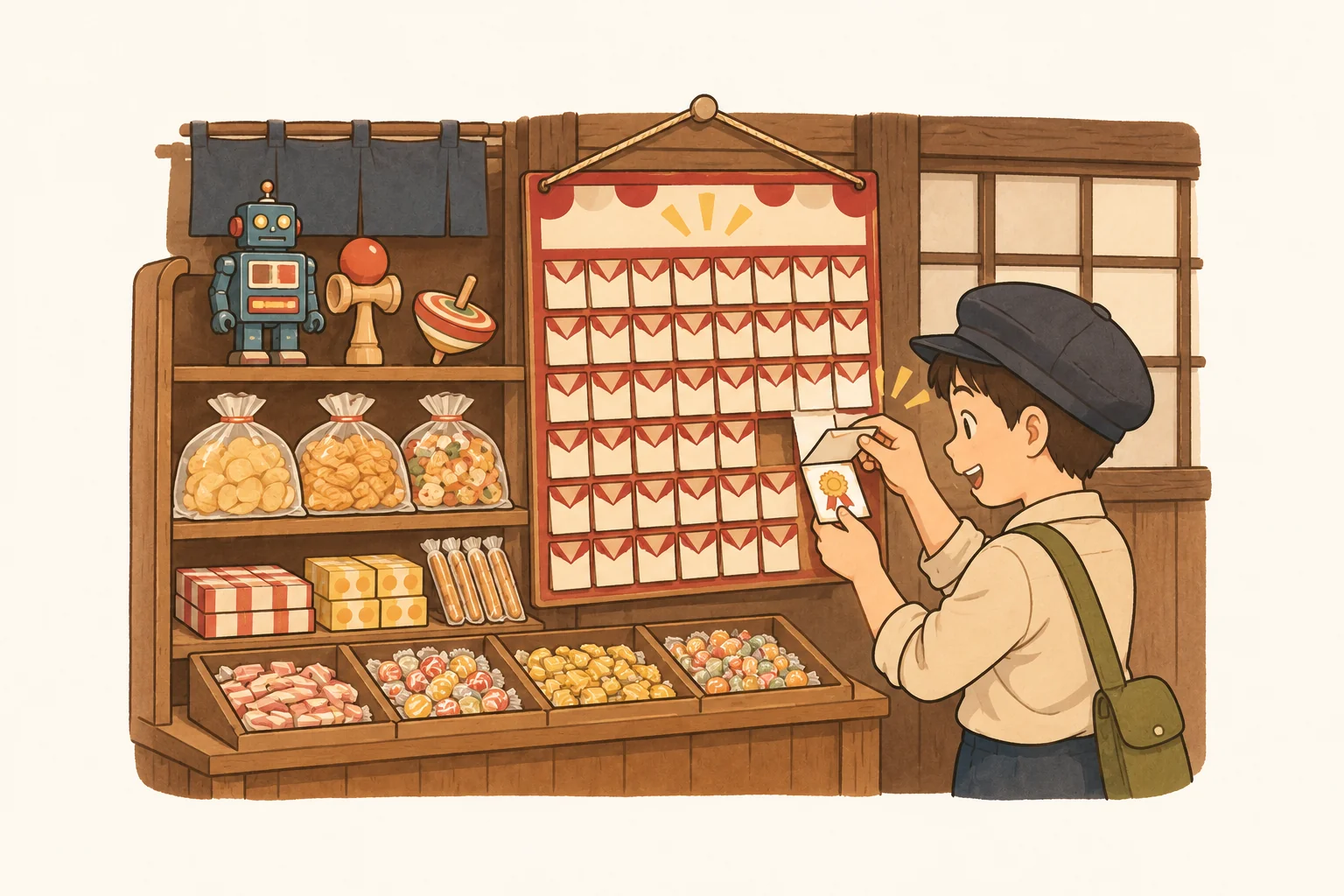
Kuji lottery tickets on a dagashiya wall; a child tears one off and peels it open to see the prize.
It is a clever piece of design. A ten-yen snack becomes a small adventure when there is a chance of winning something more, and the children keep coming back. A winning stick has to be shown to the grandma, who exchanges it with a smile; a losing one just means trying again tomorrow. The shop became an after-school clubhouse where kids compared their luck, traded rare menko and watched one another play the arcade machine by the door.
For many Japanese people the dagashiya was the first place they navigated the world without a parent. You learned to count money, wait your turn, speak politely to an adult, bargain with friends and live with disappointment. The shopkeeper was also part of the neighborhood’s informal watch over its children: she noticed who was bullying whom, who was out too late, and who had pocketed something without paying. When adults today call the dagashiya natsukashii, the word for a warm, wistful nostalgia, they are remembering that close-knit street life as much as the taste of vinegared squid.
04From Edo Snacks to a Postwar Golden Age
Cheap sweets for ordinary people go back to the Edo period (1603–1868). White sugar, much of it generally thought to have been imported, was then expensive, so fine confectionery was reserved for the wealthy, for temples and for formal occasions. Commoners ate sweets made with brown sugar, malt syrup, rice flour and soybean flour, sometimes called ichimon-gashi, "one-mon sweets," after the smallest coin. Little shops and street peddlers sold them in the cities, and the idea of dagashi as cheap, cheerful food for everyday people took shape.
From the 1850s onward, Western drinks and candies entered Japan. Lemonade arrived at the very end of the Edo period: Commodore Perry’s officers are said to have served it to Japanese officials in 1853, and by 1865 it was being made in Nagasaki. The marble-stoppered bottle came later, in the Meiji era (1868–1912). The name ramune is generally thought to be a Japanese rendering of "lemonade." By the early twentieth century city neighborhoods had shops that sold not only sweets but also toys, menko and lottery games aimed at children; by one account, selling toys became common only in the Taishō (1912–1926) and early Shōwa years.
The true golden age came after the Second World War. Once the hungry years of the late 1940s were over, Japan entered a period of rapid economic growth. New housing spread across cities and suburbs, and the baby-boom generation filled the schools. A single neighborhood could hold dozens of elementary-school children, enough to support a dagashiya or two. Many families turned the street-facing room of their home into a shop, with a grandparent minding the counter. The profits were small, but it was a steady livelihood and a useful role for an older family member. In the same years, kamishibai storytellers rode bicycles into vacant lots and clapped wooden sticks to summon children to picture-card shows; to watch, you were expected to buy a stick of the storyteller’s candy. Kamishibai and the dagashiya together defined a Shōwa child’s afternoon.
Behind the shops stood a network of small confectionery factories, many in Tokyo’s old downtown, Ōsaka and Nagoya (Okayama is said to be another), and specialist wholesalers who distributed their products to shops nationwide. These were family businesses running on thin margins, earning fractions of a yen on each item.
05Decline and Afterlife
From the 1980s the number of dagashiya fell steeply, though some would date the shops’ heyday as children’s gathering places to the 1950s. The birth rate dropped, so there were fewer children. Convenience stores and supermarkets spread everywhere and stocked the same snacks. Video games kept kids indoors. The grandmothers who ran the shops grew old, and their children had other jobs. Above all, the economics never worked: selling ten-yen snacks cannot pay modern rent, and most shops survived only because the family owned the building. One by one they closed when their owners died.
The snacks themselves did not disappear. Umaibō, Yotchan Ika and Big Katsu are still sold in supermarkets and convenience stores, and many supermarkets have a dedicated dagashi corner. Large warehouse-style dagashi stores advertise themselves as the biggest in Japan and draw families on weekend outings. Adults buy boxes of dagashi for parties, and some bars and izakaya offer all-you-can-eat dagashi alongside the drinks, a deliberately childish snack paired with beer.
The dagashiya has also found a place in popular culture. The manga Dagashi Kashi, later adapted as an anime, is set in a rural dagashiya and introduces a real snack in nearly every chapter. The children’s book series Fushigi Dagashiya Zenitendō imagines a mysterious shop that sells magic sweets with unpredictable effects, and has become a bestseller among Japanese schoolchildren. Visitors from Taiwan often compare the dagashiya to their own kám-á-tiàm corner shops, and for many Western readers the closest equivalent is the penny-candy counter of an old general store.
06Visiting a Dagashiya Today
In Tokyo the best-known survivor is Kamikawaguchiya, a tiny wooden shop in the grounds of Kishimojin, a temple dedicated to a guardian goddess of children in Zōshigaya, near Ikebukuro. It is said to have been founded in 1781 and is often called the oldest dagashiya in Japan. It is said to have stayed in one family throughout, and as of 2022 its shopkeeper was Uchiyama Masayo, the thirteenth generation. The temple grounds are known for a centuries-old ginkgo, which the shop is said to stand beside, and visitors routinely stop at the shop for a few snacks on their way out.
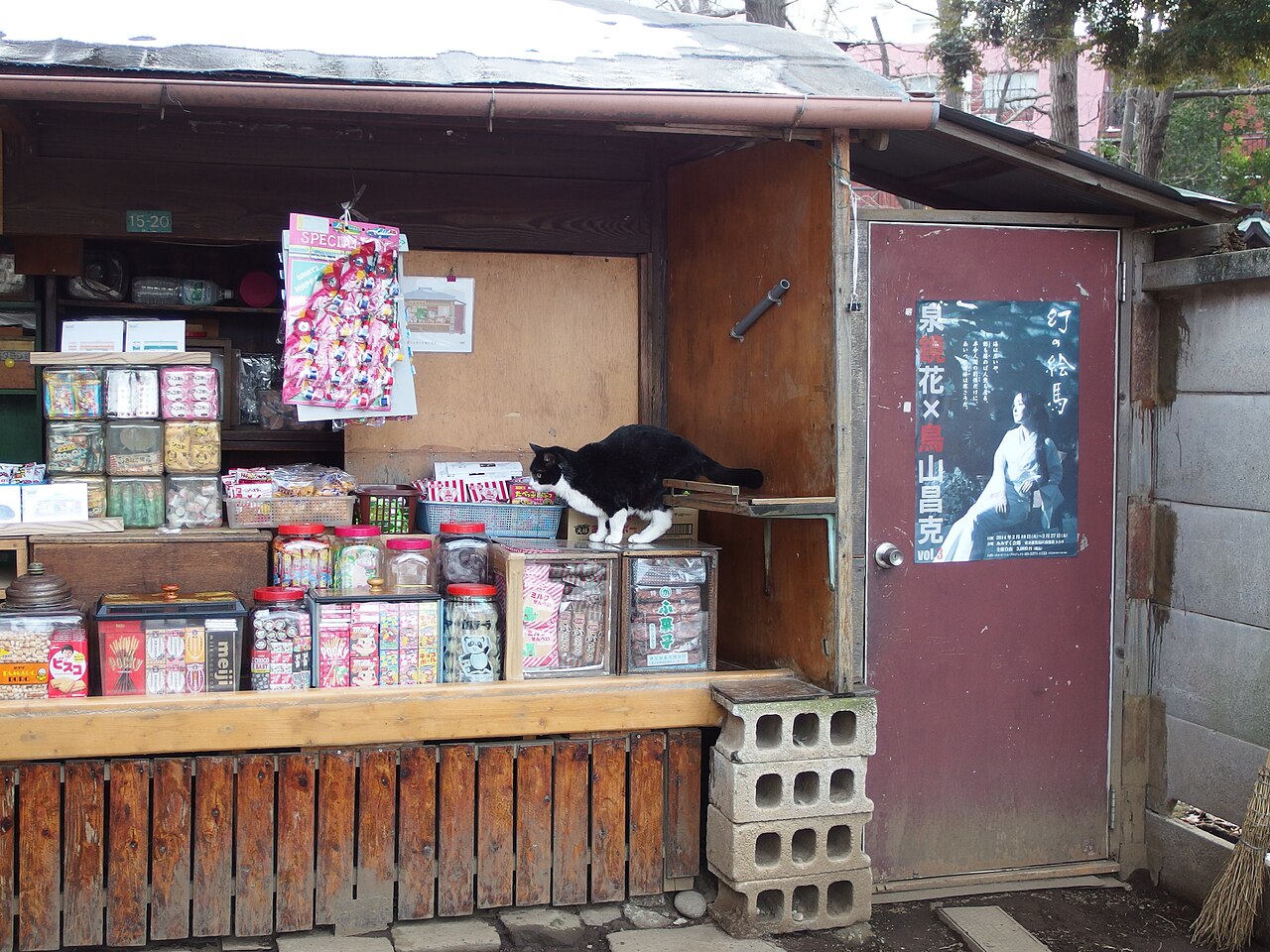
Kamikawaguchiya in the grounds of Zōshigaya Kishimojin: a small wooden hut, its snacks in clear jars and boxes.Guilhem Vellut, "Candy shop @ Kishimojin Temple @ Toshima," CC BY 2.0 · CC BY
Elsewhere, dagashiya survive in older neighborhoods and in tourist streets that trade on Shōwa nostalgia, sometimes with vintage posters and enamel signs on the walls. Several museums and theme attractions recreate whole Shōwa-era streets indoors, and a dagashiya is always one of the buildings.
The etiquette is simple. Pick up a small basket if one is offered, choose what you want, and bring it to the counter to pay. Everything is sold individually, so buying one of this and one of that is completely normal, and a total of a few hundred yen is a big purchase. Bring coins, especially ten-yen pieces; many older shops cannot break large notes and do not take cards. The aisles are narrow, so take off your backpack before you turn around. If there are local children in the shop, let them choose first. It is still their place.
For a first visit, try two or three flavors of Umaibō, a packet of Yotchan Ika, a Big Katsu and a five-yen chocolate, then pull a lottery ticket and buy a bottle of ramune. Stand outside, press the marble down, and listen for the pop. For less than three hundred yen you will have tasted the walk home from school for several generations of Japanese children.