
At a glance
How curry reached Japan by way of Britain, spread through the navy and boxed roux, and branched into katsu curry, soup curry and more.
- Japanese curry descends directly from the 19th-century British curry stew made with curry powder and thickened with flour.
- In the Meiji era the navy adopted curry to fight beriberi, and discharged sailors carried it home.
- The Maritime Self-Defense Force still eats curry every Friday; Yokosuka calls itself the "City of Curry."
- Solid roux blocks reached the market in the 1950s and 1960s: break off a few squares, drop them in the pot, and the curry is done.
- Otsuka Foods’ Bon Curry, launched in 1968, was one of the first retort-pouch foods sold to ordinary consumers.
Ask Japanese people what they cook most at home, or what they loved most as children, and curry rice (karē raisu) comes up again and again. It is not a dish Japan sends abroad as a symbol of itself, the way it does sushi or ramen, yet it may be the most widely eaten meal in the country: thick, glossy, mildly sweet, ladled beside a mound of white rice. It came from India by way of Britain, arrived in the 1870s as an exotic Western food, and over a century and a half turned into something no Indian cook would recognize. This is the story of what Japanese curry is, why it tastes the way it does, how it got into every kitchen in the country, and where to eat its best versions when you visit.
01What Japanese Curry Is
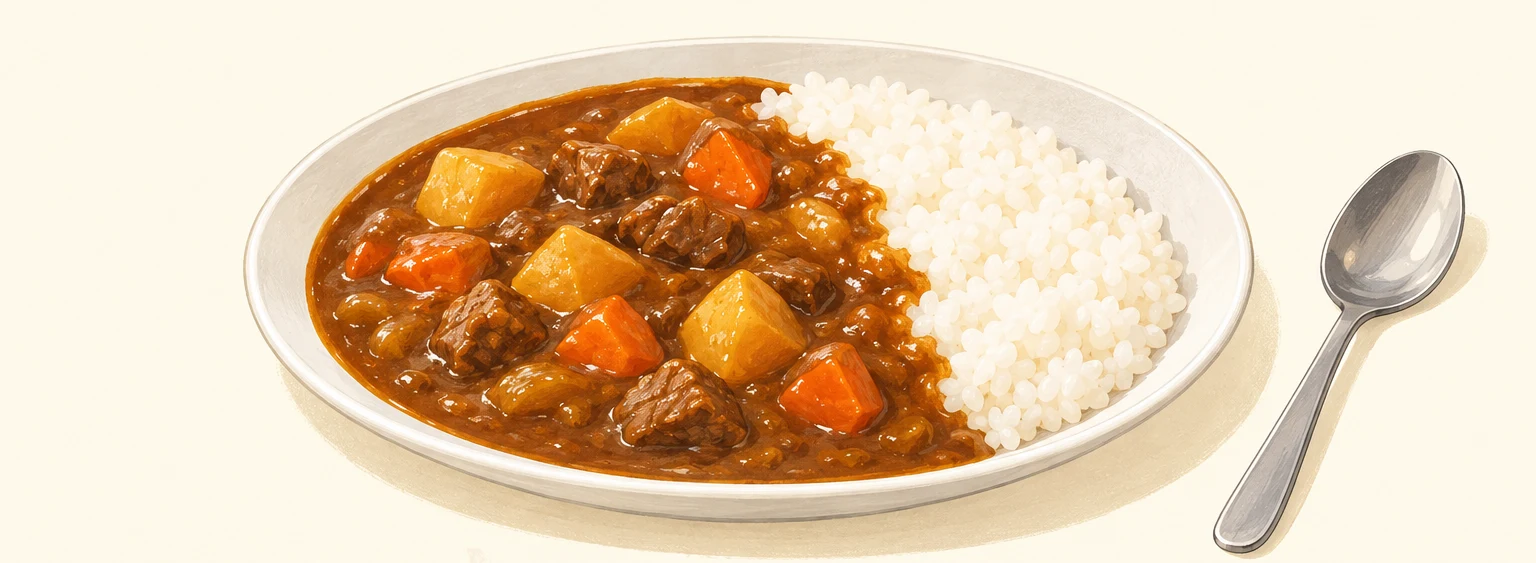
Picture the standard plate. An oval white dish holds rice on one side and, on the other, a dark brown sauce thick enough to coat the back of a spoon. In it are soft chunks of potato, carrot and onion, and pieces of pork or beef. At the edge sits a small heap of fukujinzuke, a crunchy red relish of pickled vegetables in sweet soy, or a few sweet-pickled shallots called rakkyō. You eat it with a spoon.
If you know Indian food, the differences are obvious at the first bite. Most Indian curries are built from whole and ground spices fried in oil, and their sauces range from thin to almost dry. Japanese curry is thickened with a roux of flour cooked in fat, the way a French cook would thicken a stew, and its texture is closer to gravy. The heat is gentle and rounded. Onions are cooked down until they caramelize, and home cooks quietly add grated apple, honey, ketchup, Worcestershire sauce, a square of dark chocolate or a spoonful of instant coffee. The goal is depth and sweetness rather than sharp spice. Packets are labeled amakuchi (mild), chūkara (medium hot) and karakuchi (hot), and in most families the children get the mild one.
It is not Thai curry either; there is no coconut milk, lemongrass or fish sauce. The real ancestor of Japanese curry is the British curry of the nineteenth century: a meat stew seasoned with ready-made curry powder and thickened with flour, served with rice. Japan adopted that dish and kept pushing it further toward rice.
Regional habits shape the meat. Eastern Japan, around Tokyo, tends to use pork; western Japan, around Ōsaka and Kōbe, prefers beef, in line with the long-standing meat preferences of the two regions. Chicken and seafood curries are common everywhere.
02A Western Dish from British Ships
Curry entered Japan after the country opened its ports in the 1850s and 1860s. By around 1872, the first cookbooks introducing Western cuisine to Japanese readers included recipes for it. One called for leeks, ginger and garlic fried with curry powder, then simmered with chicken, shrimp, sea bream, or frog. The curry powder itself was imported from British firms, and the dish was filed alongside beefsteak and cutlets as yōshoku, Western food: novel, prestigious and expensive.
At first it was called raisu karē, "rice curry"; the reverse form, karē raisu, slowly became standard. Both names survive. People sometimes claim that one means rice and sauce served together and the other means served separately, but nobody uses the distinction consistently, and older people and old-fashioned cafeterias still say raisu karē.
Schools and the military carried curry out of the Western restaurants and into ordinary life. Sapporo Agricultural College in Hokkaidō is said to have served curry rice in its dormitory, and a popular story holds that the American educator William S. Clark, the school’s head teacher, banned students from eating rice except with curry, as part of a push toward bread and Western diet. The story is widely repeated but is generally considered a later embellishment.
The firmer line runs through the navy. The Imperial Japanese Navy modeled itself on Britain’s Royal Navy, including in the galley. In the 1880s it was also losing large numbers of sailors to beriberi, and the naval surgeon Takaki Kanehiro became convinced that the cause was a diet of almost nothing but polished white rice. He pushed for meat, bread and barley in the rations. Curry fit the problem neatly. One pot could hold meat and vegetables together, it could be made in bulk for hundreds of men at once, and because it was eaten over rice, sailors who wanted rice above all would actually eat it. The army also put curry into its cooking manuals. When conscripts went home, they took the taste with them, and curry spread through towns and villages that had never seen a Western restaurant.
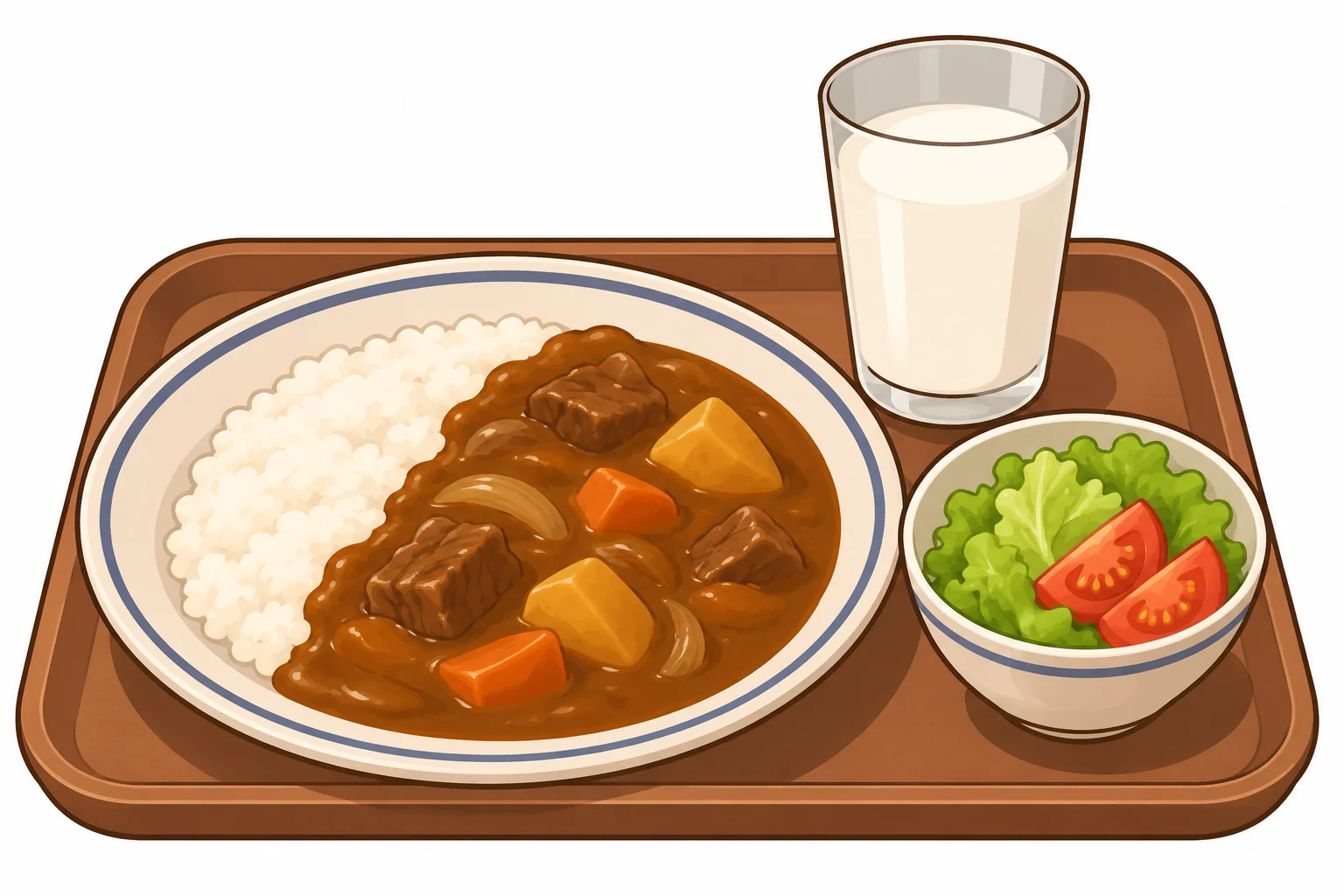
Yokosuka navy curry served the traditional way, with a glass of milk and a small salad (illustration).
That heritage is still advertised. "Navy curry" is a recognized style. Japan’s Maritime Self-Defense Force serves curry every Friday, a custom often explained as a way for crews on long voyages to keep track of the days, and each ship guards its own recipe. The port city of Yokosuka, south of Tokyo and long home to the navy, brands itself the "City of Curry." Restaurants there serve Yokosuka Navy Curry made from a Meiji-era naval recipe, and by local rule it comes with a glass of milk and a small salad, as the old rations did.
03The Roux Block: A Pot of Stew in a Box
Curry became Japan’s everyday dish because Japanese companies learned to make it easy. Domestic curry powder appeared in Ōsaka in the early twentieth century, and in the 1920s Yamazaki Minejirō, founder of what became S&B Foods, developed a Japanese curry powder to rival the British imports that until then had been nearly synonymous with the product.
The real revolution was the solid roux block. It looks like a bar of chocolate scored into squares: flour, fat, curry powder and seasonings, cooked and pressed into shape. You break off a few squares, drop them into a pot of simmered meat and vegetables, stir, and the sauce thickens on its own. Powdered and paste roux came first; solid blocks reached the market in the 1950s and 1960s, and food companies fought for kitchens with heavy television advertising. In 1963 House Foods launched Vermont Curry, sweetened with apple and honey and pitched squarely at children. Its 1970s commercials featured the pop singer Saijō Hideki shouting "Hideki, kangeki!" ("Hideki is thrilled!"), a line people of a certain age can still quote. S&B’s Golden Curry and House’s Java Curry followed, and all three still fill supermarket shelves.
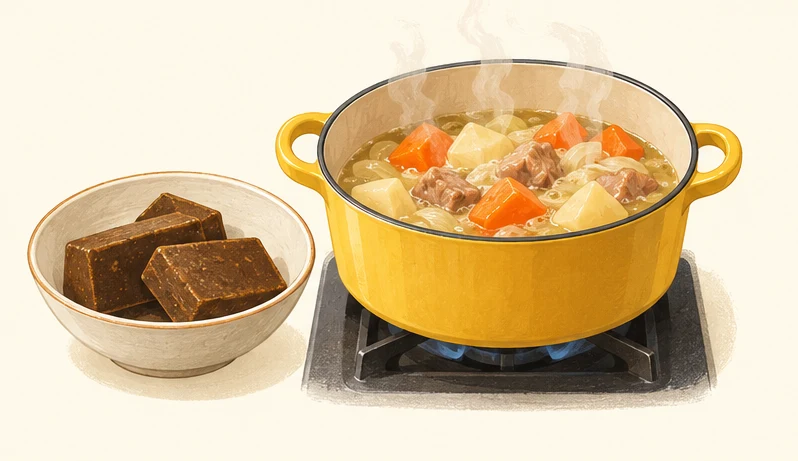
Solid curry roux blocks, like squares of chocolate, waiting to go into a pot of simmering meat and vegetables.
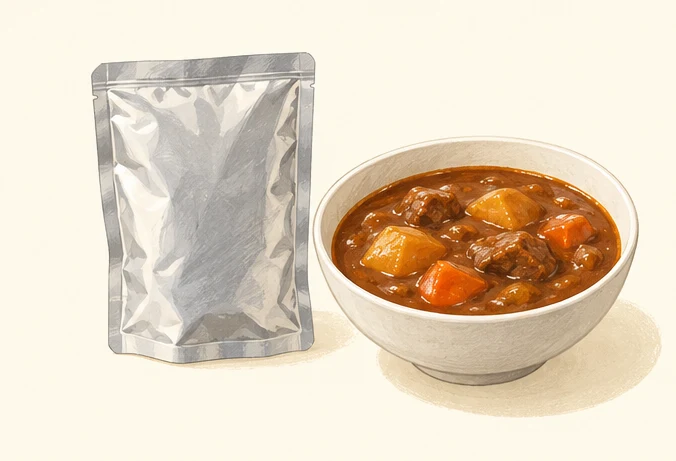
Retort curry: heat the silver pouch, pour it out, and the curry is ready
The roux block standardized the dish. A cook did not need to know cumin from coriander. The recipe printed on the back of the box, onion, carrot, potato and meat, browned, simmered, then finished with the roux, has barely changed in decades and is effectively the national recipe. Because everyone starts from the same base, every family adds its own touch: two brands mixed together, a spoonful of jam, a dash of soy sauce, a little yogurt. That small secret is what makes "my mother’s curry" taste different from anyone else’s.
The other invention was retort-pouch curry. In 1968 Otsuka Foods launched Bon Curry, one of the first retort-pouch foods sold to ordinary consumers anywhere in the world: a sealed pouch you heat in boiling water for a few minutes and pour over rice. The box showed the actress Matsuyama Yōko, and enamel advertising signs with her face, said to have been blue, once hung on shop walls across rural Japan. Today Japanese supermarkets carry an astonishing range of pouch curries, and tourist shops sell gotōchi (local specialty) versions made with Hokkaidō scallops, Hiroshima oysters or regional wagyu.
04The Pot at Home
For most Japanese people, curry is first of all a home memory. It is a reliable children’s favorite and often the first dish a child learns to cook. Mothers’ curry, school lunch curry, and the curry classmates cook together over open fires on school camping trips are shared experiences across the country, and curry has long ranked near the top of school lunch menus.
Home curry is made in a big pot meant to last two or three meals, and almost everyone agrees that "second-day curry" tastes better. Overnight, the potatoes and onions break down into the sauce and the flavors settle. There is a catch: a large pot cooling slowly at room temperature is a good home for bacteria, and health authorities regularly remind people to divide leftovers into small containers and refrigerate them quickly.
Leftovers have their own afterlife. Thinned with dashi and poured over noodles, curry becomes curry udon. Spread over rice, topped with cheese and an egg and baked, it becomes yaki karē, baked curry, the signature dish of the port district of Mojikō in Kitakyūshū.
05Famous Restaurants and Local Variations
Once curry was everywhere, it began crossing with other Japanese foods.
The best known hybrid is katsu karē, curry rice topped with a sliced, breaded pork cutlet. The Ginza restaurant Swiss claims to have created it in 1948 for Chiba Shigeru, a player for the Yomiuri Giants baseball team, who supposedly wanted his cutlet and curry on one plate to save time. Other restaurants claim earlier versions, so treat the Swiss story as the most famous of several.
Soba restaurants have their own curry. They thin it with dashi made from bonito and kelp, flavor it with soy sauce and thicken it with starch, so it tastes savory and brothy rather than rich and buttery. Curry udon and karē nanban soba are winter staples, and Sanchōan, an old soba shop near Waseda in Tokyo that closed in 2018, was said to have invented karē nanban in the late Meiji period. Karē pan, curry bread, wraps curry in dough, coats it in breadcrumbs and deep-fries it; a bakery in Tokyo’s Kōtō ward claims to have invented it in 1927, and today it is sold in bakeries and convenience stores everywhere.
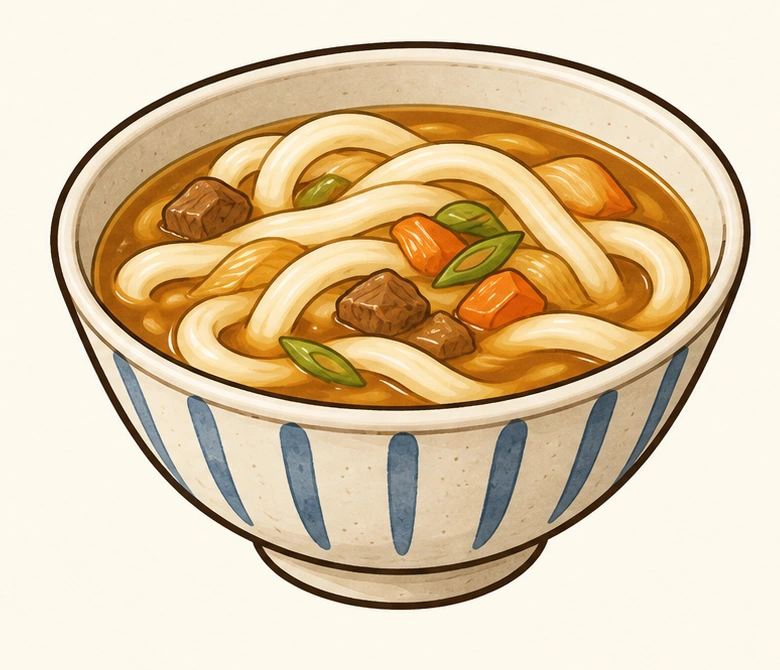
Curry udon: curry thinned with dashi over thick udon noodles.
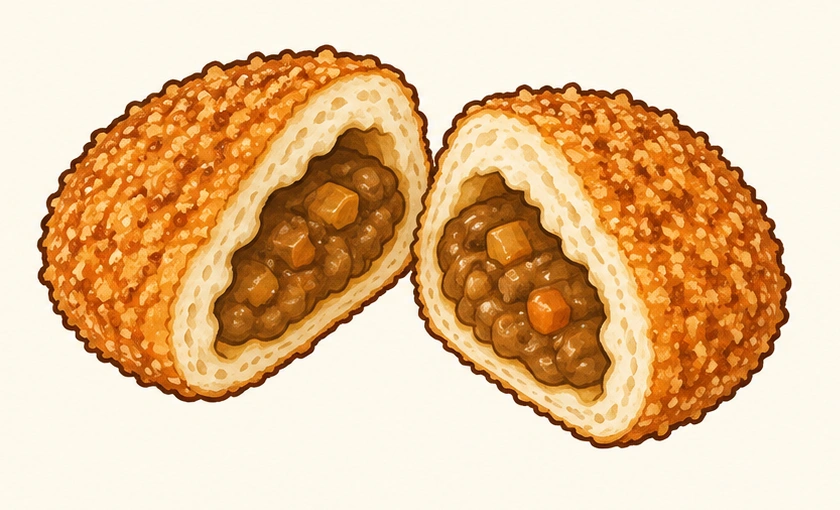
Curry bread: curry filling wrapped in dough, crumbed and deep-fried, crisp outside and soft inside.
A separate line chased authenticity. In 1927 the Nakamuraya bakery in Shinjuku introduced "pure Indian-style curry," with a real story behind it. Rash Behari Bose, an Indian independence activist wanted by the British, had been sheltered by Nakamuraya’s owners, married their daughter, and brought the cooking of his homeland to the shop’s restaurant. Made with bone-in chicken and good rice, it cost several times as much as an ordinary curry and sold anyway. After the war, in 1949, the Indian-run Nair’s Restaurant opened in Ginza, still famous for its chicken curry.
Regions developed their own styles. Kanazawa curry, from Ishikawa Prefecture, is dark and dense, served on a stainless steel plate with a pork cutlet drizzled with Worcestershire sauce and a pile of shredded cabbage, and eaten with a fork or a split-tipped spoon; Champion Curry and Go Go Curry, which has branches in New York, are its best-known chains. Sapporo is famous for soup curry, a thin, intensely spiced broth with a whole chicken leg and large pieces of roasted vegetables, served with rice in a separate bowl; you spoon rice into the soup. It developed in Sapporo from the 1970s, and the name "soup curry" caught on in the 1990s. In Tokyo, Jinbōchō, the district of secondhand bookshops, doubles as a curry district, where European-style curry houses sit next to Indian and Thai restaurants.
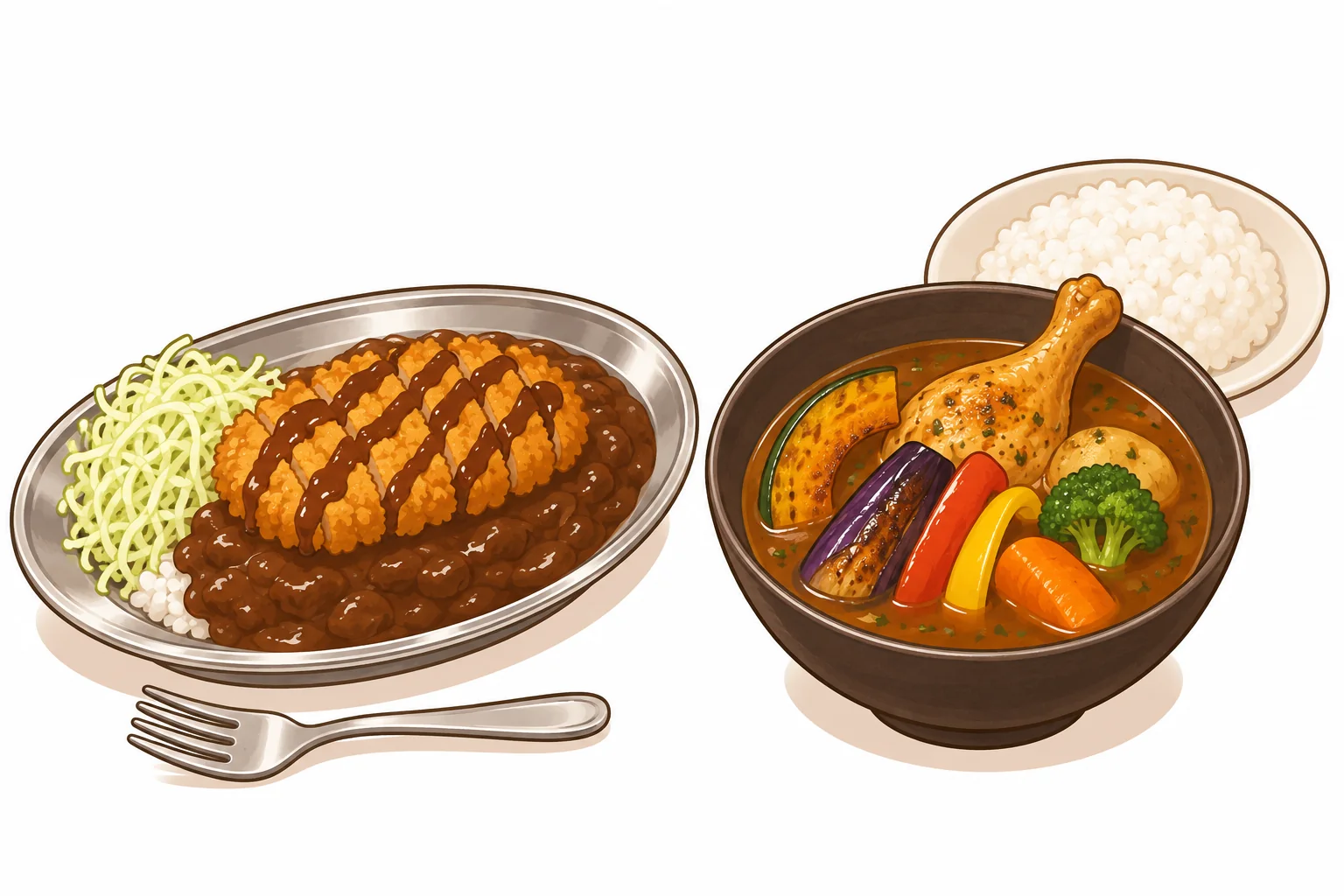
Kanazawa curry with a pork cutlet on a steel plate, beside Sapporo soup curry with chicken leg and vegetables (illustration).
The chain that made curry a national franchise is CoCo Ichibanya, founded in 1978 in Aichi Prefecture. Its system is very Japanese: one base sauce, rice by the gram, heat levels you raise step by step, and dozens of toppings, from pork cutlet and fried shrimp to spinach, natto and cheese, so each customer builds a personal plate. It has expanded across East and Southeast Asia and the United States, and in 2020 it opened in India.
06Eating Curry in Japan
Curry is one of the easiest meals to eat in Japan. Chains such as CoCo Ichibanya, and beef bowl chains such as Matsuya, serve curry rice, as of 2026, for anywhere from a few hundred to just over a thousand yen. At some, you buy a meal ticket from a machine at the door and hand it to the staff. At CoCo Ichibanya, start at the regular level; the numbered heat levels are added on top of the base, and from level three up they are genuinely hot.
For something more careful, try a yōshoku restaurant or an old kissaten coffee shop. These usually serve "European-style" curry, made with butter, beef stock and a deeply browned roux. It is nearly black, rich and sweet at first, with the heat arriving later, and it often comes in a silver gravy boat so you can pour it over the rice yourself. A soba shop’s karē nanban is gentler and smells of dashi, a good bowl on a cold day.
When traveling, look for the local version: navy curry in Yokosuka, soup curry in Sapporo, steel-plate curry in Kanazawa, baked curry in Mojikō. The rows of local retort curries in supermarkets and station gift shops, each with a regional picture on the box, make light and dependable souvenirs.
There are few rules. Use the spoon, work from the line where sauce meets rice, and help yourself to the pickles, which are usually free. At lunchtime in a busy curry shop you will see office workers finish a plate in ten minutes and leave. For most people in Japan, curry is not something to make a pilgrimage for. It is simply what you eat on an ordinary weekday.