
At a glance
How pan-fried gyoza came to Japan with postwar repatriates from Manchuria, why they are eaten with rice and beer, and why Utsunomiya and Hamamatsu compete every year.
- In Japan "gyoza" means pan-fried dumplings by default: thin skins, finely chopped filling, lots of garlic, eaten as a side for rice rather than a staple.
- After the war, Japanese repatriated from northeast China opened stalls and shops that brought gyoza into everyday eating.
- You mix the dip at the table from soy sauce, vinegar and chili oil; vinegar with black pepper alone is a recent favorite.
- Utsunomiya, Hamamatsu and Miyazaki vie for the top spot in gyoza spending; as of early 2026 Hamamatsu led three years running, 2023–2025.
- Gyoza no Ōshō opened its first shop in Kyoto in 1967 and had 728 shops, two of them in Taiwan, as of March 2026.
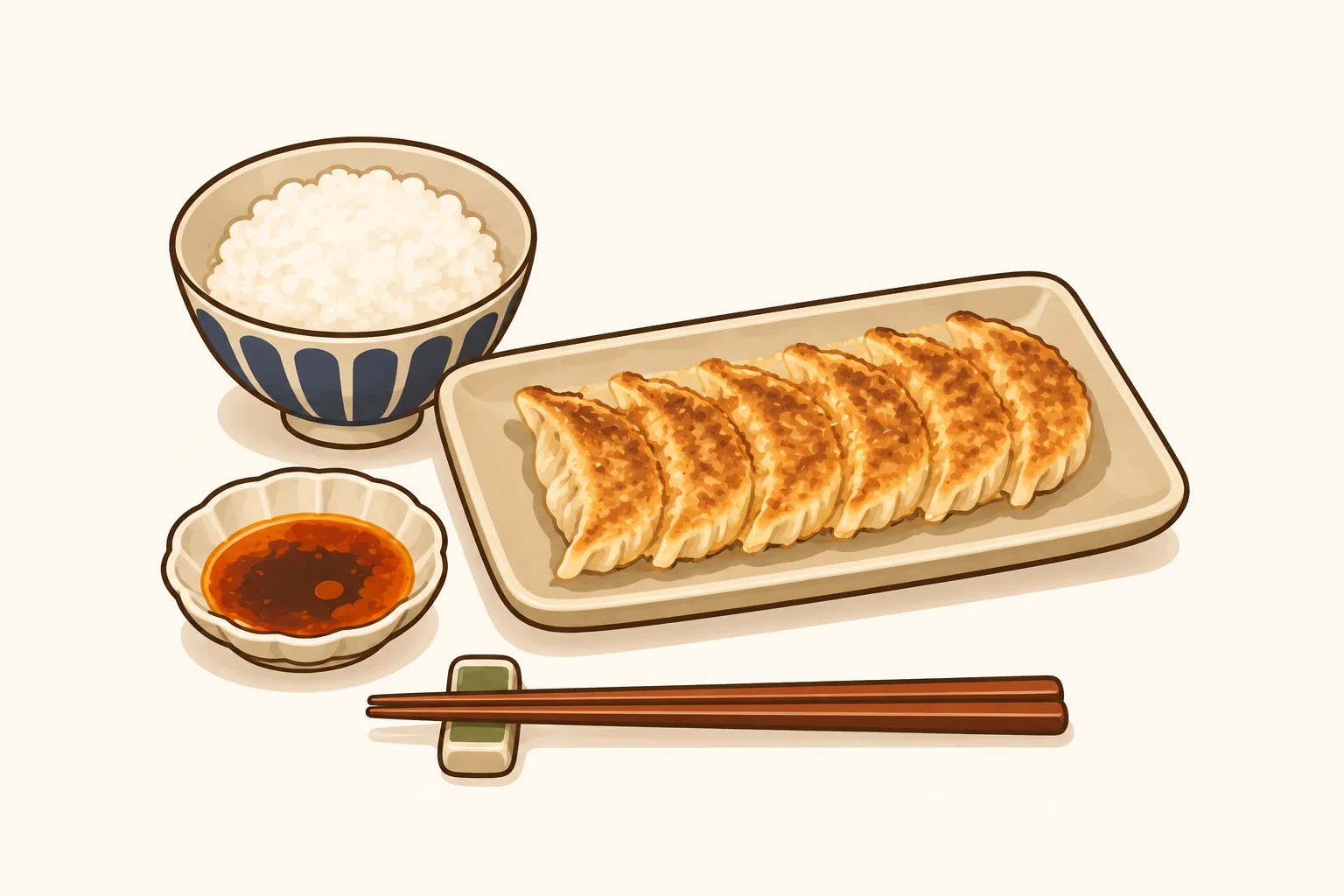
Order gyoza almost anywhere in Japan and you get the same thing: five or six small dumplings, lined up in a neat row, their bottoms fried to a deep golden crust and their tops soft and steamed. They arrive next to a bowl of ramen, a bowl of rice, or a cold glass of beer, and they cost a few hundred yen. Gyoza came to Japan from China, but they took hold only after the Second World War, and in the decades since they have become something distinctly Japanese: thinner-skinned, heavier on garlic and cabbage, almost always pan-fried, and eaten as a side dish rather than a meal. This is the story of what gyoza are, how they got to Japan, why two cities fight every year over who eats the most of them, and how to order and eat them when you are there.
01What Arrives on the Plate
In Japan, the word gyoza on its own means yaki-gyōza, pan-fried dumplings. The wrapper is a thin disc of wheat dough, folded over a filling and pleated along one edge into a crescent. The filling is minced pork mixed with a large amount of finely chopped cabbage or napa cabbage, plus garlic chives (nira), garlic, and ginger, seasoned with soy sauce and sesame oil. Compared with the dumplings of northern China, Japanese gyoza are smaller, the skin is thinner, the filling is chopped finer and is softer and juicier, and garlic is close to non-negotiable.
- 1Brown the bottomsin an oiled frying pan
- 2Add water, coverwater, sometimes with flour; steams the upper wrapper
- 3Uncover, add oilthe bottoms crisp up again
- 4Flip onto the platecrust-side up
Brown, steam, then crisp again: a crackling base and a soft top in one bite.
The cooking method is what gives them their character. The cook lines the dumplings up tightly in an oiled frying pan and lets the bottoms brown. Then water, sometimes mixed with a little flour or starch, goes into the hot pan, the lid goes on, and the dumplings steam for a few minutes until the upper part of the wrapper turns translucent and tender. The lid comes off, the remaining water boils away, a little more oil is drizzled around the edge, and the bottoms crisp up again. Many shops flip the whole row out onto the plate crust-side up. The result is two textures in one bite: a crackling base, a soft, chewy top, and a burst of hot juice from the filling.
- 1
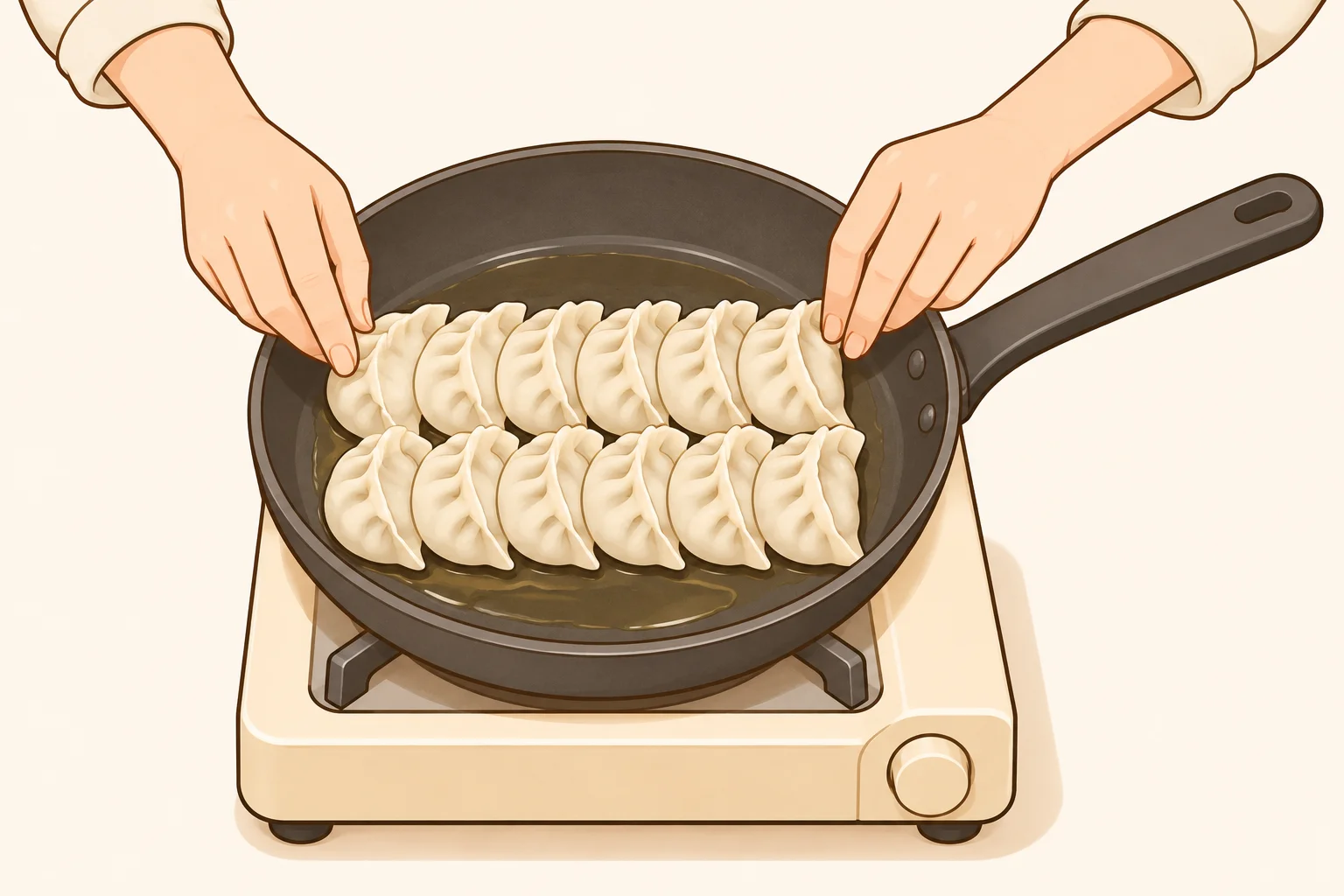 The dumplings are lined up tightly in an oiled pan and the bottoms left to brown.
- 2
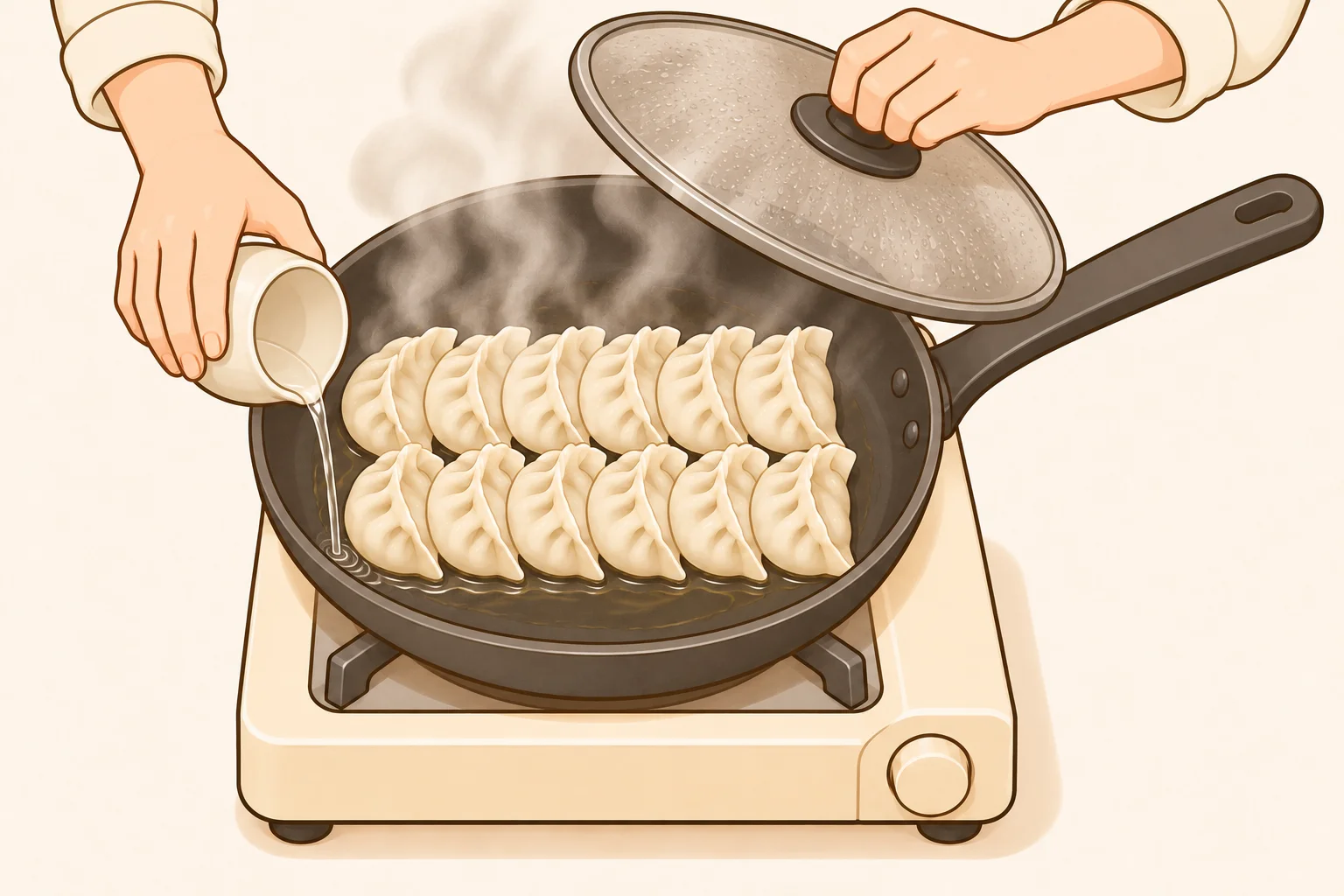 A little water goes in and the lid goes on, so steam cooks the upper part of the wrappers.
- 3
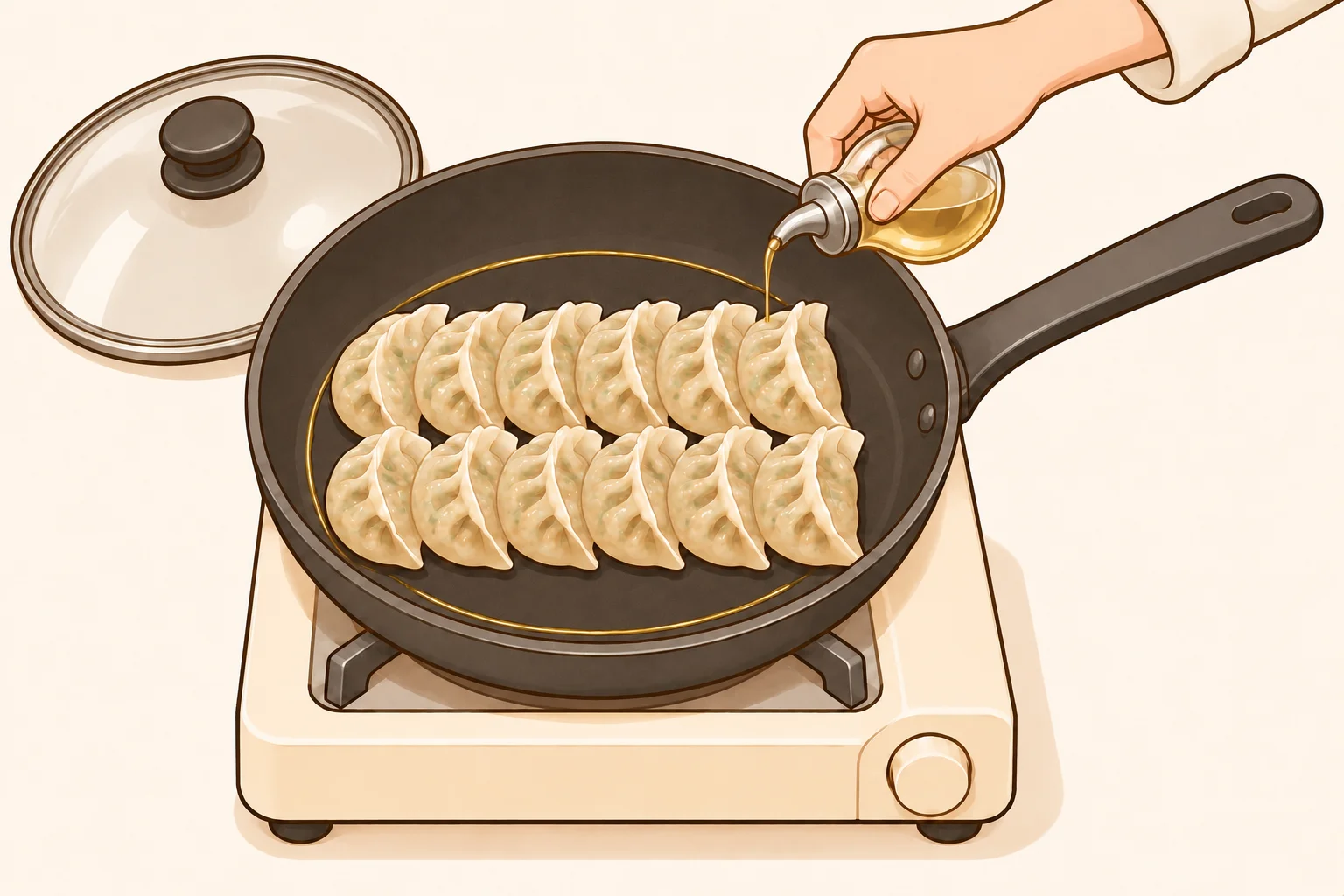 With the lid off and the water boiled away, oil is drizzled around the edge to crisp the bottoms again.
- 4
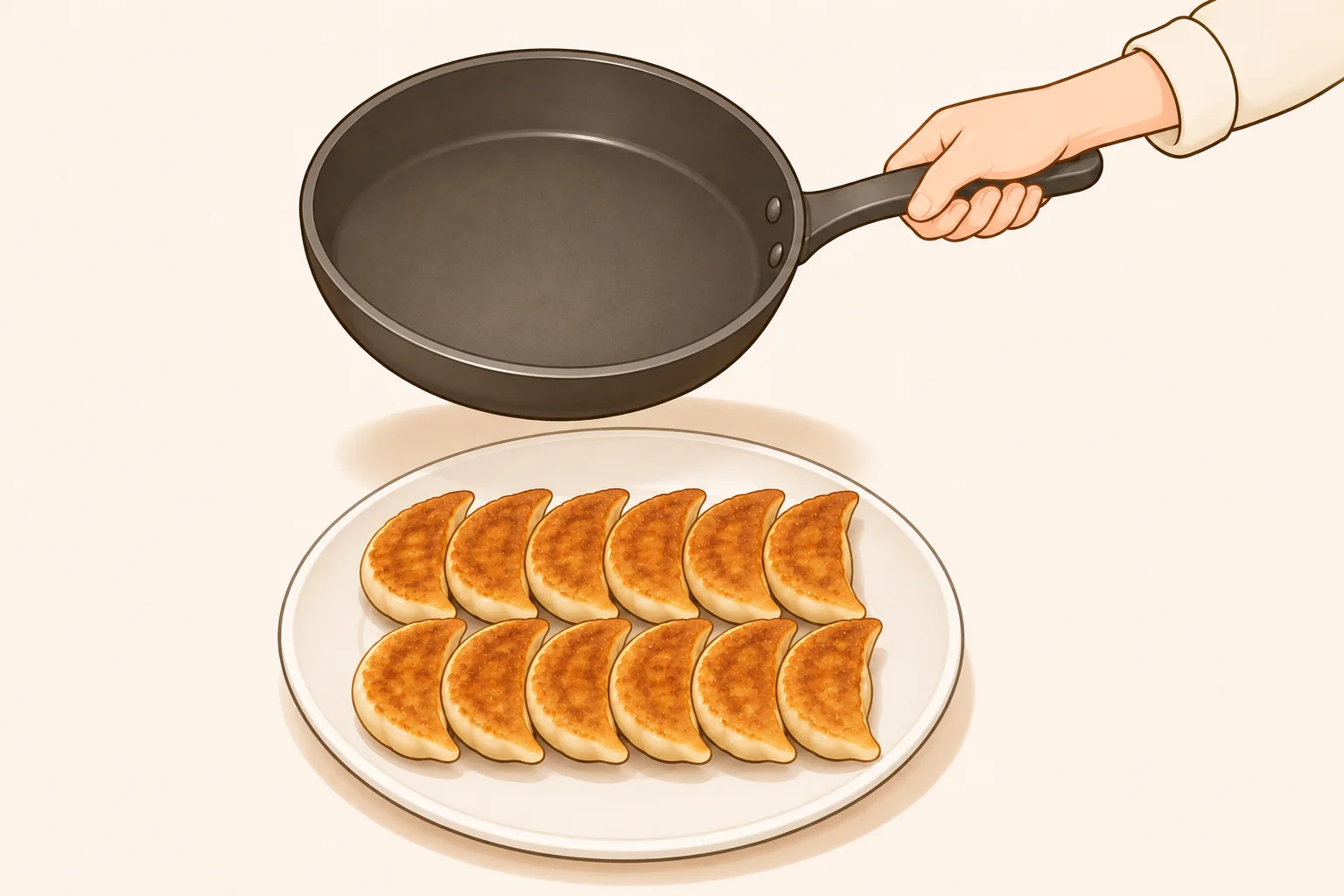 Many shops flip the whole row out onto the plate, crust side up.
The dipping sauce is something you mix yourself. On almost every table in a ramen shop or Chinese restaurant in Japan you will find three small bottles: soy sauce, rice vinegar, and rāyu, chili oil. The standard mix is roughly equal parts soy sauce and vinegar with a few drops of chili oil. A more recent fashion is su-koshō, plain vinegar with a heavy grind of black pepper, which is sharper and lighter.
Japan has other kinds of gyoza too. Sui-gyōza are boiled, closer to the classic Chinese shuijiao; age-gyōza are deep-fried; and some places serve them in soup. But in ordinary speech, these all need a prefix. Plain "gyoza" means the pan-fried kind, which in Chinese terms is closer to a guotie, or potsticker, than to the boiled dumplings that northern Chinese families eat at New Year.
02Brought Home from Manchuria
People in Japan like to point out that gyoza have a long history in the country. A popular anecdote says that Tokugawa Mitsukuni, the lord of the Mito domain in the seventeenth century, was served dumplings by Zhu Shunshui, a Chinese Confucian scholar who had fled the fall of the Ming dynasty, making Mitsukuni the first Japanese person to eat gyoza. It is a later story, and the better-known version of it is about ramen; even if it is true, it was a curiosity at a lord’s table. From the late nineteenth century, Chinese communities in the port cities of Yokohama, Kōbe, and Nagasaki made dumplings too. But gyoza as everyday Japanese food date from after 1945.
The people who made the difference were the hikiagesha, the Japanese repatriated from overseas at the end of the war. When the war ended, about 1.5 million Japanese civilians were living in Manchuria, in northeastern China, where Japan had set up the puppet state of Manchukuo, and most of them were eventually sent home. In Manchuria they had eaten dumplings and learned to make them. Back in a hungry, bombed-out Japan, wheat flour was easier to come by than many other foods, and a dumpling needs only a little meat to be filling and flavorful. Repatriates opened stalls and tiny shops near train stations and in black-market alleys. In Tokyo’s Shibuya, a lane called Koibumi Yokochō, "Love-Letter Alley," was home to Minmin (Minmin Yōnikukan, 1952–2008), opened by Takahashi Michihiro, a repatriate who had grown up in Dalian, and often credited with helping to spread pan-fried gyoza in the capital. Restaurants called Minmin still exist across Japan, though not all of them descend from this one.
The name itself points back to where the dish came from. The Japanese pronunciation, gyōza, is neither the Mandarin jiǎozi nor the regular Japanese reading of the characters. It is generally thought to reflect a regional pronunciation from Shandong or the northeast, where many Shandong migrants had settled, as heard and written down by Japanese people living there.
Why fried rather than boiled? Two explanations are usually given. One is that in northern China, leftover boiled dumplings were often fried the next day, and that this is the version many Japanese brought home. The other is that in Japan, gyoza were going to be eaten with rice, and frying gives them the oily, savory crust that makes rice go down. Both are plausible, and both probably played a part. By the 1950s and 1960s, gyoza and ramen had become the twin pillars of the Japanese chūka restaurant, the neighborhood "Chinese" eatery.
03A Dumpling That Goes with Rice
For visitors from China, the most surprising thing about gyoza in Japan is that people eat them with rice. In northern China, dumplings are the staple: the wrapper is the starch. In Japan, gyoza are an okazu, a dish that accompanies rice. The most common set meal at a Japanese Chinese restaurant is the gyōza teishoku: a plate of gyoza, a bowl of rice, a bowl of soup, and some pickles. At ramen shops, ramen with a side of gyoza is a standard order, sometimes with a small bowl of fried rice as well. Three servings of carbohydrates on one tray strike no one in Japan as odd.
The logic comes from the structure of the Japanese meal. Rice sits at the center, and everything else is there to make the rice taste good. Salty, savory, oily dishes are prized for precisely that reason. As Chinese cooking was absorbed into Japanese home and restaurant food after the war, dishes such as mapo tofu, stir-fried pork with green peppers, and gyoza were adjusted to fit this framework. Gyoza got more garlic and soy sauce, a crisper crust, and a tangy dipping sauce. The thin Japanese wrapper helps too: with less dough per dumpling, a plate of gyoza works as a side rather than a meal in itself.
Beer is the other natural partner. Fried, garlicky, and a little greasy, gyoza are classic drinking food, and "gyoza and beer" is as fixed a pairing in Japanese as edamame and beer. A draft beer, a plate of gyoza, and perhaps a dish of smashed cucumber is a cheap, satisfying after-work dinner for many office workers.
That everyday status is part of what makes gyoza in Japan different. They carry none of the ceremony of New Year dumplings in a Chinese family. They are quick, inexpensive, and available on every shopping street.
04Utsunomiya, Hamamatsu, and the Gyoza Capital Contest
Two cities claim to be Japan’s gyoza capital: Utsunomiya in Tochigi Prefecture, north of Tokyo, and Hamamatsu in Shizuoka Prefecture, on the Pacific coast between Tokyo and Nagoya.
Utsunomiya’s story also runs through the war. The Imperial Japanese Army’s 14th Division was based there and served in Manchuria, and soldiers who came back brought a taste for dumplings with them. In 1990, city officials noticed that in the national Family Income and Expenditure Survey, then run by the Management and Coordination Agency (its statistics work now belongs to the Ministry of Internal Affairs and Communications), households in Utsunomiya spent more on gyoza than those in any other prefectural capital. The city seized on this. Local shops formed an association, the city branded itself as a gyoza town, and in 1994 a statue of Venus wrapped in a gyoza skin, carved from local Ōya stone, went up outside the station. Utsunomiya’s gyoza shops tend to be plain and cheap, and they usually offer three versions: fried, boiled, and deep-fried. The best-known, Minmin, open since 1958, has had lines outside for decades, and locals think nothing of ordering several plates.
Hamamatsu joined the contest in the late 2000s. Its signature is presentation: the dumplings are arranged in a circle in the pan, flipped out as a ring, and the empty middle is filled with a small mound of boiled bean sprouts, said to have started as a way to make the plate look fuller. Hamamatsu gyoza are heavy on cabbage and taste mild and slightly sweet; the area was known for pig farming and cabbage growing. Ishimatsu is one of the old shops most associated with the style.
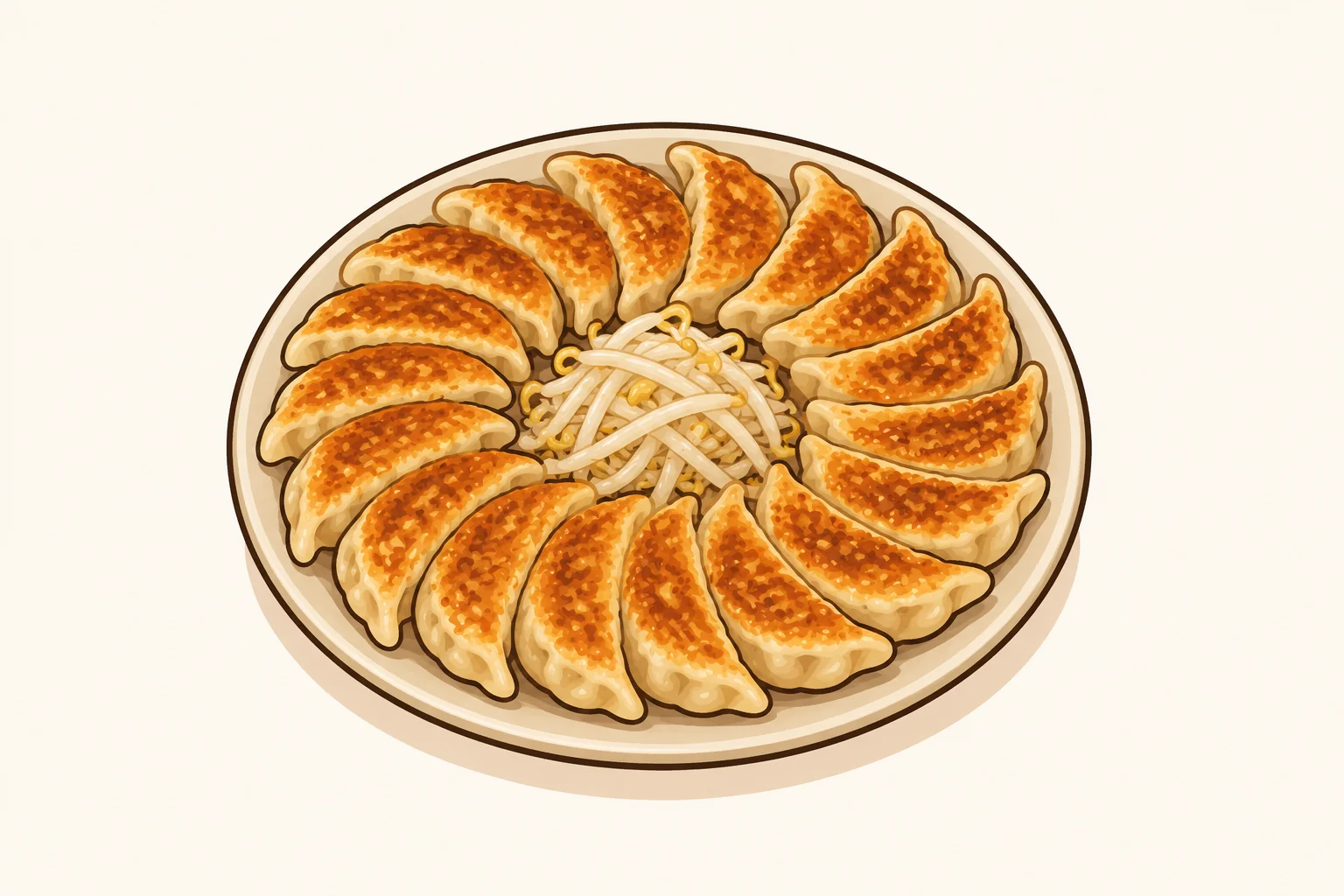
Hamamatsu gyoza, flipped out as a ring with a small mound of boiled bean sprouts in the middle.
The rivalry plays out every winter when the annual survey results come out. Whichever city’s households spent the most on gyoza over the previous year can claim the title, and through the 2010s the lead went back and forth, with local news covering each result like a sports score. More recently Miyazaki, in Kyūshū, broke in and took the top spot in 2021 and 2022, turning a two-way contest into a three-way one; Hamamatsu then came first three years running, from 2023 to 2025 (as of the results published in early 2026). The statistic only counts fresh gyoza bought at shops and taken home, raw or cooked; it does not include frozen gyoza, eating out, or homemade dumplings. So it measures a habit of buying gyoza to eat at home more than the quality of any city’s cooking. That has not stopped the cities from treating it as a matter of civic pride.
Other places have their own styles. In Hakata, in Fukuoka, hitokuchi gyōza, "one-bite gyoza," are about the size of a thumb, eaten by the dozen with beer, sometimes brought to the table in the iron pan they were fried in. In Kōbe, gyoza are often dipped in a sweet miso sauce. In Kamata, in Tokyo’s Ōta Ward, a restaurant called Nīhao, opened in 1983 by Yagi Isao, who had grown up in Dalian and later returned to Japan, made hanetsuki gyōza famous: "winged gyoza," fried with a flour-and-water slurry that sets into a thin, lacy, crisp sheet joining the dumplings together. Winged gyoza are now common all over the country.
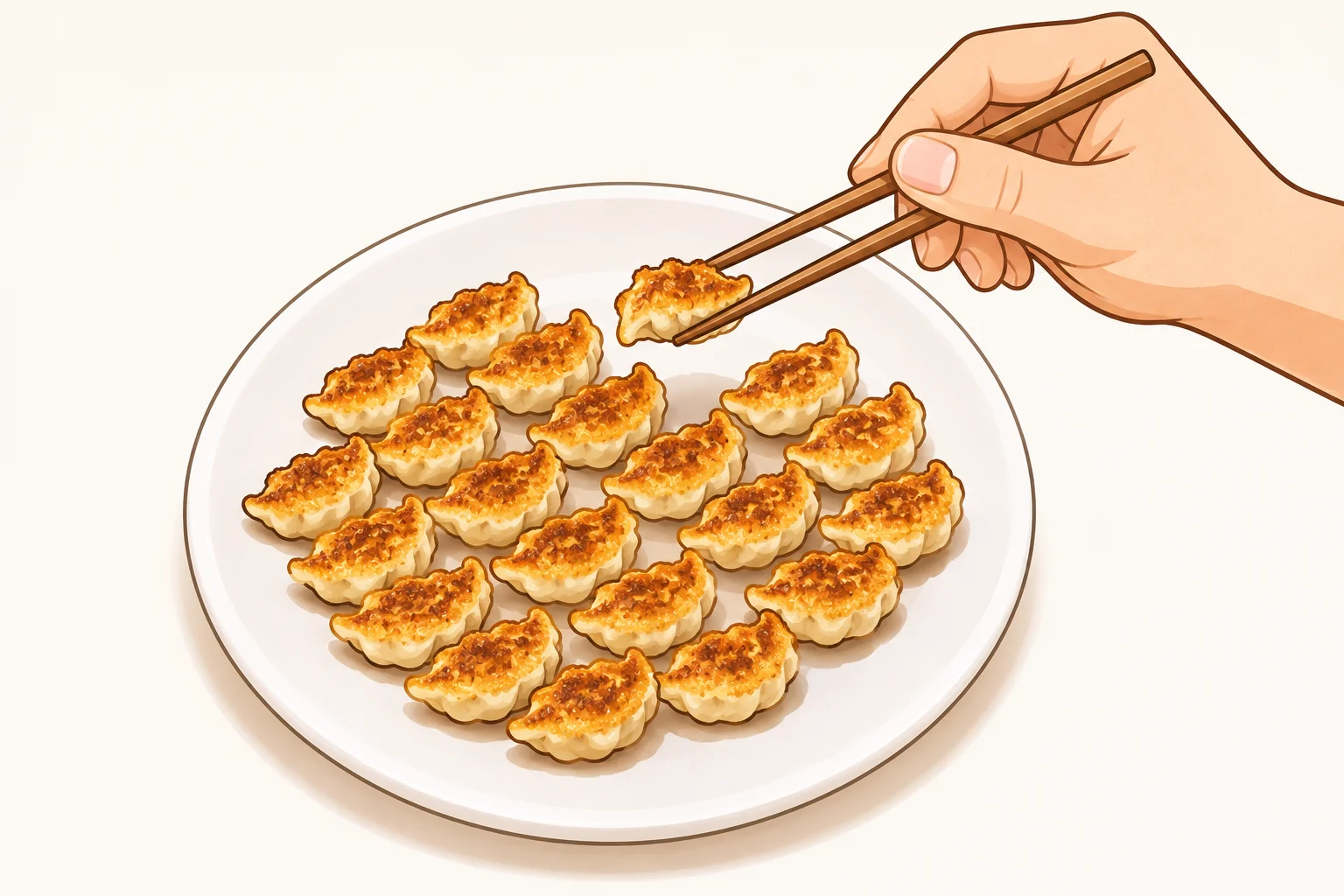
Hakata’s hitokuchi gyōza, one-bite gyoza about the size of a thumb, eaten by the dozen with beer.
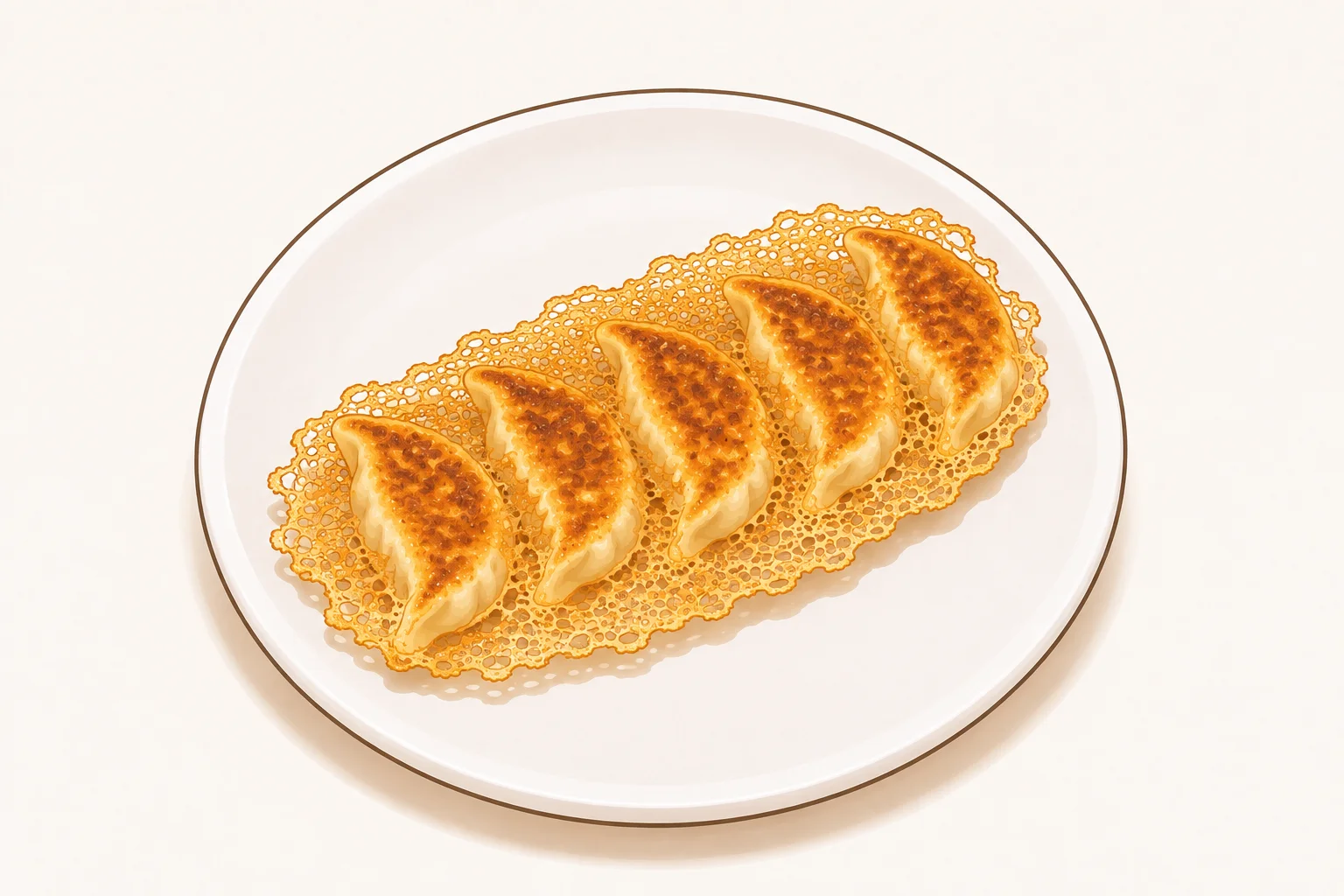
Hanetsuki gyōza from Kamata, Tokyo: a thin, lacy, crisp sheet joins the dumplings together like a wing.
05Chains, Freezers, and Unstaffed Shops
The place most Japanese people eat gyoza out is a chain restaurant, and the biggest name is Gyoza no Ōshō. The first branch opened in Kyoto, at the Shijō-Ōmiya intersection, in 1967, and as of March 2026 the chain had 728 locations. Its gyoza are mid-sized and garlicky, and the price has always been kept low, a few hundred yen a plate, which made Ōshō a canteen for students and workers. There is a separate chain, Ōsaka Ōshō, which shares the same roots but split off long ago; the two are constantly confused. Beyond those, almost every ramen chain and family restaurant has gyoza on the menu.
At home, gyoza are both a project and a convenience food. Making them from scratch is a common thing to do with friends or family: a "gyoza party" where everyone sits around the table pleating dumplings, then fries them on an electric hotplate. Supermarkets sell packs of ready-made wrappers for exactly this purpose. Much more often, though, gyoza come from the freezer. Food companies began mass-producing frozen gyoza in the 1970s, and they are now among the best-selling frozen foods in Japan. Recent versions can go straight into a pan with no oil or water and still come out with crisp wings. In 2008, frozen gyoza imported from China were found to be contaminated with pesticide and made a number of people seriously ill. The case shook public confidence, and since then major producers have advertised domestic production.
The newest sight on Japanese streets is the unstaffed gyoza shop. During the COVID-19 pandemic, small storefronts selling frozen raw gyoza with no staff at all spread rapidly across the country. Freezers hold bags of dumplings, prices are posted on the wall, and customers take what they want and drop the money into a box. The model depends on people knowing exactly what they are buying and on a general expectation that customers will pay.
06Eating Gyoza in Japan
The easiest introduction is to walk into any neighborhood ramen shop or chūka restaurant and order a plate. The menu will usually just say 餃子. A serving of five or six typically costs between about 300 and 600 yen (as of 2026). To eat like a local, add a bowl of rice or a draft beer. Before the gyoza arrive, mix your sauce in the little dish: soy sauce and vinegar with a few drops of chili oil, or try vinegar and black pepper alone.
If you want to compare regional styles, Utsunomiya is an easy day trip, under an hour from Tokyo by shinkansen. There are dozens of gyoza shops around the station, as well as places that gather several famous shops’ gyoza under one roof so you can taste a few in one sitting. Locals often order one plate of fried and one of boiled, with rice, which is a good way to see how the same filling changes with the cooking. Hamamatsu is on the Tōkaidō shinkansen line between Tokyo and Ōsaka; look for the ring of dumplings with bean sprouts in the middle. In Hakata, find a yatai street stall or a small bar and work through plates of one-bite gyoza with beer.
A few small things help. Eat gyoza as soon as they arrive; the crust stays crisp for only a few minutes. Gyoza do not usually come with soup, so order some separately or get ramen alongside. When a shop is busy, gyoza are often made to order and a wait of ten minutes or so is normal. And if you have a meeting the next day, some shops advertise garlic-free gyoza, and Japanese convenience stores sell breath-freshening drinks for exactly this situation, which local office workers buy without embarrassment.