
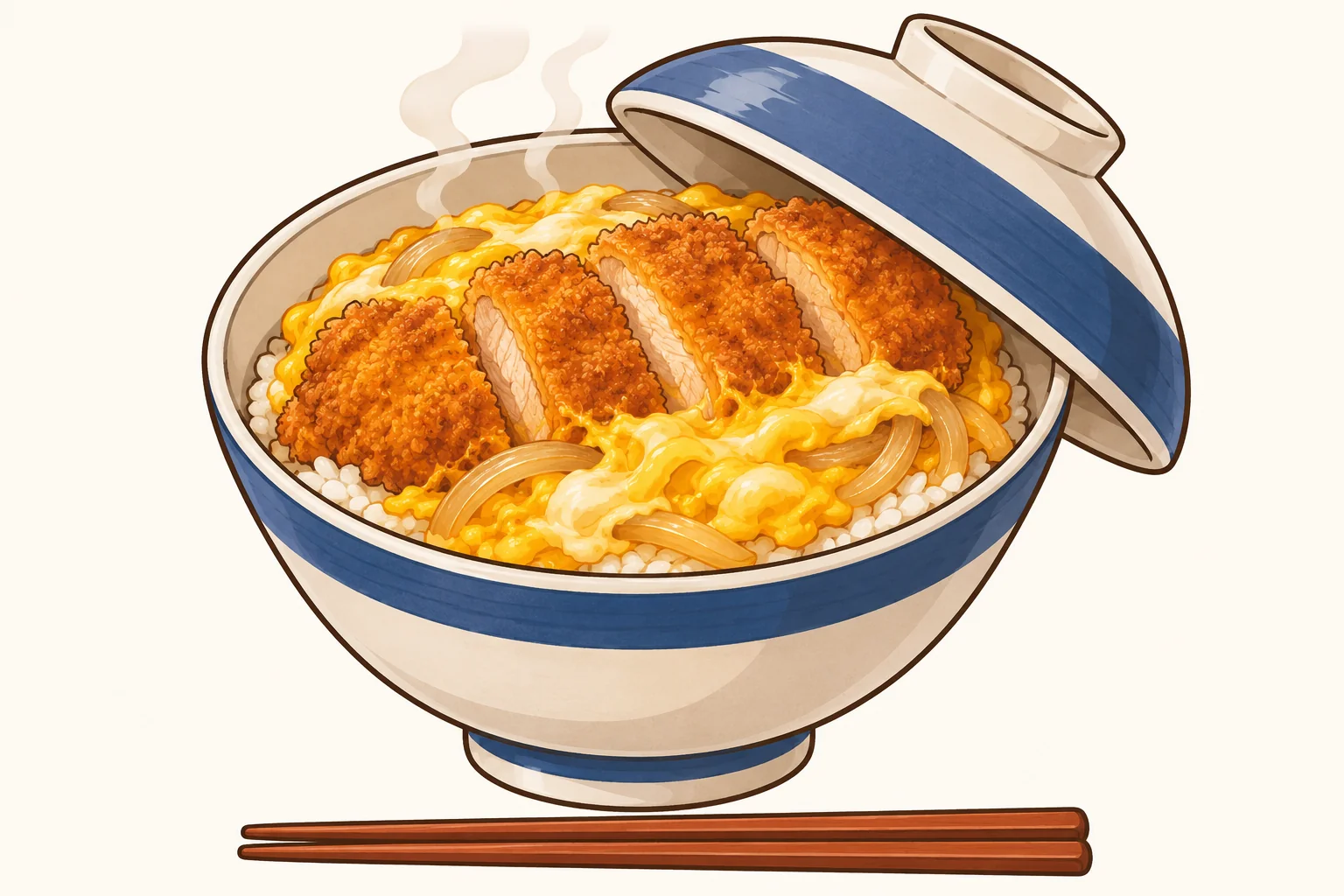
At a glance
How Japan’s rice bowls grew from Edo-period eel on rice into gyūdon, oyakodon and regional katsudon, why one bowl works so well, and how to order and eat them.
- Donburi is rice in a deep bowl topped with eel, tempura, chicken and egg, beef or raw fish.
- It is usually traced to late-Edo eel on rice, said to have begun with Ōkubo Imasuke in the early 19th century.
- In 1899 Yoshinoya opened beside the Nihonbashi fish market, selling gyūdon to fishmongers who started work early.
- Katsudon in Tokyo is simmered with egg; Fukui and other areas favor sauce katsudon with no egg.
- As of 2026 a regular gyūdon at the chains costs roughly 400–500 yen, often bought with a ticket from a machine.
Donburi is the Japanese rice bowl: a deep, heavy bowl of white rice with something good laid over the top, usually finished with a sweet-salty sauce that seeps down into the grains. It might be grilled eel, battered shrimp, chicken simmered with egg, thin-sliced beef, or a heap of raw fish. Donburi is not refined cooking and doesn’t pretend to be. It is what office workers eat at noon, what students eat before an exam, and what a tired traveler can buy at two in the morning for the price of a coffee. This is an introduction to what donburi is, where the classic bowls came from, why the format has lasted, and how to order one in Japan.
01A Bowl, a Dish, and a Way of Eating
The word donburi refers to three things at once. It is the bowl itself, thicker and deeper than an ordinary rice bowl and often fitted with a lid. It is the category of dish served in that bowl. And it is a method: putting the main dish directly on top of the rice instead of beside it. In everyday speech the word is shortened to don and attached to whatever is on top, which gives you tendon (tempura bowl), gyūdon (beef bowl), katsudon (pork cutlet bowl) and so on.
The character used for it, 丼, is an old variant of the character for "well" with a dot in the middle. Where the reading donburi comes from is not settled. One popular explanation traces it to kendonburi-bachi, the bowl used by Edo-period kendon shops, which sold cheap food in single fixed servings; another says it imitates the plop of something dropped into a well. Both are later guesses rather than documented history.
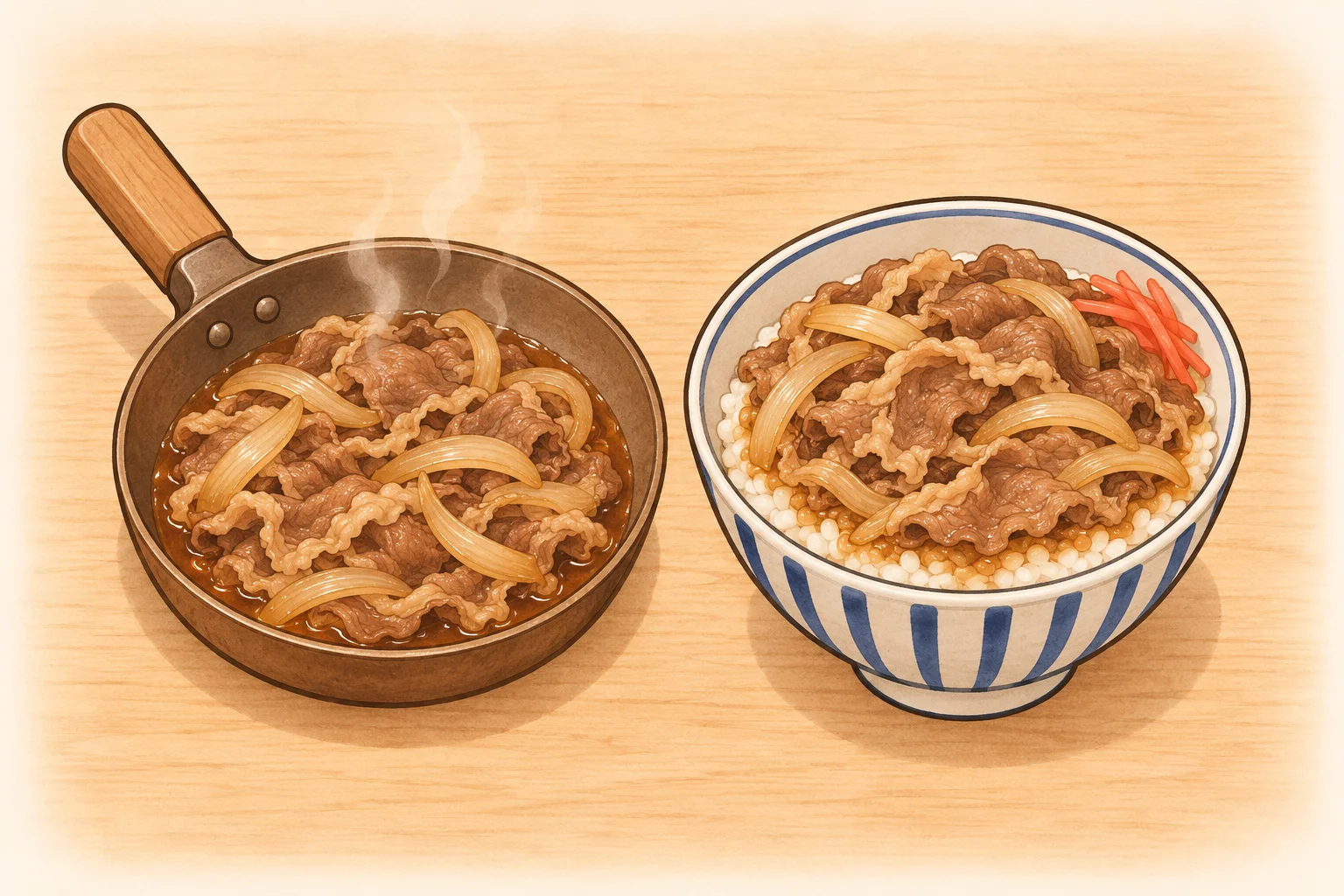
Gyūdon: beef and onion simmered in sauce, then laid over rice.
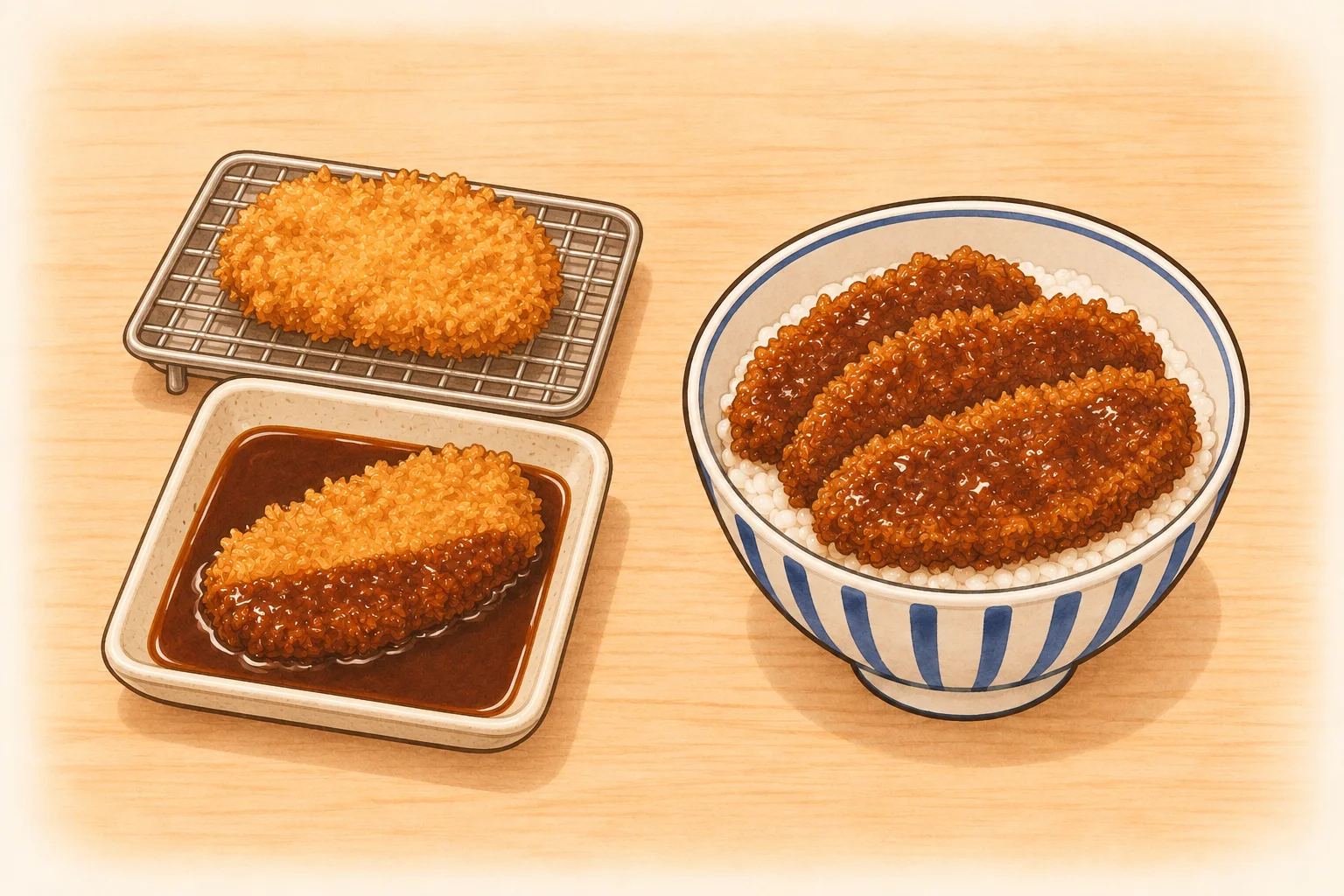
Sauce katsudon: a cutlet fried and dipped in sauce, laid over rice with no egg.
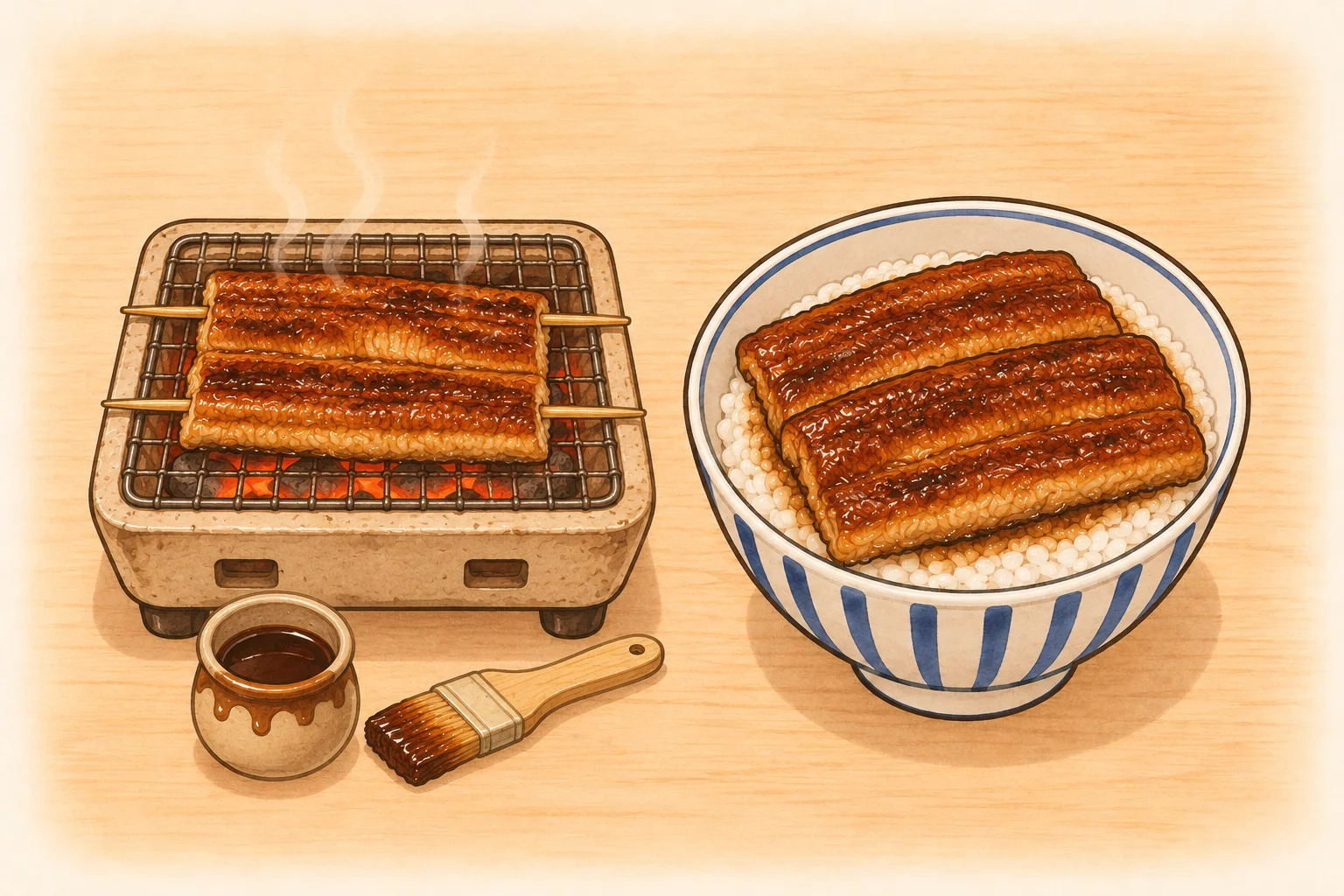
Unadon: eel grilled and glazed, laid over rice.
To see why donburi feels different, it helps to know the standard shape of a Japanese meal. The traditional pattern, often summarized as ichijū sansai ("one soup, three sides"), keeps rice, soup and side dishes in separate small vessels. You take a bite of fish, then a bite of rice, and the flavors combine in your mouth. Donburi does that combining in the bowl. The topping’s juices and sauce run down, the rice absorbs them, and the last few mouthfuls at the bottom, soaked and slightly sticky, are often the best part. Japanese has a word for wanting more of that: tsuyudaku, "dripping with sauce," which you can say when ordering at a beef bowl counter.
The sauce in most donburi is a variation on the same base of soy sauce, mirin, sugar and dashi (Japanese stock). In the Kantō region around Tokyo it tends to be darker and sweeter; in the Kansai region around Ōsaka and Kyoto it leans lighter, with more stock. The lid matters too. It keeps the food hot, and lifting it releases a puff of steam and smell that is part of the experience.
02Eel on Rice: How It Started
The usual starting point for donburi is eel. By the late Edo period, kabayaki, eel split open, skewered, basted with sauce and grilled over charcoal, was one of the great pleasures of the city of Edo (now Tokyo). It was originally eaten alongside rice, not on top of it.
The best-known origin story concerns a man named Ōkubo Imasuke, a financial backer of the Nakamura-za kabuki theater in Edo’s Sakai-chō during the Bunka era (the early 1800s). According to the story, he loved eel but often couldn’t eat it fresh off the grill, so he had it delivered sandwiched between layers of hot rice, which kept it warm and soft. The tale is told everywhere, but its details come from later accounts and are best treated as legend. What is clear is that by the end of the Edo period, shops selling grilled eel on rice were common.
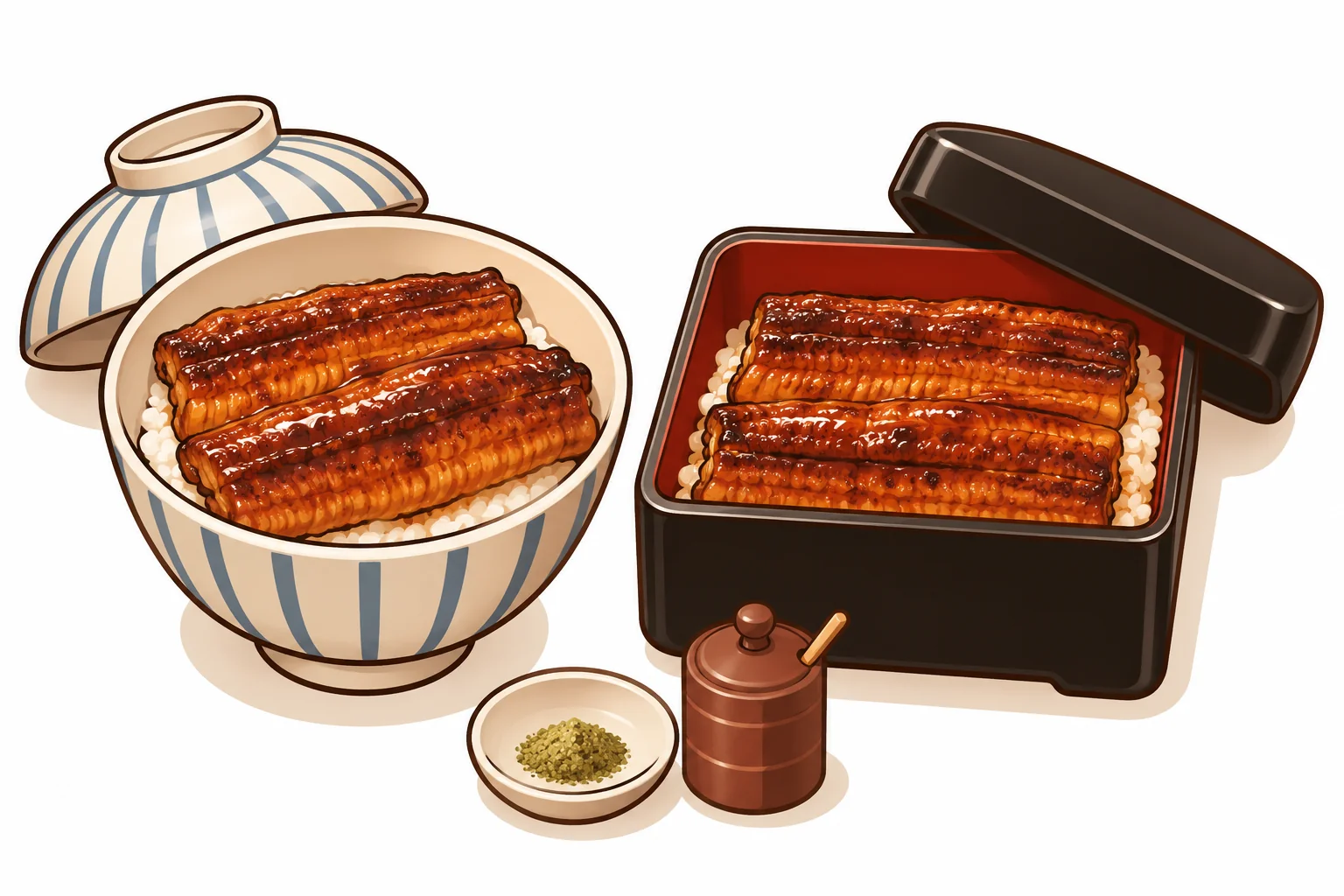
Unadon in a round bowl beside unajū in a square lacquer box, black outside and red within (illustration).
Eel on rice eventually split into two forms. Unadon is served in a round bowl. Unajū is served in a lacquered rectangular box (jūbako) and is usually the more formal and expensive version. Many eel restaurants still grade their offerings as matsu, take and ume (pine, bamboo and plum), which refers to how much eel you get, not how it is cooked.
Tendon appeared around the end of the Edo period or the beginning of the Meiji era (1868–1912). Tempura began as a street food in Edo, fried fish and shrimp eaten standing at a stall with a dipping sauce. Putting it over rice and pouring on a thick, dark sauce turned a snack into a meal. Several old shops in Asakusa in Tokyo are still known for this heavy, deeply colored style of tendon, in which the batter soaks up the sauce.
The Meiji era brought beef into the Japanese diet after centuries of avoiding the meat of four-legged animals, and the bowl changed with it. Gyūdon grew out of gyūnabe, a hotpot of beef and green onion simmered in sweet soy that was fashionable in the 1870s. Ladled over rice, it was sold as gyūmeshi, "beef rice." In 1899, Yoshinoya opened next to the fish market at Nihonbashi in Tokyo, serving beef bowls to fishmongers who started work before dawn and needed something fast and filling. When the market moved to Tsukiji after the 1923 Great Kantō Earthquake, Yoshinoya moved with it.
Oyakodon is generally credited to Tamahide, a chicken restaurant in the Ningyōchō district of Tokyo. The story is that in the Meiji period, customers eating its gamecock hotpot liked to finish by binding the leftover broth and chicken with egg and pouring it over rice, and the restaurant turned this into a dish of its own. The name means "parent and child bowl," since it holds both the chicken and the egg, a joke that is both blunt and a little dark.
Katsudon came later still, generally dated to the Taishō era (1912–1926). Several places claim to have invented it, including a story set among students in Tokyo’s Waseda area and rival claims from Fukui and elsewhere; Kōfu in Yamanashi even claims a version from the late Meiji period. As the next section shows, "katsudon" does not even mean the same thing everywhere in Japan.
03The Classic Bowls
Oyakodon is the most homely of them. Pieces of chicken thigh and sliced onion are simmered briefly in a small pan with the sweet-salty sauce, then beaten egg is poured in and cooked only until it is half set before the whole thing slides onto the rice. A good oyakodon has egg that is partly custardy and partly still runny, so that it flows into the rice when you push it with your chopsticks. Japanese kitchens have a dedicated oyakodon pan for this, small and shallow with a handle that sticks straight up, made to cook one portion at a time. Make the same dish with pork or beef instead of chicken and it becomes tanindon, the "strangers’ bowl," because the meat and egg are no longer related.
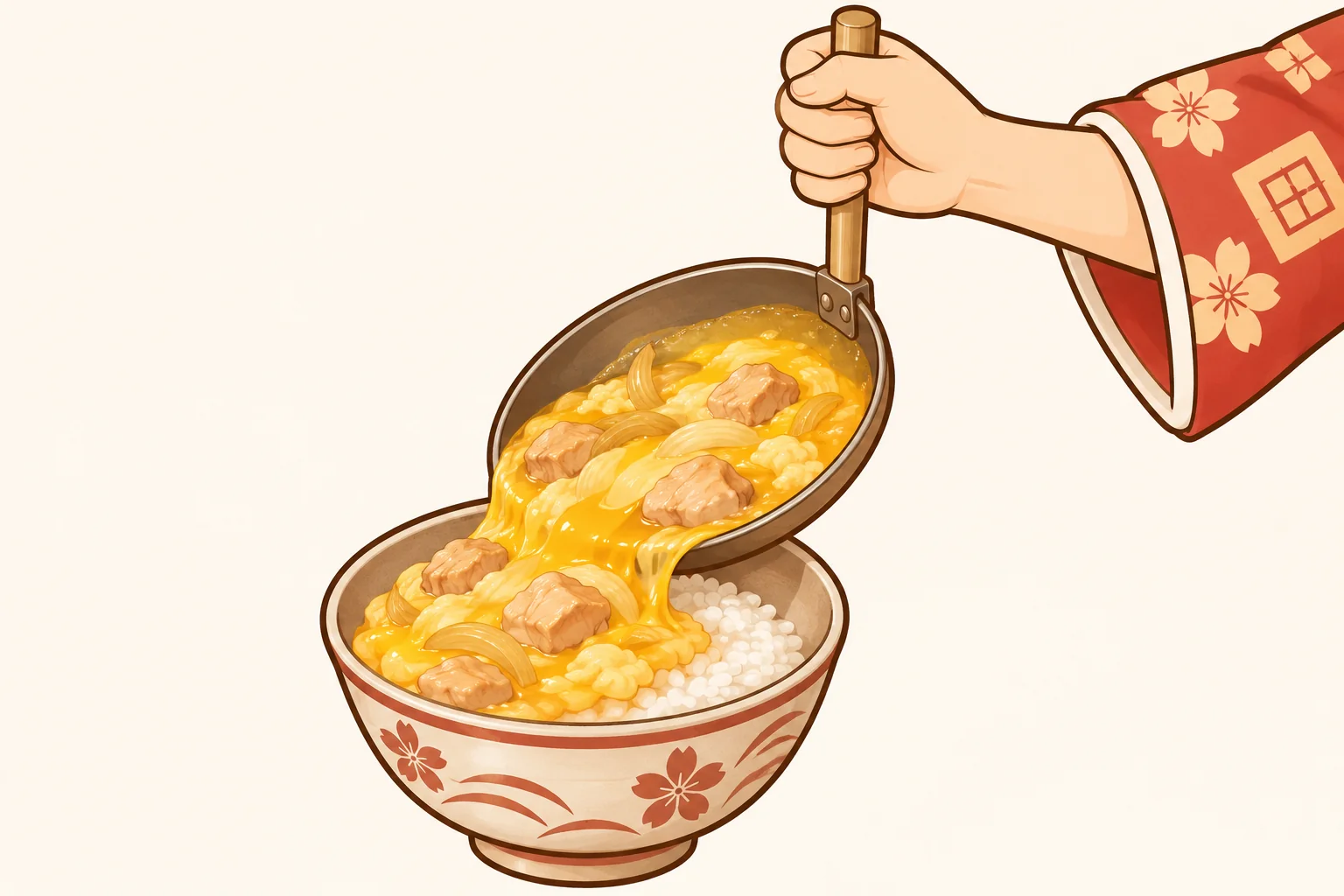
A small oyakodon pan with an upright handle cooks one portion, slid onto the rice while the egg is still runny.
Katsudon, in Tokyo and most of the country, is made in the same way as oyakodon. A freshly fried pork cutlet (tonkatsu) is cut into strips and simmered with onion in the sauce, then bound with egg and set on rice. The result is a cutlet that is crisp in some places and soft in others, soaked with sauce and egg. In Fukui, Komagane in Nagano, parts of Gunma and some other areas, the local standard is sauce katsudon: no egg, just the cutlet dipped in a sweetened Worcestershire-style sauce and laid on rice, sometimes over a bed of shredded cabbage. Niigata has a version with a soy-based sauce, and Okayama one topped with demi-glace. Japanese business travelers often make a point of trying the local katsudon.
Katsudon carries two cultural associations worth knowing. Because katsu sounds like katsu (勝つ), "to win," parents cook it for children on the night before an exam and athletes eat it before a match. The other association comes from television: the police interrogator who sets a bowl of katsudon in front of a suspect, who eats it and breaks down in a tearful confession. It became a stock scene in Shōwa-era crime dramas and is now mostly a joke.
Gyūdon stands for speed. Thinly sliced beef belly and onion sit simmering in sauce in a big pot behind the counter. When a customer sits down, rice goes into a bowl, beef and sauce go on top, and the bowl is on the counter within a minute. Yoshinoya’s slogan, umai, yasui, hayai ("tasty, cheap, fast"), is about as good a definition of gyūdon as anyone has written.
Tendon typically comes with two large shrimp and an assortment of vegetable and fish tempura, such as kisu (Japanese whiting), eggplant, pumpkin and green pepper, with sauce poured over or with the pieces briefly dipped in sauce before they go on the rice. A cheaper variation uses kakiage, a fritter of small shrimp and shredded vegetables, as the topping.
Kaisendon and tekkadon are the raw-fish bowls. Tekkadon is vinegared rice covered with slices of lean red tuna; its name is often said to come from tekkaba, a gambling den, where players could eat without leaving the table, though that too is folk etymology. Kaisendon piles a bowl with whatever the sea offers: tuna, salmon roe, sea urchin, sweet shrimp, scallops. These bowls are close relatives of sushi, usually made with seasoned rice, but they are eaten without ceremony, and they are a specialty of markets such as Hakodate’s morning market and the outer market at Tsukiji.
There are many regional bowls too. Obihiro in Hokkaidō is famous for butadon, pork grilled and glazed with a sweet soy sauce. Chinese-style restaurants serve chūkadon, rice covered with a thick, glossy stir-fry of vegetables and seafood. Coastal towns have bowls of bonito, small white fish or tiny sakura shrimp. As long as something hot or fresh is laid over rice in a bowl, people in Japan are happy to call it a donburi.
04Why a Bowl?
The first reason donburi caught on is speed. Edo was a city where men far outnumbered women, roughly two to one among townspeople in the 18th century, many of them single working men: carpenters, porters, shop clerks, laborers who had come in from the provinces. They wanted food that was quick, cheap and filling, and the city’s famous fast foods, including soba, sushi and tempura, all grew up to serve them. A donburi needs no array of small dishes and no waiting for a full meal to arrive. You pick up the bowl and finish it in a few minutes.
The second reason is delivery. Japan has a long tradition of demae, restaurant delivery. Soba shops and small diners sent delivery men out by bicycle, one hand on the handlebar and the other balancing a tall stack of dishes. A lidded donburi bowl is ideal for this: the lid keeps out dust and keeps in heat, and the food doesn’t spill or come apart. In postwar offices, ordering oyakodon or tendon from the shop down the street for lunch was completely routine. When you were done, you left the empty bowl outside the door and the shop came back to collect it.
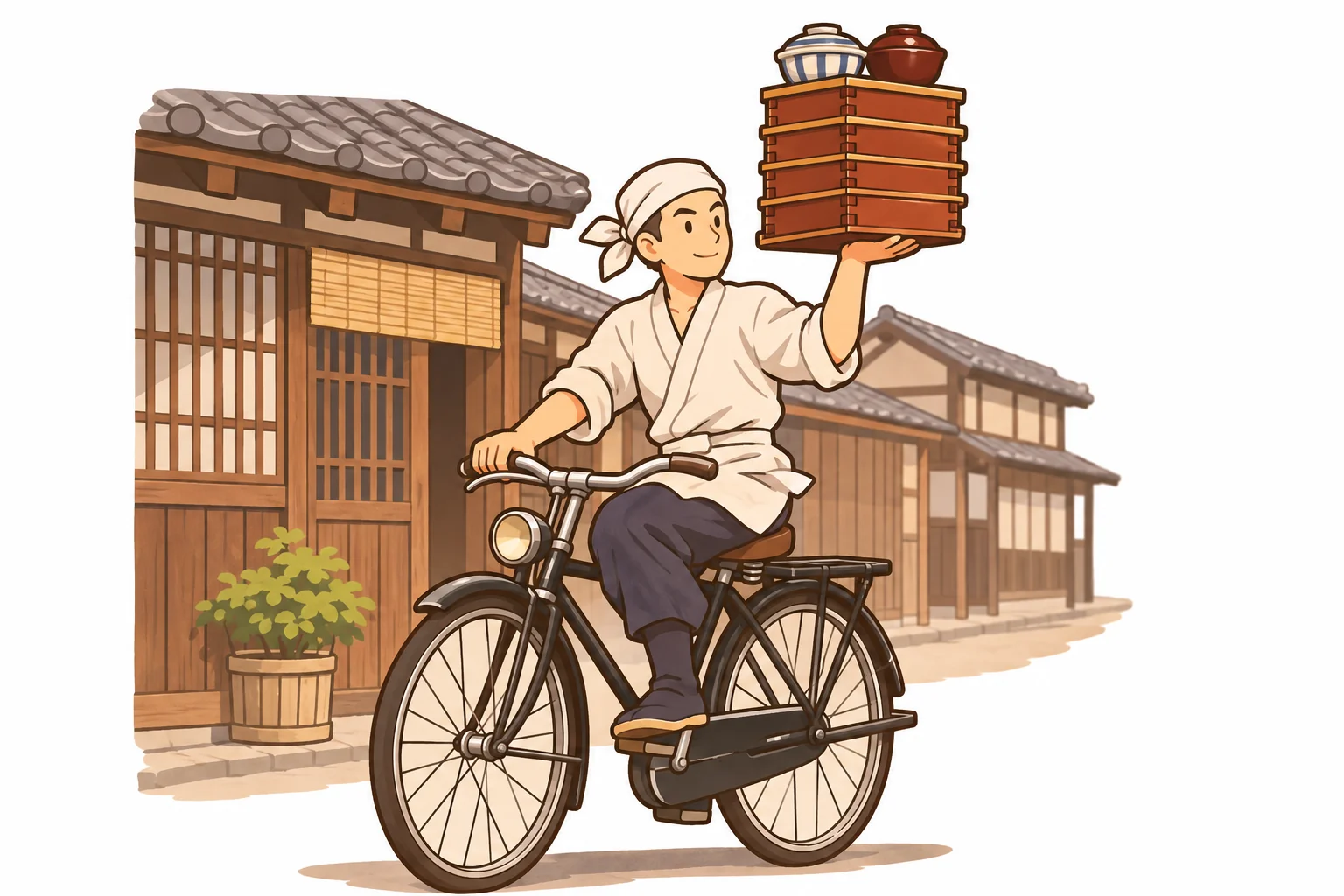
A Shōwa delivery boy on a bicycle, steering with one hand and balancing stacked noodle trays with the other (illustration).
The third reason is flavor. Japanese cooking treats plain rice as a neutral base that balances the stronger tastes of everything else. Donburi toppings are deliberately bold, and their sauces are sweet and salty because they have to season the rice beneath them. By the bottom of the bowl, the rice has taken on the sauce completely, and many Japanese people will tell you that this is the point of the whole thing.
Donburi is the classic example of what Japanese call B-kyū gurume, "B-grade gourmet": cheap, popular food that everyone loves without making a fuss about it. It does have an upmarket end. As of around 2025, a top-grade unajū at a famous eel restaurant can cost several thousand yen, and old tendon houses in Ginza are not cheap. But mostly it is a lunch eaten in ten minutes. Even the language reflects its easygoing character: donburi kanjō, "donburi accounting," means handling money without keeping track. That phrase probably refers to the large pouch on an old-time craftsman’s apron, also called a donburi, rather than the bowl, but the casual spirit is the same.
05Eating Donburi in Japan
The donburi you are most likely to meet first is gyūdon from one of the big three chains: Yoshinoya, Matsuya and Sukiya. Between them they cover the country. At Matsuya and many other shops, you order at a ticket machine by the door: insert money, press the button for your dish, take the ticket, and hand it to the staff, though some branches now use tablets or QR codes at the table instead. Sizes usually run small, regular (namimori), large (ōmori) and extra-large (tokumori), and as of 2026 a regular beef bowl costs roughly 400 to 500 yen. You can add a raw egg or a soft-cooked onsen tamago to stir into the beef. On the counter you will find pickled red ginger and shichimi tōgarashi, a seven-spice chili blend, to help yourself to. A set usually adds miso soup and a small dish of pickles. Ask for tsuyudaku if you want extra sauce, tsuyunuki if you want none.
For tendon, the chain Tenya fries to order at prices only a little above those of gyūdon. For katsudon, try a tonkatsu restaurant or a chain such as Katsuya. Almost every soba and udon shop also serves oyakodon, tendon and katsudon, and at lunchtime the most common order among office workers is a set of a small donburi with a bowl of noodles.
For eel, go to a specialist. A good eel restaurant splits and grills the fish to order, which can take twenty or thirty minutes, and the wait is part of the meal. In the Kantō style, the eel is steamed before grilling, which makes it soft and fluffy. In the Kansai style it is grilled directly, giving a crisper skin. Nagoya has its own way of eating eel on rice, hitsumabushi: you eat the first portion as it comes, the second with chopped green onion and wasabi, and the third with hot broth poured over it.
Kaisendon is best eaten early in the morning at a market. At Tsukiji’s outer market and the morning markets of Hokkaidō, shops display plastic food models and photos out front, and as of around 2025 prices run from around 2,000 yen to 5,000 or 6,000 yen, with the bowls heavy on sea urchin and salmon roe at the top of the range.
As for manners, it is perfectly normal to lift the bowl and hold it close while you eat; in Japan, rice bowls and soup bowls are meant to be held. Use your chopsticks to bring rice and topping to your mouth together rather than eating all the topping first. If the bowl has a lid, set it upside down beside you while you eat and put it back on when you’re finished, a small courtesy to the shop. And do finish the rice at the bottom. That is where the flavor ends up.