
At a glance
Why Japanese bento is made to taste good cold, and how it moved from samurai rations to kabuki intervals, station ekiben and the family kitchen.
- A bento is a meal made ahead, packed into a container and eaten away from the kitchen, usually cold.
- The word bentō spread around the late sixteenth century and is usually traced to a Southern Song colloquial term meaning "convenient."
- The makunouchi bento, eaten between acts of Edo-period kabuki, set the standard layout of rice with several small separate dishes.
- Accounts of the first ekiben differ; the best-known is two rice balls wrapped in bamboo sheath sold at Utsunomiya Station in 1885.
- As of 2026, Ekibenya Matsuri at Tokyo Station stocks more than 150 kinds of ekiben from across Japan.
A bento is a meal made ahead, packed into a box, and eaten somewhere else. That plain description covers an astonishing range: a rice ball wrapped in bamboo sheath, a child’s lunch in which the rice has been shaped into a panda, a lacquered box from a Kyoto restaurant, a clay pot of seasoned rice bought on a mountain railway. What unites them is a set of habits that are distinctly Japanese: the food is meant to be eaten at room temperature, it is arranged to be looked at before it is eaten, and it fits a complete, balanced meal into a very small space. This piece explains what goes into a bento and why, how the packed lunch developed from samurai rations into theater food and railway souvenirs, what the boxes themselves are made of, and how to buy and eat a good one when you are in Japan.
01What Is in the Box
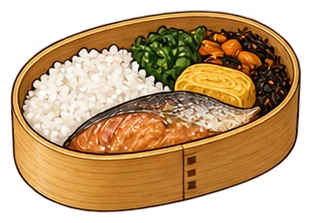
Open an ordinary home-made bento and you will probably find something like this. Roughly half the box is white rice, pressed down firmly, perhaps sprinkled with black sesame or furikake (a dry seasoning of fish flakes, seaweed and sesame), or with a single red umeboshi, a salted pickled plum, in the middle. The other half is packed tight with small portions of several dishes: a slice of tamagoyaki, the rolled sweet-savory omelet; two or three pieces of karaage, Japanese fried chicken; a piece of grilled salted salmon; a little spinach dressed with sesame; a floret of boiled broccoli; a cherry tomato; and, in many children’s lunches, a small red sausage cut so that its end curls into eight little legs when fried, the famous "octopus wiener." Between the items sit lettuce leaves, foil cups, or strips of green plastic cut to look like grass, called baran, which stop flavors and juices from mixing. When the lid goes on, nothing moves.
The single most important fact about bento is that it is usually eaten cold, or more precisely at room temperature, hours after it was made. Many packed-lunch cultures assume a microwave at the other end. Japanese bento traditionally assumes none, and this shapes everything inside it. The short-grain japonica rice that Japan grows is sticky and moist; when it cools, it stays soft and slightly sweet rather than turning hard and crumbly, which is why rice balls and sushi have always been room-temperature foods. Bento dishes are seasoned a little more strongly than food served hot at the table, because flavors dull as food cools. Wet dishes are reduced until the sauce clings, or thickened with starch, so that nothing seeps into the rice. Fried things are fried thoroughly so they do not turn greasy. Salted salmon, vinegared rice and pickled plums are regulars partly because they taste good and partly because salt and acid help food keep. The cook lets everything cool before closing the lid, since trapped steam makes rice soggy and encourages spoilage.
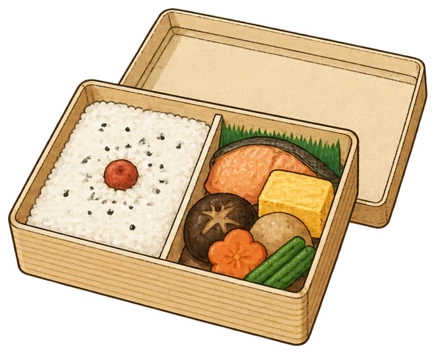
Half the box is rice with a pickled plum in the middle; the other half holds salmon, rolled omelet, shiitake and greens.
The second fact is that a bento is meant to look good. Japanese cooks often say that you eat first with your eyes, and the bento box is where that idea is most visible in everyday life. Home cooks talk about getting "red, yellow and green" into the box: tomato, carrot or plum for red, egg for yellow, vegetables for green. Add the white of the rice and the black of seaweed or sesame and you have the five colors that Japanese nutrition education has long used as a rule of thumb. If the colors are all there, the cook reasons, the nutrition is probably balanced too. Because the box is small, the packing becomes a craft. Rice goes in first and is pressed at an angle; larger items are stood upright against it; small items fill the gaps; a bright accent goes on last.
The third fact is proportion. A widely taught Japanese method for planning a packed lunch uses the box itself as a measuring tool: choose a box whose volume in milliliters roughly matches the calories you need, then fill about three parts with the staple, one part with the main protein dish, and two parts with vegetable side dishes. Few home cooks would name the method, but the instinct of "half rice, half side dishes, more vegetables than meat" is something many Japanese people absorbed by watching a parent pack lunch.
02From Dried Rice to "Bento": Where the Packed Meal Came From
Carrying food on a journey is as old in Japan as anywhere. Ancient travelers and soldiers carried hoshii, cooked rice that had been dried in the sun; it was light, kept for a long time, and could be softened with water on the road. At aristocratic banquets in the Heian period (794–1185), servants and attendants were given tonjiki, large balls of pressed rice, a distant ancestor of the onigiri. Medieval warriors setting out on campaign carried koshi-hyōrō, "waist provisions," rice balls and pickles wrapped in bamboo sheath or cloth and tied at the belt.
The word bento itself appears much later and became common around the late sixteenth century. The usual explanation is that it comes from a colloquial Chinese term of the Southern Song dynasty, written with characters meaning "convenient" or "handy." In Japan it gradually came to mean food carried along to be eaten when convenient, and the container that held it. There is also a popular story that the warlord Oda Nobunaga coined the word when distributing simple meals to large numbers of people at his castle, but this is a later legend rather than history.
Bento became something more than a practical necessity in the Edo period (1603–1868). Two and a half centuries of peace and the growth of cities like Edo, Ōsaka and Kyoto gave townspeople time and money for outings, and every outing needed food. Wealthy families going to view cherry blossoms carried a sagejū, a wooden frame with a handle holding a stack of lacquered boxes, a sake flask, small plates and chopsticks. Spread out under the trees, it became a portable banquet. The stacked lacquer boxes (jūbako) in which Japanese families still serve osechi, the New Year feast, belong to the same family of objects.
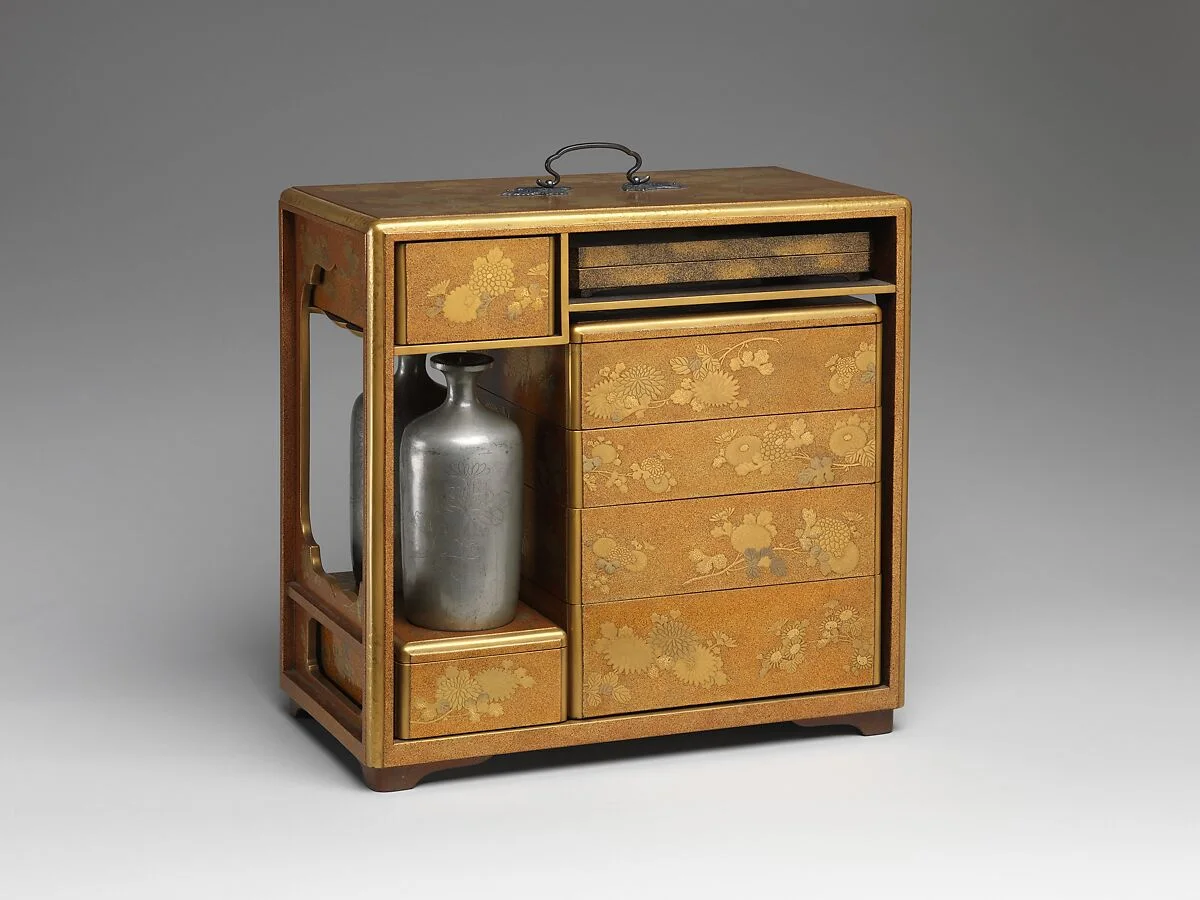
An eighteenth-century sagejū: stacked lacquer boxes and a sake flask in a frame with a handle.The Metropolitan Museum of Art, Portable Picnic Set with Chrysanthemum Sprays (18th century)
The most influential bento of the Edo period was the makunouchi bento. A kabuki performance could last from morning until evening, and audiences ate during the intervals between acts. Teahouses attached to the theaters supplied boxed meals: small cylinders of rice pressed in a mold and dotted with black sesame, with grilled fish, rolled egg, fish cake, simmered vegetables and pickles alongside. The name is usually explained as "between the curtains," meaning the intermission, which is the most widely accepted account; other explanations link it to actors eating backstage or to the top division of sumo wrestlers, also called makuuchi. Whatever the origin, the makunouchi format, rice plus a set of small, separate side dishes, remains the default shape of the Japanese bento. The boxed lunch labeled "makunouchi" in a station kiosk, supermarket or convenience store today is its direct descendant, and the label still signals "a little of everything."
03The Box: Bamboo, Bentwood, Lacquer and Aluminum
To a large extent, the bento is shaped by its container.
The oldest and simplest wrapping is bamboo sheath, the papery outer layer shed by bamboo shoots. Dried, it is tough, breathable and slightly absorbent, so a rice ball wrapped in it does not sweat, and it was believed to help keep food fresh. Cooks in many regions also used kyōgi, sheets of cedar or pine shaved as thin as paper, to wrap rice or fold into shallow trays; they are said to have been especially common in the northeast and in mountain districts. Upmarket rice balls and some station bentos still come in bamboo sheath or wood shavings, and the faint woody smell when you open them is part of the experience.
The bentwood box, magewappa, is probably the best-loved traditional bento box. The most famous come from Ōdate in Akita Prefecture, where craftsmen soften thin boards of Akita cedar in hot water, bend them into an oval, stitch the overlapping seam with strips of cherry bark, and fit a base and lid. The cedar absorbs excess moisture from the rice without drying it out, so by lunchtime the grains are still separate and carry a faint scent of wood. Ōdate magewappa was designated a national Traditional Craft in 1980. As of 2026 a handmade box costs around ten thousand yen, and owners often use one for a decade or more.
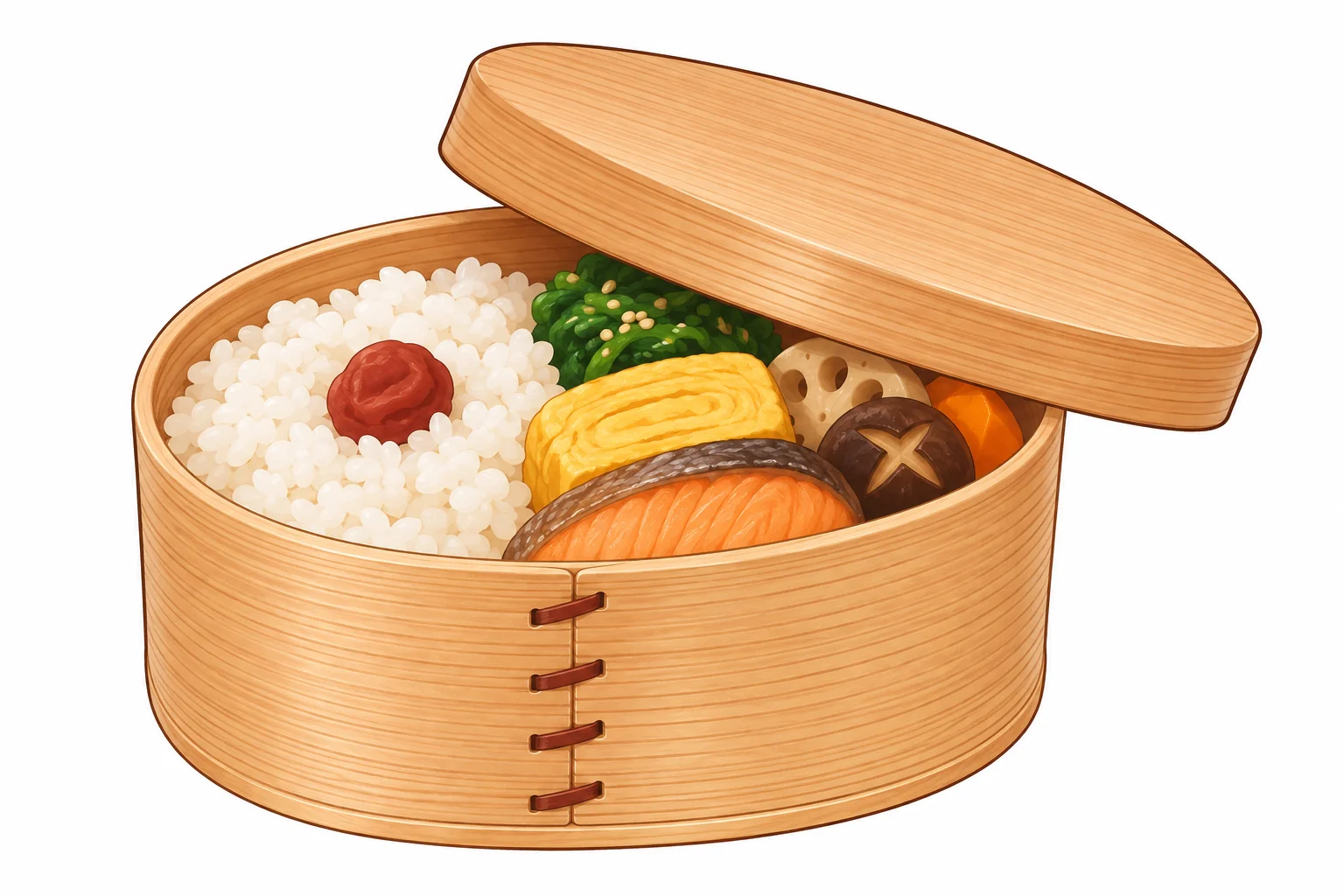
An oval Ōdate bentwood lunch box, lid half open, showing cedar grain and the cherry-bark stitched seam (illustration).
Lacquerware represents the formal side of the bento. The shōkadō bento is the best example: a square lacquered box divided by a cross-shaped partition into four compartments, holding sashimi, simmered dishes, a grilled item and rice, with a lid on top. It takes its name from Shōkadō Shōjō, an early seventeenth-century monk of the Iwashimizu Hachimangū shrine who was also a celebrated calligrapher and painter. He is said to have used a farmer’s divided seed box to hold tobacco or painting materials. Around 1933, at a tea gathering, Yuki Teiichi, founder of the Ōsaka restaurant Kitchō, saw such a box and adapted it for serving food. It became a standard for restaurant lunches and for meals at memorial services and meetings, and today a shōkadō bento is close to a formal kaiseki meal in miniature (see also: Kaiseki: How a Bowl of Rice and a Bowl of Soup Became Japan’s Most Refined Meal).
- 1
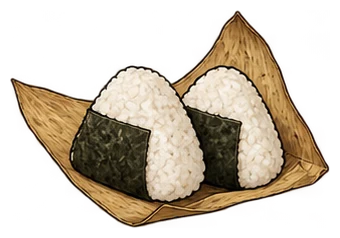 The simplest wrapping: dried bamboo sheath around rice balls, breathable and absorbent.
- 2
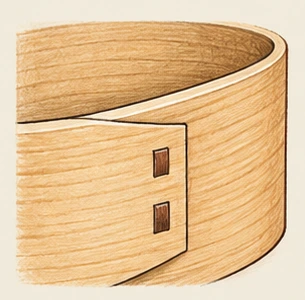 Bentwood box: a softened cedar strip bent into a loop, its overlapping joint stitched with cherry bark.
- 3
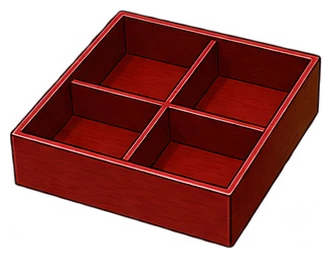 Shōkadō box: a square lacquer box divided into four sections by a cross-shaped partition.
In the twentieth century the bento box became an industrial product. From the early Shōwa era (the late 1920s and 1930s), lunch boxes of anodized aluminum, known in Japan as arumaito, spread across the country. Flat, rectangular and with a tight-fitting lid, they were carried by generations of schoolchildren and workers. In many memories of prewar and postwar schools, pupils put their aluminum boxes on or near the classroom stove in winter so that lunch would be warm by noon. Later decades brought plastic boxes, insulated stainless-steel lunch jars that keep rice and soup hot, and finally the disposable containers of convenience stores and supermarkets: black plastic bases with molded compartments and clear lids, used once and thrown away.
Walk into any Japanese housewares store today and the bento-box shelf is crowded: two-tier stacking boxes, microwave-safe boxes, boxes with a slot for chopsticks, boxes printed with cartoon characters, small boxes sold for dieters, and wrapping cloths and insulated bags to carry them in. The attention lavished on containers follows from the attention paid to the food. A good box keeps the meal tasting right, is easy to carry and wash, and makes the moment of opening it a small pleasure.
04The Home-Made Bento: Parents, Children and Care in a Box
For most Japanese people, bento means first of all a lunch made at home.
In many households the day begins with bento. Before six in the morning someone, still most often the mother, is frying a rolled omelet, crisping a few pieces of frozen karaage, portioning out leftovers from last night’s dinner, and blanching a handful of greens. Public elementary schools and most junior high schools in Japan serve school lunch, but kindergartens, high schools and many private schools expect children to bring their own, and sports days, school trips and weekend clubs all call for bento as well. A lunch made for a husband is jokingly called an aisai bento, a "beloved wife’s bento." Okāsan no bento, "mum’s bento," holds roughly the place in Japanese memory that a favorite home-cooked dish holds in many other cultures.
The classic home bento repertoire is so standard that most Japanese people could list it with their eyes closed: tamagoyaki, sweet or savory depending on the family; karaage; octopus sausages; kinpira, burdock and carrot stir-fried with soy and sugar; a small hamburger patty; grilled salmon; seaweed on the rice. The plainest of all is the hinomaru bento, a box of white rice with a single red pickled plum in the center, so named because it resembles the Japanese flag. From 1939 the government designated the first day of each month Kōa Hōkōbi, a day of patriotic austerity, and schoolchildren were expected to bring a hinomaru bento; for older Japanese the dish still carries an association with wartime frugality.
Bento also carries messages that are hard to say aloud. When a child opens a lunch box in a classroom, classmates see what is in it, and mothers know this. The pressure to make a lunch that is neat, generous and attractive has been widely discussed in Japan, and anthropologists have written about bento as a window onto Japanese ideas of motherhood and schooling. At the same time, a carefully made lunch is a form of communication between parent and child, or between partners, that needs no words, and many Japanese adults remember a parent through one particular dish that appeared in their lunch on one particular day.
Since the 2000s, that care has taken a spectacular form in kyaraben, "character bento." Parents cut eyes and mouths from sheets of nori, shape rice into pandas, Totoro or Anpanman, build cheeks from ham and cheese, and share the results on blogs and social media. A related style, deco-ben, turns lunch into landscapes, animals or even famous paintings. Stores sell nori punches, rice molds and tiny decorative picks for the purpose. Character bento drew perhaps even more attention abroad than at home, and for many people outside Japan these photographs were their first encounter with the word bento. In Japan some see it as exhausting one-upmanship; others point out that it gets children to eat their vegetables.
Packing bento also means knowing food safety. Japan’s rainy season and summers are hot and humid, and a lunch made at six in the morning and eaten at noon can spoil. So raw foods are left out, food is cooled before packing, eggs are cooked through, and many families mix a little vinegar into the rice or add an umeboshi, and tuck an ice pack into the bag in summer. Nobody takes a class in these habits; they are handed down in the kitchen.
05Ekiben: Eating a Place on the Train
If the home bento is everyday life, the ekiben, the station bento, is the ritual of travel. For a Japanese traveler on a long-distance train, choosing an ekiben on the platform or in the station shop before departure, then opening it on the fold-down tray once the train has cleared the city, is almost a fixed sequence. Many people say the journey has not really begun until the ekiben is open.
Japan’s first railway opened in 1872, and which station sold the first ekiben is disputed. The most widely repeated account dates it to 1885, when Utsunomiya Station opened that July on the Nippon Railway line north of Tokyo and a local inn, the Shiroki-ya, sold two rice balls with pickled daikon wrapped in bamboo sheath. Other accounts give earlier dates at Kōbe, Ueno, Ōsaka’s Umeda, Kumagaya or elsewhere, and no single claim can be proven. In 1889, at Himeji Station in Hyōgo Prefecture, a company called Maneki began selling a boxed makunouchi-style lunch of white rice with more than a dozen side dishes, which is generally regarded as the first ekiben in the modern sense (some sources date it to 1888 or 1890). Maneki still sells station bento at Himeji today.
What makes ekiben so appealing is that almost every one tells you where you are. At Mori Station in Hokkaidō, ikameshi, small whole squid stuffed with a mix of glutinous and ordinary rice and simmered in soy and sugar, was created in 1941 when rice was scarce, and it later became a perennial best-seller at department-store ekiben fairs. At Yokokawa Station, at the foot of the pass between Gunma and Nagano, the company Oginoya has sold Tōge no Kamameshi since 1958: seasoned rice topped with chicken, shiitake, a quail egg, bamboo shoot, chestnut and a dried apricot, served in a small, heavy pot of Mashiko stoneware. Many travelers take the empty pot home to cook rice in or use as a planter. In Toyama, masu-zushi, cured trout pressed onto vinegared rice, is wrapped in bamboo leaves inside a round wooden tub held shut with bamboo slats, commonly two of them fastened with rubber bands, and you cut it like a cake. At Yonezawa in Yamagata, Gyūniku Domannaka puts simmered domestic beef over Yamagata’s Domannaka rice and became one of the signature ekiben of the 1990s. In Yokohama, Kiyōken’s Shūmai Bento, built around its pork dumplings and sold since 1954, is so popular that office workers in the Tokyo area buy it as an ordinary lunch.
To get around the cold-food limitation, some ekiben heat themselves. Beef-tongue bentos from Sendai and some beef bentos sold in Kōbe and elsewhere have a heating pack hidden in the base; pull a string on the side, water meets quicklime, and within minutes the box is steaming. Ekiben containers are often souvenirs in themselves: plastic boxes shaped like Shinkansen noses, ceramic pots, wooden tubs, all collected by enthusiasts.
In the old days ekiben were sold by tachiuri, platform vendors who carried a tray of boxes hung from the neck and walked along the train calling out while passengers reached out of open windows to pay. Sealed windows and short stops have all but ended the practice, and it survives only at a handful of stations. Today ekiben are mostly sold in station shops. At Tokyo Station, a shop called Ekibenya Matsuri stocked more than 150 kinds of ekiben from across the country as of 2026, from Hokkaidō sea-urchin rice to Kyūshū chicken rice, so you can pick a regional bento without leaving Tokyo. Since 1966 the Keiō department store in Shinjuku has held a large national ekiben fair every year, now opening each January, and many Japanese make a point of going.
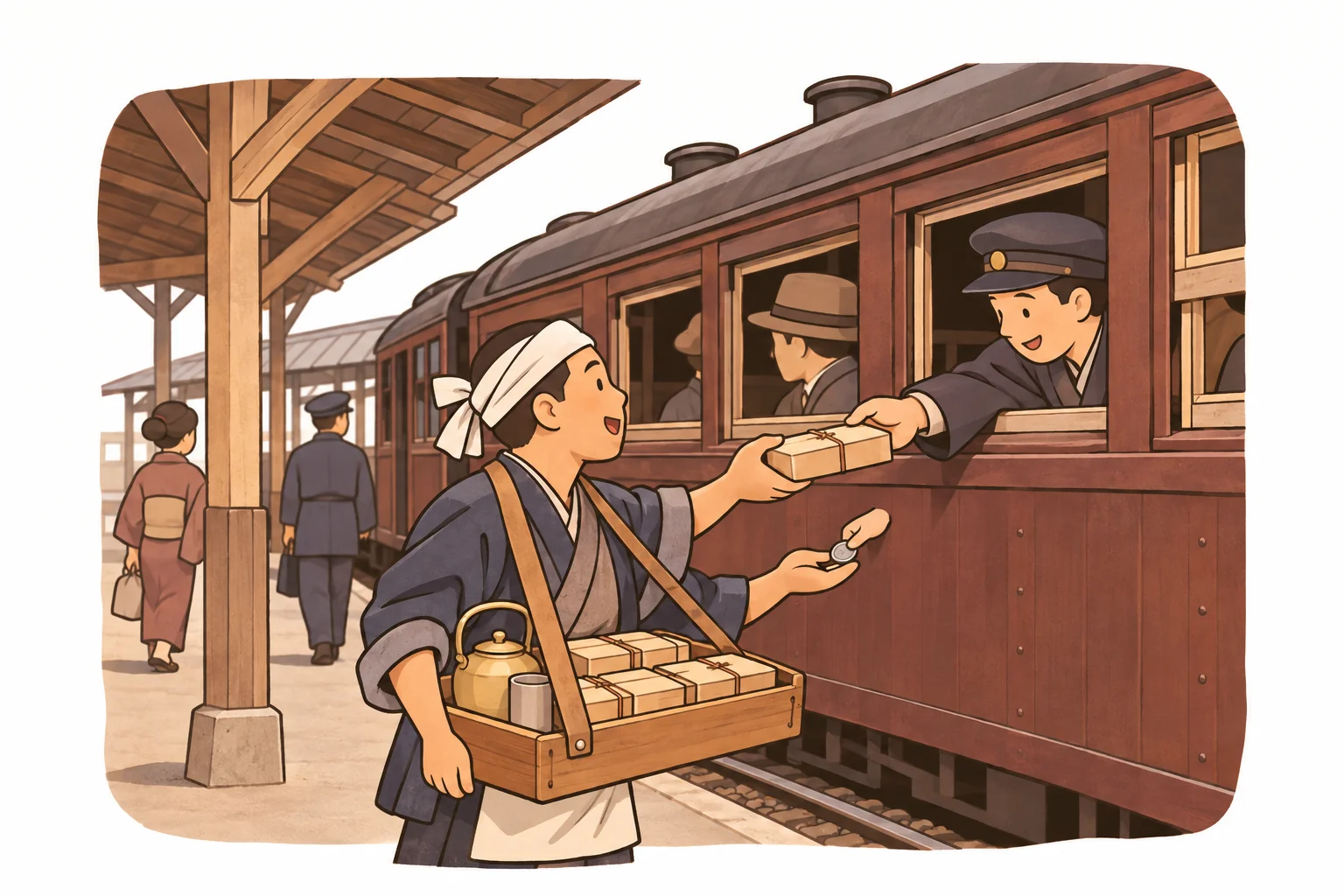
Ekiben sold on the platform: a vendor with a tray walks along the train, passengers buying through open windows (illustration).
As of 2026, ekiben typically cost between about 1,000 and 2,000 yen, more if they feature premium wagyu or seafood. That is more than a convenience-store lunch, because what you are buying is not just a meal but regional ingredients, an old shop’s recipe and the pleasure of the journey. Airports have their own version, soraben ("sky bento"), and highway service areas sell boxed lunches built on the same idea.
06Bento on the Street: Takeout Shops, Convenience Stores and Department-Store Food Halls
Today most bento eaten in Japan are bought rather than made.
In 1976 a takeout chain called Hokka Hokka Tei opened in Sōka, Saitama Prefecture, selling bento cooked to order and handed over hot. In a country whose packed lunches had always been cold, freshly cooked bento was a selling point, and with later chains such as Hotto Motto, the takeout bento shop became a fixture of Japanese streets. You order at the counter from a menu of photos, wait a few minutes, and leave with a plastic box of hot rice and freshly fried chicken or pork cutlet. The cheapest staple, nori-ben, a layer of soy-seasoned bonito flakes and a sheet of seaweed over rice, with a piece of fried white fish and a tempura-fried fish-cake stick, costs a few hundred yen as of 2026 and has fed generations of students and laborers.
Convenience stores are now among the largest bento sellers in the country. Their chilled shelves hold makunouchi boxes, pork cutlet over rice, karaage bento, pasta and fried noodles, with new items every week. At the register the clerk asks, "Atatamemasu ka?" ("Shall I heat it?"), and a nod sends it into the microwave. The details show how seriously this everyday product is taken: rice and side dishes are separated, salads or pickles that should not be heated come in a separate pack, and the label shows calories and an expiration time down to the hour. See also: Konbini: How Japan Turned the Convenience Store into Everyday Infrastructure.
Supermarkets have their own evening ritual. As closing time approaches, staff put discount stickers on the day’s bento and prepared foods, first twenty or thirty percent off, then half price, and commuters gather by the counter to wait. It is a small but dependable scene of Japanese urban life.
At the other end of the scale are the food halls in department-store basements, known as depachika. Here you find the most elaborate bento: shōkadō boxes from established restaurants, eel over rice from famous shops, delicate sushi assortments, seasonal cherry-blossom bento. Prices run from two or three thousand yen to well over ten thousand, and these boxes are bought for guests, for gifts, for blossom viewing or for an afternoon at the theater. They continue the line that runs back through the makunouchi to the Edo picnic set: a bento can be a serious meal.
07How to Buy and Eat a Bento in Japan
It is hard to travel in Japan without eating bento, and the one worth planning for is the ekiben. Before boarding a Shinkansen or limited express, arrive ten or fifteen minutes early and browse the station bento shops; major stations offer dozens of choices. Ekibenya Matsuri at Tokyo Station has the widest selection but can have lines in the morning and around noon. In cities like Kyoto, Kanazawa, Sendai or Niigata, look for the local specialties at the station itself. Boxes are labeled with the main ingredients and their origin, and display samples make it easy to choose even if you cannot read the labels. If you do not want a cold lunch, look for the self-heating boxes with a pull string.
Eating on the Shinkansen and on limited-express trains is completely normal. Japanese passengers do it themselves, and the seats have trays and the cars have bins. Commuter trains and subways are different: in a crowded carriage full of standing passengers, opening a bento would bother the people around you, and Japanese people almost never do it. Eating while walking down the street is also considered a little unrefined. If you buy a bento, find a bench, a park, or take it back to your hotel.
A few small habits help. A convenience-store bento can be heated or not, as you like; many items are designed to be eaten cool. Ekiben are generally eaten at room temperature, so do not go looking for a microwave. When you split disposable chopsticks, do not rub them together to remove splinters, which is seen as faintly rude, as it implies the chopsticks are cheap. When you finish, close the box, put the chopsticks back in their paper sleeve, and either carry it with you or use the designated bins. Public trash cans are rare on Japanese streets, so station and convenience-store bins are the easiest places to dispose of it.
In spring, picking up a few bento and drinks from a depachika or supermarket and spreading a plastic sheet in a park under the cherry trees is one of the most Japanese meals there is. And if you are staying somewhere with a kitchen, buy a bento box at a housewares store or a hundred-yen shop and try packing one yourself the next morning: rice pressed into one side, a rolled omelet, something fried, something green, something red.
08Why Bento Matters in Japan
Packed lunches exist everywhere. The Japanese bento became something distinctive because several things came together. Japanese rice tastes good cold, so cold rice could be a proper meal rather than a compromise. Japanese home cooking was already built on rice served with several small side dishes, a structure that fits naturally into a divided box. Edo-period city life turned travel rations into a pleasure for theatergoers and blossom viewers. The railways then gave every region its own ekiben. And a broader Japanese attention to small objects, to the seasons and to appearance meant that a lunch box could be humble or exquisite and still be taken seriously.
Fewer Japanese people pack their own bento now than a generation ago, and more buy them. Yet the bento’s place in daily life has hardly shifted. The sound of an omelet in the pan before dawn, the moment a lid comes off on a Shinkansen tray table, the half-price stickers going on in a supermarket at eight in the evening: these remain ordinary parts of Japanese life.