
At a glance
How the American convenience store became Japan’s everyday infrastructure: its history, hidden systems, signature foods, human costs, and how visitors can use one well.
- Japan has roughly 55,000 to 56,000 convenience stores; as of 2026, 7-Eleven, FamilyMart and Lawson together hold over 90 percent.
- Japan’s first 7-Eleven opened in Toyosu, Tokyo, on May 15, 1974, converted from a family liquor shop.
- A standard store is about 30 tsubo (around 100 square meters) and stocks some 3,000 items.
- In 1978 7-Eleven began selling rice balls with a film between nori and rice, so the seaweed stays crisp.
- At a konbini you can pay utility bills, withdraw cash, send parcels, buy tickets and even print a residence certificate.
Every visitor to Japan ends up in a konbini, usually within an hour of landing. The word is short for konbiniensu sutoa, convenience store, and there are about fifty-six thousand of them across the country: 7-Eleven, FamilyMart and Lawson above all, open around the clock, every day of the year. The format came from the United States, but Japan rebuilt it into something Americans would barely recognize, a small shop that sells fresh rice balls and decent coffee, takes your gas bill payment, ships your suitcase to the airport and prints your concert ticket. This is the story of how that happened, what is actually on the shelves, why the system works the way it does, what it costs the people who run it, and how to use one well when you are there.
01What You Walk Into
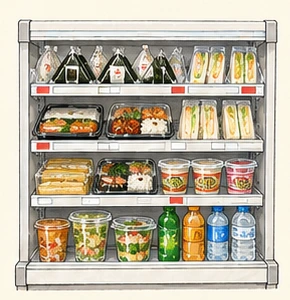
A typical Japanese convenience store is small, around a hundred square meters of selling floor. The door slides open, an electronic chime plays, and a clerk behind the counter calls out irasshaimase, "welcome." No reply is expected. The layout is so consistent from chain to chain that after a day or two you could find your way around blindfolded. Magazines line the front window, where they once served the practical purpose of making the store look busy and lit from the street. Along the walls run household goods, stationery, snacks and instant noodles. The back wall is a long glass cooler of drinks: green tea, barley tea, canned coffee, sports drinks, milk, beer, highballs in cans, small bottles of sake. The center of the store, the most valuable floor space, belongs to fresh food: rice balls, sandwiches, boxed meals, salads, noodles, desserts.
Next to the register sits a heated glass case of fried chicken, croquettes and steamed buns. In winter a shallow metal tray appears beside it, divided into square compartments where daikon radish, boiled eggs, konnyaku and fish cakes simmer in broth. Everything is clean, bright and quiet. The aisles are narrow because every square meter has to earn its keep.
A konbini carries roughly three thousand items, compared with ten thousand or more in a supermarket. That scarcity of shelf space drives everything. Products that do not sell are cut quickly, and new ones arrive every week. Each chain releases a steady stream of limited-edition rice balls, seasonal sweets and collaboration snacks, and Japanese food bloggers and YouTubers review them with the attention other countries give to restaurant openings.
The numbers are large. Japan has had around 55,000 to 56,000 convenience stores for most of the 2020s, which works out to roughly one for every 2,000 to 2,500 people. As of 2026, 7-Eleven runs about 22,000 of them, FamilyMart about 16,000 and Lawson about 14,500. Together the big three account for more than ninety percent of the market. The remainder includes Ministop, owned by the retail group Aeon, and regional chains, the most beloved of which is Seicomart in Hokkaidō. In central Tokyo it is common to stand at an intersection and see two branches of the same chain.
02An American Idea Comes to Japan
The convenience store began in Texas. In 1927 an employee of the Southland Ice Company in Dallas started selling milk, bread and eggs from an ice dock, and customers liked being able to pick up basics outside grocery hours. In 1946 the company renamed its stores 7-Eleven, after their hours: seven in the morning to eleven at night, long for the time.
Japan was ready for the idea by the late 1960s. The country was in the middle of its postwar boom, and supermarkets were spreading fast. That put enormous pressure on the small family shops that had always supplied neighborhoods: the rice dealer, the liquor shop, the corner grocer. Government planners and retail executives looked to the American convenience store as a way for these shops to modernize rather than disappear. Several experimental stores opened around Ōsaka and Tokyo at the end of the decade, and historians still argue about which one counts as Japan’s first.
The person who made the model stick was Suzuki Toshifumi, an executive at the supermarket group Ito-Yokado. After seeing 7-Eleven stores on a trip to the United States, he pushed his company to license the brand, against considerable internal skepticism. Ito-Yokado signed with Southland in 1973 and set up the company that became Seven-Eleven Japan. The first store opened on May 15, 1974, in Toyosu, in Tokyo’s Kōtō ward. Its owner, Yamamoto Kenji, whose family ran a liquor shop on the site, had written to the company at the end of 1973 asking to join, reportedly after reading about the venture in the press; he converted the shop into a franchise, and it was still open when it marked its fiftieth anniversary in 2024. That detail matters: from the start, Japanese konbini were a way to give the old neighborhood shopkeeper a future.
Competitors followed quickly. The supermarket chain Daiei opened the first Lawson in June 1975 in Toyonaka, outside Ōsaka, borrowing the name from an Ohio dairy-store chain. The supermarket chain Seiyu opened an experimental store in Sayama, Saitama, in September 1973 and spun the business off as FamilyMart in 1981. Round-the-clock hours came gradually: the early 7-Eleven really did close at eleven, and the first 24-hour trial ran at a store in Kōriyama, Fukushima, in 1975.
Suzuki and his team soon found that the American operating manuals did not fit Japanese customers, who wanted freshness, cleanliness and products suited to Japanese tastes. They kept the brand and rebuilt nearly everything else. The student eventually outgrew the teacher. When Southland ran into financial trouble in the late 1980s, Ito-Yokado and Seven-Eleven Japan bought a controlling stake in it in 1991, and in 2005 took full ownership of what had become 7-Eleven, Inc. Today the parent company, Seven & i Holdings, is headquartered in Tokyo, and 7-Eleven around the world is, in effect, a Japanese company.
03The System Behind the Shelves
What makes a Japanese konbini feel effortless is a set of systems the customer never sees.
- 1Datapoint-of-sale terminals from 1982
- 2Logisticsfrozen, chilled, room-temperature, rice dishes; about 70 deliveries a day → about 9
- 3Locationdominant strategy; all 47 prefectures by July 2019
- 4Franchisevery often a married couple or a family
- 5Fooddedicated factories, headquarters’ recipes
Five systems the customer never sees; temperature-divided combined distribution cut daily trucks per store from about seventy to about nine.
The first is data. In 1982 Seven-Eleven Japan began installing point-of-sale terminals in its stores, earlier than most retailers anywhere. Each sale recorded what was bought, when, and, in a touch that became famous, the clerk’s guess at the customer’s age group and sex, entered by pressing a button at checkout. The data flowed to headquarters and back to the stores. Suzuki called the method "hypothesis and verification": the person ordering stock makes a prediction based on weather, local events and yesterday’s sales, checks it against the next day’s results, and adjusts. A store near a school stocks differently on a sports day; a store near an office tower orders fewer rice balls before a public holiday. Ordering is done by store staff, item by item, several times a day.
The second is logistics. A konbini has almost no storage space, so shelves have to be restocked several times a day. The chains built distribution networks divided by temperature, with separate trucks for frozen goods, chilled goods, room-temperature goods and freshly made rice dishes, which are delivered two or three times a day. In the 1970s a single store received around seventy deliveries a day from different wholesalers. Combined distribution centers, which consolidate products from many suppliers by temperature zone, brought that down to about nine trucks by the early 2000s.
Stores have no stockroom; goods arrive in trucks sorted by temperature, with rice balls and bento delivered two or three times a day.
The third is location. Seven-Eleven Japan used what it calls a dominant strategy, opening many stores close together in one region before moving to the next, rather than scattering them nationwide. Dense clusters make delivery routes efficient and make the brand visible. It is also why 7-Eleven took decades to reach some prefectures. Its first stores in Okinawa opened only in July 2019, completing its presence in all forty-seven prefectures.
The fourth is the franchise model. Most Japanese convenience stores are franchises, very often run by a married couple or a family. Headquarters supplies the brand, the product range, the systems and the deliveries. The owner hires and schedules staff, places orders and runs the shop day to day, and pays headquarters a share of gross profit. This structure let the chains cover the country in a generation. It also concentrates the risk on the owner, which became a national issue in 2019.
The fifth is the food itself. Rice balls, boxed meals and sandwiches are not made in the store. They come from dedicated factories, many of which supply only one chain, working to recipes and specifications set by headquarters and revised constantly. How the rice is cooked, how much salt goes in, how a boxed meal’s side dishes are arranged so they look right after a trip in a delivery truck: all of it is engineered. This is why a convenience-store meal in Japan does not taste like fast food. It is the product of an entire manufacturing chain built around one small shop.
04What to Eat
The signature item is the onigiri, the rice ball. For most of its history the onigiri had a basic flaw: wrap it in nori seaweed in the morning and by lunchtime the nori is soggy. In 1978 Seven-Eleven Japan introduced a film wrapper that keeps the nori separate from the rice until you open it. On today’s wrappers (and, by one account, on the 1978 original as well) you pull a numbered tab down the middle, then slide off the two halves of the film from either side, and the dry, crisp sheet of nori settles around the rice. The design spread to every chain and made the rice ball the backbone of the konbini business. Classic fillings include grilled salmon, tuna with mayonnaise, pickled plum, spicy cod roe and simmered kelp. As of 2026 a rice ball usually costs from about 150 yen to a little over 200, and the big chains sell them by the hundreds of millions every year; 7-Eleven alone has been reported to sell around two billion a year.
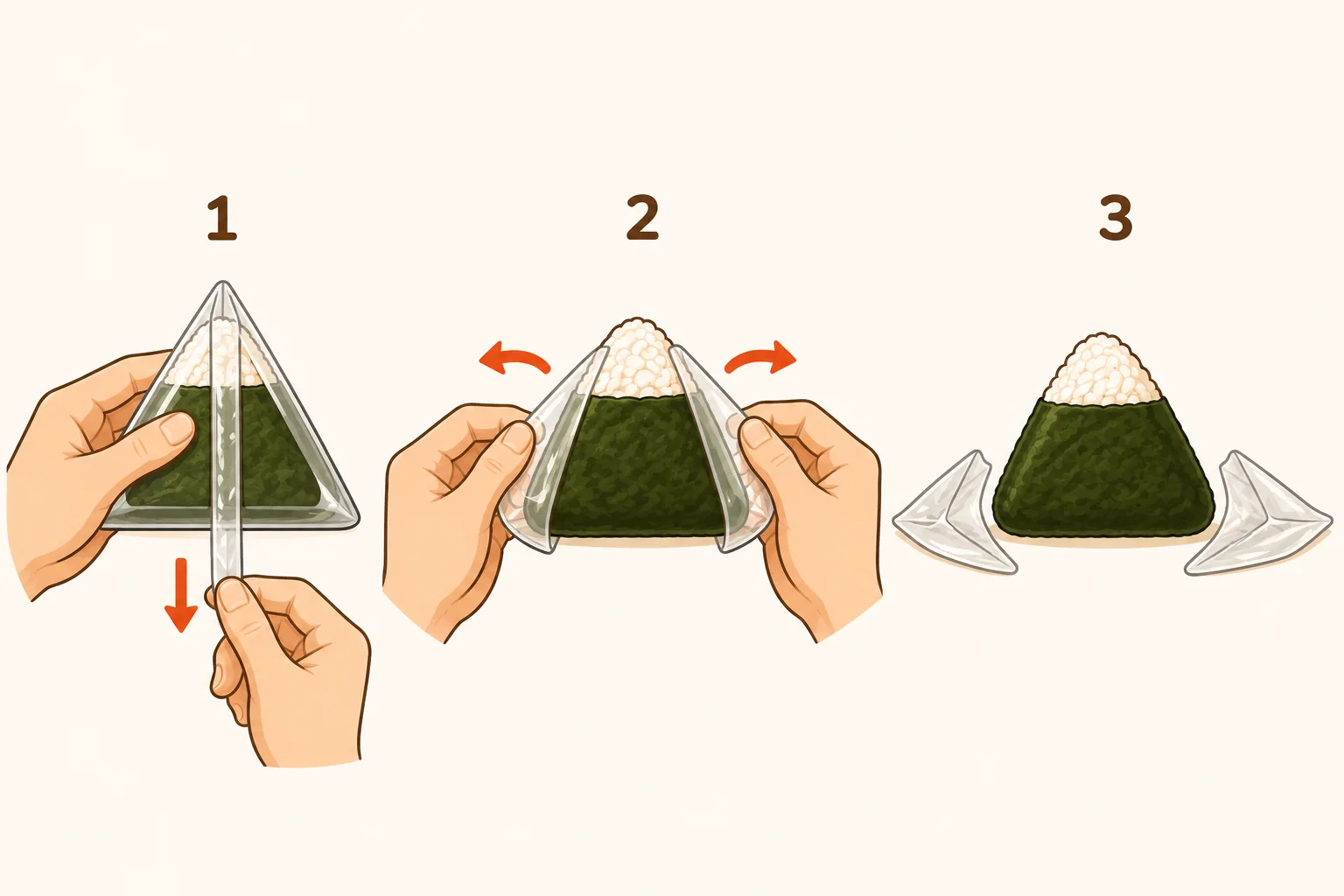
Opening a konbini onigiri: pull the numbered tab, slide off the film, and the nori settles around the rice.
Boxed meals, bento, are the next pillar: makunouchi assortments, fried chicken, hamburger steak with demi-glace, curry, spaghetti, yakisoba, usually between 500 and 700 yen as of 2026. At the register the clerk will ask atatamemasu ka?, "shall I heat it?" Say yes and it goes into a commercial microwave for half a minute. The lids often print exact wattages and heating times.
The hot case by the register is where brand loyalty is fought. Lawson’s Karaage-kun, bite-sized fried chicken nuggets in a little box with a cartoon bird on it, has been sold since 1986 in regular, red-pepper and Hokkaidō cheese versions, plus a rotating cast of strange limited flavors. FamilyMart’s Famichiki, a boneless fried chicken cutlet in a paper sleeve, appeared in 2006 and has become close to the chain’s mascot. 7-Eleven has its own fried chicken and croquettes. Japanese schoolchildren and commuters eat these standing outside the store, and the taste of a particular brand of fried chicken after cram school is a common nostalgia.
In winter, the oden pot by the register is the sign of the season. Oden, ingredients simmered in a light dashi broth, was street-stall and pub food until Seven-Eleven Japan brought it into its stores in 1979. Customers used to ladle their own picks into a paper cup with tongs: a wedge of daikon, an egg, a knot of kelp, a skewer of beef tendon. Hygiene concerns and staff shortages have led many stores to move the pot behind the counter or replace it with packaged oden.
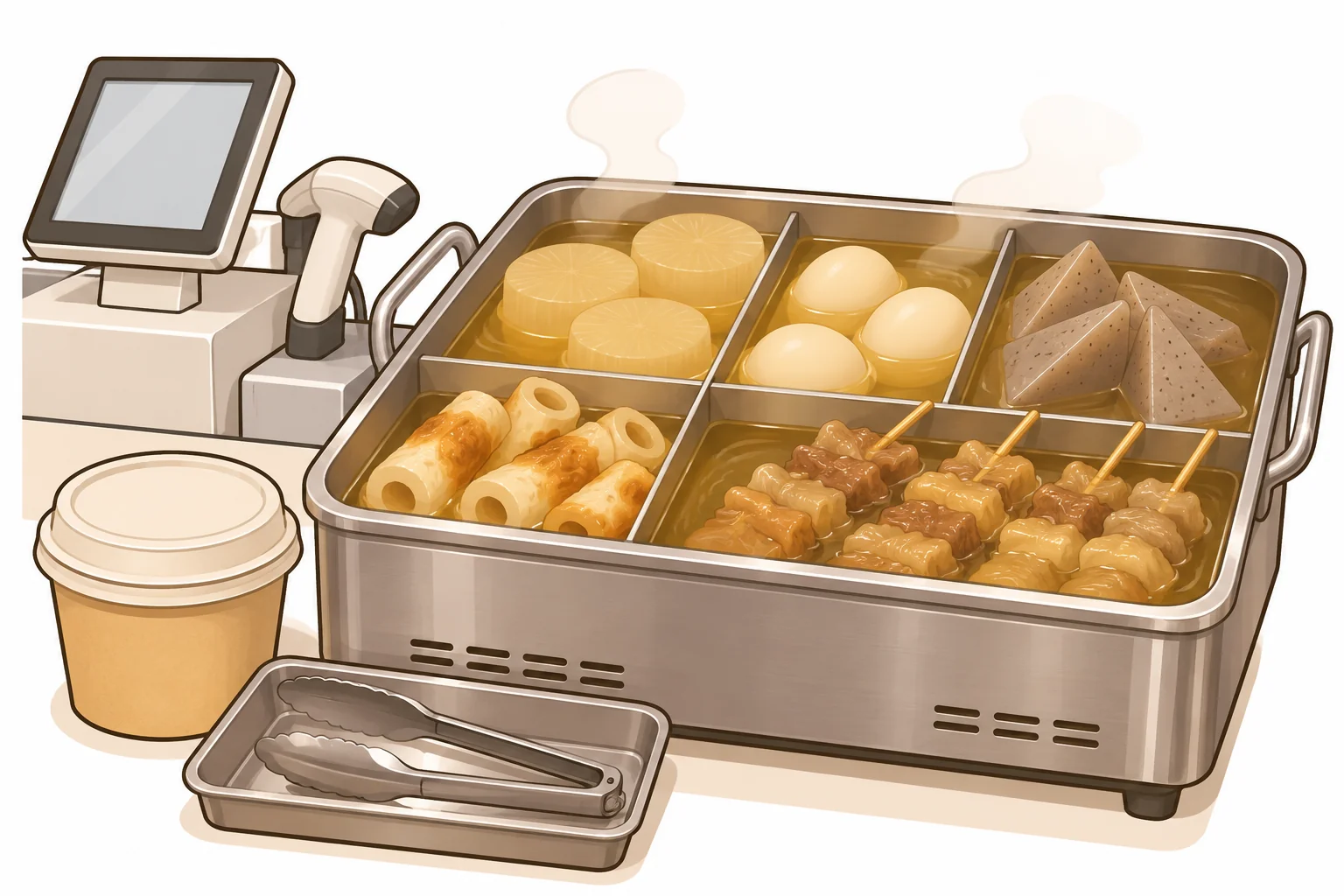
A konbini oden pot by the register: radish, eggs, konnyaku, chikuwa and beef-tendon skewers in broth (illustration).
Coffee is the newer success story. Convenience stores tried fresh coffee several times without much luck. In 2013 7-Eleven launched Seven Café, a cup of freshly ground coffee for 100 yen, where you buy an empty cup at the register and fill it yourself at a machine by the window. It took off on a scale that surprised the industry, selling some 450 million cups in its first year and passing a billion cups a year within five years, and changed how Japanese office workers buy their morning coffee. The other chains followed.
Then there are the sweets. Custard pudding, cream puffs, roll cakes, dorayaki pancakes filled with bean paste, seasonal parfaits: all the chains compete hard here, and a well-reviewed new dessert can sell out within days. The famous egg salad sandwich, soft white bread with a filling of mashed egg and mayonnaise, has become something of a pilgrimage item for foreign visitors, to the mild amusement of Japanese people who have eaten it all their lives. The drinks wall deserves a slow look of its own. Japan’s canned and bottled tea is unsweetened by default, so a bottle labeled ryokucha is plain green tea and mugicha is roasted barley tea, drunk cold all summer. Canned coffee comes in dozens of styles, from black to very sweet milk coffee, and from autumn onward a heated cabinet near the register keeps cans and small bottles of tea and coffee hot, a small pleasure on a cold morning that most visitors have never encountered at home. Seasonal shifts run through the whole store: cherry-blossom sweets in spring, chilled noodles and shaved-ice cups in summer, chestnut and sweet-potato desserts in autumn, and in winter the oden pot, steamed meat buns and preorder forms for Christmas cake and New Year dishes.
Alcohol is sold at nearly every konbini, but not to anyone under twenty; when you buy beer, the register screen asks you to tap a button confirming your age.
05More Than a Store
Japanese commentators like to call the konbini "social infrastructure," and it is not an exaggeration.
In 1987 Tokyo Electric Power began accepting bill payments at 7-Eleven stores. Gas, water, phone bills, local taxes, national pension contributions and online-shopping orders followed. A Japanese household receives a bill with a barcode and pays it downstairs, at any hour, instead of racing to a bank before it closes at three in the afternoon.
Then came cash machines. In 2001 Seven-Eleven Japan’s parent group set up its own bank, now Seven Bank, to put ATMs in its stores, and the other chains brought in machines run by partner banks. For foreign travelers, 7-Eleven ATMs have long been among the most reliable places to withdraw yen with an overseas card.
Konbini also handle parcel delivery and pickup, including the luggage delivery service takkyūbin that lets you send bags ahead to your next hotel or the airport. They have photocopiers that print, scan and fax, and multi-function kiosks that sell tickets for concerts, sports, theme parks and long-distance buses. Residents with a My Number identification card can print official documents, such as a certificate of residence, from the store’s copier. A hundred-square-meter shop does part of the work of a post office, a bank, a ticket agency and a city hall counter.
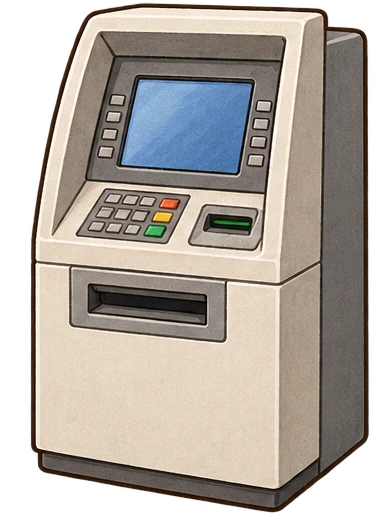
ATM: the machines in 7-Eleven have long been among the most reliable places to draw yen on a foreign card.
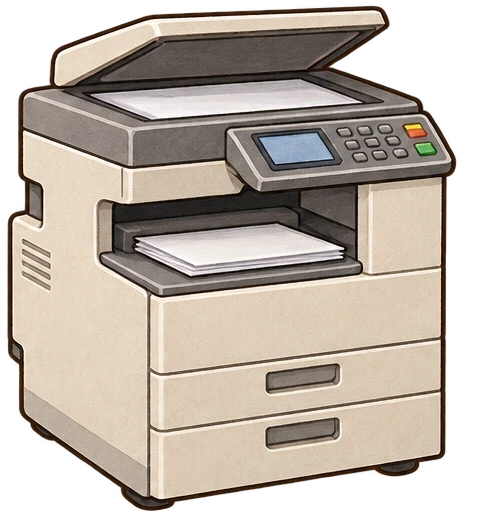
Multifunction copier: copy, print and scan, and with a My Number card print a residence certificate.

Parcels: send them at the counter or collect online orders.
The lit storefront has a public-safety role too. Many stores display a sticker marking them as a safe haven where women and children can come for help at night. After earthquakes and typhoons, the reopening of the local konbini is taken as a sign that life is returning. After the 2011 Tōhoku earthquake and tsunami the chains raced to resupply stores in the disaster zone, and in 2017 the government named the three big chains, along with several supermarket groups, "designated public institutions" under the Disaster Countermeasures Basic Act, obliging them to help supply goods in emergencies.
06The Cost of the Light
The always-open store depends on people, and the strain has become hard to ignore. A night-shift clerk often runs the store alone: ringing up sales, restocking, frying chicken, cleaning, taking in parcels, dealing with drunks. Franchise owners carry most of the risk. Headquarters takes its share of gross profit, while the owner pays for labor, utilities and much of the cost of food that expires unsold. Many owners cover night shifts themselves and go years without a real holiday.
In February 2019 the owner of a 7-Eleven in Higashi-Ōsaka, unable to hire enough staff after his wife’s death and having taken three days off in eight months, cut his hours to 6 a.m. to 1 a.m. Headquarters objected, citing his contract, and the dispute became national news; at the end of that year the company terminated his franchise and the two sides went to court. It opened a public debate about whether round-the-clock operation was worth what it cost. The chains began allowing some stores to close at night on a trial basis, and the Japan Fair Trade Commission examined franchise practices.
The labor shortage has changed who stands behind the counter. In Tokyo and Ōsaka, name tags frequently show Vietnamese, Nepali, Chinese or Myanmar names, mostly students working part-time. Self-checkout registers and small staffless stores are spreading.
Food waste is the other problem. Rice balls and boxed meals have strict sell-by times and are pulled from the shelves when they pass, and for years most of that food was thrown away. Around Setsubun in early February, when the chains push ehōmaki, thick sushi rolls eaten for good luck, photographs of piles of discarded rolls drew wide criticism. The chains have since moved to preorders and discounts or loyalty points on items near expiry. Since July 2020 plastic shopping bags have carried a mandatory charge nationwide, so the clerk will now ask whether you want one.
The konbini has also entered literature. Murata Sayaka’s novel Convenience Store Woman won the Akutagawa Prize in 2016. Its narrator has worked in the same store for eighteen years and feels like a functioning part of society only when she is following the store manual. Widely translated, the book gave many readers abroad their first sense of the people under the fluorescent lights.
The industry itself keeps consolidating. FamilyMart merged with Uny Group, owner of the Circle K and Sunkus chains, in 2016, and rebranded those stores over the following two years. In 2024 Lawson was taken private, jointly owned by the telecom company KDDI and the trading house Mitsubishi Corporation. That same year Seven & i received a takeover proposal from the Canadian convenience-store group Alimentation Couche-Tard, which caused a stir in Japan before it was withdrawn in July 2025. With the domestic market close to saturation, the chains are looking abroad and adding services rather than stores.
07Using a Konbini
You will probably visit a konbini every day of your trip, and it rewards a little know-how.
Go early for the best selection of fresh food. Between about seven and nine in the morning, and again before noon, the rice ball and bento shelves are fully stocked; late at night the choice thins out. The label on each rice ball names the filling, often with a small picture. To open one, pull the tab marked 1 straight down, then pull the corners marked 2 and 3 out to each side. Your first one may tear. By the third you will have it.
At the register the clerk will run through a short series of questions: heat it up, chopsticks or a spoon, a bag, how are you paying. If you do not catch the words, the gestures make them clear, and a nod or a shake of the head is enough. O-hashi kudasai gets you chopsticks; fukuro kudasai gets you a bag. Order items from the hot case and the oden pot at the counter by pointing. Nearly every store accepts IC transit cards such as Suica, credit cards and phone payments, and many have semi-self-service registers where the clerk scans and you pay at a machine.
Most konbini have no seating, though some have a short counter by the window called an eat-in corner. As of 2026, consumption tax is 8 percent on food you take away and 10 percent if you eat it in the store, so the clerk may ask which you are doing. The government plans to cut the rate on food and drink to 1 percent for two years from April 2027; according to reports, the bill passed the lower house in November 2026 and was still before the upper house as of November 2026. Where there is no seating, avoid eating on the pavement outside the door; take your food to a park bench or back to your room.
Trash is a real issue for visitors, since Japanese streets have very few public bins. Konbini usually have sorted bins, for burnables, plastic bottles and cans, near the door. They are meant for things bought in the store; bringing in a bag of trash from elsewhere is frowned upon. Most stores will let you use the toilet if you ask, and buying something small afterward is a courtesy that goes a long way.
The chains have different strengths. 7-Eleven is generally rated highest for rice balls and boxed meals. FamilyMart’s fried chicken and frequent dessert collaborations have a strong following. Lawson runs, alongside its standard blue stores, Natural Lawson, focused on health foods and sometimes called the "purple Lawson" for its differently colored sign, and the budget Lawson Store 100. In Hokkaidō, find a Seicomart, which locals call Seikoma. It cooks food in-store, including katsudon pork-cutlet rice bowls and fried potatoes, and it regularly tops customer satisfaction surveys. In Kyoto, local landscape rules mean many konbini near temples and old districts use muted brown or white signs instead of the usual bright stripes. The muted branches around Gion and the Higashiyama temple district have become small sightseeing curiosities in their own right, photographed by visitors who have learned to recognize the usual colors; a Lawson on the approach to Kiyomizu-dera is one often mentioned.
A konbini is not where Japanese food reaches its heights. For that you go to a sushi counter, a ramen shop, a department-store food hall. What it gives you is something else: at any hour, in a city where you cannot read most of the signs, a clean, cheap, reliable meal, a polite clerk, and a place where most small problems can be solved. Many travelers find, once they are home, that this is what they miss.