
At a glance
What sets the Japanese kissaten apart from chain cafés, how it grew from Meiji salons into the living room of Shōwa cities, and what to expect inside one today.
- Kissaten are mostly independent, old-style coffee houses that brew each cup and also serve toast, spaghetti and pudding.
- The Kahiichakan, opened in Ueno, Tokyo, in 1888, is usually called the first coffee house open to the public.
- Jun-kissa, "pure kissaten," first meant coffee and light food only, with no alcohol and no hostesses.
- The number of kissaten peaked in the early 1980s at around 150,000 nationwide.
- As of 2026 a cup of coffee at a kissaten usually costs 500 to 800 yen.
Walk down almost any shopping street in an older Japanese neighborhood and you will eventually pass one: a heavy wooden door, a faded sign spelling coffee with the old characters 珈琲, and a window display of wax spaghetti and a lurid green soda topped with ice cream. Inside are low lights, deep red velvet chairs, a counter where an elderly owner pours water over coffee grounds with the patience of a calligrapher, and, quite possibly, a haze of cigarette smoke. This is a kissaten, the Japanese coffee house. It sells coffee, but what people really come for is a chair, a little quiet, and permission to stay. This piece explains what makes a kissaten different from a café, how it grew out of Meiji-era experiments and the dubious "cafés" of the 1920s, why it became the living room of postwar Japanese cities, and what to expect when you push open the door of one today.
01What a Kissaten Is
The word kissaten literally means "tea-drinking shop." The term kissa, drinking tea, is old; the Zen monk Eisai used it in the title of his early thirteenth-century treatise on the health benefits of tea. But in modern Japan the drink at the center of a kissaten has long been coffee, and the word now calls up a very specific kind of place. It is usually independently owned, small, and furnished in a style that was fixed sometime between the 1950s and the 1970s. Coffee is made to order, one cup at a time. The menu runs to toast, sandwiches, spaghetti, pancakes, and pudding.
Japanese people draw a sharp line between a kissaten and the chain coffee shops that now dominate train stations, even though statistically they belong to the same category. At Starbucks or Doutor you order at the counter, carry your own tray, and leave when you are done. At a kissaten someone brings a glass of water and a hot or cold towel (oshibori) to your table, waits while you read the menu, and delivers your coffee in a porcelain cup on a saucer. There are newspapers, weekly magazines, sometimes a shelf of manga. Customers stay for hours, and the owner does not mind.
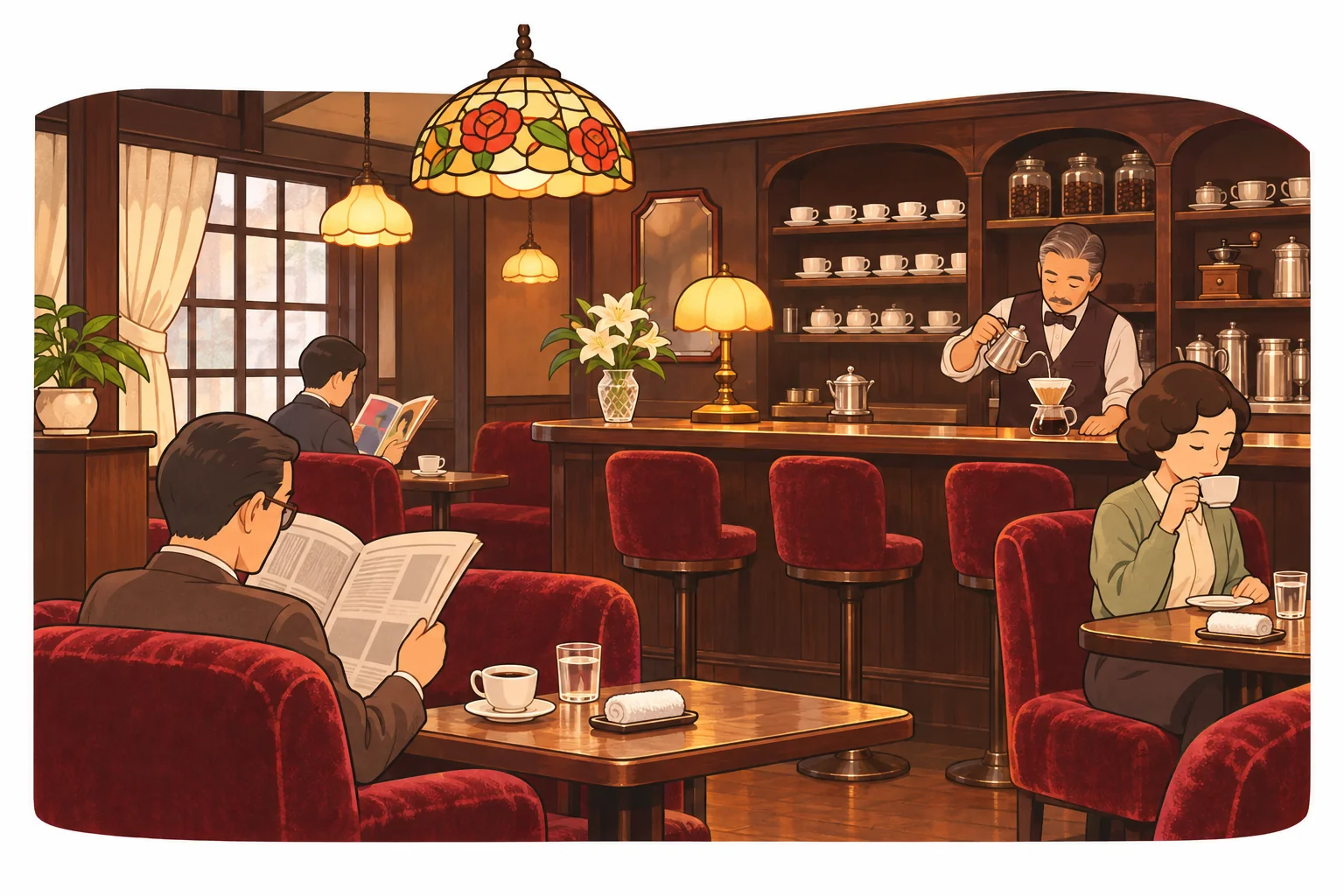
An old Shōwa-style kissaten: customers reading on red velvet chairs while the owner pours coffee slowly at the counter (illustration).
That last point explains much of the kissaten’s place in Japanese life. Homes in Japanese cities are small and rarely used for entertaining guests. For most of the twentieth century, the kissaten served as the parlor that apartments lacked: a place for business meetings, arranged-marriage introductions, waiting for a friend, writing a manuscript, or simply sitting alone with one’s thoughts. The price of a cup of coffee was effectively rent on a seat.
02From a Meiji Salon to the Ginza Cafés
Coffee reached Japan in the Edo period through the Dutch traders confined to Dejima in Nagasaki, but very few Japanese ever tasted it. The first coffee house open to the general public is usually said to be the Kahiichakan, which opened in 1888 in Shitaya Kuromonchō, near Ueno in Tokyo. Its founder, Tei Eikei, came from a Nagasaki family of hereditary Chinese interpreters and had studied in the United States. He imagined a cultural salon in the Western mold, stocked with newspapers and books, playing cards, go and shogi sets, and a writing room with paper and pens; some accounts add a billiard table. The idea was ahead of its time, and the shop closed within a few years.
Coffee houses took root in Tokyo at the end of the Meiji era. In 1911 three famous establishments opened in Ginza. Café Printemps, run by the painter Matsuyama Shōzō, operated on a membership system and attracted writers and artists. Café Lion, run by the Western restaurant Seiyōken, was known for its good-looking waitresses, said by some accounts to have worn matching uniforms. Café Paulista, founded by Mizuno Ryō, sold coffee at five sen a cup, cheap enough for ordinary office workers and students. Mizuno had organized the first emigration of Japanese laborers to Brazil, and the São Paulo state government repaid him by supplying coffee beans free of charge; that connection let Paulista introduce many Tokyoites to their first cup. A Café Paulista was still operating in Ginza as of 2026.
- 1
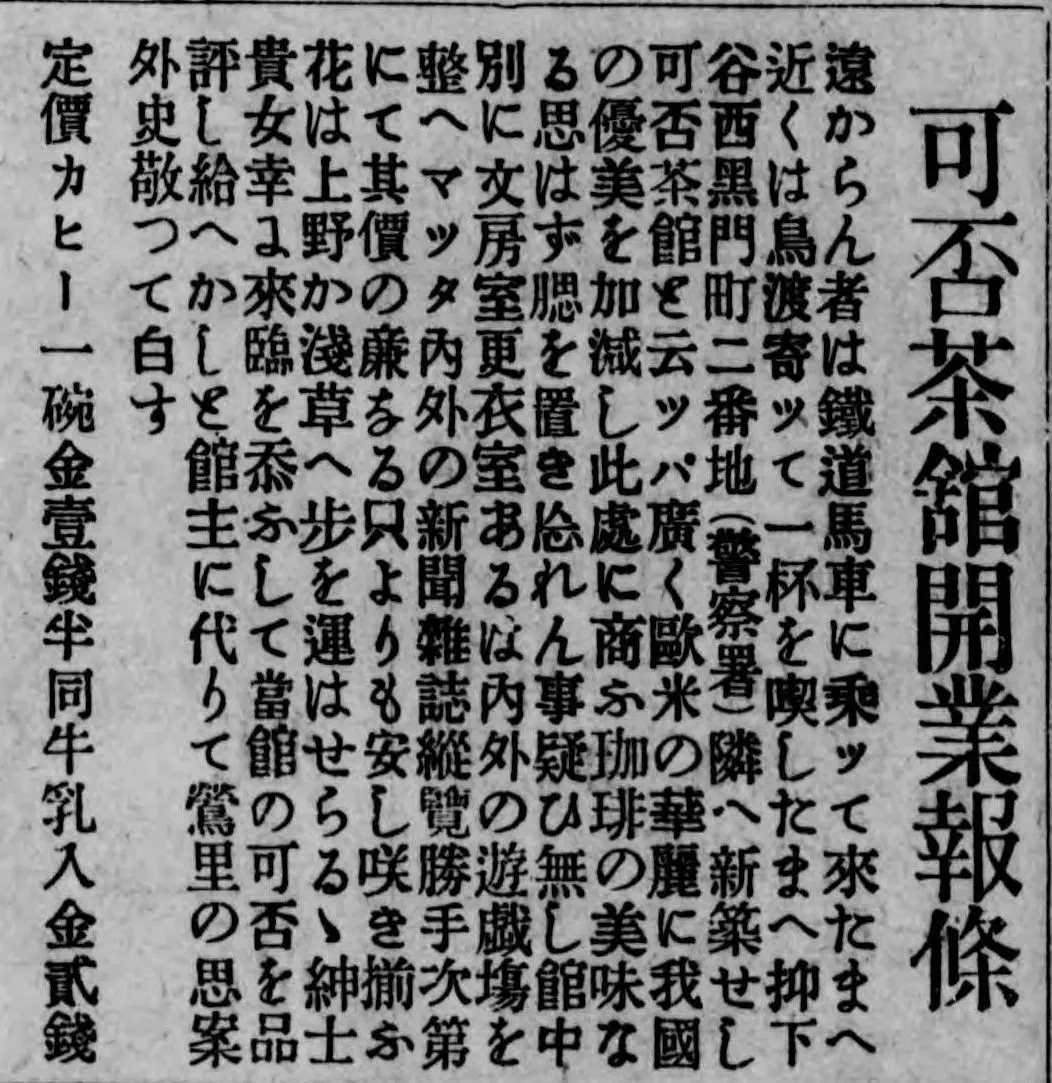 An 1888 notice announcing the opening of the Kahiichakan, listing its Japanese and foreign newspapers.National Diet Library, Book Kaleidoscope no. 39, "Coffee Break," chapter 1 · Terms of use
- 2
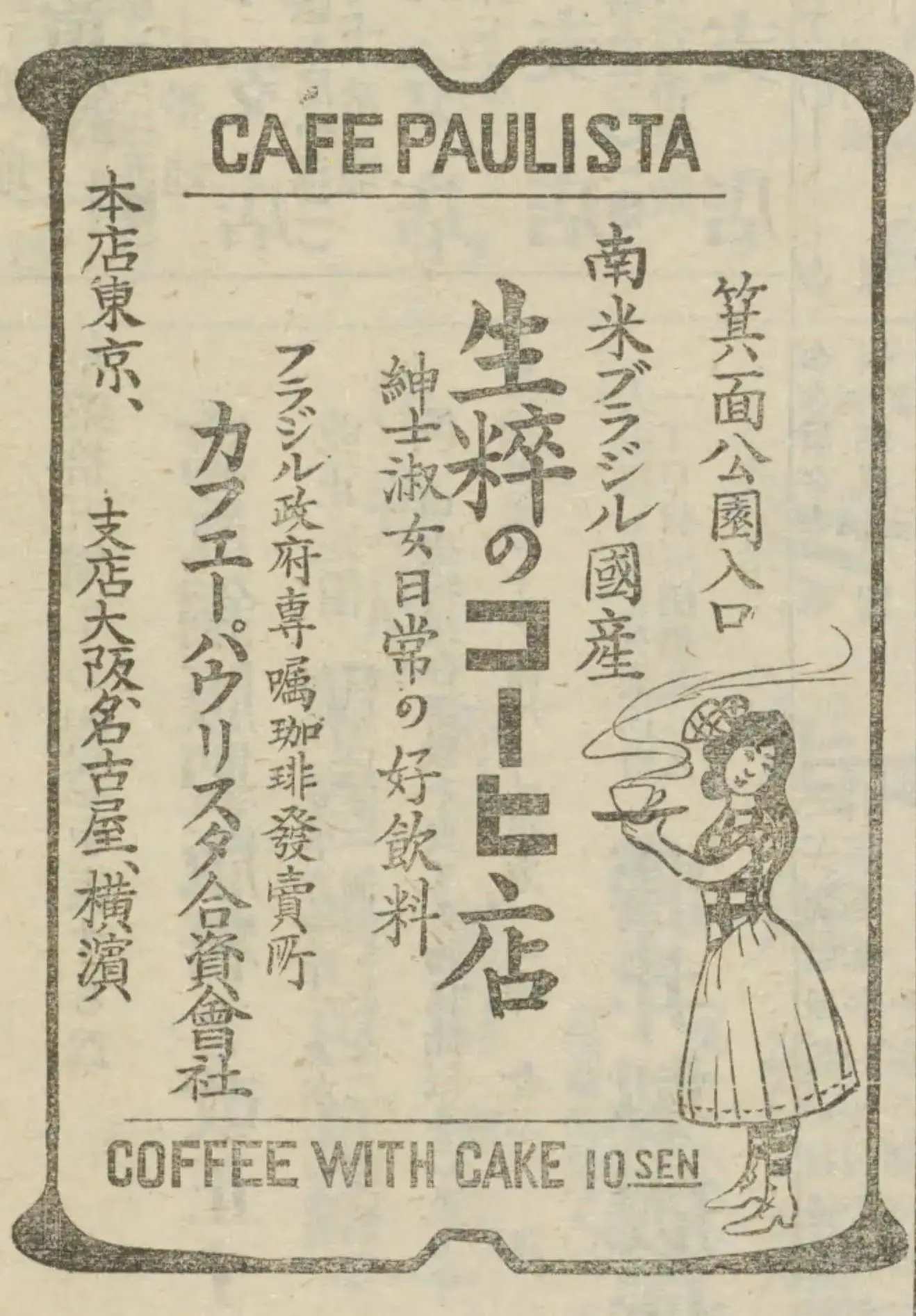 A 1911 advertisement for Café Paulista’s Minoo shop, promoting Brazilian coffee: coffee with cake, 10 sen.National Diet Library, Café Paulista newspaper advertisement (1911, artist unknown)
- 3
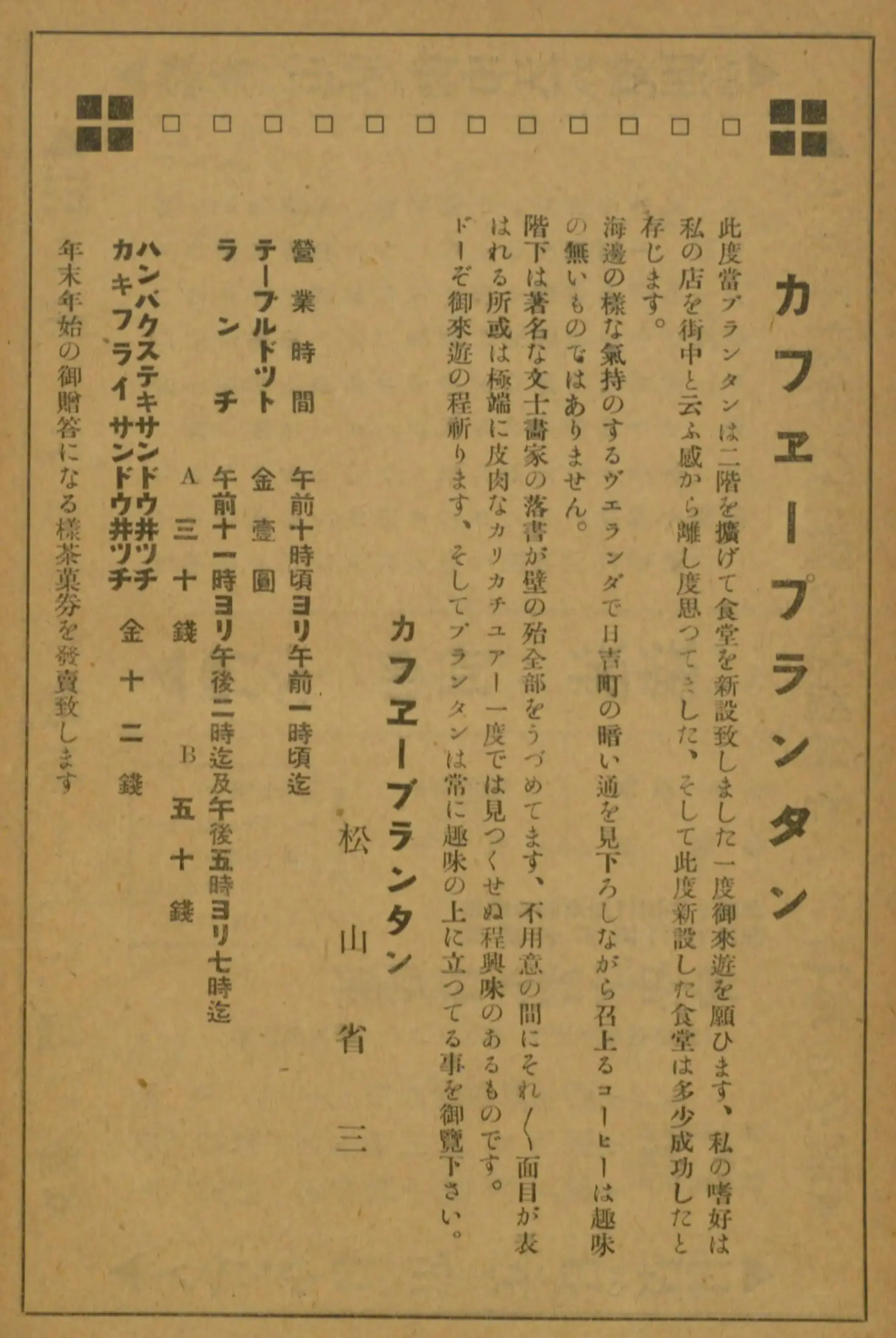 A 1913 advertisement for Café Printemps, signed by its owner, the painter Matsuyama Shōzō.National Diet Library, Book Kaleidoscope no. 39, "Coffee Break," chapter 2 · Terms of use
Then the word "café" drifted. Through the 1920s and early 1930s, many establishments calling themselves kafē came to be defined less by coffee than by their jokyū, waitresses in kimono and white aprons who sat with customers, poured drinks, and flirted for tips. The kafē of novels by Nagai Kafū and Tanizaki Jun’ichirō is often this sort of place, closer to a hostess bar than a coffee shop, and the police eventually regulated it as such. Shops that wanted to make clear they served only coffee and light food, with no alcohol and no hostesses, began putting jun-kissa, "pure kissaten," on their signs. That is how kissaten came to be the respectable word, and how jun-kissa entered the language. Today the original meaning is mostly forgotten, and jun-kissa simply sounds pleasantly retro.
03The Living Room of Shōwa Japan
During the war, coffee imports stopped and most kissaten closed or served ersatz substitutes. After the war imports resumed, and once the import of green coffee beans was liberalized around 1960, the kissaten entered its golden age. Rapid economic growth pulled millions of young workers and students into the cities, and all of them needed somewhere to go that was neither the office nor a cramped boarding house. The number of kissaten nationwide rose steadily and peaked in the early 1980s at around 150,000. In those years, saying "let’s have tea" meant, almost automatically, going to a kissaten.
The boom also produced specialists. Meikyoku kissa, "masterpiece coffee houses," played classical records through enormous speakers to customers who sat facing them in silence; conversation was discouraged or forbidden. Meikyoku Kissa Lion in Shibuya, founded in 1926, with rows of seats facing a huge wooden speaker cabinet like pews in a church, still works this way. Jazu kissa, jazz coffee houses, flourished from the 1950s through the 1970s. Imported records were expensive, and for the price of a coffee a student could hear albums he could never afford to own, played loud on serious equipment by an owner who took requests with some severity. Murakami Haruki ran a jazz kissa in Tokyo before he became a novelist. Utagoe kissa, "singing voice" coffee houses, had customers singing Russian folk songs and workers’ anthems together to an accordion, and were part of postwar left-wing youth culture. Around the secondhand bookshops of Jinbōchō in Tokyo, kissaten such as Sabōru and Ladrio became the places where students sat down to look through what they had just bought.
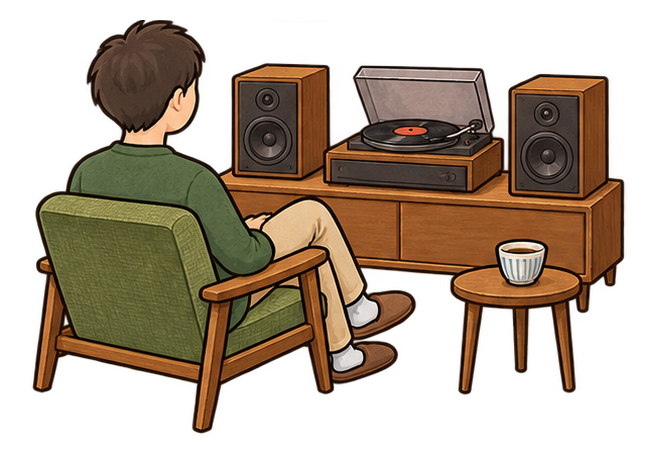
At classical-music and jazz kissaten, customers sit facing the speakers and listen to records in silence.
The decline began in the 1980s. In 1980 Doutor opened its first shop in Harajuku, selling coffee for 150 yen in a bright, fast, self-service format. In 1996 Starbucks opened its first Japanese branch in Ginza. Chains were cheaper and quicker, and younger customers moved to them. At the same time, the generation of owners who had opened shops in the 1950s and 1960s grew old without successors, and redevelopment pushed up rents. The number of kissaten has fallen steadily ever since and by the 2021 count stood at less than half of its peak.
04Blend Coffee and Spaghetti Napolitan
The standard kissaten coffee is the burendo, the house blend, usually roasted dark and served strong and bitter with a small pitcher of cream and a sugar bowl. Shops that take coffee seriously brew with neru dorippu, flannel-filter drip. The owner holds a slender-spouted kettle and drips hot water onto the grounds a little at a time, watching the bed of coffee swell and settle before adding more. It is slow, and in a quiet shop the whole room seems to watch. Other shops use siphons, glass globes over small burners in which the coffee rises and falls, a small piece of theater at the counter. Iced coffee has a long history in Japan, where it is often said to have caught on earlier than in most countries, and kissaten typically brew it in advance, chill it, and serve it with a jug of syrup.
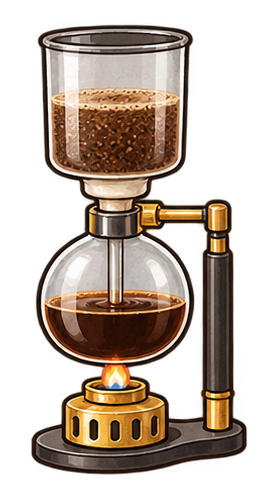
A siphon: heated by a small burner below, the coffee rises and falls between two glass globes.
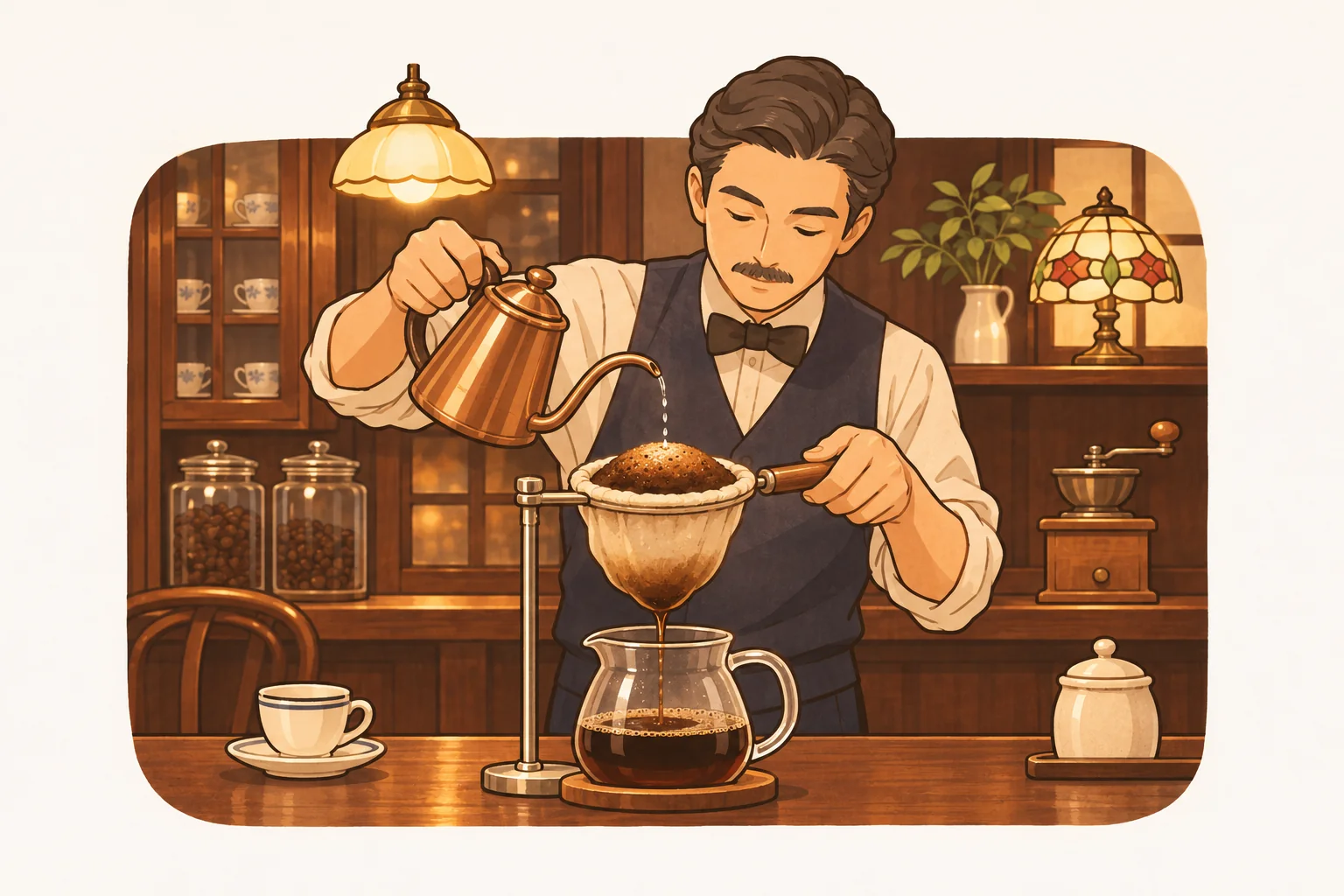
A kissaten owner drips hot water from a slender-spouted kettle onto coffee in a flannel filter, neru dorippu.
Café de l’Ambre in Ginza is the best-known example of this craft. Sekiguchi Ichirō ran it from 1948, roasting his own beans, favoring beans aged for years before roasting, and brewing every cup through flannel. He continued working into his hundreds. Among Japanese coffee people, shops like his are treated as living archives of a technique.
The food is just as distinctive. Spaghetti Napolitan is pasta stir-fried with ketchup, onion, green pepper, and sliced sausage. It is unknown in Italy, and it is a kissaten classic; it is generally traced to the Hotel New Grand in postwar Yokohama, though the hotel’s version used a sauce made from fresh tomatoes, and the all-ketchup style spread later through ordinary Western-style diners. Then there is pizza toast, a thick slice of white bread with tomato sauce, peppers, and melted cheese; egg-salad sandwiches cut into neat rectangles; pancakes (hottokēki) served as a tall stack with a pat of butter; a firm, slightly bitter caramel custard pudding; and the cream soda, a glass of bright green melon soda with a scoop of vanilla ice cream and a cherry on top. None of this is refined. For many Japanese it is the taste of childhood trips into town with their parents, when a plate of Napolitan felt sophisticated and Western.
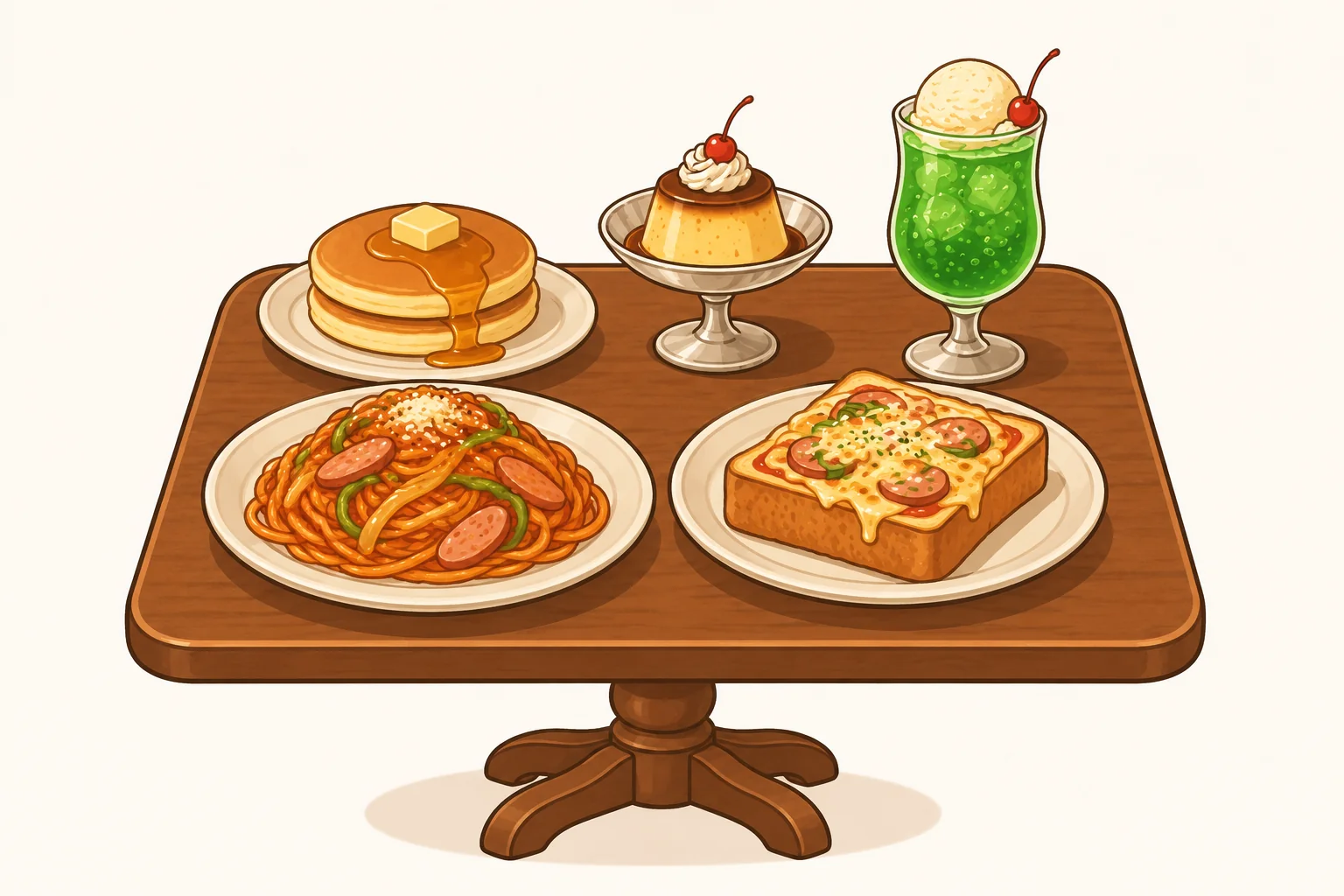
Kissaten classics: spaghetti Napolitan, pizza toast, caramel custard pudding and a cream soda.
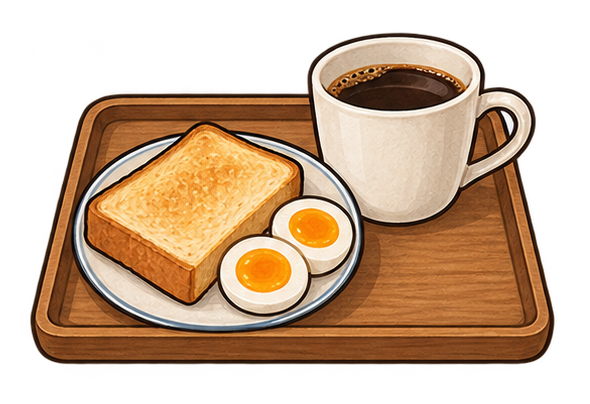
Nagoya went further and built a whole culture on breakfast. Order a coffee in the morning at a Nagoya kissaten and it comes with free thick-cut toast and a boiled egg, a custom called mōningu, "morning service." Some shops add salad, a small cup of yogurt, or a spread of sweet red bean paste for the toast. In the government’s household spending survey, Nagoya households have long ranked at or near the top for spending on kissaten, often vying with neighboring Gifu for first place (Nagoya ranked first in 2025), and Komeda’s Coffee, which started in Nagoya, has spread this comfortable, suburban style of kissaten across the country.
05Kyoto’s Survivors and the Retro Revival
Kyoto may be the best city in Japan for old kissaten. It has many universities, many students, a long-standing population of writers and artists, and it largely escaped wartime bombing, so many shops survived in their original rooms. Salon de Thé François near Shijō-Kawaramachi opened in 1934; its interior was designed to resemble the saloon of a luxury liner, it was a gathering place for antiwar intellectuals in the 1930s, and in 2003 the building was entered on the national register of tangible cultural properties. Inoda Coffee, founded in 1940, is known for serving its coffee with milk and sugar already added unless you say otherwise, and its main shop fills every morning with regulars eating breakfast. Smart Coffee on Teramachi is famous for French toast. The basement café of Rokuyōsha near Kawaramachi has been a refuge for several generations of young Kyoto residents.
In the 2010s, the kissaten found an unexpected new audience. Young Japanese began to treat jun-kissa as an aesthetic: stained-glass lampshades, velvet banquettes, matchboxes printed with the shop’s name, and the photogenic cream soda all did well on social media. Enthusiasts toured old shops across the country and published photo books and guides, and some new cafés deliberately imitate Shōwa-era interiors. The revival has not saved the originals. Every year, shops that have been open for fifty or sixty years close when their owners retire, and the final day, with regulars lining up for one last cup, has become a familiar item in local news.
06Visiting a Kissaten
Kissaten are easy to spot. Look for wax food samples in the window and the old-fashioned characters 珈琲 on the sign. Inside, a staff member will either wave you to any seat or show you to one. Water and an oshibori will arrive. Menus are often only in Japanese, but a few words go a long way: burendo for the house blend, aisu kōhī for iced coffee, naporitan for the spaghetti. In the morning, look for mōningu on the menu; in Nagoya it is close to obligatory.
Expect to pay more than at a chain, usually 500 to 800 yen for a coffee and more at a celebrated hand-drip shop. Part of what you are paying for is the seat, so there is no need to rush. Reading, writing, or simply sitting are all normal. When the shop is busy and people are waiting outside, it is polite to leave once you have finished. Many older shops accept cash only. You usually pay at the register near the door, bringing the bill slip from your table.
Voices in old kissaten are kept low, and in a meikyoku kissa silence is the rule. Ask before taking photos; some shops ban interior photography or allow you to photograph only your own order. Smokers and non-smokers alike should know that Japan’s Health Promotion Act, revised in 2018 and fully in force from April 2020, banned indoor smoking in most restaurants, but small, long-established independent shops were allowed to choose to permit it. As a result, some old kissaten remain smoking establishments, and a sticker by the door will say so.