
At a glance
How Japan’s department stores grew from Edo kimono drapers and railway terminals, why their food basements thrive, and how to shop them as a visitor.
- Mitsukoshi began as Echigoya, opened in 1673 and famous for cash-only, fixed-price selling.
- In 1904 the Mitsui drapery became Mitsukoshi Gofukuten and issued its 'department store declaration'.
- Hankyu opened its store in Ōsaka’s Umeda terminal in 1929, regarded as the world’s first railway-terminal department store.
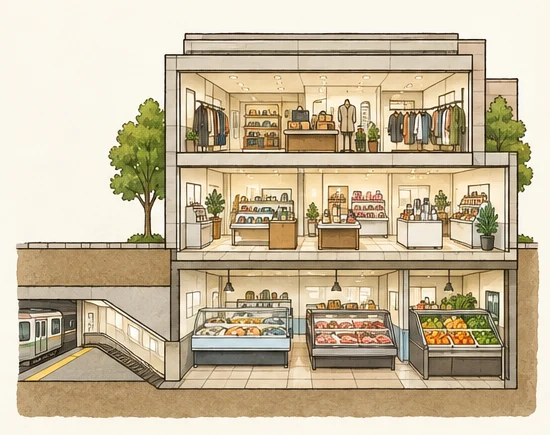
- Floors follow a set order: cosmetics on the ground floor, clothing above, restaurants at the top, food in the basement.
- The word depachika caught on around 2000; near closing time, deli and bento counters put out discount stickers.
Step off a train at almost any big station in Japan and you are rarely more than a few minutes’ walk from a department store. Upstairs are kimono, watches, tableware and the gifts people give their bosses; downstairs, in the basement, is the depachika, a food hall so crowded, bright and noisy that many visitors remember it more vividly than any temple. This piece explains where Japanese department stores came from, why the basement became the liveliest floor in the building, and how to make the most of a visit.
01Kimono Merchants Become Department Stores
Most of Japan’s oldest department stores began as drapers selling kimono fabric, a trade called gofuku. The best-known story is Mitsukoshi’s. In 1673 a merchant named Mitsui Takatoshi opened a shop called Echigoya in Edo, today’s Tokyo, and later moved it to Suruga-chō in the Nihonbashi district. At the time, the big drapers carried bolts of cloth to the homes of samurai and wealthy merchants, let them pick at leisure, and settled the bill on credit twice a year, at midsummer and year-end, or once in the twelfth month, at prices that depended on who you were. Echigoya did something different. Its slogan, genkin kakene nashi, meant cash only, no inflated prices: anyone could walk in off the street, buy a length of cloth at the posted price and take it home. Later generations of retailers liked to point to this as the moment modern shopping began in Japan.
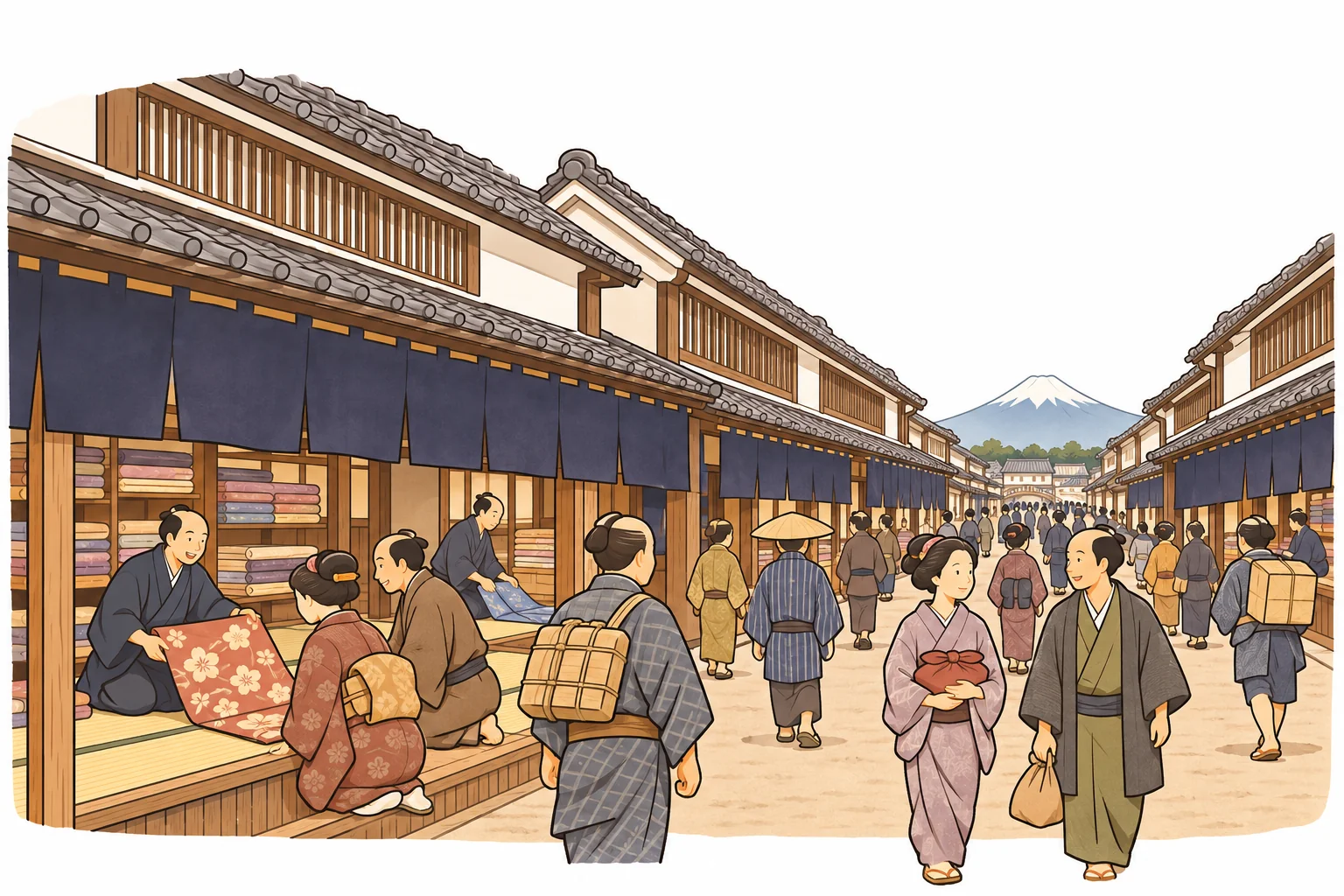
Suruga-chō in Nihonbashi, late Edo: the Echigoya shopfronts with long curtains, Mount Fuji in the distance (illustration).
Other famous names have similar roots. Daimaru grew out of the Shimomura family’s business in Kyoto, Matsuzakaya out of the Itō family’s in Nagoya, and Takashimaya opened in Kyoto in 1831. Shirokiya, which opened in Nihonbashi in 1662, traded a few streets from Echigoya for more than two centuries. All of them made their money on cloth during the Edo period (1603–1868), and all of them, in the Meiji era that followed, looked hard at the department stores of London, Paris and New York.
The usual turning point is 1904. In December that year the Mitsui drapery was reorganized as the Mitsukoshi Gofukuten company and wrote to its customers announcing that it would become, in part, a "department store" of the American kind, widening its range so that anything to do with clothing and adornment could be bought under one roof; the declaration ran in the major newspapers on January 2, 1905. Food and garden goods arrived only with the new building of 1914. Over the next two decades the old drapers tore down their wooden shops and put up multistory Western buildings with elevators, display windows and exhibition halls. The Mitsukoshi flagship in Nihonbashi, completed in 1914, was guarded by a pair of bronze lions modeled on those in Trafalgar Square. They are still there, and Tokyoites still pat them for luck.
One small detail tells you how formal these places once were. In the early years shoppers took off their shoes at the entrance and handed them to an attendant, as they would on entering a house. The stores went over to outdoor shoes gradually, especially as they rebuilt after the Great Kantō Earthquake of 1923, and the change helped turn the department store from somewhere you visited into somewhere you dropped in.
02Railways and the Family Day Out
Japan’s department stores have a second ancestor: the railway. In 1929 Kobayashi Ichizō, founder of the Hankyu railway, opened a department store inside his terminal building at Umeda in Ōsaka. It is often described as the world’s first terminal department store. His logic was simple. His trains carried families in from the new suburbs he had built along his lines; the station was the first place they set foot in the city; so the station should sell them what they came for. The Hankyu dining hall became famous for cheap curry rice, and a well-loved story says that during the Depression some customers ordered only plain rice and poured the free Worcestershire sauce on the tables over it. The management let them, reasoning that these people would come back as paying customers one day. Whether every detail is true, the tale of "sauce rice" is still told as a summary of Kobayashi’s approach.
Other railways followed: Tōkyū at Shibuya, Seibu and Tōbu at Ikebukuro, Keiō and Odakyū at Shinjuku. Japanese cities ended up with two kinds of department store. The old drapers clustered in historic shopping streets such as Nihonbashi and Ginza in Tokyo or Shinsaibashi in Ōsaka. The railway stores grew at the big terminals, following the commuters. Many of the huge stores a visitor sees today at Shinjuku, Shibuya, Umeda, Nagoya or Kyoto Station belong to the second group.
By the middle of the twentieth century a trip to the department store was a family occasion. You browsed clothes and household goods in the morning, ate lunch in the big dining hall, and let the children order the okosama ranchi, a kids’ plate of rice, a little hamburger, spaghetti and a flag stuck on top. The dish is generally credited to the Mitsukoshi Nihonbashi dining hall in 1930, where it was first called okosama yōshoku, "Western food for children." After lunch everyone went up to the roof, which might hold a small amusement park with a carousel and coin-operated rides, a pet stall, or even a Shinto shrine. When older Japanese talk about "going to the department store" as children, it is this whole day they mean.
03How the Building Is Organized
Japanese department stores follow a layout so consistent that once you know one, you can navigate them all. The ground floor is cosmetics, handbags and accessories: the brightest lights, the strongest perfume, and the highest profits, placed there to pull people in. Women’s fashion takes the next few floors, followed by menswear, children’s clothing, kimono, watches and jewelry, homeware and an art gallery. Near the top is the resutoran-gai, a restaurant floor with sushi, tempura, tonkatsu (breaded pork cutlet), Western-style yōshoku and more. And at the bottom, one or two basement levels of food.
- 1Basementfood
- 2Ground floorcosmetics, handbags, accessories
- 3Next floorswomen’s fashion
- 4Abovemenswear, children’s clothing, kimono, watches and jewelry, homeware, art
- 5Near the toprestaurant floor: sushi, tempura, tonkatsu, yōshoku
The layout is so consistent that once you know one store you know them all: food at the bottom, restaurants near the top.
Behind the counters, the business works differently from what most Western shoppers would assume. Most of the counters are run by the brands themselves, which send their own staff, while the store supplies the space, the reputation and the customers and takes a cut of sales. That is why a single store can host hundreds of brands, and why the person behind each counter usually knows the products in detail.
Service is what Japanese stores are most admired for. At opening time, staff line the entrance and the aisles and bow as the first customers walk in. For decades uniformed elevator attendants in white gloves announced each floor in a high, precise voice; a few stores still keep them. Buy something and you will be asked whether it is for yourself or a gift. If it is a gift, it will be wrapped with great care and, for formal occasions, finished with a noshi paper band stating the purpose of the present.
The wrapping paper is a brand in its own right. Since 1950 Mitsukoshi has used Hana hiraku ("Flowers Blooming"), a red-and-white abstract design by the painter Inokuma Genichirō that almost anyone in Japan recognizes on sight. Takashimaya’s rose paper is nearly as famous. Which store’s paper a gift arrived in once said a good deal about how much thought had gone into it.
04Gifts, Seasons and Regional Fairs
Much of the department store’s place in Japanese life comes from gift-giving. Twice a year, in the summer ochūgen and the year-end oseibo seasons, people send presents to bosses, relatives, teachers and business contacts: boxed ham, a case of beer, premium fruit, fine soap. Stores print thick catalogs and set up special order halls where customers choose an item, fill in an address and leave the delivery to the store. Return gifts after weddings and funerals, greetings when moving house, presents for a child starting school: all of these traditionally pass through the department store gift counter.
The calendar runs a little ahead inside the building. Before New Year come fukubukuro lucky bags and orders for osechi, the tiered boxes of New Year food. February brings Valentine’s chocolate, which in Japan women traditionally give to men; Isetan Shinjuku’s chocolate fair, with chocolatiers flown in from abroad, draws long queues. Spring means school supplies, summer means yukata, autumn means chestnut sweets, and by November the Christmas cake orders open.
The other event that draws people in on purpose is the bussanten, a fair of regional specialties held in the store’s event hall. Hokkaidō fairs are the most popular; Takashimaya held the first one organized by Hokkaidō itself in a department store in 1951. Today they come with seafood rice bowls, dairy sweets and ramen stalls cooking on the spot. Shiroi Koibito, the white-chocolate biscuit that is hard to find outside Hokkaidō, has been reported as a fixture of these fairs. There are Kyoto fairs, Kyūshū fairs, Okinawa fairs and ekiben fairs of railway lunch boxes from all over the country. City shoppers get a taste of places they may never visit; small regional producers get a foothold in the big-city market.
05The Depachika
If you only have time for one floor, make it the basement. The word depachika joins depāto (department store) and chika (basement). Ride the escalator down and the sound changes first: a chorus of staff calling irasshaimase ("welcome"), the rustle of bags, the hiss of a fryer. Then the glass cases come into view, filled with bento, sushi, tempura, yakitori, salads, French pastries, Japanese sweets, pickles, tea, sake, and fruit arranged like jewelry.
Department stores have always sold food, but the basement as a destination is a more recent development. The word depachika came into wide use around 2000, when Tōkyū opened its Food Show at Shibuya Station and rival stores rushed to expand and remodel their food floors. Television and magazines covered every new opening, queues formed outside star shops, and the press talked of a depachika boom. The timing was not accidental. More households had two working parents, more people lived alone, and more of them wanted to pick up dinner on the way home, something better than the supermarket. Japanese call this kind of food nakashoku, "in-between eating," halfway between eating out and cooking at home, and the depachika is its most polished form.
The prepared-food counters, called sōzai, are the heart of it. Salads are sold by the hundred grams, and simmered vegetables, grilled fish, croquettes and dressed greens come in small portions so you can assemble a meal from a dozen counters. Deli brands that display salads like museum pieces spread rapidly from the 1990s and changed how people felt about buying ready-made food. Next to them are bento and sushi counters, from classic makunouchi boxes to eel rice, scattered sushi and inari pockets made by branches of well-known restaurants.
The sweets section is usually the most crowded. Western-style patisseries sell cakes, cream puffs and baumkuchen, the layered German ring cake that became a Japanese favorite. Old confectioners sell yōkan bean jelly, daifuku rice cakes and seasonal namagashi shaped like flowers or leaves. Many traditional shops from Kyoto, Kanazawa or small regional towns have a counter in Tokyo only at one or two particular stores, and some items appear only on certain days and sell out. When a Japanese person needs a gift to bring on a visit, this is often where they buy it, on the way.
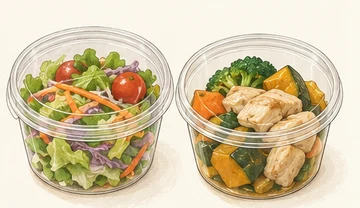
Deli dishes: salads and simmered dishes in small tubs, so you can buy a little of each.
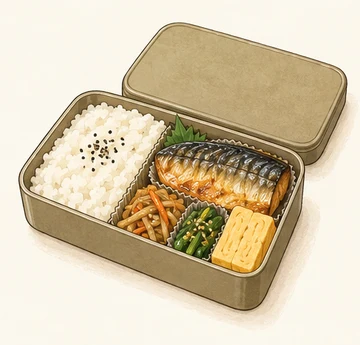
Bento: rice and side dishes in one box, ready to take home and eat.
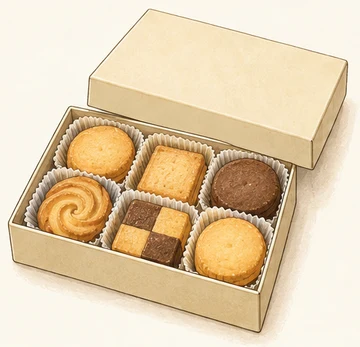
A boxed assortment of sweets: the kind of gift people pick up here on the way to a visit.
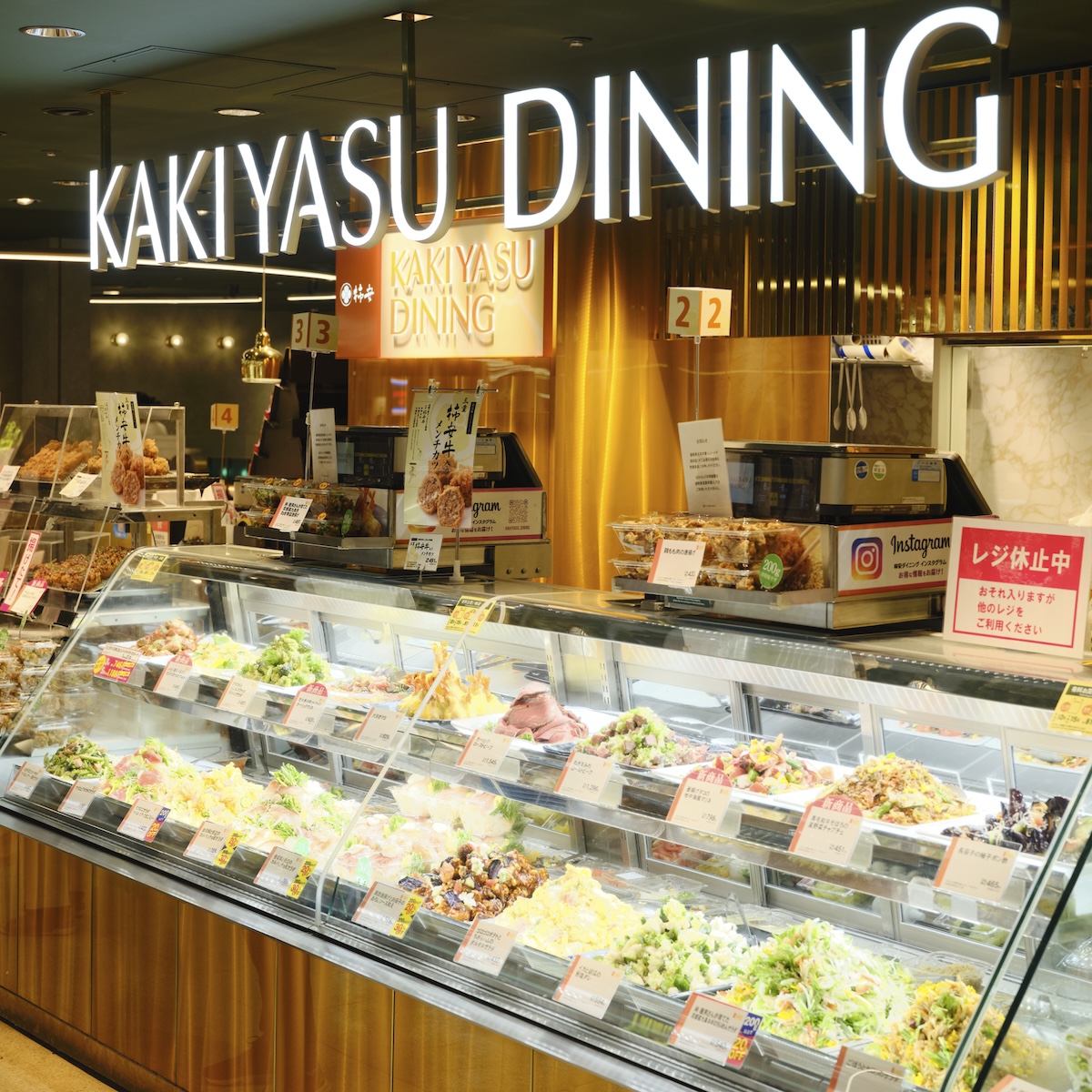
A deli counter in a department-store food hall, its long glass case full of salads and prepared dishes
The basement has its own daily rhythm. Just after opening it is calm enough to look properly. At lunchtime office workers come for bento. After six in the evening it is at its most crowded. And as closing time approaches, the prepared-food counters start applying discount stickers: ten percent off, then twenty, then half price. Regular shoppers know exactly when to arrive.
06Visiting a Department Store
Pick up a floor guide at the entrance or by the elevators; large stores usually have one in English. If you can, arrive just as the doors open to see the staff bow you in. It is one of the most distinctive small ceremonies of Japanese retail.
In the depachika, each counter takes its own payment, so you pay where you choose, not at a central checkout. Staff may offer a sample to taste; it is fine to try and walk on. If they ask how long you will be carrying the food, they are deciding how many ice packs to put in the bag. Food floors rarely have seating, and eating while walking is frowned upon in Japan, so plan to take your purchases to a park bench, a station waiting area or your hotel room.
Foreign visitors can shop tax-free. Bring your passport and register the purchase at the store’s tax-free counter. Since November 2026 Japan has used a refund system: you pay the price including consumption tax, customs confirms the goods at the airport or port when you leave within 90 days of purchase, and the store then refunds the tax. The old split between consumables such as food and cosmetics and general goods like clothes and watches has been abolished. Purchases must still total at least 5,000 yen before tax, with different kinds of goods counted together, generally reckoned per store per day.
It is worth knowing that Japanese department stores are not what they were. National department store sales peaked in the early 1990s and have fallen for most of the years since, squeezed by suburban malls, specialty chains, online shopping and convenience stores. Many stores in regional cities have closed, and even some famous Tokyo branches have shut or been rebuilt. The survivors lean increasingly on two things: foreign tourists, and the food basement. On a weekday afternoon the fashion floors can feel quiet while the depachika below is packed.
For the classic experience in Tokyo, visit Mitsukoshi and Takashimaya in Nihonbashi, whose prewar buildings are worth seeing in themselves; in 2009 Takashimaya’s Nihonbashi store became the first department store building designated an Important Cultural Property, and Mitsukoshi’s main building followed in 2016. Isetan in Shinjuku sets the standard for both fashion and food. In Ōsaka, the Hankyu and Hanshin stores at Umeda sit side by side; Hanshin’s basement is known for cheap, cheerful local food, and its squid-pancake stand, ikayaki, has had a queue for decades. In Kyoto and Nagoya, the stores built into the main stations, Isetan and Takashimaya respectively, are easy to explore between trains.