
At a glance
How ordinary trees become miniature ancient landscapes in Japan, from Chinese potted scenery to Ōmiya Bonsai Village, and how to look at a fine bonsai.
- Most bonsai are ordinary species such as black pine, Japanese white pine and shimpaku juniper, kept small by shallow pots and years of pruning.
- Growing trees in pots for viewing began in China, where early potted scenery existed by the Tang dynasty, and later reached Japan.
- Bonsai in today’s sense took shape between the late Edo and Meiji periods, when the word bonsai itself came into common use.
- Shape comes mainly from pruning and from wiring with aluminum or copper; small trees are repotted every year or two, large ones every three to five.
- The Kokufu Bonsai Exhibition, first held in 1934, takes place each February in Ueno and is the most prestigious show in Japanese bonsai.
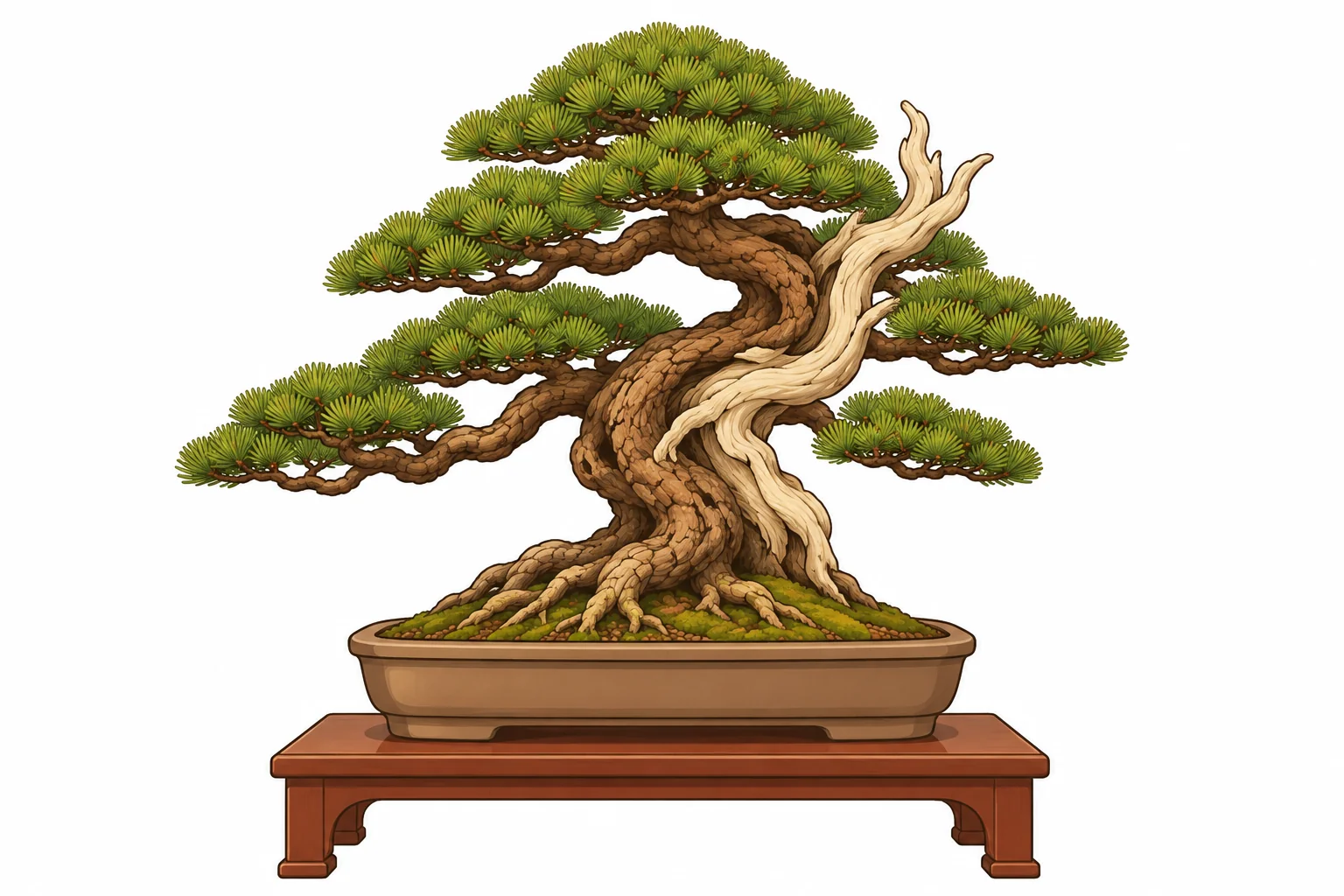
A Japanese black pine stands about two feet tall in a brown, unglazed tray. Its trunk is as thick as a man’s forearm and flares where it enters the soil; its lowest branch reaches out sideways and dips, as if weighted by decades of snow. Crouch down to its level and the pot disappears: you are looking at a coastal pine on a windy headland. That illusion is the whole point of bonsai, and it takes years, often several lifetimes, to produce. This essay explains what bonsai actually is, why the Japanese have cared about it for so long, how it grew out of Chinese potted landscapes into a word the whole world now uses, and where and how to see it properly in Japan.
01What Bonsai Is, and What It Is Not
The word bonsai means simply "tray planting" (bon is a shallow dish or tray, sai is to plant). In Japan it does not mean any small plant in a pot. It means a tree, or occasionally a group of trees, grown in a container and trained over many years so that it suggests a mature tree in nature, at a fraction of the size.
The most common misunderstanding is that bonsai are special dwarf varieties. Nearly all of them are ordinary species: Japanese black pine, Japanese white pine, Chinese juniper, Japanese maple, Japanese zelkova, flowering apricot, satsuki azalea. Planted in open ground, the same trees would grow ten or twenty meters tall. They stay small because their roots are confined to a shallow pot and periodically pruned, and because their shoots are pinched, cut back and thinned every year. The tree’s energy goes into thickening the trunk and multiplying fine twigs rather than gaining height, and over time the leaves and needles themselves become smaller. A bonsai’s size is the outcome of a long negotiation between a grower and a living plant.
Because the tree is alive, a bonsai is never finished. It grows, it can be damaged by sun or frost, it can die of a single forgotten weekend of watering. Many of the best trees in Japan have passed through the hands of three or four owners. The person who looks after one for twenty years knows that he or she is only one chapter in its story.
| Family | Examples | Admired for |
|---|---|---|
| Conifers (shōhaku) | pines, junipers | evergreen |
| Deciduous (zōki) | maples, zelkova, beech, ginkgo | spring buds, autumn color, bare winter branches |
| Flowering (hanamono) | apricot, cherry, azalea, quince | flowers |
| Fruiting (mimono) | persimmon, crab apple, pyracantha | fruit |
By type there are four broad families, each admired for something different; conifers are considered the classic bonsai.
Japanese growers sort bonsai in several ways. By size, the smallest, called mame ("bean") bonsai, fit in the palm of a hand; shōhin trees are up to about 20 centimeters tall; above that come medium and large trees, the biggest of which need two or three people to lift. By type, there are four broad families. Conifers (shōhaku), above all pines and junipers, are evergreen and considered the classic, most serious bonsai. Deciduous broadleaf trees (zōki), such as maples, zelkova, beech and ginkgo, are admired for their spring buds, autumn color and, in winter, the bare tracery of their branches. Flowering trees (hanamono) include apricot, cherry, quince and azalea. Fruiting trees (mimono) include persimmon, crab apple and pyracantha, grown for their small, bright fruit.
There is also a vocabulary of shapes. Chokkan, formal upright, has a straight trunk tapering evenly, like a solitary tree on a plain. Moyōgi, informal upright, curves gently from side to side as it rises, and is the most common form. Shakan leans to one side, as a tree does when it grows away from wind or toward light. Kengai, cascade, plunges over the rim of a tall pot and below its base, like a pine hanging from a cliff. Bunjingi, the "literati" style, has a long, thin, often contorted trunk with only a few branches at the top, inspired by the lean trees in Chinese scholar painting. Hōkidachi, the broom style used for zelkova, fans out evenly from the top of the trunk. There are also twin trunks, clumps, forest plantings of many trees in one slab-like pot (yose-ue), and root-over-rock compositions in which a tree grips a stone. None of this is a rulebook; it is a shared language that lets one enthusiast say "a juniper in slanting style" and have another picture it at once.
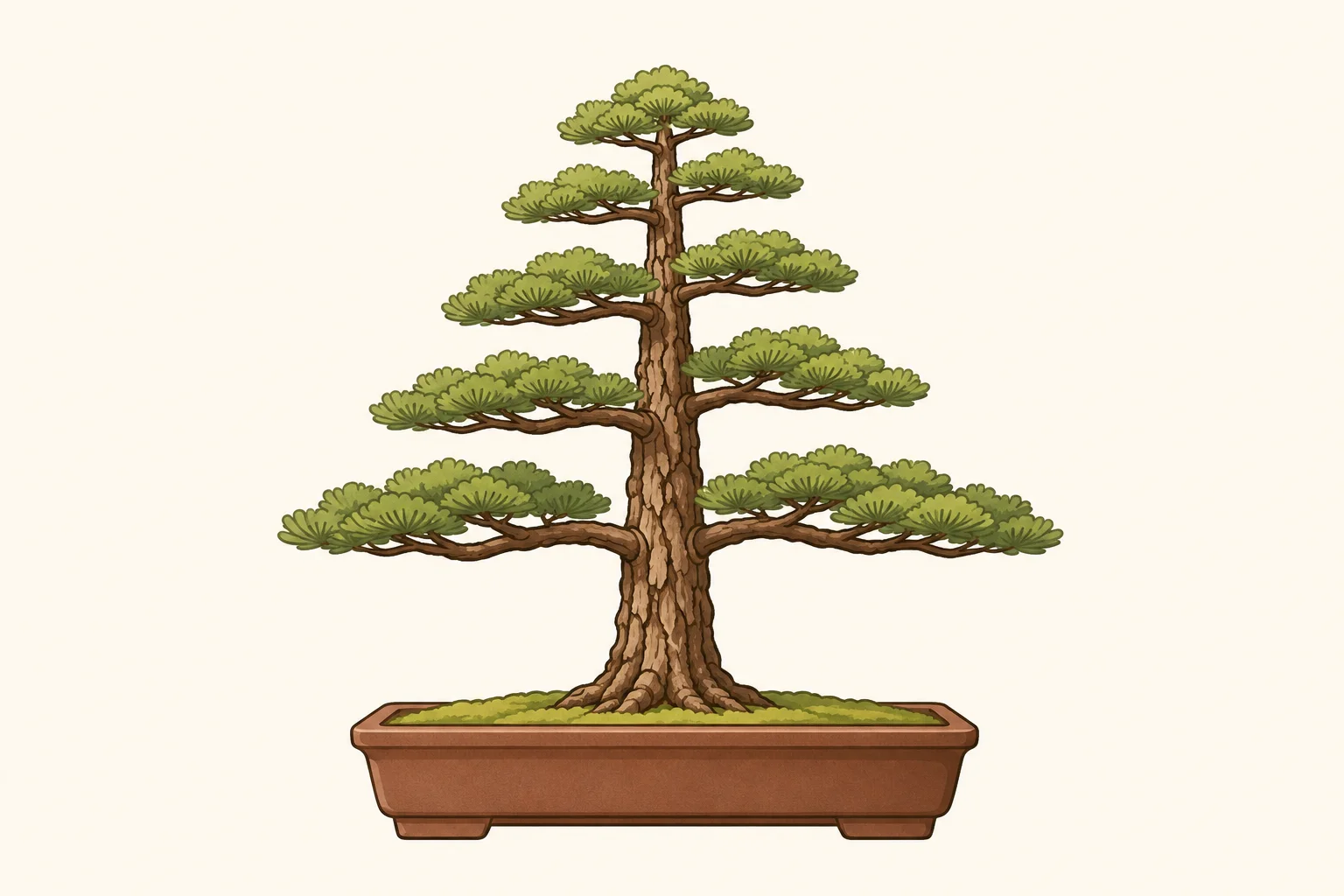
Chokkan, formal upright: a straight trunk tapering evenly.
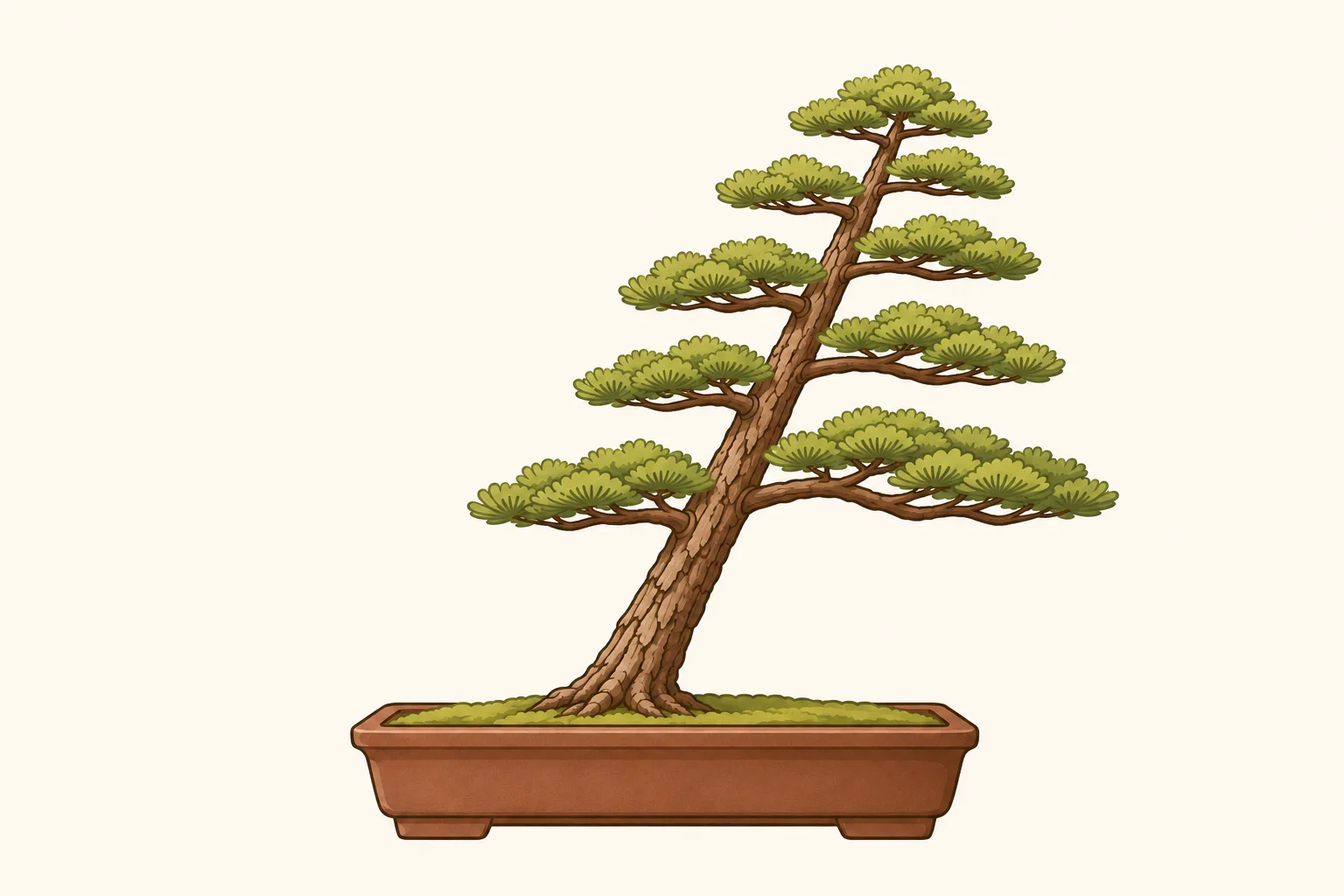
Shakan: the trunk leans to one side.
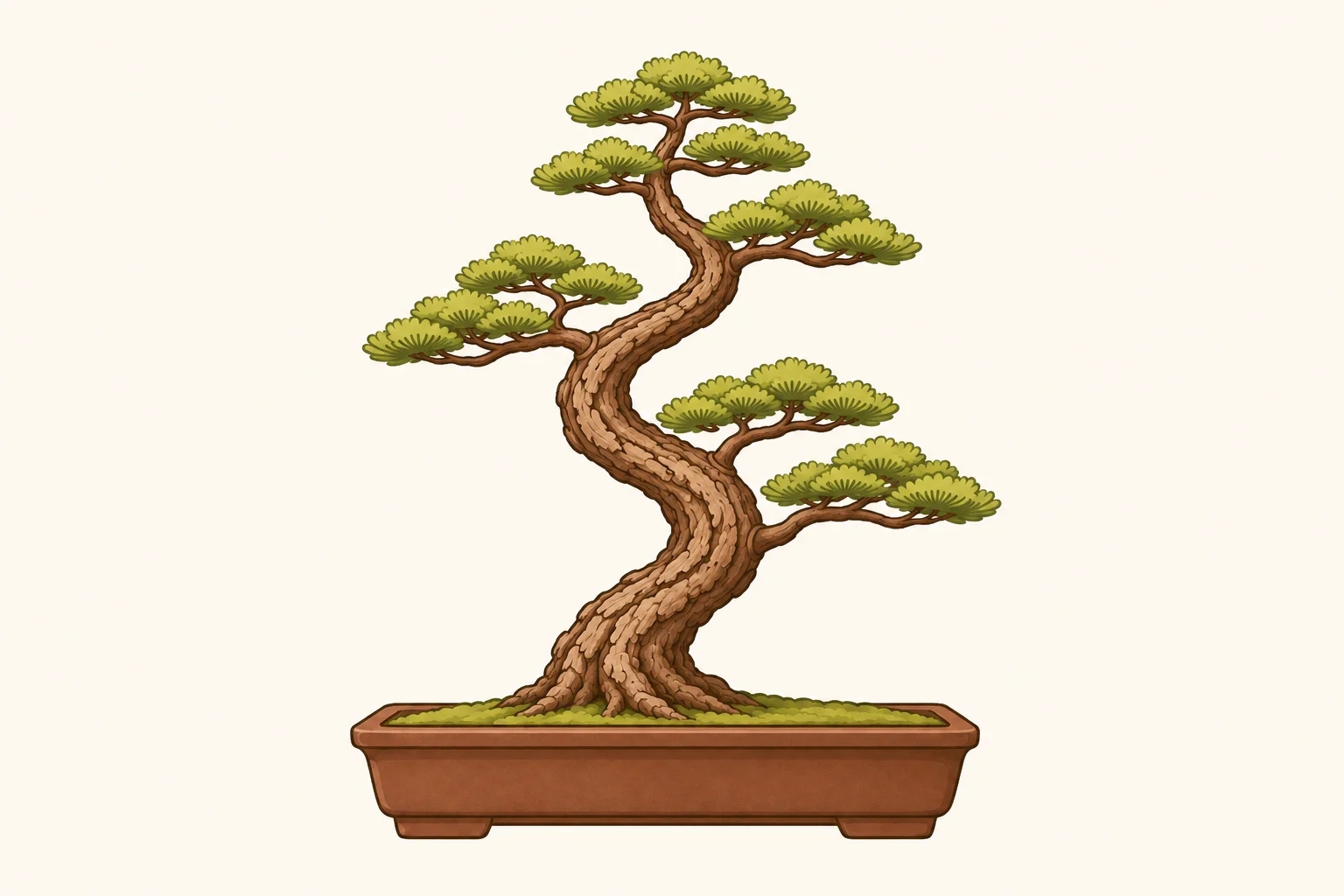
Moyōgi, informal upright: the trunk curves gently from side to side as it rises, the most common form.
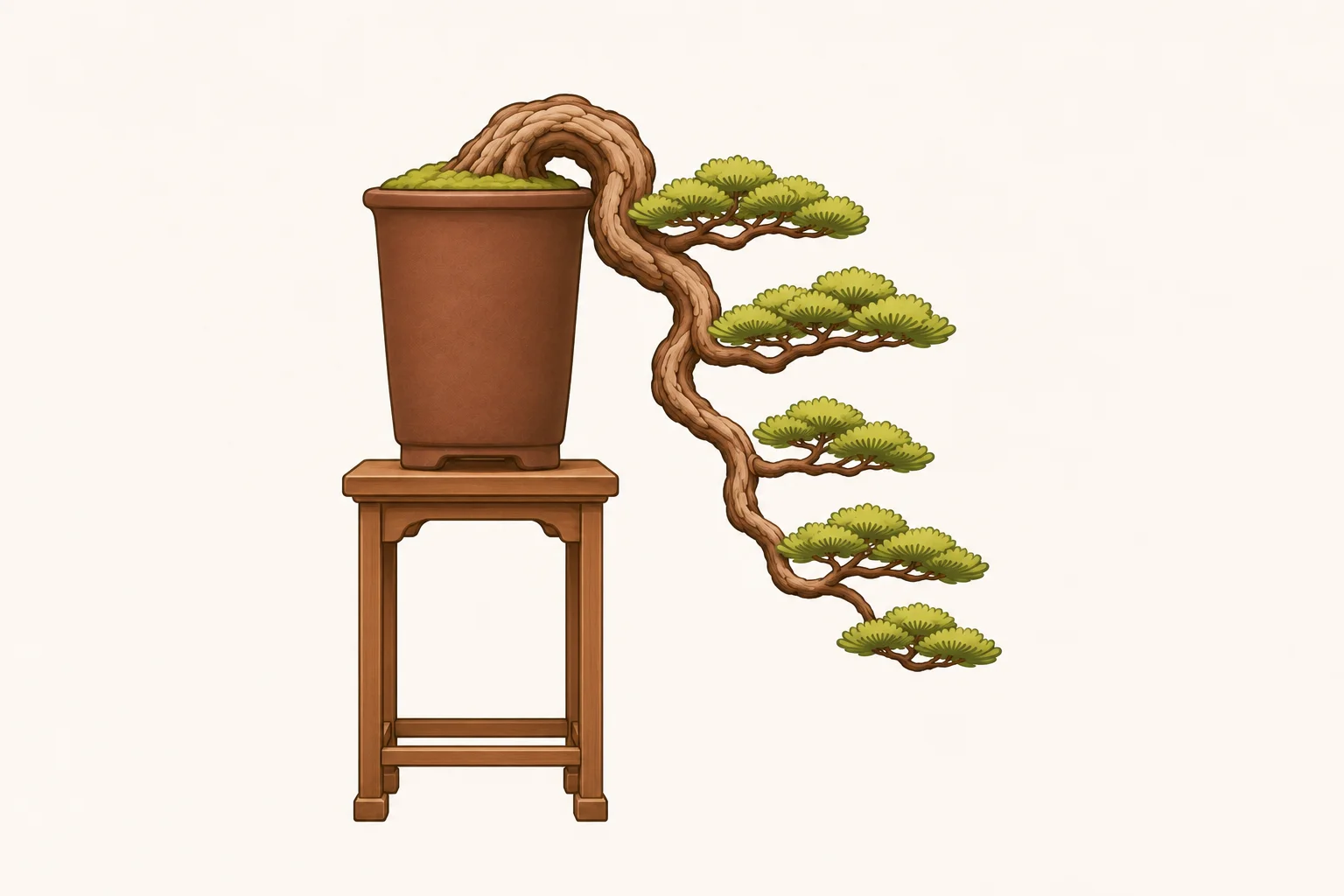
Kengai, cascade: the trunk plunges over the rim of a tall pot and below its base.
02Why People Look at Small Trees
The first pleasure of bonsai is a trick of scale. A well-made tree persuades you that you are looking at something large and far away. Japanese growers talk about wanting the viewer to see a landscape, not a plant: the salt wind on a seaside pine, the weight of snow on a mountain conifer, the dappled light in a stand of maples. The smaller the object, the more work the imagination does, and the more the viewer brings to it.
The second is age. The quality most prized in a bonsai is the appearance of great age, and often the reality of it. A thick trunk that flares at the base, bark that has cracked into plates, surface roots that spread in every direction to grip the soil, lower branches that droop rather than reach upward: these are signs of time, and a grower spends years coaxing them out. The Japanese affection for things that show their years runs through tea ceremony utensils and the aesthetic often summed up as wabi-sabi, and bonsai is one of its most literal expressions. You are not looking at a picture of an old tree; you are looking at an old tree.
The third is asymmetry and space. Classical Japanese bonsai almost never aims for symmetry. A tree has a definite front. Its apex leans slightly toward the viewer, as if bowing. The first and longest branch sits about a third of the way up and points to one side; the second, a little higher and shorter, goes to the other side; a third branch goes toward the back to give depth. The overall silhouette is a lopsided triangle. Between the branches there are gaps through which you can see the line of the trunk and the air behind it. The same thinking shapes ikebana and the Japanese garden: in a limited space, the incomplete suggests the whole.
The fourth is that a bonsai is a relationship rather than an object. It changes every season. In spring, new shoots must be pinched; in summer, the tree needs shade and water two or three times a day; in autumn, the deciduous trees turn; in winter, the bare branches reveal the structure that the grower has spent years building, and this is the time for pruning and wiring. A common saying among Japanese growers is that it takes three years just to learn to water, meaning that the real skill lies less in dramatic styling than in daily, attentive care.
03From Chinese Penjing to Japanese Bonsai
Growing trees and rocks in containers to evoke landscapes began in China, where the art is called penjing. A wall painting in the tomb passage of the Tang dynasty prince Zhanghuai, from the early eighth century, shows a servant carrying a potted landscape; by some descriptions, a maidservant holding a tray of small trees and rocks. The practice reached Japan with Buddhist monks, envoys and traders, and by the late Heian and Kamakura periods, aristocrats and clergy were enjoying potted trees. A picture scroll completed in 1309, the Kasuga Gongen genki-e, shows potted trees at a house, by some descriptions set on a shelf under the eaves, and is often cited as one of the earliest Japanese images of the practice. At that time such trees were called hachi-no-ki, "potted trees."
That word is also the title of the most famous bonsai story in Japan, the Noh play Hachi-no-ki. On a snowy night, an itinerant monk asks for shelter at a poor house in Sano, in the province of Kōzuke. The master, Sano Genzaemon Tsuneyo, was once a samurai but has been cheated of his lands by relatives. He has no firewood, so he cuts up his three treasured potted trees, a plum, a cherry and a pine, and burns them to warm his guest, declaring that if the shogunate ever calls, he will ride to Kamakura on his thin horse and be first to arrive. Later a call to arms comes; Tsuneyo turns up in battered armor and finds that the monk was Hōjō Tokiyori, the former regent, traveling in disguise. Tokiyori restores his lands and rewards him with three estates whose names echo the three trees: Umeda, Sakurai and Matsuida in the usual Noh text (another version gives Umeda, Matsueda and Sakurai). The story is a later dramatization, not history, but it shows that by the Muromachi period a potted tree was something an audience would instantly understand as a man’s cherished possession.
In the Edo period (1603–1868), gardening became a mass enthusiasm. Shoguns and daimyo collected fine plants; townspeople lined the alleys outside their row houses with pots; crazes arose for satsuki azaleas, morning glories and variegated plants, and whole villages of nurserymen grew up on the edge of Edo. The third shogun, Tokugawa Iemitsu, is said to have loved potted trees. A Japanese white pine in the Imperial collection, known as "Sandai Shōgun no Matsu" (the Third Shogun’s Pine), is said to have been one of his, and is believed to be more than 500 years old. Much Edo-period potted gardening, however, prized curiosity, oddly shaped trunks and rare varieties, rather than the natural-looking trees that bonsai later idealized.
Bonsai as we know it took shape from the late Edo period into the Meiji era. Educated Japanese of the time were enthusiastic about sencha, steeped green tea, and about Chinese scholarly culture, and potted trees were reconsidered as part of that literati world. The taste shifted toward trees that looked like real trees in real mountains. The word bonsai came into general use in this period, displacing older terms. Members of the imperial family and the new aristocracy, politicians and businessmen of the Meiji and Taishō eras became great collectors; the statesman Ōkuma Shigenobu was a well-known enthusiast whose mansion was lined with large bonsai, said to be mostly big potted pines; by one account Itō Hirobumi was also a devotee. The Imperial Household kept a bonsai collection of its own. In Tokyo, bonsai nurseries were concentrated around Dangozaka in Sendagi, Komagome and Hongō.
After the Great Kantō Earthquake of 1923, several Tokyo growers looked for cleaner air, more space and better water, and moved to a wooded area outside Ōmiya, in Saitama, north of the capital. In 1925 the settlement became Ōmiya Bonsai Village. In 1928 the residents formed an association and agreed on rules: each household was to keep at least ten bonsai, boundaries were to be living hedges, gates were to be left open to visitors, and no house was to rise above one story. The open-gate rule survives as a custom, which is why you can still wander into the nurseries today. At its height the village had somewhere between twenty and thirty nurseries; counts differ from source to source. In 1934, the first Kokufu-ten, the national bonsai exhibition, was held at the Tokyo Prefectural Art Museum in Ueno. Bonsai had entered the art museum, and the Kokufu-ten is still the most prestigious exhibition in the Japanese bonsai world.
During the Second World War bonsai was a luxury, and many nurseries struggled or closed. After the war, officers of the Allied occupation took an interest, and politicians and foreign guests began to visit Ōmiya; Ōmiya growers are said to have begun giving lessons to foreigners and building an export trade. Displays at the 1964 Tokyo Olympics and, above all, the 1970 Ōsaka Expo, where a large exhibition of masterpiece trees was shown, introduced bonsai to huge foreign audiences. The Japanese word entered English and many other languages.
In 1976, for the United States bicentennial, the Nippon Bonsai Association gave 53 trees to the American people. They became the founding collection of the National Bonsai & Penjing Museum at the U.S. National Arboretum in Washington, D.C. One of them is a Japanese white pine that had been in the care of the Yamaki family of Hiroshima since 1625. On August 6, 1945, it stood in the family’s nursery about 3 kilometers from the hypocenter; a wall protected it from the blast, and the tree and the family survived. Its history was not widely known until 2001, when two of Yamaki Masaru’s grandsons visited the museum. It remains the most famous tree in the collection.
The first World Bonsai Convention was held in Ōmiya in 1989, and the eighth returned to Saitama in 2017. In 2010, the city of Saitama opened the Ōmiya Bonsai Art Museum, the first public museum in Japan dedicated to bonsai.
04How a Bonsai Is Made
A bonsai can begin in several ways. It can be grown from seed, cuttings or air layers, which takes decades before the tree has any character. It can be developed from nursery stock, partly trained material bought from a specialist grower. Or it can be collected from the wild, a practice called yamadori, literally "taking from the mountains." The most celebrated wild material in Japan was the Itoigawa juniper, a form of Juniperus chinensis found on the cliffs of Itoigawa in Niigata Prefecture, its trunks twisted and partly killed by alpine wind and snow. By the 1970s nearly all the large wild trees had been dug up; much of today’s great juniper material comes from trees collected decades ago and grown on in pots ever since. Some accounts add that wild collection is now tightly restricted and that much material comes from abroad, especially China.
For pines, the great source is Kagawa Prefecture on Shikoku. The Kinashi and Kokubunji areas of Takamatsu have grown pine bonsai since the Edo period and produce the large majority of Japan’s pine bonsai, supplying both the domestic market and a substantial export trade.
Two techniques do most of the shaping: pruning and wiring. Pruning decides which branches stay and which go, and so fixes the skeleton of the tree. Wiring means coiling annealed aluminum or copper wire around a branch so that it can be bent and held in a new position. After some months, or a year or two, the branch sets and the wire must come off; left too long, it cuts into the bark and scars it. Copper, which holds more firmly, is the traditional choice for pines and junipers. To make a tree look old, growers often bend branches down and then out, mimicking the way heavy snow drags down the limbs of mountain trees.
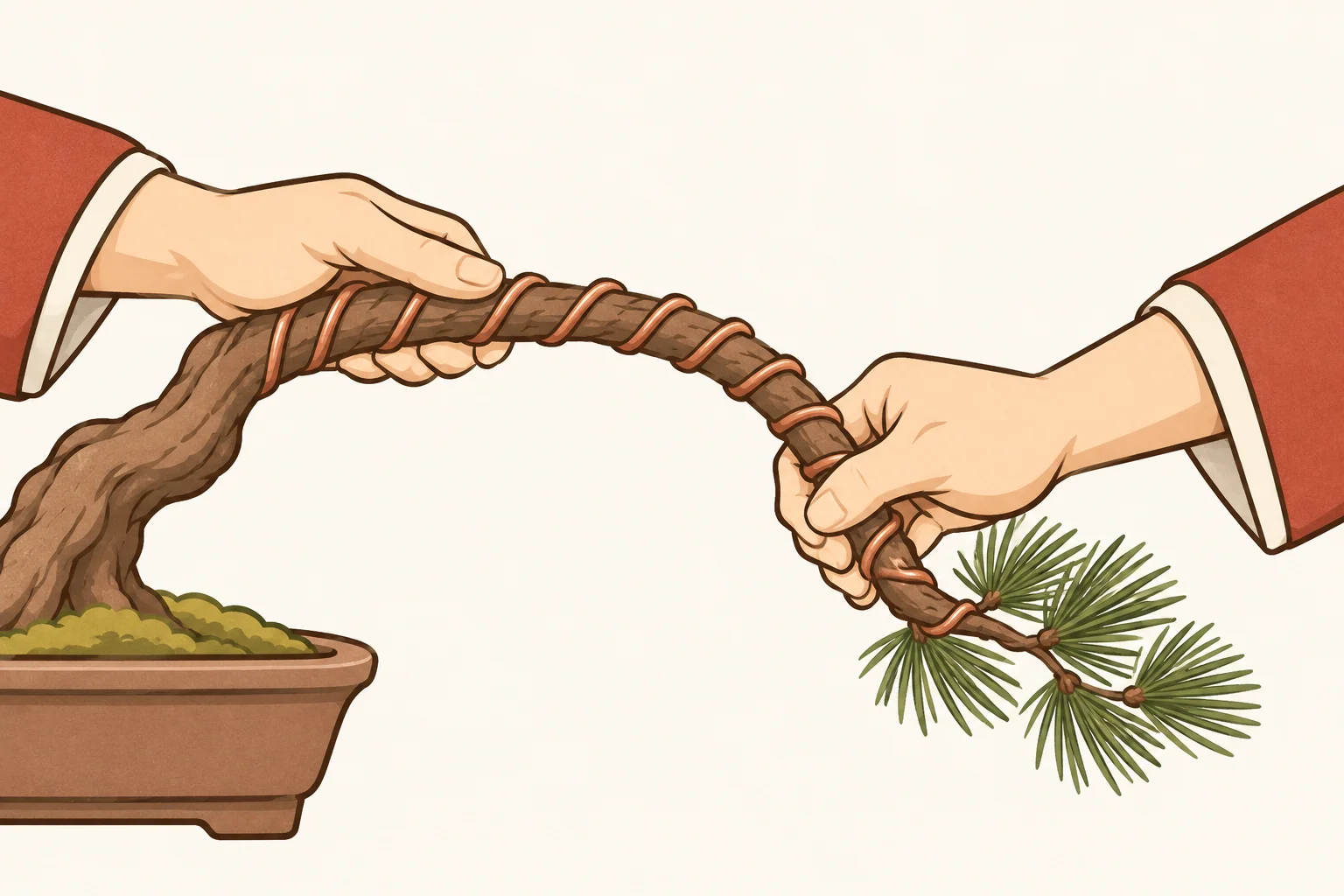
Wiring: copper or aluminum wire is coiled around a branch so that it can be bent and held in a new position.
Pines have their own seasonal routine. Japanese black pine is "decandled" in early summer: the spring shoots are cut off entirely, which forces the tree to push a second, weaker flush of buds. The needles of that second flush are shorter and the foliage denser. Japanese white pine is handled more gently, with new shoots pinched back in spring. In autumn and winter, growers pluck old and excess needles so that light can reach the interior of the tree and keep inner buds alive.
On junipers you will often see dead wood bleached nearly white. A dead branch stub is called jin, and a strip of dead, barkless wood running along the trunk is called shari. In nature these are the scars of lightning, wind and frost on high-mountain trees. In bonsai they are sometimes natural and sometimes created, by stripping bark and carving with knives, pliers and power tools, and are then treated with lime sulfur, which whitens and preserves the wood. The contrast of white dead wood, reddish living bark spiraling up beside it, and dense green foliage, life and death twisted together in one trunk, is the most dramatic sight in bonsai. After the war, growers such as Kimura Masahiko took carving to sculptural extremes, and their work influenced bonsai artists all over the world.
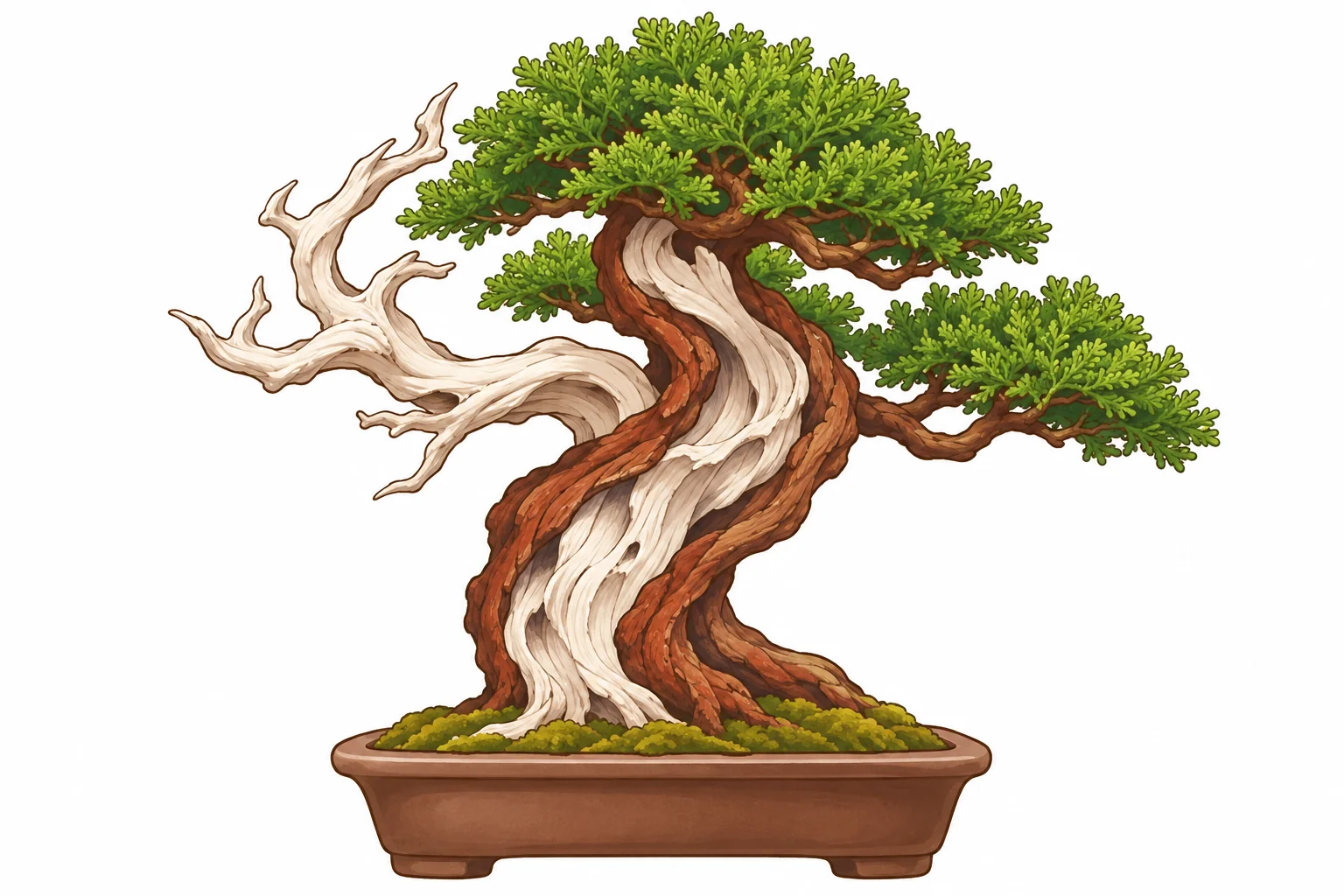
A juniper bonsai trunk: white jin and shari spiralling up with strips of red-brown living bark (illustration).
Repotting is the other great annual task. As roots grow, the soil in a shallow pot compacts and loses drainage. Small trees are repotted every year or two in early spring, large ones every three to five years: the old soil is combed out, some roots are cut back, and fresh soil goes in. The standard Japanese base is akadama, a granular red clay dug from volcanic subsoil in the Kantō region and sifted into particles, prized because it holds water yet drains freely. Growers mix it with other volcanic grits such as Kiryū and Kanuma soil according to the species. Pines like a lean, dry mix; deciduous trees want more moisture.
Watering sounds like the easy part and is not. A shallow pot holds little water. In summer a tree may need watering two or three times a day, and a day’s neglect can kill it. For the first years of a traditional apprenticeship, watering, sweeping and moving pots are most of the work. Apprenticeships at established Japanese nurseries usually last around five or six years, with apprentices often living on the premises; after finishing, many apprentices traditionally stay on for a further period of service to thank their teacher. Today a good number of apprentices in Ōmiya and elsewhere come from Europe, the Americas, China and Southeast Asia.
05The Pot and the Display
In Japan the pot is not an afterthought. The aim is a match between tree and container. Conifers are usually set in unglazed pots in reddish, purplish or dark brown clays, which are quiet and keep attention on the tree. Flowering and fruiting trees often go in glazed pots, blue, cream, celadon, that set off the color of blossom or fruit. Depth, shape, the presence or absence of feet, a rim that flares or turns in: all are chosen to suit the thickness and character of the tree. A massive pine needs a deeper rectangle; a slender literati tree looks right in a shallow round pot; a cascade needs a tall one.
The most prized pots are old Chinese pots, many from the Yixing region, imported during the Qing dynasty. Japanese collectors grade them by when they arrived, and the oldest are called kowatari, "old crossings"; a fine example can sell for more than the tree in it. Japan also has its own tradition of bonsai pottery, notably from Tokoname in Aichi Prefecture, and the pots of named modern potters are collected in their own right.
The traditional place to view a bonsai is the tokonoma, the display alcove of a Japanese room. In a formal arrangement, the main tree stands on a wooden stand. Beside it goes a small accent planting of grass, moss or a wildflower, and behind hangs a scroll suited to the season. The three together make a scene. A mountain juniper might be paired with a tuft of alpine grass and a scroll showing the moon, so that the viewer imagines a high ridge on an autumn night. The approach is close to that of the tearoom alcove and of ikebana: seasonal feeling, restraint, and space left for the viewer. The Kokufu-ten and the Ōmiya Bonsai Art Museum both show trees in alcove-style displays, and it is worth reading the tree, the accent and the scroll together.
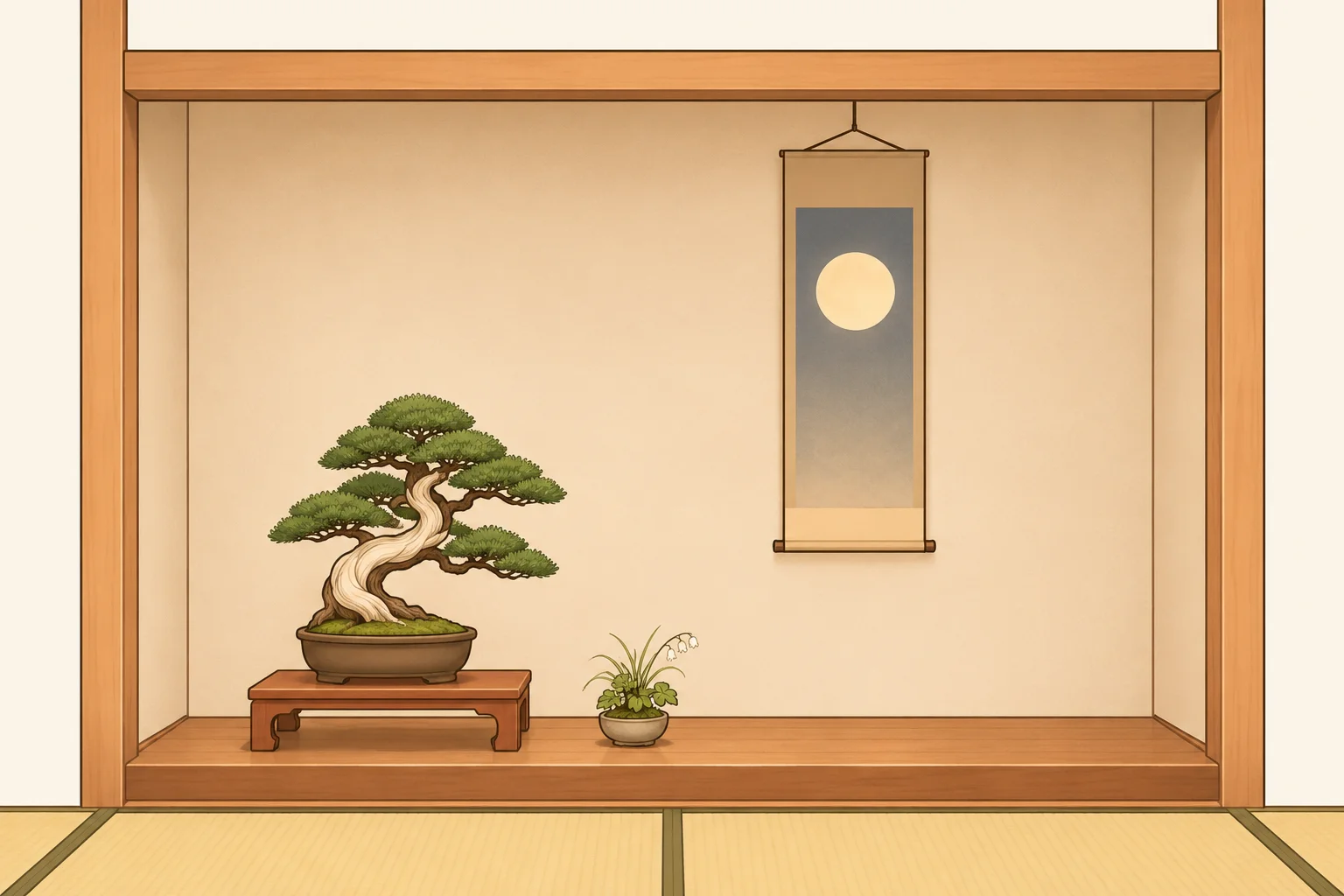
A formal tokonoma display: the main tree on a wooden stand, a small accent planting beside it and a scroll behind.
06Bonsai in Japan Today
At home in Japan, bonsai has an image problem. Many younger Japanese think of it as a pastime for retired men, something grandfather does in the garden. The community of serious growers is indeed aging, and some old nurseries have closed for lack of successors. Abroad, by contrast, interest has grown steadily for decades. There are large and sophisticated bonsai communities in Europe, North America, Taiwan and Southeast Asia, and fine Japanese trees are increasingly sold overseas. Many Ōmiya nurseries now depend heavily on foreign buyers and visitors. In a sense, Japan has been rediscovering bonsai through the world’s enthusiasm for it.
That enthusiasm, and the prices it brings, has had side effects. In early 2019, seven trees were stolen from a nursery in Kawaguchi, Saitama, including a juniper around 400 years old. The owners appealed publicly on social media for the thieves to at least water the trees, and the story was reported around the world. Ordinary good bonsai sell for tens or hundreds of thousands of yen; masterpiece trees can change hands for many millions.
Meanwhile bonsai is finding new forms in younger urban lives. Palm-sized shōhin trees, moss balls (kokedama) and small potted trees for an apartment windowsill are sold in lifestyle shops and florists. Younger professionals post their work on social media and collaborate with designers and fashion brands. Established figures have also reached out: Kobayashi Kunio of Shunka-en in Tokyo and the old Ōmiya nursery Seiko-en both run lessons and workshops for foreign visitors and new Japanese hobbyists.
07Seeing Bonsai in Japan
The easiest place to start is Ōmiya Bonsai Village in Saitama City, under an hour from central Tokyo. Take the JR Utsunomiya Line to Toro, one stop past Ōmiya, and walk about five minutes from the east exit; or change at Ōmiya to the Tōbu Urban Park Line and ride two stops to Ōmiya-kōen, about ten minutes’ walk away. It is a quiet residential neighborhood, and the nurseries open straight onto the street: Fuyō-en, Tōju-en, Seiko-en, Kyūka-en and Mansei-en are among those still working. Most let visitors walk around, but they are businesses and working nurseries first. Greet the staff when you enter, do not touch trees or pots, and ask before taking photographs.
The Ōmiya Bonsai Art Museum, at the edge of the village, is the best introduction. Indoor galleries explain the history of bonsai and display pots, tools and woodblock prints that show potted trees, along with alcove displays; an outdoor garden holds dozens of masterpiece trees, mostly conifers. According to descriptions from around 2019, the introductory panels are in Japanese and English, and an audio guide is available in English, Chinese, Korean and Japanese. Every year from May 3 to 5, the village holds its Great Bonsai Festival (Dai Bonsai Matsuri), when nurseries set up stalls and you can buy small trees and pots at reasonable prices.
The other unmissable event is the Kokufu-ten, held each February at the Tokyo Metropolitan Art Museum in Ueno Park. It is the highest-ranking exhibition in Japanese bonsai, and many of the trees belong to private collectors and appear in public only for these few days. The show runs for little more than a week, split into two halves with a change of trees, and weekends can be crowded.
In Edogawa Ward on Tokyo’s east side, Kobayashi Kunio’s Shunka-en Bonsai Museum displays a large private collection and welcomes foreign visitors, with lessons available by arrangement. For pines, Kinashi and Kokubunji in Takamatsu, Kagawa, offer the sight of fields of young pines being trained in rows, and the area holds bonsai festivals in spring and autumn. The Imperial bonsai collection in Tokyo, managed by the Imperial Household Agency, is generally not open to the public except on special occasions.
A few habits help in looking. Find the front first; exhibition trees face the viewer. Then lower yourself until your eyes are level with the rim of the pot or the lowest branch, which is where the illusion of looking up at a big tree begins. Look at the roots and at how the trunk rises out of the soil, then at where the first branch emerges, then at the outline of the crown and the spaces between the branches. On a juniper, follow the white jin and shari as they wind up beside the living bark. Look at the pot and ask whether it suits the tree. Then step back, take in the whole display, and ask yourself what landscape the tree is trying to put you in.
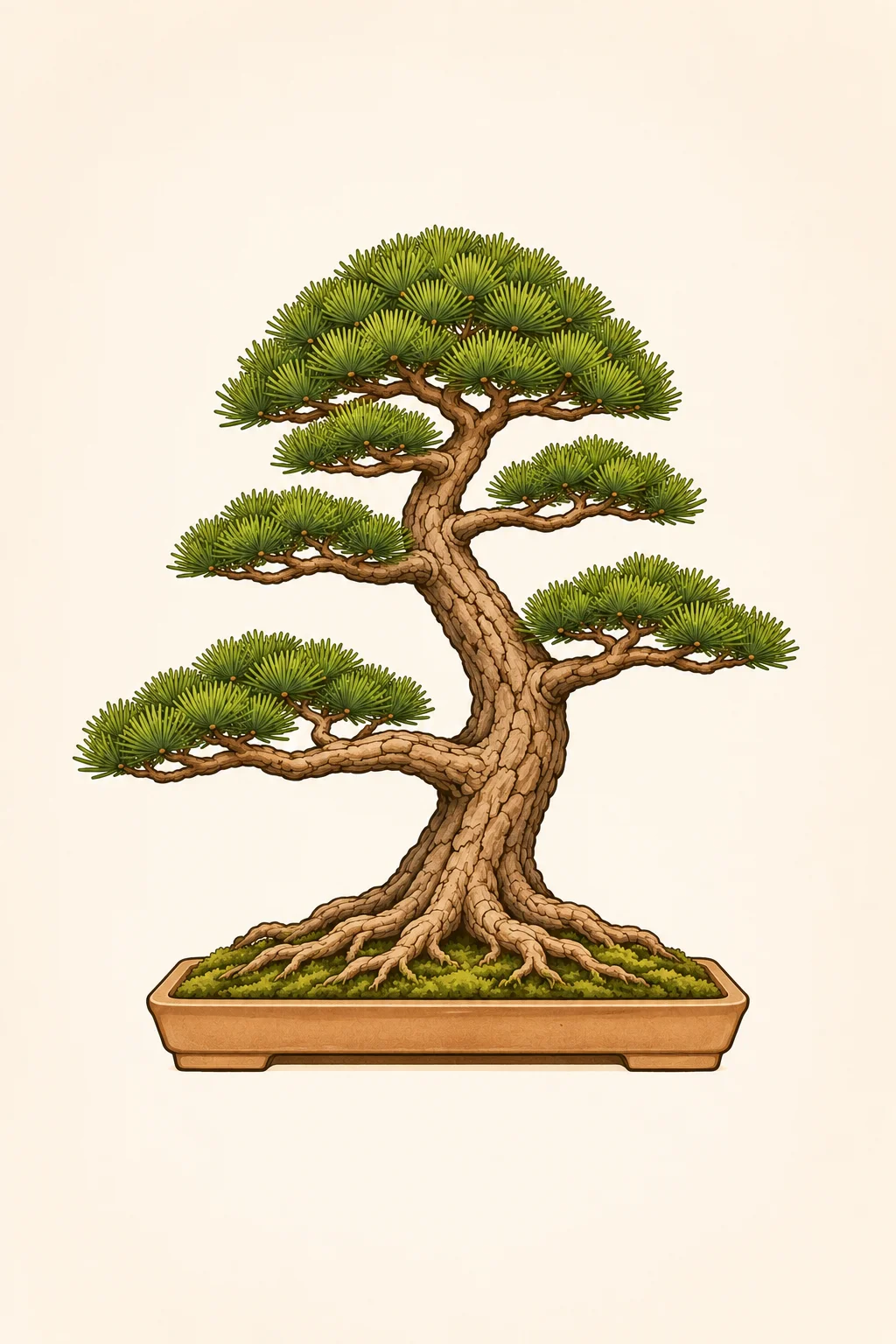
From the bottom up: pot, surface roots, trunk, branches, crown.
Taking a tree home is usually difficult. Most countries prohibit or tightly control the import of plants with soil on their roots, and the rules on species vary widely, so a tree bought on impulse in Ōmiya will not make it through customs. Some nurseries can arrange export with phytosanitary certificates to countries that permit it, at a price. A more practical souvenir is a good pot, or a pair of bonsai shears from one of Japan’s toolmakers, such as those in Sanjō, Niigata, to use on a tree at home. Better still, take a workshop in Japan and prune a small tree with your own hands; the experience travels well, even when the tree cannot.