
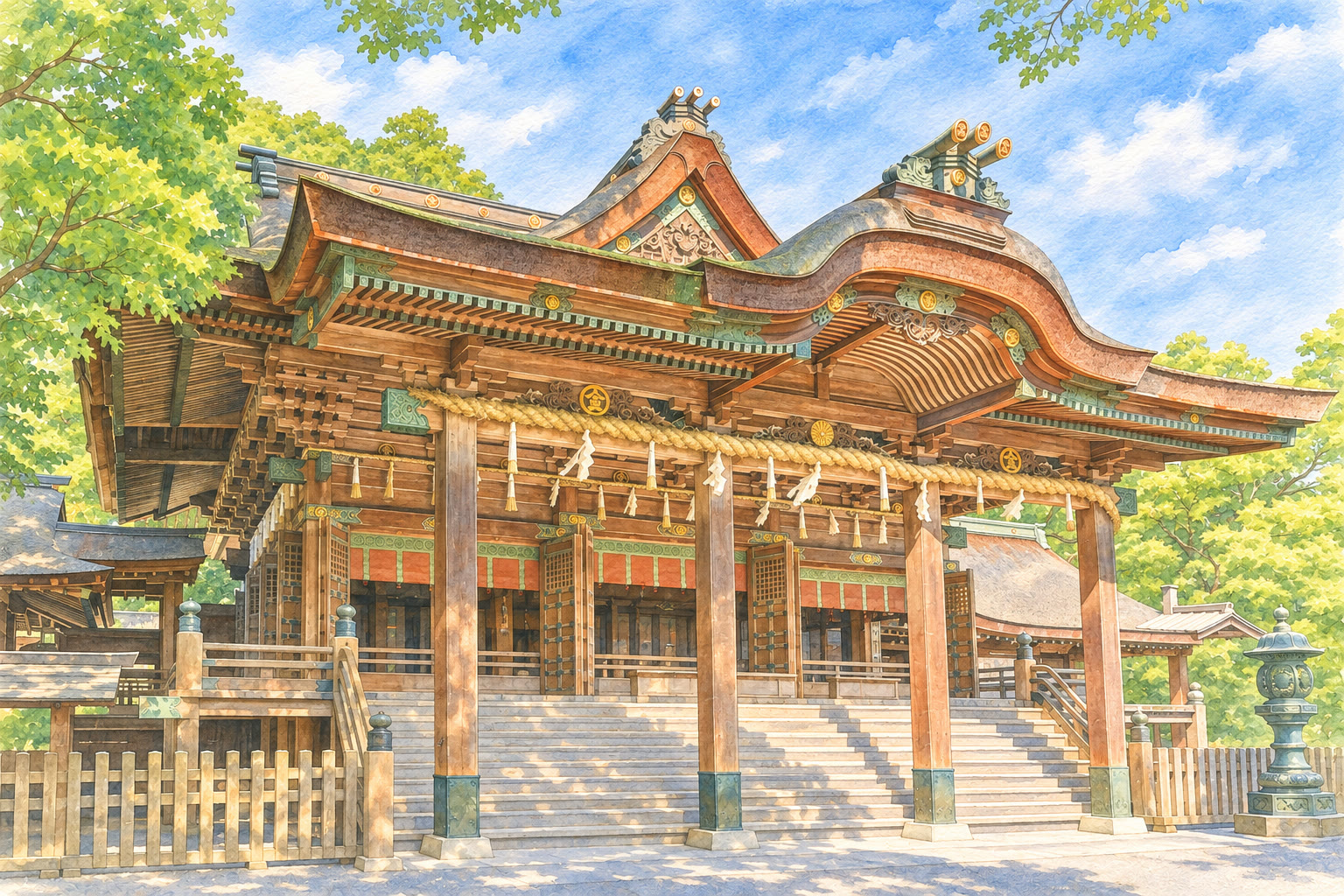
Kotohira, a town in western Kagawa Prefecture, lies at the foot of Mount Zōzu on the southern edge of the Sanuki Plain. It grew up as a shrine town serving pilgrims to Kotohiragū. Before the Meiji era the shrine was Konpira Daigongen, a site where kami and buddhas were worshipped together, administered by Konkō-in of the temple Matsuo-ji. It was revered as a guardian of seafaring and fishing, and sailors and merchants carried its cult throughout Japan. Pilgrimage to Konpira became hugely popular in the middle and late Edo period; people came by boat across the Seto Inland Sea from Ōsaka and elsewhere, and those who could not travel sometimes sent a proxy, or even a dog, to pray on their behalf.
The site covered here is Kotohiragū. After the separation of Shinto and Buddhism in the early Meiji years, Konpira Daigongen became a shrine under the name Kotohiragū, dedicated to Ōmononushi together with Emperor Sutoku. There are 785 stone steps from the approach to the main shrine. Its shoin halls preserve sliding-door paintings by Maruyama Ōkyo and others, and the old Konpira Grand Theater (Kanamaru-za) in the town, built in 1835, is the oldest surviving kabuki theater in Japan.
1KotohiragūHillside shrine to the guardian of seafarers, reached by 785 stone steps and once a major Edo-period pilgrimage goal.