
At a glance
How Christianity reached Japan in 1549, was banned and driven underground for two and a half centuries, and left churches and villages around Nagasaki that still stand.
- Christianity reached Japan in 1549, when the Jesuit Francis Xavier landed at Kagoshima.
- The shogunate extended its ban nationwide in 1614, and after the Shimabara uprising of 1637 the prohibition became total.
- Hidden Christians passed prayers down by mouth and venerated Kannon statues as Mary; in 1865 they made themselves known at Ōura Church.
- As of the end of 2024, Christian groups counted about 1.87 million adherents, under 2 percent of the population.
- In 2018 twelve Hidden Christian sites in the Nagasaki and Amakusa region were inscribed as World Heritage.
Christians make up only one to two percent of Japan’s population, yet the story of Christianity in Japan is one of the most dramatic in the country’s religious history. It arrived in 1549 with a Jesuit missionary, spread along the routes of Portuguese trade, won converts among warlords and farmers alike, and was then banned so thoroughly that for two and a half centuries it survived only in secret, in fishing villages and on remote islands around Nagasaki. Today its traces are everywhere if you know where to look: in the wooden churches of the Gotō Islands, in a bomb-scarred statue of Mary in Nagasaki, in the school names of Tokyo, and, less solemnly, in the white chapels where many Japanese couples who are not Christian get married.
01Arrival: Xavier and the Jesuits
Francis Xavier, one of the founders of the Society of Jesus, landed at Kagoshima in southern Kyūshū in 1549. He had been guided there by a Japanese man named Anjirō (often written Yajirō), a fugitive from Satsuma who had met Xavier in Malacca and been baptized. Xavier spent a little over two years in Japan. He preached in Hirado and Yamaguchi and made the long trip to Kyoto hoping to win permission from the emperor, only to find the capital wrecked by civil war and its nominal rulers powerless. He went back to Yamaguchi, put on fine clothes, presented gifts such as a clock and a musical instrument to the local lord Ōuchi Yoshitaka, and was given leave to preach.
The lesson stuck. Japan in the mid-sixteenth century was divided among competing regional lords, the daimyo, and the Jesuits understood that the way into the country ran through them. Xavier also left behind a famous verdict: in his letters he called the Japanese the best people yet discovered, curious, reasonable and sensitive to honor. He died in 1552 on Shangchuan Island off the coast of China, still trying to reach the mainland.
Early on there was a revealing confusion over words. Anjirō rendered the Christian God as Dainichi, the name of the cosmic Buddha of Shingon Buddhism, and for a time listeners took the newcomers for a new Buddhist sect from India. The missionaries soon switched to the Latin Deus, pronounced Deusu. From the very beginning, Christianity in Japan had to define itself against a landscape already full of Buddhist temples and Shinto shrines.
02The Christian Century
The next half-century is often called Japan’s "Christian century." Converts were known as Kirishitan, from the Portuguese cristão. Mission and trade went together. The Portuguese "black ships" brought Chinese silk, guns and saltpeter, and a daimyo who wanted the ships to call at his port had good reason to welcome the priests who traveled with them. Some lords went further and were baptized themselves.
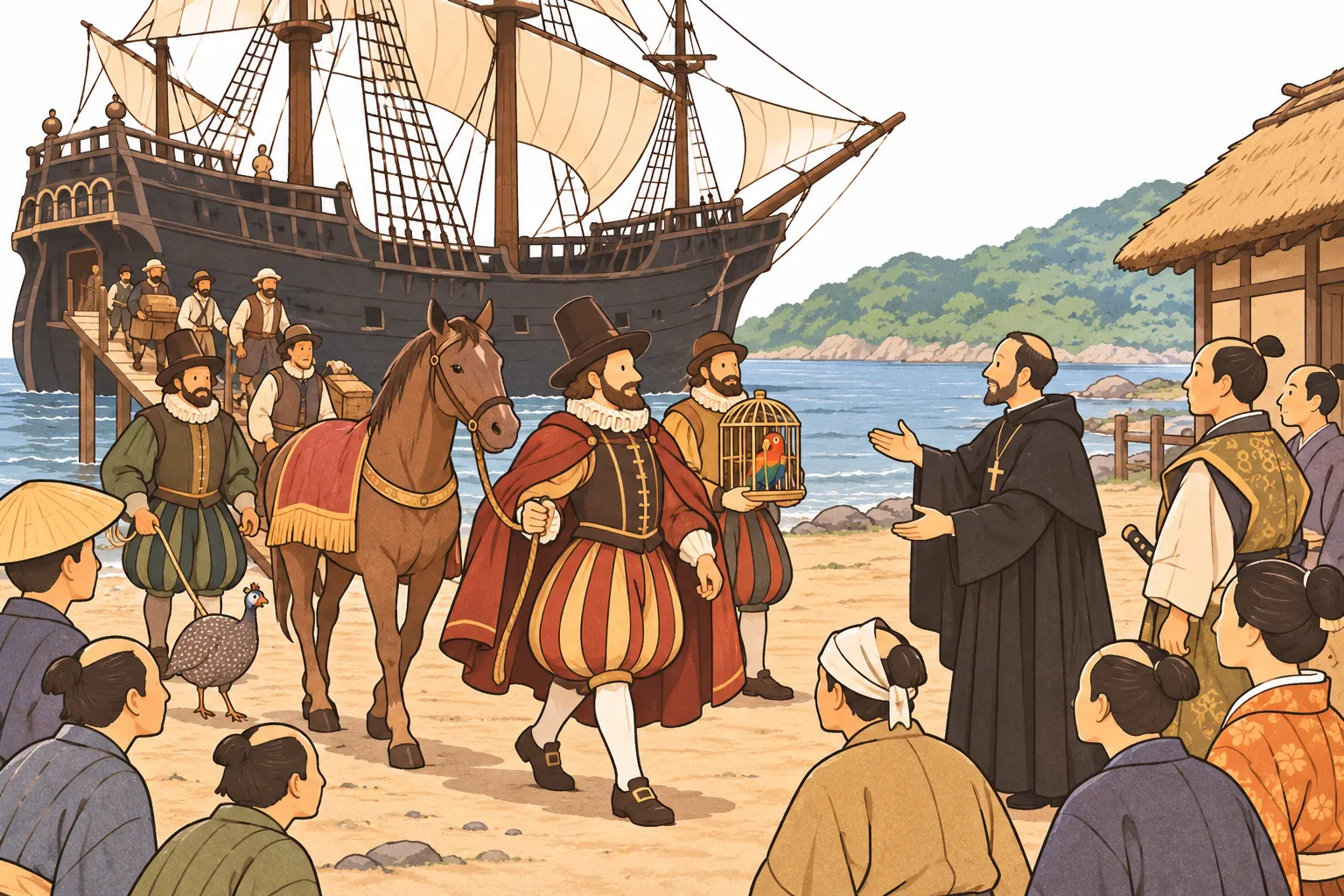
Late 16th century: a black ship lands, Portuguese in baggy breeches lead animals ashore, missionaries waiting (illustration).
The first of these "Christian daimyo" was Ōmura Sumitada of Hizen in western Kyūshū, baptized in 1563. He opened the harbor of Nagasaki to the Portuguese in 1570, and in 1580 he handed Nagasaki over to the Jesuits outright. A quiet fishing settlement became a bustling international port, and Nagasaki’s cosmopolitan character dates from this moment. Ōtomo Sōrin of Bungo and Arima Harunobu also converted. In central Japan the most devout of them all was Takayama Ukon, who later chose to give up his domain rather than renounce his faith.
The warlord Oda Nobunaga, who was unifying the country in the 1570s, treated the missionaries with open friendliness. He showed little interest in theology, but he enjoyed their globes, clocks and stories, and he was glad of anything that annoyed the powerful Buddhist institutions he was fighting. The Jesuits built a church in Kyoto that locals called the Nanban-ji, the "temple of the southern barbarians," and a seminary at Azuchi beneath Nobunaga’s castle. The painted nanban screens of the period capture the mood: a towering black ship at anchor, Portuguese merchants in baggy pantaloons parading exotic animals ashore, black-robed priests waiting to greet them.
Estimates of the number of Japanese Christians by the early seventeenth century run to around 300,000. In 1582 the Jesuit Visitor Alessandro Valignano sent four young Japanese noblemen to Europe, the so-called Tenshō embassy. They were received in Lisbon, Madrid and Rome, where they met the pope. By the time they returned in 1590, Japan had changed.
03Prohibition and Martyrdom
In 1587, having just conquered Kyūshū, Toyotomi Hideyoshi abruptly ordered all missionaries out of the country. Historians point to several motives: alarm at finding Nagasaki under Jesuit control, fear that baptized lords owed loyalty to a foreign religion, and anger at reports that Portuguese traders were buying and shipping Japanese as slaves. The edict was loosely enforced. Trade continued, and most of the priests simply kept a lower profile.
The turning point came in 1597. After the Spanish galleon San Felipe was wrecked on the coast of Tosa, remarks attributed to its crew convinced Hideyoshi that missionaries were the vanguard of conquest. He had Franciscan friars and Japanese believers arrested in Kyoto and Ōsaka, marched them hundreds of miles to Nagasaki, and crucified them on Nishizaka hill. There were twenty-six of them, including three boys; the youngest, Luis Ibaraki, is usually recorded as twelve (by his likely birth year, about eleven by Western count). The Twenty-Six Martyrs of Japan were canonized in 1862, and a memorial and museum now stand on the site of their execution.
Tokugawa Ieyasu, who took power after Hideyoshi’s death, cared more about trade than doctrine at first, and the arrival of Protestant Dutch and English merchants who did not proselytize gave him an alternative to the Catholic powers. The shogunate banned Christianity in its own territories in 1612 and across the country in 1614. Takayama Ukon was exiled to Manila, where he died soon after. Persecution then grew steadily harsher. In the Great Genna Martyrdom at Nagasaki in 1622, more than fifty people were burned or beheaded. Officials devised tortures meant to produce apostasy rather than martyrs: victims were hung upside down in pits, or scalded with water from the boiling hot springs of Unzen. In 1633 the Portuguese Jesuit Cristóvão Ferreira renounced his faith under torture, took a Japanese name, Sawano Chūan, and later helped the authorities interrogate Christians.
The Shimabara Rebellion of 1637–38 sealed Christianity’s fate. Peasants on the Shimabara Peninsula and the Amakusa Islands, crushed by taxes and famine and pressured to abandon their faith, rose up under a charismatic teenager known as Amakusa Shirō and held out in the ruined Hara Castle. The shogunate needed a huge army and months of siege to take it, and nearly all the defenders, said to number in the tens of thousands, were killed. Soon afterward the Portuguese were expelled for good, and the Dutch, confined to the little artificial island of Dejima in Nagasaki harbor, became the only Europeans allowed to trade. This is the system later called sakoku, the "closed country."
The ban was enforced through everyday bureaucracy. Every household had to register with a Buddhist temple, which certified each year that its members were not Christians. In and around Nagasaki, people were made to tread on fumie, brass plaques bearing an image of Christ or the Virgin, usually at the New Year. Public notice boards offered silver rewards for informers. This temple registration system lasted until the Meiji period, and it is one reason why so many Japanese families still have a hereditary family temple today.
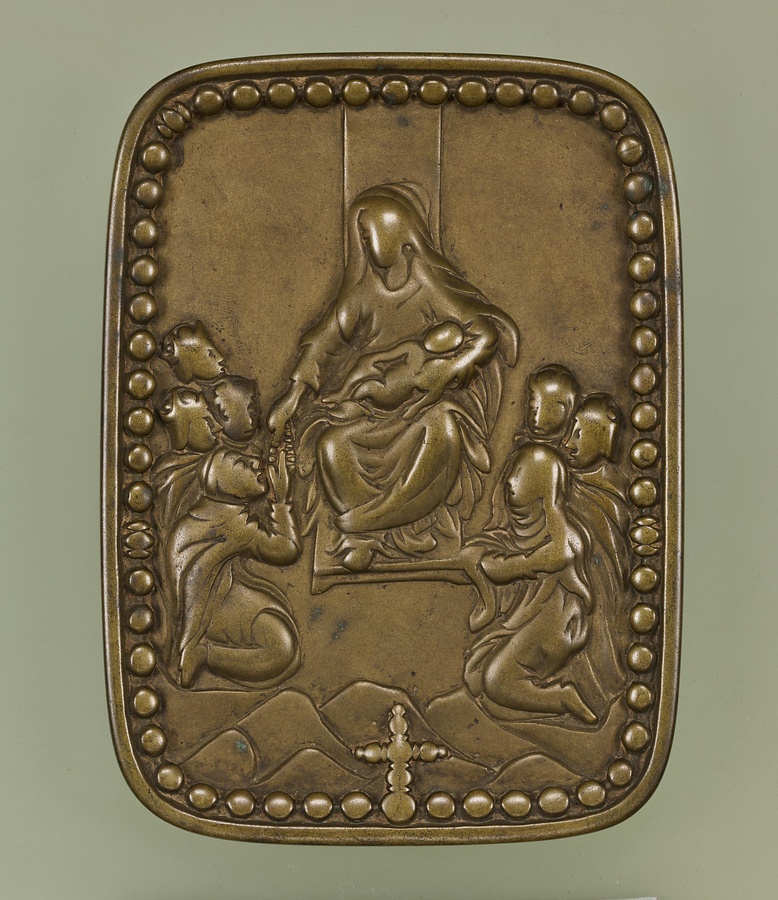
A brass fumie of the Virgin and Child (Our Lady of the Rosary), 17th century. Officials made residents step on plaques like this to prove they were not Christians.Tokyo National Museum, fumi-e: Virgin and Child (Madonna of the Rosary) (Edo period, 17th century), via Cultural Heritage Online
04The Hidden Christians
The priests were killed or driven out, but the faith did not entirely die. In villages at Sotome and Urakami near Nagasaki, on the Gotō Islands, at Hirado and Ikitsuki, and in Amakusa, communities passed as Buddhists, stepped on the fumie each year as required, and then went home to pray in secret, asking forgiveness for what they had just done. Historians call them Senpuku Kirishitan, the "hidden" or "concealed" Christians.
Without clergy they organized themselves. Each community had a keeper of the church calendar, who worked out the dates of feasts and fasts, and a baptizer, who administered the one sacrament laypeople could perform. Prayers called orasho, from the Latin oratio, were memorized and passed down orally, a mixture of Latin, Portuguese and Japanese whose meaning gradually wore away while the sounds were preserved with great care. White porcelain statues of Kannon, the Buddhist bodhisattva of compassion, served as images of the Virgin and are now known as "Maria Kannon." Crosses and holy pictures were hidden behind the household Buddhist altar.
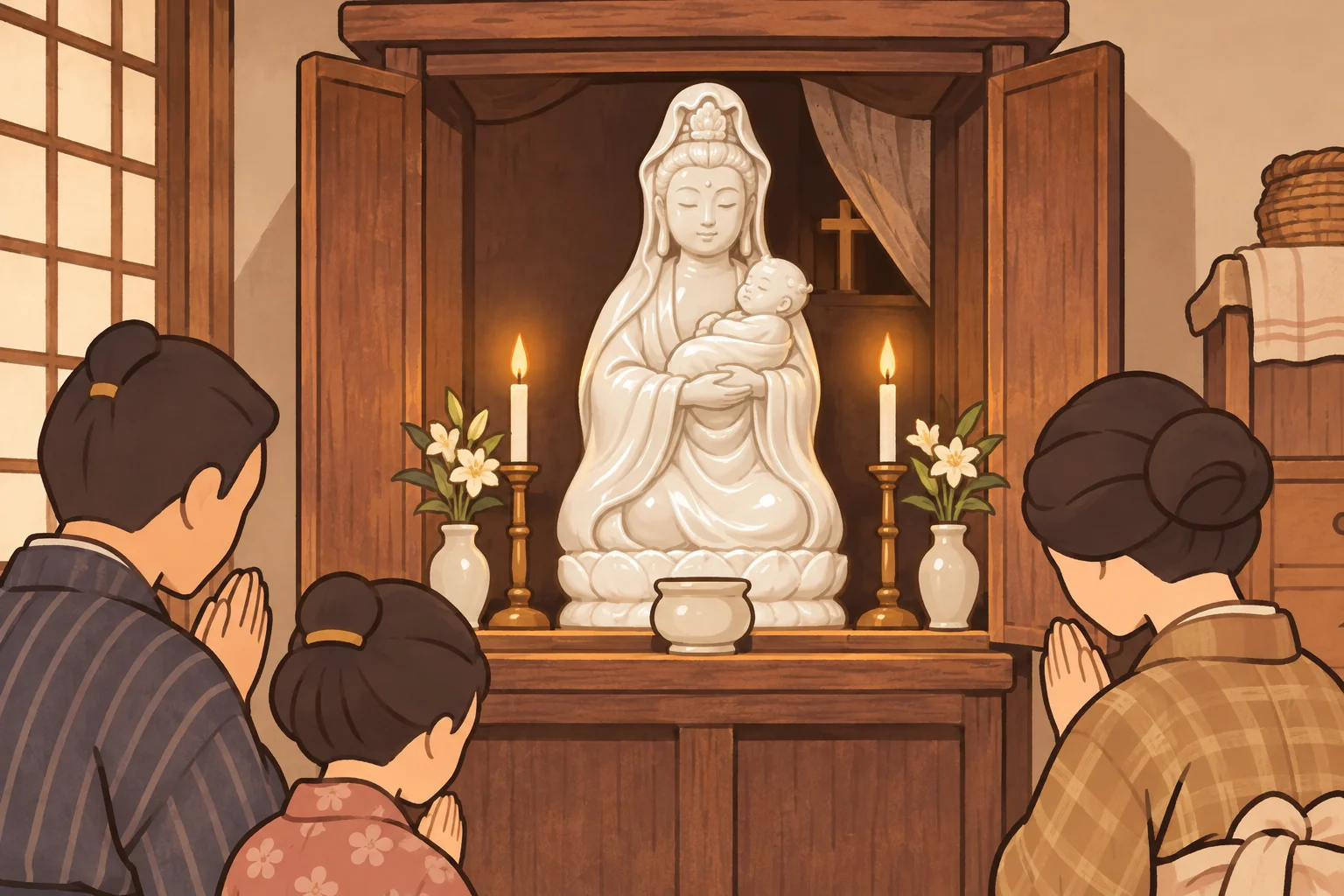
A white porcelain Kannon holding a child, worshipped by hidden Christians as the Virgin, a "Maria Kannon" (illustration).
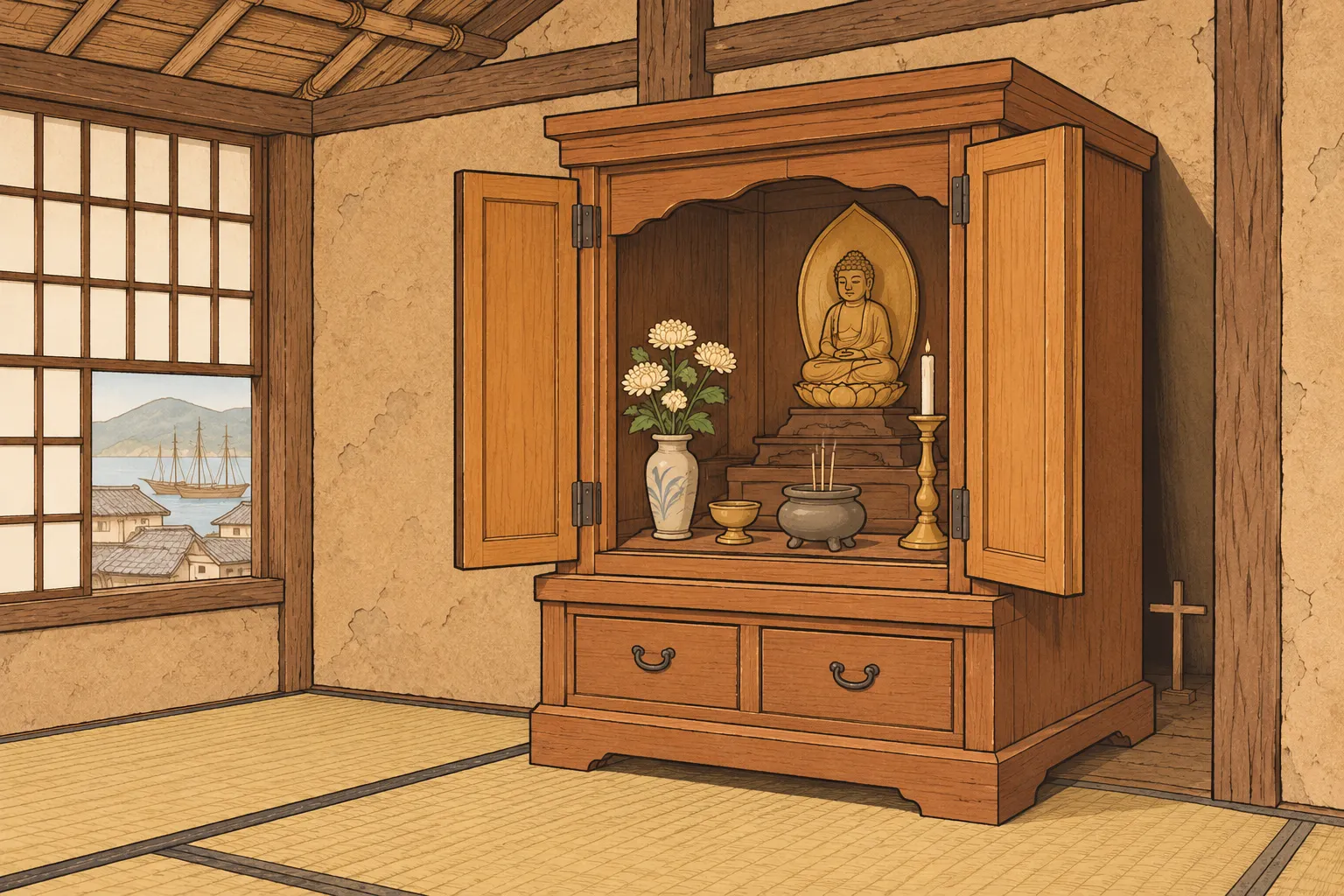
In a hidden Christian household the Buddhist altar looked like any other, with a cross concealed behind it.
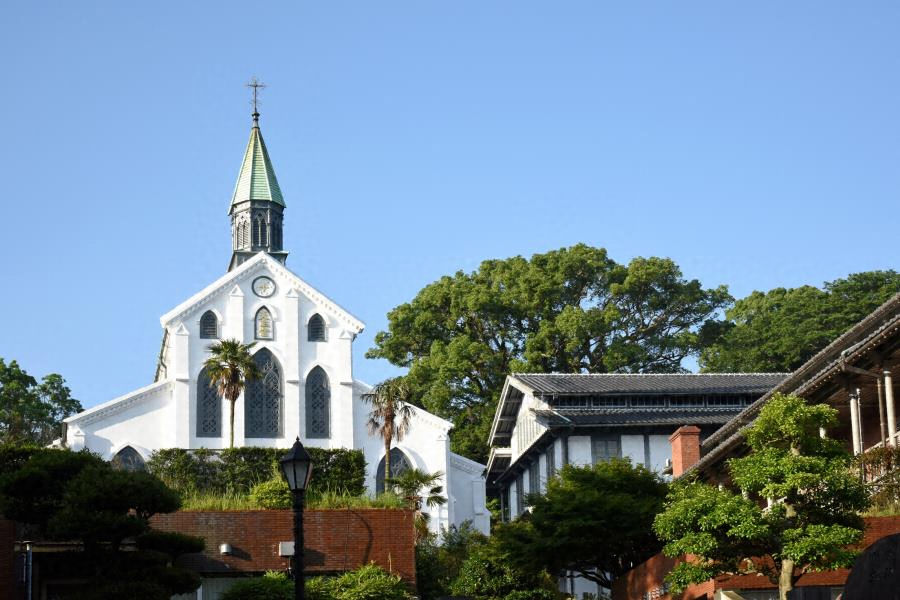
The moment that made their story famous came in 1865. After Japan reopened to the West, French priests of the Paris Foreign Missions Society built the Ōura Church in Nagasaki for the foreign community. On March 17, a few weeks after its dedication, a group of villagers from Urakami came inside. One woman approached Father Bernard Petitjean and whispered that their hearts were the same as his, then asked where the statue of Holy Mary was. The Catholic Church calls this the "Discovery of the Hidden Christians," and Pope Pius IX is said to have called it a miracle of the Orient.
The ban, however, was still in force. When the Urakami villagers declared themselves openly and refused Buddhist funerals, the authorities arrested them, and the new Meiji government exiled more than three thousand to twenty domains from Toyama westward; several hundred died. Western governments protested loudly, and the Iwakura Mission, touring the United States and Europe, heard complaints wherever it went. In 1873 the government quietly took down the notice boards banning Christianity, and the exiles came home.
Not everyone rejoined the Catholic Church. Some communities preferred to keep the prayers and rituals their ancestors had guarded for generations rather than adopt a religion that now looked foreign to them. These Kakure Kirishitan continued their own tradition on islands such as Ikitsuki into recent times, though their numbers have dwindled almost to nothing as the communities have aged.
05Schools, Novels and the Bomb
Protestant missionaries from the United States, Britain and Canada arrived after the 1850s and made their greatest mark through education. Many of Japan’s well-known private schools began as mission schools: Aoyama Gakuin, Rikkyō (St. Paul’s), Meiji Gakuin, Kwansei Gakuin, Kobe College. Niijima Jō, who had slipped out of Japan illegally and been baptized in New England, founded Dōshisha in Kyoto in 1875. William S. Clark spent only about eight months at the Sapporo Agricultural College, yet his students signed a covenant of faith, and among their successors were Uchimura Kanzō, who founded a "Non-Church" movement free of denominations and missionaries, and Nitobe Inazō, author of Bushido: The Soul of Japan.
Christians have remained a small minority, but their influence on education, social work and intellectual life has been out of all proportion to their numbers. Kagawa Toyohiko preached in the slums of Kōbe and organized cooperatives and labor unions; Tsuda Umeko founded the school that became Tsuda University. Several postwar prime ministers, among them Ōhira Masayoshi, were Christians.
In literature the essential name is Endō Shūsaku, a Catholic novelist who spent his career asking whether Christianity could ever take root in what one of his characters calls the "swamp" of Japan. His 1966 novel Silence follows a Portuguese priest smuggled into Japan during the persecution, who finally steps on the fumie. Martin Scorsese adapted it for the screen in 2016.
On August 9, 1945, the atomic bomb exploded over Urakami, the very district where hidden Christians had lived for centuries. Urakami Cathedral, at the time one of the largest churches in East Asia, was destroyed, and a large share of the parish was killed. The physician Nagai Takashi, a Catholic convert dying of leukemia brought on by years of X-ray work, wrote The Bells of Nagasaki, trying to understand the catastrophe through his faith. The rebuilt cathedral now keeps the charred head of a statue of Mary, said to have been carved in wood, that survived the blast, the "Bombed Mary."
06Christianity in Japan Today
In religious statistics published by Japan’s Agency for Cultural Affairs in December 2025 (counting to the end of 2024), Christian groups report about 1.87 million adherents, under two percent of the population, far fewer than in South Korea or the Philippines. A common explanation is that religion in Japan has traditionally been a matter of family and community rather than individual creed. People visit a Shinto shrine at New Year and for a baby’s first outing, and hold funerals with Buddhist rites, without feeling they have joined two religions. A faith that asks for exclusive commitment fits awkwardly into that layered practice.
The outward forms of Christianity, on the other hand, are everywhere. A large share of Japanese weddings take place in hotel or purpose-built chapels, often officiated by a foreign "minister" who may not be ordained, for couples who are not Christian. Christmas is a night for couples and for eating strawberry shortcake and fried chicken. Most Japanese see nothing strange in a life that includes a chapel wedding, shrine visits and a Buddhist funeral.
In 2018 the "Hidden Christian Sites in the Nagasaki Region" were added to the UNESCO World Heritage list. The twelve components include the remains of Hara Castle, Ōura Church, the villages of Shitsu and Ōno in Sotome, the Sakitsu village in Amakusa, the Kasuga village on Hirado, and settlements on the islands of Kuroshima, Nozaki, Kashiragashima, Hisaka and Naru. What the listing honors is less the architecture than the way ordinary people kept a forbidden faith alive.
In Nagasaki a natural route starts at the Twenty-Six Martyrs Monument at Nishizaka, near the station, then climbs to Ōura Church on the Minamiyamate hillside. It is one of the oldest surviving churches in Japan and a National Treasure, and the museum next to it tells the story of the 1865 discovery and the long prohibition; its displays are reported to include fumie and edicts from the ban. Urakami Cathedral stands a short walk from the Atomic Bomb Museum. If you have more time, take a ferry to the Gotō Islands, where dozens of churches, often put at more than fifty, are scattered along the coves, many built by the descendants of hidden Christians with their own labor and money after the ban was lifted. Several were designed by the local builder-architect Tetsukawa Yosuke, in brick, wood or stone. In Amakusa, the small Gothic church at Sakitsu rises among fishermen’s houses a short walk from a Shinto shrine, a good picture of how these faiths have lived side by side.
Remember that these are working parish churches. Photography inside is usually not allowed, and you should not enter during a Mass or funeral. Dress modestly, sit quietly in a pew for a while, and look at the light through the stained glass falling on the wooden floor. The people who pray there on Sunday mornings are, in many cases, the descendants of the villagers who kept their faith hidden for two hundred and fifty years.