At a glance
From a Korean king’s gift to funeral Buddhism: how temples, kami worship and the parish system shaped Japanese Buddhism, and how to read a temple visit today.
- Buddhism reached Japan from the Korean kingdom of Paekche; the date is given as 538 or 552, with 538 more widely used.
- As of 2024 Japan had about 76,000 registered temples, and almost every one belongs to a particular school.
- Kami and buddhas shared shrines and temples for over a thousand years, a fusion called shinbutsu shūgō, until separation was ordered from 1868.
- The Edo shogunate’s terauke system made every household a parishioner (danka) of a temple, which then handled its funerals and memorial rites.
- On the night of December 31, temple bells traditionally ring 108 times, one for each of the 108 worldly passions.
Most visitors to Japan spend a good part of their trip inside Buddhist temples without thinking of it as a religious experience. They queue at Sensō-ji in Tokyo, stare up at the Great Buddha in Nara, and photograph moss gardens in Kyoto. Yet many Japanese people will tell you they are not religious at all. Both things are true, and the gap between them is the best way into the subject. Buddhism in Japan is less a creed people sign up to than a set of places, sounds, family obligations and seasonal habits that have been layered over fifteen centuries. This piece explains where it came from, why it looks the way it does, how it lived for a thousand years alongside the native gods, and how to make sense of a temple when you are standing in one.
01What You See When You Walk In
A Japanese temple, or tera, usually announces itself with a gate. At larger temples the gate is a two-story structure flanked by a pair of muscular, glaring guardian figures called Niō. One has his mouth open, the other closed, forming the sounds "a" and "un," the first and last letters of the Sanskrit alphabet, so that between them they cover everything. Inside the gate you will often find a stone basin for rinsing hands, a large bronze incense burner where people waft smoke over their heads and shoulders in the belief that it soothes whatever ails them, and then the main hall, which houses the temple’s principal image.
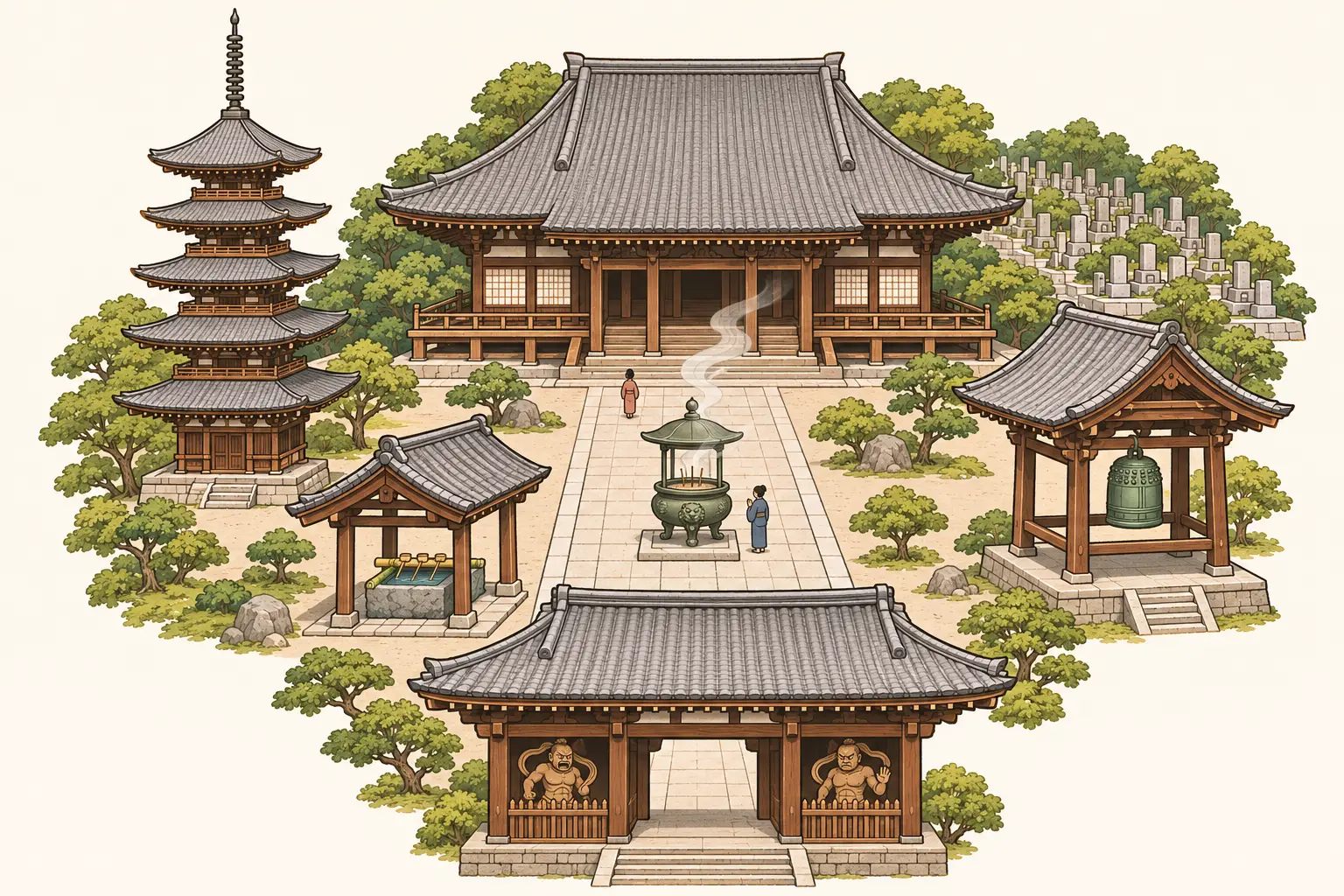
Past the gate come a stone basin, incense burner and main hall, with a pagoda, a bell tower and often a graveyard.
- 1Gate and Niōtwo guardians, one mouth open, one closed
- 2Basin for rinsing handsa stone basin
- 3Incense burnerpeople waft smoke over their heads and shoulders
- 4Main hallhouses the temple’s principal image
- 5Pagoda of three or five storiesdescends from the Indian stupa
- 6Bell towera heavy bronze bell
- 7Graveyardvery often behind the main hall
Roughly in the order you meet them walking in; the graveyard is what most distinguishes Japanese temples from those elsewhere in Asia.
Off to one side there may be a pagoda of three or five stories. The pagoda descends from the Indian stupa, a mound built over relics of the Buddha; by the time it reached Japan through China and Korea it had become a tall timber tower, and in Japan its function slowly drifted from reliquary to landmark. There is usually a bell tower with a heavy bronze bell, struck from outside with a swinging log rather than rung with a clapper. And behind the main hall, very often, there is a graveyard: rows of upright granite stones, each marked with a family name, with fresh flowers and wooden memorial slats called sotoba standing behind them.
That graveyard is the detail that most distinguishes Japanese temples from those elsewhere in Asia, and it says a great deal. For several centuries, Japanese Buddhist temples have been bound to particular households through the care of their dead. A local temple is often less a place where people go to pray than a place where their grandparents are.
The image in the main hall tells you which school the temple belongs to, because almost every temple in Japan belongs to one. A hall centered on Amida, the Buddha of the Western Paradise, usually means one of the Pure Land schools. A dim hall full of painted mandalas around a central Dainichi, the cosmic Buddha, points to Shingon esoteric Buddhism. A cool, sparse hall with a stone floor and an image of Shakyamuni is often Zen. Kannon, the bodhisattva of compassion, Yakushi, the healing Buddha, and Jizō, the protector of children and travelers, appear across many schools. According to Agency for Cultural Affairs figures, Japan had about 76,000 registered temples as of 2024, more than the number of convenience stores, and the great majority belong to a handful of large denominations: Jōdo Shinshū, Sōtō Zen, Jōdo-shū, Shingon, Nichiren, Rinzai Zen and Tendai.
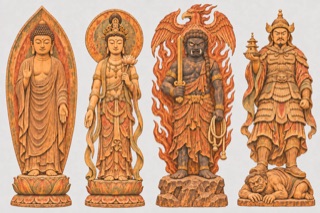 Deep diveFour Ranks of Buddhist StatuesStep out of the sunlight into a Japanese temple hall and your eyes take a moment to adjust.8 chapters
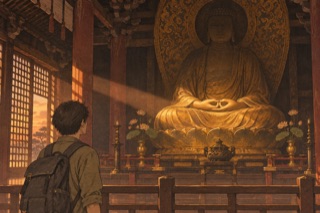 Deep diveMudras and AttributesIn the half-light of a Japanese temple hall, the face of a Buddha is often hard to make out.8 chapters
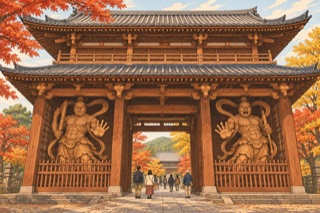 Deep diveNiō and the Four Heavenly KingsWalk up to almost any large Buddhist temple in Japan and the first figures you meet are not serene Buddhas but two furious, nearly naked giants flanking the gate.8 chapters
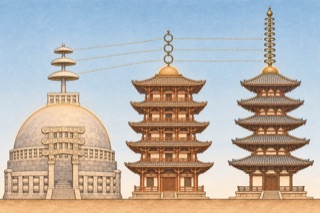 Deep divePagodasWalk up the stone lanes of Higashiyama in Kyoto and the Yasaka Pagoda rises over the tiled roofs of the old townhouses; ride the bullet train into Kyoto Station and the dark…8 chapters
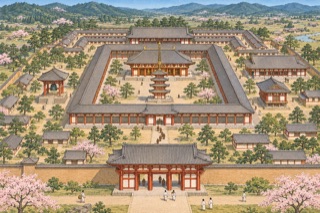 Deep diveThe GaranMost visitors to a Japanese temple experience it as a sequence: a gate, a path, a big hall, perhaps a pagoda off to one side.8 chapters
 Deep diveReading Temple NamesMost visitors to Tokyo know Sensō-ji, the great Kannon temple in Asakusa.8 chapters
02A Gift From Korea
Buddhism arrived in Japan as a piece of diplomacy. The court chronicle Nihon shoki, compiled in 720, records that in 552 King Seong of Paekche, a kingdom in southwestern Korea that badly needed Japanese military support, sent a gilt-bronze image of the Buddha, banners and sutras to the Yamato court. Other early sources give the date as 538, and Japanese textbooks today usually present 538 as the more likely year while noting the other. Either way, the new religion arrived as a foreign king’s gift, carried with the prestige of continental civilization.
According to the Nihon shoki, it split the court at once. The Soga clan argued for worshipping the image; the Mononobe and Nakatomi clans, who were responsible for military affairs and for rites to the native gods, argued that honoring a foreign deity would anger the gods of the land. When an epidemic broke out after the Soga set up the image in their home, the Mononobe threw it into a canal in Naniwa, modern Ōsaka. These stories were shaped by later writers, but they capture something real: early Japanese saw the Buddha as a powerful foreign kami, a god, and the first question was not what he taught but whether he worked.
The Soga won the argument by force. In 587 Soga no Umako defeated Mononobe no Moriya in battle, and the following year he began building Asuka-dera, Japan’s first full-scale temple, with carpenters, roof-tile makers and painters brought over from Paekche. The temple’s bronze Buddha, cast in the early seventh century and badly damaged and patched over the centuries, still sits on its original spot in the village of Asuka, south of Nara.
The figure most associated with this period is Prince Shōtoku, regent to Empress Suiko. Tradition credits him with lecturing on the Lotus Sutra, writing commentaries, and founding temples including Shitennō-ji in Ōsaka and Hōryū-ji near Nara. Historians argue over how much of the Shōtoku story is later legend, but Hōryū-ji is solid enough. Rebuilt after a fire recorded in 670, its western compound contains the oldest surviving wooden buildings in the world, and in 1993 it became, together with Himeji Castle, one of Japan’s first two cultural World Heritage Sites. Its slightly swelling columns and deep eaves preserve a style of East Asian architecture that has long since vanished in China itself.
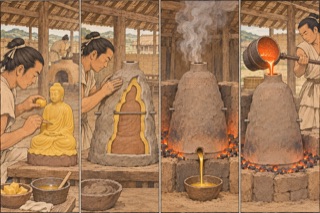
In the eighth century Buddhism became a project of the state. Emperor Shōmu, whose reign was battered by smallpox, famine and rebellion, issued an edict in 741 ordering every province to build an official monastery and nunnery, the kokubunji and kokubunniji. At the head of this network he placed Tōdai-ji in the capital at Nara, and in it a colossal bronze Buddha, Vairocana. The eye-opening ceremony in 752, in which an Indian monk named Bodhisena painted in the pupils with a brush, reportedly drew some ten thousand monks. The Buddha you see today has been recast in parts after fires in 1180 and 1567, and the present hall, rebuilt around 1709, is about two-thirds the width of the original, but it remains one of the largest wooden buildings in the world.
Monks in this era were effectively state employees, ordained with government permission and expected to protect the realm through ritual. To ordain monks properly the court needed a qualified master, and it invited the Chinese monk Jianzhen, known in Japan as Ganjin. His attempts to cross the sea failed five times over about a decade; he went blind along the way, and finally landed in Kyūshū at the end of 753. In Nara he set up an ordination platform at Tōdai-ji and later founded Tōshōdai-ji, where a famous dry-lacquer portrait of him, made around the time of his death, is still kept. The scholarly schools of Nara, later known as the Six Schools of the Southern Capital, survive in temples such as Kōfuku-ji, Yakushi-ji and Tōdai-ji. This was Buddhism for scholars and the state. Ordinary people were mostly outside it.
03When Gods Became Buddhas
When Buddhism arrived, the islands were already full of gods. Mountains, waterfalls, ancient trees, unusual rocks and clan ancestors could all be kami, and the places where they were worshipped eventually became Shinto shrines. Rather than one system defeating the other, the two grew together over more than a thousand years into a combination the Japanese call shinbutsu shūgō, the "fusion of kami and buddhas."
The fusion began with small, practical arrangements. From the eighth century, temples called jingū-ji were built beside shrines, and monks chanted sutras before the gods. The reasoning was that the kami, too, were beings caught in the cycle of rebirth and longed to hear the Buddha’s teaching. Gods could also serve Buddhism. When Tōdai-ji’s Great Buddha was being cast, the god Hachiman of Usa in Kyūshū is said to have delivered an oracle pledging the help of all the gods of heaven and earth, and Hachiman was escorted to Nara, where Tamukeyama Hachiman Shrine still stands next to Tōdai-ji. Before long he was being called Hachiman Daibosatsu, Great Bodhisattva Hachiman: a Shinto god with a Buddhist title, and no one found it strange.
By the Heian period (794–1185) this had a theory behind it, called honji suijaku, roughly "original ground and manifested traces." The buddhas and bodhisattvas were the original reality; to save the people of Japan, they appeared here in the form of local kami. Major gods were paired with Buddhist counterparts. Amaterasu, the sun goddess of Ise, was identified with Dainichi. The three shrines of Kumano in the Kii Peninsula were matched with Amida, Yakushi and the Thousand-Armed Kannon. Kami understood this way were called gongen, "provisional manifestations," and the title spread widely: Kumano Gongen, Zaō Gongen of the mountain ascetics, and eventually Tōshō Daigongen, the deified Tokugawa Ieyasu enshrined at Nikkō. Shugendō, the tradition of mountain asceticism, wove mountain gods, esoteric Buddhist ritual and physical ordeal into a single practice.
| Kami | Buddhist counterpart |
|---|---|
| Amaterasu of Ise | Dainichi |
| The three shrines of Kumano | Amida, Yakushi and the Thousand-Armed Kannon |
Each kami on the left was understood as a manifestation of the buddha or bodhisattva on the right; kami understood this way were called gongen.
On the ground, this meant shrines and temples were often one institution. In Nara, Kōfuku-ji temple and Kasuga Shrine operated almost as a unit in the medieval period, and Kōfuku-ji’s warrior monks would carry Kasuga’s sacred tree branch into Kyoto to press their demands on the court. Large shrines had pagodas and resident monks; many temples had a guardian shrine on their grounds. A medieval villager visiting a shrine might well have watched a monk recite the Heart Sutra before the altar, and would not have needed to decide whether he was facing a god or a buddha. Roughly speaking, the kami looked after this life, its harvests, safety and community, and the buddhas looked after death and the troubled mind.
The Meiji government pulled the two apart. In 1868, seeking to make the emperor and Shinto the spiritual center of the new state, it issued a series of orders known as the shinbutsu bunri, or separation of kami and buddhas. Buddhist images and titles such as gongen were to be removed from shrines, and monks serving at shrines had to leave or return to lay life. The orders spoke of separation, but in many regions they set off a wave of destruction known as haibutsu kishaku, "abolish Buddhism, destroy Shakyamuni." Temples were closed, statues burned, sutras sold for scrap paper and bells melted down. In the Satsuma domain in southern Kyūshū, more than a thousand temples were abolished and essentially no monks remained. At Kōfuku-ji, many monks became priests at Kasuga Shrine and the temple was left nearly deserted; a well-known story, possibly exaggerated, holds that its five-story pagoda was nearly sold off for a trifling sum, rumored to be just 25 yen, to be stripped for its metal fittings; one version has the buyer planning to burn the tower down to get at them. Many Buddhist sculptures now in museums in Japan and abroad left their temples in those years.
A thousand years of habit could not be undone by decree, and the traces are everywhere. Sensō-ji in Tokyo stands right next to Asakusa Shrine, which honors the three men of the temple’s founding legend: two fishermen brothers said to have netted its Kannon image in the Sumida River, and the local man who recognized it. Toyokawa Inari, one of the country’s best-known Inari sites, is in fact a Sōtō Zen temple. At Nikkō, the Tōshōgū shrine and Rinnō-ji temple still share a tangled precinct. Many Japanese homes have both a kamidana, a small shelf for Shinto talismans, and a butsudan, a Buddhist altar cabinet holding the ancestors’ memorial tablets. Going to a shrine at New Year and to the family grave at the temple during Obon is not, for most people, a choice between two religions. It is simply the calendar.
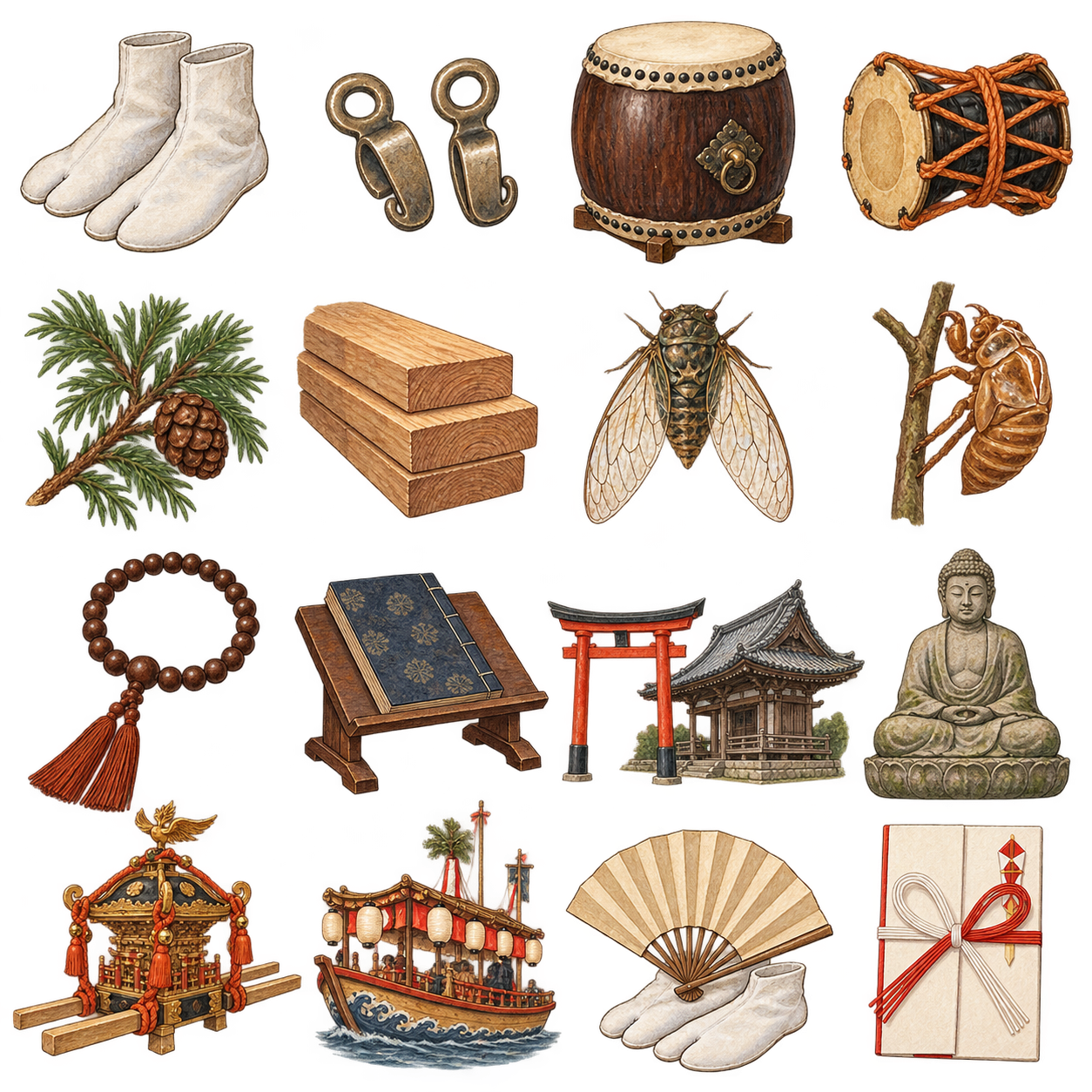
A shrine torii beside a temple hall, a common legacy of the long fusion of kami and buddhas (illustration)
04From the State to the People
At the beginning of the ninth century, two monks returned from Tang China and changed Japanese Buddhism. Saichō founded the Tendai school on Mount Hiei, northeast of Kyoto, teaching from the Lotus Sutra that all beings could become buddhas. Kūkai brought back esoteric Buddhism and founded the Shingon school, with its centers at Mount Kōya and Tō-ji in Kyoto. Shingon made the Buddhist universe something you could see and take part in: mandalas, mantras, ritual hand gestures, and the fire offering called goma, in which a priest feeds wooden sticks inscribed with prayers into a roaring flame. Both schools enjoyed court patronage, and both moved serious practice out of the capital into the mountains, which helps explain why so many important Japanese temples sit on peaks and slopes. Mount Hiei became something like the university of Japanese Buddhism; nearly all the founders of the great medieval schools studied there.
In the later Heian period a mood of anxiety settled over the aristocracy. Buddhist tradition taught that after the Buddha’s death the teaching would pass through ages of decline, ending in mappō, the "latter days of the Dharma," when people could no longer reach enlightenment by their own efforts. In Japan the start of mappō was widely calculated as 1052. Civil disorder, fires and famine made the idea feel real. The following year the imperial regent Fujiwara no Yorimichi dedicated the Phoenix Hall at Byōdō-in in Uji, south of Kyoto: a gilded Amida by the sculptor Jōchō, surrounded by small wooden bodhisattvas playing instruments on clouds, set behind a pond so that the whole building appears to float like the palace of the Pure Land. It is the building on Japan’s ten-yen coin.
If you could not save yourself, you could rely on the vow of Amida Buddha to save all who called on him. In the late twelfth and thirteenth centuries a series of monks brought this idea and others to ordinary people, in a movement later called Kamakura Buddhism. Hōnen left Mount Hiei and taught that sincerely reciting Namu Amida Butsu, "I take refuge in Amida Buddha," was enough to be reborn in the Pure Land; his school became Jōdo-shū. His disciple Shinran went further, arguing that even the faith to recite came from Amida, and that the wicked were precisely the people Amida most wanted to save. Shinran married openly and raised a family, and by tradition did not avoid meat either; later generations traced the clerical practice of "eating meat and taking a wife" back to him, and his followers became Jōdo Shinshū, today the largest Buddhist denomination in Japan. The wandering monk Ippen traveled the country with followers who danced as they chanted. Nichiren insisted that the Lotus Sutra alone was true, taught followers to chant its title, Namu Myōhō Renge Kyō, and attacked other schools so fiercely that he was exiled twice. Meanwhile Eisai brought Rinzai Zen, and the habit of drinking powdered tea, back from Song China, and Dōgen brought Sōtō Zen and built Eihei-ji in the mountains of Echizen, teaching "just sitting."
| Monk | School | Practice |
|---|---|---|
| Hōnen | Jōdo-shū | Reciting Namu Amida Butsu |
| Shinran | Jōdo Shinshū | Even the faith to recite comes from Amida |
| Ippen | — | Dancing as they chanted, traveling the country |
| Nichiren | — | Chanting Namu Myōhō Renge Kyō |
| Eisai | Rinzai Zen | Brought from Song China, with tea |
| Dōgen | Sōtō Zen | “Just sitting” |
What these movements shared was simplicity: a single phrase or a period of sitting could be the whole of practice.
What these movements shared was simplicity. You did not need to read the scriptures or fund a temple. A single phrase or a period of sitting could be the whole of practice. That is why they reached warriors, farmers and merchants, and why the denominations with the most temples today almost all trace their roots to this period. Zen took a somewhat different path: patronized by the shoguns in Kamakura and Kyoto, its "Five Mountains" monasteries became centers of Chinese learning, poetry and diplomacy, and carried dry landscape gardens, ink painting, calligraphy and the culture of tea into the heart of Japanese taste.
05Temples and the Dead
Ask an ordinary Japanese person how Buddhism touches their life and the most likely answer is: when someone dies. People sometimes describe their tradition, half-joking, as sōshiki bukkyō, "funeral Buddhism." The roots of this lie in the Edo period.
In the early seventeenth century the Tokugawa shogunate banned Christianity. To prove that no one was a secret Christian, it required every household to register with a Buddhist temple, which certified its members each year. This was the terauke system, and the annual registers of religious affiliation served as a census. Households became danka, parishioner families, of a particular temple. Funerals, memorial rites and graves belonged to that temple, and the family supported it with donations. For two and a half centuries, belonging to a temple was less a matter of belief than of administration.
Out of this grew the pattern that still holds. When someone dies, the priest gives them a kaimyō, a posthumous Buddhist name, which is written on the memorial tablet and the gravestone. Memorial services follow on the seventh day, the forty-ninth day, the first anniversary, the third, the seventh, and on through the thirty-third or even fiftieth year. At Obon in summer, the ancestors’ spirits are believed to return home; families light welcoming fires and, at the end, sending-off fires. Kyoto’s Gozan no Okuribi on the night of August 16, when giant characters burn on the hillsides around the city, is the most famous of these farewells. During the spring and autumn equinox weeks called higan, families visit the grave together. In all of this, Buddhist ritual and older Japanese ancestor veneration are so intertwined that no one tries to separate them.
The Meiji period brought another change that surprises many visitors. In 1872 the government declared that monks could eat meat, marry and let their hair grow as they wished, a matter on which the state would no longer interfere. Jōdo Shinshū clergy had always married, and now most clergy of other schools followed. Today the typical temple is run by a married priest whose son is expected to inherit it, and the priest’s wife often handles much of its daily business. You may well see a priest in robes driving to a parishioner’s home to chant at a memorial service, then going home to dinner with his family. To outsiders it can look unmonastic; in Japan it has been normal for a century and a half.
This system is now under strain. Rural temples are losing their parishioners as people move to cities, and city dwellers often have no family temple at all. Funerals are getting smaller; "direct cremation" without a ceremony, tree burials, and perpetual-care graves are replacing the family grave passed from generation to generation. The fees for posthumous names, which can run to hundreds of thousands of yen for the more elaborate ranks, draw regular criticism. A significant share of temples is expected to close in the coming decades for lack of successors. Some temples are responding by opening cafés, hosting concerts, and offering meditation and sutra copying to anyone who walks in, trying to become neighborhood places again.
06The Sound of a Temple
A Japanese temple has its own soundscape. In the early morning, monks chant sutras in the main hall to the steady knock of a mokugyo, a hollow wooden drum carved in the shape of a fish. In Zen monasteries, wooden boards, gongs and drums mark every part of the day. In the evening the big bell sounds, slow and deep, and on New Year’s Eve temples across the country ring it 108 times, once for each of the 108 worldly desires in Buddhist reckoning. This joya no kane is broadcast on television, and at many temples ordinary people can line up to take a turn on the log.
Beyond everyday sutra chanting there is a more elaborate, frankly musical form called shōmyō. The word originally named one of the classical Indian sciences, the study of language and sound; in East Asia it came to mean the melodic chanting of hymns, praises and verses in Buddhist ceremonies. Ordinary chanting is about getting through the text at a steady pace. Shōmyō is about singing it well. A single syllable can be stretched into a long, winding melody with fixed pitches, ornaments and rhythms, sung in unison by a group of monks or traded between a leader and a chorus. The texts may be in Sanskrit, in classical Chinese read in Japanese pronunciation, or in Japanese.
There are two main lineages. Tendai shōmyō is traditionally said to have been brought from China in the ninth century by the monk Ennin, and it was later centered on the temples of Ōhara, in the hills north of Kyoto. Ōhara’s monks gave the area the nickname Gyozan, after a mountain in China where, according to legend, the poet Cao Zhi heard heavenly music and composed the first Buddhist hymns in Chinese. Two streams near Sanzen-in are called Ryosen and Ritsusen, after ryo and ritsu, two modes of East Asian music. Shingon shōmyō, centered on Mount Kōya, developed its own schools, the best known being Nanzan Shinryū. Both lineages record their melodies in a notation called hakase, lines and marks drawn beside the text to show how the voice should rise, fall and turn.
Scholars generally see shōmyō as a root of much later Japanese vocal music. The way medieval blind minstrels sang The Tale of the Heike, the chant of Noh theater and the narrative singing of the puppet theater all show its influence in how the voice is produced and melodies are built. Hearing it today takes some planning, but it is possible. The most famous occasion is the Shuni-e ceremony at Tōdai-ji’s Nigatsu-dō hall each March, popularly called Omizutori, the Water-Drawing. At night, monks chant repentance texts inside the hall while others stamp and blow conch shells, and visitors outside can hear the voices through the wooden lattice while giant torches are swept along the balcony above them. Tendai and Shingon priests also give shōmyō concerts in public halls, sometimes with contemporary composers. Sitting in a dark hall while dozens of monks hold a single pitch, the sound coming up through the floor, is something many people remember long after the sights of a trip have blurred.
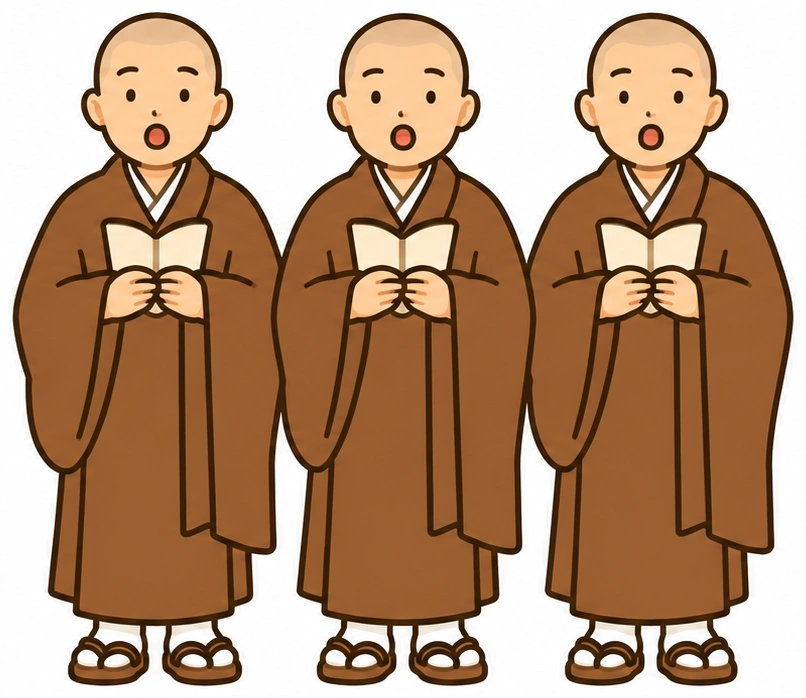
Monks holding chant books sing shōmyō together on a single pitch (illustration)
07Visiting: How to Look, Listen and Stay
You do not need to be a Buddhist to visit a temple, and nobody will expect you to be, but a few things help. A small bow at the gate is a nice gesture. At the water basin, rinse your left hand, then your right, then pour a little water into your cupped left hand to rinse your mouth, just as at a shrine. At the main hall, drop a coin into the offering box, press your palms together, bow your head and make your wish or prayer silently, then bow again. The key difference from a shrine is that you do not clap at a temple. If incense is for sale, light a bundle, set it in the burner and draw a little smoke toward yourself. Shoes come off before you enter a hall, and many halls ban photography inside, with signs at the entrance.
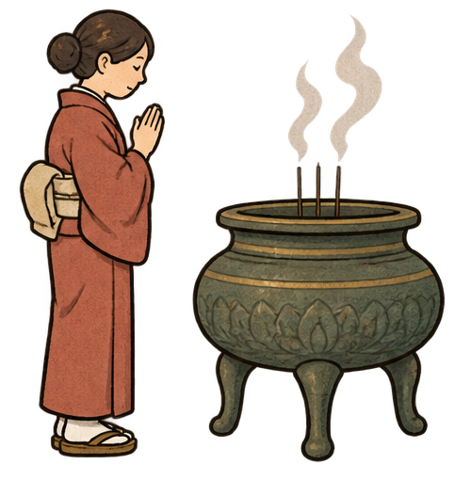
Palms together before the main hall; after placing incense in the burner, visitors waft the smoke over themselves (illustration)
Many visitors now collect goshuin, temple seals. You hand a special bound album to the temple office, and someone writes the temple’s name, its principal image and the date in brush and ink, then stamps it with vermilion seals. The custom began as a receipt for a hand-copied sutra offered to the temple, which is why some temples still call the office a nōkyōjo, "sutra-offering place." Pilgrims walking the eighty-eight temples of the Shikoku pilgrimage fill their books with exactly these.
If you have a night to spare, stay at a shukubō, temple lodging. The best-known place is Mount Kōya in Wakayama Prefecture, where around fifty temples take guests. Dinner is shōjin ryōri, Buddhist vegetarian cooking without meat or fish: sesame tofu, freeze-dried Kōya tofu, mountain vegetables and beans, laid out in lacquer bowls and changing with the season. In the morning you can join the monks’ service and watch the goma fire rise. In the evening, walk the approach to Okunoin, about two kilometers through giant cedars past some two hundred thousand graves and memorials, from those of warlords of the sixteenth century to monuments erected by modern companies for their employees. It ends at the mausoleum of Kūkai, who believers hold is not dead but in eternal meditation; monks bring him meals twice a day.
Many Zen temples in Kyoto and Kamakura hold sitting meditation sessions open to the public. A monk will show you how to sit and count your breaths, and may walk the room with a flat wooden stick called the kyōsaku. Being struck on the shoulder is not a punishment but a help against drowsiness, and you can request it by putting your palms together. Many temples also offer shakyō, sutra copying, in which you trace the 262-or-so characters of the Heart Sutra with a brush over a printed guide. It takes about an hour, and the finished sheet is left with the temple as an offering.
Then, if you can, stay a little longer than you planned. Look at the fresh flowers on the graves, at the boards listing parishioners’ donations for a new roof, and wait for the bell at dusk.