
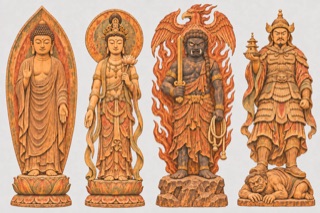
Step out of the sunlight into a Japanese temple hall and your eyes take a moment to adjust. Then the figures appear: a calm seated figure in the middle with a head covered in tiny curls; two crowned attendants hung with jewellery on either side; perhaps, in a side chapel, a blue-black figure glaring out of a wall of carved flame; and at the corners of the altar, armoured generals standing on squashed demons. None of this is random. Japanese Buddhist statues, butsuzō, are usually sorted into four ranks: nyorai (Buddhas), bosatsu (bodhisattvas), myōō (Wisdom Kings) and tenbu (devas, or guardian gods). Each rank has its own dress code, and once you know it you can place most statues in a few seconds by looking at two things: the head and the clothes.
01Why There Are Four Ranks
The ranking follows one idea: how close each figure is to enlightenment.
A nyorai, from the Sanskrit tathāgata, is a fully awakened being, a Buddha. The historical Buddha, Shakyamuni, is one; Mahayana Buddhism added many more, each presiding over a paradise or embodying a principle.
A bosatsu, or bodhisattva, is a being on the way to Buddhahood who has vowed to help others first. Some, in the scriptures, are so advanced they could become Buddhas but choose to stay in the world.
A myōō, or Wisdom King, belongs to Esoteric Buddhism. The idea is that some beings will not listen to gentle persuasion, so the Buddhas take on furious forms to break through. Wisdom Kings are often described as the wrathful manifestations of Buddhas.
Tenbu, the devas, began as Hindu and other Indian gods who were absorbed into Buddhism as protectors of the teaching. In Buddhist cosmology, gods live long and pleasant lives but are still caught in the cycle of rebirth, which is why they come last.
This four-way division is a framework drawn up by later scholars and teachers rather than a list from any ancient scripture, but it is used in almost every Japanese guidebook and museum label, and it works. The rank explains the costume. A Buddha has renounced everything, so wears nothing but a monk’s robe. A bodhisattva is still engaged with the world, so dresses as an Indian prince. A Wisdom King is fighting, so carries weapons and wears a snarl. Devas come from many mythologies and look like the people of the courts that imagined them: emperors, generals, court ladies.
02Nyorai: The Plainest Figures in the Room
Look at the head first. A Buddha has a cranial bump on top called the nikkei (uṣṇīṣa), hair arranged in tight, clockwise snail-shell curls called rahotsu, and a small dot between the eyebrows, the byakugō. That dot represents a curl of white hair; on statues it is often a rock crystal that catches the candlelight. The earlobes are long, a reminder of the heavy earrings Shakyamuni wore as a prince, and there are three folds around the neck. These marks come from the traditional list of thirty-two physical signs of a great being.
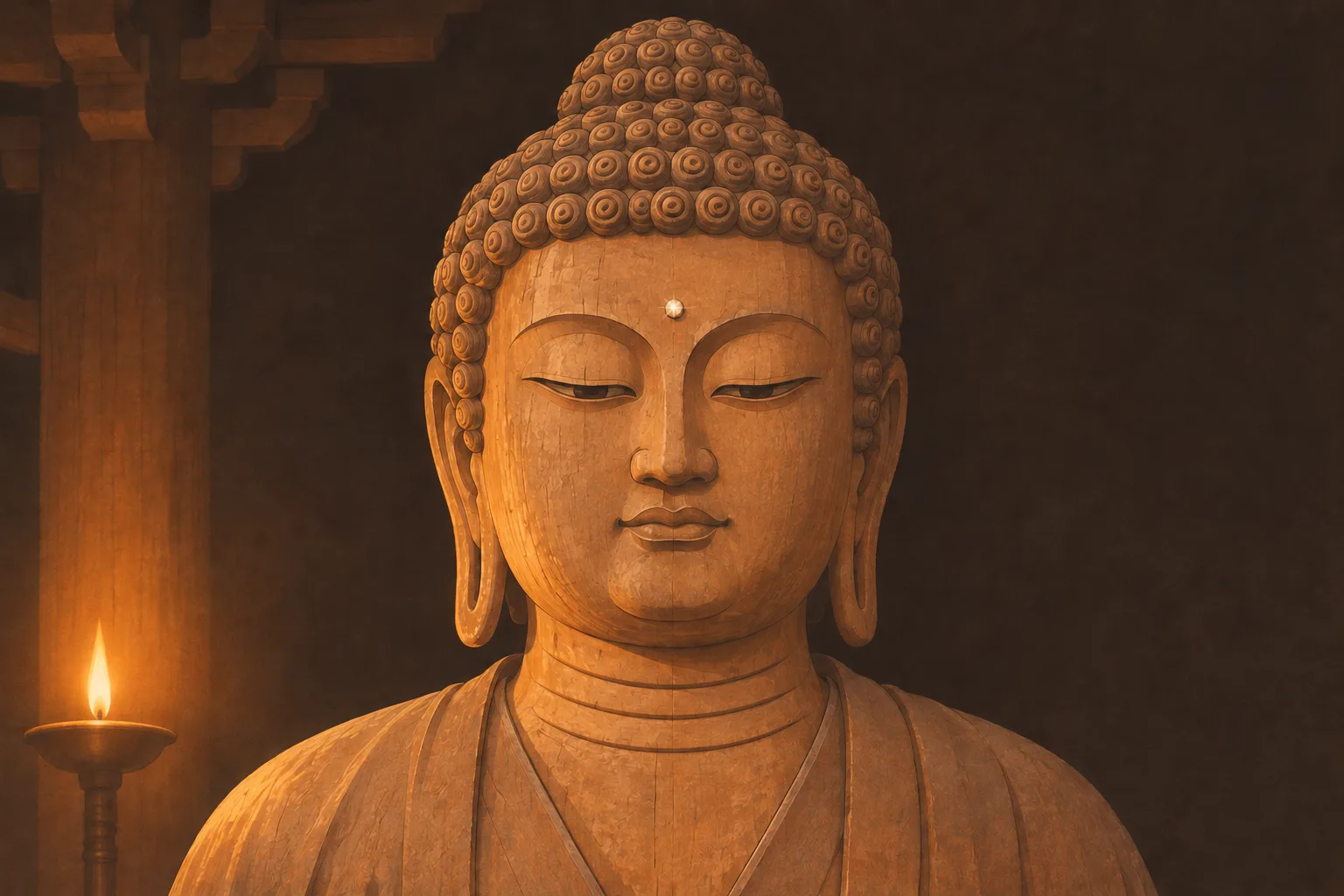
The head of a Buddha: the cranial bump, tight snail-shell curls, the dot between the eyebrows, long earlobes and three folds around the neck.
Then look at the body. A Buddha wears a single robe, draped over one or both shoulders, and no jewellery at all. That plainness is the giveaway.
Four Buddhas are common in Japan. Shakyamuni (Shaka) often sits with his right hand raised, palm out ("do not fear"), and his left hand open in his lap ("your wish is granted"). The bronze Shaka Triad in the Golden Hall of Hōryū-ji in Nara, dated 623 and attributed to the sculptor Tori, has the long face, almond eyes and faint smile of the Asuka period. At Seiryō-ji in western Kyoto is a standing Shaka that the monk Chōnen had carved in Song China in 985 and brought back in 986; its hair is coiled like rope rather than curled, and its robe ripples in tight parallel folds. It was believed to copy a portrait made in the Buddha’s lifetime, and copies of it spread across Japan. Shaka also appears as a baby, one hand pointing up and one down, bathed with sweet tea at the flower festival on 8 April, and lying on his side at his death, his nehan (parinirvana).
Amida, Buddha of the Western Pure Land, usually sits with his hands resting together in his lap, fingertips forming rings; standing to welcome the dying, he raises one hand and lowers the other. The gilded Amida at Byōdō-in in Uji, which the main article introduces, matters to sculpture because it set a standard: made by Jōchō in 1053 from joined blocks of wood, with a round face and shallow, graceful folds, it was copied for more than a century. The Great Buddha of Kamakura, about 11 metres tall and in the open air since its hall was lost, is also Amida, and at Jōruri-ji in southern Kyoto nine Amidas sit in a row, one for each grade of rebirth in paradise.
Yakushi, the Medicine Buddha, usually holds a small medicine jar in his left hand. But many early images, like the bronze Yakushi Triad at Yakushi-ji in Nara, have no jar, and you identify him by his attendants and the temple’s name. That triad is now glossy black; it was originally gilded, and the gold has worn and burned away.
Dainichi, the cosmic Buddha of Esoteric Buddhism, breaks the rule. He wears a crown and jewellery like a bodhisattva, because he is understood as the source of all Buddhas and appears as a universal sovereign. In his commonest form, his right fist grips the raised index finger of his left hand in front of the chest. The young, taut Dainichi at Enjō-ji in Nara, finished around 1176, is one of the earliest works of the sculptor Unkei.
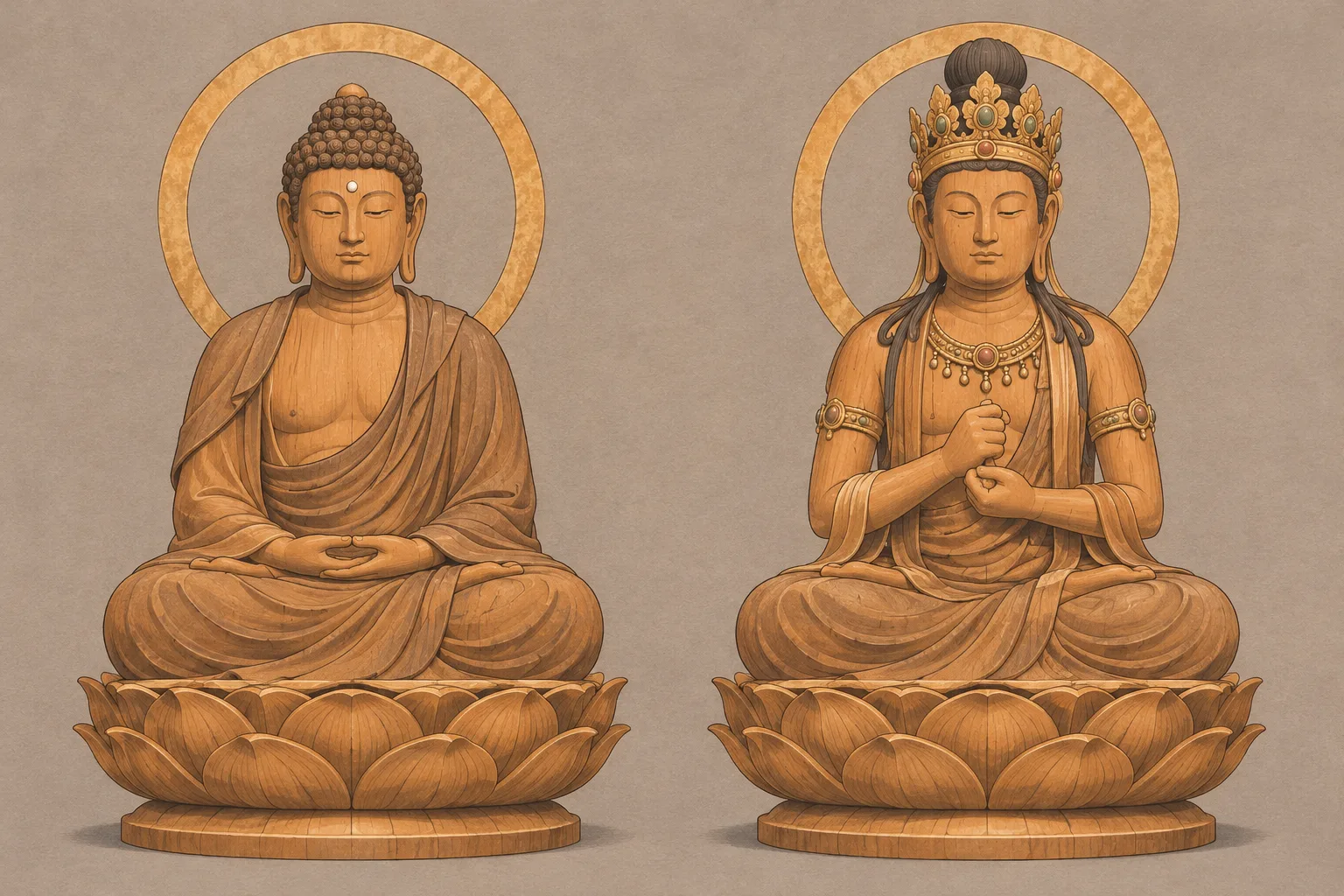
Two Buddhas side by side: Shaka on the left with curls and a plain robe, Dainichi on the right with crown, jewellery and piled-up hair, his right fist gripping the left index finger.
The Great Buddha of Tōdai-ji in Nara, dedicated in 752, is Birushana (Vairocana), closely related to Dainichi in doctrine. It wears the plain Buddha robe and curls, not the crown.
Behind a Buddha you will usually see a round or boat-shaped halo; beneath, a lotus pedestal of layered petals.
03Bosatsu: Dressed Like a Prince
The model for the bodhisattva is Prince Siddhartha before he left the palace, so bodhisattvas dress as Indian nobility. Hair is piled into a tall topknot and often crowned. Necklaces hang across the chest; bracelets circle the wrists and upper arms. A long sash crosses the torso, and a floating scarf, the ten’e, loops over the shoulders and down the arms. Below is a wrapped skirt. Faces are gentle, and the body often sways slightly onto one hip.
Kannon, the most widespread bodhisattva in Japan, usually has a tiny figure of Amida in the front of the crown, the quickest way to spot her; her many forms have their own article. Jizō is the exception: shaven-headed, dressed as a monk, holding a staff with jingling rings and a jewel, because he walks among the living and the dead in the age between Buddhas. He too has his own article.
Miroku (Maitreya) is the Buddha of the future, said to be waiting in a heaven for some 5.67 billion years before descending. Japan’s most famous image of him is at Kōryū-ji in Uzumasa, Kyoto: a slender figure carved from red pine, seated with the right foot on the left knee, the fingertips of the right hand just touching the cheek. The pose is called hanka shiyui, "half-lotus, in thought". The gilding has gone, leaving bare wood. It is usually dated to the 7th century. Japanese carvers of the time normally used camphor wood, and because red pine is the wood of the Korean peninsula, some believe the statue came from the kingdom of Silla, others that immigrant craftsmen carved it in Japan from the wood they knew; the question is open. When the first National Treasures were designated under the new Cultural Properties Protection Law in June 1951, it was among them. At Chūgū-ji in Nara a camphor-wood figure, now almost black, sits in the same pose; temple tradition calls it Nyoirin Kannon, while many scholars think it was originally Miroku, since a similar statue at Yachū-ji in Osaka Prefecture is inscribed as Miroku.
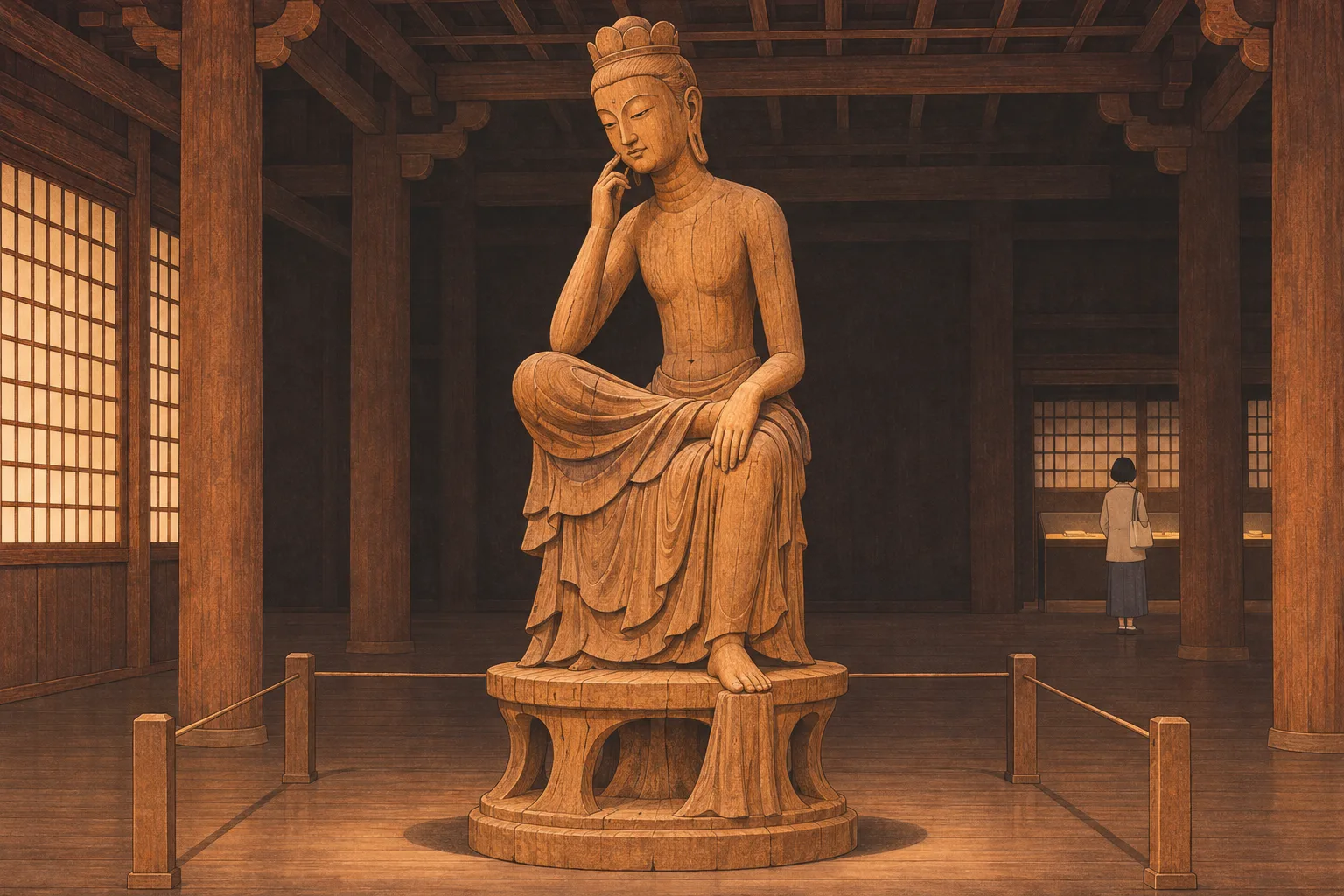
The Miroku of Kōryū-ji in Kyoto: right foot on the left knee, fingertips of the right hand just touching the cheek, the pose called hanka shiyui.
Monju (Mañjuśrī) is the bodhisattva of wisdom: a sword in the right hand to cut through confusion, a sutra scroll or lotus in the left, riding a lion. The Japanese proverb "three people together have the wisdom of Monju" is the local version of "two heads are better than one". At Abe Monju-in in Nara, a giant Monju on his lion, made by the sculptor Kaikei in the early 13th century, is accompanied by four attendants in a scene of the bodhisattva crossing the sea.
Fugen (Samantabhadra) stands for practice and rides a white elephant with six tusks. The Lotus Sutra promises his protection to those who recite it, and it also says women can attain Buddhahood, which made Fugen especially popular with Heian court women. The late Heian Fugen on his elephant at the Okura Museum in Tokyo has the soft, rounded look of a court lady.
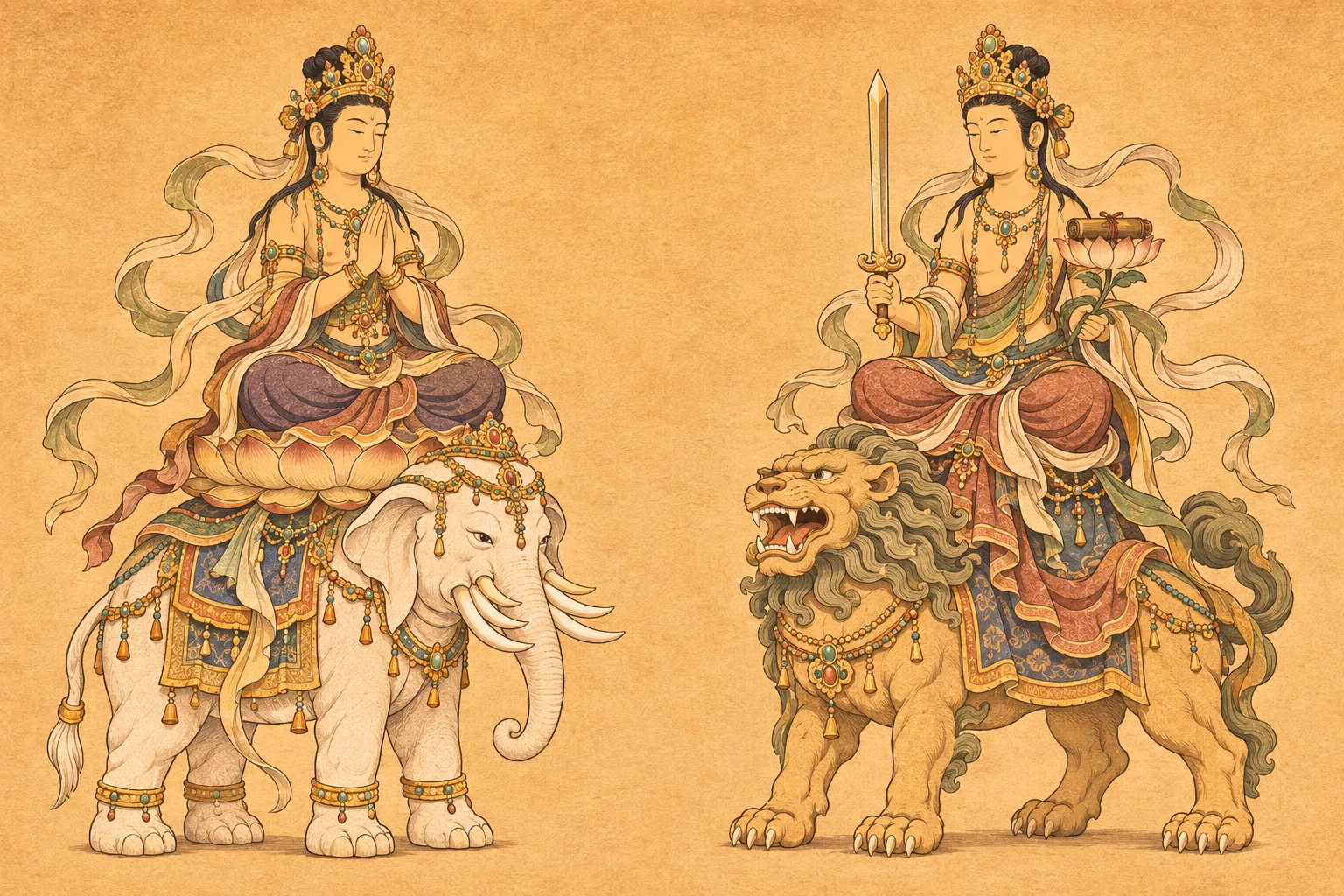
Fugen on a white elephant with six tusks, left, and Monju on a lion, right, with a sword in his right hand and a sutra resting on the lotus in his left.
Kokūzō (Ākāśagarbha), whose name means "storehouse of space", embodies boundless wisdom and is linked with memory. The young Kūkai is said to have chanted his mantra a million times to gain perfect recall. At Hōrin-ji in Arashiyama, Kyoto, children of thirteen come to pray for wisdom; tradition says they must not look back while crossing the Togetsukyō bridge afterwards, or the wisdom will slip away.
Seishi (Mahāsthāmaprāpta) appears with Kannon beside Amida. Instead of a little Buddha, Seishi’s crown has a water jar, and standing figures usually press the palms together, while Kannon holds a small lotus pedestal for carrying souls to paradise.
04Myōō: Glaring Eyes and a Wall of Fire
Wisdom Kings are the most dramatic figures in Buddhist art: bulging eyes, bared fangs, hair standing up like flame, a blazing halo, weapons in every hand. Their anger, in Esoteric thought, is directed at delusion, not at the viewer.
They arrived with Esoteric Buddhism in the early 9th century, when Kūkai returned from China in 806 and founded the Shingon school, and Tendai monks brought similar teachings. So you rarely see them in the oldest Nara temples, and often in Shingon and Tendai temples and anywhere fire rituals, goma, are performed.
Fudō Myōō, "the Immovable", leads them and is by far the most loved. His body is blue-black. He holds a sword in the right hand, sometimes with a dragon wound around it, and a rope in the left to bind those who resist. A single braid hangs over his left shoulder. Later images give him mismatched eyes, one looking up and one down, and two fangs, one pointing up and one down. He sits or stands on a block of rock rather than a lotus, and the flames behind him are often shaped like the mythical Garuda bird. Two boy attendants may flank him, one with palms joined, one holding a club. People call him O-Fudō-san. At Naritasan Shinshō-ji in Chiba, the goma fire is lit for him daily to the pounding of drums.
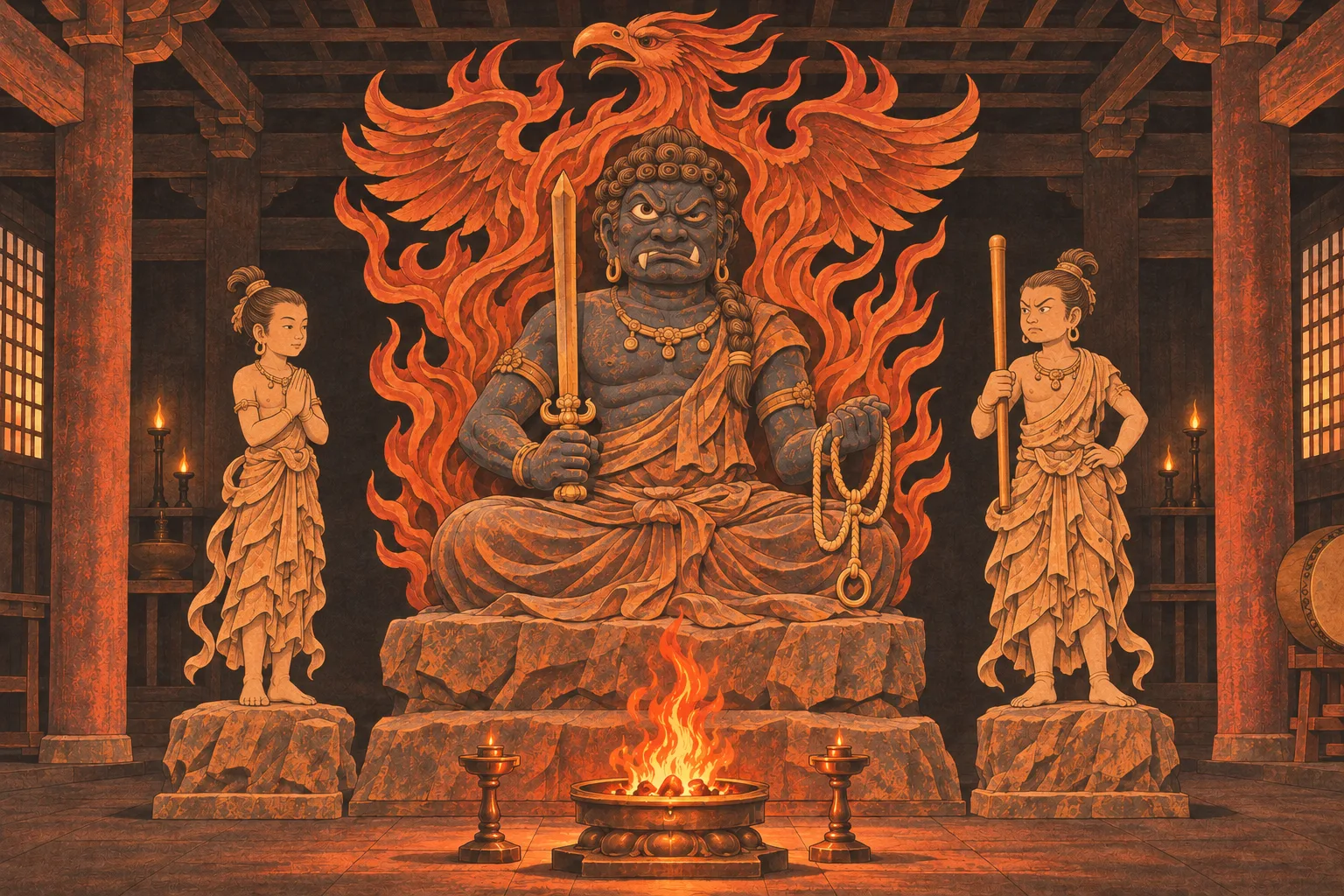
Fudō Myōō: blue-black body, sword in the right hand, rope in the left, a braid over the left shoulder, a seat of rock and a wall of flame. Two boy attendants flank him, and the goma fire burns in front.
Aizen Myōō is red all over, with three eyes, six arms and a lion in his headdress. Two hands draw a bow, the arrow aimed upward. He sits on a lotus above a treasure vase. His name means "stained by love": the idea is that desire can be turned into the drive for awakening rather than suppressed. Over time he became associated with love and marriage, and in the Edo period dyers adopted him because aizen sounds like aizome, indigo dyeing. The still vivid red Aizen at Saidai-ji in Nara was made by the sculptor Zen’en in 1247.
Gōzanze Myōō has four faces and eight arms, and under his feet lie a god and a goddess: Shiva and his consort, known in Japanese as Daijizaiten and Uma. The story says Shiva claimed to rule the three worlds and refused to submit, so Gōzanze trampled him.
Kujaku Myōō, the Peacock Wisdom King, is the exception. He is calm, dressed like a bodhisattva, and rides a peacock with spread tail. Because peacocks eat snakes, he became a protector against poison, disease and disaster, and his spells were used to bring rain. The mountain ascetic En no Gyōja is said to have mastered them. Kaikei’s Kujaku Myōō of about 1200 is kept at Kongōbu-ji on Mount Kōya.
The Five Great Wisdom Kings are a set arranged by direction: Fudō in the centre, Gōzanze in the east, Gundari in the south (snakes coiled around his body), Daiitoku in the west (six faces, six arms, six legs, riding a water buffalo), and Kongō Yasha in the north. Tendai temples sometimes substitute Ususama, who burns away impurity and later became a guardian of toilets. The set dedicated in 839 in the Lecture Hall of Tō-ji in Kyoto is the classic example.
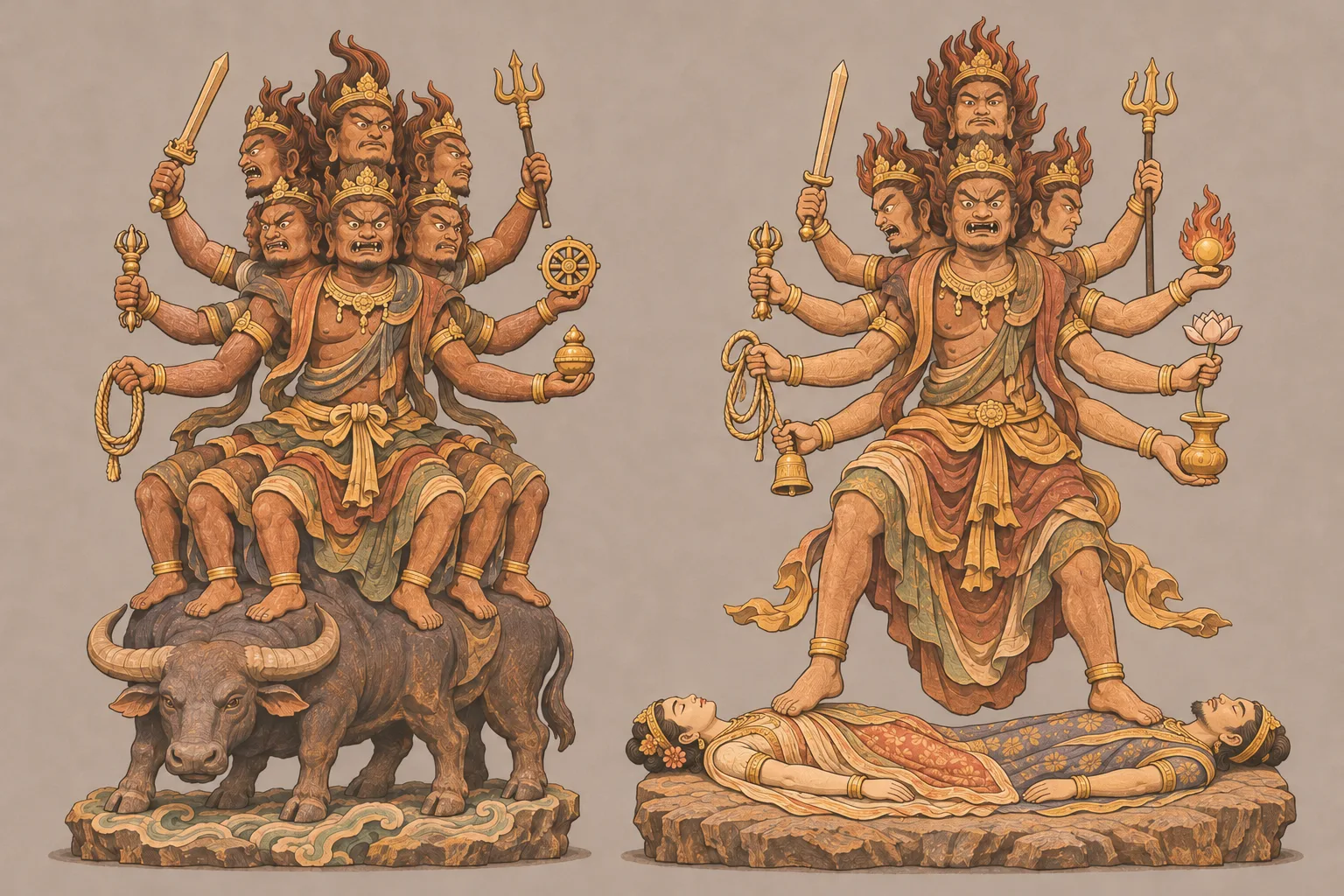
Left: Daiitoku, with many faces, arms and legs, astride a water buffalo. Right: Gōzanze, trampling a god and a goddess underfoot.
05Tenbu: The Gods Who Joined Buddhism
Devas are the largest and most varied group. They began as Indian gods and travelled through Central Asia and China, changing clothes on the way. Male devas usually wear Tang Chinese armour or official robes; female devas wear the high hair and wide sleeves of Tang court ladies. The rule of thumb: devas look like people from a real court.
Bonten (Brahmā) and Taishakuten (Indra) often appear as a pair flanking a Buddha. At Tōdai-ji’s Hokke-dō, giant dry-lacquer figures of the two from the Nara period wear Chinese robes, with the breastplate of a suit of armour showing under Bonten’s. In the Esoteric version at Tō-ji, Bonten has four faces and sits on four geese, while Taishakuten wears armour and rides a white elephant, one leg dangling; his handsome face has made him something of an online celebrity in Japan.
The Four Heavenly Kings (Shitennō), armoured guardians of the four directions who trample demons at the corners of the altar, and the Niō, the half-naked gate guardians with one mouth open and one shut, are covered in a separate deep-dive. The northern king, Tamonten, is called Bishamonten when worshipped alone, as at Kurama-dera north of Kyoto; his Lucky God role is covered elsewhere.
Kichijōten (Lakshmi), goddess of fortune and beauty, is portrayed as a Tang court lady with a jewel in her hand. A Nara-period painting of her on hemp at Yakushi-ji, with round cheeks, tiny mouth and a blush of red, is one of the oldest coloured Buddhist paintings in Japan. A Kamakura-period statue of her at Jōruri-ji, kept in a cabinet shrine, still has much of its bright paint.
Benzaiten began as Sarasvatī, an Indian river goddess of music and eloquence, which is why she often holds a lute (biwa). An older form has eight arms with weapons. Her island shrines and her Lucky God role are covered in the Seven Lucky Gods article. For statue-spotters, the form to know is the medieval one: she merged with the Japanese grain deity Ugajin, who appears in her crown as a white snake with an old man’s face.
Ashura began as a warrior demon at war with the gods and became one of the eight protector beings. The Ashura at Kōfuku-ji in Nara, made in 734, has three faces and six slender arms, no armour, and the frowning face of a teenage boy. It is made by the dry-lacquer method: layers of lacquer-soaked hemp cloth over a clay core that is later removed, leaving a light, hollow shell. When it was shown at the Tokyo and Kyushu National Museums in 2009, more than 1.65 million people came, and the show is widely credited with starting Japan’s "Buddha statue boom".
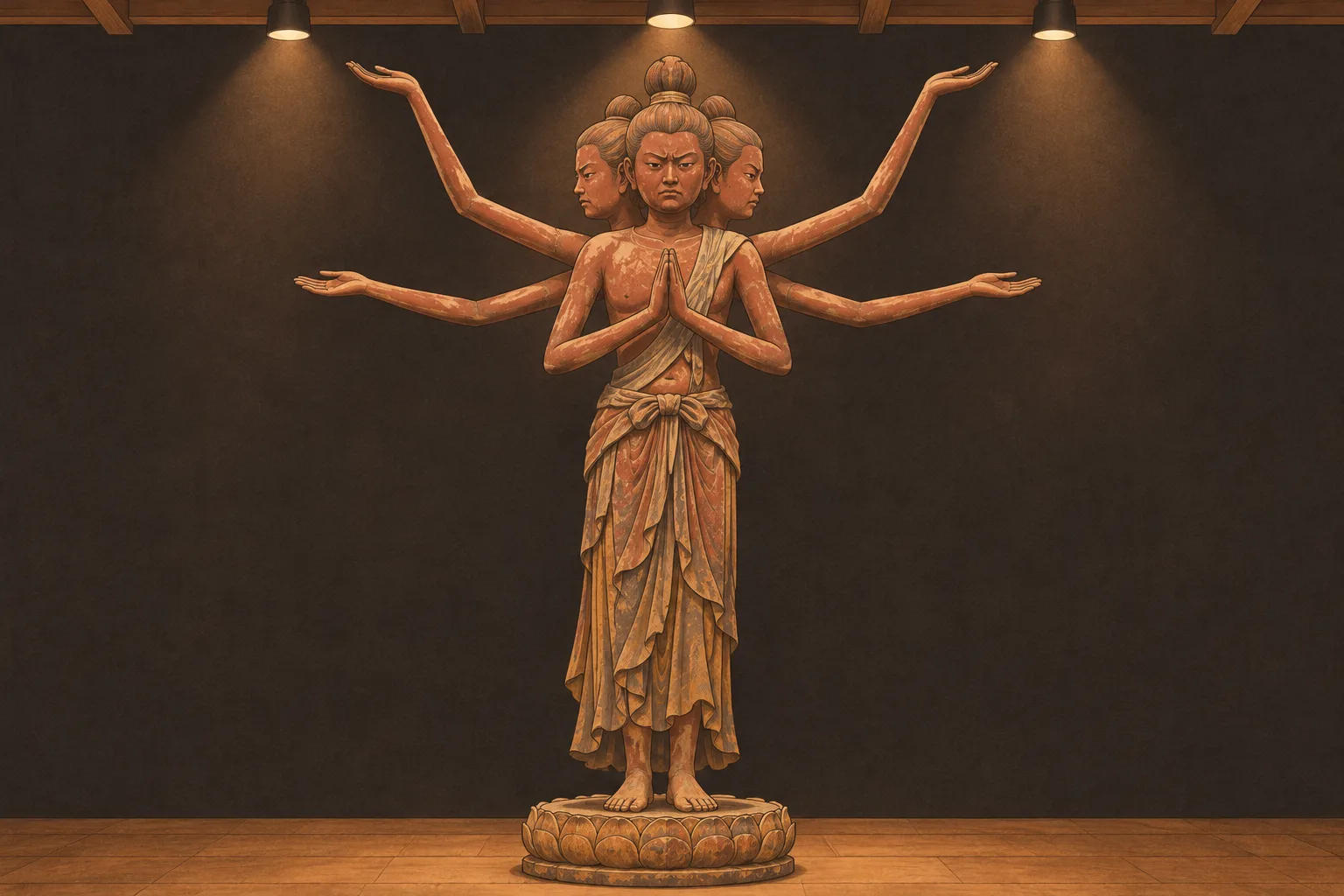
The Ashura of Kōfuku-ji in Nara: three faces, six slender arms, no armour, and the frowning face of a teenage boy.
The Twelve Heavenly Generals (Jūni Shinshō) guard Yakushi, each said to command seven thousand spirits. They stand around him in armour, hair flaring, each in a different fierce pose, like a bodyguard ringing a king. At Shin-Yakushi-ji in Nara, the Nara-period clay generals (one is a 20th-century replacement), roughly life-size, have faded from bright paint to the colour of earth; the roaring general Basara has been on Japan’s 500-yen ordinary stamp since 2012. Later they were matched to the twelve zodiac animals, each wearing one on top of his head, as at Kōfuku-ji’s Eastern Golden Hall, so visitors can look for the general of their birth year.
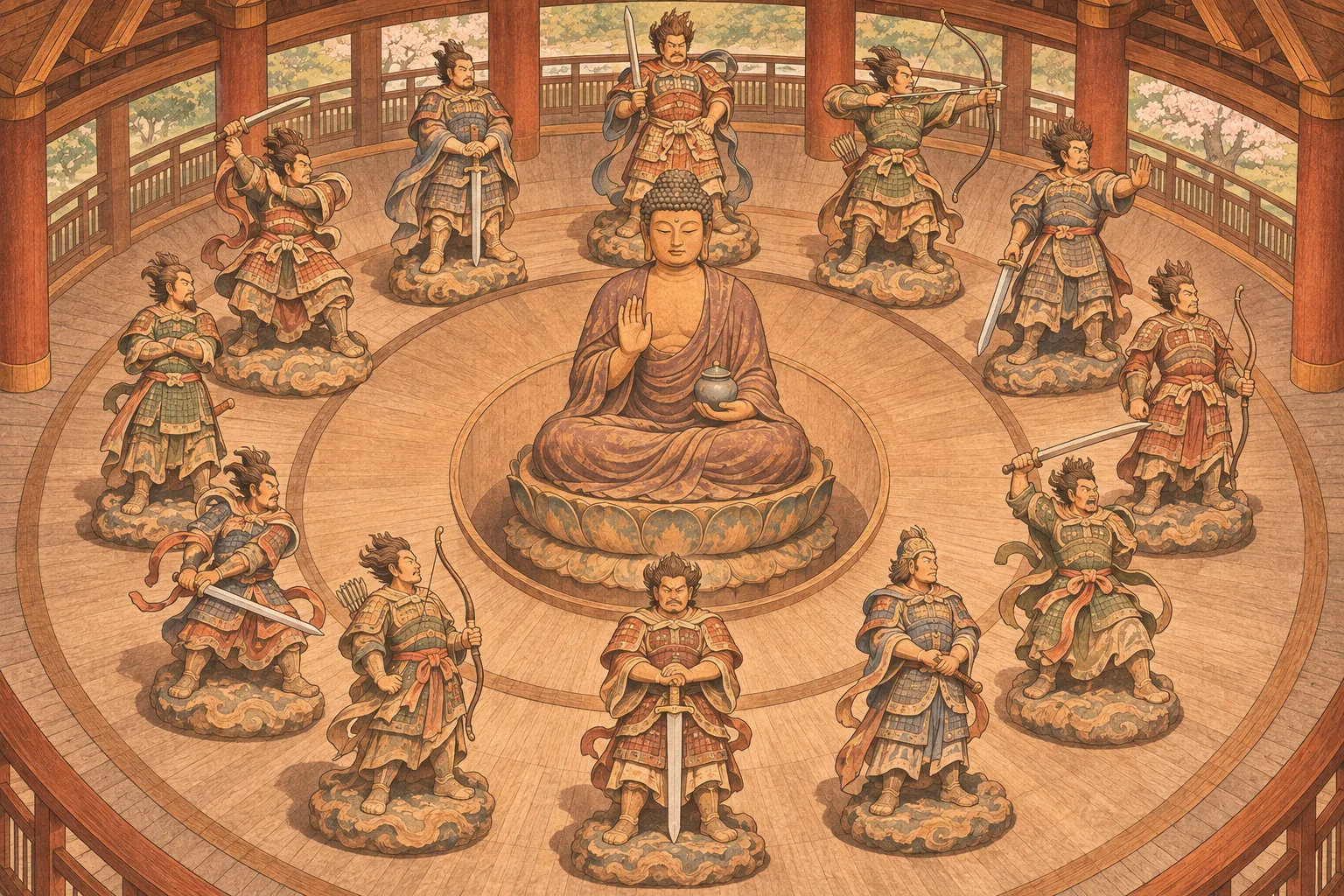
The Twelve Heavenly Generals ring Yakushi, all in armour, each in a different pose. Yakushi, in the centre, holds a medicine jar in his left hand.
Other familiar devas include Daikokuten, originally a fierce form of Shiva, who in Esoteric mandalas has three faces and six arms, a world away from his smiling Lucky God self; Kishimojin, a child-eating demoness who converted and became a protector of children; the swift temple guardian Idaten; and Dakiniten, riding a white fox, worshipped as an Inari deity at Toyokawa.
06Outside the Four Ranks: Arhats, Founders and Kami
Some statues fit none of the ranks. Rakan (arhats) are monks who have ended their own cycle of rebirth. They have shaven heads and lively, often comic faces, with long eyebrows and big noses; one scratches his ear, another hugs his knees. They come in sets of sixteen, eighteen or five hundred. The Edo-period stone rakan at Kita-in in Kawagoe are said to include one face resembling any lost loved one, if you look long enough. At Otagi Nenbutsu-ji in Kyoto, 1,200 small stone rakan were carved by ordinary visitors in the late 20th century; one holds a camera, another a sake cup.
Portraits of founders and great monks are realistic, wear monks’ robes and lack the curls and forehead dot of a Buddha. The dry-lacquer portrait of Ganjin at Tōshōdai-ji, made around his death in 763, shows him with eyes closed, consistent with the blindness he suffered on his voyages to Japan. The Kamakura-period Kūya at Rokuharamitsu-ji in Kyoto, with six tiny Amidas emerging from his mouth, is another of these lifelike portraits; it is described in the Pure Land article. Shingon temples have Kūkai seated with a ritual implement and prayer beads; Zen temples have Daruma and lifelike portraits of their abbots.
Then there are statues of kami. Under the belief that Japan’s gods were local appearances of Buddhas, kami were sometimes sculpted too. Kaikei’s Hachiman of 1201 at Tōdai-ji portrays the god as an elderly monk with a staff. Zaō Gongen at Kinpusen-ji in Yoshino, the main deity of the mountain ascetics, is blue, furious, one foot kicking the air, and looks like a Wisdom King, but he is a Japanese creation said to have appeared to En no Gyōja. After the government ordered the separation of kami and Buddhas in 1868, many such images were removed or destroyed.
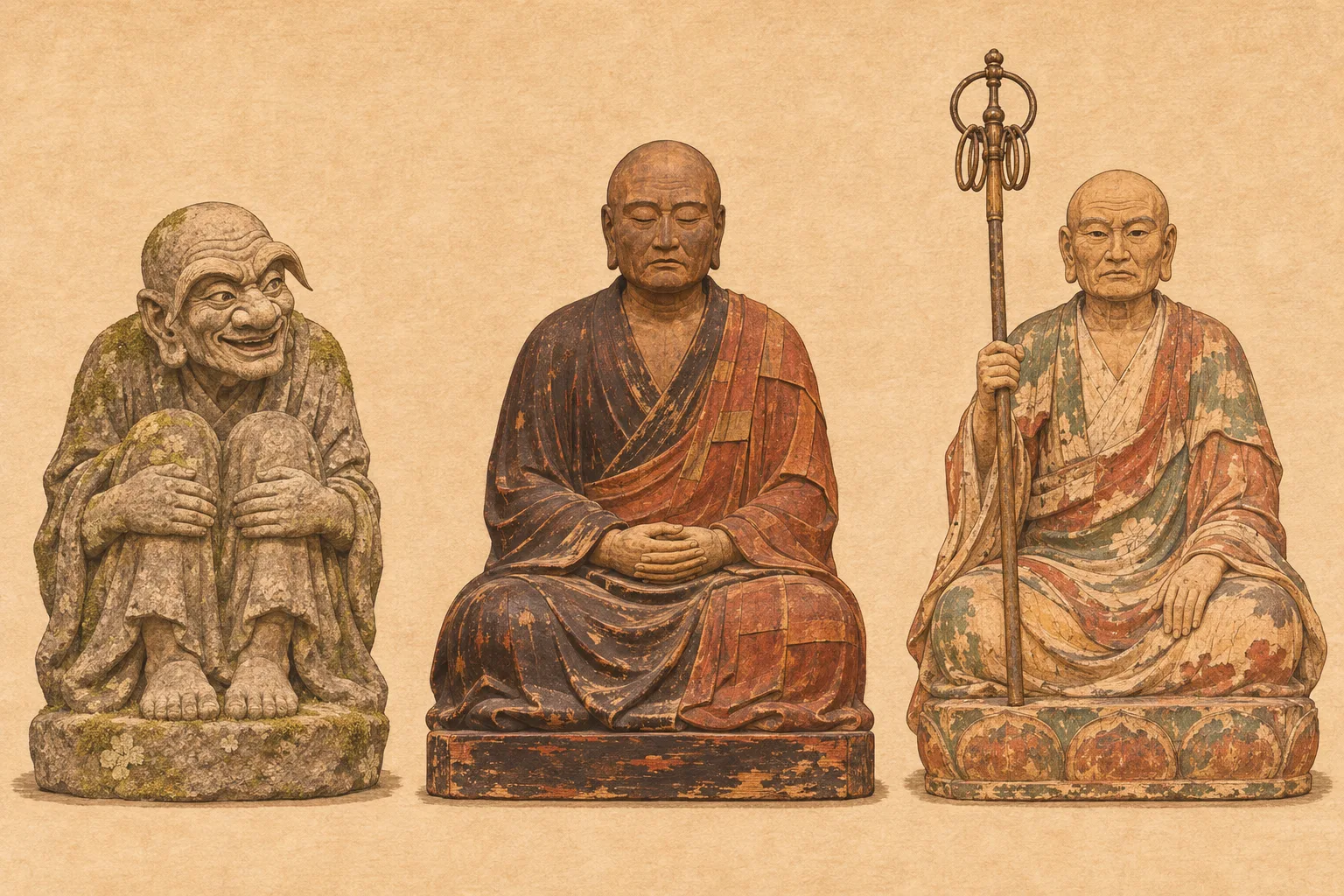
Three statues outside the four ranks, left to right: a stone rakan hugging his knees; the portrait of Ganjin with eyes closed; and the god Hachiman portrayed as an elderly monk with a staff.
07Who Stands Where in a Triad
The commonest grouping is a triad: a Buddha in the centre with two attendants. Identify the attendants and you know the Buddha, which helps when the central figure’s hands are ambiguous. Left and right below are from the viewer’s position. This is the usual arrangement from the Nara period on; Asuka-period images do not always follow it. Japanese labels that say "right attendant" or "left attendant" often mean the statue’s own right and left, the reverse of yours.
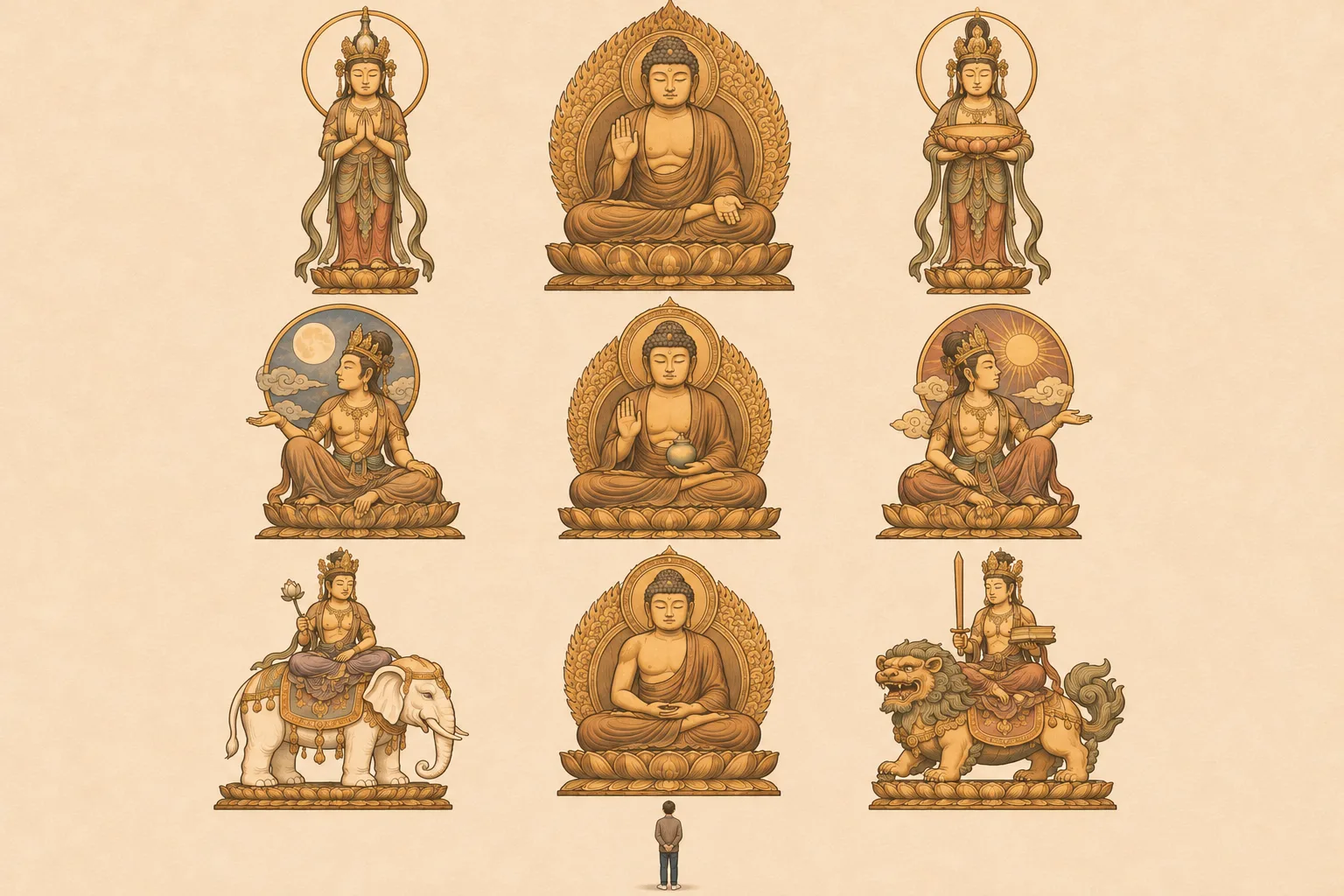
Three triads as the visitor at the bottom sees them. Top: Amida, with Kannon on the right (lotus pedestal) and Seishi on the left (palms together). Middle: Yakushi, with Nikkō on the right and Gakkō on the left. Bottom: Shaka, with Monju on the right (lion) and Fugen on the left (elephant).
The Amida Triad has Kannon on the right, holding a lotus pedestal, crown with a tiny Buddha, and Seishi on the left, palms together, crown with a water jar. At Sanzen-in in Ōhara, Kyoto, the two attendants kneel and lean forward, as if about to rise and fly down to meet the dying.
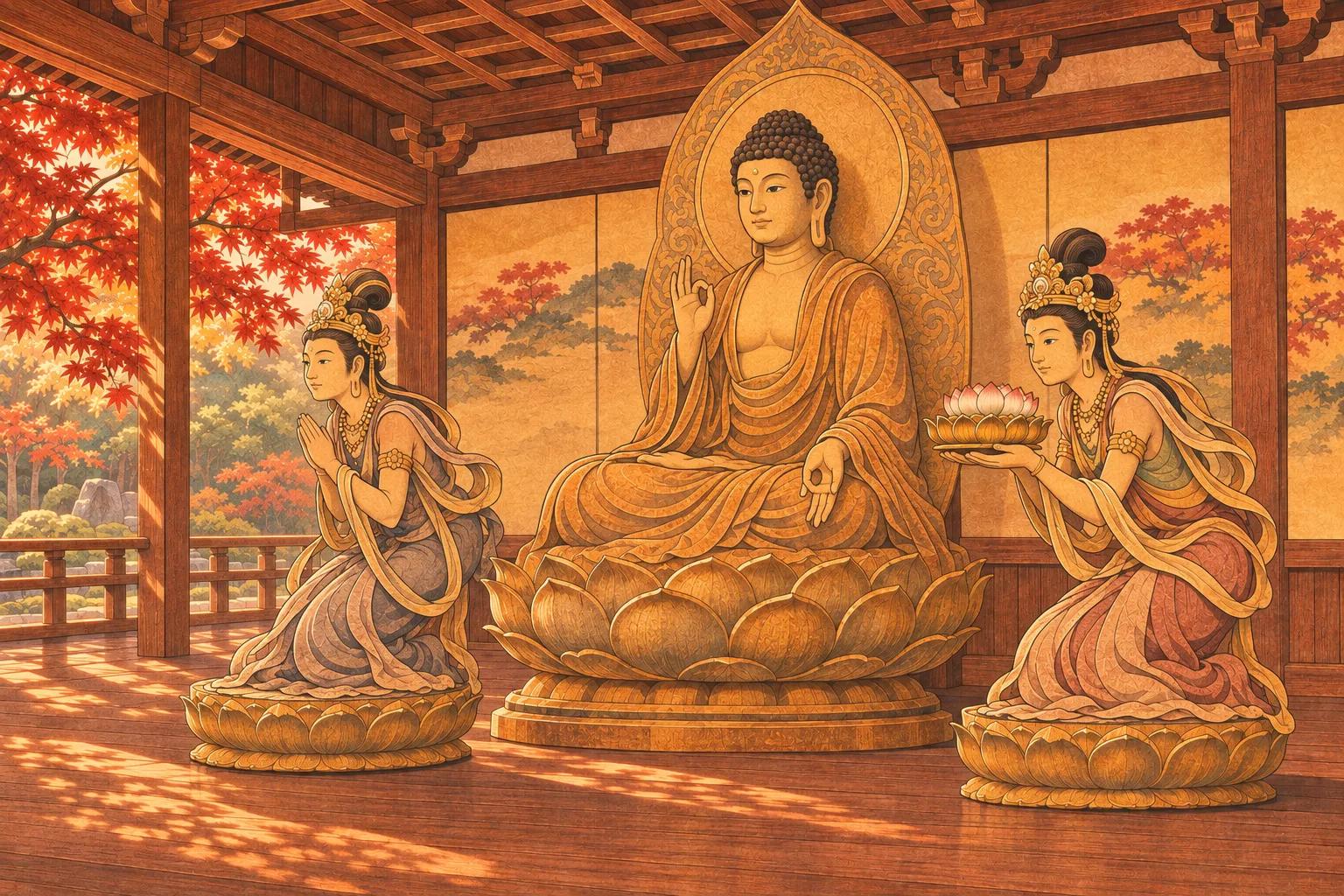
The Amida Triad at Sanzen-in in Ōhara, Kyoto. The two attendants kneel and lean forward as if about to rise: Kannon holds the lotus pedestal, Seishi joins his palms.
The Yakushi Triad has Nikkō (Sunlight) on the right and Gakkō (Moonlight) on the left. At Yakushi-ji, the two bronze attendants, each about three metres tall, sway outward from the hip in a gentle curve. The Twelve Generals often surround the whole group.
The Shaka Triad varies the most. The usual pair is Monju on his lion and Fugen on his elephant, wisdom and practice, with Monju on the right. Other versions use the medicine bodhisattvas Yakuō and Yakujō, or Bonten and Taishakuten; Zen temples often place two disciples, the old Kashō and the young Anan, both in monks’ robes. The two attendants of the Hōryū-ji Shaka Triad are unnamed in any early record and are usually called Yakuō and Yakujō.
For all four ranks in one room, visit the Lecture Hall at Tō-ji, where 21 statues dedicated in 839 form a three-dimensional mandala: five Buddhas in the centre, five bodhisattvas on one side, the Five Wisdom Kings on the other, Bonten and Taishakuten at the ends and the Four Heavenly Kings at the corners. It is the ranking system laid out in wood.
08Side by Side: Reading the Head and the Clothes
Put one of each side by side, say a Shaka, a Kannon, a Fudō and a Tamonten, and the system becomes obvious.
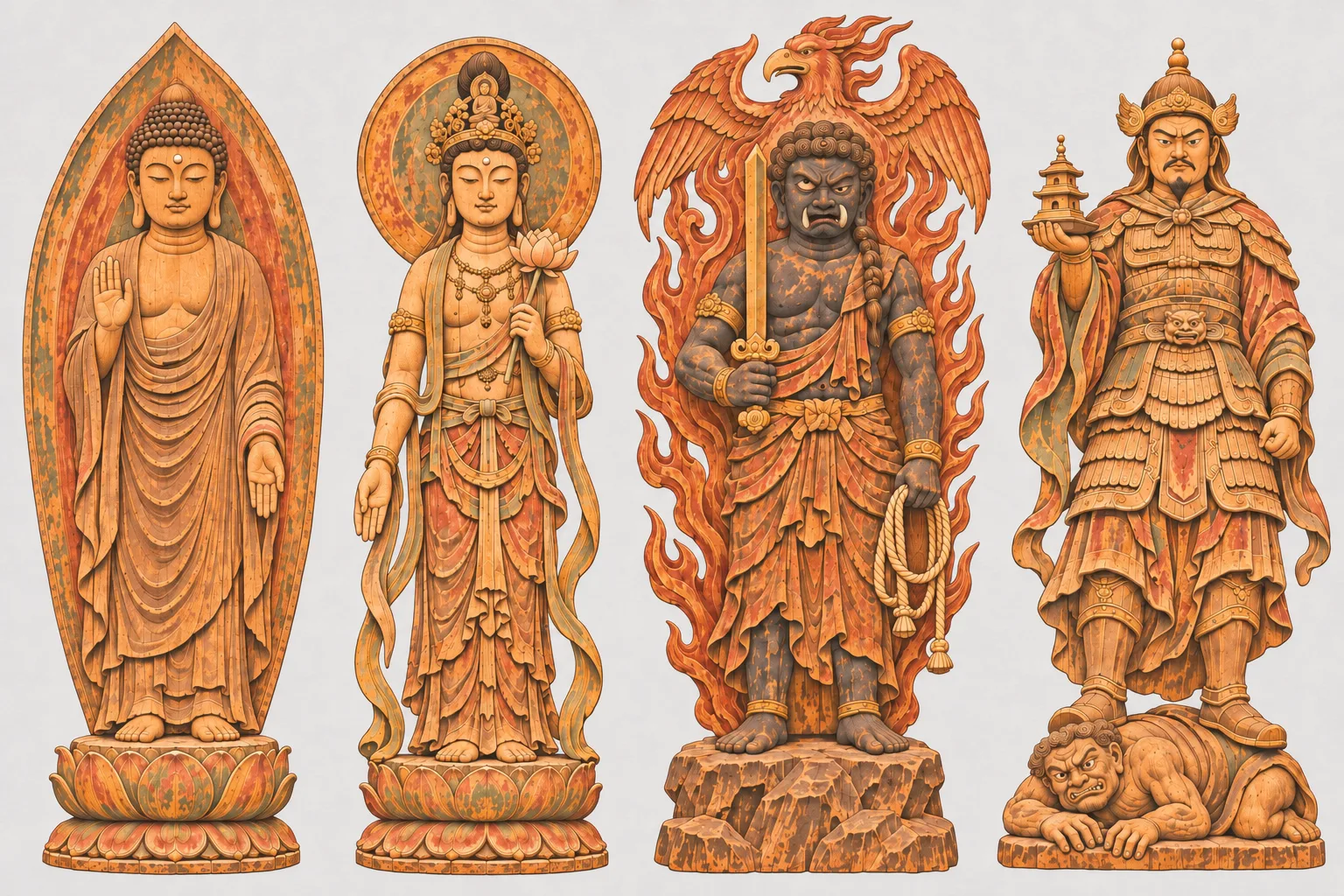
One figure from each rank, left to right: a nyorai (Shaka, plain robe and curls), a bosatsu (Kannon, crown, jewellery and lotus), a myōō (Fudō, sword, rope and flames) and a deva (Tamonten, armour, a small pagoda in his hand, a demon underfoot).
The head: the Buddha has curls and a cranial bump, nothing on top. The bodhisattva has a tall topknot and a crown. The Wisdom King has flaming, upswept hair or a braid. The deva wears a helmet, court cap or, for goddesses, piled-up hair.
The face: Buddha and bodhisattva are calm, eyes half closed and lowered. The Wisdom King glares, sometimes with a third eye. Deva generals scowl like real soldiers; goddesses and Bonten are serene.
The clothes: the Buddha wears only a robe. The bodhisattva wears jewellery, a sash and floating scarves. The Wisdom King is often half-naked and muscular, in a short skirt. The deva wears the clothes of a real court: armour, robes, wide sleeves.
Feet and back: Buddhas and bodhisattvas stand or sit on lotuses with round or boat-shaped halos. Wisdom Kings sit on rock with flames behind. Devas stand on demons, rocks or animals.
Remember the exceptions: Dainichi wears a crown, Jizō dresses as a monk, Kujaku Myōō is calm and princely, and Ashura is an unarmoured boy. For them, and for telling members of the same rank apart, look at the hand gestures and objects, a subject with its own deep-dive.
One more clue helps with age rather than rank. From the late Heian period, sculptors began fitting statues with gyokugan, eyes of rock crystal set from inside the hollow head and painted from behind. If a figure’s eyes glint back at you in the lamplight, as Unkei’s do, it very likely dates from the mid-12th century or later; the oldest known example is usually said to be an Amida triad at Chōgaku-ji in Nara. Older figures have carved, painted eyes.
In a hall, work from the centre outward: find the largest central figure and check for curls and a plain robe; look at the attendants to confirm the triad; look for flames in the side chapels; finish with the armoured figures at the corners and doors. By the end you will have the temple’s whole cast list.
More deep dives on this topic
 Four Ranks of Buddhist StatuesStep out of the sunlight into a Japanese temple hall and your eyes take a moment to adjust.
 Mudras and AttributesIn the half-light of a Japanese temple hall, the face of a Buddha is often hard to make out.
 Niō and the Four Heavenly KingsWalk up to almost any large Buddhist temple in Japan and the first figures you meet are not serene Buddhas but two furious, nearly naked giants flanking the gate.
 PagodasWalk up the stone lanes of Higashiyama in Kyoto and the Yasaka Pagoda rises over the tiled roofs of the old townhouses; ride the bullet train into Kyoto Station and the dark…
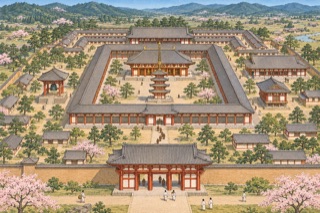 The GaranMost visitors to a Japanese temple experience it as a sequence: a gate, a path, a big hall, perhaps a pagoda off to one side.
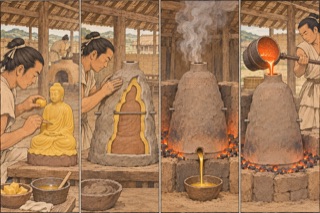 How Buddhist Statues Are MadeWalk through the temples of Nara and Kyoto and you will meet Buddhas that are gold, black, chalky grey, or the warm brown of old wood.
 Reading Temple NamesMost visitors to Tokyo know Sensō-ji, the great Kannon temple in Asakusa.
 Shōjin RyōriThe first thing many visitors eat at a temple lodging on Mount Kōya is a small, pale square that wobbles on a lacquer dish.
 A Night in a TempleMost temples in Japan close their gates at dusk.
- Back to the main article: Japanese Buddhism →