
Walk up to almost any large Buddhist temple in Japan and the first figures you meet are not serene Buddhas but two furious, nearly naked giants flanking the gate. Go inside the main hall and you may find four more warriors standing at the corners of the altar, dressed in armour, gripping swords and halberds, each one planting a foot on a squirming little demon. The giants are the Niō, the "Benevolent Kings"; the armoured four are the Shitennō, the Four Heavenly Kings. They are the most physically dramatic sculptures in Japanese religious art, all muscle, scowl and swirling scarf, and they are also among the most confused. This guide takes you from the gate to the altar and explains who these guardians are, how to tell them apart, why they look the way they do, and who else belongs to the same extended family of Buddhist bodyguards.
01The Giants at the Gate
The main gate of a Japanese temple is the sanmon, the "mountain gate", a name inherited from the days when monasteries were built in the hills. At bigger temples it is a two-storey structure, and when it houses guardian figures it is often called a niōmon, a Niō gate. On either side of the central passage, behind a wooden lattice or a screen of wire mesh, stands a colossal figure. Together they are the Niō, more formally Kongō Rikishi, "vajra-wielding strongmen".
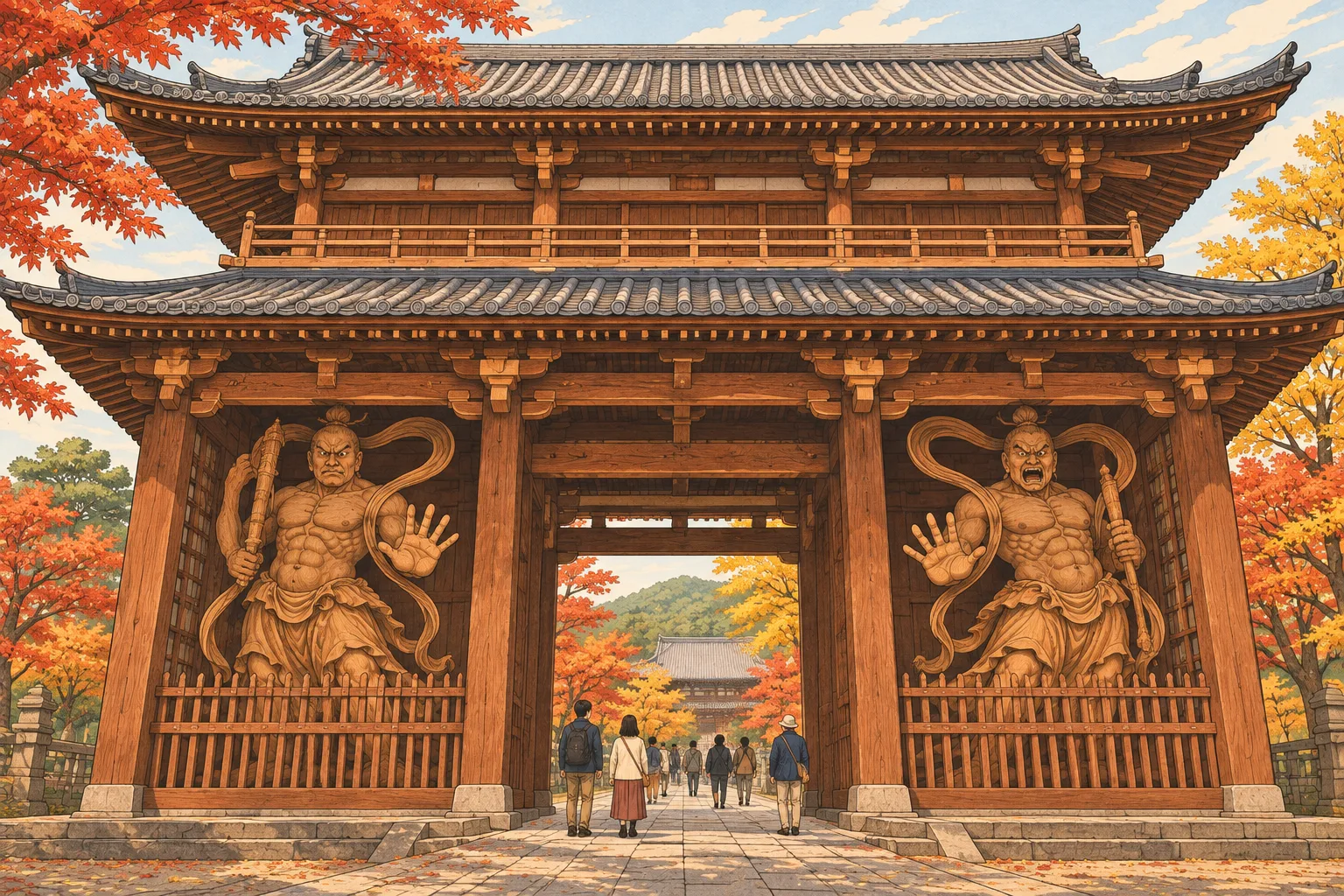
A two-storey temple gate with a Niō behind the wooden bars on each side. Seen from outside, the open-mouthed agyō is on the right and the closed-mouthed ungyō on the left.
They are built to intimidate. Each wears little more than a wrapped skirt that flares out as if caught in a gale, with a long scarf looping over the shoulders and arms. The chest, belly and arms are carved with exaggerated slabs of muscle; veins stand out on the neck and forearms like cords. The hair is tied up in a topknot, the eyebrows knot together, the eyes bulge. The body twists at the waist, one arm raised or thrust outwards, the other clenched into a fist or gripping a short, double-ended weapon.
That weapon is the vajra, kongōsho in Japanese: originally an Indian thunderbolt-club, later a ritual implement in esoteric Buddhism, with a single spike or three or five curving prongs at each end. "Kongō" means adamantine, unbreakable, and the Niō are, quite literally, the strongmen who carry the unbreakable weapon. On many older statues the vajra has long since been lost, and the figure clenches an empty fist around nothing.
The quickest way to tell the pair apart is to look at their mouths. One roars with jaws wide open; this is the agyō, the "a-form". The other has his lips pressed together in a grim line; this is the ungyō, the "un-form". Together they sound the first and last syllables of the Sanskrit alphabet, the same open-and-closed idea you see on the lion-dogs at Shintō shrines.
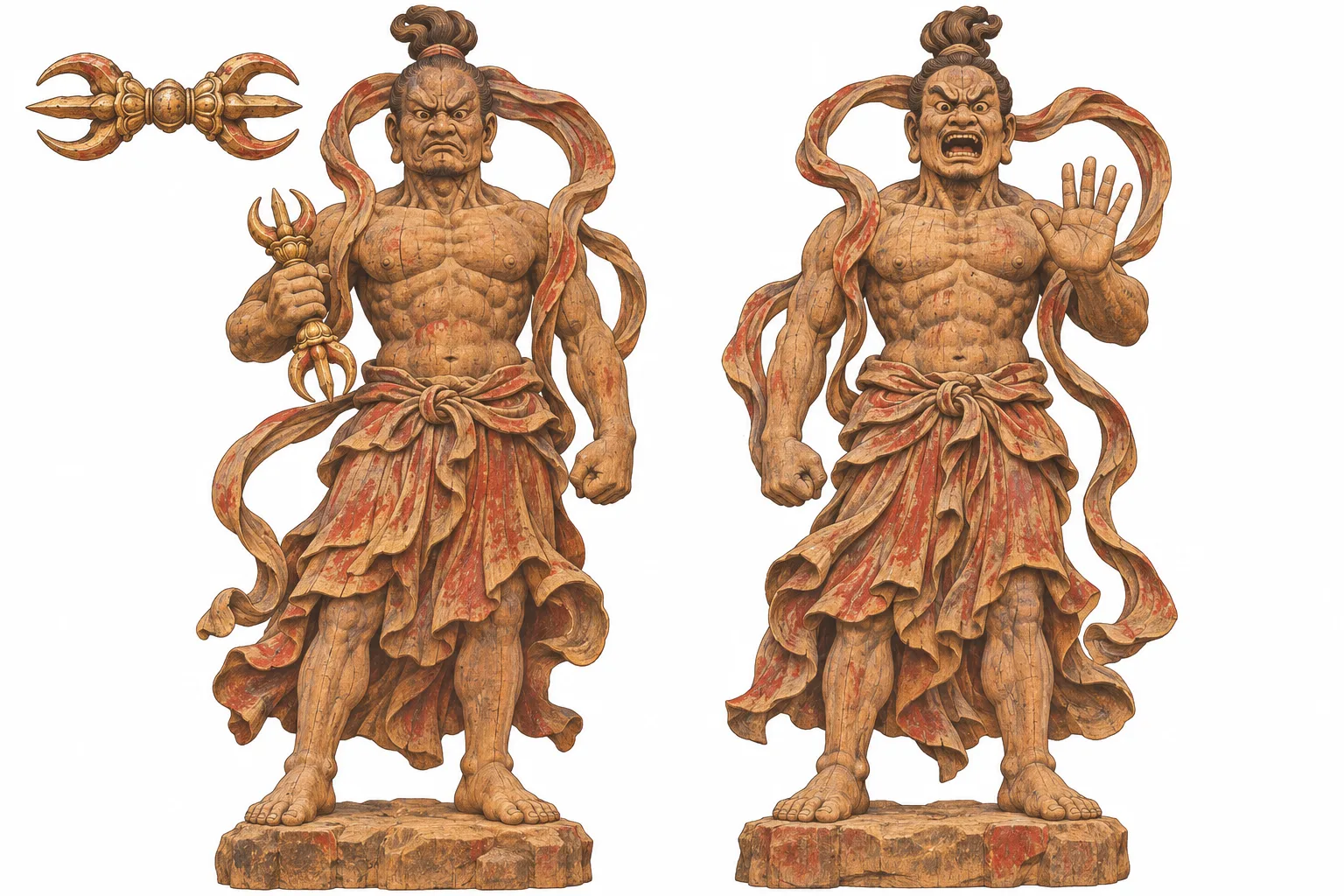
A pair of Niō: the ungyō with lips pressed shut on the left, the roaring agyō on the right. The short weapon in the ungyō’s hand is a vajra, shown enlarged at top left.
The usual arrangement, seen from outside the gate, puts the open-mouthed agyō on your right and the closed-mouthed ungyō on your left. It is a convention, not a law, and the most famous pair in Japan breaks it. Some pairs face straight outwards, others angle towards the passage so that you walk between their glares.
Why are they half naked? Because the Niō are not generals; they are strongmen. Their job is to embody raw force, and bare muscle is the most direct way to show it. The logic of placing them at the gate is simple: the gate is the boundary between the outside world and sacred ground, and anything evil has to get past them first.
Most Niō are carved in wood, though some are clay or stone. They were once brightly painted, the bodies red or flesh-toned, the skirts patterned, but centuries in a half-open gatehouse have usually weathered them back to bare timber, with a trace of vermilion left in the deepest folds. At some temples you will see dried wads of paper stuck to the wire mesh or to the statues themselves. An old folk practice held that if you chewed a scrap of paper, threw it at a Niō and it stuck on the same part of his body as your own ailment, or the part you wanted to grow strong, your wish would be granted: the strongman would lend you his strength. The wads stain and damage the statues, and most temples no longer allow it.
02Tōdaiji’s Great South Gate and the Giant Sandals
The most celebrated Niō in Japan stand in the Nandaimon, the Great South Gate, of Tōdaiji in Nara. The gate itself is a monument: rebuilt at the start of the Kamakura period in the so-called Great Buddha style imported from Song China, its enormous round pillars run from the ground almost to the roof. Inside, the two guardians are roughly 8.4 metres tall. You have to tilt your head right back to see their faces.
They were made in 1203 under the master sculptors Unkei and Kaikei, with Jōkaku, Tankei and a large workshop. According to contemporary records, the whole job took only about 69 days. The speed was possible thanks to the yosegi-zukuri technique, in which a figure is divided into many pieces of timber that teams carve in parallel and then assemble. A full dismantling and restoration from 1988 to 1993 found ink inscriptions and sutras inside the statues, which shed new light on who worked on which figure, though scholars still debate exactly how Unkei and Kaikei divided the labour.
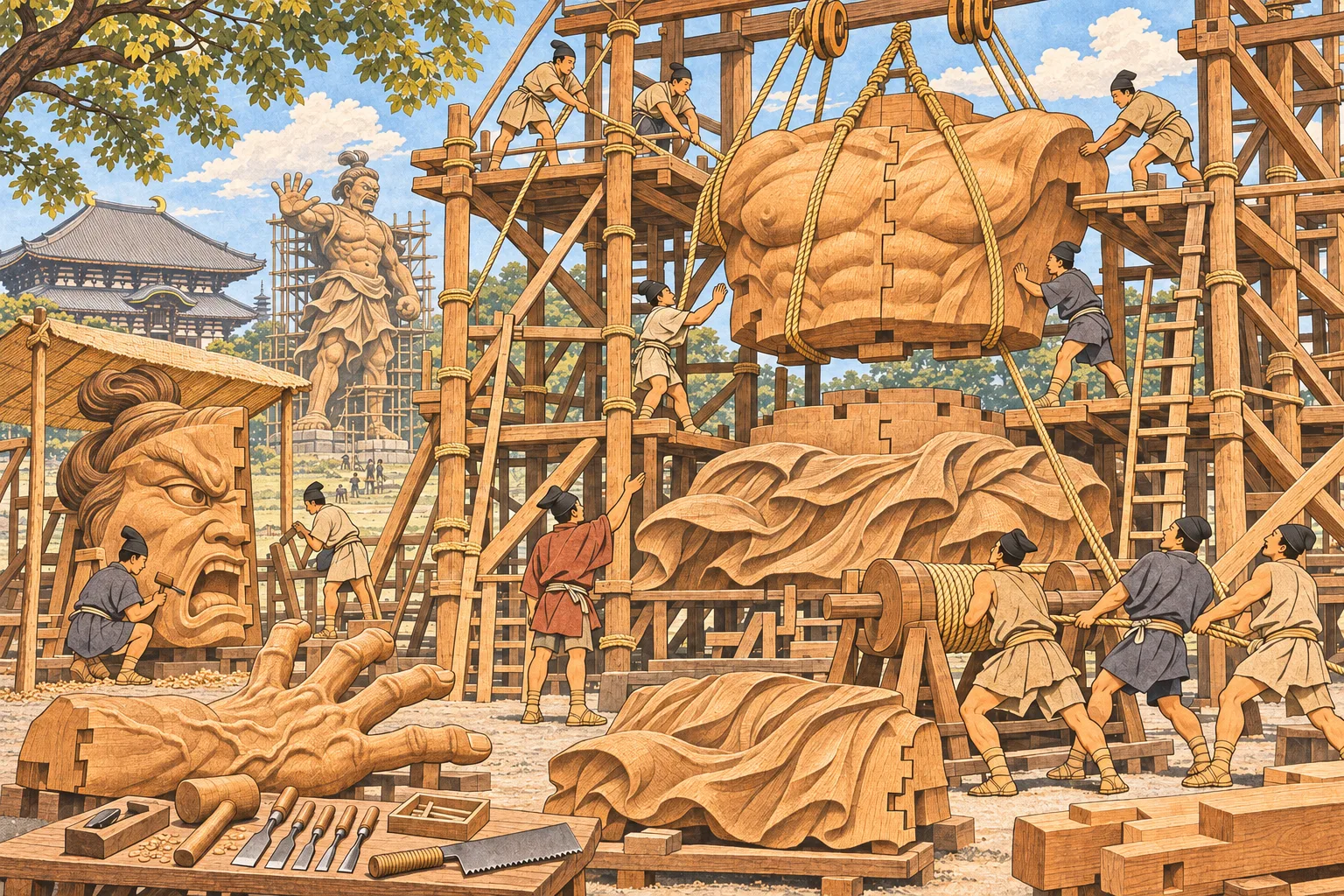
The worksite in 1203: the giant figure is divided into many blocks, carved by separate teams and hoisted into place one by one. The yosegi-zukuri technique let the pair be finished in about 69 days. (artist’s impression)
The Tōdaiji pair is unusual in two ways. The open-mouthed agyō stands on the left as you approach and the ungyō on the right, the reverse of the normal layout. And instead of facing outwards, they face each other across the passage. Various explanations have been offered for this arrangement, and none is settled. The effect is unmistakable, though: you walk straight through the crossfire of two giant stares.
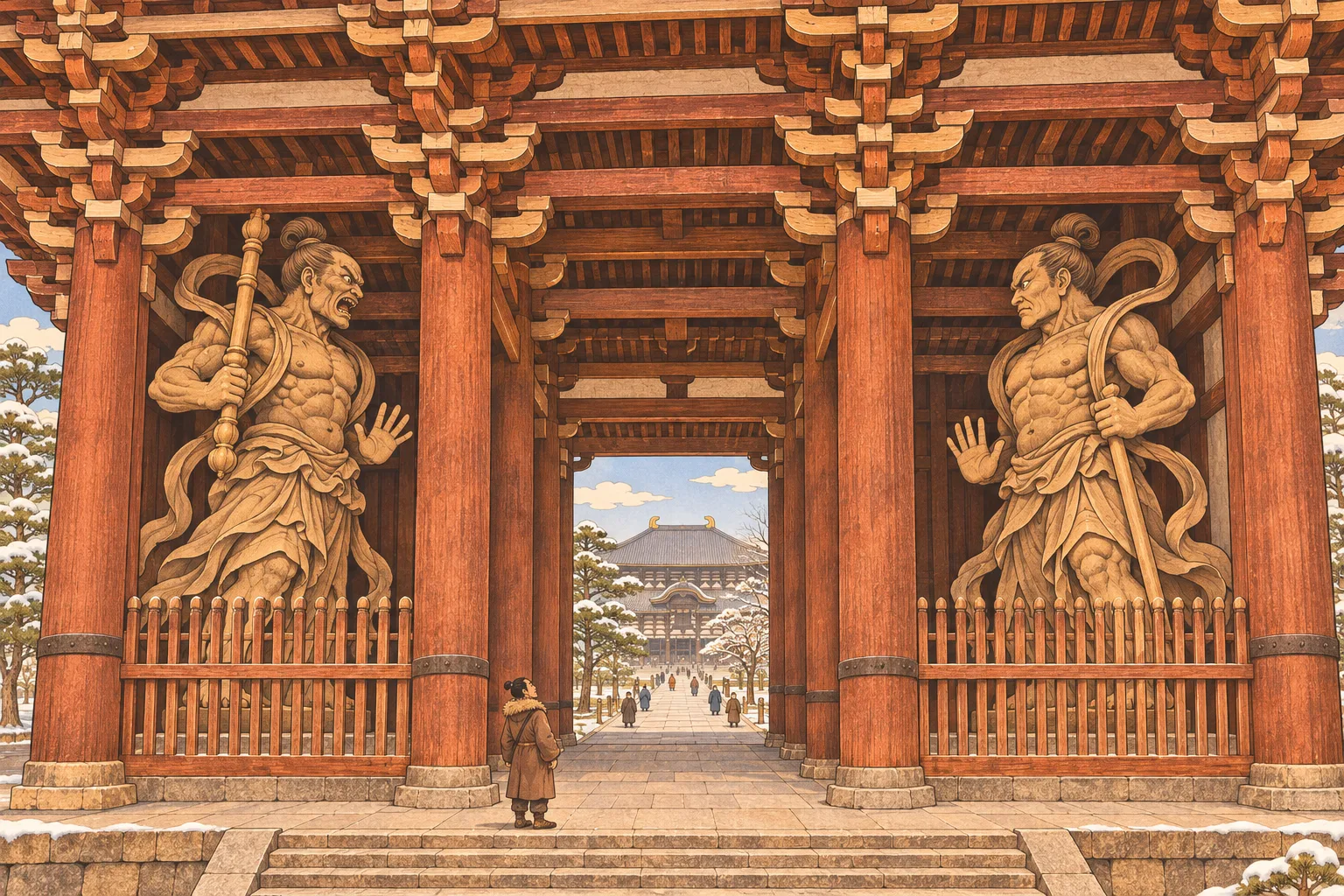
The Niō of Tōdaiji’s Great South Gate face each other across the passage, and in the reverse of the usual order: the agyō on the left as you approach, the ungyō on the right.
The ancestry of the Niō goes back to India, to a figure called Vajrapāni, "vajra in hand". In early Buddhist sculpture a single vajra-bearing bodyguard often accompanies the Buddha. As the figure travelled through Central Asia into China it doubled, and the pair settled on either side of a gateway, echoing older Chinese traditions of door guardians. The oldest surviving Niō in Japan stand in the middle gate of Hōryūji, near Nara: clay figures generally dated to around 711. They are far smaller and less muscle-bound than the Tōdaiji giants, but the open-and-closed pair on either side of the passage is already fully in place.
The single, armoured version also survives. Tōdaiji’s Hokkedō hall keeps a Nara-period clay Shūkongōjin, "vajra-holding deity", who brandishes his vajra overhead as if about to strike, veins standing out on brow and arms, his colours and gold leaf still unusually fresh. He is a hidden image, shown only on 16 December each year. The same hall also has a pair of dry-lacquer Kongō Rikishi who wear armour rather than a loincloth. Between them you can see that the vajra-bearing guardian developed in Japan along two lines: as a half-naked strongman at the gate, and as an armoured warrior.
The gatehouse holds one more surprise. At some Niō gates you will find something unexpected: an enormous straw sandal, or a pair of them, hanging on the gate wall, taller than a person. The best known pair hangs on the back of the Hōzōmon gate at Sensōji in Tokyo; each sandal is about 4.5 metres long, 1.5 metres wide and around 500 kilograms, hand-woven from rice straw by people in Murayama, Yamagata Prefecture, in northern Japan. A new pair arrives roughly every ten years.
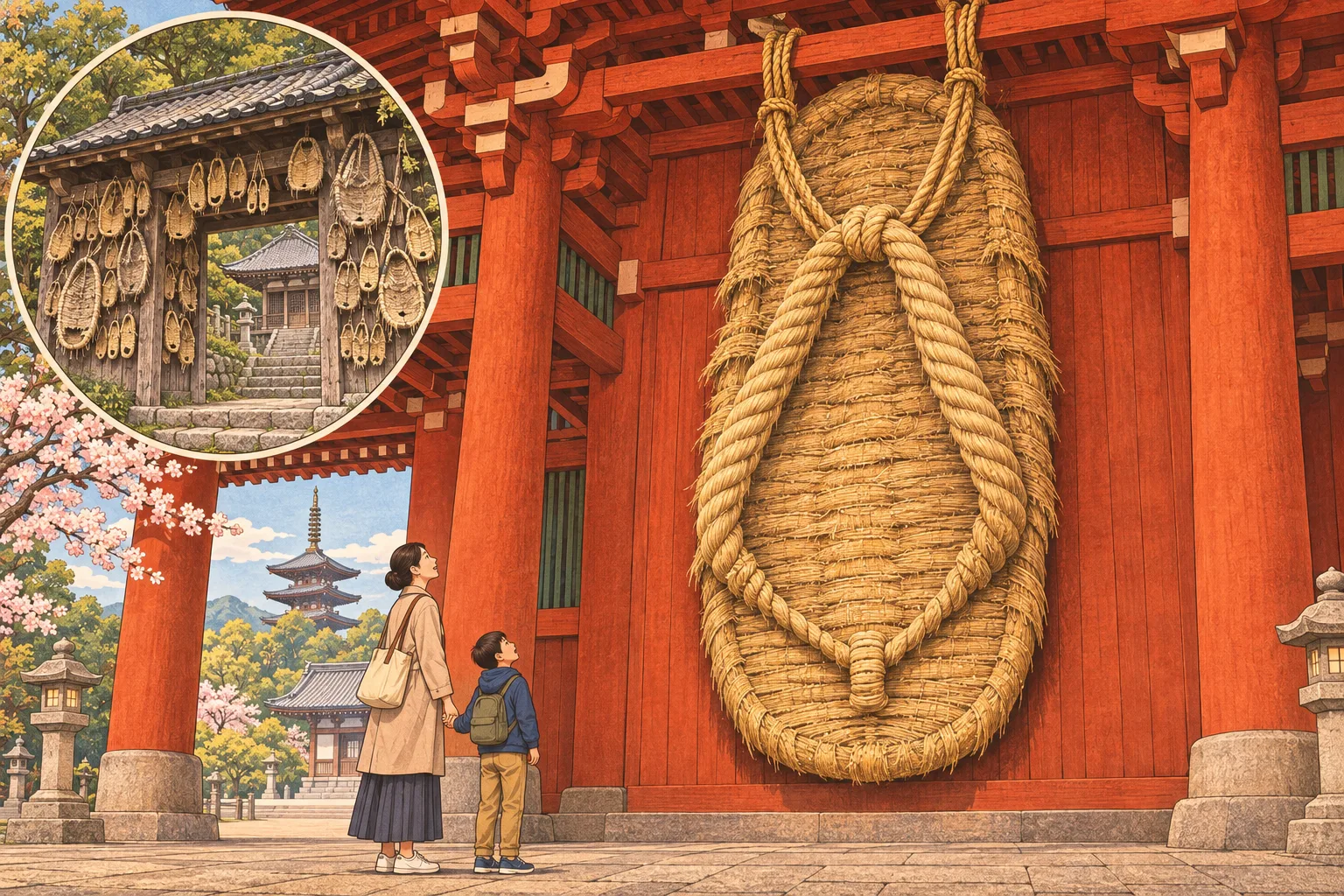
A giant sandal of rice straw hanging on a gate wall, far taller than a person. Inset: at some temples the gate is covered with straw sandals of every size.
Several explanations circulate. One holds that the Niō, as strongmen, have the strongest legs of all, so offering them sandals is a prayer for healthy, tireless legs. In the days when travel meant walking, pilgrims and porters hung small pairs of straw sandals at Niō gates, and at some rural temples the gate is still layered with sandals of every size. The other explanation is more playful: the giant sandal is a warning to demons, a way of saying "look how big the feet of our gatekeepers are". The two readings are not exclusive. Folk customs often carry several meanings at once.
03The Four Heavenly Kings and the Cosmic Mountain
Pass through the gate into the main hall and the principal Buddha sits on a raised platform called the shumidan. The name comes from Mount Sumeru, the vast mountain at the centre of the world in Buddhist cosmology. On its summit lives the god Taishakuten (Indra), and on its slopes, one on each side, live four kings who guard the four quarters of the world and protect the Buddhist law.
The altar platform is, in other words, a miniature Sumeru, and the four kings stand on its corners. Each guards his own direction: Jikokuten the east, Zōjōten the south, Kōmokuten the west and Tamonten the north. Halls traditionally face south, so as you stand in front looking in, east is on your right. That puts Jikokuten at the south-east, front right corner, Zōjōten south-west, front left, Kōmokuten north-west, back left, and Tamonten north-east, back right: a clockwise circuit beginning in the east. Japanese visitors remember the order with the first sound of each name, ji-zō-kō-ta, which happens to sound like Jizō kōta, "bought a Jizō".
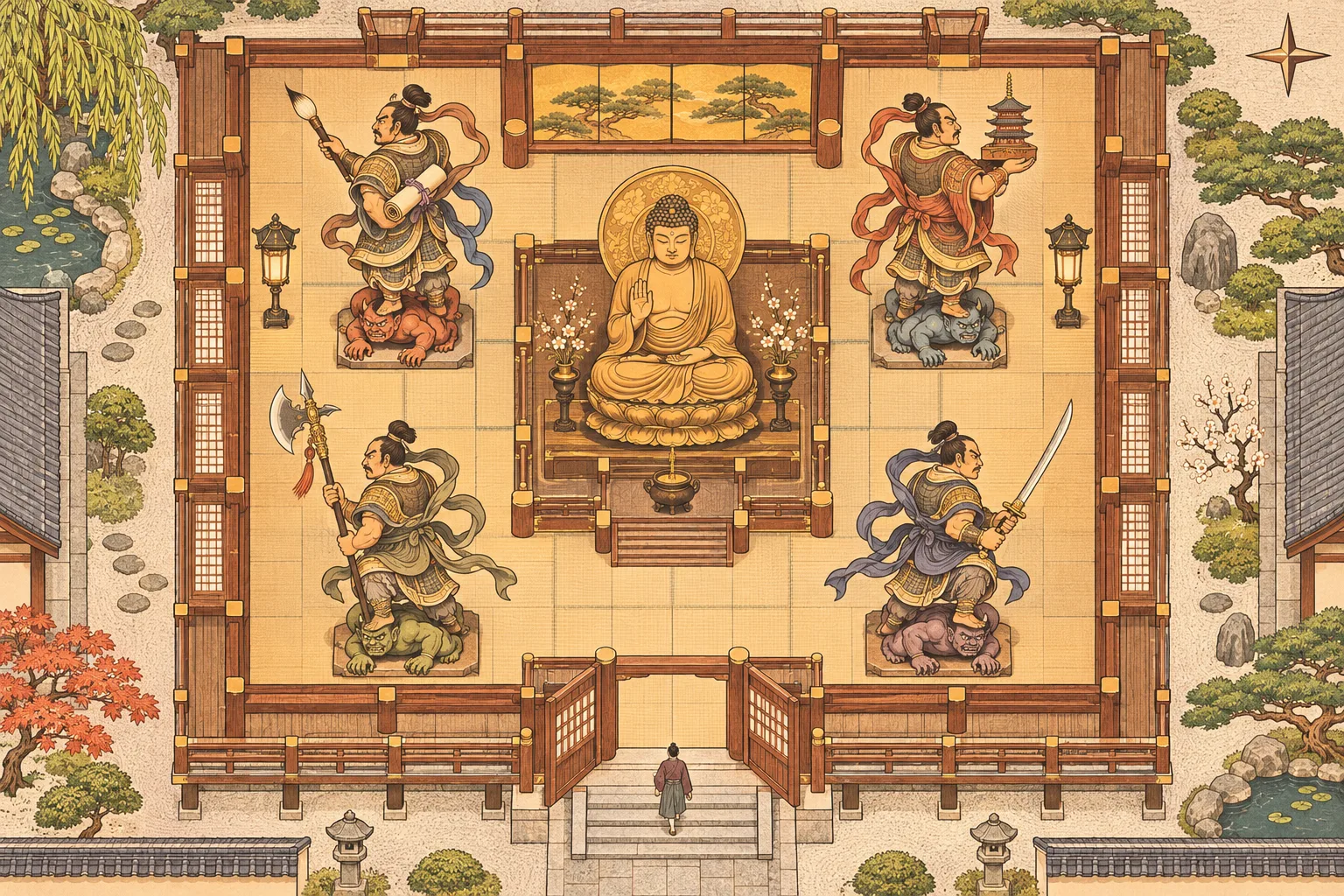
The altar from above, with the hall door (south) at the bottom. The four kings stand at the corners with their backs to the Buddha: Jikokuten, with a sword, front right (east); Zōjōten, with a halberd, front left (south); Kōmokuten, with brush and scroll, back left (west); Tamonten, with a pagoda, back right (north).
The kings stand facing outwards, backs to the Buddha, like sentries posted at the corners of a stage. In some halls they have been moved into a line beside the main image, usually the result of later rearrangement or museum-style display. Where the altar is too small for four, there may be only two, called the niten, "two kings", usually Jikokuten and Tamonten flanking the central figure. Some temples put the two kings in the gate instead of Niō, creating a nitenmon; Sensōji has one, guarded by Jikokuten and Zōjōten. If the gate guardians are wearing armour rather than a loincloth, they are Heavenly Kings, not Niō.
The Four Kings mattered to early Japanese rulers for a specific reason. The Golden Light Sutra promises that the four will protect any country whose ruler upholds the sutra. The court of the seventh and eighth centuries took this seriously. According to legend, Prince Shōtoku carved images of the Four Kings and prayed to them before a decisive battle against the Mononobe clan, and after his victory founded Shitennōji in what is now Osaka. In the eighth century Emperor Shōmu ordered provincial temples built across the country; their official name was "Temples for the Protection of the Nation by the Four Heavenly Kings of the Golden Light".
The oldest surviving set in Japan stands in the Golden Hall of Hōryūji, carved in wood in the seventh century; an inscription on one halo names Yamaguchi no Ōguchi no Atai as one of the carvers. They look nothing like later kings. They stand stiffly upright, wear crowns and long, robe-like armour, and gaze out calmly, while the demons beneath them lie flat like patient cattle. Only in the Nara period did the kings start to twist, scowl and stamp.
04Meeting the Four Kings One by One
What the kings hold varies with period and temple; there is no single canonical set. The combinations below are the most common, with the Nara-period clay figures in the Kaidan-dō (Ordination Hall) at Tōdaiji and the several sets at Kōfukuji as reference points.
Jikokuten, King of the East, "Upholder of the Realm", most often holds a sword, either upright before him or raised to strike; sometimes one hand rests on the hip. He usually glares in open fury. The kings made for Tōdaiji’s Great Buddha Hall when it was rebuilt in the Kamakura period were each painted a different body colour, and this "Great Buddha Hall style" was widely copied; in it Jikokuten is green.
Zōjōten, King of the South, "Lord of Growth", typically grips a long halberd or spear in a raised hand, the other fist on his hip, and is often the most violently twisted of the four. The Tōdaiji Kaidan-dō figure roars with mouth wide open and spear held high. In the Great Buddha Hall scheme he is red.
Kōmokuten, King of the West, "Wide-Eyed One", has the most distinctive pose: he often holds a brush in one hand and a scroll in the other, as if taking notes on the world. The Tōdaiji Kaidan-dō figure is the classic example. He carries no weapon; he simply narrows his eyes and stares into the distance, brows furrowed, lips sealed. Many consider him one of the most powerful sculptures in Japan precisely because all his anger is held behind his eyes. From the Heian period onward Kōmokuten often holds a lasso or a halberd instead. In the Great Buddha Hall scheme he is white.
Tamonten, King of the North, "He Who Hears Much", is the easiest to identify. He holds a small pagoda on the palm of one hand and a halberd or staff in the other. The pagoda is a reliquary, a container for the Buddha’s relics, symbolising his role as guardian of the teaching. Only Tamonten carries a pagoda, so if you see one, you know who it is. In the Great Buddha Hall scheme he is blue.
At the Kaidan-dō the four are arranged with a subtle pairing of their own: Jikokuten and Zōjōten show their anger openly, while Kōmokuten and Tamonten knit their brows and gaze into the distance, holding it in. At Kōfukuji, the kings in the Hokuendō (North Octagonal Hall), made in 791 in lacquer over a wooden core, are stockier and more dynamic; Jikokuten’s eyes all but burst from his face. The Kamakura-period sets in the Nan’endō (South Octagonal Hall) and the Central Golden Hall, by sculptors of the Kei school of Kōkei and his son Unkei, are more anatomically realistic. Seen side by side, the three sets trace several centuries of changing style.
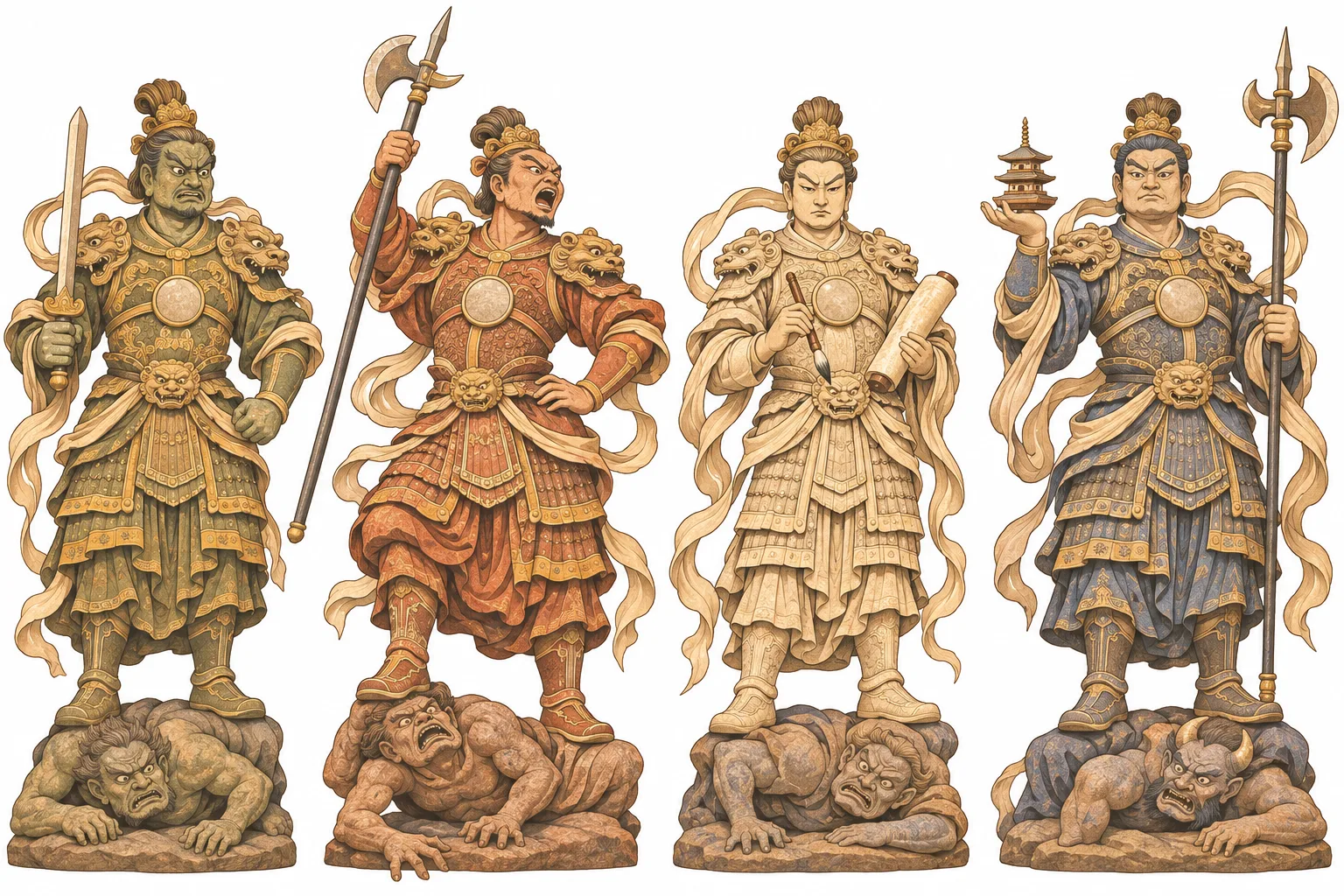
The Four Heavenly Kings, left to right: Jikokuten with a sword, Zōjōten with a raised halberd and a hand on his hip, Kōmokuten with brush and scroll, Tamonten with a small pagoda and a halberd. Each stands on a demon.
At Tōdaiji’s Great Buddha Hall you can see a half-finished set. In the two rear corners behind the Buddha stand Edo-period Kōmokuten and Tamonten, around five metres tall, the former with brush and scroll, the latter holding his pagoda high. The other two kings were never completed; only their heads are said to have been made, and those two gigantic heads now sit on the floor of the hall, where visitors can walk right up to them.
Under the kings’ feet are the jaki, "evil demons", often called amanojaku. They represent subdued evil, or in some readings the passions and delusions of the human mind. Sculptors gave themselves the most freedom here. Some demons grimace and brace their arms against the ground; some glower up at the king in open defiance; some are squashed flat yet still wear a comic expression. The Hōryūji demons are docile as livestock; from the Nara period on they suffer more and more theatrically. In Japanese folklore, Amanojaku is also a perverse little spirit who always says the opposite of what he means, and today the word describes a contrary, awkward person. When you look at a Heavenly King, look down at his feet too. The demon is often the more entertaining sculpture.
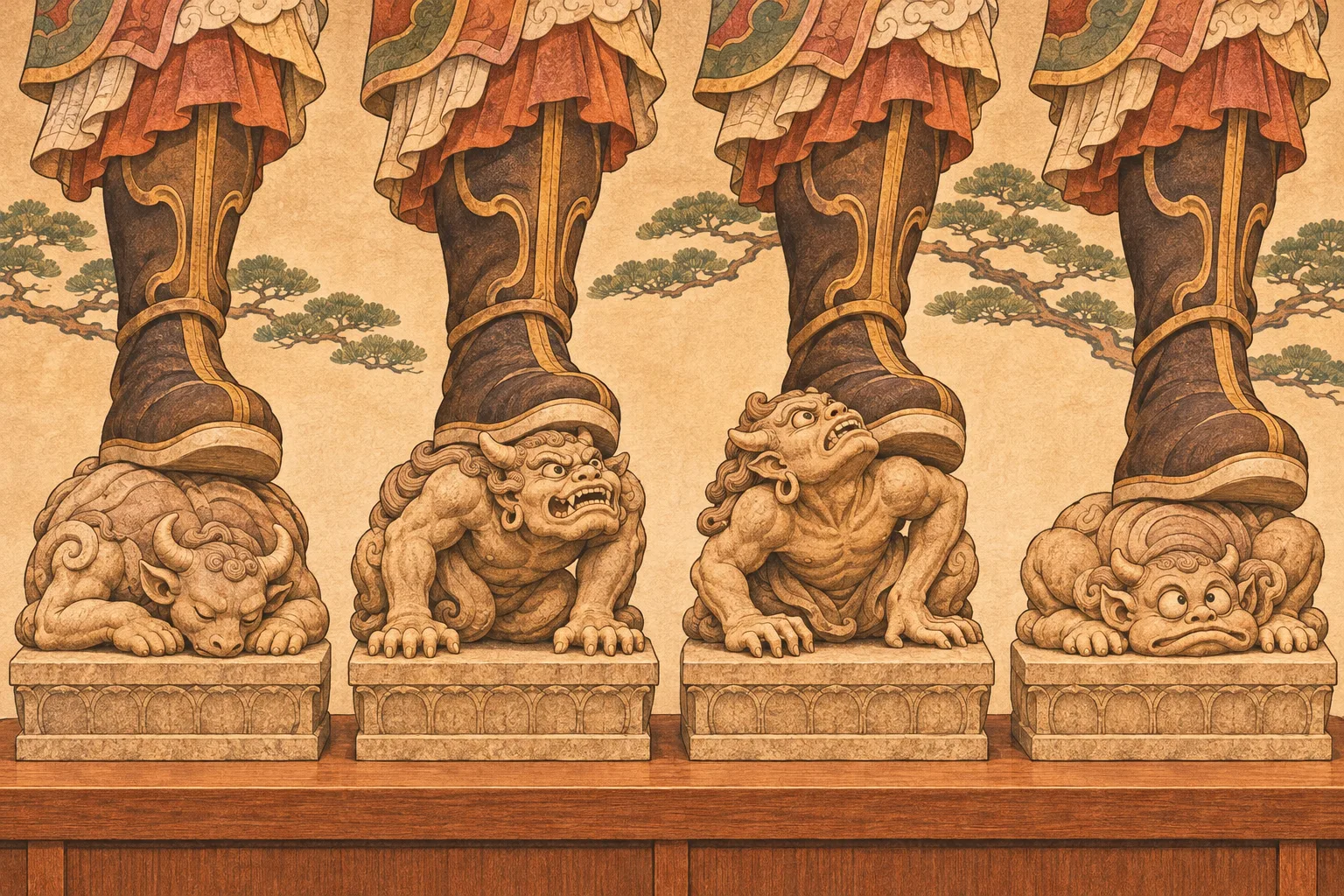
Demons under the kings’ feet, left to right: one as docile as livestock; one grimacing with arms braced on the ground; one glowering up in defiance; one squashed flat and still comic.
05Tamonten Goes Solo: Bishamonten
Of the four kings, only Tamonten is regularly worshipped on his own, and when he is, he goes by another name: Bishamonten. "Bishamon" transliterates his Sanskrit name, Vaiśravana, while "Tamon" translates its meaning. They are the same figure.
He could stand alone because in India he was already associated with wealth, and in Central Asia and China he became a war god as well. Tang-dynasty stories told of Bishamon appearing to defend Chinese cities under siege, and that cult reached Japan. Tōji in Kyoto preserves a Tobatsu Bishamonten, said to have stood originally in the Rashōmon, the main gate of the Heian capital. He looks distinctly Central Asian: a long, coat-like armour reaching below the knee, a tall crown, and instead of a demon underfoot, an earth goddess rising from the ground to hold up his feet in her hands, flanked by two small demons.
A stand-alone Bishamonten looks much like Tamonten in the four-king set: armoured, pagoda in one hand, halberd or staff in the other, often treading on a demon. At Kuramadera in the hills north of Kyoto, an eleventh-century Bishamonten carved from a single block of horse-chestnut wood raises his left hand to his brow, shading his eyes as if watching over the Heian capital below. The pose is extremely rare, though scholars still debate whether it is the statue’s original gesture. Chōgosonshiji on Mount Shigi in Nara is also famous for him; legend says Prince Shōtoku saw Bishamonten appear there in the year, day and hour of the tiger, which is why tigers are everywhere on the temple grounds.
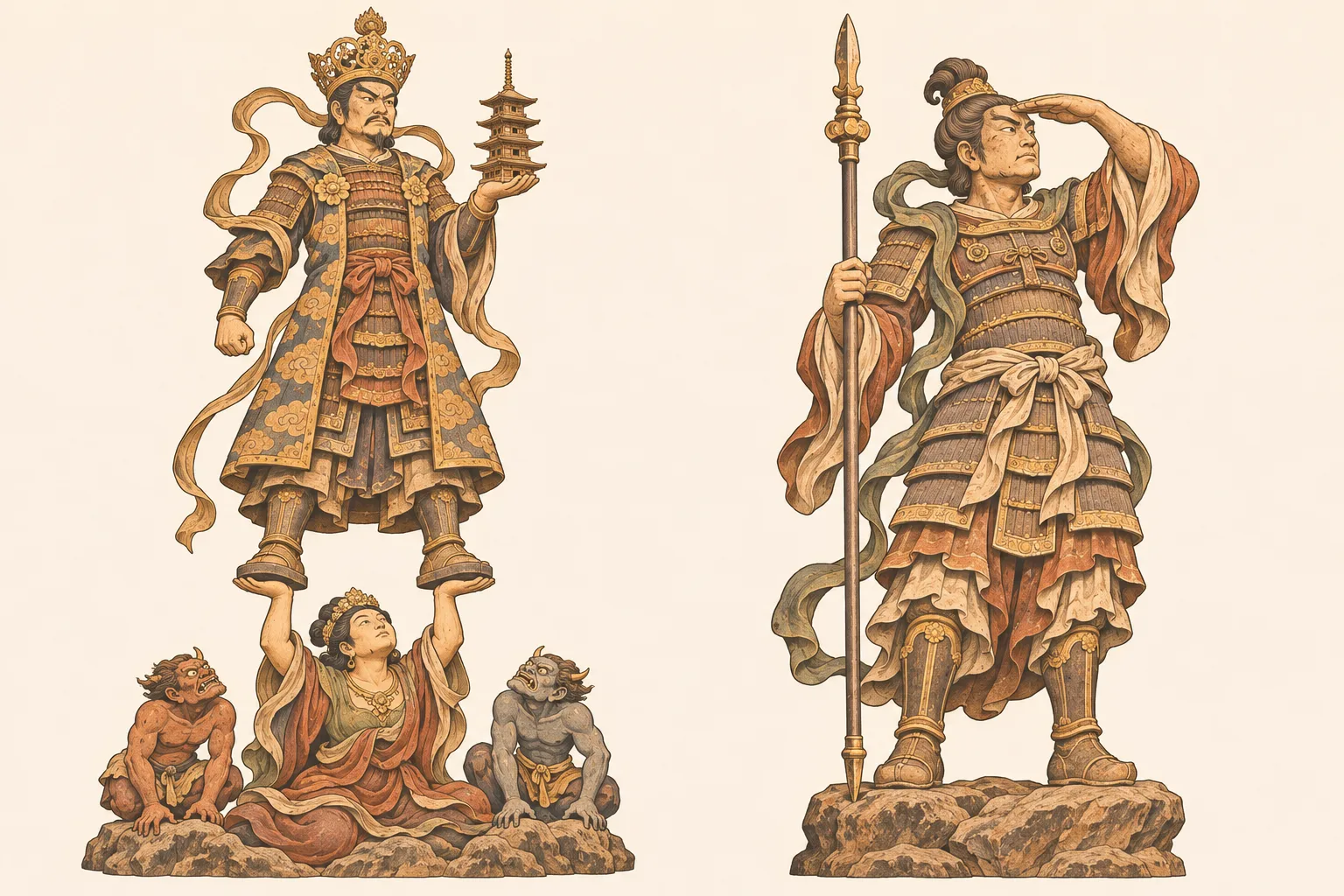
Two forms of Bishamonten. Left: Tobatsu Bishamonten in a long, coat-like armour and tall crown, his feet held up by an earth goddess flanked by two small demons. Right: the Bishamonten of Kuramadera, left hand raised to his brow as if watching the distance.
Warriors were especially devoted to him; the warlord Uesugi Kenshin famously fought under a banner bearing the first character of his name. Bishamonten later joined the Seven Lucky Gods as a bringer of good fortune, but that is a separate story.
06The Wider Guard: Twelve Generals and Eight Legions
Two more groups of armoured or semi-armoured guardians appear in Japanese temples, and visitors often take them for relatives of the Four Kings.
The Twelve Heavenly Generals, Jūni Shinshō, are the bodyguards of Yakushi Nyorai, the Medicine Buddha. The Medicine Buddha Sutra tells of twelve yaksha generals who vowed to protect anyone devoted to Yakushi, each commanding seven thousand yaksha troops. So wherever you see the twelve, Yakushi is in the middle. They dress much like the Four Kings, in Chinese-style armour, but they are smaller, they usually stand on rocks rather than on demons, and each strikes a different pose: one draws a sword, one draws a bow, one swings an axe, one shades his eyes. Lined up together they look like a sequence of freeze-frames from a fight scene.
The most famous set is at Shin-Yakushiji in Nara. In the main hall, Yakushi sits on a large round platform, and the twelve Nara-period clay generals stand in a ring around him, facing outwards. They were once vividly painted, and only patches of colour survive. The best known is Basara (Vajra), hair standing on end, mouth wide open, sword in hand; he is the face of Japan’s 500-yen definitive stamp issued in 2012. One figure in the set is a 1931 replacement; the other eleven are Nara-period originals.
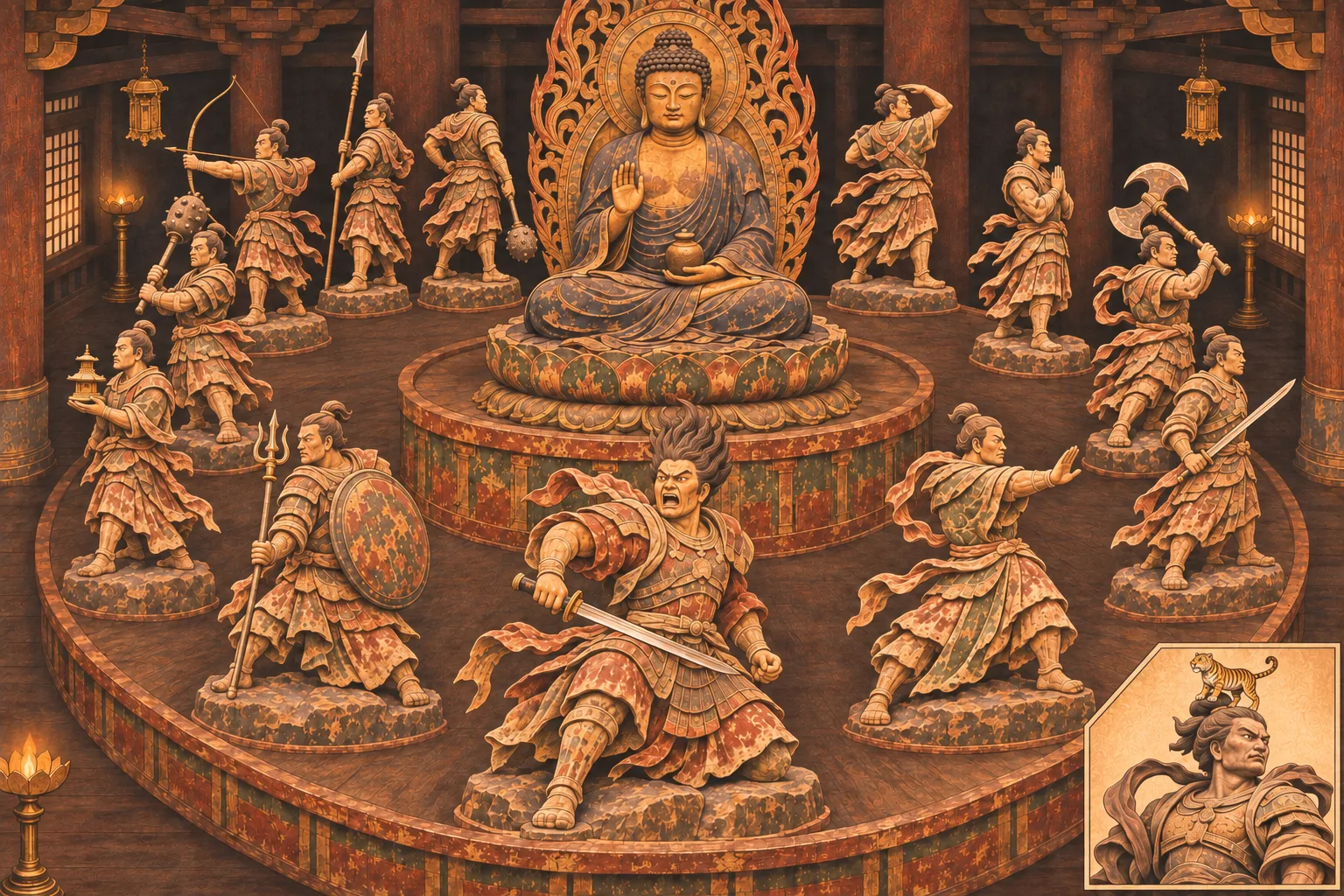
Shin-Yakushiji in Nara: Yakushi sits at the centre of the round platform, ringed by the twelve generals facing outwards. In front is Basara, hair on end, mouth wide open, sword in hand. Inset: later sets put a zodiac animal on each general’s head.
From around the Heian period the twelve generals were linked to the twelve animals of the East Asian zodiac, each guarding a direction and a two-hour period of the day. Sculptors added a small zodiac animal to each general’s headdress, a rat, an ox, a tiger, so that you can tell at a glance who is who. The Kamakura-period set in Kōfukuji’s Tōkondō (East Golden Hall) wears these animal crests. Which general matches which animal varies between temples, depending on where the count begins. Some Japanese visitors today seek out the general of their own birth year.
The Eight Legions, Hachibushū, guard the historical Buddha. Most of them began as gods and spirits of Indian mythology who were absorbed into Buddhism as protectors: devas, dragons, yaksha, gandharva celestial musicians, asura, the bird-like garuda, kinnara and mahoraga serpent beings.
Japan’s most famous set is at Kōfukuji in Nara. In 734, Empress Kōmyō commissioned a group of images for the West Golden Hall in memory of her mother, Tachibana no Michiyo, and the Eight Legions were among them. They are made in hollow dry lacquer: a clay core is modelled, layers of lacquer-soaked hemp cloth are built up over it, and once dry the core is removed, leaving a light, hollow figure. Apart from the Ashura, most of them wear armour, yet they are not fierce. Several have the faces of boys, calm, even wistful; one, Hibakara, is a bearded, middle-aged man. One has a bird’s head; another has a snake coiled about his head and chest; another, eyes closed, wears a lion-headed helmet; one survives only as a head and a fragment of torso.
The star of the group is the Ashura. He has three faces and six slender arms, wears only a simple top and skirt, and his main face carries a faint frown, like a teenager lost in thought. In Indian myth the asura are belligerent demigods forever at war with Indra, yet Kōfukuji’s Ashura has nothing warlike about him. That contrast is a large part of why he is one of the best-loved Buddhist statues in Japan.
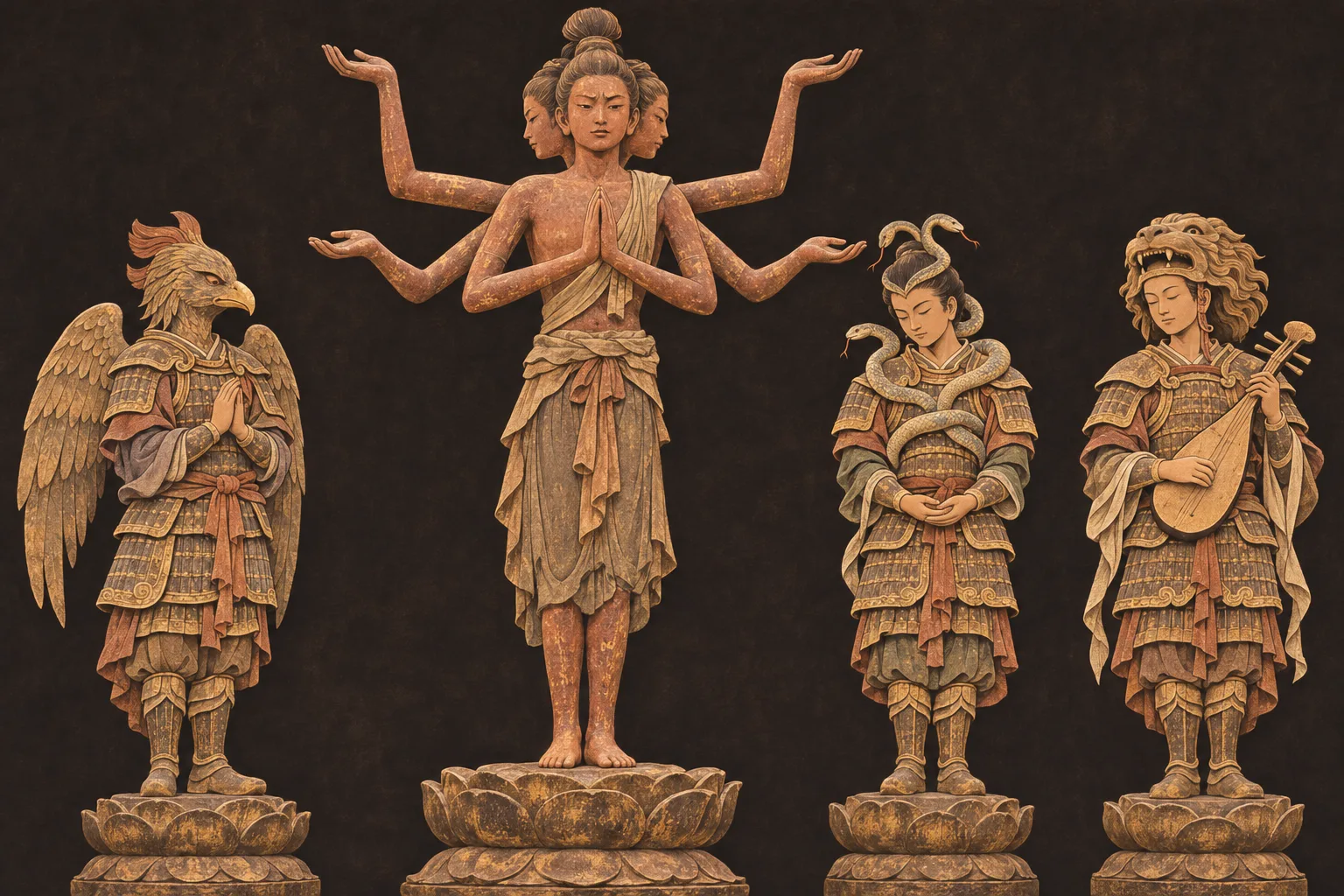
Four of the Eight Legions at Kōfukuji. In the centre, the Ashura with three faces, six arms and no armour; on the left, the bird-headed figure; on the right, one with a snake coiled about his head and chest and one in a lion-headed helmet, all three in armour.
At Sanjūsangendō in Kyoto, a Kamakura-period set of twenty-eight attendants surrounds the thousand-armed Kannon. The Four Kings are among them, and so are Misshaku Kongō and Naraen Kengo, the most muscular and fierce of the group, also called Kongō Rikishi: the Niō brought indoors. The gods of wind and thunder stand at either end. The more of these groups you see, the clearer it becomes that Buddhist guardians come in concentric rings.
07Armour from Tang China
The armour on the Four Kings and the Twelve Generals looks nothing like a samurai’s, and for good reason: it is not Japanese armour at all, but the battle dress of Tang-dynasty Chinese generals.
Tang armour has a few telltale features. Two round plates sit on the chest, polished to catch the light, which is generally taken to be why the style was called "bright light armour". The shoulder guards are often shaped as animal heads swallowing the upper arm. A grimacing beast mask clamps the belt at the waist. A long armoured skirt falls to the knees, the feet are in tall boots, and a long scarf streams behind. A Nara-period Heavenly King is essentially a three-dimensional portrait of a Tang general, with a demon-queller’s scowl added.
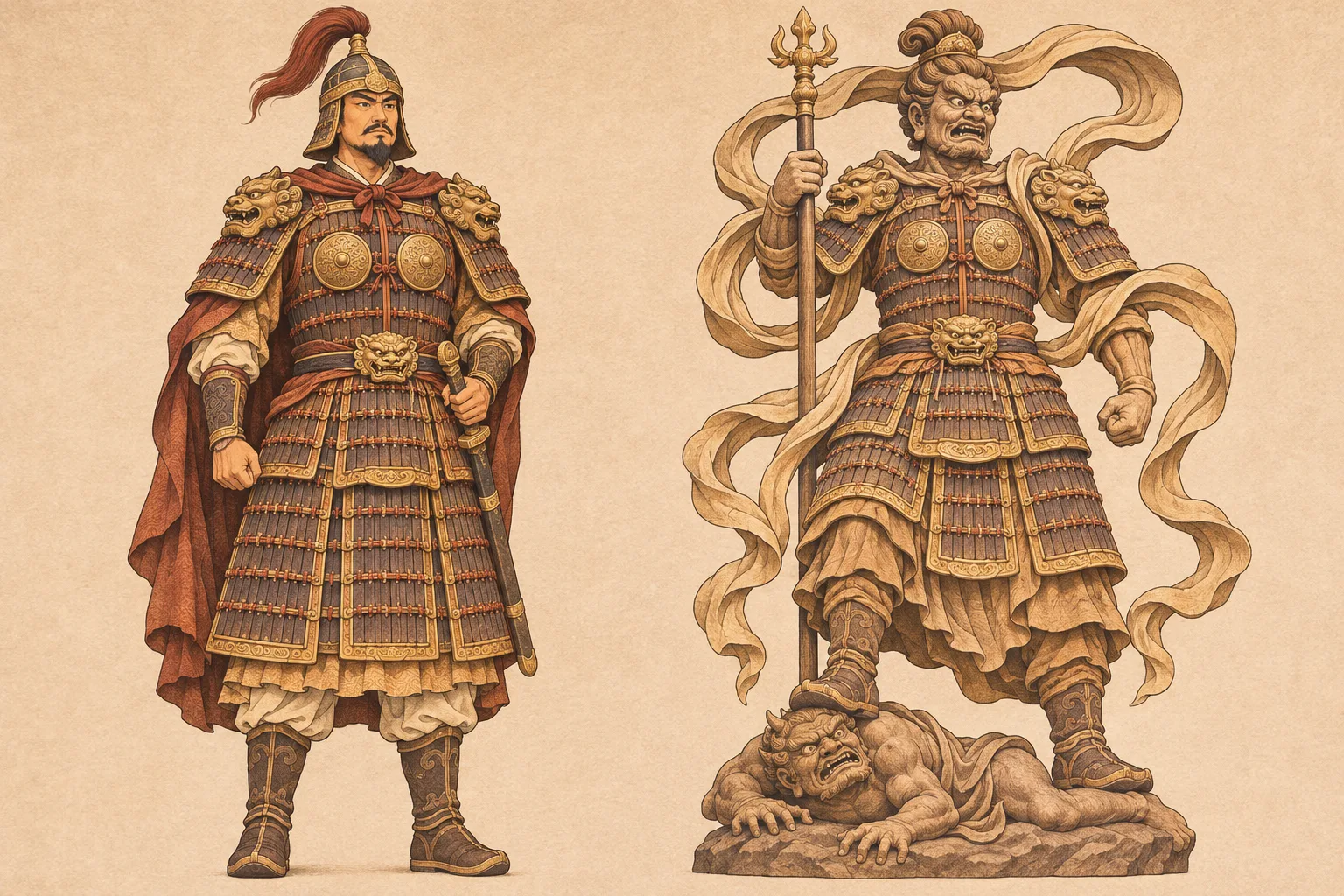
A Tang general, left, and a Nara-period Heavenly King, right. The armour is the same: two round chest plates, animal-head shoulder guards, a beast mask at the belt. Only the scowl, the streaming scarf and the demon underfoot are added.
Hōryūji’s kings are the exception: they follow the older style of China’s Northern and Southern Dynasties, flat and frontal, their armour more like a long robe with a few divisions across the chest. Japanese missions to Tang China then brought back the new, three-dimensional manner, and by the eighth century the kings had become twisting, fleshy and lifelike, as in the Kaidan-dō and Hokuendō sets.
After the ninth century contact with China thinned, and Japanese sculpture went its own way. Early Heian sculptors favoured ichiboku-zukuri, carving the main body from a single block, which produced heavy, solid figures with deep, sharp drapery folds. In the Kamakura period Unkei, Kaikei and their circle pushed realism as far as it would go: shifting weight, tensed muscles, veins, and inlaid crystal eyes called gyokugan, which make a statue seem to look back at you when seen from below.
What did not change was the armour. Even in the Kamakura period, when samurai ruled Japan and Japanese armour had reached its classic form, the kings kept their Tang outfits. Nobody dressed them as samurai. The Tang look had become the uniform of a Buddhist guardian, detached from real warfare. The Japanese touch shows elsewhere: in proportions and poses that grew ever more theatrical, in demons that grew ever more comic, in richer colour, and on some figures in kirikane, fine patterns of cut gold leaf laid over the painted armour.
08Side by Side: How to Tell Them Apart
With all these guardians in mind, a few simple clues will sort them out.
Start with location. Huge figures in the gate, outdoors or half outdoors, are Niō. Four armoured figures at the corners of the altar inside the hall are the Heavenly Kings. Twelve smaller armoured figures around a Medicine Buddha are the Twelve Generals. A varied group around the historical Buddha, perhaps including a bird-headed figure, is the Eight Legions. And if the pair at the entrance are stone lion-dogs and you are at a Shintō shrine rather than a temple, they are komainu, a different tradition altogether.
Next, clothing. Niō are bare-chested, wearing only a skirt and scarf, never armour. The Four Kings are fully armoured in Tang style and stand on demons. The Twelve Generals are also armoured but smaller, usually without demons, perhaps with a zodiac animal on the head. Kōfukuji’s Eight Legions mostly wear armour too, but their faces are calm and often boyish.
Then, what they hold. Niō hold a vajra or an empty fist. Among the kings, a pagoda means Tamonten, the most reliable clue of all; brush and scroll usually mean Kōmokuten; a long halberd and a violent twist often mean Zōjōten; a sword often means Jikokuten. Because attributes shift with period and temple, the safest method is to combine them with position: front right Jikokuten, front left Zōjōten, back left Kōmokuten, back right Tamonten.
Finally, numbers. A pair is Niō; four is the Heavenly Kings; a single armoured figure with a pagoda, worshipped as the main image, is Bishamonten.
One more figure often gets mixed in: Fudō Myōō, the Immovable Wisdom King. He too glares and bares his fangs, but he is not a bodyguard. He is a wrathful manifestation of Buddhist compassion, aimed at those too stubborn to be reached any other way. He sits or stands on a rock, wreathed in flames, holding a sword and a rope, with a stocky, childlike body and no Tang armour. If you see a halo of fire, you are looking at a Wisdom King, not a guardian general.
Taken together, these figures form layers from outside in: the Niō block evil at the gate, the four kings hold the corners of the hall, and the generals and legions guard the Buddha at close quarters. For most Japanese today, the appeal is less doctrinal than intuitive. With two such ferocious figures at the door, whatever lies inside must be safe.
More deep dives on this topic
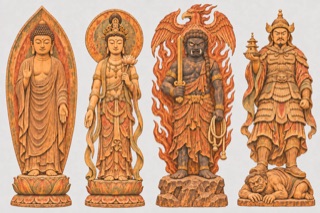 Four Ranks of Buddhist StatuesStep out of the sunlight into a Japanese temple hall and your eyes take a moment to adjust.
 Mudras and AttributesIn the half-light of a Japanese temple hall, the face of a Buddha is often hard to make out.
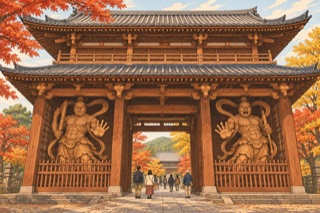 Niō and the Four Heavenly KingsWalk up to almost any large Buddhist temple in Japan and the first figures you meet are not serene Buddhas but two furious, nearly naked giants flanking the gate.
 PagodasWalk up the stone lanes of Higashiyama in Kyoto and the Yasaka Pagoda rises over the tiled roofs of the old townhouses; ride the bullet train into Kyoto Station and the dark…
 The GaranMost visitors to a Japanese temple experience it as a sequence: a gate, a path, a big hall, perhaps a pagoda off to one side.
 How Buddhist Statues Are MadeWalk through the temples of Nara and Kyoto and you will meet Buddhas that are gold, black, chalky grey, or the warm brown of old wood.
 Reading Temple NamesMost visitors to Tokyo know Sensō-ji, the great Kannon temple in Asakusa.
 Shōjin RyōriThe first thing many visitors eat at a temple lodging on Mount Kōya is a small, pale square that wobbles on a lacquer dish.
 A Night in a TempleMost temples in Japan close their gates at dusk.
- Back to the main article: Japanese Buddhism →