
In the half-light of a Japanese temple hall, the face of a Buddha is often hard to make out. The hands are easier. One palm raised and turned outward, the other resting on the knee. Two hands stacked in the lap with the thumbs touching. A fist wrapped around a single upright finger. These gestures are called mudras, in or inzō in Japanese, and the objects held in the hands, a medicine jar, a lotus, a sword, a coil of rope, are called attributes, jimotsu. Together they form a visual code that sculptors and worshippers have shared for well over a thousand years. Learn to read it and you hold half the key to identifying a statue. Only half, though: the same gesture can mean different things on different figures, and some hands you see today are not the hands the sculptor carved.
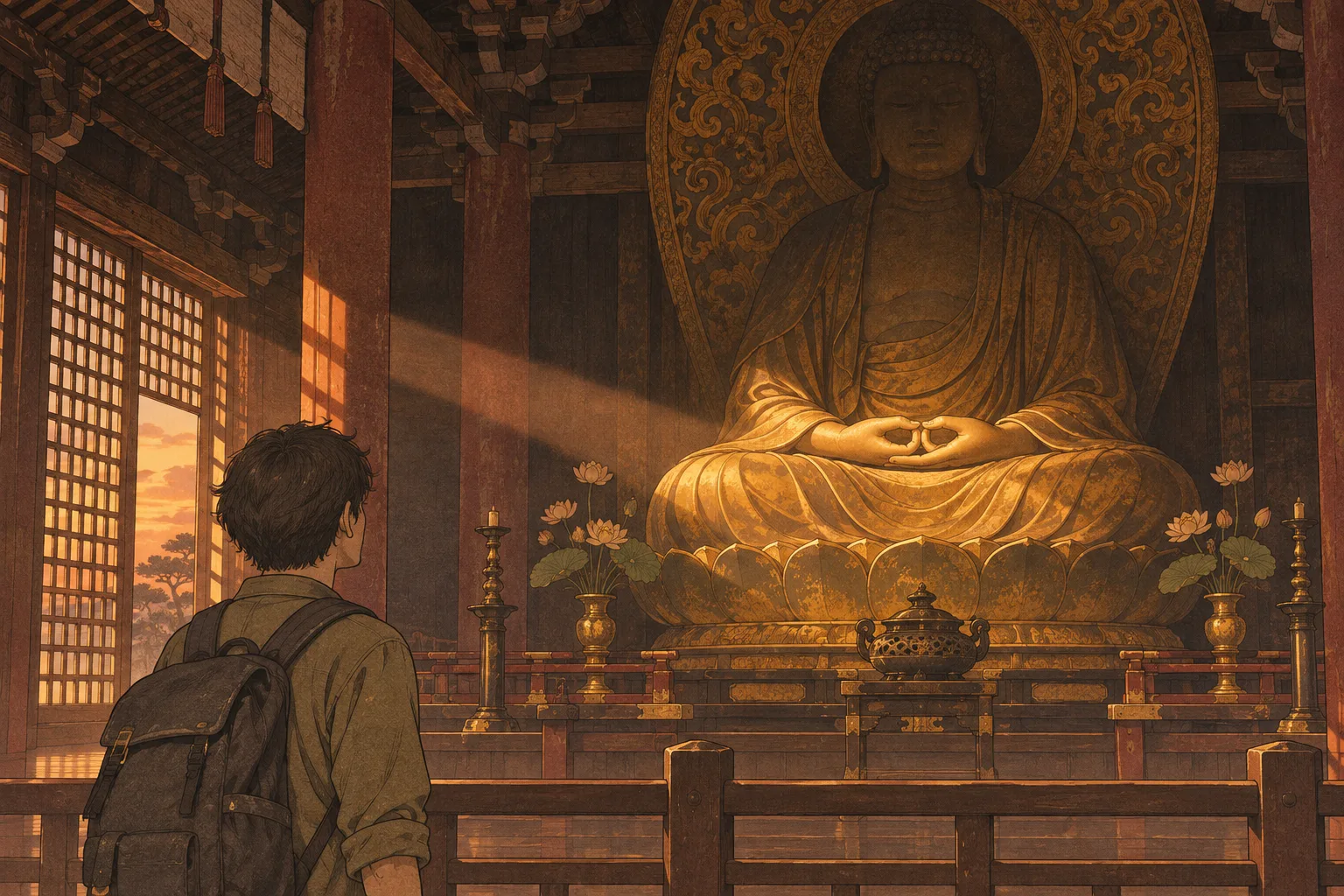
In the half-light of a temple hall the face stays in shadow; the hands folded in the lap are what you see first.
01Why the Hands Speak
The Sanskrit word mudrā means a seal or stamp, the mark you press into wax to show who you are and what you promise. A mudra on a statue works the same way: it is a seal set on the figure’s body.
The earliest Buddha images, made in Gandhara and Mathura in what are now Pakistan and northern India between roughly the 1st and 3rd centuries, used only a handful of gestures, and they read almost like ordinary body language. A raised palm meant "be at ease." Hands in the lap meant meditation. As Buddhist art matured, the key moments of the Buddha’s life became fixed scenes, and the gestures that went with those scenes became fixed too.
Then, from around the 7th century, Esoteric Buddhism (mikkyō) raised the stakes. In Esoteric practice, a monk aligns body, speech and mind with a deity at the same time, by forming hand seals, chanting mantras and visualising the figure. The hand gesture stopped being a picture of something and became part of the ritual itself. The number of mudras multiplied into the hundreds, each with exact finger positions and a name.
Japan received both layers. The first came with Buddhism in the 6th and 7th centuries: a small set of gestures that can mostly be explained by stories from the Buddha’s life. The second arrived in the early 9th century, when the monks Kūkai and Saichō brought Esoteric teachings back from Tang China, along with ritual manuals that specified which seal every deity makes and what it holds. Older images invite storytelling; Esoteric images are closer to reading a code.
Attributes follow similar logic. Bodhisattvas and guardian deities usually carry something: a tool for saving beings, like the medicine jar or the monk’s staff; a symbol, like the lotus of purity; or a weapon, because many guardian deities began as Indian gods and kept their gear when they joined the Buddhist pantheon. Buddhas, by contrast, are usually empty-handed. They have renounced everything, so the few that do hold an object become easy to spot.
One caution before we start. Mudra names and meanings vary between schools, periods and scholars. What follows is the account most commonly given in Japanese temples and art-history books, with alternatives noted where they matter.
02Five Gestures from the Life of the Buddha
Five mudras are traditionally associated with Shaka, the historical Buddha (Shakyamuni). They are easiest to remember as moments in his story.
The fear-not gesture, semui-in, raises the right hand to chest or shoulder height, fingers straight and together, palm facing out. It is the gesture of someone saying "stop, don’t be afraid." It was a sign of protection in India before Buddhism adopted it.
In the wish-granting gesture, yogan-in, the hand points downward with the palm facing out, as if offering something. On a standing figure it hangs by the side; on a seated one it rests on or in front of the knee, palm showing.
In Japan these two almost always appear as a pair: right hand fear-not, left hand wish-granting. Nearly every Buddha of the Asuka period (roughly 538–710) uses this combination. The Asuka Daibutsu at Asukadera in Nara, a bronze traditionally credited to the sculptor Tori Busshi around 609, still raises its right hand and lowers its left despite heavy fire damage and repair. The Shaka Triad in Hōryūji’s Golden Hall, dated 623, does the same. Because the pairing was used for Shaka, Yakushi and Amida alike, Japanese writers sometimes call it the tsūin, the "general-purpose" gesture.
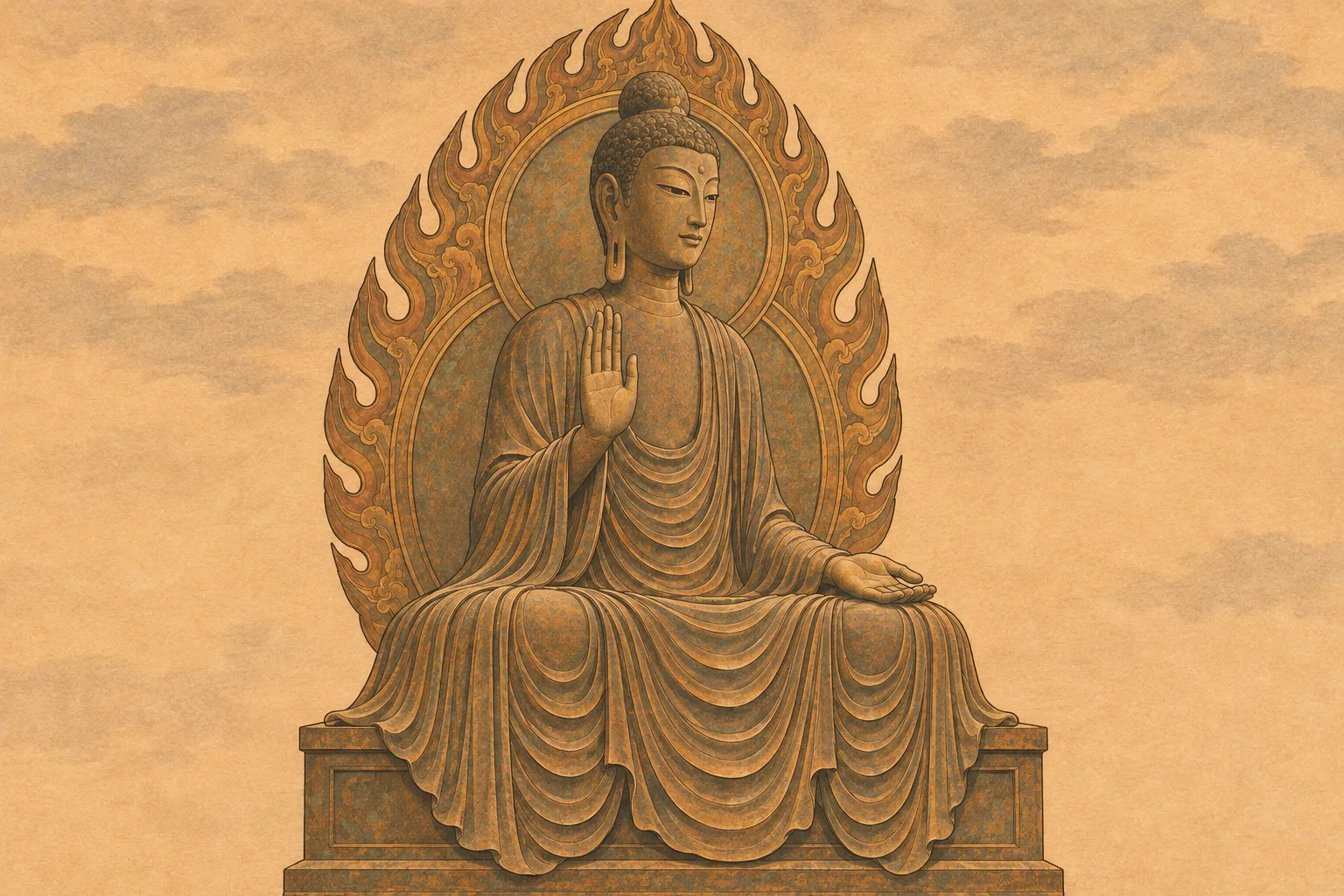
A Shaka in the Asuka style: right hand raised in the fear-not gesture, left hand resting palm-up on the knee. Nearly every Buddha of the Asuka period uses this pair.
In the meditation gesture, jōin, both hands rest in the lap, palms up, one on top of the other, thumb tips touching to form a flat oval. This is the Buddha seated in deep concentration before his awakening. In Japan it is usually called the hokkai jōin, and if you have seen Zen monks sitting zazen you have seen it: it is the same hand position used in seated meditation, described step by step in the article on Zen. Shaka statues in Zen temples, such as the main images of Buddha halls in Kyoto and Kamakura, often make this gesture, sometimes with the hands stacked the other way round. Some of these Zen Shakas even wear a crown, the hōkan Shaka; the main image of the Buddha hall at Engakuji in Kamakura is one.
For the gesture of turning the Wheel of the Dharma, tenbōrin-in, both hands are raised before the chest, each forming a ring with thumb and forefinger, the rings brought close together or interlocked, as if turning a wheel. The "wheel" is the teaching; the moment is the Buddha’s first sermon in the Deer Park at Sarnath. The 5th-century seated Buddha excavated at Sarnath makes this gesture and is often held up as the classic Gupta image. In Japan the strict form is uncommon; a simpler "preaching gesture" is far more frequent (see section 5).
In the earth-touching gesture, sokuchi-in, also called subduing Māra, gōma-in, the right hand reaches down over the right knee, fingertips brushing the ground; the left lies palm-up in the lap. The story: as the Buddha sat under the Bodhi tree on the night of his awakening, the demon Māra attacked him with armies and temptresses and demanded to know by what right he sat there. The Buddha did not rise. He simply touched the earth and called it to witness his countless lives of practice. The earth shook and Māra’s army fled.
Travellers who know Thailand, Myanmar or Bodh Gaya will find this the most familiar Buddha gesture of all. In Japan it is surprisingly rare as a standalone Shaka image. You are more likely to meet it in Esoteric mandalas, where Tenkuraion Nyorai, one of the four Buddhas surrounding the centre of the Womb Realm mandala, makes the earth-touching gesture.
Put in order, the five gestures tell a life: meditation, victory over Māra, the first sermon, and throughout, reassurance and generosity. Indian and Chinese sculptors compressed a biography into a few hand positions. Japan took up mainly two or three of them.
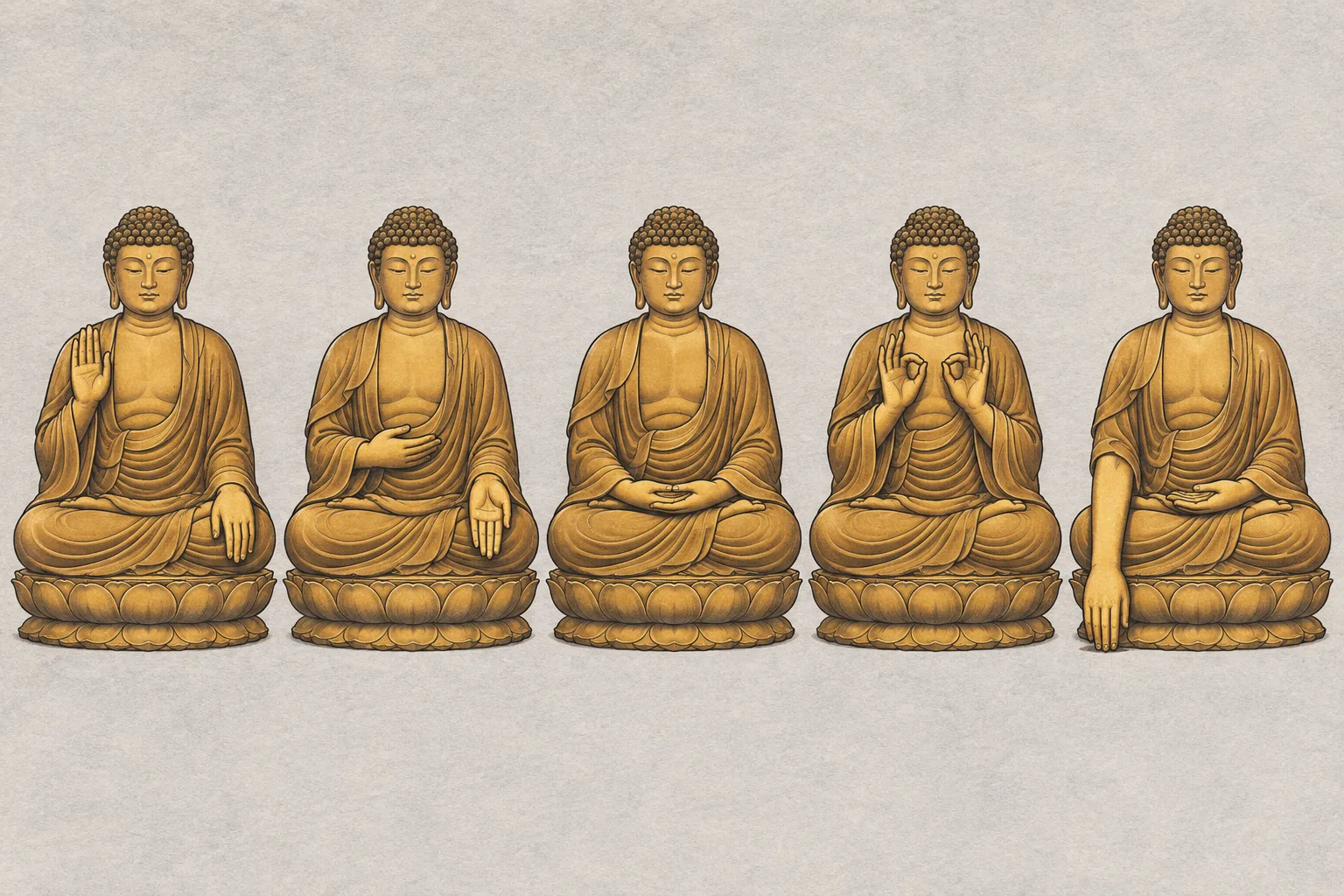
Five gestures on the same seated Shaka. Left to right: fear-not (semui-in), wish-granting (yogan-in), meditation (jōin), turning the Wheel (tenbōrin-in) and earth-touching (sokuchi-in).
03Amida’s Hands: Meditation, Welcome and the Nine Grades
From the late Heian period (the 11th and 12th centuries), devotion to Amida, the Buddha of the Western Pure Land, swept through Japan. Amida became one of the most common statues in the country, and his hands developed more variations than any other figure’s.
Amida’s own meditation gesture, mida jōin, looks at first glance like the ordinary meditation mudra, but look closer. The index fingers are raised and bent back so their outer joints touch, and each thumb meets the tip of its index finger. The result is two small rings side by side, not one large oval. The great gilded Amida in the Phoenix Hall at Byōdōin in Uji, completed by the sculptor Jōchō in 1053 and about 2.8 metres tall, makes this gesture. So does the Great Buddha of Kamakura at Kōtokuin, the bronze giant sitting in the open air. Standing in front of it and looking up, the paired hands in its lap are one of the first details you can read clearly.
In the welcoming gesture, raigō-in, which the Pure Land article introduces briefly, the right hand is raised, the left lowered, both palms facing out, and on each hand the thumb touches another finger to form a ring. In outline it looks just like the fear-not and wish-granting pair; the difference is entirely in those small rings. Raigō means "welcoming descent": the belief that at the moment of death, Amida comes down from the Pure Land to receive the believer. From the late 12th century, workshops produced large numbers of standing Amida figures about three shaku tall (around 90 centimetres), leaning slightly forward as though stepping toward the dying person. In the Ōjō Gokuraku-in hall at Sanzen-in in Ōhara, north of Kyoto, the seated Amida makes the welcoming gesture while his two attendants kneel and lean forward, Kannon holding out a lotus pedestal to carry the soul, Seishi with palms joined.
The third is a preaching gesture, with both hands raised before the chest, each forming a ring, palms out.
Combine these three hand positions with three finger choices and you get what Japanese iconography calls the kuhon-in, the nine mudras of the nine grades of rebirth. The Contemplation Sutra says those reborn in the Pure Land fall into nine grades according to their conduct in life: upper, middle and lower rank, each split into upper, middle and lower birth. Three gestures times three fingers gives nine. Which of the two marks the rank and which the birth depends on the book. In one arrangement the gesture gives the rank (meditation for upper, preaching for middle, welcoming for lower) and the finger touching the thumb gives the birth (index for upper, middle finger for middle, ring finger for lower). In the other, found in equally reputable Japanese dictionaries, it is the reverse: the finger gives the rank and the gesture gives the birth. Both agree that the meditation gesture with the index finger is "upper rank, upper birth," so the Byōdōin Amida and the Kamakura Great Buddha get that label either way. The other eight names shift: a welcoming gesture with the index finger is "lower rank, upper birth" in the first scheme and "upper rank, lower birth" in the second.
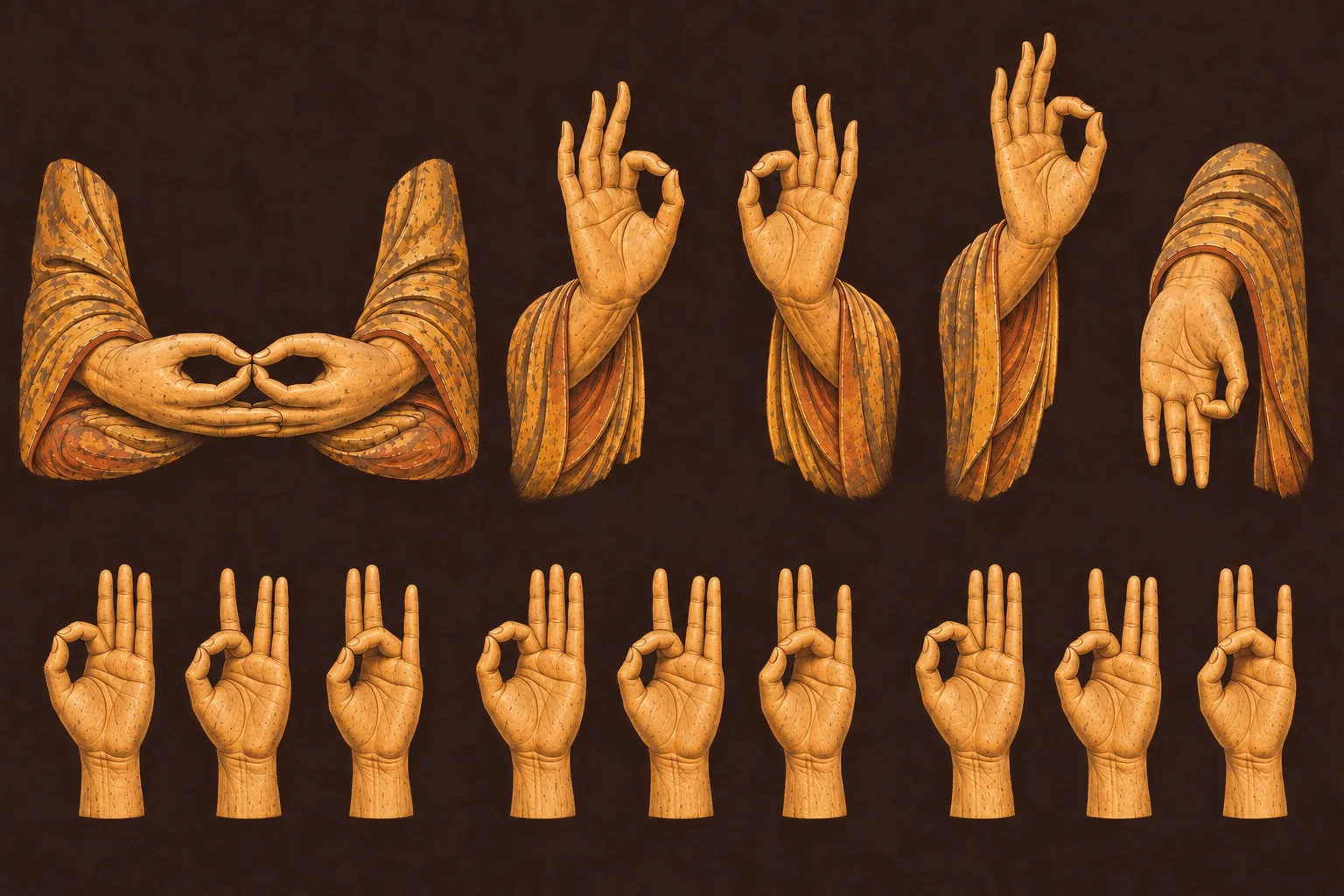
Amida’s three hand positions. Top, left to right: meditation (hands in the lap), preaching (both hands at the chest) and welcoming (right hand up, left hand down). Bottom: in each group of three, the thumb meets the index, middle and ring finger in turn.
The system is elegant, but it is late. The Contemplation Sutra describes nine grades, not nine mudras, and no ritual manual prescribes them. The set is generally thought to have been worked out in the Edo period; it appears in the Butsuzō zui, an illustrated iconographic handbook published in the Genroku era (1688–1704), and no earlier statues follow it. The nine Edo-period Amidas of Jōshinji, the "Kuhonbutsu" temple in Tokyo, each make a different mudra, a sign of how widely the scheme had spread by then. Heian and Kamakura statues were not carved to fit it; the labels were applied afterwards.
The best place to see the idea of nine grades in wood is Jōruriji, in the hills of Kizugawa south of Kyoto. Its main hall holds nine gilded Amida figures of the late Heian period in a single row, the central one carved in the late 11th century and the other eight in the early 12th, and it is usually described as the only nine-Amida hall to survive from that era. Here is the twist: the nine statues do not make nine different gestures. The large central Amida makes the welcoming gesture; the eight smaller ones all make Amida’s meditation gesture with the index fingers. In the language of the nine mudras, the eight are all "upper rank, upper birth," and the central figure is "upper rank, lower birth" or "lower rank, upper birth," depending on the scheme. The nine figures themselves stand for the nine grades. Walk the length of the long hall and you see eight pairs of hands folded quietly in eight laps, and in the middle one pair, one hand up and one down. Across a pond to the east stands a three-storey pagoda housing Yakushi, the Buddha of the Eastern Pure Land, so that east and west face each other over the water.
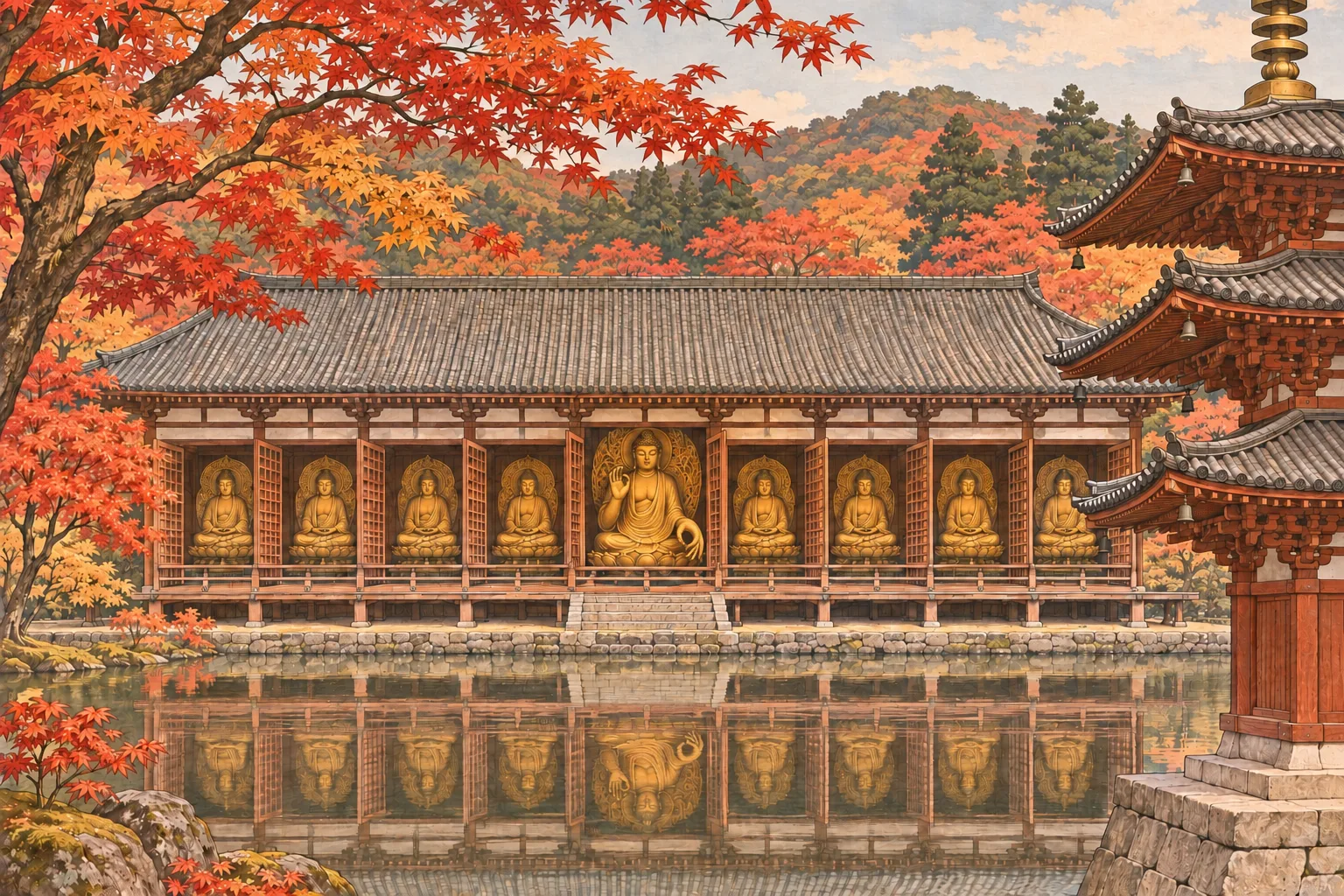
The nine-Amida hall of Jōruriji, seen across the pond from beside the pagoda. Nine figures sit in a row: the large central one makes the welcoming gesture, the eight smaller ones Amida’s meditation gesture.
04Dainichi: The Wisdom Fist and the Meditation Seal
In Esoteric Buddhism the code becomes strict. The central Buddha of the Shingon school is Dainichi Nyorai, the Great Sun Buddha, who appears in two basic forms tied to the two great mandalas. The hands tell them apart.
In the Diamond Realm (kongōkai), Dainichi makes the wisdom-fist mudra (chiken-in). The left hand makes a fist with the index finger pointing up; the right hand wraps around that finger, held at chest height. It looks a little like gripping a short rod. Interpretations stack up. The usual reading is that the right hand stands for the Buddha and the left for living beings, joined to show that the two, like delusion and awakening, are not separate. The name is also explained by the belief that the gesture dispels ignorance and leads into the Buddha’s wisdom.
In the Womb Realm (taizōkai), Dainichi makes the meditation seal, hokkai jōin: the same gesture as the meditating Shaka. On Shaka in a Zen hall it means concentration; on Dainichi it stands for principle, the underlying reality of all things. The two forms together express what Shingon calls the non-duality of the two realms.
There is a clue you will see even before the hands. Dainichi wears a jewelled crown, necklaces and armlets, dressed like a prince or a bodhisattva, not in the plain monk’s robe and tight snail-shell curls of other Buddhas. Among crowned Buddhas he is by far the most common; the few others include the crowned Amida of Tendai practice halls and the crowned Shaka of some Zen temples. So when you meet a crowned seated figure in an Esoteric temple, do not assume it is a bodhisattva. Check the hands: a gripped finger at the chest means Diamond Realm Dainichi; stacked hands in the lap mean Womb Realm Dainichi.
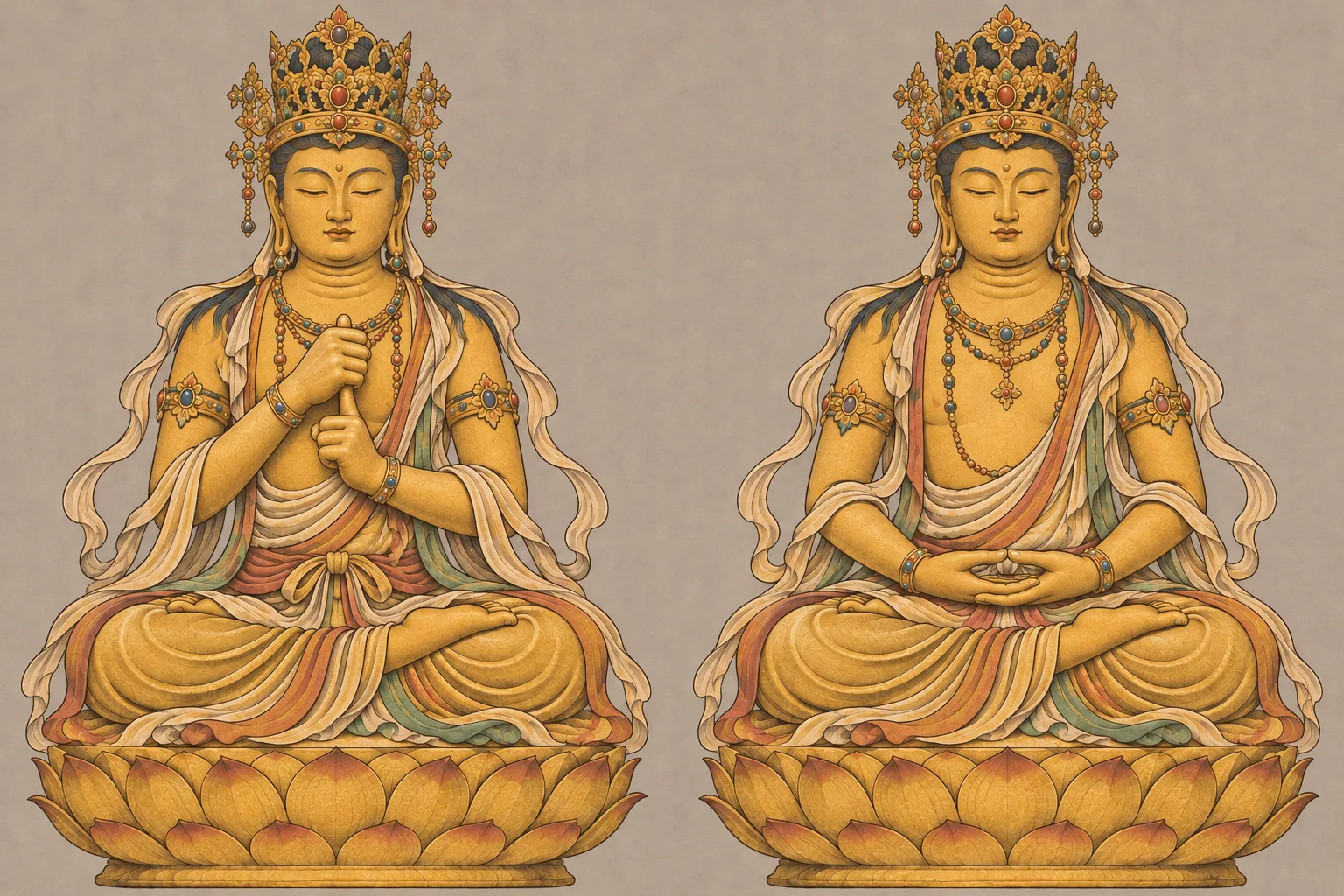
The two forms of Dainichi, both crowned and jewelled. Left: Diamond Realm, with the wisdom fist (chiken-in), the right hand gripping the raised left index finger. Right: Womb Realm, with the meditation seal (hokkai jōin) in the lap.
The seated Dainichi at Enjōji in Nara, completed by the young sculptor Unkei in 1176 and just under a metre tall, makes the wisdom fist with its arms held clear of the body and beautifully carved fingers. At Tōji in Kyoto, the central figure of the sculptural mandala in the Lecture Hall is a wisdom-fist Dainichi. In the Great Stupa (Konpon Daitō) on Mount Kōya, a Womb Realm Dainichi sits surrounded by the four Buddhas of the Diamond Realm, so a single building holds both mandalas.
What you see on statues is only the outermost layer of the system. Shingon and Tendai priests perform rituals that move through dozens of seals in sequence, often hidden beneath their sleeves, and most of these are not shown to outsiders.
05Joined Palms, Preaching Hands and Other Common Gestures
A few more gestures appear again and again in Japanese temples.
Gasshō, palms pressed together before the chest, fingers up, is the gesture Japanese visitors themselves make at the altar. It means reverence. On statues it is mostly made by attendants and bodhisattvas, rarely by the main figure, because it is a gesture of honouring someone higher. In the Raigō triad, Seishi often joins palms. The thousand-armed Kannon usually has its two main hands joined at the chest: at Sanjūsangendō in Kyoto, 1,001 standing Kannon figures (described in the article on Kannon) stand in rows, and every one of them holds its central hands together, row after row of joined palms receding into the dim hall. Esoteric images also use the diamond gasshō (kongō gasshō), with the fingers interlaced at the tips.
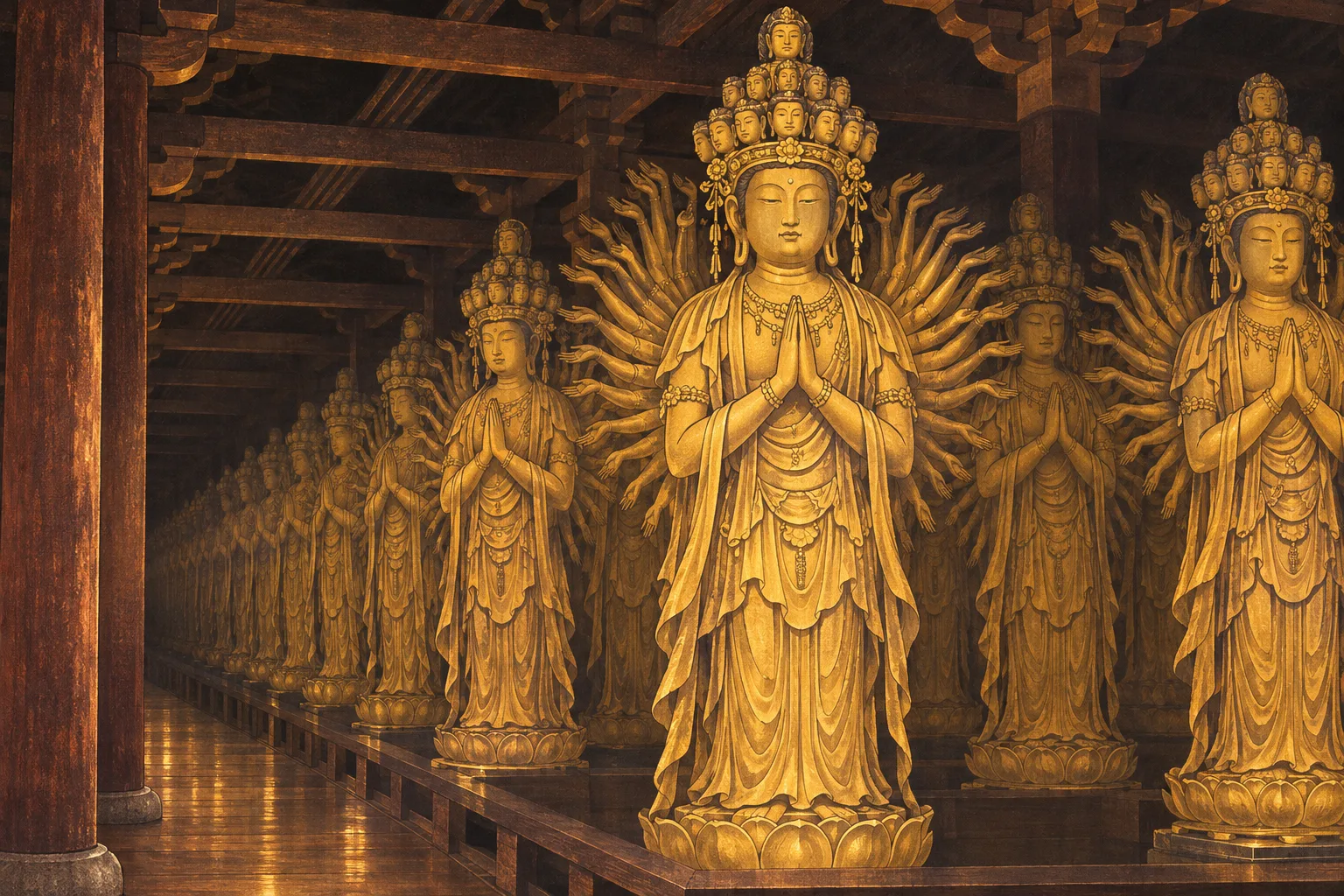
The thousand-armed Kannon figures of Sanjūsangendō in Kyoto: each holds its two main hands joined at the chest, row after row down the hall.
The preaching gesture (seppō-in) in Japan covers a loose family of forms: one or both hands raised before the chest, a ring formed between thumb and finger, palm out. Amida’s preaching mudras in the nine-grade scheme belong here. One of the Amida figures in the 7th-century wall paintings of Hōryūji’s Golden Hall is often described as making the wheel-turning gesture; the original walls were badly damaged by fire in 1949, and what visitors usually see are copies.
The pensive pose belongs to the half-lotus contemplating figures, one leg hanging down, the other crossed over the knee, the right elbow resting on that knee and the fingertips lightly touching the cheek. The two most famous are at Kōryūji in Kyoto and Chūgūji in Nara. They are usually identified as Miroku, the Buddha of the future, though Chūgūji’s own tradition calls its figure Nyoirin Kannon. The pose has no strict mudra name, but it is the most memorable moment in early Japanese sculpture.
The newborn Buddha points one hand to the sky and the other to the earth. Every year on 8 April, at the Hana Matsuri flower festival, temples set out a small bronze child in a flower-decked pavilion, and visitors pour sweet hydrangea tea over it with a ladle. According to legend, the infant Shaka took seven steps and declared, "Above heaven and below heaven, I alone am the honoured one."
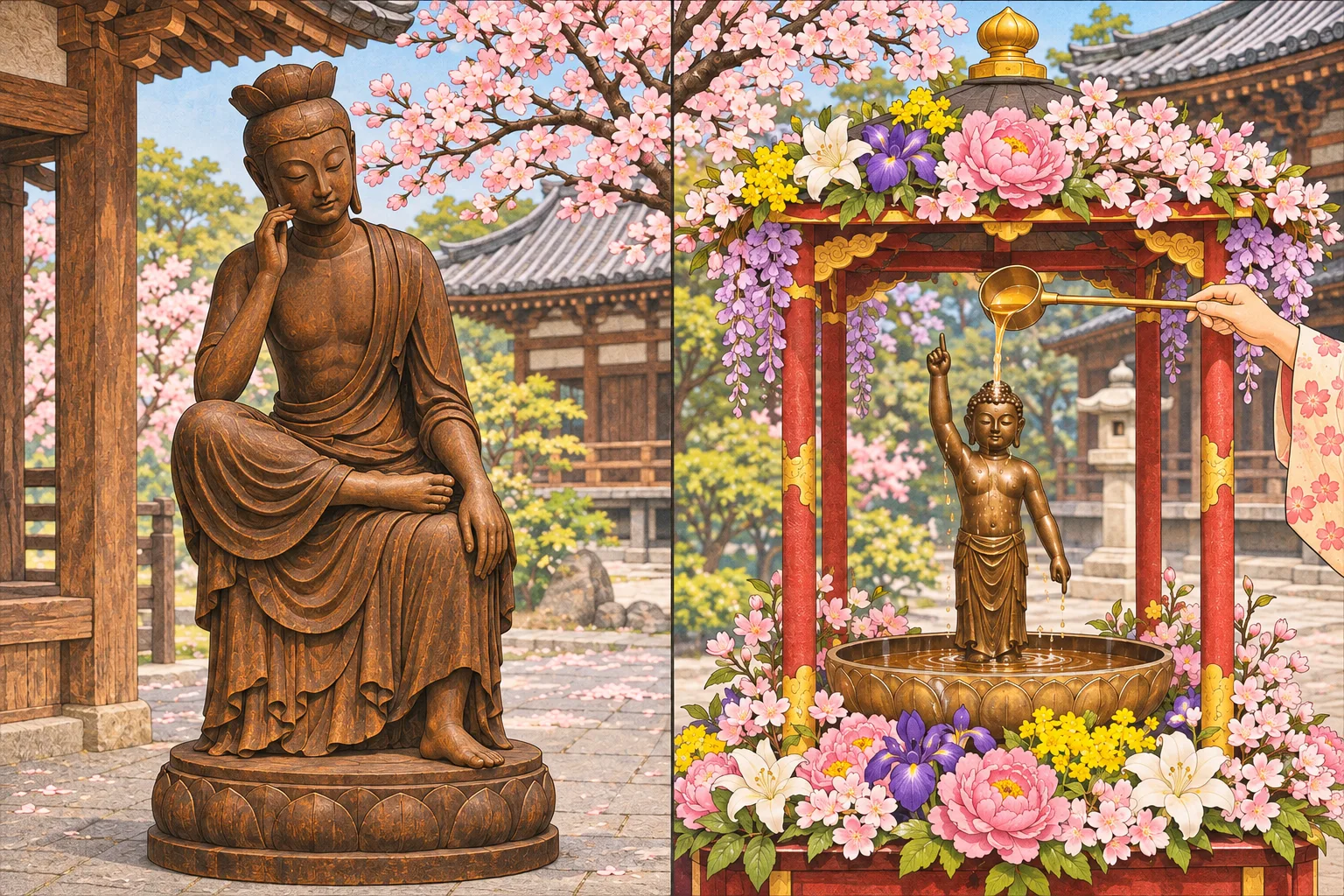
Left: the pensive half-lotus pose, one leg across the other knee and the fingertips of the right hand near the cheek. Right: the newborn Buddha at the flower festival on 8 April, one hand to the sky and one to the earth, as a visitor ladles sweet tea over it.
Some hands are best not forced into a named category. Eleven-headed and Shō Kannon often let the right hand hang loosely, palm forward, and in the Hasedera style that hand holds a monk’s staff. It resembles the wish-granting gesture, but many books simply describe it as a lowered hand.
06What They Hold
If mudras are verbs, attributes are nouns, and they are often the quicker route to a name.
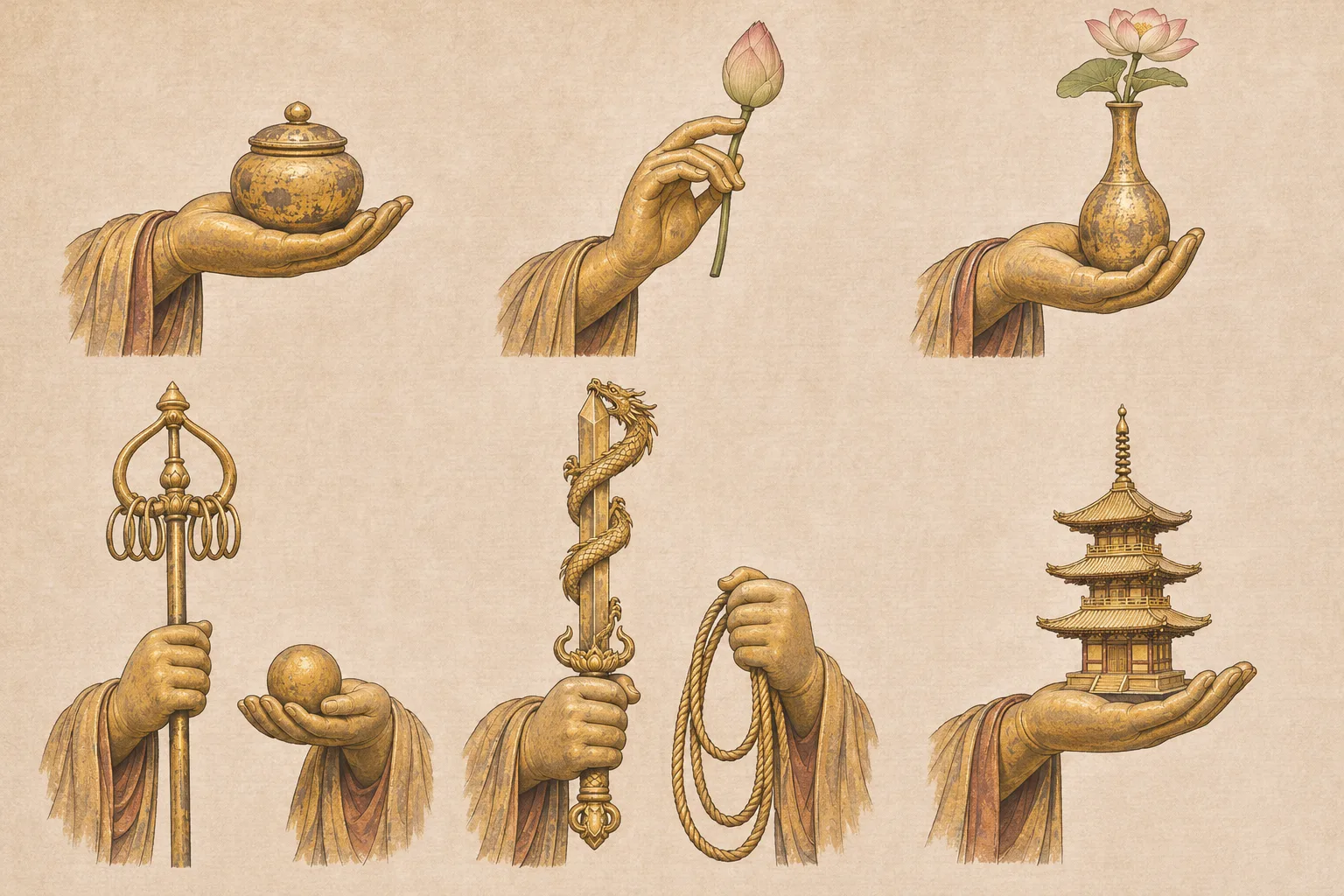
Six common attributes. Top, left to right: Yakushi’s medicine jar, Shō Kannon’s lotus bud, Eleven-headed Kannon’s water flask with a lotus. Bottom: Jizō’s staff and jewel, Fudō Myōō’s Kurikara sword and lasso, Tamonten’s small pagoda.
Yakushi, the Medicine Buddha, vowed to cure the sick, and he holds a small jar, about fist-sized, in his left hand while his right makes the fear-not gesture. He is the best-known exception to the empty-handed Buddha rule. But early Yakushi figures did not always hold one. The famous bronze Yakushi in the Golden Hall of Yakushiji in Nara, from the late 7th or early 8th century, rests an empty left hand palm-up on its knee and looks exactly like a Shaka. Jar-holding figures appear around the turn of the 9th century, such as the 9th-century Yakushi of Gangōji in Nara, and the jar became standard from the Heian period on. For a jarless Yakushi you rely on the temple’s tradition, the hall’s name, and the attendants, the sun and moon bodhisattvas Nikkō and Gakkō and the Twelve Heavenly Generals.
Kannon’s usual attributes are the lotus and the water flask. Shō Kannon often holds a lotus stem in the left hand, sometimes a closed bud, while the right hand reaches as if to open the petals. One explanation is that the bud stands for the Buddha-nature latent in every being, which Kannon helps to open. Eleven-headed Kannon commonly holds a water flask, suibyō, often with a lotus in it, in the left hand, with the right in the wish-granting gesture; the flask was originally an Indian monk’s vessel and here represents the pure water that washes away suffering. The Eleven-headed Kannon at Hasedera in Nara also holds a monk’s staff in its right hand, a variant known as the Hasedera style.
Jizō’s monk’s robe, wish-granting jewel and jingling pilgrim staff are covered in the article on Jizō, but two details reward a closer look. The jewel, round or slightly pointed like a flame, usually rests on a flat upturned palm, which is itself close to the wish-granting gesture. The staff head is an oval or heart-shaped metal frame threaded with loose rings, most often six, which some explain as one for each of the six realms of rebirth. Early Jizō figures often hold only the jewel, the right hand lowered in the wish-granting gesture; the jewel-and-staff pair appears from about the mid-Heian period and has been the standard form ever since. Even the roughest roadside stone Jizō usually shows the outline of jewel and staff.
Fudō Myōō, the Immovable Wisdom King, grips an upright sword in his right hand and a lasso, kensaku, in his left. The sword is sometimes wrapped by a dragon biting its tip, called the Kurikara sword. The sword cuts through delusion; the rope binds and drags back those who resist the teaching. Add the scowl, the halo of flame and, on many statues, the mismatched eyes, one looking up and one down, and Fudō is almost impossible to mistake.
The thousand-armed Kannon carries the largest arsenal. The arithmetic of its forty-two arms is explained in the article on Kannon; here the point is what the hands hold. Each holds an object or makes a gesture: a sun disc and a moon disc, a mirror, a bow and an arrow, an axe, a begging bowl, a conch, a sutra scroll, a bunch of grapes, a skull-topped staff, and a pair of hands held overhead lifting a tiny Buddha. Each object answers a different kind of prayer. In front of the great Kannon at Tōshōdaiji in Nara, which tries to show all thousand hands, you can read them one by one, like a list written on a body.
The guardian deities carry weapons and treasures. The Four Heavenly Kings stand at the corners of the altar, trampling demons. Jikokuten (east) usually holds a sword; Zōjōten (south) a halberd or sword; Kōmokuten (west) often a brush and scroll; Tamonten (north) a small pagoda in one hand and a halberd in the other. Worshipped alone, Tamonten is called Bishamonten, and that little pagoda is his signature. The Kōmokuten in the Kaidan-dō of Tōdaiji, brush in hand and frowning into the distance, is a much-cited example. The Niō guardians at temple gates hold a vajra (kongōsho), a short club with pronged ends that began as the weapon of an Indian thunder god. Benzaiten often cradles a lute; her eight-armed form brandishes bow, arrows, sword and wheel.
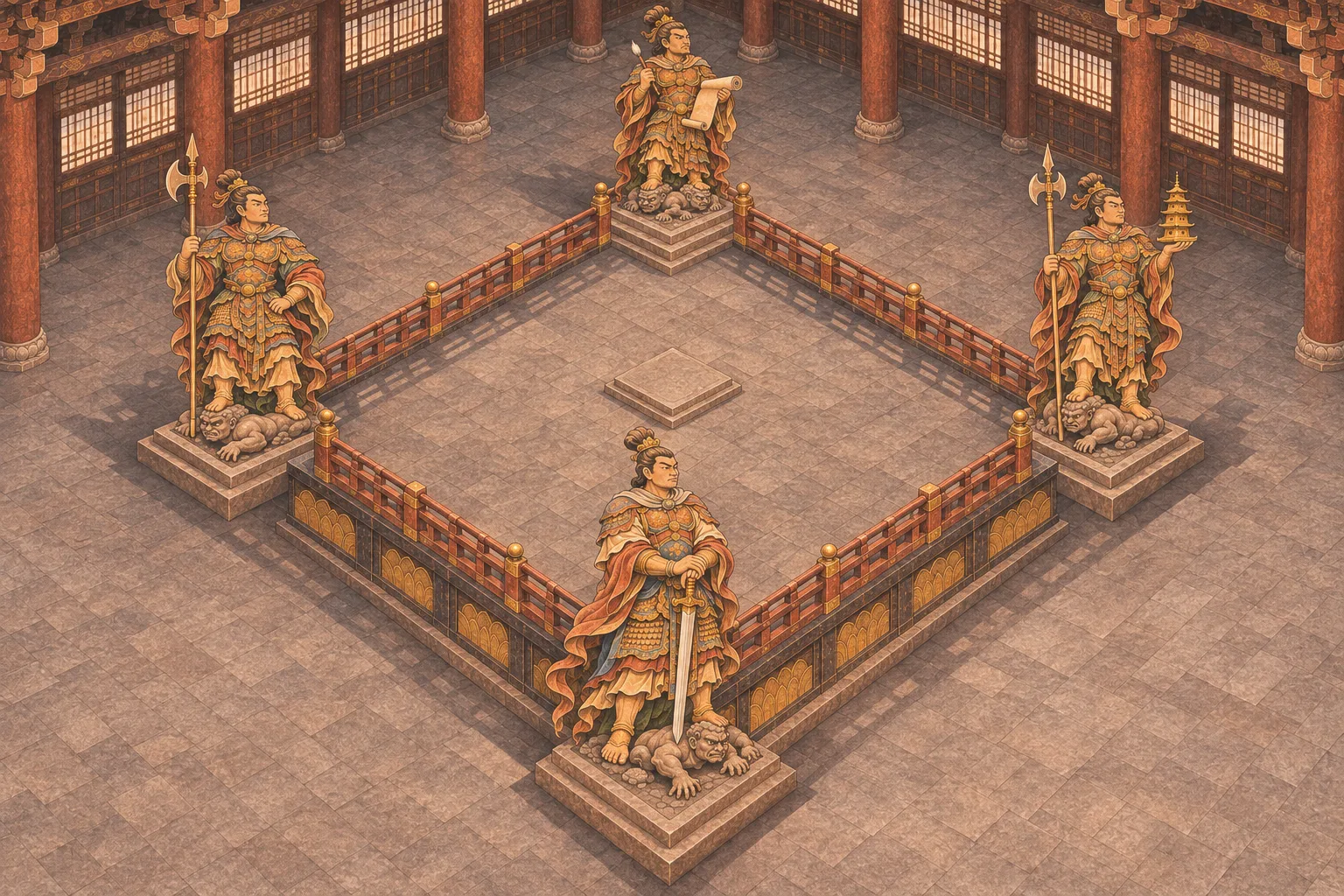
The Four Heavenly Kings at the corners of the altar, trampling demons. Nearest, with a sword, is Jikokuten; on the left, with a halberd, Zōjōten; at the back, with brush and scroll, Kōmokuten; on the right, with pagoda and halberd, Tamonten.
Two bodhisattvas are worth adding. Monju, the bodhisattva of wisdom, holds a sword and a sutra scroll and rides a lion. Fugen rides a white elephant, usually with palms joined.
07Side by Side: Same Gesture, Different Meaning
Here are the pairs that most often confuse visitors.
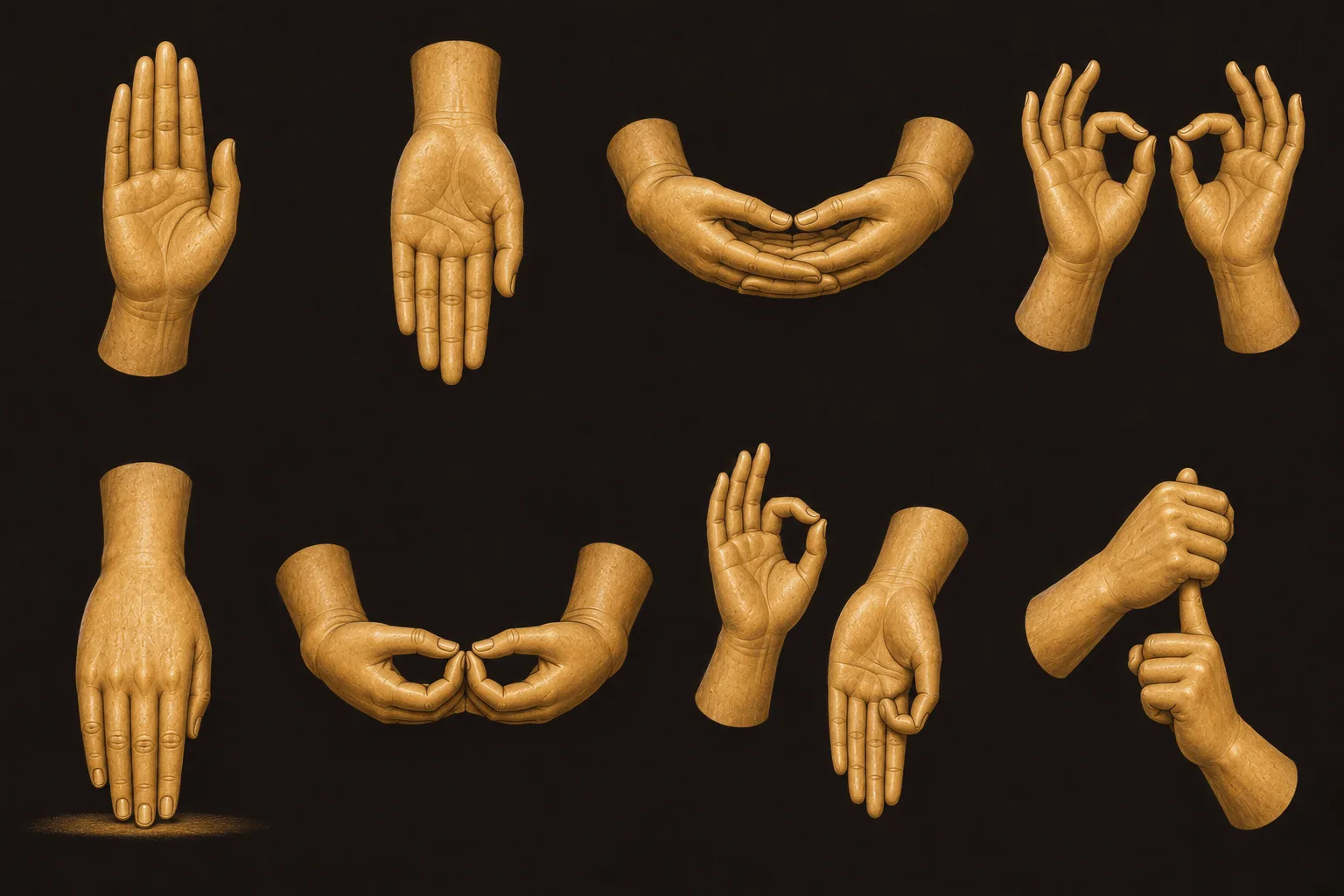
Eight gestures. Top, left to right: fear-not, wish-granting, the meditation seal (hokkai jōin), turning the Wheel. Bottom: earth-touching, Amida’s meditation gesture (mida jōin), the welcoming gesture (raigō-in), the wisdom fist (chiken-in).
Start with hands in the lap. The meditation seal makes one wide oval with the thumbs touching; it belongs to Shaka (often in Zen temples) and Womb Realm Dainichi (who wears a crown); a crowned Zen Shaka is told apart by the temple’s school. Amida’s meditation gesture makes two small rings with bent index fingers; it is almost exclusive to Amida. The wisdom fist is held at the chest, not the lap, but beginners often lump it in; remember it as "a hand gripping a finger."
Next, one hand up and one down. Fear-not plus wish-granting has open, straight fingers and no rings; it is the early all-purpose pairing used by several Buddhas. The welcoming gesture looks almost identical but adds a thumb-and-finger ring, and it belongs mainly to Amida from the late Heian period on. Lean in and look at the fingertips.
Then both hands at the chest. The wheel-turning gesture brings two rings together as if spinning a wheel; Amida’s preaching gesture holds two rings side by side, palms out. Japanese books often call both "preaching mudras."
The same gesture can also change meaning with the figure. The meditation seal is concentration on Shaka and cosmic principle on Dainichi. The raised palm is reassurance on Shaka and a promise of healing on Yakushi. Joined palms on a figure usually mean it is not the main image of the hall, because it is honouring someone else.
There are three reasons you cannot identify a statue by its hands alone. First, early gestures were few and shared: an Asuka-period Shaka, Yakushi and Amida can look nearly identical from the wrists down. Second, many rules, like the nine grades, were systematised later and applied backward to older statues. Third, and most practically, hands break. Most wooden statues from the late Heian period on use the joined-block technique (yosegi-zukuri), and the hands, sometimes individual fingers, were carved separately and slotted in. Over centuries the joints loosen and pieces fall off, and later restorers carve replacements, following temple tradition or the fashion of their own day. A Yakushi that loses its jar starts to look like a Shaka. An Amida with replacement fingers may no longer show its original grade. Catalogue entries often note "both hands are later replacements" for exactly this reason.
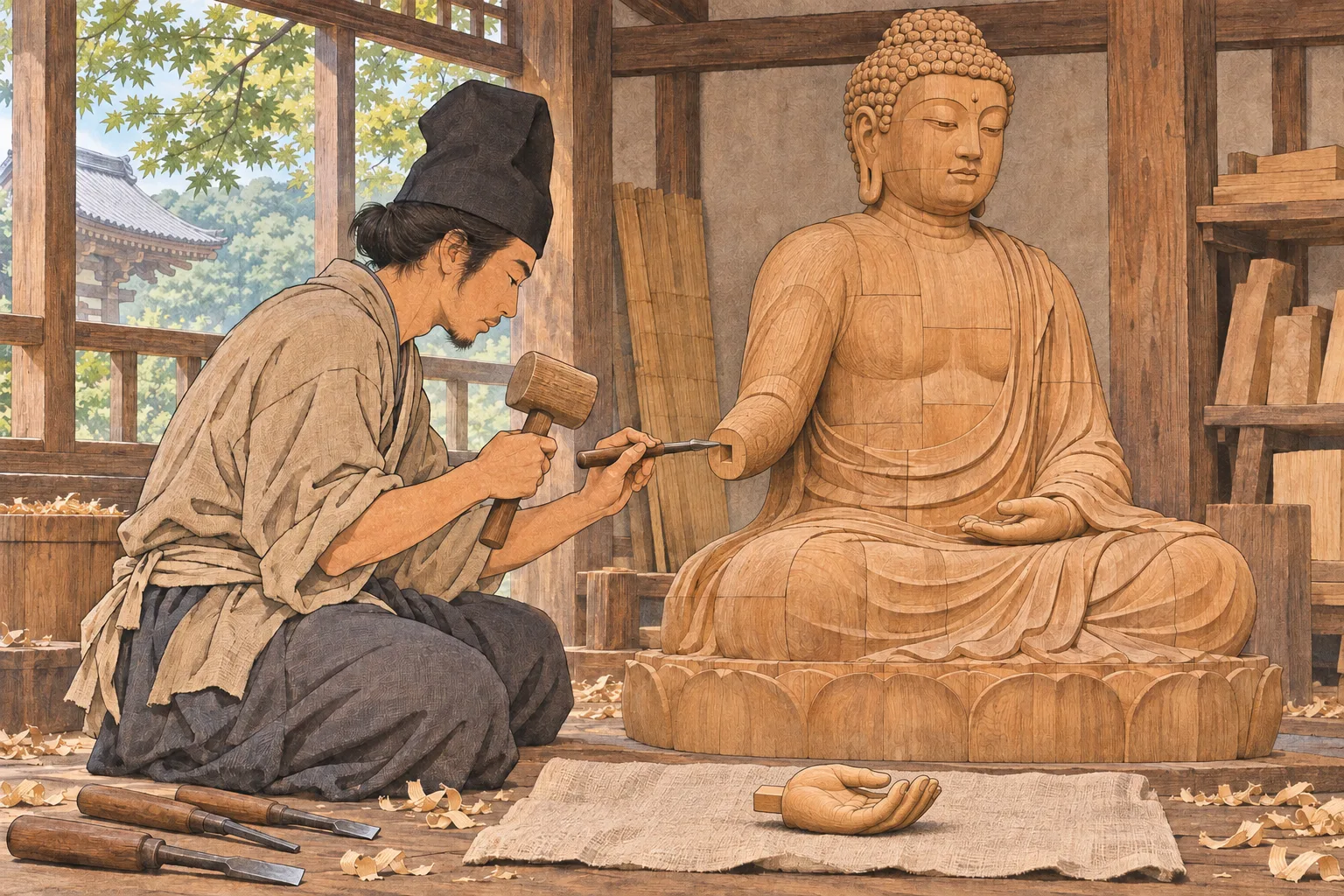
On joined-block statues the hands are often carved separately and slotted in. Here the sculptor trims the socket at the wrist; the finished hand lies on the cloth in front. (artist’s impression)
So treat the hands as one clue among several: snail-shell curls or crown, monk’s robe or scarves and jewellery, seated or standing, a mount or none, who stands to either side, the name of the hall, the school of the temple. Nikkō and Gakkō on either side mean Yakushi, jar or no jar. Kannon and Seishi on either side mean Amida. A crown with a wisdom fist can only be Diamond Realm Dainichi.
08How the Hands Are Seen Today
Most Japanese visitors do not stop to classify mudras. They join their palms, bow, drop a coin and make a wish, and whether the Buddha in front of them is welcoming or meditating is beside the point. Close readers of hands are art lovers, students and the self-described butsuzō fans who have made temple-statue exhibitions some of the most crowded shows in Japanese museums in recent decades. Nearly every beginner’s guide to Buddhist statues includes a page of mudra diagrams, and museum shops sell handkerchiefs and stickers printed with them.
For priests the gestures mean something else. A Shingon or Tendai priest learns to move through seal after seal in ritual, a bodily skill built over years. A Zen monk sitting zazen holds the meditation seal every day and cares whether the thumbs stay lightly touching, not what the gesture is called in an art-history book.
Popular culture borrows the look. The rapid hand signs of ninja fiction, the nine syllables rin, pyō, tō, sha, kai, jin, retsu, zai, zen, are generally traced to a Chinese Daoist incantation that later mixed with Esoteric-style hand seals through mountain asceticism (Shugendō) and folk practice, before novels and manga exaggerated it. It is related to the hands on temple statues, but it is not the same thing.
For a traveller the simplest method is this: when you step into a hall, look at the hands first, then the head and the attendants. The hands tell you what the figure is doing, meditating, teaching, welcoming, reassuring, or gripping a single finger of wisdom. The head and the companions tell you who it is.
More deep dives on this topic
 Four Ranks of Buddhist StatuesStep out of the sunlight into a Japanese temple hall and your eyes take a moment to adjust.
 Mudras and AttributesIn the half-light of a Japanese temple hall, the face of a Buddha is often hard to make out.
 Niō and the Four Heavenly KingsWalk up to almost any large Buddhist temple in Japan and the first figures you meet are not serene Buddhas but two furious, nearly naked giants flanking the gate.
 PagodasWalk up the stone lanes of Higashiyama in Kyoto and the Yasaka Pagoda rises over the tiled roofs of the old townhouses; ride the bullet train into Kyoto Station and the dark…
 The GaranMost visitors to a Japanese temple experience it as a sequence: a gate, a path, a big hall, perhaps a pagoda off to one side.
 How Buddhist Statues Are MadeWalk through the temples of Nara and Kyoto and you will meet Buddhas that are gold, black, chalky grey, or the warm brown of old wood.
 Reading Temple NamesMost visitors to Tokyo know Sensō-ji, the great Kannon temple in Asakusa.
 Shōjin RyōriThe first thing many visitors eat at a temple lodging on Mount Kōya is a small, pale square that wobbles on a lacquer dish.
 A Night in a TempleMost temples in Japan close their gates at dusk.
- Back to the main article: Japanese Buddhism →