
Walk through the temples of Nara and Kyoto and you will meet Buddhas that are gold, black, chalky grey, or the warm brown of old wood. Some weigh tonnes; one famous figure weighs about as much as a small child. The differences are not only a matter of style. Underneath the surface, a Japanese Buddhist statue may be a bronze shell, a clay figure built around a wooden post, a hollow skin of lacquered cloth, a single tree trunk, or dozens of wooden blocks glued together like a puzzle. Over about a thousand years the main method shifted from bronze to clay and lacquer, then to solid wood, then to assembled wood, and each shift tells you something about money, materials, belief and how sculptors organised their work. Once you know what to look for, the inside of a statue becomes a way of reading its age.
01Cast in Metal: Gilt Bronze
When Buddhism reached Japan from the Korean kingdom of Baekje in the sixth century, the images that came with it were mostly small gilt-bronze figures: bronze cast in a mould and then coated with gold. The first statues made in Japan followed that model.
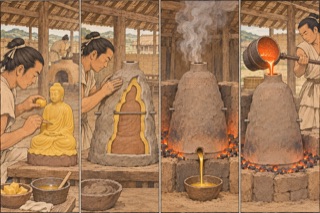
The basic technique is lost-wax casting. A sculptor builds a rough core of clay in the shape of the figure, then covers it with a layer of beeswax and carves the face, fingers and drapery into the wax. A second layer of clay is packed around the wax to make an outer mould, with metal pins pushed through to hold the core in place. When the whole thing is heated, the wax melts and runs out, leaving a thin, statue-shaped gap between core and mould. Molten bronze is poured into that gap. After cooling, the outer mould is broken away, the clay core is dug out, and the surface is filed, polished and patched where air bubbles left holes. On small figures you can sometimes spot a square opening in the back where the core was removed, or tiny holes where the pins once sat.
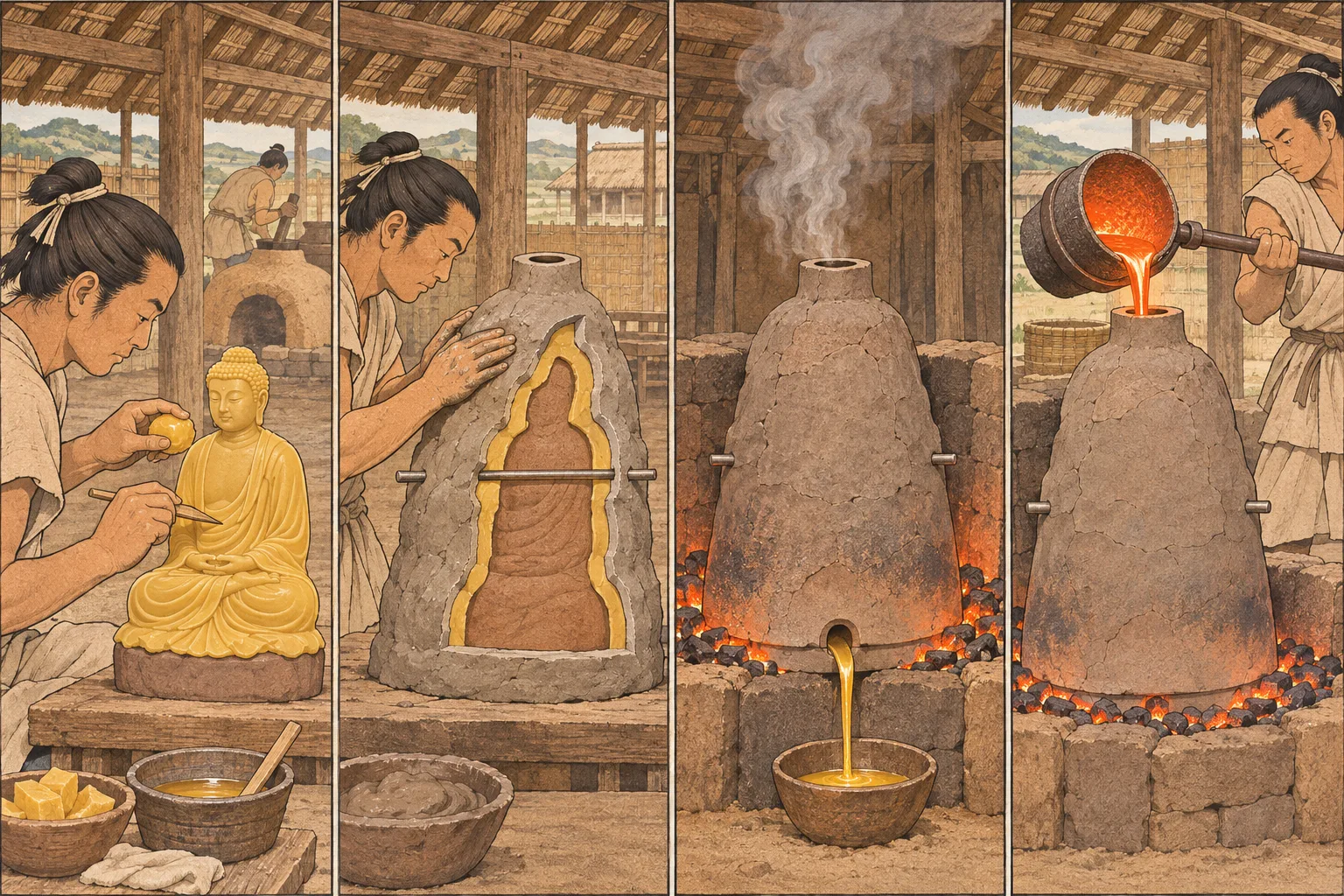
Lost-wax casting in four steps, left to right: carving the wax over a clay core; wrapping it in a clay outer mould held by pins; baking until the wax runs out; pouring molten bronze in from the top. (artist’s impression)
Gilding was done with mercury. Gold was dissolved in mercury to make a silvery paste, brushed onto the bronze and heated over charcoal. The mercury boiled away as vapour and the gold stayed bonded to the metal. Repeated several times, this produced a deep, soft gold. Where that gold has worn off, the bronze beneath has darkened to a glossy black, which is why so many ancient bronze Buddhas in Japan look black today.
The Asuka Great Buddha at Asuka-dera (now called Angoin), vowed in 605 and generally thought to have been completed around 609 by the sculptor Kuratsukuri no Tori, is one of the earliest large statues made in Japan. It was badly damaged by a lightning fire in 1196 and has been patched many times since; how much of the original survives is still debated. Up close its face is a patchwork of different textures and colours, a record of every repair. Tori’s style is easier to see at Hōryū-ji, where the Shaka Triad in the Golden Hall carries an inscription dated 623 naming him as its maker. The faces are long, the eyes almond-shaped, the lips curved in a faint smile, and the robes fall in symmetrical folds that spill over the front of the pedestal like a frozen waterfall. The central figure, attendants and the large flame-shaped halo were cast as separate pieces and fitted together, an approach called split casting that becomes essential as figures grow larger.
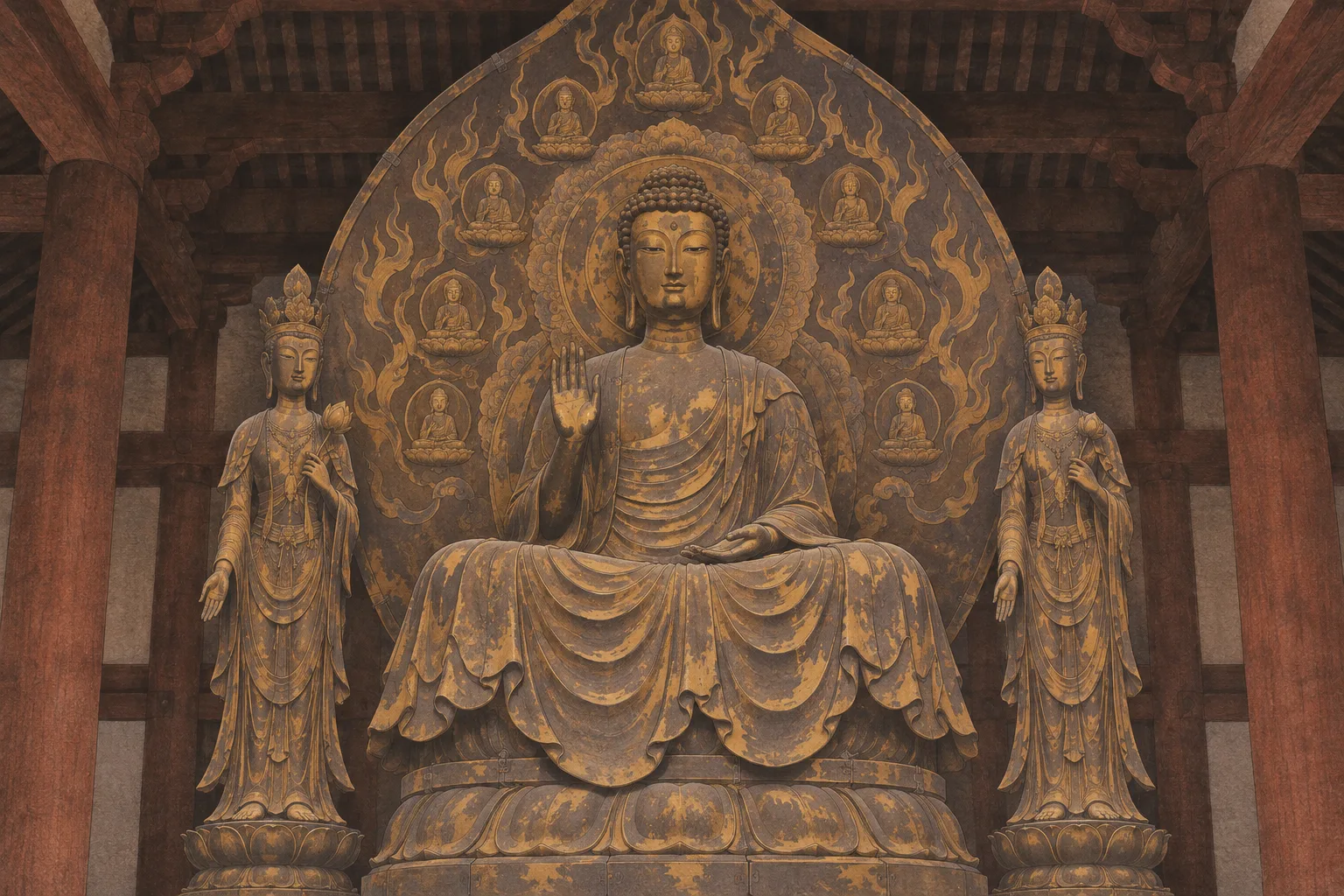
The Shaka Triad in the Golden Hall of Hōryū-ji: long faces, almond-shaped eyes and symmetrical folds spilling over the pedestal. The central figure, attendants and halo were cast as separate pieces.
A later stage of bronze work stands in the Golden Hall of Yakushi-ji: the Yakushi Triad, its gold almost entirely gone, its surface a deep oily black that catches faint light in the dim hall. The seated Buddha is full-bodied and the two attendants sway in graceful S-curves. Scholars have argued since the Meiji era over whether the triad was cast at the temple’s first site in the earlier capital and moved, or cast fresh after the temple relocated to Nara, which places its date either in the late seventh or early eighth century.
02The Biggest Bronze: Tōdai-ji
Bronze reached its peak, and its limit, with the Great Buddha of Tōdai-ji. Emperor Shōmu vowed to build it in 743, and its eyes were ceremonially "opened" in 752. At roughly 15 metres tall, it was far too big for a wax model.
Instead, workers built a full-size clay figure around a timber frame. They took the outer mould off this figure in sections, shaved a layer from the surface of the clay figure equal to the thickness the bronze should be, put the mould sections back, and poured metal into the gap. According to temple records, the statue was cast in eight horizontal stages from the bottom up. After each stage, earth was heaped around it to make a working platform for the next, so that by the end the Buddha was buried inside an artificial hill, which then had to be dug away. The hundreds of snail-shell curls on its head were cast separately and attached. The project swallowed a large share of the country’s copper output.
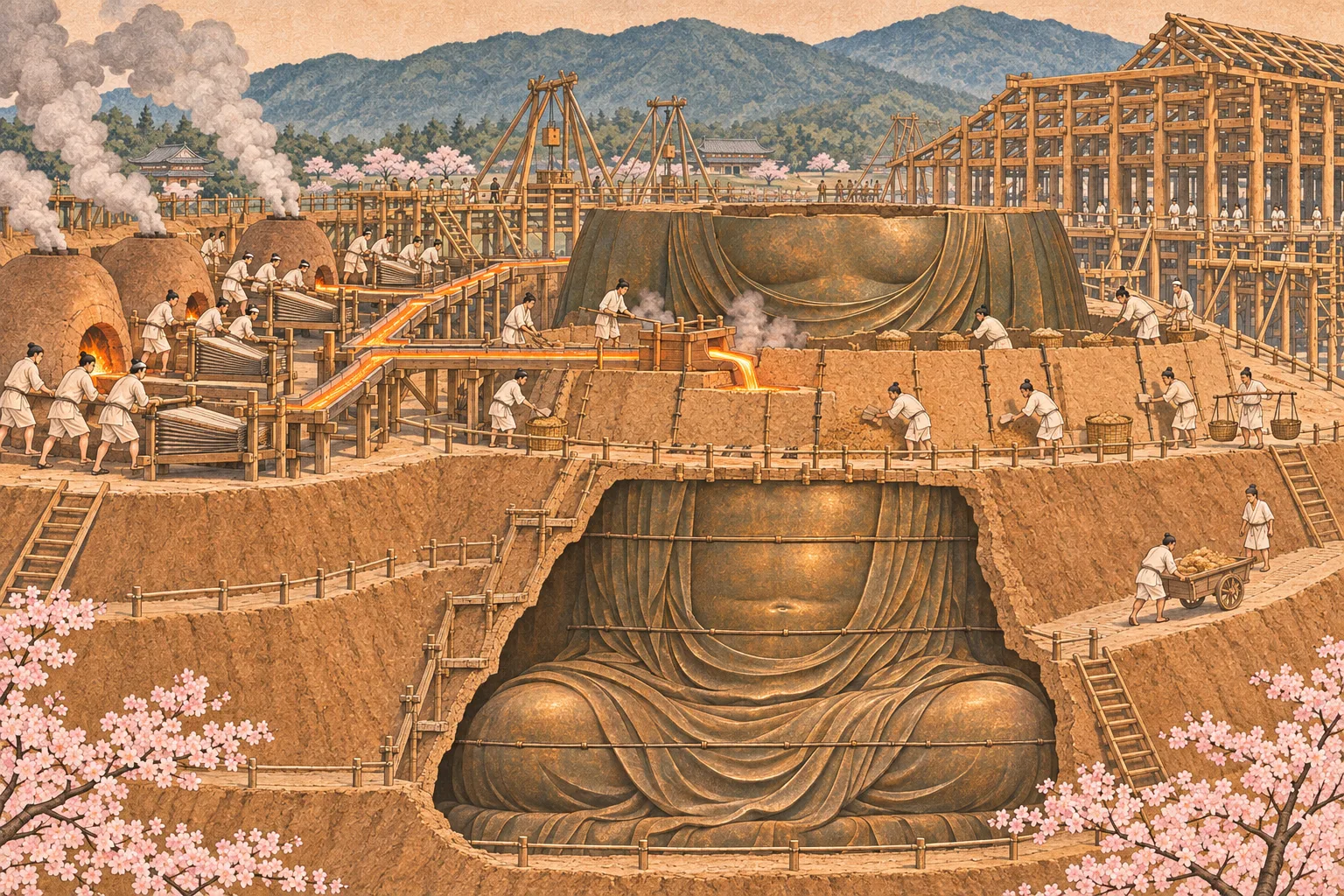
Casting the Great Buddha of Tōdai-ji in the eighth century. The statue rose stage by stage inside a growing mound of earth, with molten bronze running from the furnaces into the mould. (artist’s impression)
What visitors see today is not the eighth-century statue intact. It was damaged in wars in 1180 and 1567; the head was recast in the Edo period, and much of the body has been repaired. The eighth-century metal survives mainly from the belly down through the legs and on the lotus pedestal, where the petals are engraved with fine-line images of a Buddhist cosmos.
03Clay and Lacquer: The Nara Workshops
In the eighth century, alongside bronze, Nara’s great temples used two techniques learned from Tang China: modelled clay and dry lacquer. Ironically, fewer examples of either survive in China from that period, so Nara is the best place in the world to see them.
A clay statue (sozō) begins with a wooden skeleton: a central post with crosspieces for the arms and head, wrapped tightly with straw rope so the clay will grip. Coarse clay mixed with chopped straw goes on first to build the mass. Finer clay follows, and the final skin is very fine clay mixed with paper fibre and powdered mica, smooth enough for eyebrows, fingernails and the crisp edge of a sleeve. Once dry, the figure was coated in white ground and painted, sometimes gilded. Because clay can be added as well as taken away, these figures have a softness that carving struggles to match: fleshy cheeks, tensed muscles, parted lips.
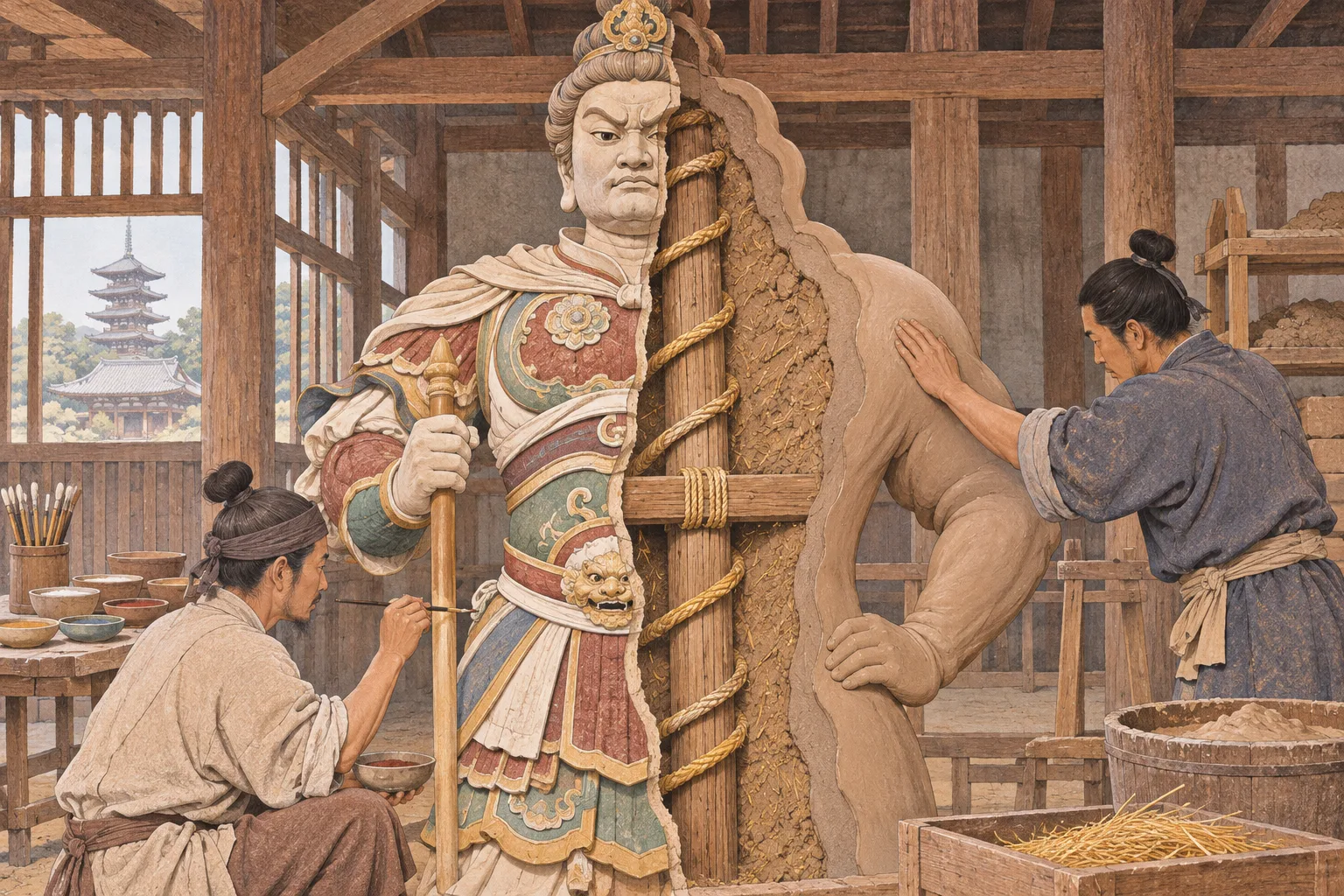
Inside a clay statue: one half is finished and painted, the other shows the wooden skeleton, the straw rope wound round it and the coarse clay mixed with straw. (artist’s impression)
The Four Heavenly Kings in Tōdai-ji’s Kaidan-dō are the best known. Dressed in Chinese-style armour and standing on crouching demons, each has a distinct expression; one narrows his eyes and holds a brush and scroll as if recording everything he sees. Their paint has faded so much that the grey-brown clay shows through, which makes the modelling of their faces stand out all the more. Older still are the clay tableaux at the base of Hōryū-ji’s five-storey pagoda, generally dated to 711. On the north side, a reclining Buddha lies at the moment of death surrounded by small disciples who wail, beat their chests and contort their faces in grief, some of the earliest raw emotion in Japanese sculpture. You peer in through a grille, and it takes a moment for your eyes to adjust.
Clay’s drawbacks are obvious. It is heavy, hates damp, cannot be moved, and shatters in earthquakes. Many clay figures survive only as heads.
Dry lacquer (kanshitsu) came in two forms. In hollow dry lacquer (dakkatsu kanshitsu), a clay model was coated in lacquer and wrapped in hemp cloth, then given more lacquer and more cloth, layer after layer, until it formed a hard shell. Workers cut an opening in the back, scooped out all the clay, set a wooden armature inside for support and closed the hole. Finally they modelled the fine details on the surface with kokuso, a putty of lacquer mixed with sawdust, before gilding or painting.
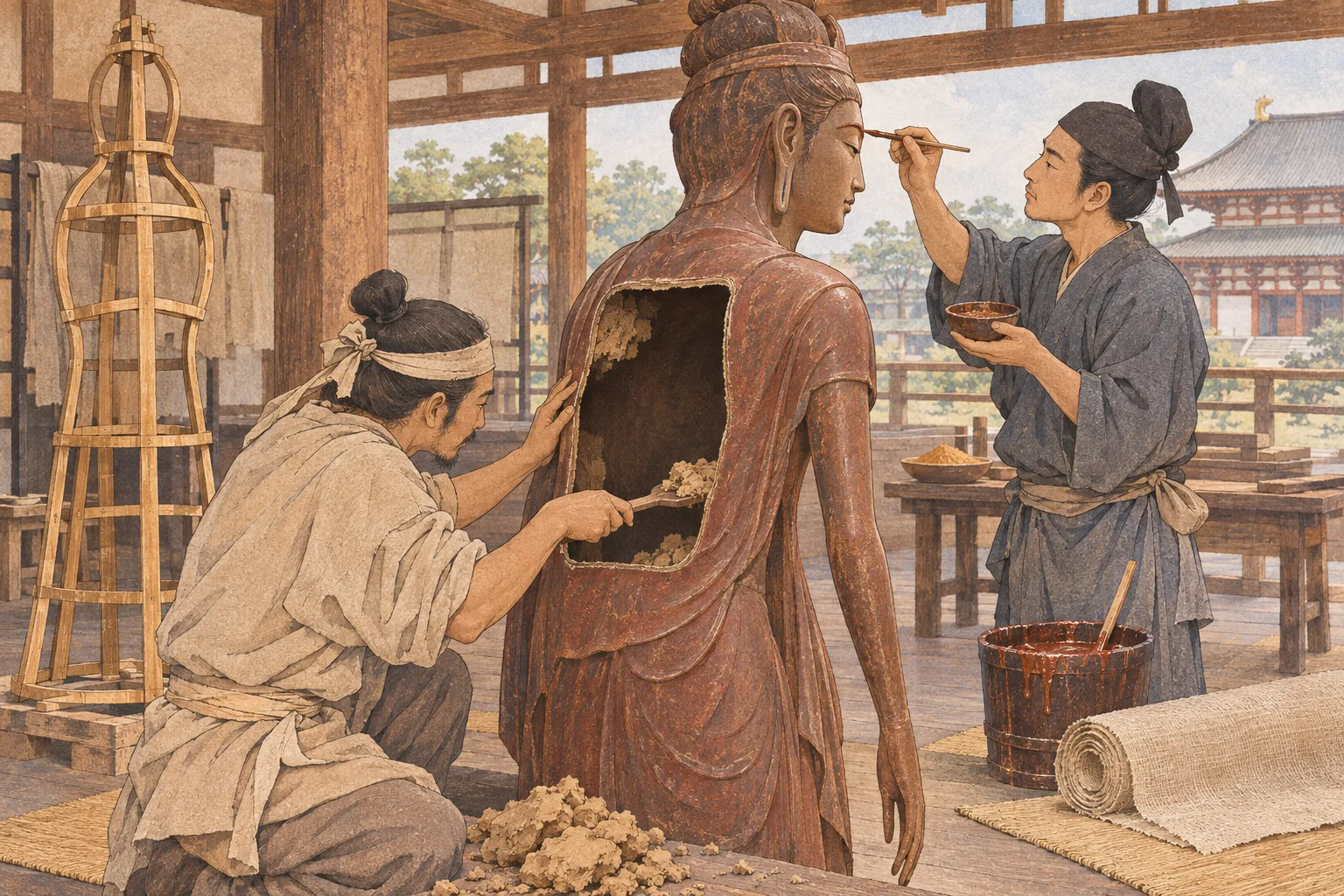
The key step in hollow dry lacquer: once the shell of lacquered cloth has hardened, the clay is scooped out through an opening in the back. The wooden armature on the left goes inside afterwards. (artist’s impression)
The result is light and almost empty inside. The Ashura at Kōfuku-ji, made in 734 as part of a set commissioned by Empress Kōmyō in memory of her mother, is the famous example: three faces, six arms as thin as reeds, and the expression of a troubled boy. Arms that slender would snap in clay and would be hard to achieve in solid wood; hollow lacquer made them possible. The statue stands about 1.5 metres tall, yet each figure in its set weighs only around 10 to 15 kilograms; their lightness is said to be why they could be carried out of Kōfuku-ji during its many fires. In 2009 it travelled to Tokyo and Kyushu, where more than 1.6 million people came to see it. The portrait of the monk Jianzhen (Ganjin in Japanese) at Tōshōdai-ji, with closed eyes, thin pressed lips and lined skin, shows how lacquer’s layer-by-layer build-up suited realistic portraiture.
The second form, wood-core dry lacquer (mokushin kanshitsu), skipped the clay model. Sculptors carved a rough figure in wood and modelled the surface in a thicker layer of lacquer putty. It used less lacquer and was sturdier. By the late eighth century it had largely replaced the hollow method, as seen in the Thousand-Armed Kannon in Tōshōdai-ji’s Golden Hall, and it points the way to what came next: more wood, less lacquer.
The reason was cost. A lacquer tree yields only a small amount of sap each year, and a large statue consumed enormous quantities, along with cloth and labour. These works were almost all commissioned by the court and the great state temples, which had a government office running their workshops. When state spending on temple building fell away, so did dry lacquer.
04Carved from One Tree
From the late eighth and ninth centuries, wood became the main material, carved by a method called ichiboku-zukuri: the head and torso cut from a single block of timber. Arms, pedestals and halos might be added separately, but the body is one piece.
These statues have real weight. The standing Yakushi at Jingo-ji in Kyoto is solid and broad-thighed with a stern face, narrowed eyes and a tight mouth. Its robe folds are cut deep, alternating a rounded ridge with a sharp one in a rolling-wave pattern. Some of these figures were left unpainted or only lightly coloured so the wood grain shows. The standing Eleven-Headed Kannon at Hokke-ji in Nara, another single-block masterpiece, sways slightly with the toes of one foot lifted, as if about to step forward.
Several things pushed sculptors to wood. Bronze and lacquer were expensive, and once large state projects ended, provincial temples and mountain monks needed something easier to obtain. Japan had plenty of timber. China also had a fashion for "sandalwood images," figures carved from fragrant, close-grained wood and left unpainted; Japan had no sandalwood, and wood analysis since the late 1990s has found that most eighth- and ninth-century carved statues are kaya (Japanese nutmeg-yew). Researchers link this to a Buddhist commentary that names a particular tree as a substitute for sandalwood, a tree the Japanese seem to have identified as kaya. And there was respect for trees themselves. Temple legends tell of images carved from trees struck by lightning or from old trees at shrines, and of "spirit wood" that glowed. Keeping the statue in one piece kept the tree whole.
Wood had been used before, in the Asuka period, mostly camphor, the material of the Kudara Kannon and the Guze Kannon at Hōryū-ji. But bronze was the main medium then.
Solid wood has one big problem: it cracks. The outside of a log dries before the inside, shrinks unevenly, and within a few years long splits open up. Carvers solved this by hollowing (uchiguri): cutting into the back or base of the figure and removing the heartwood so the walls were of even thickness, then covering the opening with a back panel. Turn many of these statues around in a museum and you will see the rectangular outline of that panel. Early figures were only shallowly hollowed or not at all, and some still carry long cracks.
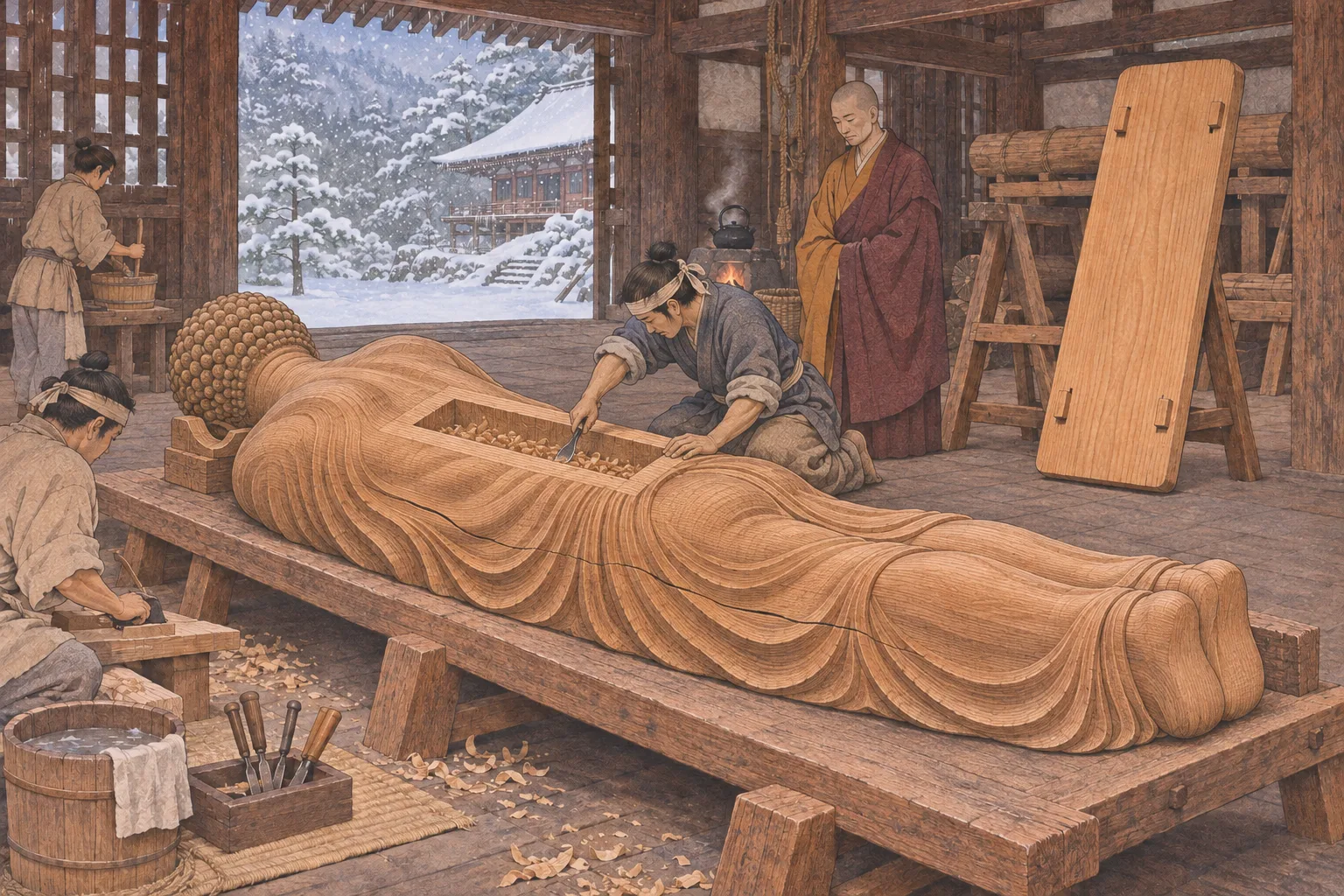
Hollowing a single-block statue from the back to keep the wood from cracking. The board leaning on the right will close the cavity; a lengthwise crack already runs down the figure. (artist’s impression)
The other limit is size. A statue can only be as big as the tree you can find.
05Assembled Wood: Jōchō’s Revolution
In the eleventh century, Kyoto’s aristocrats were gripped by Pure Land devotion and by the belief that the age of the Decline of the Dharma would begin in 1052. They built halls to Amida Buddha in hopes of rebirth in his paradise, and the most powerful, such as the Fujiwara regents, ordered statues by the dozen. The sculptor Jōchō perfected a method that met the demand: yosegi-zukuri, joined-block construction.
The head and body are planned as several blocks. Each is roughed out and hollowed separately, then the blocks are joined with glue, pins and dowels, and the finished surface is carved across the joins, lacquered and gilded. Hands and forearms are separate pieces again.
The advantages are practical. You no longer need giant logs. Every block is hollowed thin, so the statue is light and rarely cracks. Several assistant carvers can work on different blocks at once while the master controls proportion, so big commissions get done fast. And statues can be taken apart to move or repair. From Jōchō’s time on, almost every large wooden Buddha in Japan was made this way.
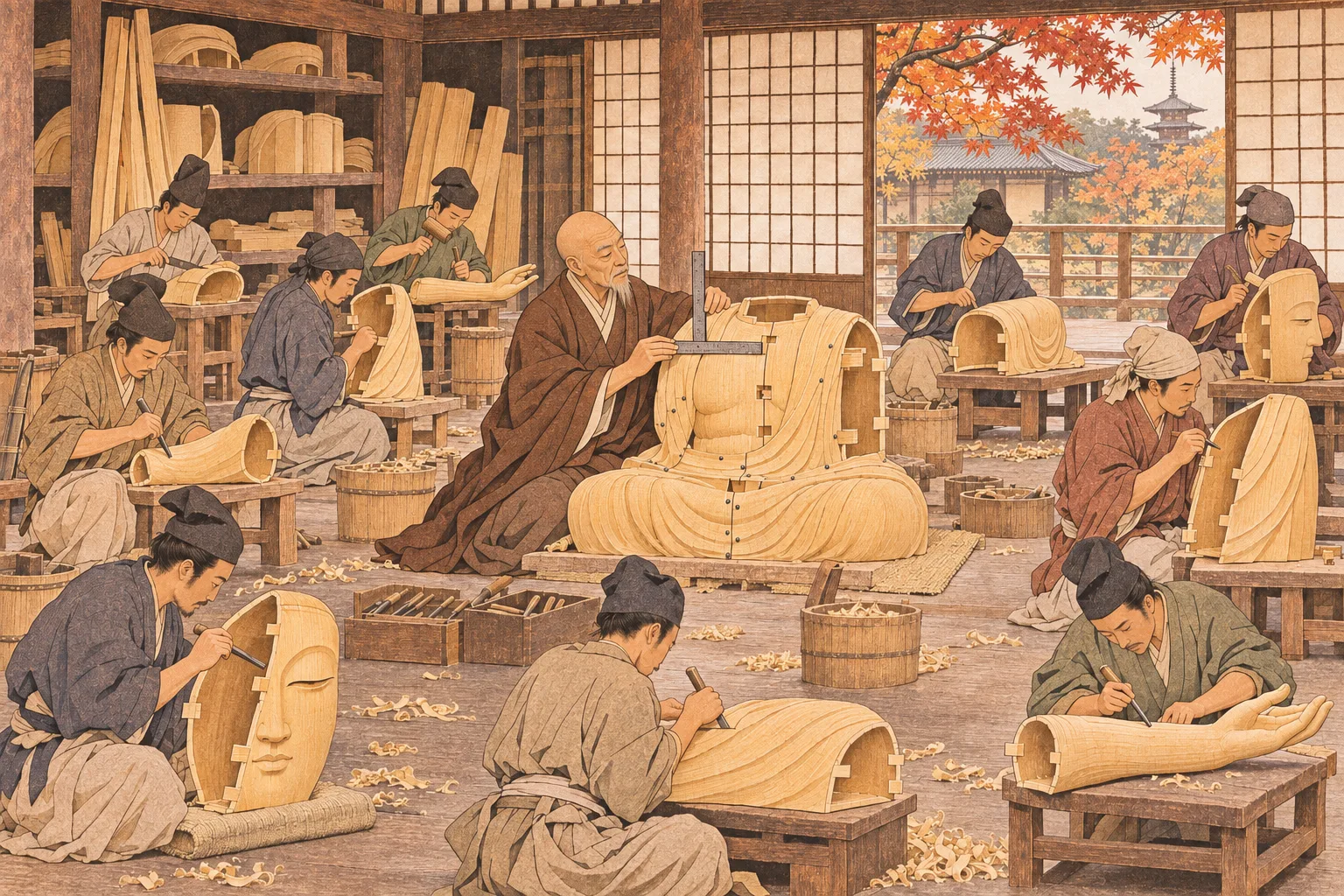
A joined-block workshop: each carver roughs out and hollows one block, while the master in the centre checks the seated figure being assembled. (artist’s impression)
His only certain surviving work is the Amida in the Phoenix Hall of Byōdō-in, completed in 1053: Japanese cypress, gold leaf over lacquer, about 2.8 metres tall seated. The face is round and calm, the eyes half-closed and looking down, the robe folds shallow and smooth as ripples. Compared with the brooding ninth-century figures it feels weightless. Aristocrats treated it as the correct form of a Buddha, and Kyoto sculptors copied the "Jōchō style" for more than a century.
A variation, warihagi-zukuri (split-and-join), sits between one-block and multi-block carving. The sculptor carves a whole figure from one log, then splits it lengthwise into front and back halves, hollows both, and rejoins them. The head may also be cut off at the neck, hollowed and refitted. The wood grain still runs continuously across the halves.
By now the standard timber was hinoki, used for statues since the late seventh century but only now dominant: Japanese cypress: straight-grained, easy to split cleanly, stable as it dries, fine-surfaced and fragrant. Broadly speaking, camphor in the seventh century, kaya in the eighth and ninth, hinoki from the late Heian period onward: the change of wood tracks the change from solid to assembled construction.
06Skin and Eyes: Finishing the Surface
Most old statues now look brown or black, but when new they were brilliant. Seated Buddhas were usually finished in shippaku, gold leaf laid over lacquer: several coats of lacquer, then sheets of leaf pressed on while the last coat was still tacky. Bodhisattvas, guardian deities and wisdom kings were more often painted over a white ground of powdered shell, with bands of colour shading from pale to deep on hems and lotus petals.
Kirikane, cut gold, is the most delicate finish. Gold leaf is fused into thicker sheets, cut with a bamboo blade into lines finer than a hair and into tiny triangles and diamonds, and laid on piece by piece to make repeating patterns on the robes. In a dark hall these lines catch the light like a net. The technique flourished from the late Heian into the Kamakura period, and fine lines of cut gold edge the robes of some works by the sculptor Kaikei.
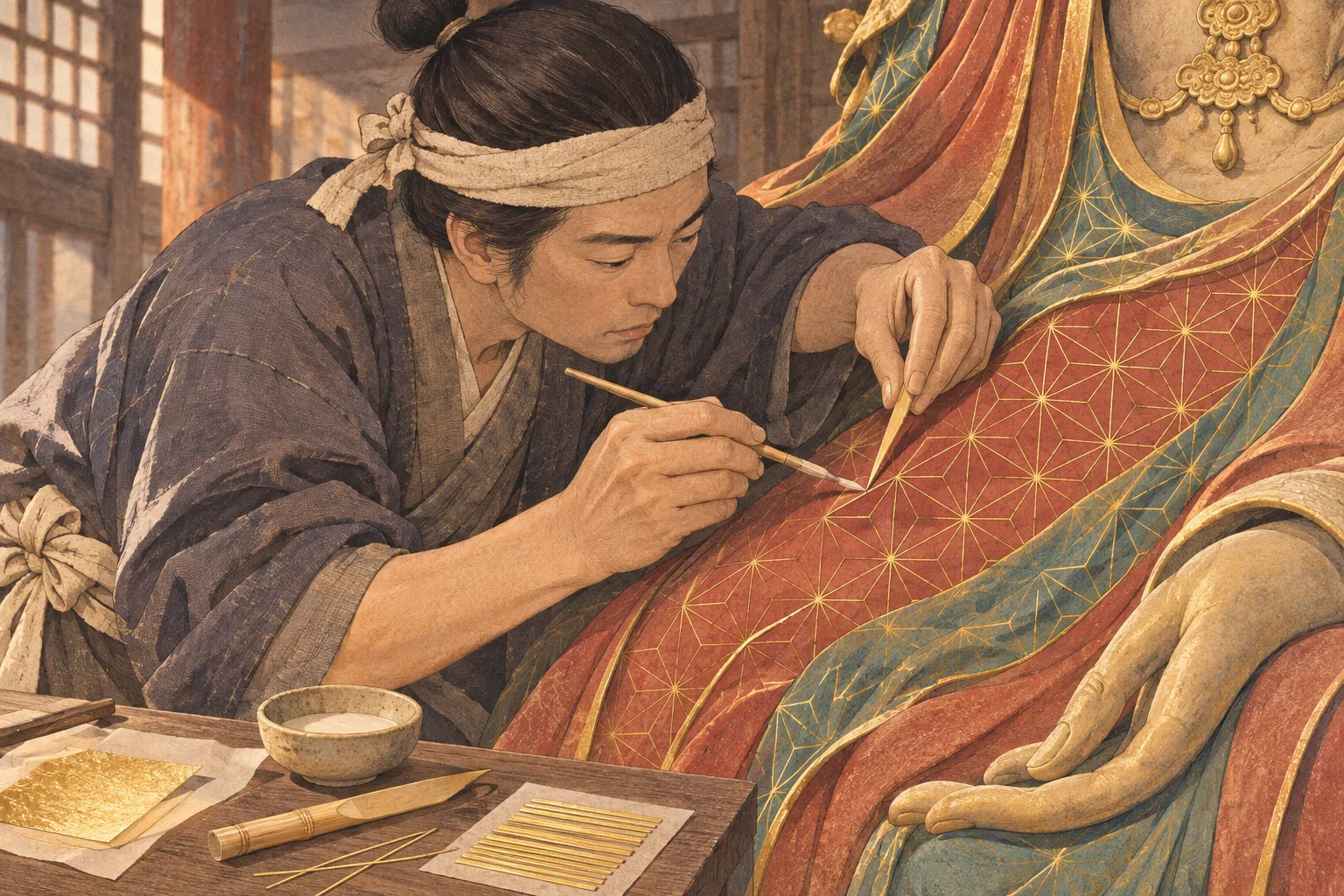
Kirikane: hair-fine lines of cut gold leaf are laid one by one on the painted robe to build a repeating pattern. Gold leaf, a bamboo blade and cut strips lie on the table. (artist’s impression)
Then there are the eyes. Earlier statues had eyes carved into the wood and painted. From the twelfth century, sculptors began fitting gyokugan, crystal eyes: a thin lens of rock crystal set into the eye socket from inside the head, its back painted with pupil and iris, backed by white paper or cotton and wedged in place with a wooden block. The effect is a wet gleam that seems to follow you. To set the eyes from behind, the face had to open, so these heads are split front and back, something joined-block and split-and-join construction made easy. The Amida Triad at Chōgaku-ji near Nara, from the mid-twelfth century, is usually cited as the earliest dated example. If a statue’s eyes glint when a lamp moves, they are almost certainly crystal.
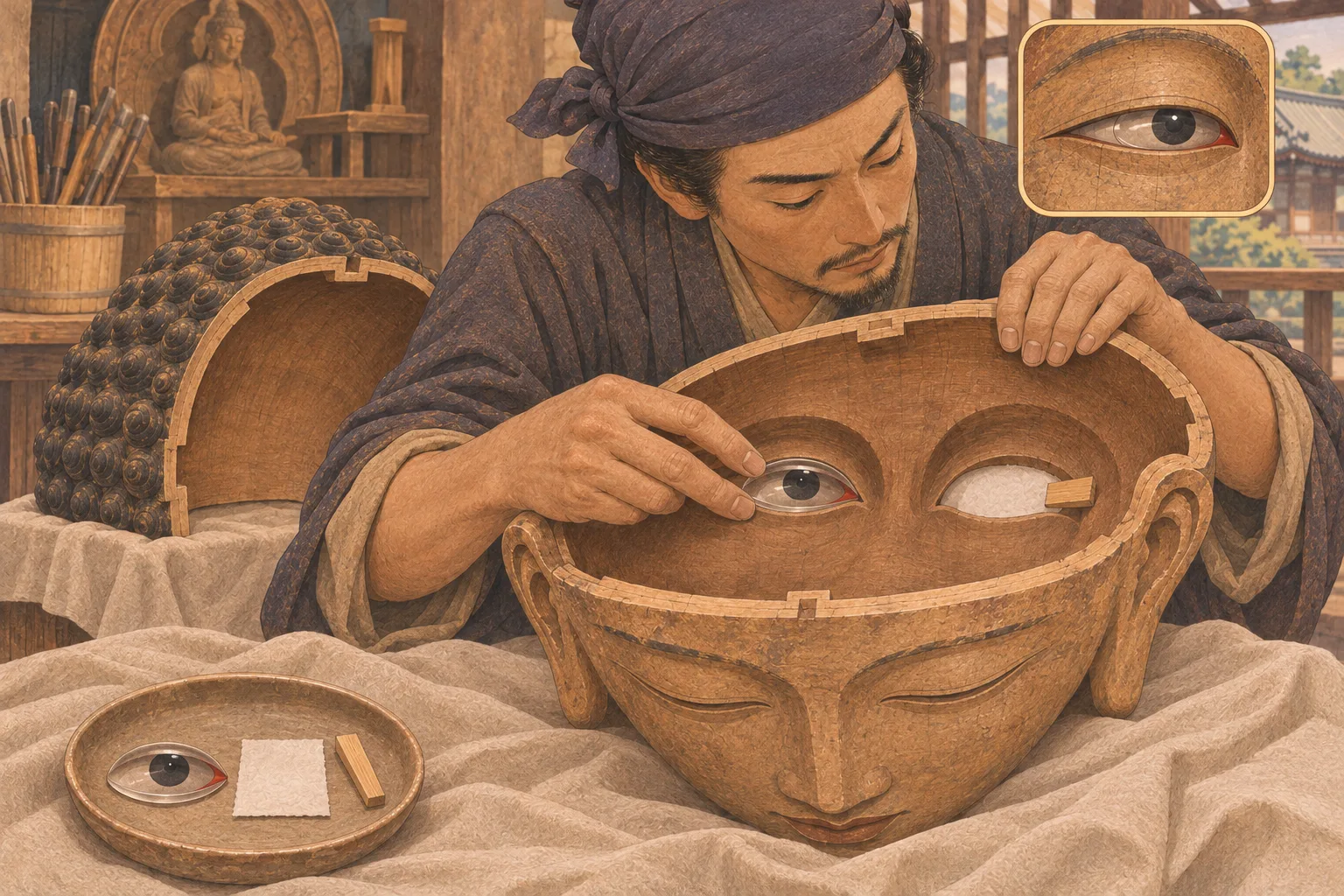
Crystal eyes are fitted from inside the face: a thin crystal lens painted with the pupil on its back, a backing of white paper, and a wooden block to hold it. Top right: the eye seen from outside.
07The Workshops: From Tori to the Kei School
Kuratsukuri no Tori’s family were saddle makers, a trade that combined metalwork, carving and lacquer, and his grandfather is said to have come from the continent. Early Japanese sculpture grew out of these immigrant craft lineages.
In the Nara period the state ran production. The office that built Tōdai-ji had departments of founders, carpenters, lacquerers and painters, and its paperwork about rations and wages survives. Few individual names are remembered.
By the mid-Heian period, sculptors (busshi) ran private workshops that took commissions from nobles and temples. Jōchō was the first sculptor given a Buddhist clerical rank, hokkyō, in 1022, a sign of new status. After him, his successors split into three lines. In Kyoto, the In school (names with the character "in") and the En school (names with "en") served the court and nobility in the polished Jōchō manner. In Nara, a third line based at the great old temples became known as the Kei school, after the "kei" in its members’ names.
In 1180, during the Genpei War, Taira forces burned Nara, destroying most of Tōdai-ji and Kōfuku-ji. Rebuilding gave the Kei school its chance. Unkei, son of Kōkei, carved muscular, alert figures with crystal eyes for both temples and the new warrior class in the east. In 1203 he, Kaikei and others produced the two guardian kings in Tōdai-ji’s Great South Gate, each about 8.4 metres tall and assembled from many blocks of wood, reportedly in about 69 days. Kaikei, a devout Amida follower who signed himself An’amidabutsu, preferred a gentler, refined style; his many standing Amidas about a metre tall suited private worship and spread across the country. Unkei’s son Tankei later made the central Thousand-Armed Kannon at Sanjūsangen-dō, where 124 of the 1,001 life-size standing Kannon around it survive from the original hall of 1164 and the rest were carved after a fire in 1249 by sculptors of several schools, many of whom wrote their names inside the figures. The Kei school remained the leading line of sculptors into the Edo period.
08What Lies Inside
Hollow statues invited people to put things inside them. These deposits (tainai nōnyūhin) include sutras, prayers stating who made the statue and why, relics, small Buddha images, mirrors, hair and teeth. Most moving are the lists of names: hundreds or even thousands of donors and well-wishers, from nobles to farmers, sealed inside a statue to bind themselves to the Buddha. The Shaka at Seiryō-ji in Kyoto, carved in Song China and brought back by the monk Chōnen in the 980s, contains silk models of the internal organs. In some of Unkei’s works, a small wooden five-ringed stupa and a crystal "moon disc" representing the heart have been found at chest level.
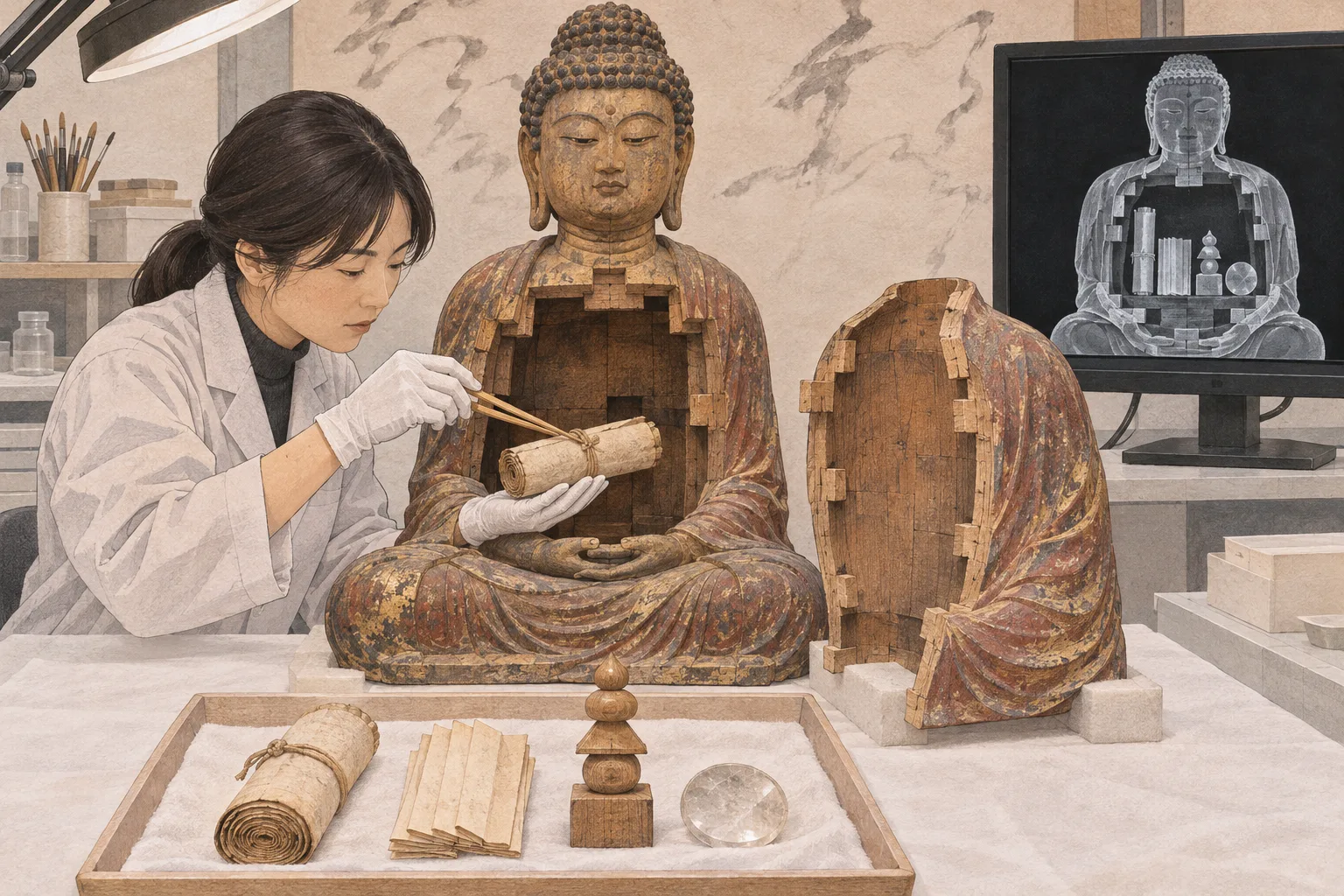
A joined-block statue opened for repair. Scrolls, folded documents, a small five-ringed stupa and a crystal moon disc come out of the cavity; the screen shows a scan of the same figure.
Inscriptions inside statues are how many makers and dates are known. Sculptors wrote their names and the year on interior walls or under pedestals, unseen until someone opened the figure. Today X-rays and CT scans reveal deposits and joinery without dismantling anything, and several statues have been newly attributed to Unkei or Kaikei this way.
A statue’s life is also a history of repairs: insects, loose joints, flaking gold, broken fingers, fires and earthquakes. Joined-block figures can be taken apart, damaged blocks replaced and reglued, so a single Buddha may contain wood from the Heian, Kamakura and Edo periods, often with a note from each restorer left inside for the next. Modern conservation in Japan began after the anti-Buddhist upheavals of the early Meiji era, when the Japan Art Institute, founded in 1898 by Okakura Kakuzō and others, set up a restoration studio in Nara under the sculptor Niiro Chūnosuke, who went on to direct work on some 2,000 statues, among them the Kudara Kannon at Hōryū-ji and the Fukūkenjaku Kannon at Tōdai-ji. Early restorers often replaced missing parts boldly; today the rule is to stabilise and leave losses visible. A Buddha with missing fingers may be cared for deliberately that way.
09Side by Side: One Seated Buddha, Five Ways
Imagine the same seated Buddha made five ways and sliced down the middle.
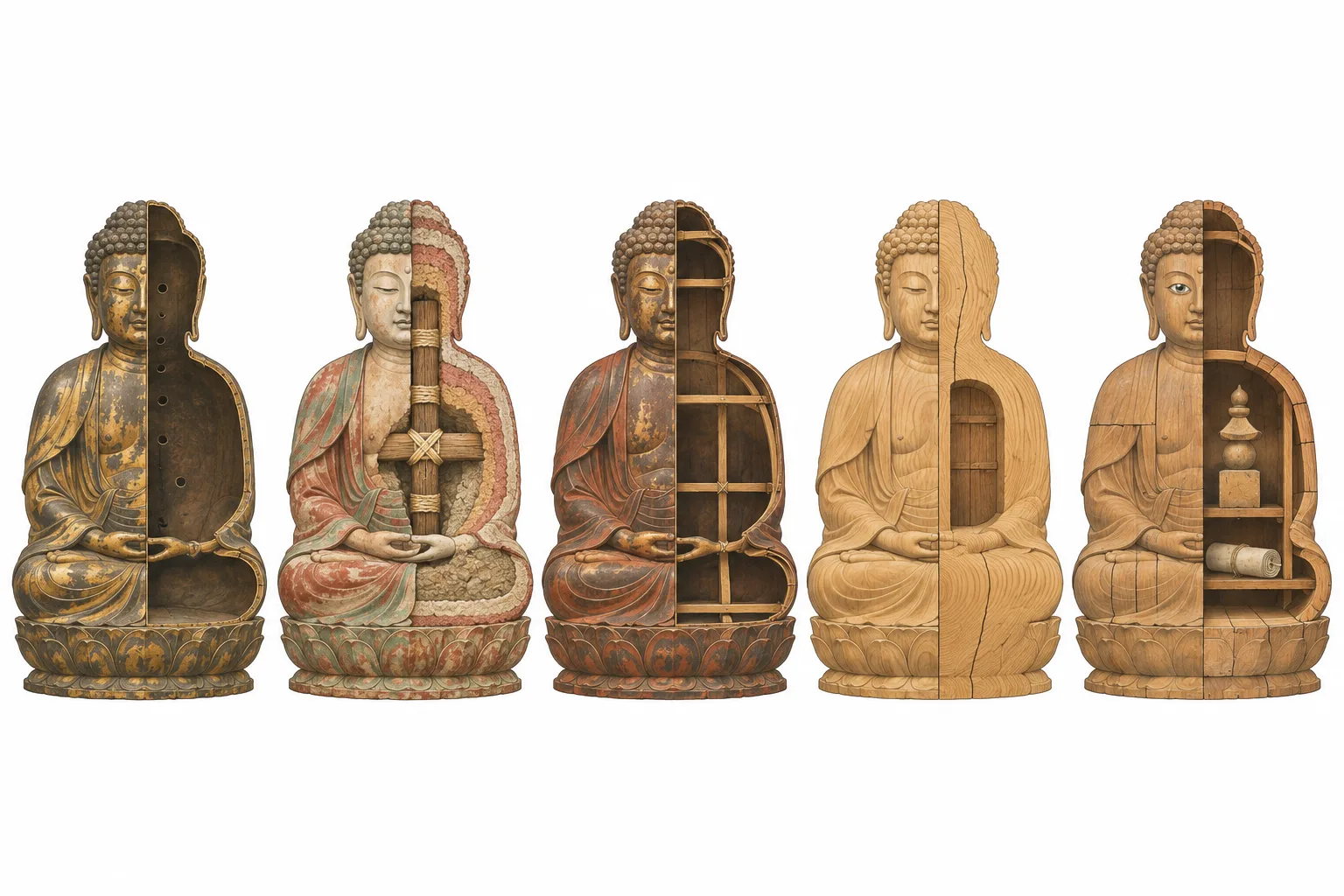
One seated Buddha made five ways, each cut open on one side. Left to right: gilt bronze, clay, hollow dry lacquer, single-block wood, joined-block wood. Compare the thickness of the shell and what is inside.
The bronze version is a thin metal shell, once packed with a clay core and now usually hollow. It is very heavy, gold or glossy black, with crisp cast edges; on big figures you may see horizontal seams between casting stages.
The clay version is a wooden post wrapped in straw rope and layered with coarse, medium and fine clay, solid all the way through. It is heavy and painted, with grey-brown clay showing through flaking colour and fine cracks, and its forms are soft and fleshy.
The hollow dry-lacquer version is a thin skin of lacquered cloth around a light wooden frame, nearly empty. It is light and rounded, with slightly soft details and slender limbs. The wood-core variant is a carved core under a thick lacquer coat.
The single-block wooden version is solid timber, or a thick-walled cavity closed with a back panel. It is heavy and massive, with deep folds and sometimes long vertical cracks, and the grain runs unbroken from head to base.
The joined-block version is a thin shell of many boards around a large cavity that may hold scrolls and small images. It is light and evenly proportioned, gilded or painted, often with crystal eyes if it dates from the Kamakura period on, and if you look closely you may spot a fine seam at the neck or in the robe.
In a temple, start with colour and sheen: cold metallic gold or black means bronze; grey-brown earth showing through means clay. Then the body: thin, airy limbs suggest lacquer; heavy mass and deep wave-like folds suggest early Heian solid wood; calm, even forms with a smooth gilded surface suggest late Heian or later joined wood. Date helps too. Large seventh-century statues tend to be bronze, eighth-century Nara favoured clay and lacquer, the ninth century carved from single logs, and from the eleventh century almost everything was assembled. No method vanished completely, and bronze Buddhas were still being cast in the Edo period, but the overall direction is clear.
More deep dives on this topic
 Four Ranks of Buddhist StatuesStep out of the sunlight into a Japanese temple hall and your eyes take a moment to adjust.
 Mudras and AttributesIn the half-light of a Japanese temple hall, the face of a Buddha is often hard to make out.
 Niō and the Four Heavenly KingsWalk up to almost any large Buddhist temple in Japan and the first figures you meet are not serene Buddhas but two furious, nearly naked giants flanking the gate.
 PagodasWalk up the stone lanes of Higashiyama in Kyoto and the Yasaka Pagoda rises over the tiled roofs of the old townhouses; ride the bullet train into Kyoto Station and the dark…
 The GaranMost visitors to a Japanese temple experience it as a sequence: a gate, a path, a big hall, perhaps a pagoda off to one side.
 How Buddhist Statues Are MadeWalk through the temples of Nara and Kyoto and you will meet Buddhas that are gold, black, chalky grey, or the warm brown of old wood.
 Reading Temple NamesMost visitors to Tokyo know Sensō-ji, the great Kannon temple in Asakusa.
 Shōjin RyōriThe first thing many visitors eat at a temple lodging on Mount Kōya is a small, pale square that wobbles on a lacquer dish.
 A Night in a TempleMost temples in Japan close their gates at dusk.
- Back to the main article: Japanese Buddhism →