
Most temples in Japan close their gates at dusk. Some keep a door open and a room ready. These are shukubō, temple lodgings, and staying in one means stepping into a working religious house for a single turn of its day: an evening meal with no meat or fish, a long silence bent over a sheet of paper tracing the Heart Sutra with a brush, a bell before dawn, and a seat at the back of the main hall while monks chant in the half-dark.
This piece follows that night in order. It starts with why such lodgings exist at all, looks at how they differ from one sacred site to another, and then walks through what a guest actually encounters: the entrance and the room, the practice of sutra copying and its long history, the instruments of the morning service, the fire ritual, the meditation sessions, and the quiet business of leaving.
01Where Temple Lodgings Came From
The word bō originally meant a monk’s quarters, and by extension one of the many sub-temples that clustered around a great monastery. A major temple in medieval Japan was less a single building than a small town: a central precinct of halls and pagodas surrounded by dozens or hundreds of sub-temples, each with its own abbot and disciples. When pilgrims began arriving in numbers from the Heian period (794–1185) onwards, these sub-temples were the obvious place to put them up. A shukubō is simply a lodging bō.
From early on, the arrangement was more than hospitality. A sub-temple would form a lasting bond with a particular region or family. When people from that province climbed the mountain, they stayed with "their" temple; the monks prayed on their behalf, guided them round the halls and kept their memorial records. Historians call this a patron–priest bond (shidan). Warlords often entrusted a whole domain to one sub-temple: in 1580 Sanada Masayuki issued a lodging certificate declaring that people from his home district of Sanada would stay at Rengejōin whenever they visited Mount Kōya. Kōya’s sub-temples still hold large numbers of memorial registers and death registers for warrior houses and the people of their domains. Retainers sent to pray on a lord’s behalf would stay there too.
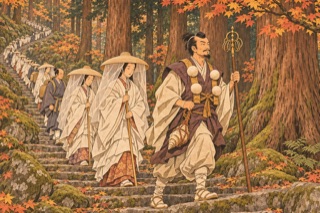
Two kinds of intermediaries kept pilgrims flowing. The sendatsu, literally "one who has arrived first", were guides, often mountain ascetics of the Shugendō tradition, who led processions of aristocrats along the hard roads to Kumano in the late Heian and medieval centuries. As warriors and commoners joined in, the crowds grew so long that "the ants’ pilgrimage to Kumano" became a Japanese byword for an endless file of people. The other figure was the oshi (read onshi at Ise): agents of a temple or shrine who lived out in the provinces, organised local devotees into savings clubs called kō, handed out talismans and almanacs, and, when a club had saved enough for the journey, hosted its members at their own houses near the sacred site. In the Edo period (1603–1868) whole streets of oshi houses lined the approaches to Ise, Mount Fuji, the Three Mountains of Dewa and other pilgrimage centres.
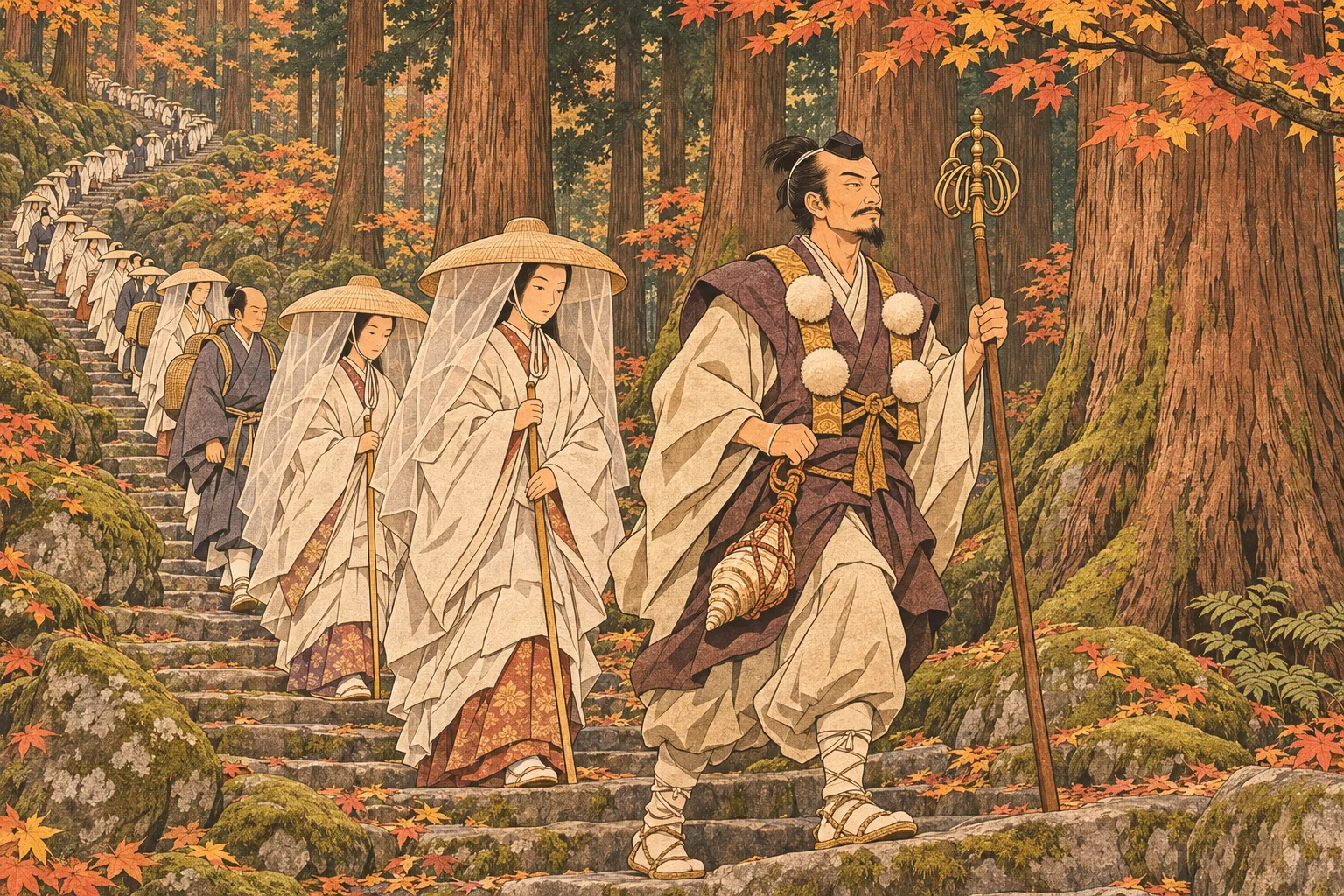
On the road to Kumano a sendatsu, a mountain ascetic acting as guide, leads the way; the pilgrims behind him stretch up the stone steps in an endless file. (artist’s impression)
So a shukubō was never just an inn. The guest gave an offering; the host returned prayer and guidance; the night’s lodging was part of the pilgrimage. That system was badly shaken in the early Meiji years, when the government ordered Buddhism and Shinto separated. Many mountains where the two had mingled were turned into purely Shinto shrines, the oshi system was abolished, and at Ise the oshi houses all but vanished. Some lodgings survived by becoming guesthouses attached to shrines. After the Second World War, railways, buses and school trips brought ordinary travellers back, and in the last two decades temple stays have drawn large numbers of visitors from abroad. The clientele changed; the rhythm of the stay largely did not.
02Five Sacred Sites, Five Kinds of Shukubō
Mount Kōya is the classic case. On a high basin in northern Wakayama, the monk Kūkai founded a training centre for Shingon Buddhism in the 9th century, and the mountaintop grew into a temple town with more than a hundred temples along its main street. Around fifty of them take overnight guests. Here the lodging is the sub-temple: you pass through a gate into a garden of raked gravel or moss, enter by a porch with a curved gable, and sleep in rooms whose sliding doors may carry painted landscapes centuries old. Dinner is temple vegetarian food; the morning brings service in the sub-temple’s own hall, often followed by a fire ritual.
Mount Hiei, above Kyoto, works differently. Enryakuji is scattered across three forested zones far apart, and its sub-temples are generally thought of as places of training rather than inns. Visitors today mostly stay in a temple-run lodge, with Tendai morning service, sitting meditation and sutra copying offered as the core of the stay. At the foot of the mountain, in Sakamoto, stand the satobō, retirement residences for elderly monks, behind distinctive dry-stone walls.
Zenkōji in Nagano belongs to no single school; it is jointly maintained by a Tendai temple and a Jōdo (Pure Land) convent. Its thirty-nine lodgings sit along the approach and in the lanes around the main hall: Tendai houses, whose names end in -in, under the Daikanjin, and Jōdo houses, ending in -bō, under the Daihongan. Many once had long ties with devotee groups from particular districts, much as the oshi did. Guests can attend the O-asaji, the morning service, which begins at sunrise and so shifts with the seasons. The two chief priests, the abbot of the Daikanjin and the abbess of the Daihongan (a post always held by a woman), walk in procession to and from the hall, and worshippers kneel by the path to have a rosary touched to their heads—four times each morning in all.
The Three Mountains of Dewa in Yamagata—Haguro, Gassan and Yudono—were a Shugendō centre where Buddhas and kami were worshipped together. In the village of Tōge at the foot of Mount Haguro, the lodgings are run by hereditary families of mountain ascetics (yamabushi), who also guide guests up the peaks. After Meiji the mountains became Shinto shrines, but the lodgings kept their character: sacred ropes over the doors, altars where both traditions show, and dinners of mountain vegetables. The classic route climbs Haguro, Gassan and Yudono in turn, read as present, past and future: a journey of symbolic death and rebirth.
Mount Minobu in Yamanashi is the head temple of the Nichiren school, Kuonji. Sub-temples along the approach take guests, and a steep flight of stone steps leads up to the main hall. What you hear here is not esoteric chant but the rhythmic repetition of Namu myōhō renge kyō, "Homage to the Lotus Sutra", usually kept in time with flat, hand-held fan drums.
Temple lodgings also exist along the Shikoku pilgrimage route, in some sub-temples of the great Kyoto monasteries, and at scattered temples in Nara and Kamakura.
03Arrival: The Porch, the Room and the House Rules
You arrive in the late afternoon and take off your shoes in the genkan, the entrance hall. In a temple it is often grander than in a house: a broad stepping stone below a high, polished wooden floor, and on Mount Kōya perhaps pilgrims’ staffs propped by the door.
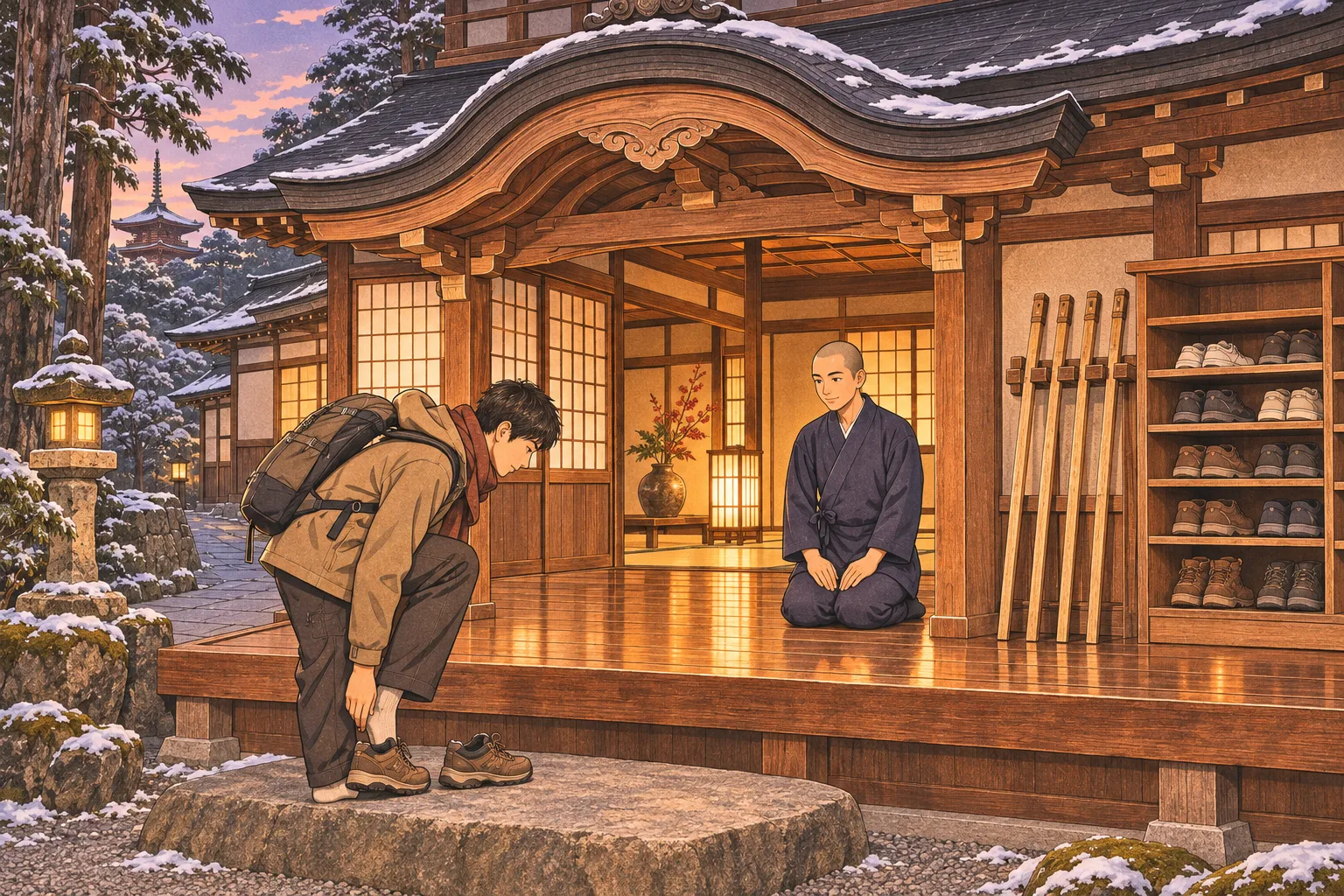
Arriving at a temple lodging in the late afternoon: shoes come off at the broad stepping stone below a high, polished wooden floor, with pilgrims’ staffs propped by the wall.
The room looks like any Japanese-style inn room at first glance, but the details are a temple’s. The alcove scroll is more likely a Buddhist painting or a famous monk’s calligraphy than a landscape. Many guest rooms are carved out of a sub-temple’s study halls and reception halls, so neighbours may be separated by nothing more than sliding panels, and some older rooms have no lock. At many temples you lay out and fold your own bedding, which is treated as part of temple life rather than a lack of service.
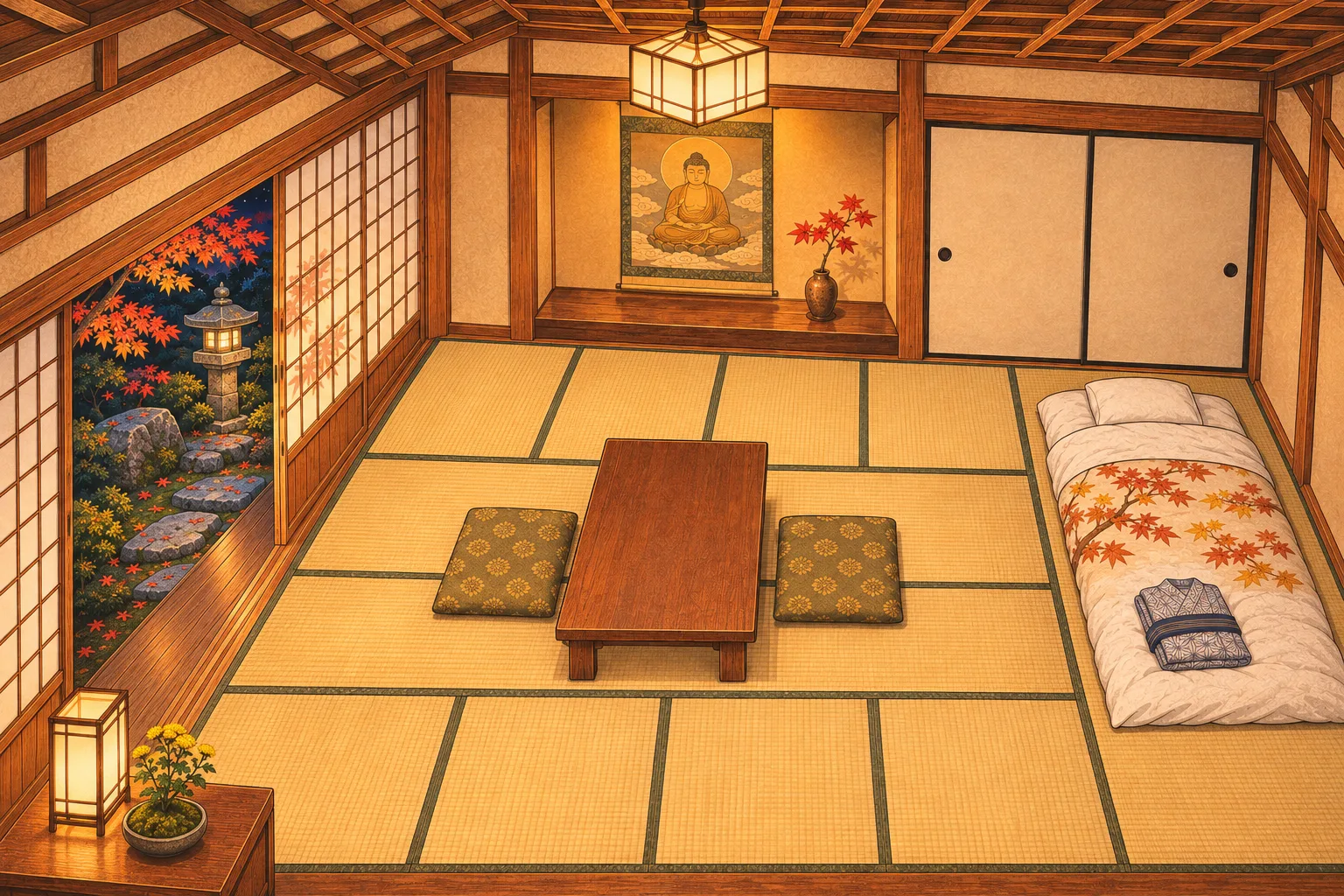
A guest room in a temple lodging: tatami, a low table and paper screens, much like an inn, except that a Buddhist painting hangs in the alcove. The bedding is laid out with a folded yukata on top.
The house rules follow from one fact: this is a working temple, and you are a guest in the monks’ living space. Keep your voice down in the halls. Don’t photograph rituals without asking. Some temples lock the gate at night; some forbid alcohol, while others will bring a bottle of beer with dinner. Old corridors are bare wood, and on Mount Kōya in winter they are bitterly cold underfoot.
Dinner arrives on lacquered trays, often in a large hall. It is shōjin ryōri, Buddhist vegetarian cooking without meat, fish or pungent alliums—sesame tofu, freeze-dried Kōya tofu, mountain greens—which has a story of its own. After dinner some temples hold a short talk by a monk, or open the sutra-copying room.
04Copying the Heart Sutra
Shakyō, sutra copying, is the act of writing out a Buddhist scripture by brush. Almost every temple that offers it to visitors uses the Heart Sutra, because it is short: 262 characters of text plus its title, enough to fit on one sheet.
You sit at a low desk, often facing the temple’s main image. Laid out in front of you are an inkstone, an inkstick, a fine brush, a tiny water dropper, a sheet of thin copying paper over a printed model of the text, a paperweight, and sometimes a dark felt underlay.
First comes purification, and practices vary. Some temples set an incense burner at the threshold for you to step over so the smoke passes over your body; at Yakushiji in Nara it is a large elephant-shaped burner called the kōzō. Some give you a pinch of zukō, powdered incense, to rub into your palms and wrists. Some hand you a single dried clove to hold in your mouth, said to purify the breath so it does not defile the scripture. Many simply ask you to wash your hands and bow. You place your palms together towards the main image, and the group may recite the sutra once before starting.
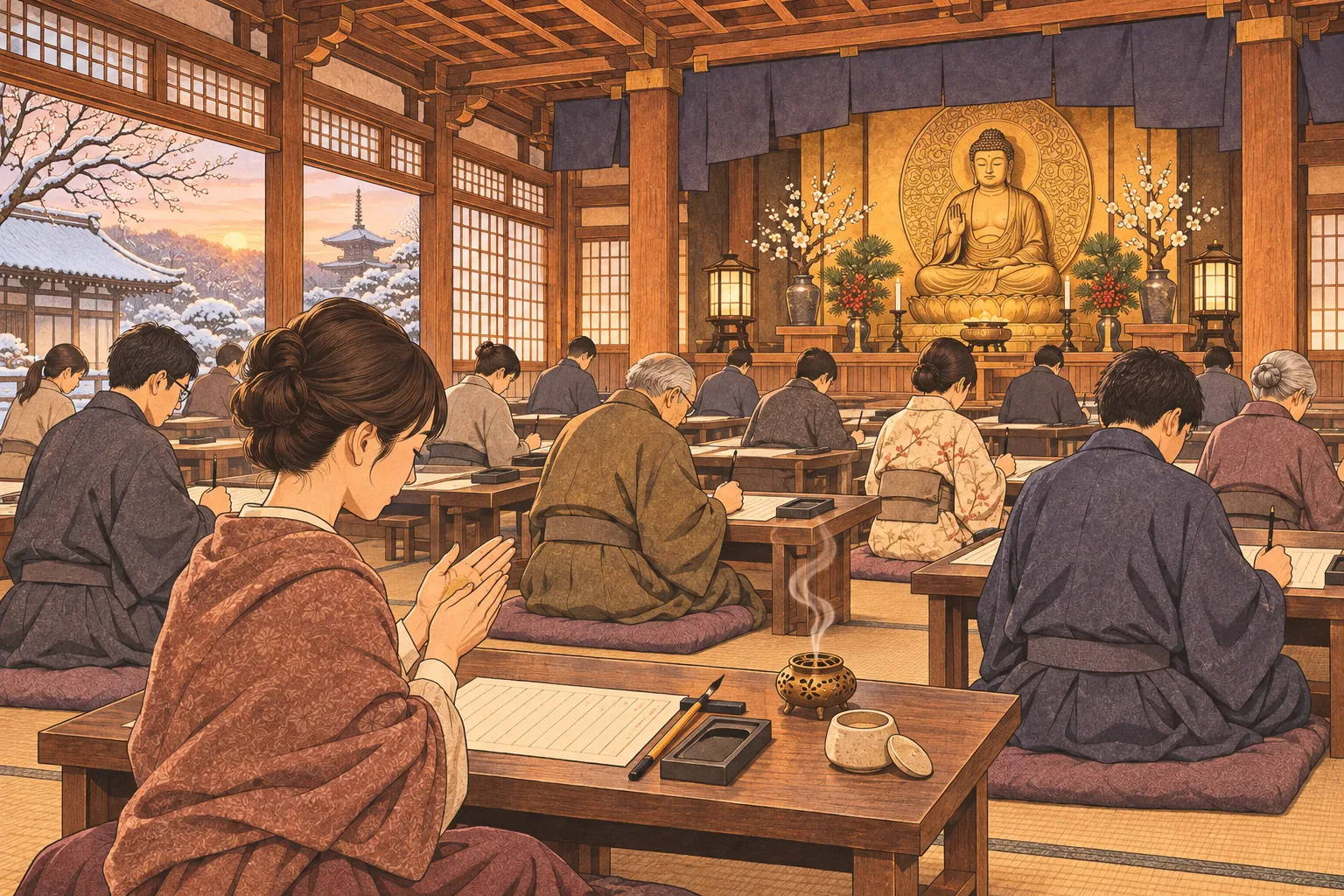
A sutra-copying hall, the low desks set in rows facing the main image. The guest in front rubs a pinch of powdered incense into her palms, purifying herself before she picks up the brush.
Then you grind ink. A few drops of water go into the well of the inkstone; you stand the stick upright on the flat part and move it in slow circles until the liquid darkens. Temples often say this is the moment to let the mind settle.
The copying paper is thin enough to see the model through it, so most visitors trace. You begin at the right with the title, Maka hannya haramitta shingyō, and work down each vertical column, moving leftwards. Classical sutra copies put seventeen characters to a column, and many models keep that layout. The aim is not beautiful calligraphy but completeness: no stroke skipped, no character missed. A mistake is not scrubbed out; a common instruction is to mark a small dot beside it and write the correct character in the space above or below the column, though temples differ.
The last columns are your own. You write a short prayer or dedication—for the family’s safety, for good health, for a wish to come true, or in memory of someone who has died—then the date, your address and your name. You bow again and place the finished sheet in the offering box before the altar. The temple keeps these copies before the main image and later dedicates them in a ceremony; some store them in a pagoda or sutra repository.
A sister practice is shabutsu, tracing a Buddhist image instead of text. With the same thin sheet over a line drawing, you follow the outline of Kannon, Jizō, Fudō Myōō or Yakushi: the folds of robes, the position of the hands, the halo, the lotus pedestal. Fudō’s halo of flame alone is dozens of curling lines. Shabutsu also ends with a dedication, date and name, and is offered in the same way. As a lay activity it became popular much later than sutra copying.
05Thirteen Centuries of Copied Sutras
In Nara-period Japan (710–794), sutra copying was a state industry. With no printing, the only way to supply the new temples with scripture was by hand, so the court ran a sutra-copying office staffed by professional scribes. They were paid by the sheet—one bolt of cloth for every forty sheets copied. Proofreaders hunted for errors, and mistakes cost money: leave a line out uncorrected and four sheets’ pay was docked and given to whoever caught it. Thousands of the documents preserved in the Shōsōin repository at Tōdaiji come from this office—paper accounts, work logs, payroll. One draft petition from the copying office lists the scribes’ demands: fresh white work robes to replace worn ones, regular leave, better food than the coarse fare they were given, and a ration of "medicinal" sake, usually read as relief for bodies worn down by years at the desk.
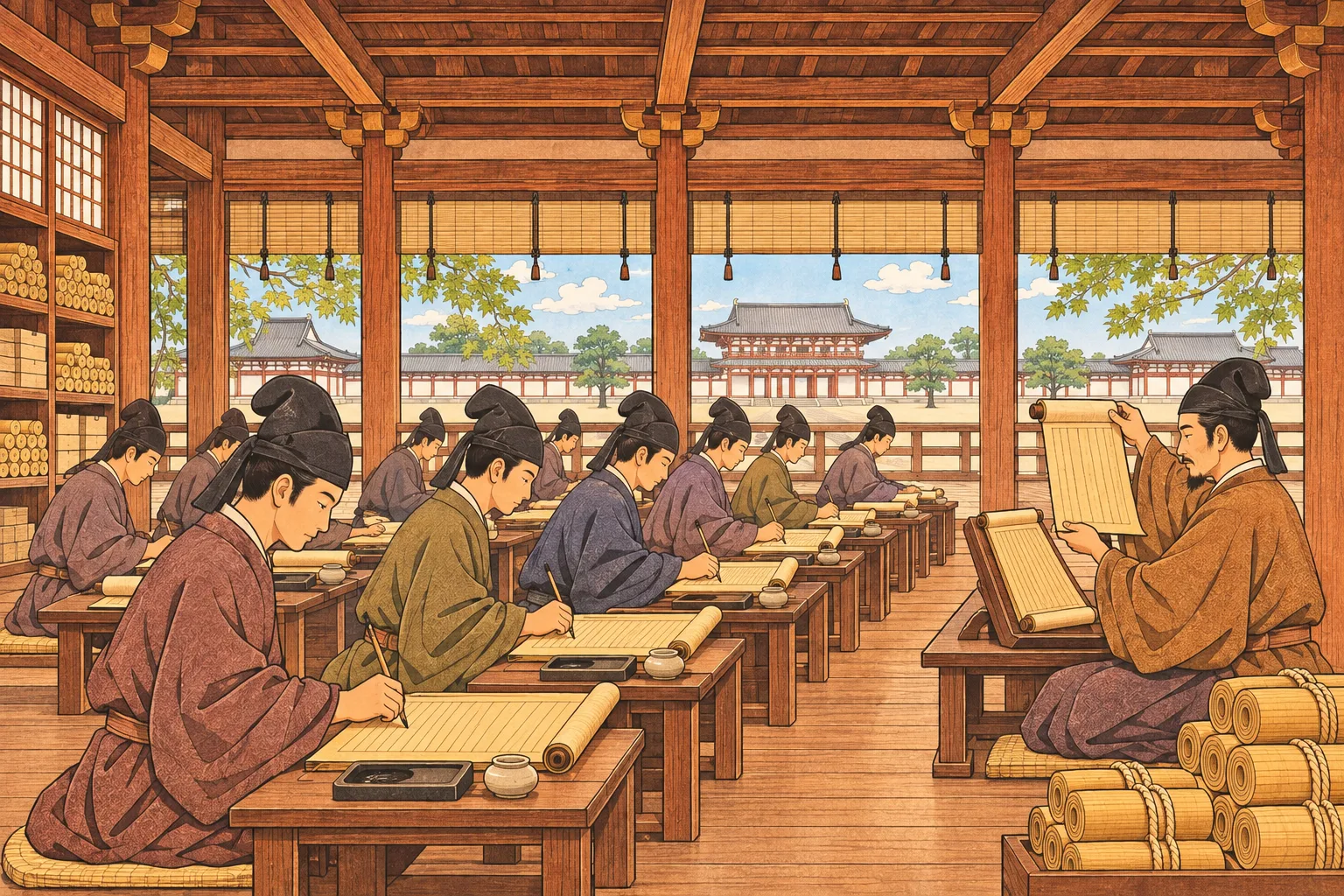
A Nara-period sutra-copying office: rows of scribes bent over their desks, and on the right a proofreader checking a finished scroll for errors. (artist’s impression)
The best known Nara project is the complete canon commissioned by Empress Kōmyō, called the "Fifth Month, First Day Sutras" after the date in her dedication: the first day of the fifth month of Tenpyō 12, or 740. Nara copies are usually on tan hemp or mulberry paper, ruled into neat columns, in dense black ink and upright regular script.
In the Heian period copying became an aristocratic act of merit, and it became lavish. Scribes wrote in gold on indigo-dyed paper, or alternated gold and silver lines. Fujiwara no Kiyohira, lord of the north, sponsored a full canon in alternating gold and silver on indigo, now known as the Chūsonji sutras. Others were written on fan-shaped sheets painted with scenes of daily life and scattered with metal leaf, like the Lotus Sutra fan albums kept at Shitennōji in Osaka.
The high point of decorated sutras is usually taken to be the Heike Nōkyō. In 1164 Taira no Kiyomori and members of his clan shared out the copying of a set of thirty-three scrolls and dedicated them to Itsukushima Shrine on Miyajima: thirty for the Lotus Sutra with its opening and closing sutras, one each for the Amida Sutra and the Heart Sutra, and Kiyomori’s own dedication. The papers glitter with gold and silver leaf and are painted with lotus ponds, court ladies and bodhisattvas; the rollers end in crystal knobs set in openwork metal fittings, and the set has its own ornamented box. That a Buddhist scripture was offered to a shrine surprised nobody: at the time the two traditions were closely intertwined. The scrolls remain at Itsukushima and are a National Treasure.
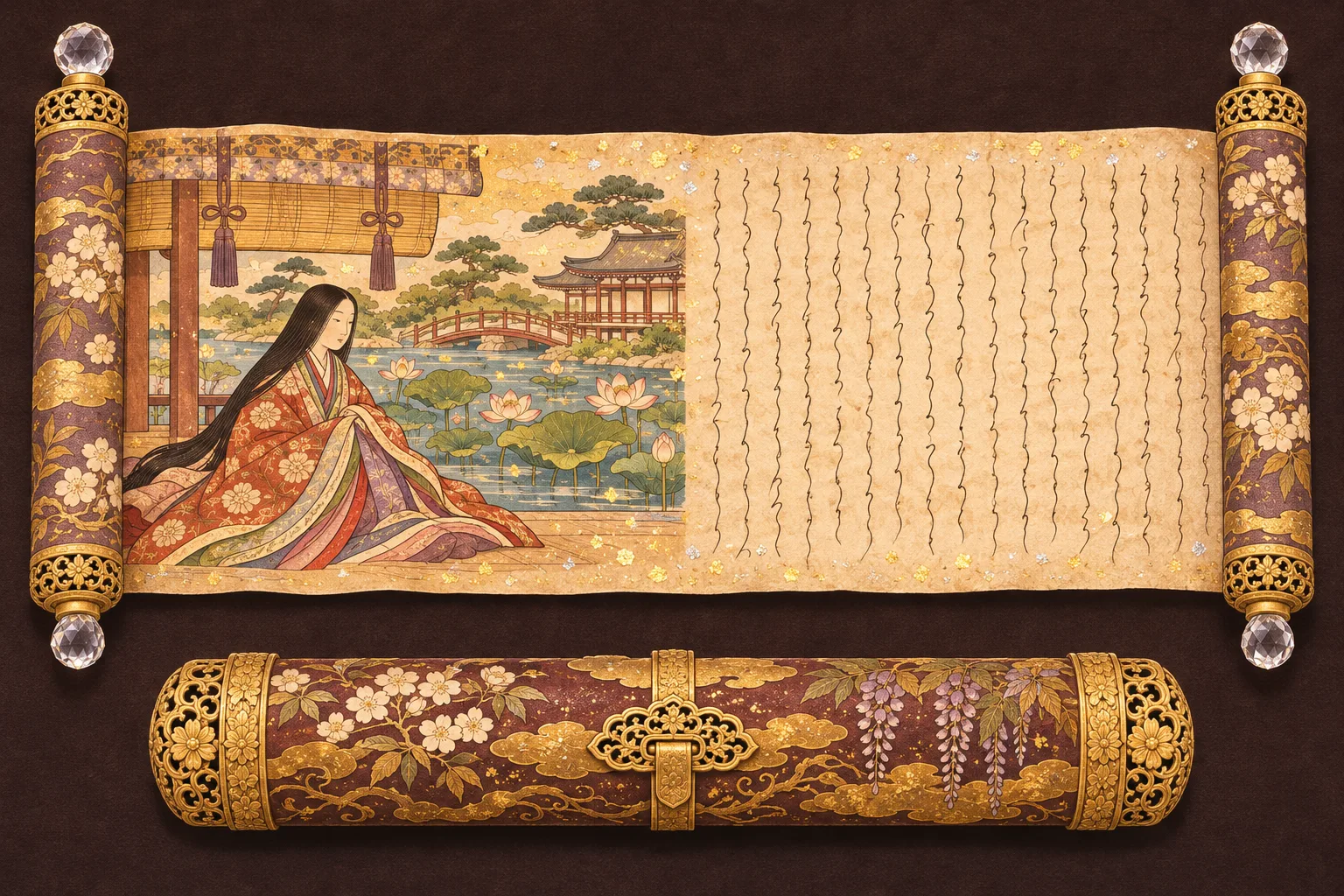
A decorated sutra in the manner of the Heike Nōkyō: paper scattered with gold and silver leaf, a lotus pond and a court lady painted at the opening, and crystal knobs set in openwork metal on the roller ends. (artist’s impression)
From the 11th century another destination appeared: underground. Buddhist teaching held that after the Buddha’s death the Dharma would decline, and a widely used reckoning in Japan put the start of the final age, mappō, in 1052. Fearing the scriptures would be lost, people sealed copies in bronze or ceramic cylinders and buried them in mounds, called kyōzuka, to wait for the future Buddha Maitreya, due in 5.67 billion years. The oldest surviving dated example is the gilt cylinder Fujiwara no Michinaga buried in 1007 on Mount Kinpu, deep in the mountains beyond Yoshino, at the summit now called Sanjōgatake. It held sutras copied in his own hand and was dug up in 1691 during rebuilding of the summit hall, its surface inscribed with his vow.
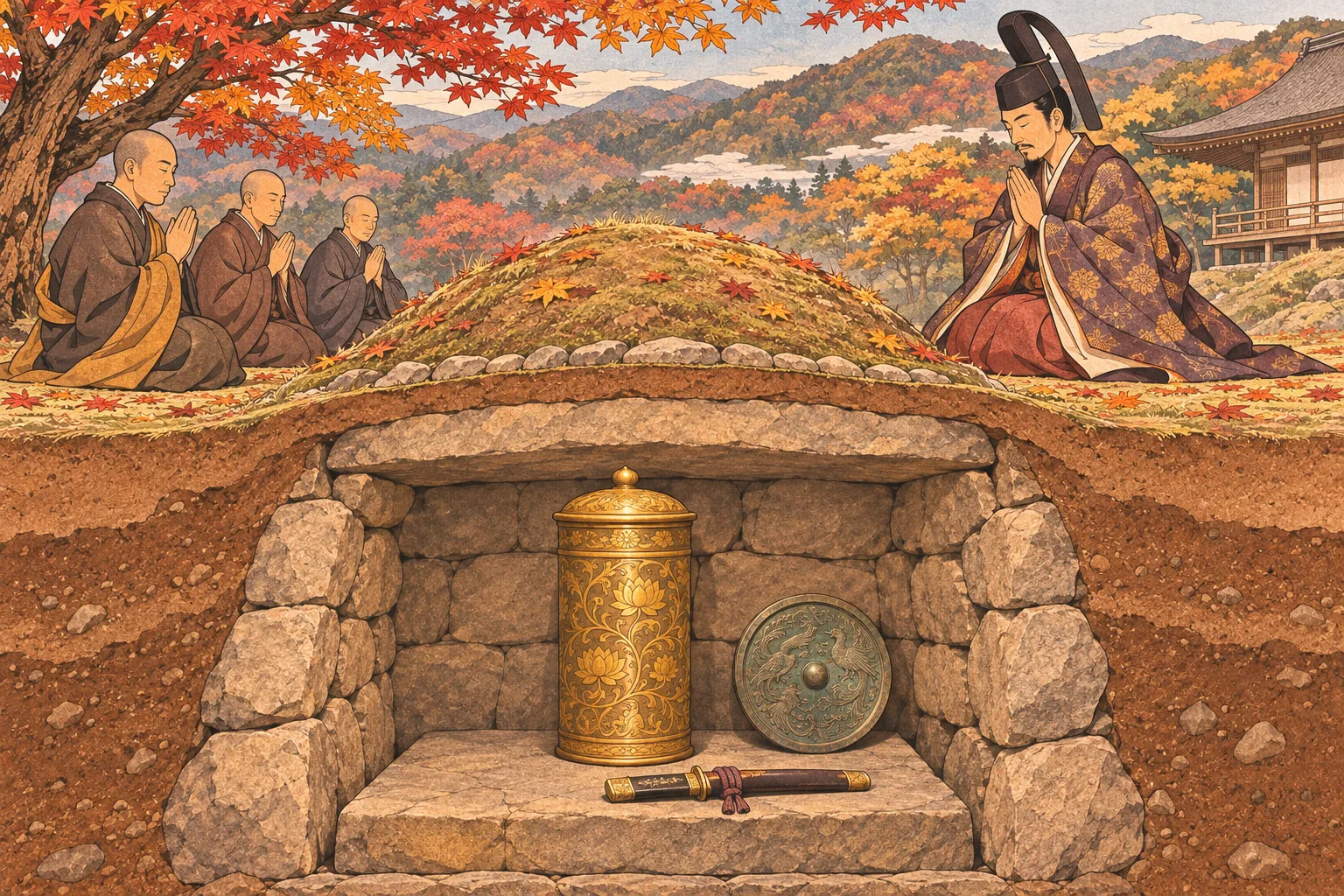
A sutra mound in cross-section: the copied scrolls, sealed in a lidded cylinder, lie in a stone chamber under the mound to wait for the future Buddha, while monks and the donor join their palms above. (artist’s impression)
Later centuries made copying personal: a son copying a sutra for a dead parent, a family copying for a sick child, some devotees bowing after every character. In the 20th century it reached a new scale. From 1968 Yakushiji in Nara invited people across Japan to copy the Heart Sutra and send it with a donation to fund the rebuilding of its Golden Hall, burned in fighting in 1528. By the time the new hall was completed in 1976, a million copies had come in, and the same method went on to rebuild the West Pagoda and other halls. The sheet you leave in a temple’s offering box today belongs to that tradition.
06Side by Side: The Copying Desk and the Sounds of Morning
At the copying desk, the inkstone is the flat black stone with a deep end (the "sea") and a flat end (the "land"); the inkstick is the black bar you grind on it; the water dropper is the little ceramic or metal pot that releases a few drops at a time. The brush is a small fine-pointed one, far slimmer than a calligraphy brush. The model sheet, printed with grey or black characters inside ruled columns, sits at the bottom; the translucent copying paper lies on top; a long thin metal or wooden paperweight holds both. Powdered incense is a pale brown dust in a small dish, rubbed on the hands; the clove is a dried brown bud with a round head, held in the mouth and not swallowed. Neither is burned, unlike the incense sticks in the burner. The offering box is a wooden or lacquered box before the altar or by the exit.
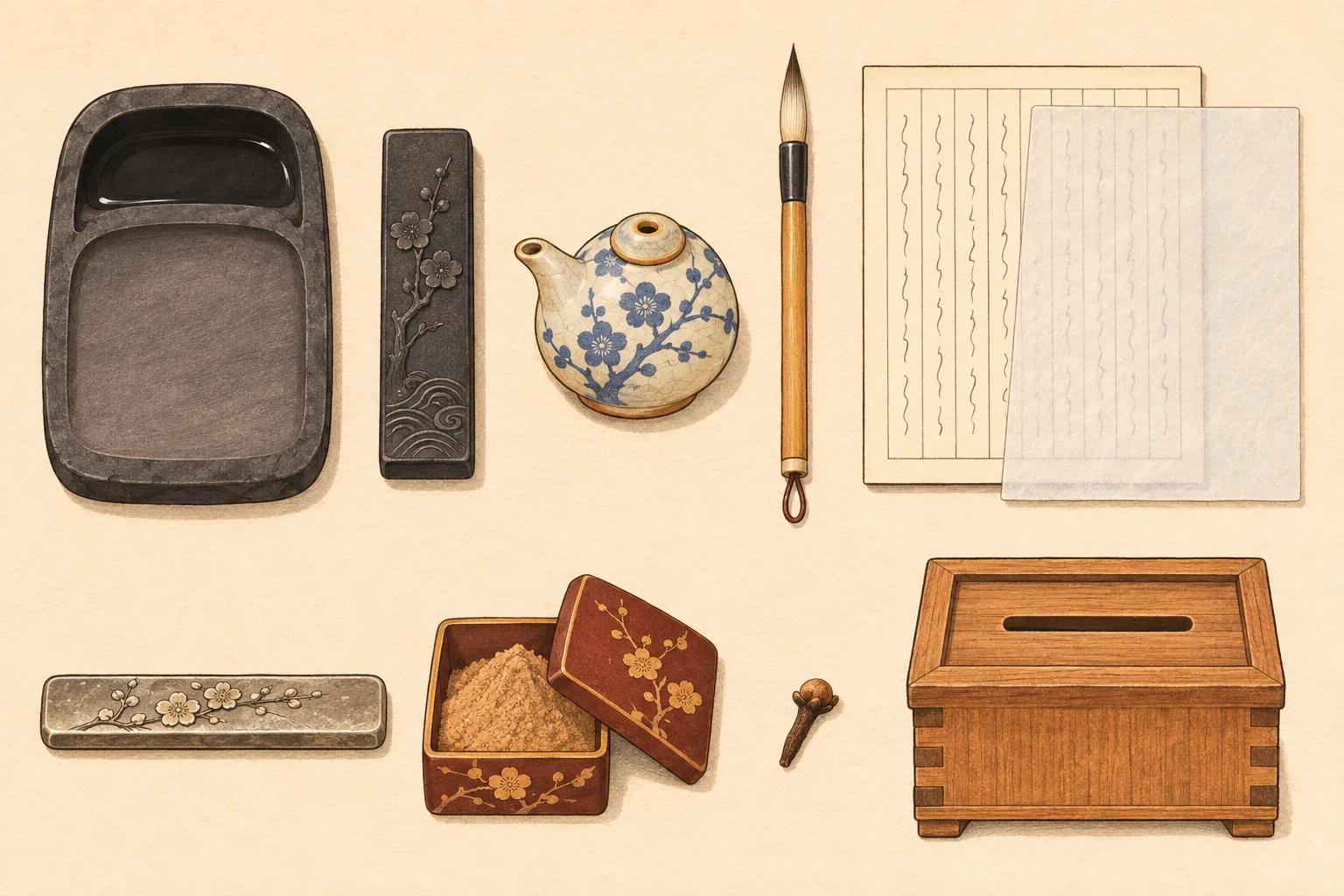
The tools of sutra copying. Top, left to right: inkstone, inkstick, water dropper, brush, and the model sheet with translucent copying paper laid over it. Bottom: paperweight, a box of powdered incense (zukō), a single clove, and the box where finished copies are offered.
Sutra copying and shabutsu end the same way but look different: one is columns of characters, the other a single figure in outline with only a dedication in the corner. Neither is a calligraphy souvenir; both stay with the temple. Nor should either be confused with a goshuin, the brushed temple seal written by the temple’s staff in a pilgrim’s book, which you do take home.
The morning service is a layering of sounds that are easy to tell apart once you know their sources. The great temple bell, bonshō, hangs in its own tower and is struck from the side with a suspended log; its note is low and hangs for a long time. A smaller bell under the eaves of a hall calls monks inside. The mokugyo is a round, hollow wooden block carved in the form of fish, most often a pair of dragon-headed fish holding a jewel between them, struck with a padded mallet to give a dull "tok, tok" that sets the chanting pace; it is used mainly in Zen, Tendai and Pure Land temples. Nichiren chanting is more often driven by fan drums, and some temples use the mokushō, a flat wooden disc laid face down and struck with a ball-tipped stick for a sharper voice. The bowl-shaped bronze gong, kin (smaller ones are called rin), sits on a cushion and is struck on the rim to mark the start and end of passages, ringing clear and long; the kei is a different object, a flat bronze plate hung from a frame. A small bowl bell on a wooden handle, the inkin, is carried by the monk who directs the ritual, struck to give signals or to lead the monks in procession. The big drum, beaten hard and fast, belongs to the fire ritual.
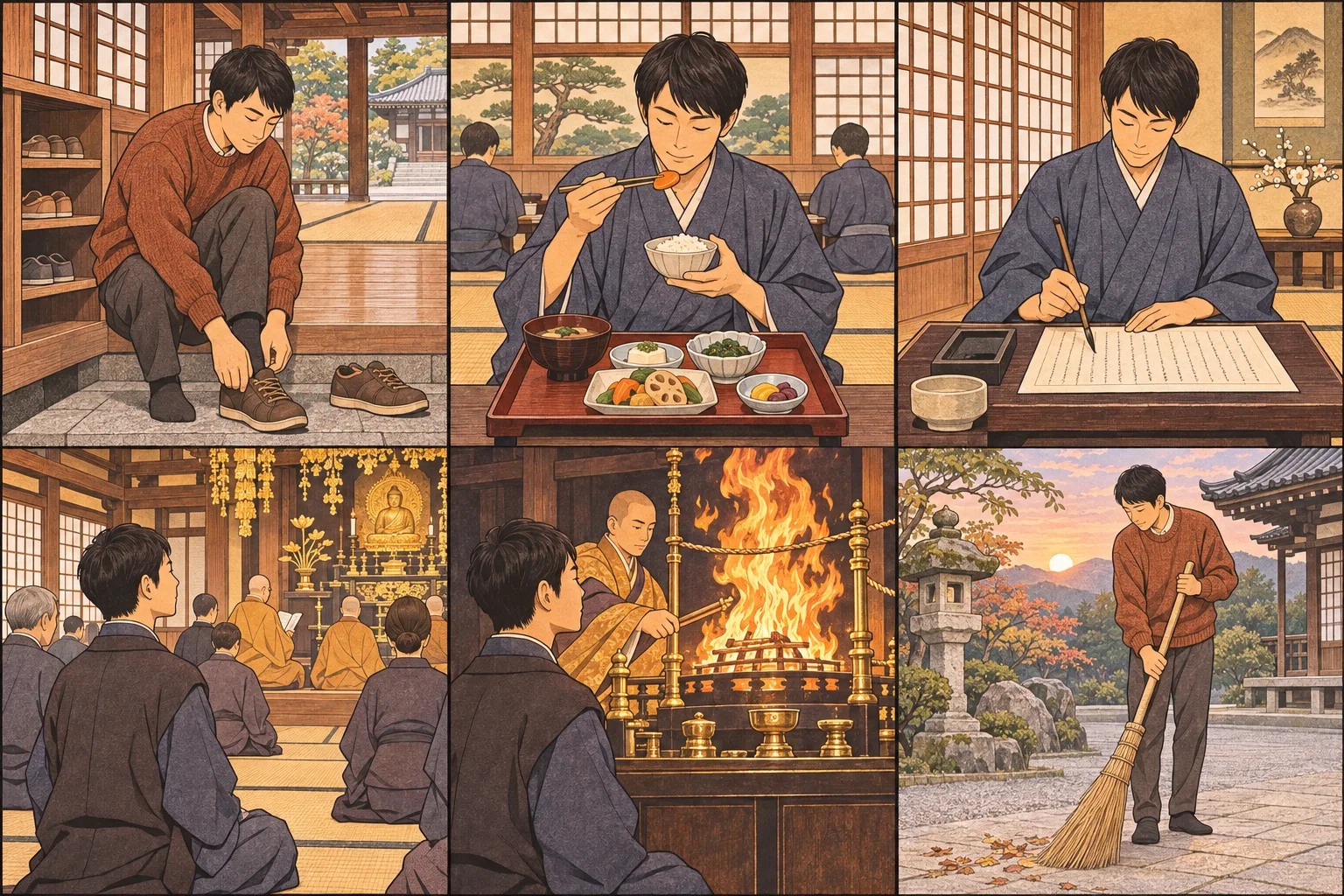
Six scenes from one night at a temple lodging. Top, left to right: shoes off at the entrance, the vegetarian dinner, copying the sutra. Bottom: morning service from the back of the hall, the goma fire, sweeping the garden at sunrise.
07Before Dawn: Morning Service and the Fire Ritual
The morning service, gongyō, is the chanting and worship monks perform before the main image every day. Guests are invited into a service that would happen anyway, not a show staged for them. Someone may walk the corridors before dawn ringing a bell or striking a wooden board to wake the house.
Guests file into the outer area of the hall and sit on the tatami at the back. Candles and lamps light the inner sanctum; the main image sits in a cabinet on the altar platform, its gilded halo catching the flames. Monks in robes take their places, the officiant at a raised seat in front. A strike of the bowl gong, and the chanting begins.
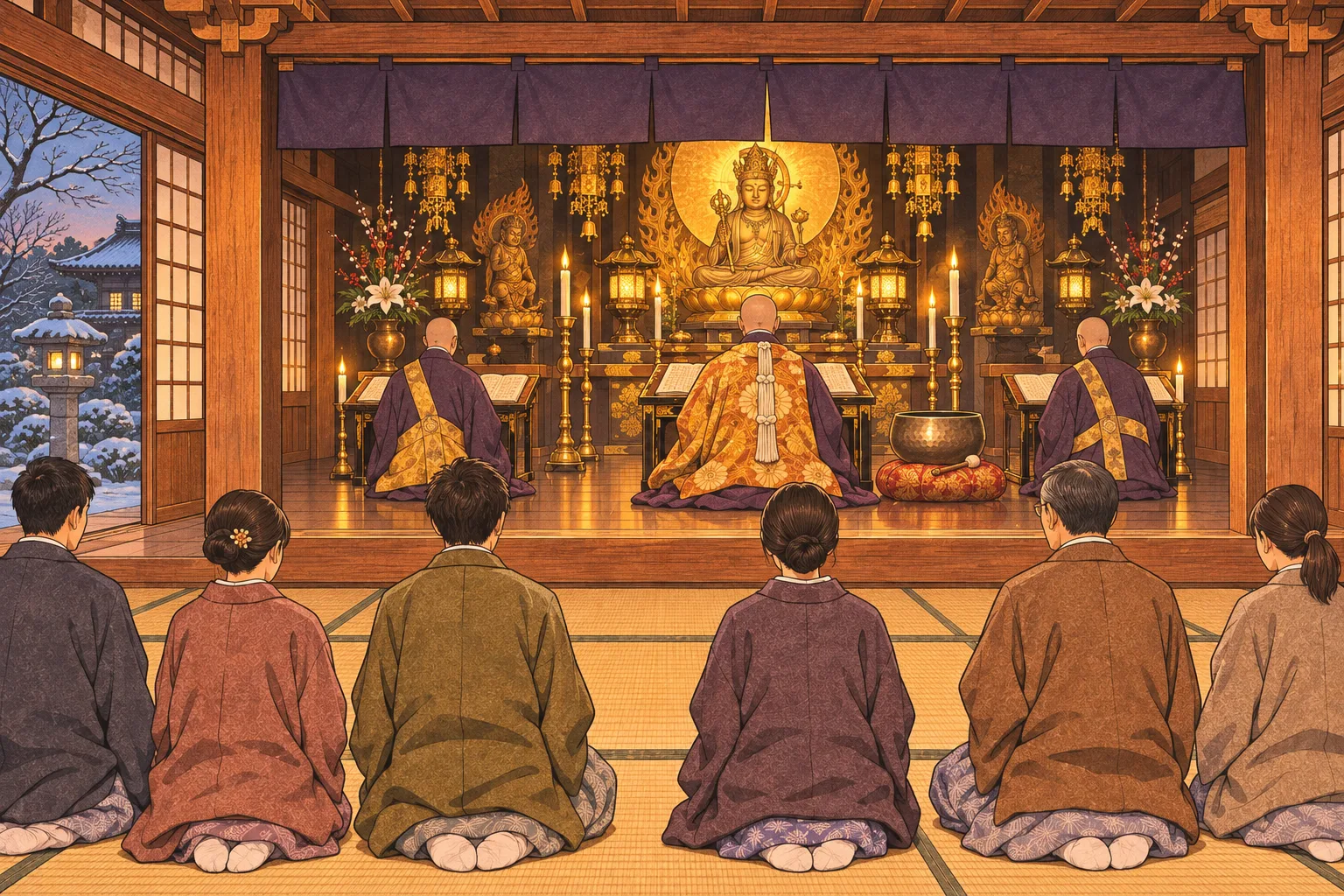
Morning service before dawn: candles light the inner sanctum, the monks chant facing the main image with the bowl gong beside them, and the guests sit on the tatami of the outer area.
What you hear depends on the school. Shingon temples recite the Heart Sutra and the Rishukyō, with mantras in transliterated Sanskrit; Tendai monks chant mainly passages from the Lotus Sutra, with some Pure Land texts, though the order varies by temple; Pure Land services centre on repeating Namu Amida Butsu; Nichiren temples chant the title of the Lotus Sutra; Zen temples chant the Heart Sutra and the Great Compassion Dhāraṇī to the beat of the mokugyo. You may be given a text to follow or simply listen. What most first-timers remember is the depth of it: a few low voices overlapping until the timber hall seems to hum.
Afterwards a monk may lead guests to offer incense or give a short talk about the temple. Guests who have asked for memorial prayers may hear their ancestors’ names read in the chant.
At many Shingon and Tendai lodgings the service is followed by goma, the fire ritual. Derived from Vedic fire offerings and absorbed into esoteric Buddhism, it is performed before Fudō Myōō or another wrathful deity. A hearth sits at the centre of a raised altar; the priest lights it and feeds it with wooden sticks on which worshippers have written their wishes, then grain, incense, oil and other offerings, while chanting mantras and forming hand gestures. The flames can rise nearly to the ceiling, the heat fills the hall, and the drum and chant quicken. In Shingon the fire stands for the Buddha’s wisdom burning away worldly passions. At the end the priest may pass guests’ rosaries or belongings over the embers.
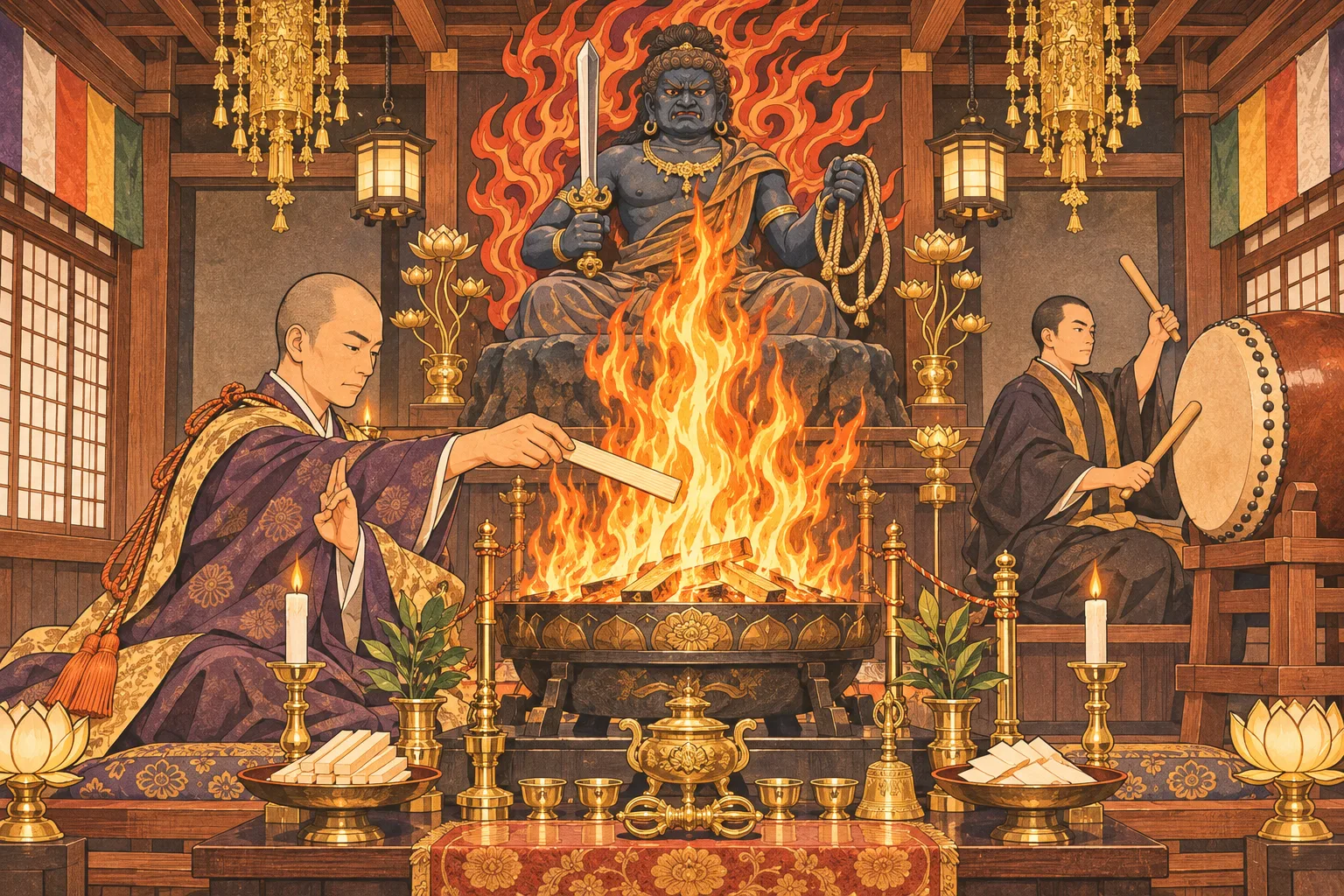
Goma, the fire ritual: flames rise from the hearth before Fudō Myōō as the priest feeds in wooden sticks carrying worshippers’ wishes, to the beat of a drum.
08Meditation, Chores, Breakfast and Farewell
Many Shingon lodgings offer ajikan, "contemplation of the letter A". Before the meditator hangs a scroll showing a white full-moon disc resting on an eight-petalled lotus, with the Sanskrit syllable a written in Siddham script at its centre. In Shingon teaching a is the root of all sounds and letters, standing for the unborn nature of things. You sit, settle the breath, gaze at the syllable, hold its image with eyes closed, and voice a long, soft "aaa" that thins with the breath.
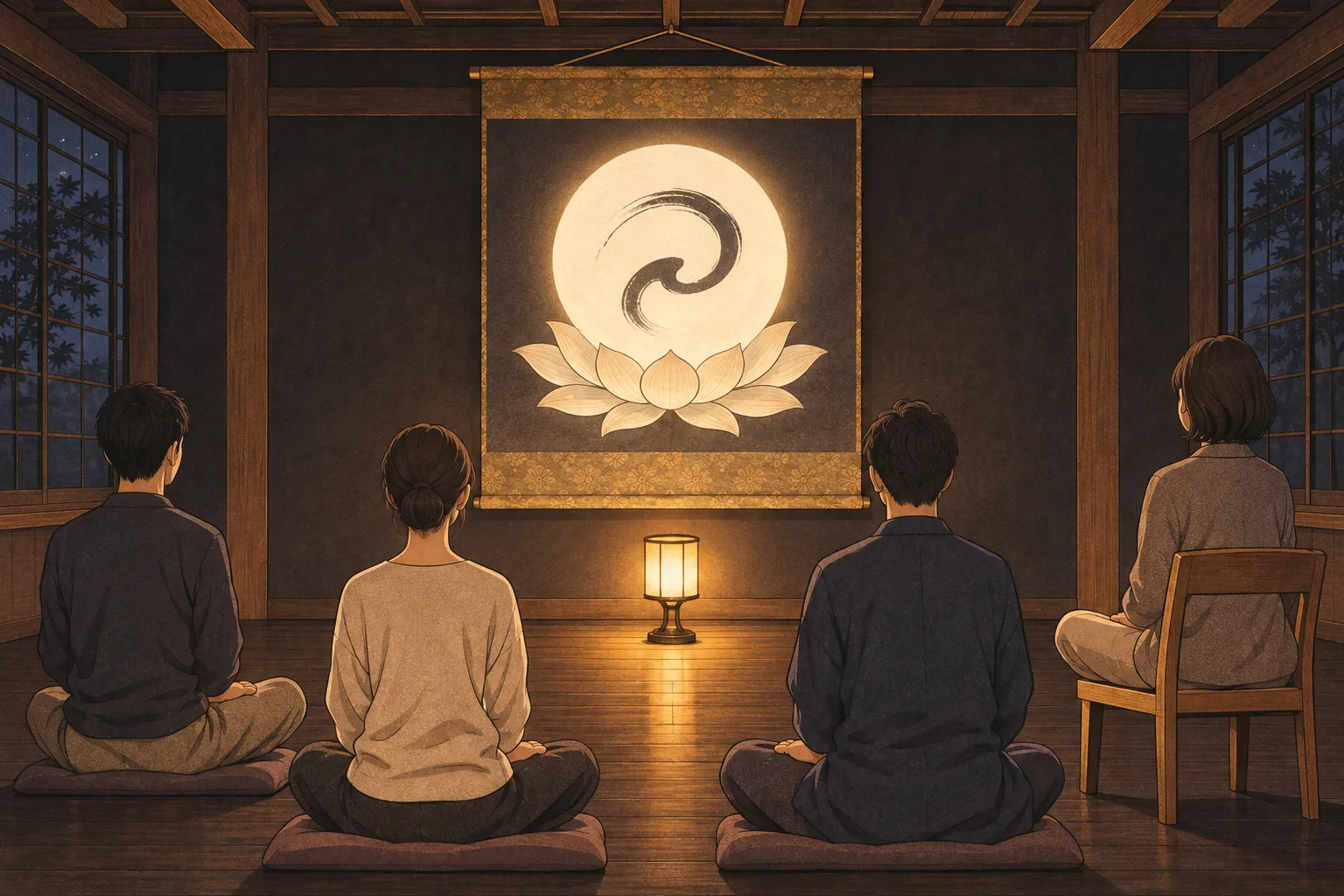
Ajikan: guests sit before a scroll showing a white full-moon disc on a lotus, with the Sanskrit syllable a at its centre. One guest uses a chair.
Gachirinkan, moon-disc contemplation, is its foundation: you picture a clear full moon in your chest, let it expand to fill the room, the mountain and the world, then draw it back. Sessions are held in near darkness with a single lamp, and chairs are often allowed. It differs from Zen sitting, with its own posture and its wake-up stick, in having a definite object to visualise and a sound to voice.
After service, some temples invite guests to samu, temple work: sweeping gravel and stone steps with bamboo brooms, or pushing a damp cloth along the wooden corridors on hands and feet. Breakfast is simpler than dinner: rice or rice porridge, miso soup, pickles, a pickled plum, perhaps sesame tofu, never egg or fish.
Before leaving, guests return to the main hall to bow to the image and thank the abbot, and many ask for a goshuin or a talisman. On Mount Kōya, people walk to Kūkai’s mausoleum in the Okunoin cemetery in the morning. At Zenkōji, after the dawn service, they descend into the pitch-black passage beneath the main hall to grope for the lock said to lie directly under the hidden image. At Tōge, the host leads them out to climb the mountain. Back at the entrance, your shoes are waiting, the slippers already lined up for the next guest.
More deep dives on this topic
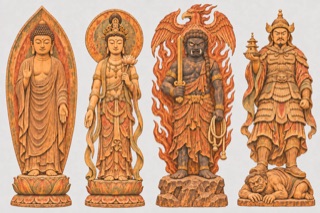 Four Ranks of Buddhist StatuesStep out of the sunlight into a Japanese temple hall and your eyes take a moment to adjust.
 Mudras and AttributesIn the half-light of a Japanese temple hall, the face of a Buddha is often hard to make out.
 Niō and the Four Heavenly KingsWalk up to almost any large Buddhist temple in Japan and the first figures you meet are not serene Buddhas but two furious, nearly naked giants flanking the gate.
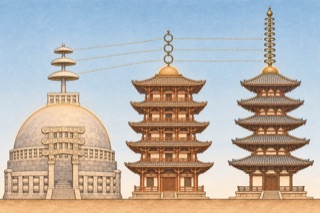 PagodasWalk up the stone lanes of Higashiyama in Kyoto and the Yasaka Pagoda rises over the tiled roofs of the old townhouses; ride the bullet train into Kyoto Station and the dark…
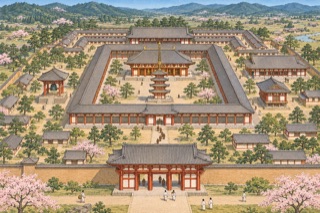 The GaranMost visitors to a Japanese temple experience it as a sequence: a gate, a path, a big hall, perhaps a pagoda off to one side.
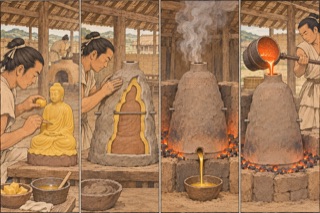 How Buddhist Statues Are MadeWalk through the temples of Nara and Kyoto and you will meet Buddhas that are gold, black, chalky grey, or the warm brown of old wood.
 Reading Temple NamesMost visitors to Tokyo know Sensō-ji, the great Kannon temple in Asakusa.
 Shōjin RyōriThe first thing many visitors eat at a temple lodging on Mount Kōya is a small, pale square that wobbles on a lacquer dish.
 A Night in a TempleMost temples in Japan close their gates at dusk.
- Back to the main article: Japanese Buddhism →