
The first thing many visitors eat at a temple lodging on Mount Kōya is a small, pale square that wobbles on a lacquer dish. It looks like tofu and is called tofu, but it contains no soybeans at all: it is sesame and arrowroot-like starch, stirred by hand until the spoon drags. That is a fair introduction to shōjin ryōri, the vegetarian cooking of Japanese Buddhist temples. It works under strict limits — no meat, no fish, not even garlic or onions — and turns those limits into technique. Over seven or eight centuries it gave the whole country tofu dishes, wheat gluten, soy-milk skin and a stock made without fish, and it shaped the meal served before the tea ceremony. This piece walks through what the rules are, who cooks, the dishes you are most likely to meet, the very different Chinese-style banquet of the Ōbaku school, and where the tradition still lives.
01What "shōjin" means
Shōjin was not originally a food word. It is the Japanese reading of a Buddhist term for diligence or sustained effort, one of the six "perfections" a bodhisattva practises. Food entered the picture because a life of effort was supposed to be a life of restraint, and a disciplined diet was part of it. Dishes that kept the precepts came to be called shōjin-mono, "things of diligence", and a meal of them shōjin ryōri.
The word also has a lay life in Japan. Families once kept shōjin days, abstaining from meat and fish during mourning or before a festival. The meal at which they returned to normal food was the shōjin otoshi, "dropping the shōjin" — and today that phrase usually means the meal served to relatives after a funeral, which, confusingly, often includes fish.
The rules of the temple kitchen come down to three. First, nothing that involves killing an animal: no meat, no poultry, no fish or shellfish. That includes the bonito flakes and dried sardines that flavour most ordinary Japanese stock, which is why the temple kitchen had to invent its own. Eggs and dairy are traditionally left out as well.
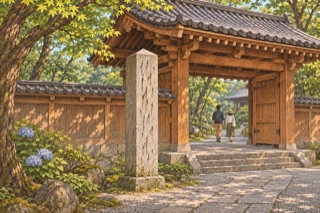
Second, no gokun, the "five pungent roots". The usual list is green onion, garlic, Chinese chives, rakkyō (a small pickling shallot) and asafoetida. Asafoetida does not grow in Japan, so Japanese lists sometimes substitute another allium, and not every temple names the same five. The scriptural reason is that these strong-smelling plants stir up anger when eaten raw and desire when cooked. At the gates of many Zen temples stands a stone pillar carved with the phrase "no pungent foods or alcohol may enter the mountain gate". It is one of the first things a visitor can read, if they know the characters.
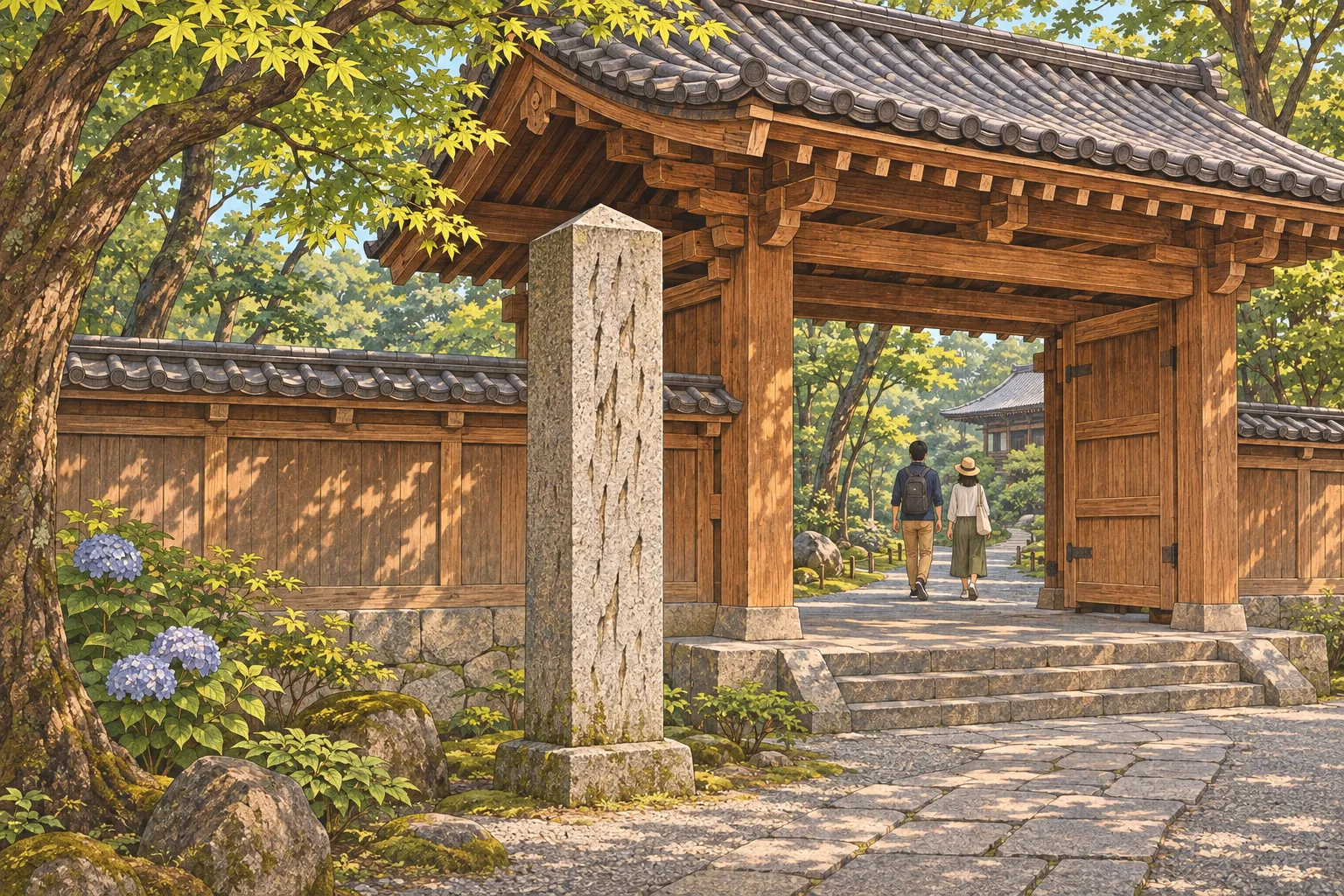
The stone pillar beside a Zen temple gate. Many temples carve on it the rule that pungent foods may not pass the gate.
Third, a principle often taught as "five methods, five flavours, five colours". The methods are raw, simmered, grilled, fried and steamed; the flavours sweet, sour, spicy, bitter and salty, sometimes with a sixth, "mild"; the colours green, yellow, red, white and black. A well-made temple meal is meant to vary all three: green spinach, yellow pumpkin, red carrot, white tofu, black sesame or hijiki seaweed. The formula is often compared to Chinese five-element thinking, but it does not appear in Dōgen’s writings and its origin is unclear. The temples themselves more often quote the thirteenth-century monk Dōgen, who cited a Song-dynasty monastic code on six flavours (bitter, sour, sweet, spicy, salty and mild) and three virtues: food should be light and soft, clean, and prepared according to the rules.
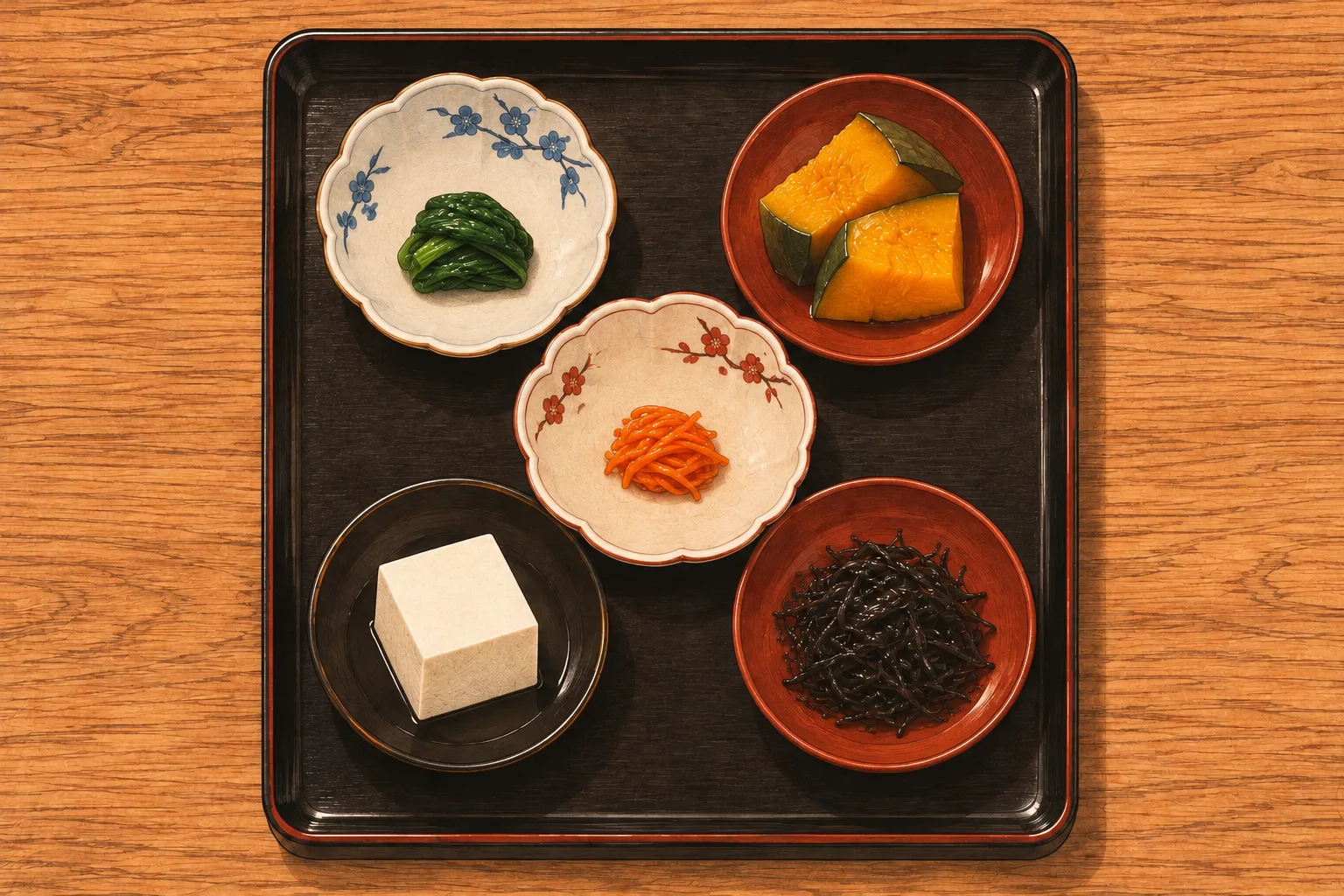
The five colours on one tray: green spinach, yellow pumpkin, red carrot, white tofu and black hijiki.
02Japan’s long habit of not eating meat
Avoiding meat in Japan is older than shōjin ryōri. In 675 Emperor Tenmu banned the eating of cattle, horses, dogs, monkeys and chickens during the farming months, and later courts issued similar orders. Monasteries kept vegetarian precepts throughout the Nara and Heian periods. But their food was mostly steamed rice, pickles and plain boiled vegetables — a diet, not a cuisine.
The cuisine arrived with Zen in the Kamakura period (1185–1333). Monks such as Eisai and Dōgen travelled to Song-dynasty China and came back with more than meditation. Chinese monasteries had kitchens that ground soybeans, pressed tofu, worked wheat gluten, and served light snacks between meals. The mortar and pestle — in Japan a ridged ceramic suribachi and a wooden surikogi — became standard temple equipment, and with them came foods that need grinding before they are good to eat: sesame, beans, and the pastes made from them. Over the following centuries the techniques moved out of the monasteries, through the warrior and aristocratic households that patronised Zen, and into towns.
03The tenzo and Dōgen’s kitchen
In a Zen monastery the head cook is called the tenzo. It is not a junior job. The tenzo is one of six senior officers who run the community’s practical affairs, and in a large monastery he plans the food for hundreds of people: purchasing, storage, quantities, cooking and cleaning.
The position owes much of its prestige in Japan to Dōgen (1200–1253), founder of the Sōtō school. In his own account, in the fifth month of 1223, while his ship lay at the Chinese port of Qingyuan (modern Ningbo), an elderly monk came aboard to buy Japanese dried shiitake. Over tea he explained that he was the tenzo of Ayuwang monastery, a man from Sichuan who had left home forty years before and was now sixty-one. The next day was the fifth of the fifth month, a festival, and he wanted to make the monks a noodle soup but had nothing good to flavour it with, so he had walked some thirty-odd li to the port and meant to walk back the same day. The young Dōgen urged him to stay and talk: surely someone else could do the cooking, and an old man should be meditating and reading sutras instead. The tenzo laughed and told him that he did not yet understand what practice was.
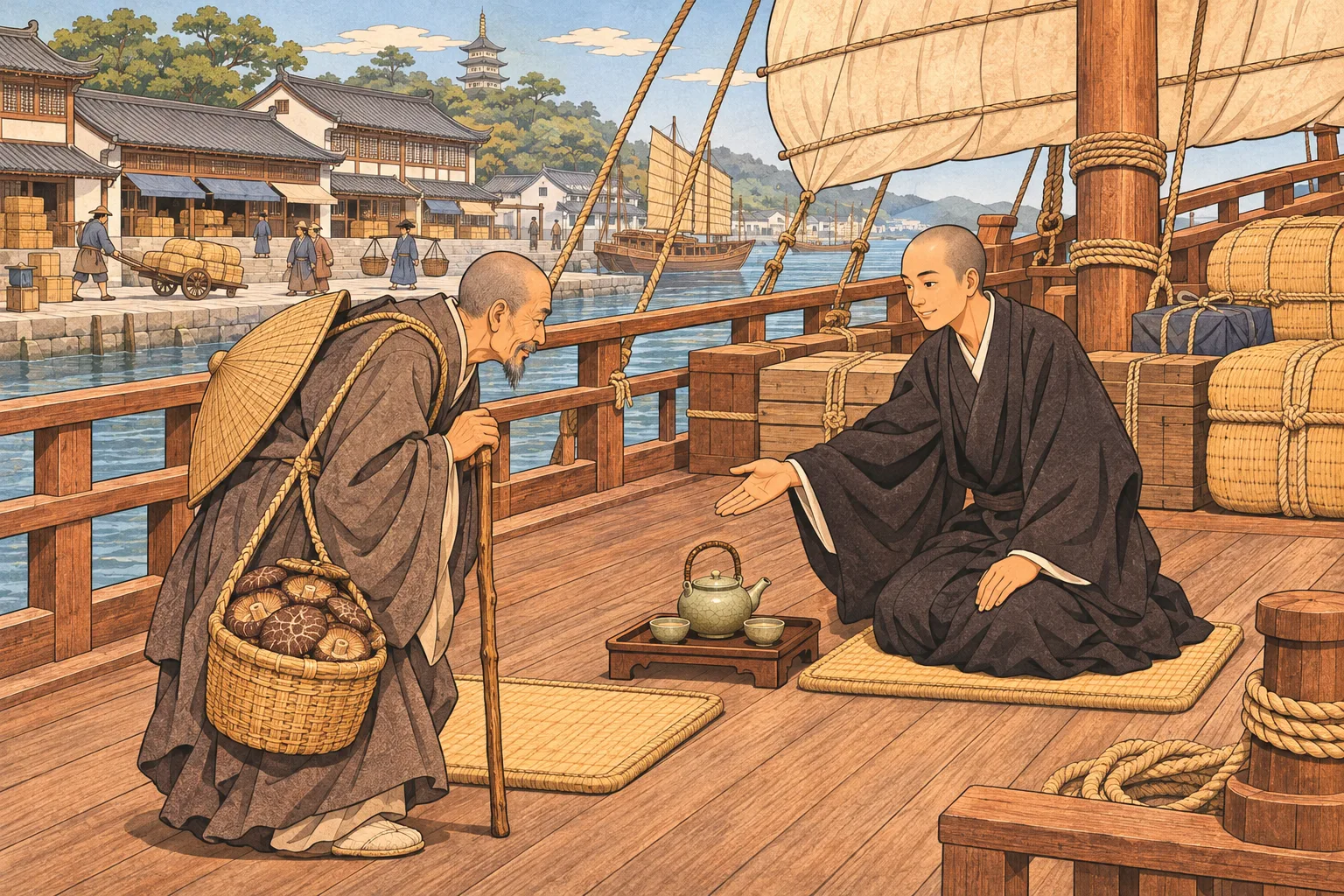
The port of Qingyuan (modern Ningbo), fifth month of 1223: the old tenzo of Ayuwang monastery comes aboard to buy Japanese dried shiitake, and the young Dōgen offers him tea. (artist’s impression)
A second encounter took place at Tiantong monastery. One day after the midday meal, with the sun beating down and the paving tiles hot underfoot, Dōgen found another old tenzo in front of the Buddha hall, leaning on a bamboo staff, bareheaded, his back bent like a bow, spreading something out to dry. Dōgen’s word literally means "moss"; it is usually read as mushrooms, though some commentators take it to mean seaweed, since the coast around Ningbo has long eaten it. Dōgen asked his age: sixty-eight. Why not let a lay worker do it? "Others are not me," the old man replied. Then why in this heat? "If not now, when?" Dōgen later wrote that only then did he grasp the weight of the cook’s work. Both stories appear in his Instructions for the Cook (Tenzo Kyōkun), written around 1237, and they are the passages Japanese people quote most often about temple food.
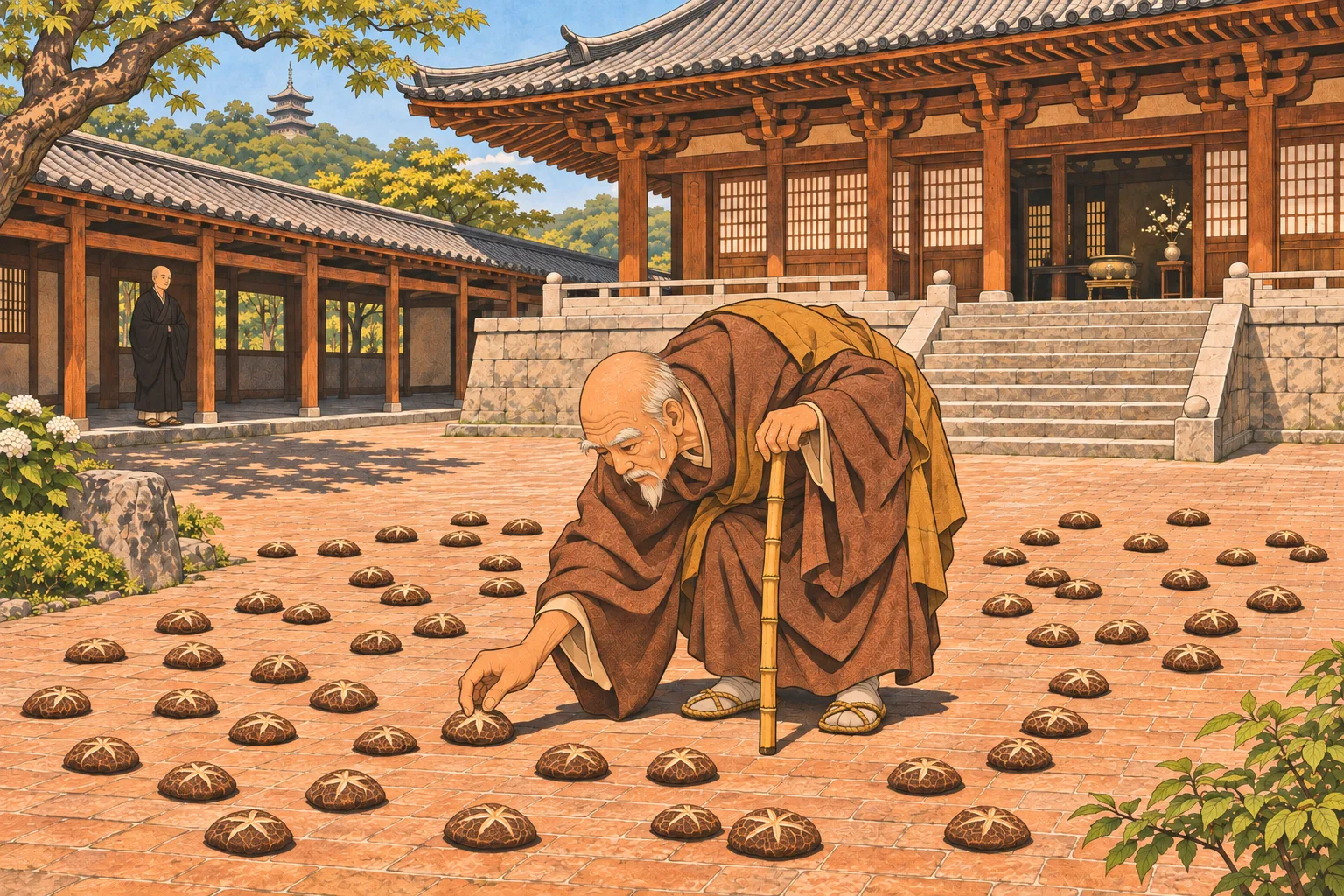
Tiantong monastery after the midday meal: the old tenzo, bareheaded and bent like a bow over his bamboo staff, spreads mushrooms to dry on the hot paving before the Buddha hall. Dōgen watches from the corridor. (artist’s impression)
The book itself is entirely about the kitchen. The tenzo confers the night before with the other officers on tomorrow’s rice and vegetables. He watches the rice being washed, picking out sand without throwing away grain. The water from washing rice is not tossed carelessly. A leaf of greens should be handled with the care given to the body of a Buddha. The cook should not be pleased by fine ingredients or careless with poor ones; a fine milk broth and a soup of coarse greens call for the same attention. Leftover scraps should find a use. When the cooking is done, every pot and utensil is cleaned and put back in its place. The idea that cooking is itself practice — not a chore that takes time away from practice — is the reason the tenzo’s kitchen sits at the heart of shōjin ryōri rather than at its edge.
Dōgen later wrote a companion text at Eihei-ji on how to receive food, the Fushukuhanpō. It covers the eating side: the set of nested bowls, how food is served and received, the verses recited before eating. That ritual belongs with the Zen monastery’s daily routine and is described in the Zen article; here the point is simply that, for Dōgen, cooking and eating were two halves of the same practice.
In large monasteries today the tenzo is usually a monk with several years of training, and the post rotates. Junior monks work under him washing rice, cutting vegetables and tending the fires. The kitchen is quiet: no idle talk, only the sound of knives, water and flame. Several former tenzo of major temples have written cookbooks of their monastery’s food, and some now teach temple cooking abroad.
At Eihei-ji, Dōgen’s mountain monastery in Fukui, the kitchen building is called the Daikuin. Its ground floor is the kitchen where the tenzo and his helpers cook. Hanging near the entrance is an enormous wooden pestle shaped like the surikogi used to grind sesame; it is said to have been carved from a tool used to pound the ground flat during construction work in the Meiji era, and it is well worn. Visitors like to touch it, since doing so is said to improve one’s cooking. Near the kitchen stands Idaten, a guardian of monasteries famous for his speed: legend says he chased down a demon who had stolen relics of the Buddha. Popular tradition adds that he ran far and wide to gather food for the Buddha and the monks, and one theory links him to the everyday Japanese word for a feast, gochisō, whose characters mean running about to provide a meal.
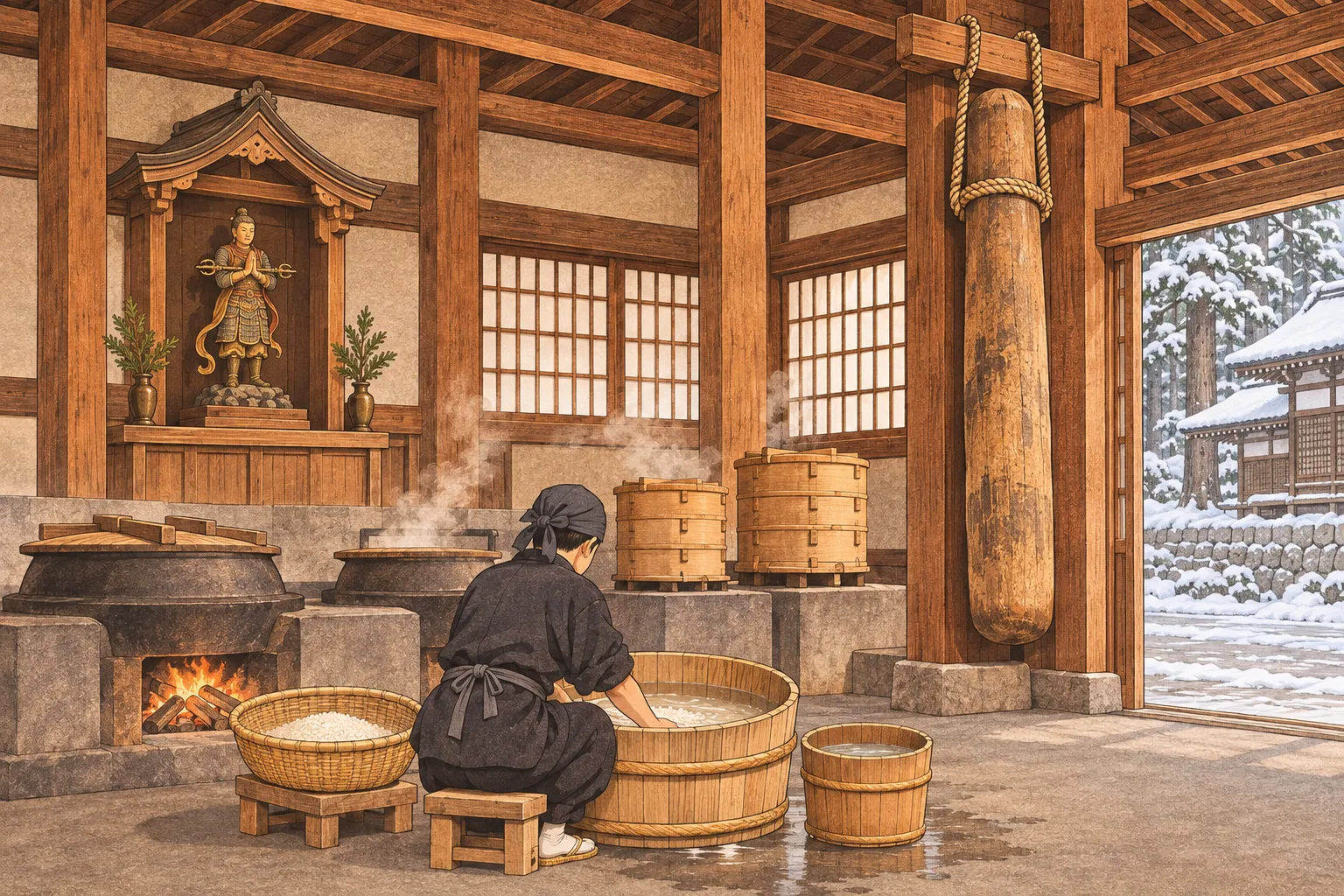
The Daikuin, the kitchen building of Eihei-ji: an enormous wooden pestle, shaped like the surikogi used to grind sesame, hangs from a pillar. Idaten stands in the shrine on the left.
04The dishes you will meet
Goma-dōfu (sesame tofu). A smooth, glossy square, usually ivory to pale grey-beige, that trembles when picked up with chopsticks. It is sticky at first bite, then springy, with a deep roasted-sesame flavour. It contains white sesame, water and kuzu starch, the refined root starch of the kudzu vine. The traditional method is slow and physical: the sesame is ground in the mortar until it releases oil, mixed with water and strained into a sesame "milk", then cooked with kuzu over low heat while being stirred constantly for half an hour or more. The paste grows heavier and the spatula harder to move; stop, and it scorches. It is set in a mould, chilled, cut, and served with a dab of wasabi and a little soy-based sauce, or with sweet miso. Kuzu is chosen because it sets clear and elastic and does not harden when cold; kuzu from Yoshino in Nara is especially prized. Mount Kōya’s goma-dōfu is the most famous, and it appears at almost every temple-lodging meal there, but Eihei-ji and many other temples make their own. Versions made with black sesame come out charcoal grey.
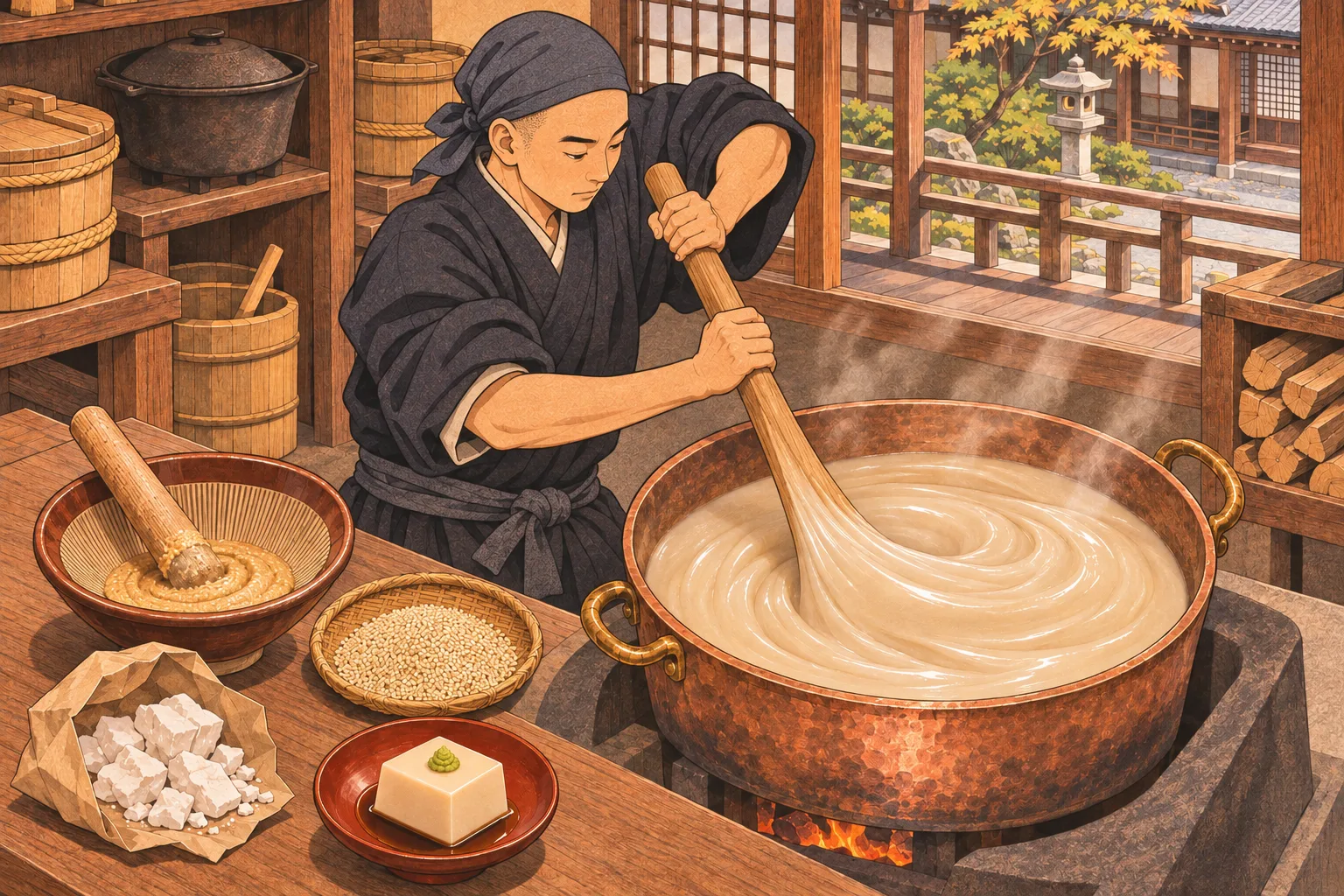
Making goma-dōfu: sesame ground in the mortar, kuzu starch, and a long, constant stir with a wooden spatula over the fire. The finished ivory square sits in the small dish in front.
Kōya-dōfu (freeze-dried tofu). This one really is soybean tofu, but frozen and dried. The result is a light, hard, beige block full of tiny holes, rather like a sponge. Soaked to soften and simmered in sweetened stock, it releases a rush of broth when bitten. The common story, set in the Kamakura period, is that tofu prepared at a lodging on cold Mount Kōya froze overnight; the monks cooked it rather than waste it, liked the texture, and learned that frozen and dried tofu kept for months. Similar products in Tōhoku are called shimi-dōfu, once made by hanging tofu under the eaves in winter. Today kōya-dōfu is made mainly in factories in Nagano and elsewhere, by machine freezing and drying. For a mountain temple without refrigeration, a tofu that kept all season mattered.
Yudōfu (simmered tofu). The simplest dish of all. A sheet of kombu kelp goes into an earthenware pot of water, then large cubes of soft tofu. Over gentle heat the tofu warms until it begins to sway, and is lifted out and dipped in soy sauce. A traditional yudōfu pot has a small well in the centre where the cup of dipping sauce sits, warmed by the water around it. Restaurants usually add sliced green onion, ginger and bonito flakes as condiments; a strict temple version leaves out the onion and the fish. The approach to Nanzen-ji in eastern Kyoto is generally said to have been known for yudōfu since the Edo period, served at teahouses outside the gate to pilgrims and travellers. The Saga area around Tenryū-ji is known for it too. Kyoto’s soft well water suits tofu-making.
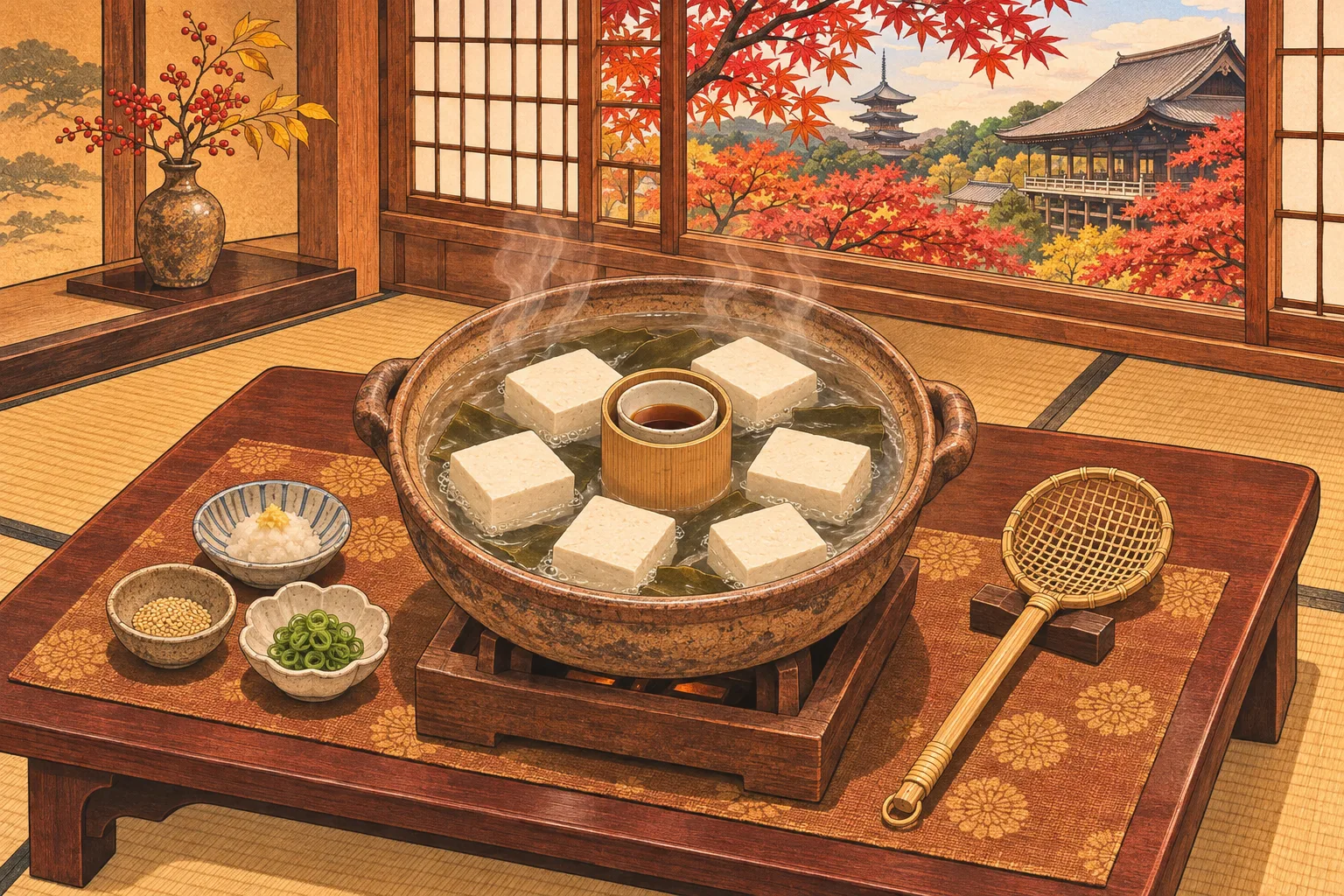
Yudōfu: large blocks of soft tofu warming gently over a sheet of kombu in an earthenware pot. The small tube in the middle holds the cup of dipping sauce and keeps it warm.
Nama-fu and yuba (wheat gluten and soy-milk skin). Fu is wheat gluten — what remains after dough is kneaded under water until the starch washes out. Nama-fu, "fresh fu", is gluten mixed with glutinous rice flour and steamed: soft, chewy, more springy than rice cake. Kyoto makes it into maple leaves, cherry blossoms and ginkgo leaves, tints it green with mugwort or studs it with millet, and grills it or simmers it in broth. Fu manjū are sweets with a nama-fu skin around bean paste, wrapped in a bamboo leaf. Yaki-fu, by contrast, is baked dry gluten, light and crisp, often shaped into little rings for miso soup. Fu is thought to have come from China with Zen monks. Yaki-fu should not be confused with the Chinese spongy gluten also called kaofu.
Yuba is the skin that forms on soy milk heated gently in a shallow pan. Craftsmen lift each pale yellow sheet with a thin bamboo skewer and hang it to drain. Fresh yuba is soft and tastes of cream and beans, eaten with a little soy sauce; dried yuba keeps and is softened for soups, rolls and frying. The two great centres are Kyoto and Nikkō, and they even write the word differently — Kyoto with characters meaning "hot-water leaf", Nikkō with "hot-water wave". The usual explanation is that Kyoto lifts the skin as a single thin layer, while Nikkō folds it double as it is lifted, giving a thicker sheet with a stronger bean flavour; some add that Kyoto lifts from the edge and Nikkō from the centre.
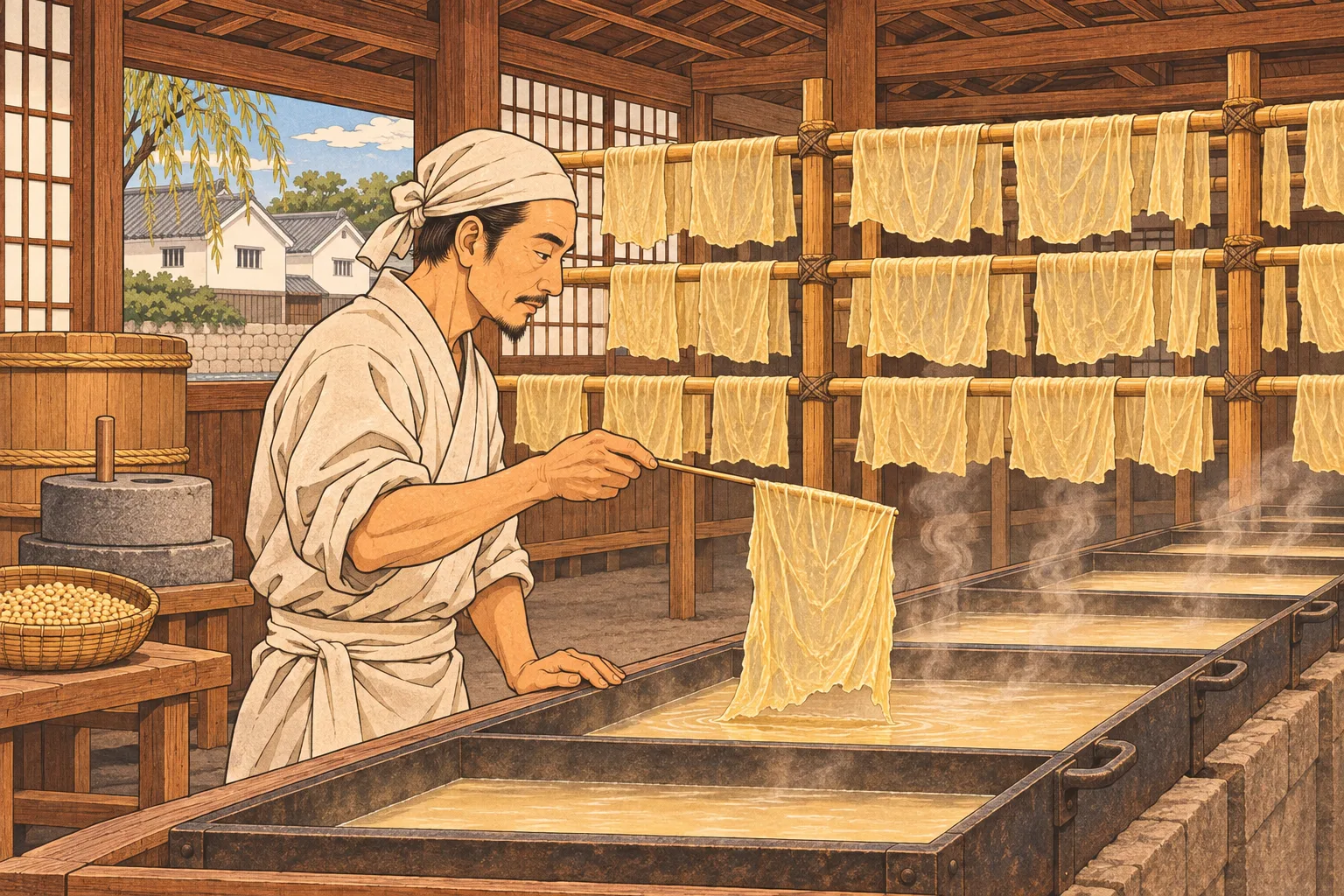
Making yuba: soy milk is heated gently in shallow pans, and each pale yellow skin is lifted with a thin bamboo skewer and hung up to drain.
Ganmodoki (tofu fritters). Golden, slightly crisp patties about five or six centimetres across. Inside is white mashed tofu speckled with carrot, burdock, wood-ear mushroom and hijiki, sometimes with a ginkgo nut. Pressed tofu is mashed, bound with grated mountain yam, shaped and deep-fried. The name means "mock goose", and one explanation is that the taste was thought to resemble wild goose; another is that the dish imitated meat dumplings. In western Japan the same thing is called hiryōzu, a name usually traced to a Portuguese fried pastry. Today ganmodoki bobs in every pot of oden, and few people eating it think of temples at all.
Tofu also works as a sauce in the temple kitchen. Pressed tofu ground in the mortar with sesame and a little white miso makes a thick white dressing; folded through blanched spinach, slivers of carrot and konnyaku, it becomes shira-ae, a small dish of green and orange in a white coat that turns up on many shōjin trays. Ground sesame alone gives goma-ae. Both dishes depend on the suribachi, which is why the mortar and pestle are as much a symbol of the temple kitchen as the rice pot.
All of these foods share an idea that runs through shōjin cooking: imitation. A monastery that eats no meat still has to feed bodies doing hard physical work, and gluten, soy-milk skin and fried tofu supply protein and a satisfying chew. Sometimes the cooks admit the borrowing in the name itself, as with the "mock goose". The Ōbaku kitchen, below, takes the game much further.
Kombu and shiitake stock. Ordinary Japanese dashi uses kombu and bonito flakes. The temple version uses only plants: kombu, dried shiitake, sometimes dried gourd strips or toasted soybeans. Kombu is often cold-steeped: wiped of dust (but not of its white bloom, which carries flavour), left in water overnight, and lifted out in the morning. Alternatively it is heated slowly and removed just before boiling, since boiling makes the stock slimy. Dried shiitake are soaked slowly in cold water, often overnight in the refrigerator; the amber soaking liquid becomes stock and the softened mushrooms go into the cooking. The savoury compounds in kombu and shiitake reinforce each other, so temple cooks often combine the two. The stock is lighter than bonito dashi, which pushes the cook to rely on the ingredients themselves and season gently. Nothing is thrown away: the steeped kombu is sliced and simmered into a sweet-salty relish or cut into a stew, and the shiitake are cooked as a dish in their own right. Remember the old tenzo buying Japanese mushrooms in Ningbo: dried shiitake were already valued enough in Song China to be worth a long walk to the port.
05Fucha ryōri: a Chinese banquet at a Japanese temple
Everything so far comes from the Sōtō and Rinzai Zen traditions. In the seventeenth century a second, very different style arrived.
In 1654 the Chinese monk Yinyuan Longqi — known in Japan as Ingen Ryūki — sailed from Fujian to Nagasaki at the invitation of the Chinese community there. He was sixty-three. The shogunate later granted him land at Uji, south of Kyoto, where in 1661 he founded a monastery named after his home temple: Ōbaku-san Manpuku-ji, head temple of the Ōbaku school. Manpuku-ji still looks like a Ming Chinese monastery. Its halls have raised stone terraces, a large wooden fish, the kaipan, is struck to announce ceremonies and meals and is said to be the ancestor of the wooden-fish drum, and the monks chant daily in Ōbaku Tōon, a pronunciation said to derive from Ming-era Nanjing Mandarin. Its food kept the habits of Ming monastic kitchens too. This is fucha ryōri.
Fucha means "tea for everyone": originally the tea, snacks and vegetarian meal shared by the whole community after a ceremony or meeting. The striking difference from Japanese shōjin food is how it is eaten. A Japanese temple meal is served on individual trays, one per person. Fucha is served at a table for four, seated on chairs, with large platters and bowls in the middle from which everyone helps themselves. In seventeenth-century Japan that was novel. Nagasaki had a similar shared-table cuisine, shippoku, which uses meat and fish; fucha is often described as its vegetarian counterpart. Manpuku-ji’s rule is that the four sit without rank and finish everything in good humour.
The dish names keep their Chinese readings. Shunkan is a large platter of a dozen or more simmered vegetables, bamboo shoots, gluten and tofu, piled by colour into a little landscape. Unpen is chopped vegetables cooked and bound with kuzu so that they look like drifting cloud; it is often said to use up trimmings, so that nothing is wasted. Yuji are fried foods in which both the batter and the ingredient are seasoned first, close relatives of tempura. Mafu is sesame tofu, which Manpuku-ji calls the ancestor of goma-dōfu. Sume is a clear soup, shintsai a mild dish of seasonal vegetables, and suigo the closing fruit and sweets. The most entertaining are the mock dishes: a slab of tofu and grated yam pressed onto a sheet of nori to look like eel skin, fried and glazed with sweet sauce so that it passes for grilled eel; "fish" made of gluten or konnyaku. Fucha uses more oil than Japanese temple food, stronger flavours, brighter colours, and a lot of kuzu-thickened sauces — all signs of its Chinese origin.
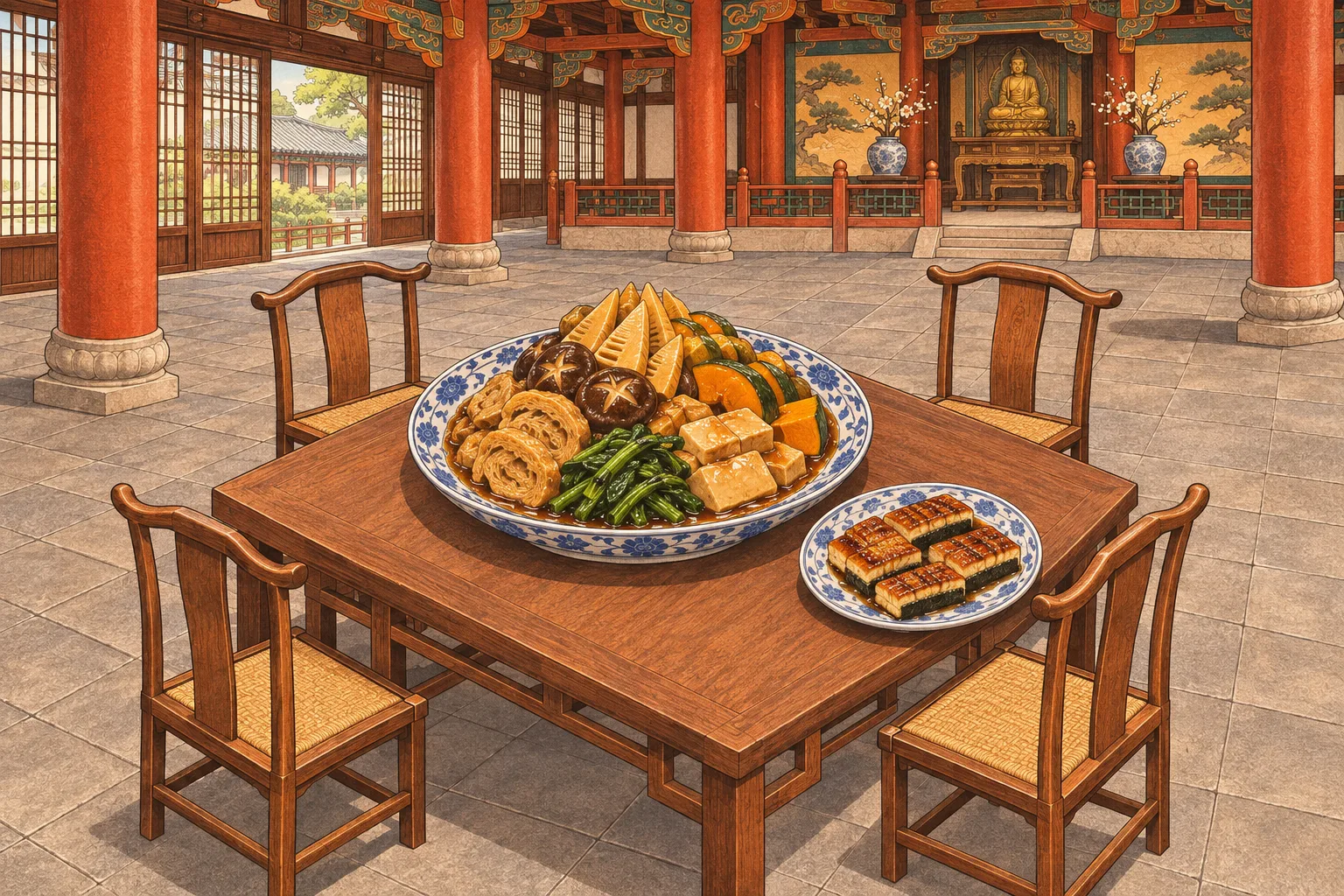
Shunkan, the centrepiece of a fucha meal: a large platter of simmered vegetables, bamboo shoots, gluten and tofu piled by colour into a little landscape. The smaller plate holds mock eel.
A fucha meal usually begins with tea and sweets, moves through shunkan, dressed vegetables, soup, fried things and mock dishes, and ends with rice and pickles. Food is to be shared out fairly and finished. The Ōbaku monks brought other things with them as well: Japanese call the common green bean ingen-mame, after Ingen, who is said to have introduced it (some say what he actually brought was the hyacinth bean), and the Ōbaku school helped popularise sencha, steeped green tea. Manpuku-ji still serves fucha today, both in the traditional shared-platter style and in a simplified boxed version.
06Side by side: the tray and the table
Put a classic shōjin tray next to a fucha table and the two traditions explain themselves.
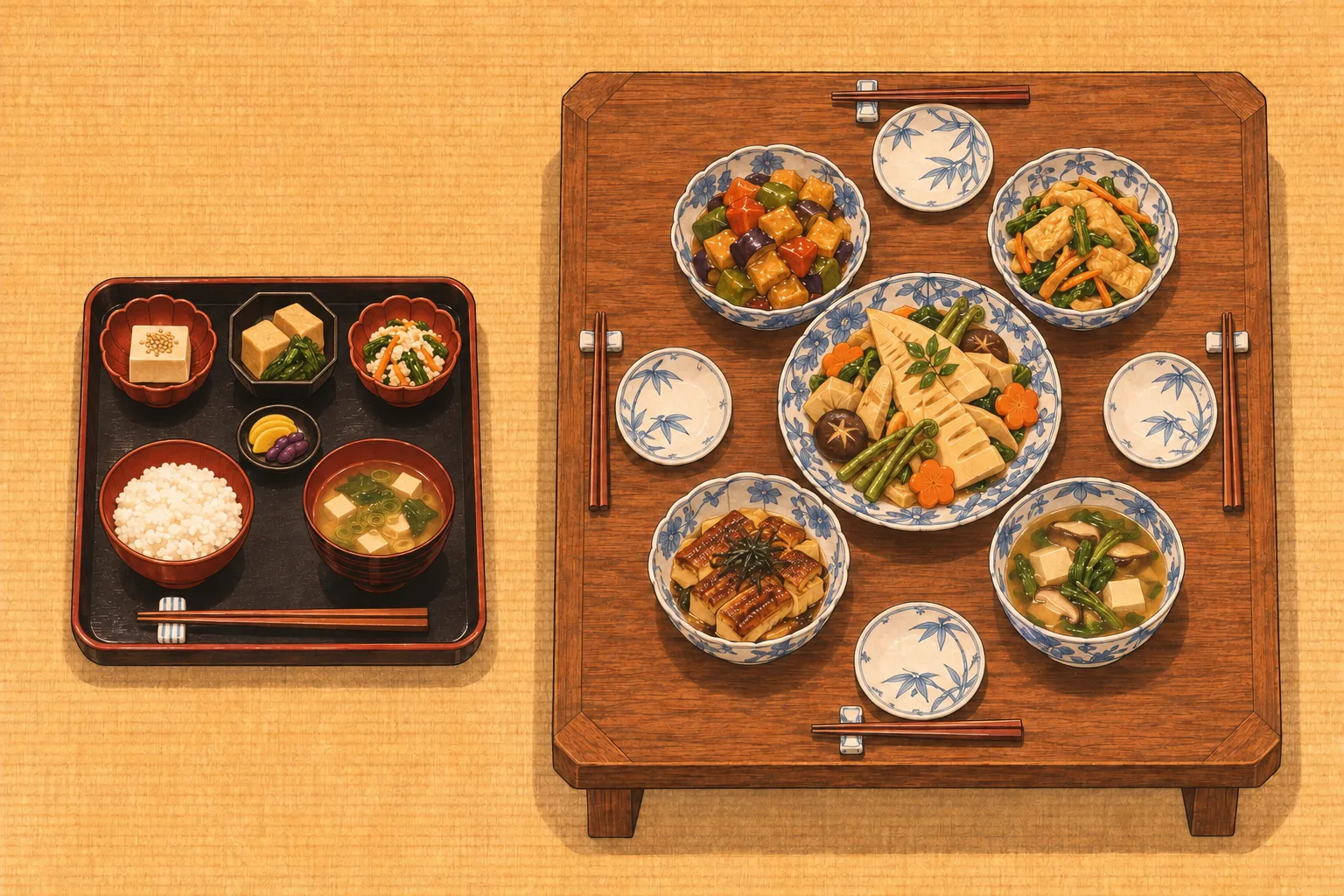
Left: a shōjin tray for one, rice at front left, soup at front right, three small dishes behind and pickles in the middle. Right: a fucha table for four, a platter of shunkan in the centre, large shared bowls around it, and only a small plate and chopsticks for each diner.
The shōjin meal is built on the pattern of one soup and three side dishes, plus rice and pickles. Each diner has a small lacquered tray or legged table, red or black, laid out by rule: rice bowl at front left, soup bowl at front right, two or three small dishes behind, pickles in the middle. Portions are a few mouthfuls each. A typical tray might hold goma-dōfu, simmered kōya-dōfu and vegetables, dressed greens and a clear soup made from kombu and shiitake. The palette is quiet, organised by the five colours rather than by strong sauces.
The fucha table seats four on chairs. In the centre sits a platter of shunkan perhaps forty or fifty centimetres across, surrounded by large bowls of unpen, heaped yuji, mock eel, soup and sweets. Each diner has only a small plate and chopsticks. The colours are deeper, the surfaces glossier with oil, and the dishes are as likely to be blue-and-white porcelain as lacquer.
Several of the signature foods are easy to confuse. Goma-dōfu is greyish or beige, sticky and elastic, and made from sesame; ordinary tofu is snow white and breaks easily. Kōya-dōfu is dry, beige and porous before soaking; fresh tofu is wet and soft. Nama-fu is soft, chewy and often shaped and coloured; yaki-fu is dry, crisp and ring-shaped. Yuba is a thin sheet folded or rolled; it is not the same as the thicker, drier bean-curd sheets common in Chinese cooking. Ganmodoki is a patty with visible flecks of vegetable inside; aburaage, the fried tofu pouch used for inari sushi, is a single sliced sheet of tofu, hollow inside.
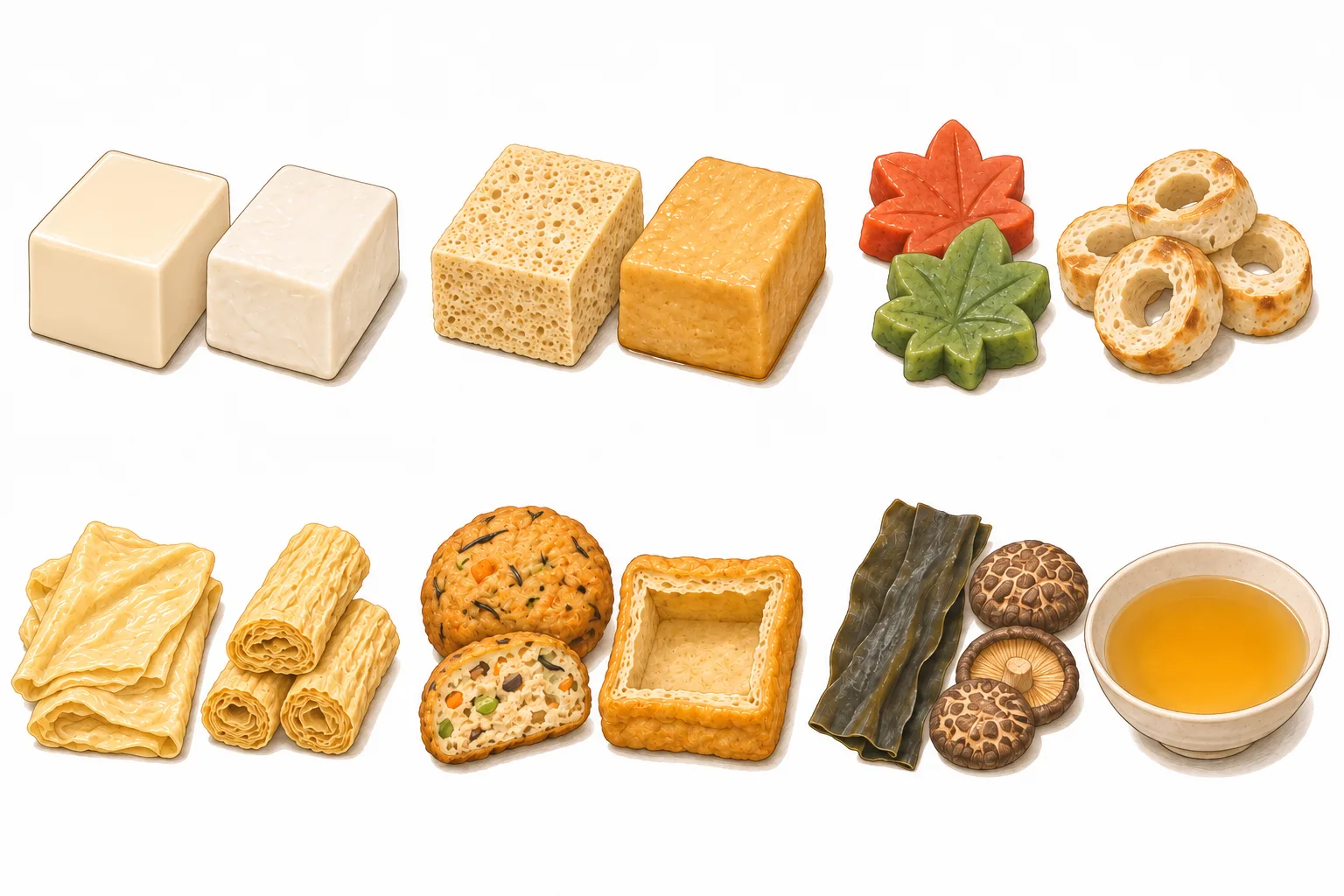
Six pairs that are easy to confuse. Top, left to right: goma-dōfu and ordinary tofu; kōya-dōfu dry and simmered; nama-fu and ring-shaped yaki-fu. Bottom: fresh yuba and dried yuba rolls; ganmodoki and aburaage; kombu and dried shiitake with the stock they make.
07From the temple kitchen to every kitchen
The deepest influence of shōjin ryōri is that it showed Japan how to eat well without meat. Tofu, fu, yuba, sesame and miso dishes spread out from the monasteries during the Kamakura and Muromachi periods. By the Edo period tofu was an everyday food of city life; in 1782 a cookbook called One Hundred Tofu Delicacies (Tōfu Hyakuchin) presented a hundred tofu recipes and became a bestseller.
The tea ceremony’s meal, kaiseki, also grew from the monastic table. It began as a light meal eaten before thick tea, and its one-soup-three-dishes structure matches the temple tray. The one-soup-three-dishes pattern is generally said to appear already in Zen temple records of the sixteenth century. The romantic story behind the name kaiseki, of monks holding warm stones against their stomachs on winter nights, and the difference between tea kaiseki and banquet kaiseki, are covered in the kaiseki article. What tea kaiseki took from the temple was the frame: one serving per guest, rice and soup at the centre, few dishes, all in season, nothing left on the plate. Unlike temple food, it serves fish.
Miso and soy sauce have their own temple legend. The monk Kakushin is said to have learned a vegetable-studded miso at Jingshan monastery in China and brought it back to Kōkoku-ji in Kii province, where it became kinzanji miso; the liquid that pooled in the barrels supposedly developed, in nearby Yuasa, into Japanese soy sauce. It is a widely told local story, not all of it secure. In Kamakura, the Zen temple Kenchō-ji is traditionally credited with kenchin-jiru, a soup of tofu and root vegetables sautéed and then simmered, which is now ordinary home cooking. The temple story is that its founder, Lanxi Daolong, gathered up tofu a trainee had dropped, washed it and put it in the soup. Another theory derives the name from kenchin, a temple dish brought from China, made of chopped vegetables and tofu stir-fried, rolled in fried tofu skin or yuba and deep-fried. Both explanations are still told.
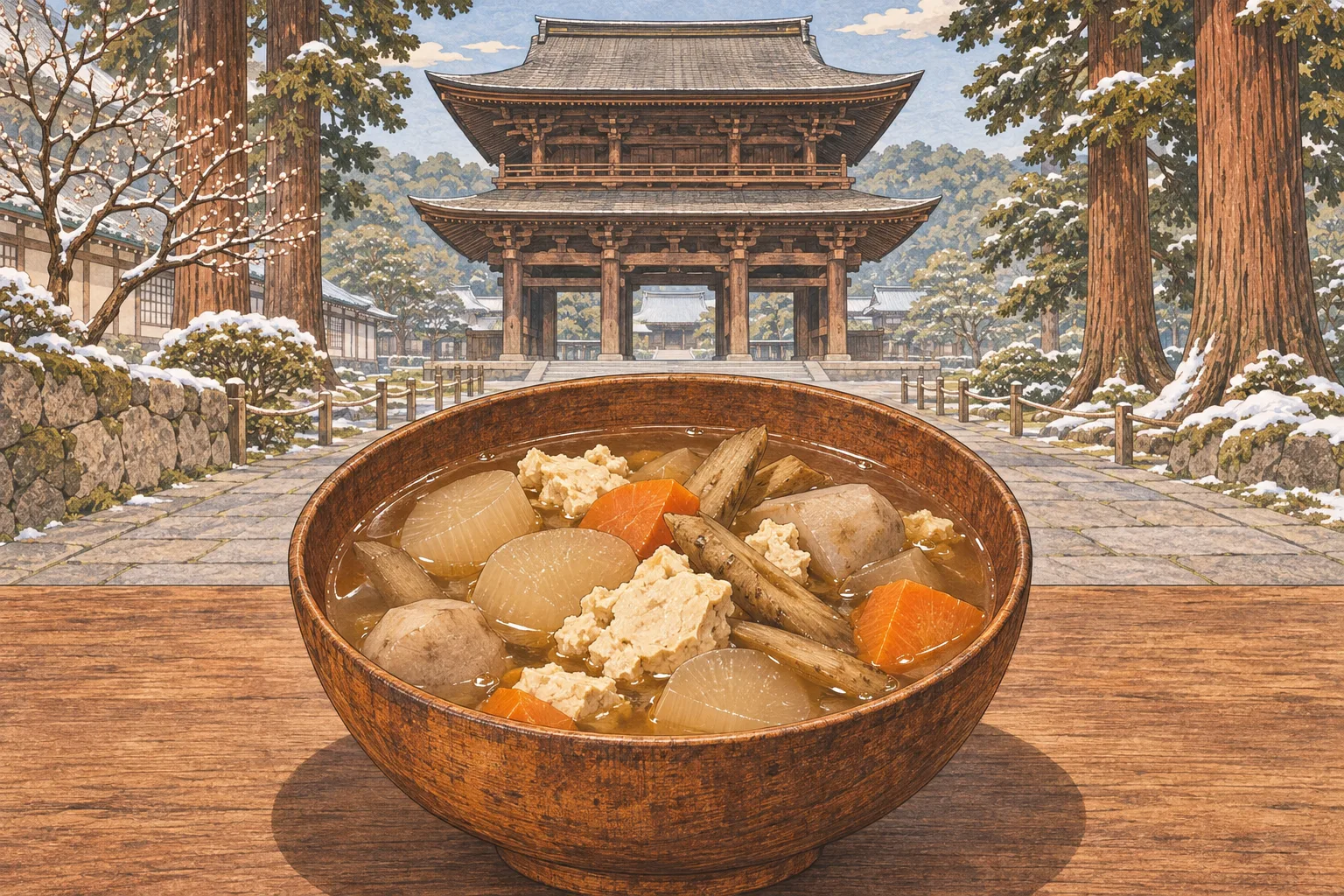
A bowl of kenchin-jiru before the gate of Kenchō-ji in Kamakura: tofu and root vegetables, sautéed and then simmered.
The pre-meal phrase itadakimasu is usually explained today as thanks for nature’s gifts and for the lives in the food, and some go further and trace it to Buddhist thought and temple food. Treat that last link as one interpretation. Itadaku literally means to raise something above one’s head in respect, and so to receive humbly. The custom of the whole family saying it together became fixed fairly late: the food historian Kumakura Isao cites an earlier survey of women over eighty, who recalled that in their childhood busy households ate in shifts with little ceremony; in his account, itadakimasu and gochisōsama became household manners only once families gathered round a low dining table (chabudai) — a modern development.
08Where to find it today
The most direct way to meet shōjin ryōri is still at a temple. Eihei-ji in Fukui and Sōji-ji in Yokohama, the two head temples of the Sōtō school, offer meditation stays at which guests eat monastery food. Mount Kōya in Wakayama has around fifty temple lodgings, where dinner is a full shōjin set and goma-dōfu and kōya-dōfu are almost guaranteed. In Kyoto, the approach to Nanzen-ji and the Saga area near Tenryū-ji are known for yudōfu, and sub-temples within Tenryū-ji, Daitoku-ji and other Zen compounds serve temple meals. Manpuku-ji at Uji is the place for fucha ryōri.
What visitors eat is rarely quite what the monks eat. The everyday monastery diet is plainer — gruel, rice, one soup, one dish — while the meals served to guests have finer tableware and more courses. The principles underneath are the same: take no life, avoid the pungent roots, waste nothing, and put real effort into the humblest ingredients — beans, sesame, wheat and seaweed.
More deep dives on this topic
 Four Ranks of Buddhist StatuesStep out of the sunlight into a Japanese temple hall and your eyes take a moment to adjust.
 Mudras and AttributesIn the half-light of a Japanese temple hall, the face of a Buddha is often hard to make out.
 Niō and the Four Heavenly KingsWalk up to almost any large Buddhist temple in Japan and the first figures you meet are not serene Buddhas but two furious, nearly naked giants flanking the gate.
 PagodasWalk up the stone lanes of Higashiyama in Kyoto and the Yasaka Pagoda rises over the tiled roofs of the old townhouses; ride the bullet train into Kyoto Station and the dark…
 The GaranMost visitors to a Japanese temple experience it as a sequence: a gate, a path, a big hall, perhaps a pagoda off to one side.
 How Buddhist Statues Are MadeWalk through the temples of Nara and Kyoto and you will meet Buddhas that are gold, black, chalky grey, or the warm brown of old wood.
 Reading Temple NamesMost visitors to Tokyo know Sensō-ji, the great Kannon temple in Asakusa.
 Shōjin RyōriThe first thing many visitors eat at a temple lodging on Mount Kōya is a small, pale square that wobbles on a lacquer dish.
 A Night in a TempleMost temples in Japan close their gates at dusk.
- Back to the main article: Japanese Buddhism →