
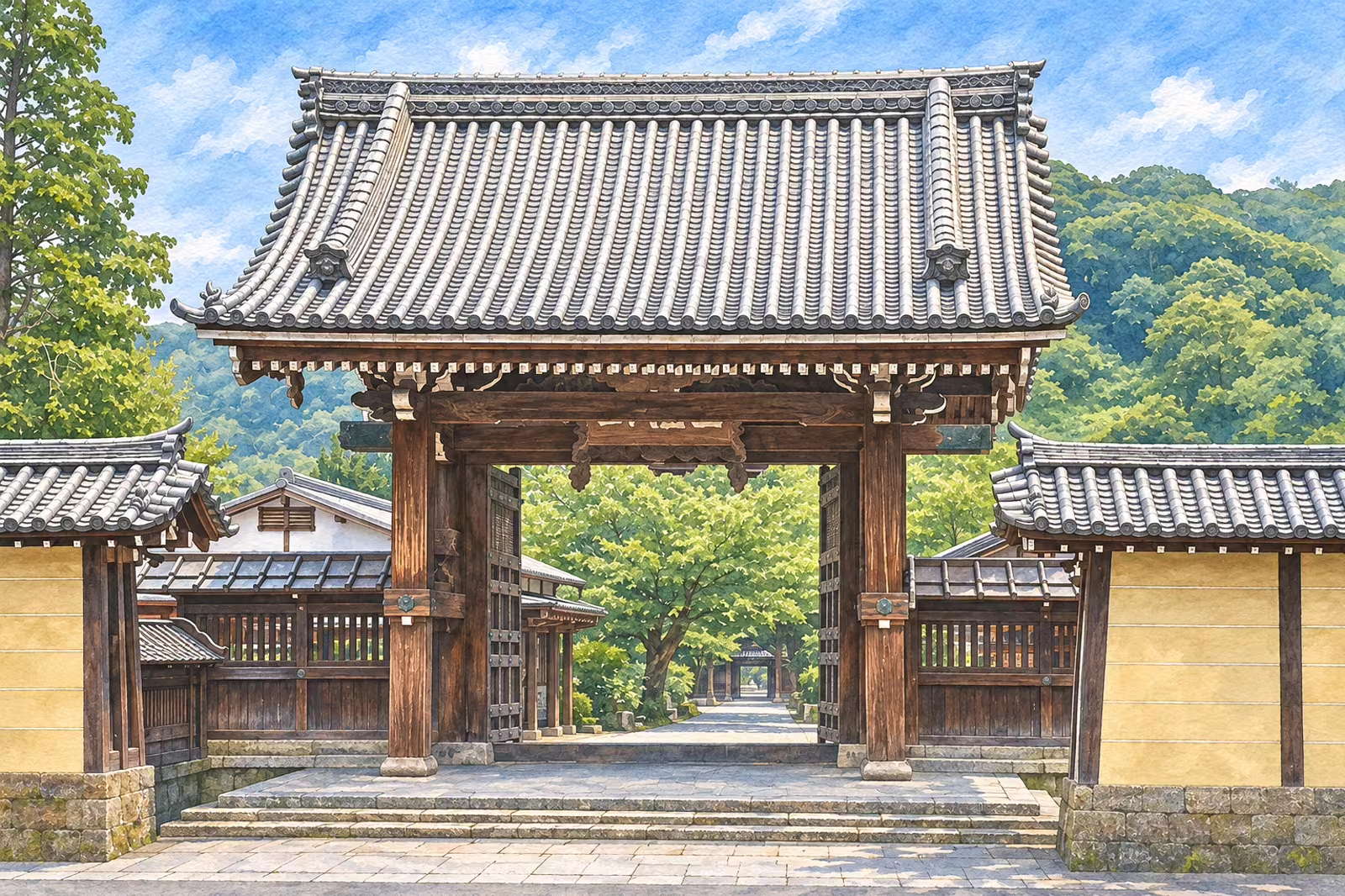
Kenchō-ji, in Kita-Kamakura in Kamakura, Kanagawa Prefecture, is the head temple of the Kenchō-ji branch of Rinzai Zen and ranks first among the Five Mountains of Kamakura. It was founded in 1253 by the regent Hōjō Tokiyori, with the Chinese monk Rankei Dōryū (Lanxi Daolong in Chinese) as its founding abbot. It is generally regarded as the first temple in Japan built to practice Zen exclusively according to the monastic rules of Song China, and Kamakura’s Zen tradition grew from here.
01Founding, decline and revival
Rankei Dōryū crossed from Song China in 1246 and won the trust of Tokiyori, who brought him to Kamakura to head the new monastery. The temple took its name from the Kenchō era in which it was built. The site is said to have been an execution ground known as Jigokudani, the "Valley of Hell", which is why the principal image is not the Buddha Shakyamuni but the bodhisattva Jizō. Rankei introduced Song-style monastic codes, and monks lived a strict communal life of meditation; later émigré masters such as Mugaku Sogen also served as abbot. In the late Kamakura period the temple suffered repeatedly from earthquakes and fires, and around 1325 the shogunate dispatched a "Kenchō-ji ship" to trade with Yuan China to raise funds for rebuilding. After the fall of the Kamakura shogunate the temple declined for a long period, recovering gradually in the early Edo period with Tokugawa support.
02What can be seen today
The main gate, the Sanmon gate, the Buddha hall, the Dharma hall and the abbot’s quarters stand roughly in a single line, preserving the layout of a Song-style Zen monastery. The Sanmon was rebuilt in 1775. The Buddha hall and the Karamon gate originally belonged to the mausoleum of Tokugawa Hidetada’s wife at Zōjō-ji in Edo and were moved here in the mid-seventeenth century. The Dharma hall dates from 1814; the dragon among clouds on its ceiling was painted in 2003. All of these are designated Important Cultural Properties. The juniper trees in front of the Buddha hall are said to have been planted by Rankei himself. The temple bell, cast in 1255 and inscribed with a text composed by Rankei, is a National Treasure, as is the portrait of Rankei Dōryū; the wooden seated statue of Hōjō Tokiyori is an Important Cultural Property. The garden behind the abbot’s quarters is traditionally attributed to Musō Soseki, and the temple grounds are a national Historic Site. Hansōbō, the guardian shrine, stands on the hill behind, and monks still train in the monastery’s meditation hall. Kenchin-jiru, a homely Japanese soup of root vegetables and tofu, is said to take its name from the temple.