
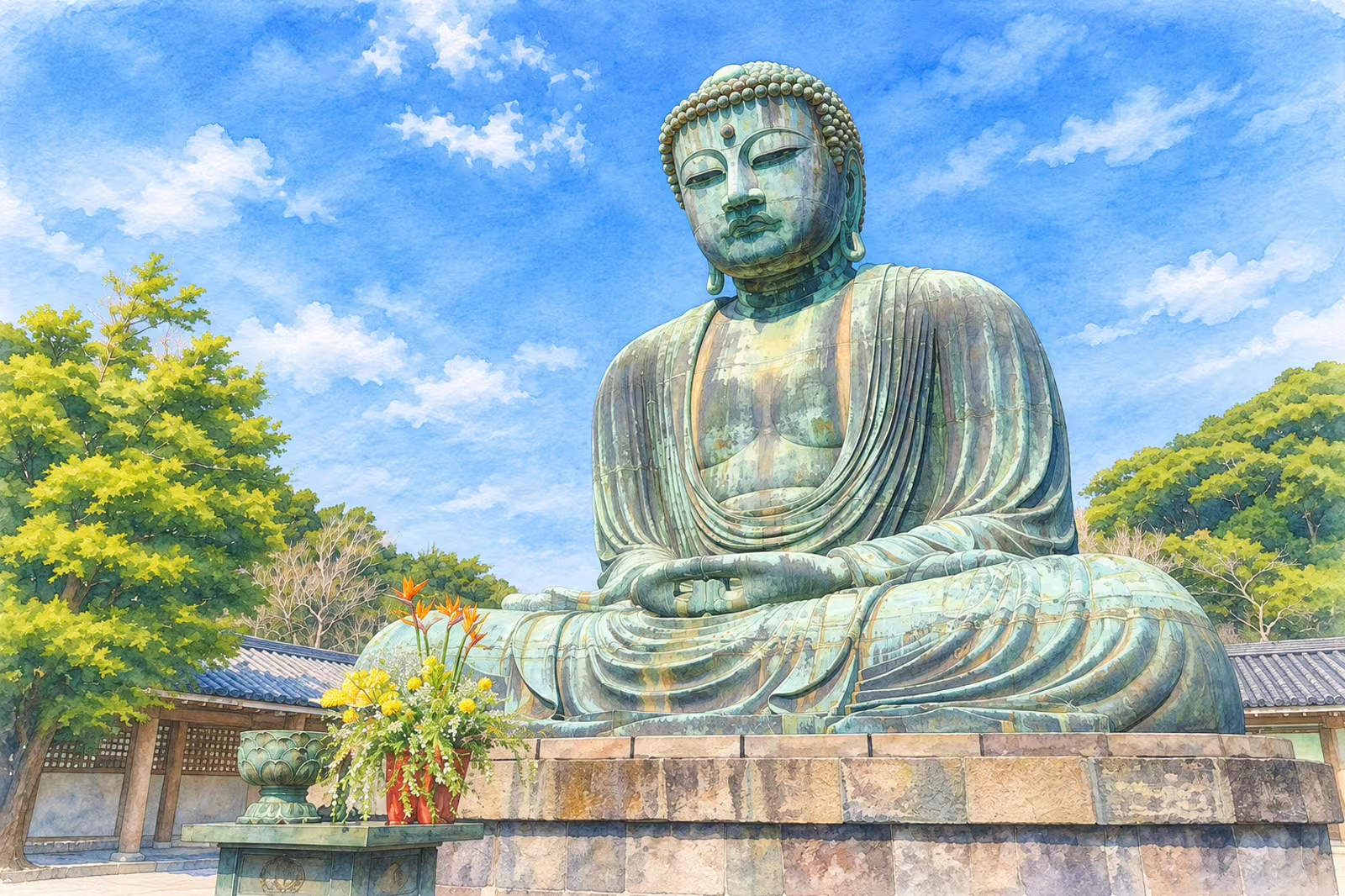
The Great Buddha of Kamakura is the principal image of Kōtoku-in, a Pure Land temple in the Hase district of Kamakura, Kanagawa Prefecture. It is a seated bronze figure of Amida Buddha, about 11.3 meters tall and weighing about 121 tonnes. One of the largest bronze statues surviving from the Kamakura period, it once sat inside a great hall, but has sat in the open for more than five hundred years since the hall was lost. It is a National Treasure and the best-known image of Kamakura.
01From Wood to Bronze
According to the Azuma Kagami, a monk named Jōkō raised funds around the country to make a giant wooden Buddha, begun in 1238 and dedicated in 1243 along with a hall to house it. In 1252 work began on casting a bronze Amida, which is generally taken as the start of the present statue. The sources say little about how the wooden and bronze images were related, or who cast the bronze figure and who paid for it, and these questions are still debated. The statue was cast in sections, layer by layer from the bottom up, and the horizontal seams and the structure of the hollow interior still show this method. Traces of the original gilding remain near the cheeks.
02Losing the Hall
Records say the hall was damaged by storms in 1334 and 1369, and by the late fifteenth century the Buddha was sitting in the open. A popular account holds that a tsunami in 1498 swept the hall away, but contemporary records are not enough to confirm it. In the mid-Edo period, the monk Yūten and the merchant Nojima Shinzaemon, among others, raised money for repairs, and the temple was reorganized under the name Kōtoku-in, after which it was run by Pure Land monks. The Great Kantō Earthquake of 1923 damaged the statue’s base, which was then repaired, and further work in 1959–1961 strengthened the statue to reduce the shock of future earthquakes.
03What Can Be Seen Today
The body of the statue is essentially the original Kamakura-period casting, and its position and orientation are believed not to have changed significantly. Visitors can usually enter the hollow interior. Foundation stones from the hall survive around the statue, and excavations around 2000 confirmed the scale of the hall site, which is a designated National Historic Site. As of 2026, the Buddha and Kōtoku-in remain central to Kamakura’s bid for World Heritage status, but Kamakura has not been inscribed on the World Heritage List.
The Great Buddha of Kamakura (Kōtoku-in)
01A Buddha Under the Open Sky
Walk up the lane from Hase Station, pass through the gate, and the figure appears at the end of a gravel courtyard: a seated bronze Buddha, head slightly bowed, hands resting in his lap, with wooded hills behind him and nothing at all above him. He is about 11.3 meters tall, about 13.35 meters with his stone base, and weighs roughly 121 tons. In Japanese he is simply the Kamakura Daibutsu, "the Great Buddha of Kamakura." Formally he is the principal image of Kōtoku-in, a temple of the Jōdo (Pure Land) school, and he is designated a National Treasure.
What strikes most visitors is not the size but the setting. The Great Buddha of Nara sits inside an enormous wooden hall. This one sits outdoors, and has done so for more than five hundred years. It was not meant to be this way. Large foundation stones scattered across the grounds mark where a great hall once stood. The story of this place is the story of how that hall was built, how it was lost, and how the statue survived without it.
It is also a story with an unclear beginning. For one of the most recognizable images in Japan, remarkably little is known about who commissioned it or why.
02Kamakura in the Thirteenth Century
In 1192 Minamoto no Yoritomo was named shogun, and Kamakura, a small seaside town ringed by hills, became the seat of Japan’s first warrior government, the Kamakura shogunate. After Yoritomo’s line died out, real power passed to the Hōjō family, who governed as regents (shikken) on behalf of figurehead shoguns.
The Hōjō regents built Kamakura into a religious as well as political capital. They patronized Zen monks arriving from Song China, founded great temples such as Kenchō-ji, and supported the cult of Hachiman at Tsurugaoka. A colossal Buddha, of the kind Nara had possessed since the eighth century, fit naturally into the ambitions of an eastern capital that wished to rival the old imperial center.
The Daibutsu stands in an area then called Fukasawa, west of the city center, on the road toward Hase and Gokuraku-ji. It was outside the core of the shogunal city, but close to the beach at Yuigahama and to the routes leading west.
03Jōkō and the Wooden Buddha
The main contemporary source is the Azuma Kagami ("Mirror of the East"), the shogunate’s own chronicle. It records that on the twenty-third day of the third month of 1238, work began on a Great Buddha hall at Fukasawa, at the initiative of a monk named Jōkō. Jōkō was a kanjin monk, a fundraising cleric who collected donations from people of every rank for a religious project. Within two months the head of the statue had been raised, and the hall’s ridgepole went up in 1241. Jōkō’s campaign was ambitious: he petitioned the shogunate to order a levy of one coin per person in the Hokuriku and western provinces.
The first Great Buddha was a wooden Amida. In the autumn of 1242 the anonymous author of the travel diary Tōkan Kikō passed by and found the statue nearly finished and the hall about two-thirds built. In the sixth month of 1243 the Azuma Kagami records the dedication of an Amida "more than eight jō" tall (a jō is about three meters; the figure likely refers to the height a standing figure would have, which corresponds roughly to the present seated statue).
What role the shogunate played is not stated outright. The regent when work began was Hōjō Yasutoki. The government did divert fines and confiscated swords to the project, so it clearly lent support. Yet the chronicle does not present the Buddha as a government undertaking. This is a striking contrast with Nara’s Great Buddha, which was cast by order of Emperor Shōmu with the resources of the state.
04Casting the Bronze, 1252
The wooden statue did not last long. In an entry for the seventeenth day of the eighth month of 1252, the Azuma Kagami notes that casting began at Fukasawa of a gilt-bronze Shaka (Shakyamuni) Buddha, eight jō high. The regent was now Hōjō Tokiyori, and Jōkō was still the fundraiser.
Why the wooden figure was replaced within a decade is not explained. It may have been damaged by storms; it may always have been intended as a model or stopgap for a bronze. Both are guesses.
The entry raises a further puzzle. It calls the new statue Shaka, but the Buddha you see is unmistakably Amida (Amitābha), the Buddha of the Western Pure Land, his hands joined in Amida’s meditation mudra. Most scholars accept that the present statue is the one begun in 1252 and that "Shaka" is an error in the chronicle, though the discrepancy has never been fully resolved.
The Azuma Kagami says nothing about when the bronze was completed. The only craftsman whose name survives is the caster Tanji Hisatomo. On two temple bells he cast in 1264, he signed himself master caster of the "New Great Buddha" of Kamakura, which suggests the statue was finished by the early 1260s.
05How the Statue Was Made
The Daibutsu was cast in place, in sections, from the bottom up. Craftsmen built a model and then outer and inner molds in horizontal bands, poured molten bronze into one band, built the next band on top and poured again. The body was cast in about seven tiers, in some forty separate pours. Inside the statue the joins are clearly visible; at the seams the later pour was made to wrap over the edge of the earlier one, locking them together.
From the outside the seams are hard to see. The proportions were also adjusted for a viewer standing below: the head is large and the body leans forward, so that the face does not shrink away when you look up at it.
Analysis of the metal shows a high lead content, and the copper has been traced to southern China. Japan imported Chinese Song-dynasty coins in huge quantities in this period, which has led to a widely cited theory that much of the bronze came from melted-down coins. It is plausible but not proven.
Stylistically the statue builds on the realism of the Kei school of sculptors (the workshop of Unkei) with Song Chinese influences. Traces of gold leaf survive on both cheeks. The statue was originally gilded, and when new it would have glowed in the dim interior of its hall.
06The Hall Falls
The bronze Buddha was housed in a very large hall; excavations show it measured about 44 meters across the front and 42.5 meters deep, and that its roof did not use tiles. Over the next two centuries the building was repeatedly damaged.
The war chronicle Taiheiki tells how a gale brought down the hall’s framework and crushed more than five hundred warriors of Hōjō Tokiyuki who had taken refuge inside. Tokiyuki, the son of the last Hōjō head Takatoki, had briefly retaken Kamakura in a rising known as the Nakasendai Rebellion. The Taiheiki dates the collapse to 1334, but the rebellion is generally placed in 1335, and the collapse is often given under that year. The hall fell again in a storm in 1369.
The final loss is usually attributed to the great Meiō earthquake of 1498, when, according to provincial chronicles, an earthquake and tsunami destroyed the hall and drowned more than two hundred people. Some sources give the year as 1495, which the temple’s own researchers regard as an error. There is a complication: the Zen monk Banri Shūkyū, touring Kamakura in 1486, already described the Buddha as sitting in the open without a hall. Either way, by the end of the fifteenth century the hall was gone, and it was never rebuilt.
From the fourteenth century the Buddha was looked after by the Zen temple Kenchō-ji. Kamakura had ceased to be a capital when the shogunate fell in 1333, and many of its great temples declined. In 1610 the abbot Gien of Daigo-ji visited and noted in his diary that the Buddha was cast metal, that there was no hall, and that only the great foundation stones remained.
07Revival Under the Edo Shogunate
The Genroku earthquake of 1703 toppled the front of the stone base and tilted the statue. The following year Yūten, a Jōdo priest who would later become abbot of Zōjō-ji in Edo, made emergency repairs, patching the base and covering cracks with copper plates.
In 1712 Yūten, backed by Nojima Shinzaemon, a wealthy merchant of Asakusa in Edo, bought the fields around the statue and began a full revival. The pair of bronze lanterns in front of the Buddha was donated by Nojima early that year. The Buddha was placed under the Jōdo temple Kōmyō-ji, a prayer hall was built, and the new temple took the name Kōtoku-in, which was Nojima’s Buddhist name. Its full name today is Taiisan Kōtoku-in Shōjōsen-ji.
The revival soon stalled. Nojima was banished for an offense, and Yūten died in 1718. In 1733 a priest named Yōkoku, who had formed a parent-child bond with Nojima, became Kōtoku-in’s first resident abbot. He found the statue full of holes, its curls fallen away, the doors in its back missing, and birds nesting inside. With shogunal permission he begged for alms on the streets of Edo and hired the Kanda caster Nishimura Izumi-no-kami to repair the head and body and to cast a new urna and lotus petals; a dedication of the repairs was held in 1736. The bronze doors on the back, long kept at Kenchō-ji, were returned and refitted at this time. In 1743 a fire destroyed all of Kōtoku-in’s buildings, though the statue was unharmed, and Yōkoku’s larger plans ended there.
In the Edo period, Kamakura became a sightseeing destination for people from the capital. The Daibutsu, together with Tsurugaoka Hachimangū and the Hase Kannon, was part of the standard tour and appears in guidebooks and woodblock prints. The popular writer Jippensha Ikku describes going inside the statue, a custom that continues today.
08The Buddha and the West
Europeans had seen the statue early: the English captain John Saris visited in 1613, and Richard Cocks, head of the English trading post at Hirado, went inside it in 1616. After Yokohama opened to foreign trade in 1859, foreigners were allowed to travel within about 40 kilometers of the settlement, and the Daibutsu became one of the sights every visitor wanted to see. In 1862 an American missionary’s wife wrote that she and her companions had sat on the Buddha’s thumb.
Photographers of the late Edo and Meiji periods, Felice Beato among them, made it a favorite subject, and their prints circulated widely as souvenirs. The Great Buddha became one of the images through which Europe and America pictured Japan. Rudyard Kipling saw it on his honeymoon journey in 1892 and wrote "The Buddha at Kamakura," a poem urging Western Christians not to mock the worship of others.
Japanese writers took it up too. The poet Yosano Akiko wrote a well-known tanka praising the Buddha among the summer trees as a handsome man, while calling him Shakyamuni. A stone inscribed with the poem was set up in the grounds in 1952, the statue’s seven-hundredth anniversary. Her slip echoes the chronicle’s "Shaka" of seven centuries earlier.
09Earthquake and Modern Repair
The statue was first designated a National Treasure in 1897. On September 1, 1923, the Great Kantō Earthquake struck Kamakura. The front of the base sank by about a foot and the statue slid forward by more than a foot, though it did not fall. An aftershock in January 1924 damaged the platform further. State-funded repairs began later that year and were completed in 1925.
Under the postwar cultural properties law the statue was listed as an Important Cultural Property in 1950 and redesignated a National Treasure in 1958. A major restoration followed from 1959 to 1961. Its two main aims were to strengthen the neck, where the bronze is thin and most likely to fail in an earthquake, and to install a sliding base isolator: a stainless-steel plate between statue and base, so that in a quake the statue can slide rather than absorb the full force of the shaking.
In 2016 the statue received its first conservation work since then, including cleaning, analysis of surface corrosion, inspection of the isolator, and high-resolution imaging.
10Excavating the Lost Hall
In 2000 and 2001 the Kamakura city board of education excavated parts of the temple grounds. The dig showed that the statue had been cast on this very spot: the casting surface had been leveled, layers of earth had been heaped up sloping toward the statue, and copper fragments and bellows nozzles matched the statue’s metal. It also located the footings under the hall’s foundation stones and fixed the size of the building. The large stones you see around the statue are its column bases.
In 2004 the grounds were designated a National Historic Site, "Site of the Kamakura Great Buddha Hall." The Daibutsu was a core element of Kamakura’s bid for UNESCO World Heritage status as an ancient samurai capital, but the nomination was withdrawn in 2013 after an unfavorable advisory evaluation.
11Walking the Grounds
The gate you entered, the Niōmon, is said to have been moved here from elsewhere in the early eighteenth century; the guardian figures inside are mid-Edo work.
In front of the Buddha, note the pair of bronze lanterns Nojima Shinzaemon donated in 1712. Then stand directly before the statue and look up. The face reads well from here, as it was designed to. Walk to one side to see the forward lean, and around to the back, where the two bronze doors returned from Kenchō-ji in Yōkoku’s time are set into its back. Behind the statue also stand several large bronze lotus petals cast during the Edo repairs and inscribed with the names of donors.
The head carries 656 snail-shell curls. On a sunny day, look at the cheeks for the faint glint of remaining gold.
The interior can be entered from a doorway in the side of the base. Inside, you can look up at the grid of joins left by the sectional casting.
Around the courtyard, look for the large foundation stones of the vanished hall. They are the best evidence on the site that the Buddha was not built to sit in the open.
Until recently a small hall called the Kangetsu-dō stood behind the statue. Said to have come from a Korean royal palace, it was donated to the temple in 1924. Kōtoku-in dismantled it in 2024, and in 2025 its parts were formally handed over to Korea. Nearby is the stone with Yosano Akiko’s poem.
On the wall of the corridor to the right of the statue hangs a pair of straw sandals about 1.8 meters long. Children from Hitachi-Ōta in Ibaraki Prefecture first offered them in 1951 and have replaced them roughly every three years since 1956, so that the Buddha might walk the country on behalf of the people.