
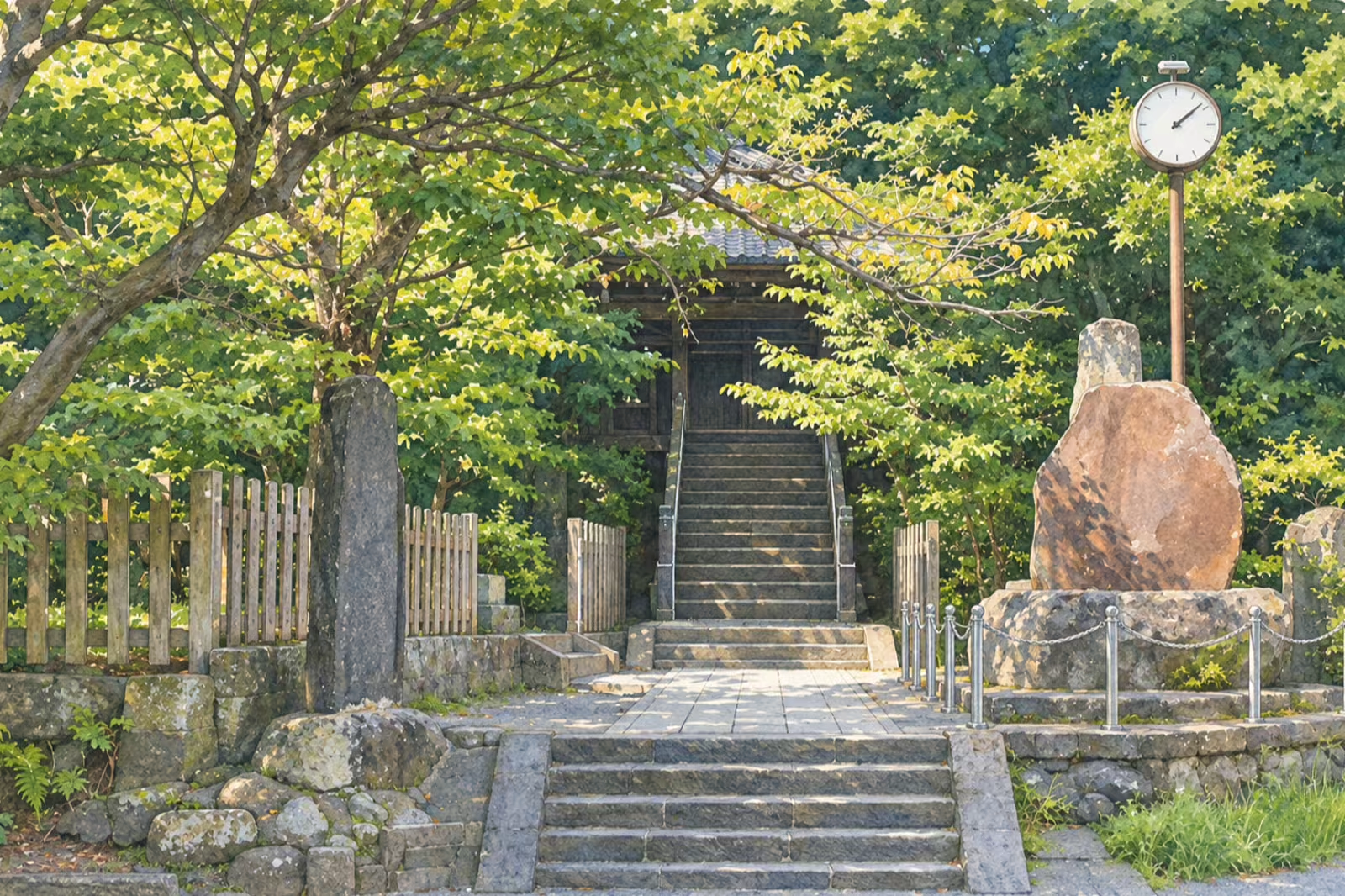
The Kamakura Hokkedō sites stand on a hillside in Yukinoshita, Kamakura, Kanagawa Prefecture, northeast of Tsurugaoka Hachimangū. Here were the memorial halls of Minamoto no Yoritomo, founder of the Kamakura shogunate, and of the regent Hōjō Yoshitoki, and at the foot of the slope lies Ōkura, where Yoritomo first set up his government. The founding of the shogunate, the rise of the Hōjō and a bloody political purge all left traces on this small slope. The Hokkedō site is a nationally designated Historic Site.
01The Ōkura palace and two memorial halls
Yoritomo entered Kamakura in 1180 and built his residence at Ōkura, which became the early shogunate’s seat of government, usually called the Ōkura Palace. Its exact extent is still uncertain; most of the area is now covered by a school, streets and houses, and a stone marker stands near Seisen Elementary School.
During his lifetime Yoritomo kept a private chapel on the slope behind his residence. After his death in 1199 it became a hokkedō, a memorial hall where his successors and vassals held rites in his honor. When Hōjō Yoshitoki, the second regent, died in 1224, his own memorial hall was built on the hillside just east of Yoritomo’s, according to the chronicle Azuma Kagami. Placing the regent’s memorial beside the founder’s tied Hōjō power to Yoritomo’s legacy.
In the Hōji Battle of 1247, Miura Yasumura and his kin were defeated by forces loyal to the regent Hōjō Tokiyori and retreated into Yoritomo’s memorial hall, where, according to the records, more than 500 people killed themselves. A rock-cut burial cave below Yoritomo’s grave is generally regarded as the tomb of the Miura, though this has not been confirmed by excavation.
02What can be seen today
Neither memorial hall survives. The present "grave of Yoritomo" is a layered stone pagoda, and its stone walls and lanterns date mainly from a 1779 restoration by Shimazu Shigehide, lord of Satsuma, whose family claimed descent from Yoritomo. The site of Yoshitoki’s hall was excavated around 2005, revealing the base-stone foundations of a square hall, which Kamakura City identified as Yoshitoki’s hokkedō from its location and the Azuma Kagami account. The remains were reburied and the pillar positions are marked on the ground. Around 2006 the national Historic Site was expanded and renamed to cover the graves of both Yoritomo and Yoshitoki.
Above the Yoshitoki site are three yagura burial caves attributed to Ōe no Hiromoto, Mōri Suemitsu and Shimazu Tadahisa. Their present form largely reflects work in the late Edo period by the Chōshū and Satsuma domains, which honored these figures as ancestors, rather than medieval originals. Shirahata Shrine, dedicated to Yoritomo, stands at the foot of the slope.