
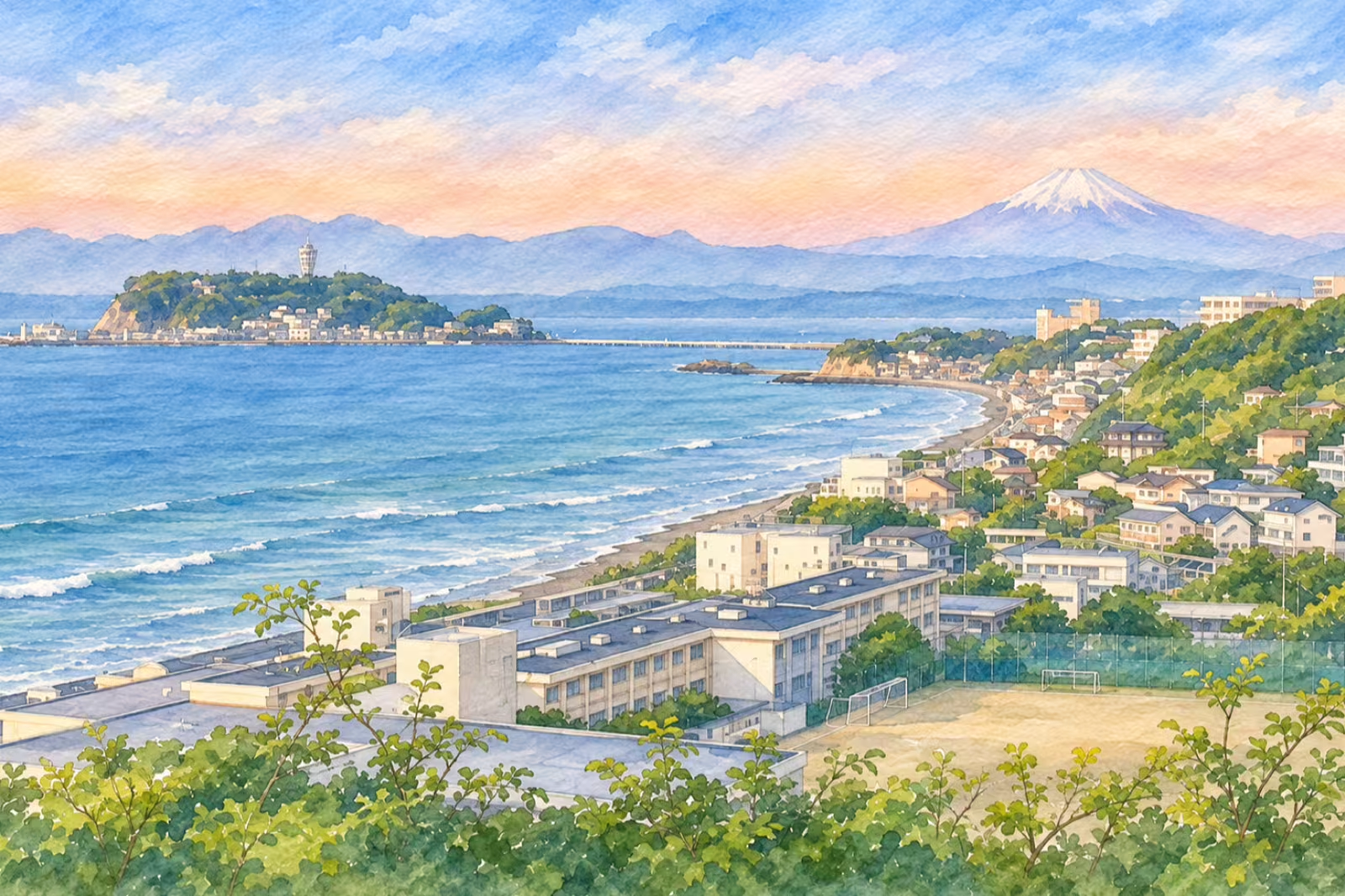
Inamuragasaki is a small headland on the southwestern coast of Kamakura, Kanagawa Prefecture, jutting into Sagami Bay between Yuigahama and Shichirigahama. It is tied to the fall of the Kamakura shogunate in 1333. According to the war chronicle Taiheiki, the commander Nitta Yoshisada threw his sword into the sea here and prayed, the tide drew back, and his army rushed along the exposed shore into the city. The story made Inamuragasaki the emblem of the shogunate’s end, and the headland is now a nationally designated Historic Site.
01The 1333 attack on Kamakura
Kamakura is ringed by hills on three sides and open to the sea on the fourth. Overland, it could only be entered through a handful of narrow passes cut into the ridges, known as kiridōshi, which made it easy to defend. In the fifth month of 1333, Nitta Yoshisada raised troops in Kōzuke Province, defeated shogunate forces on his way south, and reached Kamakura. His army split to attack the Kewaizaka pass to the northwest, Kobukurozaka to the north, and Gokurakuji-zaka to the west, but the defenders held for several days. On the Gokurakuji-zaka front the Nitta commander Ōdachi Muneuji was killed; a nearby mound called the Jūichinin-zuka, the "Mound of Eleven," is traditionally said to commemorate those who fell with him.
Just beyond Gokurakuji-zaka, the shore beneath the Inamuragasaki cliffs was too narrow for an army in ordinary conditions. The Taiheiki says that after Yoshisada offered his gold-mounted sword, the sea receded and his men slipped around the defenses along the beach. The sword episode is a literary flourish, but many researchers believe a real, unusually low tide was exploited. Once inside, the attackers fought through the streets as fires spread. On the 22nd day of the fifth month, Hōjō Takatoki, head of the regent family, withdrew with several hundred relatives and retainers to Tōshō-ji, the Hōjō family temple, where they took their own lives. The Kamakura shogunate ended there.
02Inamuragasaki today
The headland is now Inamuragasaki Park, with a monument marking the traditional site of Nitta Yoshisada’s crossing and views toward Enoshima and Mount Fuji. It was designated a national Historic Site around 1934, on the strength of the crossing legend. The coastline and roads have been reshaped since medieval times. The park also holds a bronze memorial to the 1910 boating accident in which students of Zushi Kaisei Middle School drowned.
Other places connected with the battle are scattered around the city: Gokurakuji-zaka and the Mound of Eleven, the Kewaizaka and Kobukurozaka passes, and the site of Tōshō-ji with the nearby Harakiri Yagura cave. The temple site was excavated and then reburied, and it is also a designated national Historic Site.