
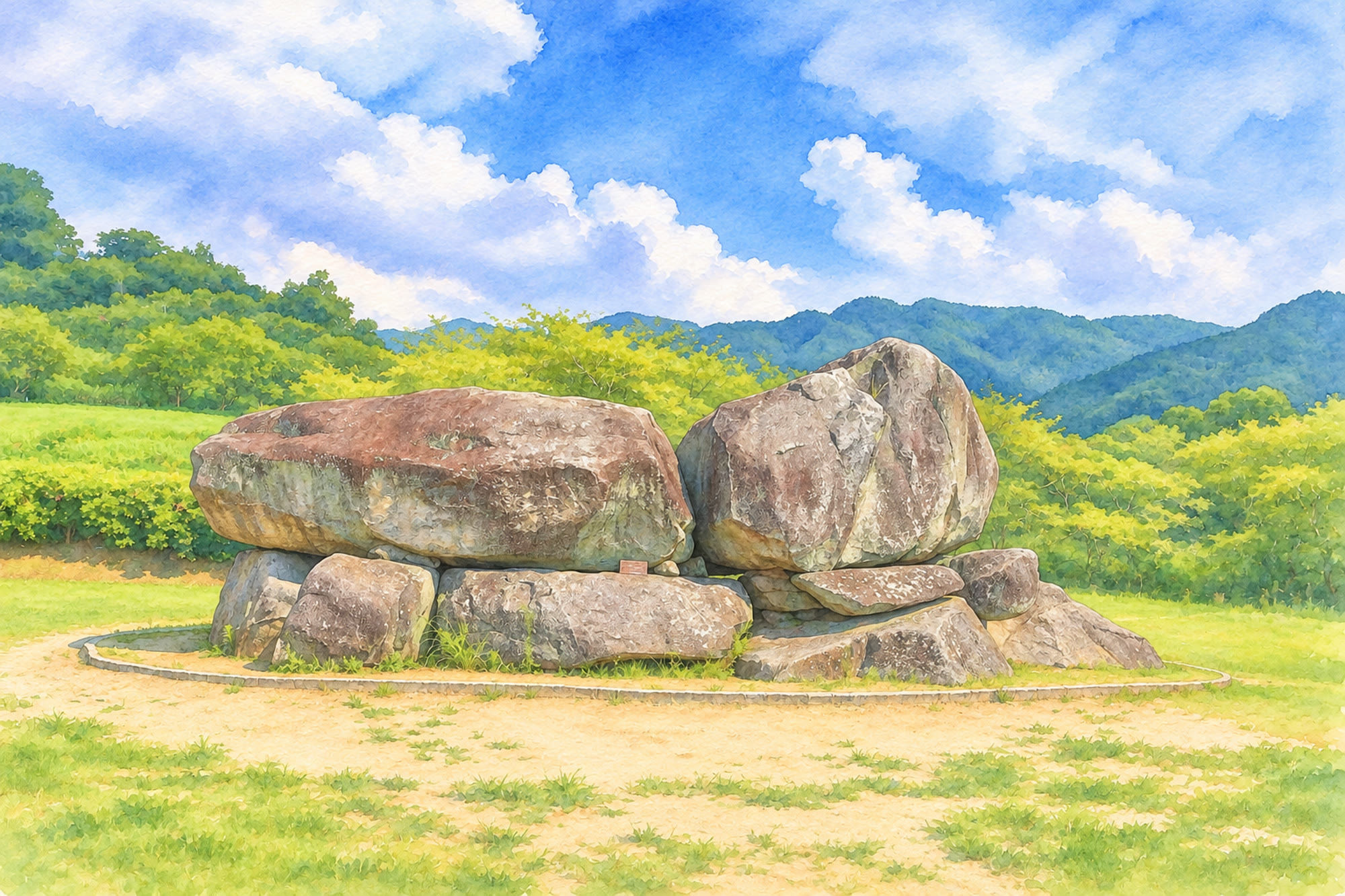
Asuka-dera and the Ishibutai Tomb lie about 1.5 kilometers apart in Asuka village, Nara Prefecture. Both are tied to Soga no Umako, the minister who dominated the court from the late sixth century until his death in 626. Asuka-dera was Japan’s first full-scale Buddhist temple, and its bronze Buddha is among the oldest datable Buddhist statues in the country. Ishibutai, a mass of giant stones stripped of its earth mound, is generally thought to be Umako’s tomb.
01The Soga temple
According to the Nihon shoki (the court chronicle of 720), Umako vowed to build a temple before fighting his rival Mononobe no Moriya in 587. In 588 the Korean kingdom of Baekje sent monks, relics, and craftsmen including carpenters, tile makers, and a painter, and work began on a temple called Hōkō-ji, essentially finished by 596. In 605 Empress Suiko ordered a large Buddha image, which Tori Busshi cast and installed the next year (another source gives 609). Excavations in 1956–57 revealed a pagoda with a main hall on each of three sides, a plan usually linked to the Korean kingdom of Goguryeo. The chronicle also says Prince Naka no Ōe and Nakatomi no Kamatari met beneath a zelkova tree here, and that after the Isshi Coup of 645 the prince used the temple as his base against Soga no Emishi. A successor, Gangō-ji, was founded in Nara in 718, but the Asuka temple carried on until a lightning fire in 1196 began its long decline.
02The tomb of giant stones
Ishibutai, in the Shimanoshō district, is a stone chamber of more than 30 blocks, usually estimated at about 2,300 tons in all; the larger of the two ceiling stones weighs around 77 tons. The chamber is about 7.7 meters long, 3.5 meters wide, and 4.7 meters high, reached by a passage of about 11 meters. With the covering earth gone, the exposed stones earned the name "stone stage," and one legend tells of a fox dancing on top in the form of a woman. The Nihon shoki records Umako’s burial at the Momohara grave in 626, and his residence stood nearby, but no inscription confirms the attribution. Some suggest the mound was stripped after the Soga fell in 645. Excavations in 1933 and 1935 found a square base about 50 meters on a side, with a moat and outer bank.
03What survives
The temple site is now Ango-in, a small Shingon (Buzan branch) temple whose main hall dates from the late Edo period. The Asuka Daibutsu, an Important Cultural Property, was badly damaged in 1196 and heavily repaired. Only parts of the head and right hand were long thought original; surveys in the 2010s suggest more survives, and the question is open. It is believed never to have moved. A stone pagoda in the fields to the west, a later monument, is linked to a legend that Soga no Iruka’s head was buried there. Ishibutai became a Special Historic Site in 1952, and visitors can walk into the chamber. Both are among the 19 components of the Ancient Capitals of Asuka and Fujiwara, inscribed as World Heritage in July 2026.
Asuka-dera and the Ishibutai Tomb
01Two Sites, One Man
Most visitors to the village of Asuka, in the south of the Nara basin, find themselves walking between rice fields, low hills, and scattered stones whose purpose is not obvious at first glance. Two places in this landscape belong together. One is Asuka-dera, a modest temple whose main hall holds a scarred bronze Buddha about 2.75 meters tall. The other, about 1.5 kilometers to the southeast (some two kilometers on foot), is Ishibutai, a heap of enormous granite boulders on a grassy slope, capped by two flat slabs, with a dark doorway leading inside.
The temple was the first full-scale Buddhist monastery in Japan. The stones are the bare skeleton of one of the largest burial chambers ever built in the country. Both are linked to the same person, Soga no Umako, the chief minister who controlled the Yamato court for about half a century, from the 570s until his death in 626. He founded the temple; he is generally thought to have been buried in the tomb. Taken together, the two sites show what the Soga family built at the height of its power, and what remained after it fell.
02Who Were the Soga?
The origins of the Soga clan are obscure. Later genealogies traced them to Takeuchi no Sukune, a legendary minister said to have served several early sovereigns, and some modern historians have suggested a connection with immigrants from the Korean Peninsula, though neither idea can be proved. What is clear is that the Soga rose quickly in the middle of the sixth century, based in the Takaichi and Asuka area of Yamato province, and that they worked closely with the immigrant communities, known in Japanese as toraijin, who brought writing, accounting, metalworking, and other skills from the continent. These groups managed much of the court’s storehouses and paperwork, and the Soga acted as their patrons.
The first great figure of the family was Soga no Iname, who held the title of ōomi, or great minister, under Emperor Senka and Emperor Kinmei. His rival was the Mononobe family, hereditary military and ritual specialists, whose head held the parallel title of ōmuraji. Iname married two of his daughters to Kinmei, and three of their children later reigned: Emperor Yōmei, Emperor Sushun, and Empress Suiko. Marriage into the royal line, rather than military force alone, was the foundation of Soga power.
Buddhism became the family’s cause. According to the Nihon shoki, the official chronicle compiled in 720, King Seong of Baekje, one of the kingdoms of Korea, sent a gilt-bronze Buddha and scriptures to Kinmei. The emperor asked his ministers whether the image should be worshipped. Iname said yes; the Mononobe and Nakatomi leaders warned that the native gods would be angered. Kinmei let Iname worship the image privately; Iname installed it in his house at Owarida and turned his house at Mukuhara into a temple. When an epidemic followed, the Mononobe blamed the foreign god, threw the statue into a canal at Naniwa, and burned the temple. The Nihon shoki dates the arrival of Buddhism to 552, while other early sources give 538; the earlier date is more widely used today, though both have defenders.
03The War of 587 and Umako’s Vow
Iname died in 570. His son Umako became great minister under Emperor Bidatsu, facing Mononobe no Moriya across the court. The quarrel over Buddhism continued into the next generation. Umako enshrined Buddhist images and sponsored the ordination of three young women, led by the nun Zenshin, the first Buddhist clergy in Japan. Moriya, blaming another outbreak of disease on the new religion, tore down a pagoda, burned images, and had the nuns flogged.
The real issue was succession. After Bidatsu died in 585 and his successor Yōmei died in 587, the two ministers backed rival candidates, and the dispute turned into open war. Umako gathered most of the leading clans and several princes, among them the young Prince Umayado, later known as Prince Shōtoku, and attacked Moriya’s base at Shibukawa in Kawachi. The Nihon shoki says the Soga forces were driven back three times. Umayado carved images of the Four Heavenly Kings and vowed to build them a temple if victory came; Umako made a similar vow to build a temple and spread the Buddhist teaching. Moriya was then shot down, and the main line of the Mononobe was destroyed.
The prince’s vow is said to be the origin of Shitennō-ji in Osaka. Umako’s became Asuka-dera. The story has the shape of a later pious legend, and the episode of the carved guardians in particular may have been embellished, but the political result is not in doubt: after 587 no family at court could match the Soga.
04Craftsmen from Baekje
In 588, the year after the war, Baekje sent monks and relics of the Buddha to Yamato, together with a group of specialists whose names the Nihon shoki records: two temple carpenters, a metalworker to cast the spire fittings, four roof-tile makers, and a painter. (A later temple record gives slightly different numbers.) Nothing like a Buddhist monastery had yet been built in the islands. Every element had to be learned from these experts, from the rammed-earth platforms and stone column bases to bracketed eaves, fired clay tiles, and the bronze rings at the top of a pagoda.
The site chosen was Asuka no Magami-no-hara, where, according to the chronicle, the house of a local family was cleared away. Timber was cut in the mountains in 590, and work on the halls and corridors began in 592. In the first month of 593 relics were deposited in the foundation stone of the pagoda, and the central pillar was raised the next day. A later chronicle, the Fusō ryakki, adds that Umako and more than a hundred followers attended in Baekje-style dress; the Nihon shoki does not mention this. By 596 the temple was essentially complete. Umako’s son Zentoku was appointed its administrator, and two foreign monks took up residence: Eji (Hyeja in Korean) from Goguryeo, who was the teacher of Prince Umayado, and Esō (Hyechong in Korean) from Baekje.
The temple’s formal name was Hōkō-ji, "the temple where the Dharma flourishes," but it was commonly called Asuka-dera after its location. For people who had known only thatched or shingled buildings and earthen burial mounds, a tiled hall on stone foundations and a tall wooden pagoda would have been an astonishing sight, and a very public demonstration of the Soga family’s wealth and overseas connections.
05What the Excavations Found
For centuries the original layout of the temple was known only vaguely. Excavations in 1956 and 1957 by the Nara National Research Institute for Cultural Properties changed that, and the results surprised specialists.
The plan centered on a wooden pagoda. A main hall stood to its north, and two more main halls stood to the east and west, so that three halls faced the pagoda from three sides. A roofed corridor enclosed the group, with a middle gate on the south and a lecture hall beyond the corridor on the north. This "one pagoda, three halls" plan does not match the arrangements that later became standard in Japan. Archaeologists noticed that the ruins of a temple at Cheongam-ri, near Pyongyang in the territory of ancient Goguryeo, had a similar arrangement, and many now see Goguryeo influence in the design, even though the written sources credit Baekje craftsmen. How to reconcile the two remains under discussion.
The pagoda’s foundation stone lay about 2.7 meters below the surface. On and around it the excavators found comma-shaped jewels, tubular beads, glass beads, gold and silver sheet and grains, ear rings, a horse bell, armor, and small knives; the armor still lay where it had been placed, while much of the rest was scattered in later charcoal fill. These are almost exactly the kinds of objects buried in the great mounded tombs of the period. The relics belonged to a new religion, but the offerings placed with them followed the habits of the old aristocratic burial culture. The deposit had been disturbed once before: after lightning destroyed the pagoda in 1196, the relics were dug up in 1197, an event recorded in a document of the time, and reburied in a new container inside a stone casket. The excavators found that Kamakura-period container about 60 centimeters below the surface, and the scattered beads and grains on the foundation stone are thought to be items missed in 1197.
The temple’s roof tiles are often described as the oldest in Japan. Their round end tiles bear simple lotus designs. When the temple was re-established in Nara in the eighth century, some of its tiles went with it, and a number of tiles on the roofs of the main hall (Gokuraku-dō) and the Zenshitsu at Gangō-ji in Nara are believed to date from the Asuka period, making them among the oldest roof tiles still in use anywhere in Japan.
06Tori Busshi and the Asuka Daibutsu
In 605 Empress Suiko ordered two large Buddha images, one in bronze and one in embroidery, each about sixteen feet (jōroku) in nominal height, a standard size for a major Buddha image. The sculptor was Kuratsukuri no Tori, known as Tori Busshi, "Tori the Buddha-maker." His grandfather Shiba Tatto was an immigrant said to have come from the continent, and his father Tasuna was among the early converts. The king of Goguryeo, hearing of the project, is said to have sent 300 ryō of gold.
According to the Nihon shoki, when the bronze image was finished in 606, it turned out to be taller than the door of the main hall, and the workmen proposed breaking down the doorway. Tori found a way to bring it in without damage, and Suiko rewarded him with court rank and rice land in Ōmi. The details of the anecdote may be colored, but the reward itself is plausible. An inscription preserved in a later temple record gives 609 as the date instead, and also gives the Goguryeo gold as 320 ryō; the exact year is uncertain, though many scholars lean toward 609.
Tori’s best-known surviving work is the Shaka Triad of 623 in the main hall of Hōryū-ji, which is well preserved and defines what art historians call the Tori style: almond-shaped eyes, a faint smile, and symmetrical, stylized drapery. The Asuka Daibutsu fared far worse. The fire of 1196 left it badly damaged, and it was repaired repeatedly in later centuries. The common view has been that only small portions of the original casting survive, chiefly part of the face around the forehead and eyes and some fingers of the right hand, while the rest is later recasting. Surveys since the 2010s, including X-ray fluorescence analysis, suggest that most of the face and right hand may be original, while most of the body is later recasting; the question is still debated. Visitors can see the difference in color and surface between parts of the face and the rest of the head.
Even in this state, the statue is counted among the oldest datable Buddhist images in Japan and is designated an Important Cultural Property. Its stone pedestal is thought to be original, and the statue is generally believed never to have left the spot where it was first installed. The present main hall, built in the late Edo period (the 1820s), covers only part of the footprint of the original central main hall.
07The Height of Soga Power
While the temple was going up, Umako was at the peak of his power. After the war of 587 he placed his nephew on the throne as Emperor Sushun. The new emperor resented his uncle’s dominance, and in 592, the chronicle says, he remarked on seeing a boar presented at court that he wished he could cut off the head of the man he hated as easily. When word reached Umako, he arranged for an assassin, Yamato no Aya no Koma, to kill the emperor during a ceremony at which tribute from the eastern provinces was to be presented. It is generally regarded as the only reliably recorded murder of a reigning sovereign by a subject in Japanese history.
Umako then supported his niece, Bidatsu’s widow, who became Empress Suiko, the first woman to reign in her own right in Japan. Prince Umayado took part in government. The famous reforms of her reign, the twelve court ranks, the Seventeen-Article Constitution, and the missions to Sui China, were long credited to the prince alone, but many historians now think Umako played an equally large role, and their exact shares are hard to separate. What is certain is that Buddhism gained official protection. In 594 Suiko issued an edict encouraging the Three Treasures, and leading families competed to build clan temples of their own. By 624, according to the chronicle, there were 46 temples in the country. Asuka-dera was the first.
In his last years Umako asked Suiko to grant the Soga the district of Katsuragi, claiming it as the clan’s ancestral home; she refused, one of the few recorded occasions on which she told him no. He died in 626. The Nihon shoki describes him as skilled in strategy and in argument, and devoted to Buddhism, and says he dug a small pond with an island in it at his house beside the Asuka River, which led people to call him the "Island Minister." He was buried, the chronicle says, at the Momohara grave.
08Ishibutai: A Chamber of Giant Stones
Umako’s house stood in the area now called Shimanoshō, and Ishibutai stands there too. That is the core of the argument for identifying it as his tomb. The place name Momohara is thought to refer to this area; the tomb’s construction is dated to the early seventh century, matching his death; and its sheer scale suits a man who had dominated the court for fifty years. No epitaph or inscribed object has been found, however, so the identification is a strong probability, not a proven fact.
Ishibutai is a corridor-type stone chamber, entered from the side through a passage. It was built from more than 30 granite blocks, thought to have been quarried on the slopes of nearby Mount Tōnomine, with a combined weight usually estimated at about 2,300 tons. Two slabs form the roof; the southern one is estimated at about 77 tons and the northern at somewhat over 60 (estimates range from 64 to 67). The burial chamber proper is about 7.7 meters long, 3.5 meters wide, and 4.7 meters high, and the passage leading to it is about 11 meters long (the record made at the 1935 designation gives about 8.5). Only a handful of chambers in Japan, such as that of the Mise Maruyama tomb in Kashihara, rival it in size.
No record explains how the stones were moved and lifted. The usual reconstruction is that the side walls were stacked first, earth was piled around them to make ramps, the roof slabs were hauled up those ramps, and the whole structure was finally buried beneath a mound. When it was new, people would have seen a great earthen tomb, not exposed rock.
09The Missing Mound
What happened to that mound is the central mystery of the site.
Hamada Kōsaku and his colleagues from Kyoto Imperial University excavated Ishibutai in 1933 and 1935, in one of the first large-scale scientific investigations of a Japanese tomb. They found that the tomb rested on a square base about 50 meters on a side, with stone-faced slopes, surrounded by a moat roughly 6 to 8 meters wide and an outer bank. The shape of the mound that once stood on this base cannot be determined; some scholars reconstruct a square mound, others a round mound on a square base.
The chamber had been opened and emptied long before. The excavators found only fragments of a stone coffin, reportedly of tuff, and some pottery shards. Why the mound was removed is debated. One popular explanation links it to the destruction of the main Soga line in 645, suggesting that the family’s enemies stripped the grave as a deliberate humiliation. The idea is widely repeated but has no documentary support. Others think the earth was carted off gradually over later centuries, for example to make farmland.
The name Ishibutai, "stone stage," comes from the flat top of the exposed roof slabs. Local tradition says that on moonlit nights a fox took the form of a woman and danced there; another story has traveling performers using the stones as a stage. These are folk tales recorded in relatively recent times.
Excavations outside the northwest corner of the outer bank and on the west side of the tomb have also found small corridor-type chambers, generally thought to be earlier tombs destroyed when Ishibutai was built, suggesting that an existing cemetery was cleared to make room for it. Some scholars connect this with a passage in the Nihon shoki, in the account before Emperor Jomei’s accession, describing members of the Soga clan gathering to build a tomb for the Island Minister and lodging at the site.
Ishibutai was designated a Historic Site in 1935 and raised to Special Historic Site in 1952. The surrounding area is now a park, and the chamber can be entered.
10Shimanoshō: The Minister’s Residence
West of the tomb, along the Asuka River, lies the heart of Shimanoshō. Excavations here uncovered a large square pond, about 42 meters on each side, lined with stones and dated to the early seventh century. Many researchers believe it was the pond with an island that gave Umako his nickname, though here too there is no direct proof.
After Umako’s death his residence appears to have passed into royal hands, and it later became the Shima Palace of Prince Kusakabe, son of Emperor Tenmu and Empress Jitō. When the prince died in 689, his attendants composed laments preserved in the Man’yōshū, the eighth-century poetry anthology, that mention the palace and its ponds. Little of this can be seen on the ground today, but from the slope by the tomb, looking west across the river flats, one is looking at the home territory of the Soga.
11The Fall of the Soga and the Temple’s Part in It
Umako’s son Soga no Emishi succeeded him as great minister, and his grandson Soga no Iruka gradually took control. The Nihon shoki charges them with arrogance: building fortified mansions on Amakashi Hill overlooking the palace, calling their children princes, and preparing two great tombs for themselves. In 643 Iruka sent troops against Prince Yamashiro no Ōe, the son of Prince Umayado, who killed himself with his family at the temple in Ikaruga, ending Umayado’s line.
These accounts were written by the victors after the Soga fell and should be read with that in mind. Still, resentment of Soga dominance among the royal family and other clans was real. The chronicle tells how Nakatomi no Kamatari, looking for a prince to work with, attended a game of kickball beneath a great zelkova tree at Hōkō-ji. When Prince Naka no Ōe’s shoe flew off, Kamatari picked it up and returned it on his knees, and the two became allies. The open ground by the tree, just west of the temple, served as a plaza for ceremonies and gatherings.
In the sixth month of 645, during a ceremony at the Itabuki Palace to receive tribute from the Korean kingdoms, Naka no Ōe and his companions cut down Iruka in the hall. This was the Isshi Coup. Naka no Ōe then occupied Asuka-dera and made it his headquarters, and princes and nobles came there to join him. Emishi held out on Amakashi Hill, and the next day he died in his burning mansion, taking with him, according to the chronicle, records of the court’s history.
The temple the Soga had built thus became the base from which their main line was destroyed. By then it was more than a family temple: it was the largest walled complex in Asuka, with an open plaza beside it, and it carried public meaning far beyond the Soga. After 645 it was not abandoned but continued under court patronage, and it was later treated as one of the great state temples.
12After the Move to Nara
In the later seventh century the monk Dōshō, who had studied in Tang China, built a meditation hall in the southeast of the temple grounds, and is said to have brought back many scriptures. Under Emperor Tenmu, Asuka-dera ranked with Daikandai-ji and Kawara-dera among the temples most favored by the state.
When the capital moved to Heijō-kyō in 710, the major temples followed one by one. In 718 a new Gangō-ji was established in Nara as the successor of Hōkō-ji. The original temple in Asuka was not abandoned, however, and continued as the "original Gangō-ji." In 1196 lightning struck the pagoda and fire destroyed most of the buildings. After that the temple declined rapidly, and for a long time, it is said, the Buddha sat in the open or under a makeshift shelter. In the Edo period a small temple was rebuilt on the site of the central main hall. This is today’s Ango-in, belonging to the Buzan branch of Shingon Buddhism; its main hall dates from the late Edo period. The temple site was designated a Historic Site in 1966, and in July 2026 the Asuka-dera site and Ishibutai were inscribed on the World Heritage List as two of the 19 components of the Ancient Capitals of Asuka and Fujiwara.
In the fields just west of the temple stands a five-tiered stone pagoda known as Iruka’s head mound. One legend says Iruka’s severed head flew here from the palace; another says it was buried on this spot. The pagoda’s style belongs to the Kamakura or Nanboku-chō period, more than six centuries after Iruka’s death, so it is a later memorial to the legend rather than a contemporary grave. Looking west from it, one can see Amakashi Hill close by.
13Walking the Sites
A visit can begin at Asuka-dera. Inside the main hall the Buddha faces south. It is worth looking at the face from different angles: from the front it appears stern, while from the side it can seem softer. The floor level around the statue is roughly that of the original central hall.
Outside, the fields to the east, west, and south of the temple cover the foundations of the east and west halls, the pagoda, and the middle gate, marked only by signs. The pagoda’s foundation stone still lies deep beneath the ground just south of the hall.
From the temple, walk west through the fields to Iruka’s head mound and look back. Today’s Ango-in occupies only a corner of the original complex, whose precinct extended more than 300 meters north to south and over 200 meters east to west, wider at the south. The plaza where the zelkova once stood, and where the famous kickball game is said to have taken place, was in this area.
From there, follow the Asuka River south past the palace sites and on to Shimanoshō and Ishibutai, about two kilometers away. At the tomb, look first at the thickness of the roof slabs, then walk down the passage into the chamber and look up. The stones are held in place by their own weight and fit, without mortar. A drainage channel runs around the floor of the chamber, confirmed during the excavations.
Finally, walk around the outside of the tomb. The stone-faced slopes of the square base and the line of the surrounding moat are still visible, and they give a sense of how large the vanished mound must have been. Umako’s house and its island pond lay on the flat ground just to the west.