

At a glance
The Kojiki’s creation, serpent-slaying and heavenly-descent myths retold in order, with how they shaped shrines, rituals and modern imperial ideology, and where to meet them today.
- Japan’s myths come mainly from the Kojiki (712) and the Nihon shoki (720), known together as the Kiki.
- Amaterasu, the highest deity in the myths, is a female sun deity and the ancestral god of the imperial house.
- The mirror, the straw rope and Ame-no-Uzume’s dance in the cave story are seen as the origins of shrine ritual and kagura.
- Ise’s main sanctuaries are rebuilt on the neighboring plot every 20 years; the 62nd rebuilding was in 2013 and the next is planned for 2033.
- Takachiho’s night kagura keeps 33 dances and, as of 2025, is still performed all night in homes from mid-November to early February.
Japan’s founding myths tell of two gods who stirred the sea with a jeweled spear and drew up islands, of a sun goddess who hid in a cave and left the world in darkness, of her violent brother who killed an eight-headed serpent, and of her grandson who came down to a mountain in Kyūshū carrying a mirror, a jewel and a sword. Written down in the early eighth century, these stories were for most of Japanese history the official account of where the country and its emperors came from, and they are still in use. The Sun Goddess Amaterasu is worshipped today at Ise, the most sacred shrine in Japan; the great hall at Izumo stands where the god who surrendered the land was promised a palace; and in the mountains of Miyazaki villagers, as of 2025, still dance the opening of the heavenly cave through winter nights. Knowing the myths makes much of what a visitor sees in Japan, from straw ropes on trees to mirrors in shrine halls, legible.
01Where the Myths Come From
Almost everything we call "Japanese mythology" comes from two books compiled at the court of the young Yamato state. The first is the Kojiki (Record of Ancient Matters), presented to Empress Genmei in 712. Its preface tells how Emperor Tenmu, in the late seventh century, worried that the genealogies and old tales kept by the great clans had become corrupted, and ordered a courtier named Hieda no Are, said to be able to memorize anything he heard once, to learn the correct versions by heart. After Tenmu died the project lapsed, until the scholar-official Ō no Yasumaro was told to write down what Are had memorized. The result is three books: the first entirely about the age of the gods, the second and third about the early emperors.
The second is the Nihon shoki (Chronicles of Japan), finished in 720 under Prince Toneri. It is far longer, thirty books, and written in formal classical Chinese in the style of a Chinese dynastic history, because it was meant to show the world, and especially the continent, that Japan had a history worthy of a civilized state. Its mythological chapters have an unusual habit: after the main narrative, it adds "one writing says..." and records alternative versions, sometimes half a dozen of them. The Kojiki, by contrast, uses Chinese characters partly for their sound to capture Japanese words, names and songs, and reads as one continuous, vivid story. Scholars call the two together the Kiki.
The court also ordered each province in 713 to compile a gazetteer, a fudoki. Only the Izumo fudoki survives nearly complete, and its myths differ noticeably from the court’s. In its most famous story a god decides Izumo is too small, throws a rope over spare pieces of land across the sea, and hauls them in, chanting "Come, land! Come, land!", to stitch them onto the coast; that is how the Shimane Peninsula was made. The Kojiki and Nihon shoki present one selection out of many local traditions, arranged so that it ends with the imperial line.
For centuries the Nihon shoki was the book that mattered; courtiers held formal lectures on it. The Kojiki was a curiosity until the eighteenth century, when the scholar Motoori Norinaga spent some thirty-five years, from 1764 to 1798, writing a 44-volume commentary on it, the Kojiki-den. Motoori argued that the Kojiki preserved the authentic, pre-Chinese Japanese way of thinking, and from his time onward it became the book most Japanese think of as their mythology. The retellings below follow the Kojiki unless noted.
02The Making of the Islands and the Land of the Dead
The Kojiki opens with a series of gods who simply appear in the High Plain of Heaven, Takamagahara, and vanish without doing anything. After seven generations come a brother and sister, Izanagi and Izanami, "he who invites" and "she who invites." The heavenly gods hand them a jeweled spear and tell them to firm up the land, which is still drifting like oil on water. Standing on the Floating Bridge of Heaven, the pair dip the spear into the brine and stir it until it gurgles. When they lift it out, the salt water dripping from its tip piles up into an island, Onogoro, "self-congealed."
They descend, set up a great pillar, and agree to walk around it in opposite directions and marry where they meet. Izanami speaks first: "What a fine young man!" The child they produce is a leech-child, without bones, and they set it adrift in a reed boat. The heavenly gods, consulted by divination, rule that the woman should not have spoken first. The pair circle the pillar again, Izanagi speaks first, and this time Izanami gives birth to the islands of Japan: Awaji, Shikoku, Oki, Kyūshū, Iki, Tsushima, Sado and finally Honshū, the "Great Eight Islands." After the islands she bears the gods of the sea, rivers, wind, trees, mountains and fields. Several places claim to be Onogoro, among them a small island off Awaji called Nushima, and Awaji itself has the Izanagi Jingū, which tradition names as the place where Izanagi retired.
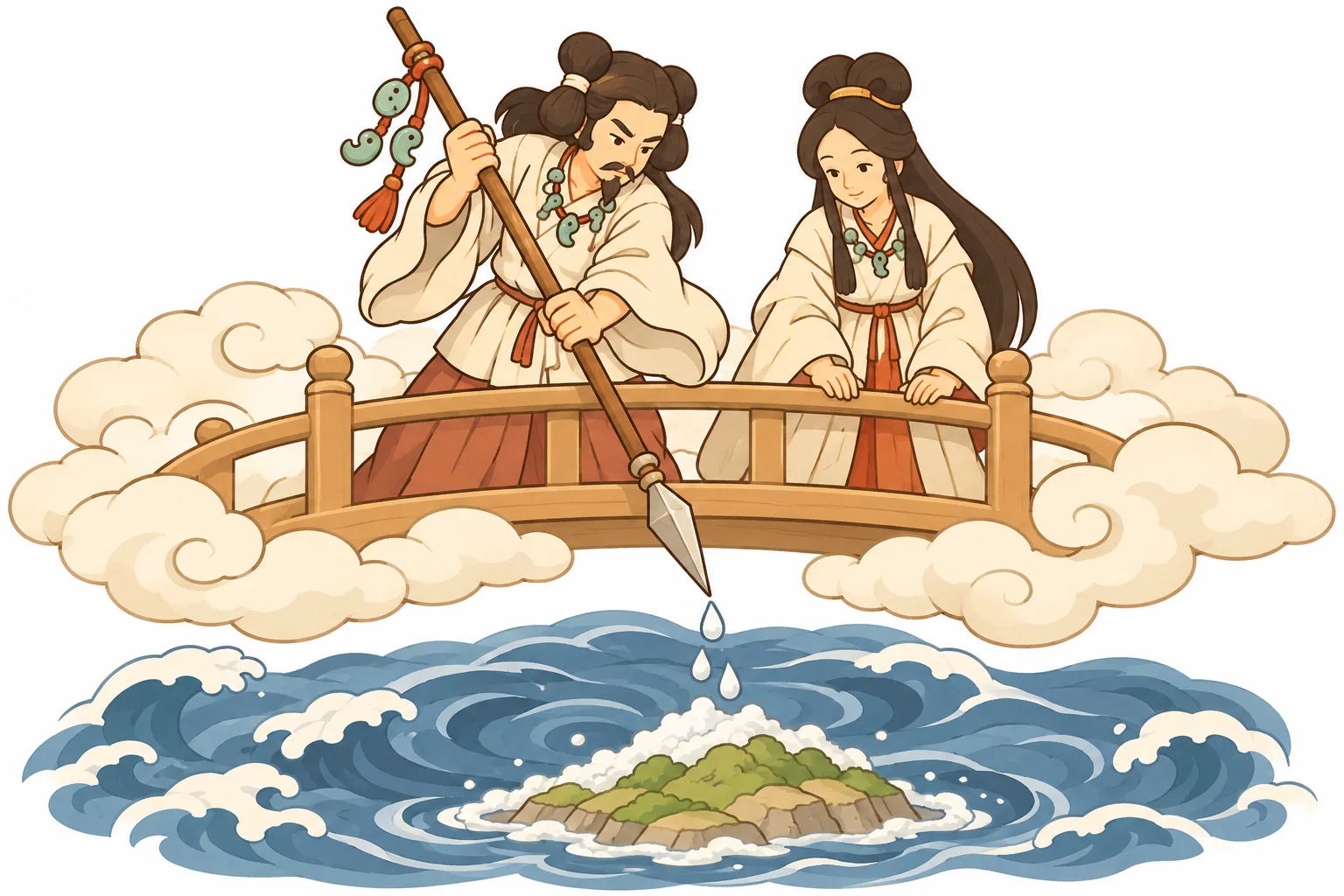
Izanagi and Izanami stir the sea with a spear from the Floating Bridge of Heaven; brine dripping from it forms an island (illustration).
The last child Izanami bears is the fire god Kagutsuchi, and he burns her as he is born. She sickens and dies. Izanagi, mad with grief, cuts off the fire god’s head; from the blood on his sword spring more gods, including the thunder and sword god Takemikazuchi, who will matter later. Then Izanagi does what Orpheus did: he goes down to Yomi, the land of the dead, to bring his wife back.
Izanami speaks to him from behind the door of a hall. It is too late, she says; she has already eaten the food of Yomi. But she will ask the gods of the underworld whether she may leave, and he must not look at her while she does. He waits, grows impatient, breaks a tooth off the comb in his hair, lights it, and goes in. He sees her body rotting, swarming with maggots, with eight thunder gods coiled on it.
He runs. Izanami, shamed, sends the hags of Yomi and then the thunder gods after him. He throws down his headdress and comb, which turn into grapes and bamboo shoots, and the hags stop to eat them. At the foot of the slope out of Yomi, Yomotsu Hirasaka, he throws three peaches and the army retreats. Finally Izanami herself comes, and Izanagi blocks the pass with a boulder so heavy it would take a thousand men to move. Across the stone they divorce. Izanami says that if he treats her this way she will strangle a thousand of his people each day. Izanagi replies that he will then build fifteen hundred birthing huts each day. That is why, the Kojiki says, a thousand people die every day and fifteen hundred are born. The text places the slope in Izumo, and near Matsue a quiet wooded spot with boulders and a straw rope is marked as Yomotsu Hirasaka.
03Purification and the Birth of Amaterasu
Back from the dead, Izanagi says he has been somewhere filthy and must wash. He goes to a river mouth in Himuka, in Kyūshū, strips, and bathes. Each item of clothing he throws down becomes a god; the pollution washing off him becomes gods of misfortune, followed by gods who set misfortune right. Last of all, washing his left eye, he produces Amaterasu Ōmikami, the Great Divinity Illuminating Heaven. From his right eye comes Tsukuyomi, the moon. From his nose comes Susanoo, the "Impetuous Male." Izanagi rejoices that at the end of all his begetting he has three noble children. He gives Amaterasu his necklace and the rule of Heaven, Tsukuyomi the realm of night, and Susanoo the sea.
This scene sits underneath a large part of Shinto practice. The basin at a shrine entrance where you rinse your hands and mouth, the ritual purifications called harae and misogi that priests perform in rivers and the sea, all rest on the idea that pollution, kegare, can be washed away with water. Kegare is less a moral sin than a contagious contamination, and death is its worst form, which is why Izanagi must bathe and why many Japanese still sprinkle salt on themselves after a funeral. Only this link between Shinto and the myths is traced here; see also: Shinto: The Way of the Kami, from Torii Gates to the Household Shelf.
Amaterasu is the highest deity in the myths and, unusually among the world’s sun deities, a goddess. The Nihon shoki gives her another name, Ōhirume-no-muchi, which seems to mean something like "great sun-woman." Scholars have offered several explanations for a female sun: that she began as a priestess who served the sun and was later deified, or that her female character was strengthened when the myths were being compiled under the reigning empresses Jitō and Genmei. These remain theories. What is certain is that the court presented her as the ancestor of the imperial house, and the emperor’s right to rule descended from her.
Tsukuyomi, by contrast, barely has a story. One variant in the Nihon shoki gives him a single episode: visiting the food goddess Ukemochi, he watches her produce rice, fish and game from her mouth and, disgusted, kills her. Amaterasu declares she never wants to see him again, which is why sun and moon live apart, one by day and one by night. From the dead goddess’s body grow cattle, horses, silkworms and grain. The Kojiki tells the same story of Susanoo.
04The Cave of Heaven
Susanoo does not go to rule the sea. He weeps, and keeps weeping until his beard reaches his chest, the green mountains wither and the rivers dry up. Asked why, he says he wants to go to his mother in the land of the dead. Izanagi, furious, banishes him. Susanoo decides to say goodbye to his sister first and climbs to Heaven so violently that the mountains shake. Amaterasu assumes he has come to take her realm. She ties her hair up in a man’s style, straps on quivers of arrows, and stamps the ground until her legs sink into it, ready for war.
Susanoo protests his good intentions and proposes a contest of oaths, an ukehi, to prove them. Standing on opposite banks of the Heavenly River, Amaterasu takes his sword, breaks it in three, chews the pieces and blows out a mist that becomes three goddesses, the deities still worshipped at Munakata in northern Kyūshū. Susanoo chews his sister’s jewels and blows out five gods, one of whom, Ame-no-oshihomimi, will be the ancestor of the emperors. Susanoo declares that because he produced gentle goddesses his heart is pure, calls himself the winner, and celebrates by running riot. He breaks down the ridges between Amaterasu’s rice fields, fills in the ditches, and defecates in the hall where she is about to celebrate the harvest. She makes excuses for him. Then he tears a hole in the roof of her weaving hall and drops in a piebald horse he has flayed backward, and one of the weaving maidens, startled, strikes herself with her shuttle and dies.
Amaterasu, frightened at last, goes into the Rock Cave of Heaven, Ame-no-Iwato, and shuts the stone door. Heaven and Earth go dark, and every kind of calamity breaks out. The eight hundred myriad gods, a phrase meaning "countless," gather on the dry bed of the Heavenly River to decide what to do, and the god of wisdom, Omoikane, makes a plan. They gather roosters and make them crow. They have a great mirror forged, the Yata no Kagami, and a long string of curved jewels made, the Yasakani no Magatama. They uproot a sakaki tree and hang the jewels and mirror on its branches. One god recites a ritual prayer. The strongest of them, Ame-no-Tajikarao, hides beside the door.
- 1
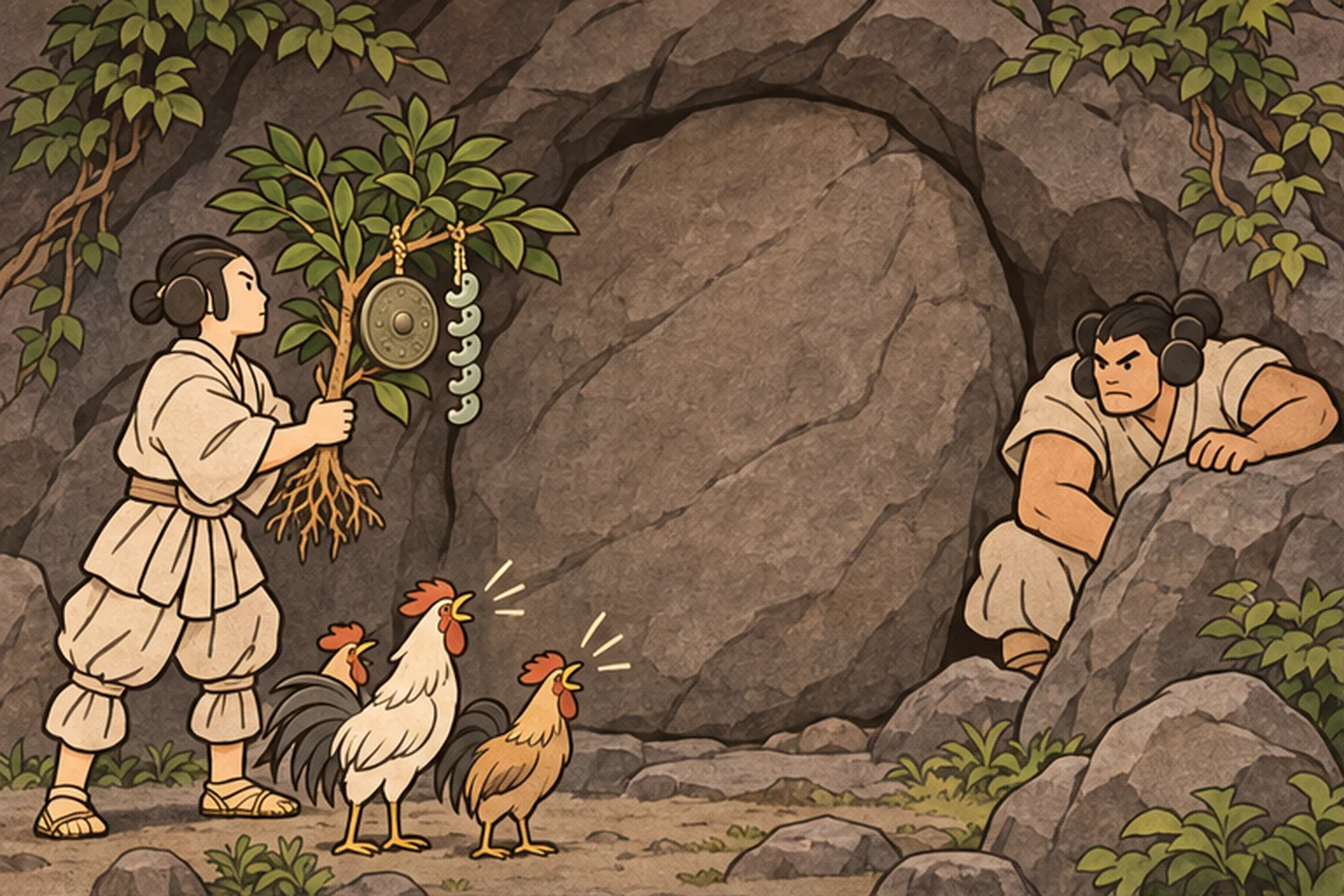 With the stone door shut, the gods make roosters crow and hang a mirror and jewels on a sakaki tree.
- 2
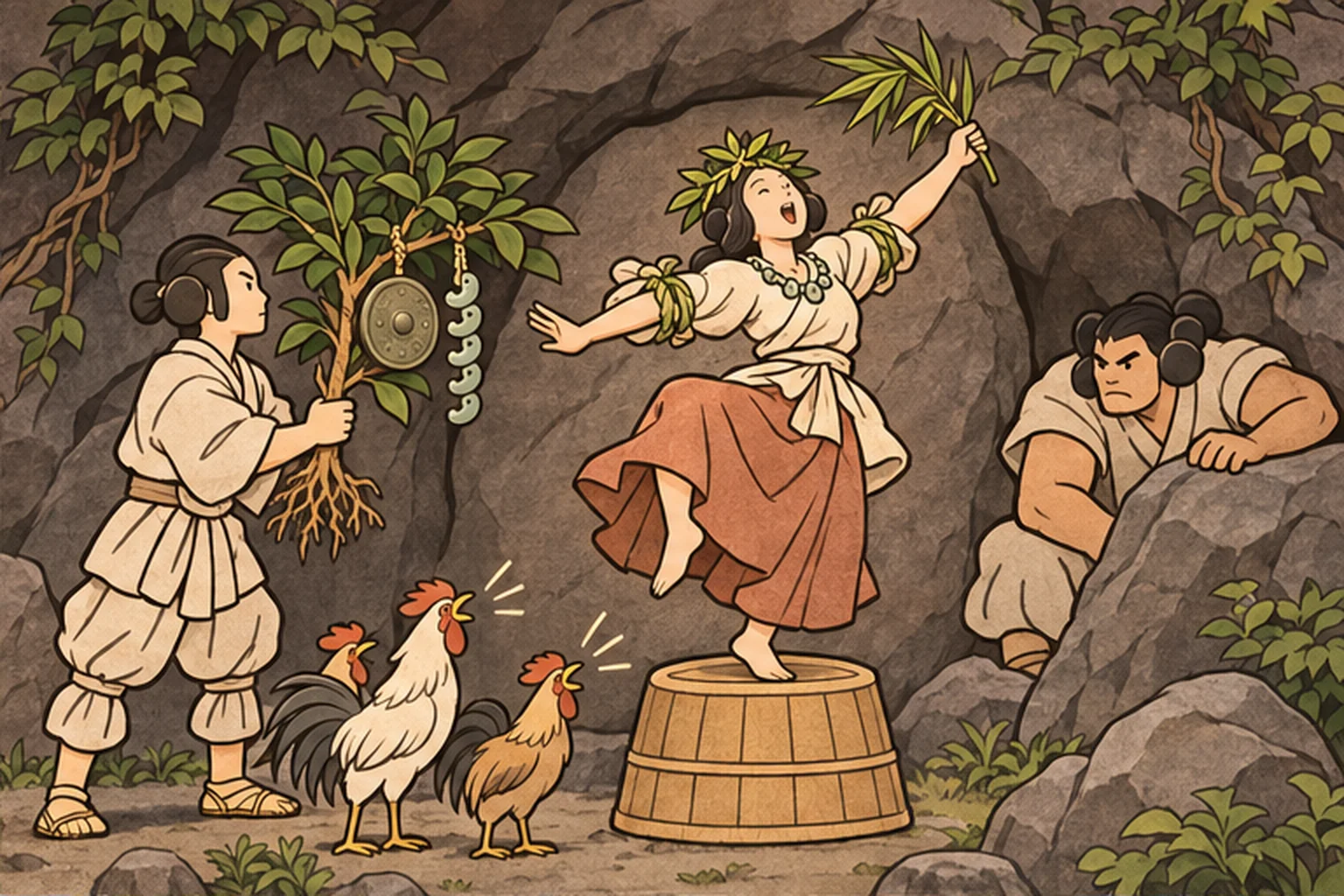 Ame-no-Uzume overturns a tub in front of the cave and stamps on it as she dances.
- 3
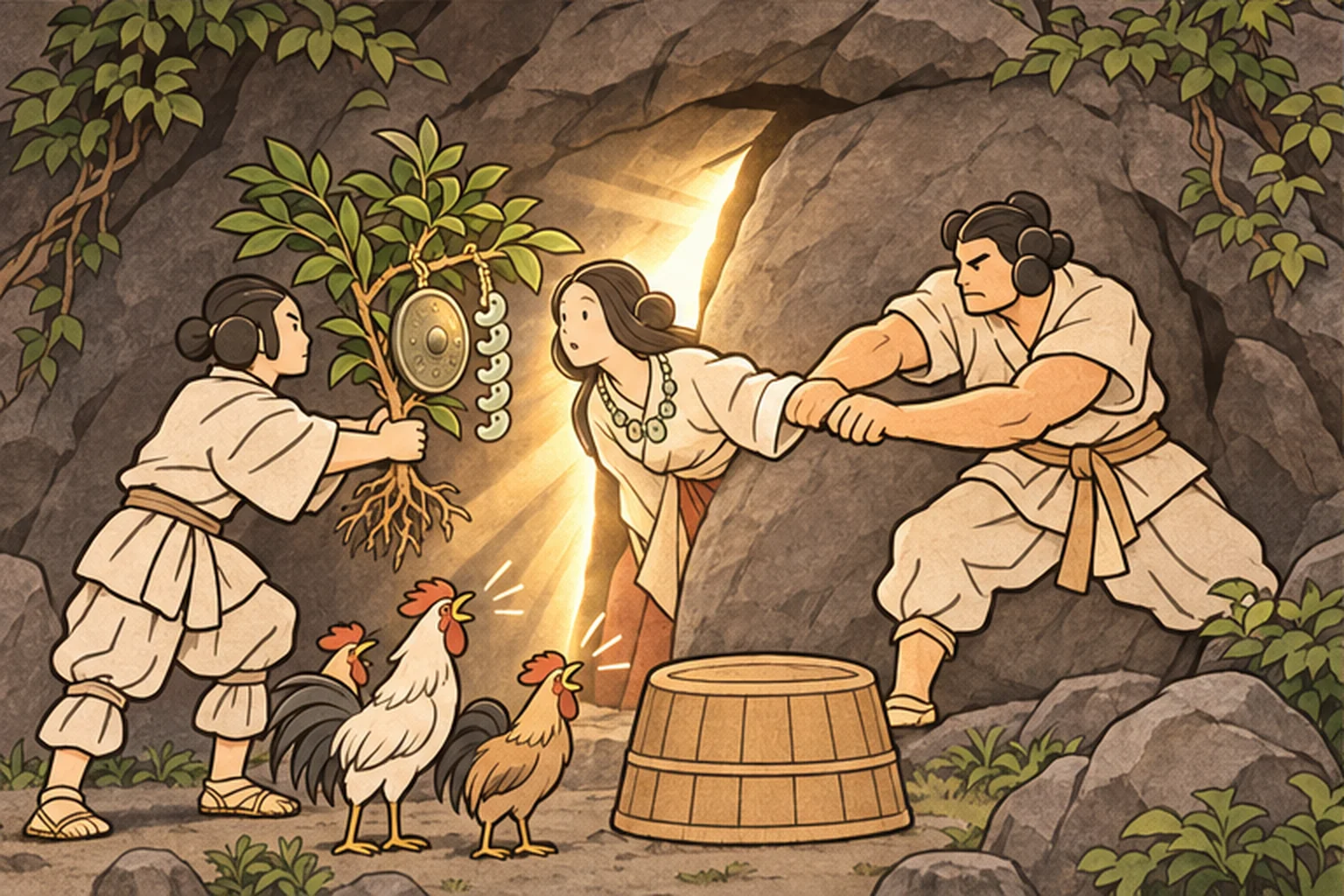 Amaterasu opens the door a crack, the mirror is held up, and Ame-no-Tajikarao pulls her out by the hand.
- 4
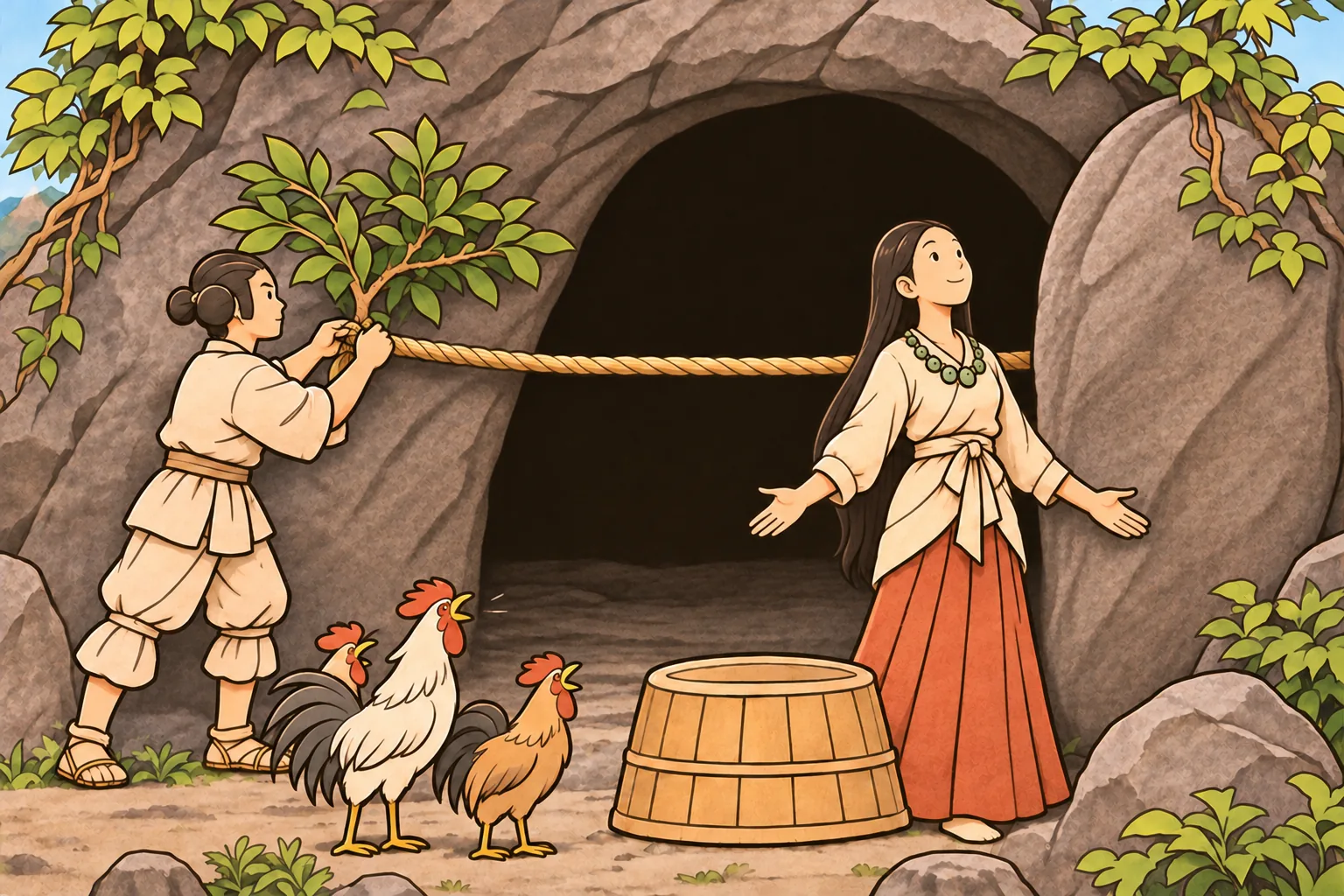 A straw rope is stretched across the cave behind her, so that she cannot go back in.
Then the goddess Ame-no-Uzume dances. She ties back her sleeves with vines, crowns herself with leaves, overturns a tub in front of the cave and stamps on it until it booms. As the dance takes hold of her she bares her breasts and pushes her skirt down to her genitals, and the gods roar with laughter until Heaven shakes. Inside, Amaterasu is puzzled. With her hidden, the world should be dark and miserable; why is Uzume dancing and everyone laughing? She opens the door a crack to ask. Uzume answers that a god even more glorious than she has appeared, and they are celebrating. At that moment the mirror is held up. Amaterasu sees her own face shining in it, takes it for the rival god, and leans out further. Tajikarao seizes her hand and pulls her out, and another god stretches a rope of straw across the cave mouth behind her: she may not go back in. Light returns. The gods fine Susanoo, cut off his beard, pull out his fingernails and toenails, and drive him out of Heaven.
Much of Shinto ritual is laid out in this one scene. The mirror stands for the sun and for Amaterasu, and in many shrines the object in the inner sanctuary is not a statue but a mirror. Offerings hung on sakaki branches, the recited prayers called norito, the sound of a drum, all have their model here. The straw rope across the cave is taken as the origin of the shimenawa, the thick ropes hung on shrine gates, sacred trees and great rocks to mark them as belonging to the gods. And Uzume’s dance is regarded as the first kagura, the sacred dance performed for the gods, which is why she is honored as the patron of the performing arts.
The story is localized at Takachiho, a mountain town in northern Miyazaki Prefecture. At Amano Iwato Shrine the object of worship is the cave itself, on the far side of a gorge; you cannot approach it, but a priest will take you to a viewing platform to bow toward it. A ten-minute walk along the river brings you to Amano Yasugawara, a broad cavern where the gods are said to have met, its floor covered with thousands of small cairns of stones stacked by visitors making wishes. As of 2025 the villages around Takachiho still perform yokagura, night kagura, from mid-November to early February: thirty-three dances performed through the night in a private house, including the strongman searching for the cave, Uzume’s dance, and the opening of the door.
05Ise: Where Amaterasu Lives
Amaterasu’s home on earth is the Ise Jingū in Mie Prefecture, called simply Jingū, "the Shrine." According to the Nihon shoki, the mirror from the cave was first kept in the emperor’s palace, until awe of the goddess led to its removal, and under the legendary Emperor Suinin a princess named Yamatohime carried it from province to province looking for a permanent home. When she reached Ise the goddess spoke: this was a land where the waves of the eternal world roll in, a remote and lovely land, and she wished to live there. Those reigns belong to legend, and historians generally date the real founding of Ise somewhere between the fifth and seventh centuries.
Ise is not one shrine but a complex of 125, centered on two. The Inner Shrine, Naikū, is Amaterasu’s. The Outer Shrine, Gekū, belongs to Toyouke, a goddess of food. A ninth-century record of the Outer Shrine explains that Amaterasu appeared in a dream to Emperor Yūryaku and complained that she could not eat in peace alone, and asked for Toyouke to be brought from Tanba to cook for her. Twice every day, morning and evening, priests at Gekū still light a fire by friction and offer rice, salt, water, fish and seasonal vegetables to Amaterasu and the other gods, a rite said to have been performed without a break for some 1,500 years.
Ise’s best-known custom is the Shikinen Sengū, the periodic rebuilding. Every twenty years the main sanctuaries of both shrines, and many lesser ones, are rebuilt from scratch on an adjacent plot, identical down to the last detail, together with all the sacred treasures, clothing and furnishings. The deity is moved to the new building by night and the old one is dismantled. The first rebuilding took place in 690 under Empress Jitō. The custom lapsed for over a century during the civil wars of the fifteenth and sixteenth centuries, then resumed; the 62nd rebuilding was held in 2013, and the next is planned for 2033. The halls, of unpainted cypress and thick thatch with crossed chigi boards rising from the gables, show no trace of Buddhist architecture and are thought to preserve some of the oldest Japanese building forms. Why twenty years? There is no settled answer; the usual ones are that twenty years lets one generation of carpenters pass its skills to the next, and that Shinto values tokowaka, being forever fresh and pure. A widely repeated explanation holds that unpainted wood and thatch need renewing after about twenty years, though the shrine itself does not give decay as the reason. Preparations take eight years, beginning with the Yamaguchi-sai, a rite at Ise asking the mountain gods for a safe felling, followed by ceremonies in the Kiso mountains where the cypress is cut.
- 1Yamaguchi-saiasking the mountain gods for a safe felling
- 2Felling ceremonies in the Kiso mountains
- 3Rebuilt identically on an adjacent plotwith all the sacred treasures, clothing and furnishings
- 4Deity moved to the new building
- 5Old building dismantled
The cycle repeats every twenty years and takes eight years to prepare; the first was in 690, the 62nd in 2013, the next planned for 2033.
Ise also became, in the Edo period, the great pilgrimage of ordinary Japanese. Commoners could rarely leave their domains, but a pilgrimage to Ise was an accepted reason. Villages formed confraternities, Ise-kō, pooling money so members could take turns making the trip, with sightseeing and the pleasure quarter at Furuichi thrown in. Roughly every sixty years there was a mass outbreak called okage mairi, "pilgrimage of thanks," in which people walked off from masters and families, fed along the way by charitable households. The 1830 outbreak is recorded as drawing about 4.3 million pilgrims within a few months, in a country of perhaps thirty million.
The mirror at Ise is one of the Three Sacred Treasures, the regalia of the imperial throne. The sword is at Atsuta Shrine in Nagoya and the jewel in the Imperial Palace in Tokyo, which also holds replicas of the mirror and sword. None of them is ever shown. Even at an enthronement the sword and jewel appear only in wrapped boxes.
06Susanoo in Izumo
Cast out of Heaven, Susanoo lands on the upper reaches of the Hi River in Izumo. Seeing chopsticks floating downstream, he follows the river up and finds an old couple weeping with their daughter. They once had eight daughters, they say, and every year an eight-forked serpent, Yamata no Orochi, has come and eaten one. Now only Kushinadahime is left, and it is nearly time. The serpent has eight heads and eight tails, eyes red as winter cherries, moss and cypresses growing on its back; it stretches across eight valleys and eight hills, and its belly is always oozing blood.
Susanoo reveals who he is and asks for the girl’s hand. When the parents agree, he turns her into a comb and sticks it in his hair. He has them brew a powerful sake, refined eight times over, build a fence with eight gates, and set a vat of sake behind each gate. The serpent comes, plunges one head into each vat, drinks, and falls asleep. Susanoo hacks it to pieces until the river runs red. When his sword strikes the middle tail its edge chips, and he cuts the tail open to find a great sword inside. Recognizing something extraordinary, he sends it up to Amaterasu. This is the Kusanagi sword, the sword of the Three Treasures.
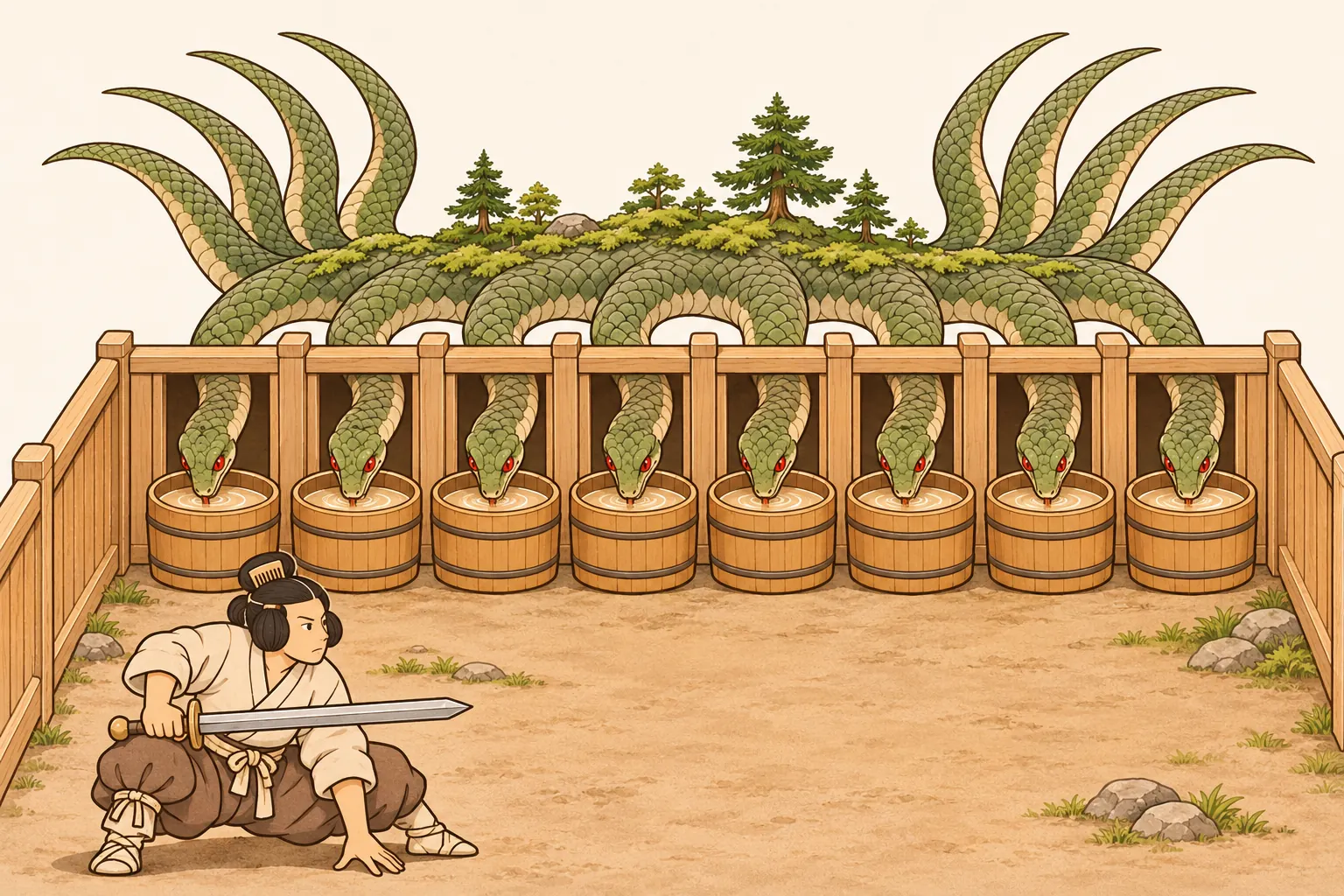
Yamata no Orochi plunges one head into each of the eight sake vats Susanoo set behind a fence with eight gates.
Susanoo builds a palace at Suga and, seeing clouds rise over it, composes a verse that begins "Eightfold rise the clouds / In Izumo an eightfold fence." Later tradition, beginning with the preface to the tenth-century Kokinshū anthology, treats it as the first Japanese poem. Suga Shrine in Unnan claims to be the site of that palace. Yaegaki Shrine in Matsue, dedicated to Susanoo and Kushinadahime, is a popular place to pray for a good marriage; in a pond behind it visitors float a sheet of paper with a coin on it and watch how fast it sinks to learn how soon they will marry.
The upper Hi River was an area of iron production, smelted from river sand, and the serpent is often read as a flooding river, the sword in its tail as the region’s iron. In Izumo and neighboring Iwami, the serpent fight is the star of Iwami kagura, a fast, loud style of sacred dance in which long serpents of paper and bamboo hoops coil, writhe and breathe fireworks before Susanoo cuts them down.
07Ōkuninushi, the White Hare and the Surrender of the Land
Izumo’s other great god is Ōkuninushi, "Great Lord of the Land," a descendant of Susanoo. As a young god he has eighty brothers, who all want to marry Yagamihime, a princess of Inaba, and set off together, making him carry the baggage. At Cape Keta they find a hare stripped of its fur and tell it, as a joke, to bathe in seawater and dry off in the wind. The salt cracks its skin. When Ōkuninushi comes along it tells him its story: it had lived on the island of Oki and wanted to cross to the mainland, so it challenged the wani, usually understood as sharks, to see whose clan was bigger, and had them line up from the island to the shore so it could count them. Just short of land it boasted that they had been fooled, and the last one skinned it. Ōkuninushi tells it to wash in fresh water at the river mouth and roll in the pollen of cattails. The hare is healed and prophesies that Yagamihime will choose him over his brothers.
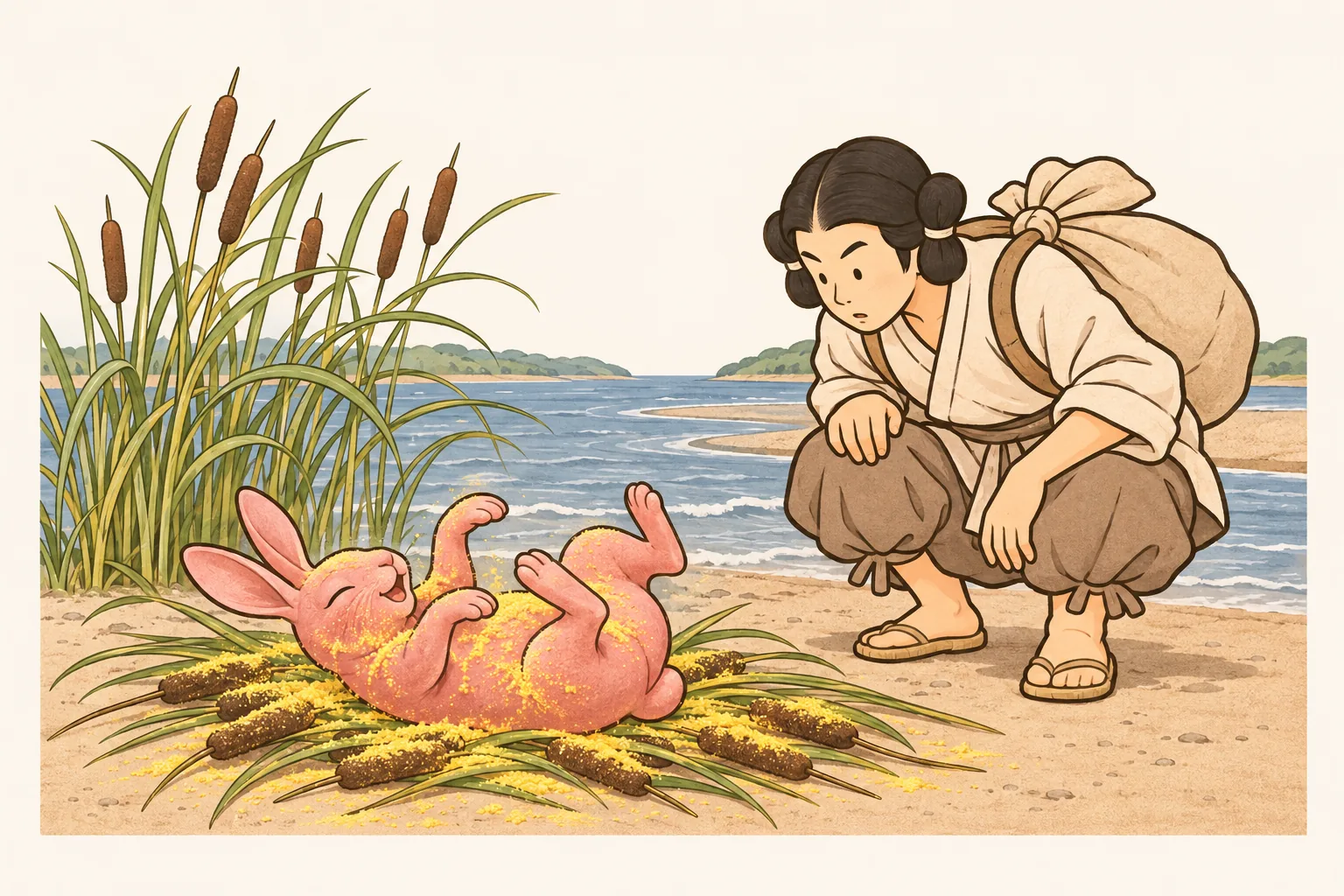
The White Hare of Inaba: the young Ōkuninushi, carrying his brothers' baggage, tells the skinned hare to roll in cattail pollen.
The White Hare of Inaba is one of the first myths Japanese children hear. Hakuto Shrine on the coast of Tottori City is dedicated to the hare and is visited by people praying about skin ailments and, these days, romance.
The princess does choose Ōkuninushi, and the jealous brothers kill him by rolling a red-hot boulder down a mountain and telling him to catch the "boar"; his mother obtains help from Heaven to revive him. He flees to Susanoo in the underworld and falls in love with Susanoo’s daughter Suseribime. Susanoo puts him through ordeals, a night in a room of snakes, then one of centipedes and wasps, then a grass fire set around him in a field; his wife’s magic scarf and a helpful mouse see him through. Finally, while Susanoo sleeps, Ōkuninushi ties the god’s hair to the rafters and escapes with Suseribime, Susanoo’s sword and bow, and a heavenly zither. Susanoo chases him to the boundary slope and shouts after him, more blessing than curse: use the sword and bow to defeat your brothers, become Great Lord of the Land, and build your palace.
With a tiny god named Sukunabikona, who arrives across the sea in a seed-pod boat, Ōkuninushi builds and orders the land, teaching medicine and the control of pests. He is still worshipped as a god of land, farming, healing and, above all, en, the bonds that bring people together, especially in marriage. Because his name can be read Daikoku, he merged in popular religion with Daikokuten, one of the Seven Gods of Fortune, whose sack is said to recall the young god carrying his brothers’ bags.
Then Amaterasu declares that the Central Land of Reed Plains should be ruled by her descendants. Her first envoy goes native for three years; the second marries Ōkuninushi’s daughter and stays eight years. The third is Takemikazuchi, the god born from the fire god’s blood. At Inasa Beach in Izumo he plants his sword point-up in the crest of a wave, sits cross-legged on the tip, and demands an answer. One of Ōkuninushi’s sons agrees at once. The other, Takeminakata, challenges Takemikazuchi to a trial of strength, has his hand crushed like a reed, and flees all the way to Lake Suwa in the mountains of Shinano, where he promises never to leave. He is the god of Suwa Taisha in Nagano, famous for the Onbashira festival, held every six years (locally, "once in seven," counting inclusively), when giant fir logs are ridden down steep slopes.
Ōkuninushi yields the land on one condition: that he be given a palace whose pillars reach the bedrock and whose roof beams rise to Heaven. That palace is Izumo Taisha. Its present main hall, rebuilt in 1744, stands about 24 meters tall, among the tallest shrine buildings in Japan. Shrine tradition held that in earlier ages the hall stood 16 jō, about 48 meters, which most people took for exaggeration until 2000, when excavations in the precinct uncovered the base of a pillar made of three enormous cedar trunks bound together, about three meters across, dating to around the thirteenth century. The pillar is now displayed at the Shimane Museum of Ancient Izumo next to the shrine.
Izumo Taisha has its own customs. Worshippers clap four times instead of the usual two. The enormous shimenawa across the front of the Kagura-den hall is about thirteen meters long and weighs around five tons. And in the tenth month of the old lunar calendar, all the gods of Japan are said to gather in Izumo to decide the year’s matches and fortunes. Elsewhere the month is called Kannazuki, "the month without gods"; in Izumo it is Kamiarizuki, "the month with gods." The folk etymology is medieval and probably not the original meaning, but the shrine welcomes the gods anyway, with bonfires on Inasa Beach on the night they arrive across the sea.
08The Descent of the Heavenly Grandson
With the land surrendered, Amaterasu’s grandson Ninigi is sent down to rule it. She gives him the jewels, the mirror and the Kusanagi sword, telling him to regard the mirror as her own self, and sends with him the gods of the cave, Uzume among them. At a crossroads in the sky a god with a long nose and glowing eyes blocks the way; questioned by Uzume, he turns out to be Sarutahiko, an earthly god come to guide them. Ninigi parts the clouds and descends onto a peak called Takachiho in Himuka. Two places claim it: the town of Takachiho, and the peak of Takachiho-no-mine in the Kirishima range, whose summit holds a bronze spear of unknown origin, said in one legend to have been planted there by Ninigi. Sarutahiko became a god of roads and guidance, and the long-nosed masked figure who leads many shrine processions is him.
Ninigi falls in love with a beautiful woman, Konohanasakuyahime, "princess of blossoming trees," and asks her father, the mountain god Ōyamatsumi, for her hand. The father happily sends her along with her elder sister, Iwanagahime, "princess of long-lasting rock." The sister is ugly and Ninigi sends her back. Her father explains what he has done: he sent both so that the heavenly grandson’s life would be as enduring as rock and as flourishing as blossom, and now it will be as brief as the flowers. That, say the chronicles, is why the emperors are not immortal. Konohanasakuyahime conceives after a single night. When Ninigi doubts the child is his, she seals herself in a birthing hut without doors, sets it on fire, and bears three sons in the flames unharmed. She is the goddess of Mount Fuji, worshipped at Fujisan Hongū Sengen Taisha and the many Sengen shrines across Japan.
Two of her sons are Umisachihiko, "luck of the sea," and Yamasachihiko, "luck of the mountains." The younger loses his brother’s fishhook and, refused forgiveness, is sent to the palace of the sea god, where he marries the sea god’s daughter Toyotamahime. The hook is found in the throat of a sea bream, and the sea god gives him two jewels that raise and lower the tides, with which he subdues his brother. When Toyotamahime comes ashore to give birth she asks him not to look. He looks, and sees her in her true form, a huge wani writhing on the ground. Ashamed, she returns to the sea, leaving her son to be raised by her sister. That son marries the sister, and their youngest child becomes Jinmu, the first emperor. Udo Jingū, on the Nichinan coast of Miyazaki, stands in a sea cave said to be where Toyotamahime gave birth; visitors throw clay "luck stones" at a turtle-shaped rock below, hoping to land one in the hollow on its back.
09From Gods to Emperors, and What the Modern State Made of It
Jinmu’s story is where the myths shade into history. He sets out east from Himuka with his brothers along the Inland Sea. Landing near present-day Ōsaka, he is driven back by a local chieftain and his elder brother is mortally wounded. Jinmu decides the defeat came from fighting with the sun in his face, unfitting for a descendant of the sun, and sails around the Kii Peninsula to land at Kumano. In the mountains there, Heaven sends a giant crow, Yatagarasu, to guide him to Yamato; later art gives it three legs. After his victory Jinmu is enthroned at Kashihara.
Yatagarasu became the messenger of the gods of Kumano, whose talismans are still written in crow-shaped characters. Since 1931 it has also been the emblem of the Japan Football Association, which is why a three-legged crow appears on the shirts of Japan’s national teams.
The Nihon shoki dates Jinmu’s enthronement to a kanoto-tori year that later calculation fixed at 660 BCE. In the 1890s the historian Naka Michiyo showed that the date appears to have been produced by counting back 1,260 years, a cycle in Chinese portent theory associated with great upheavals, from the year 601, and historians have broadly accepted this. The first emperors live impossibly long lives, and the second through ninth are names without deeds. Historians do not treat them as historical.
Modern Japan, however, did. In 1873 the Meiji state fixed February 11 as Kigensetsu, the anniversary of Jinmu’s accession. Schoolchildren learned history beginning with Amaterasu and the descent of Ninigi, and the goddess’s command that her descendants would rule "as long as heaven and earth endure" was taught as the foundation of the nation. In 1940 the country celebrated the 2,600th year of the imperial era; the Navy fighter adopted that year, the Zero, took its name from the last digit. The same year the Waseda historian Tsuda Sōkichi, who had argued that the age-of-the-gods chapters were a political creation of the later court, had four books banned and was prosecuted, with his publisher Iwanami Shigeo, under the Publication Law. He was convicted in 1942; the case was later dropped on a statute of limitations.
After defeat, on New Year’s Day 1946, Emperor Shōwa issued a rescript rejecting the idea that the emperor was a living god, usually called the "Declaration of Humanity." Kigensetsu was abolished in 1948 and revived in 1966 as National Foundation Day, observed from 1967; February 11 is a public holiday today, and still a contested one. Postwar scholars went back to reading the myths as literature and as evidence of early thought, comparing Izanagi in the underworld with Orpheus, or the lost fishhook with tales from Southeast Asia.
10Meeting the Myths in Japan Today
At Ise, custom is to visit the Outer Shrine first. Gekū is a few minutes’ walk from Iseshi Station. Its sanctuary is enclosed by four fences; visitors bow at the outermost gate, glimpsing thatched roofs past a white curtain. A bus takes you to Naikū in about fifteen minutes. The Inner Shrine begins at the Uji Bridge over the Isuzu River, with a large torii at each end made from the ridge pillars of the previous main halls. The approach is paved with gravel that crunches underfoot, and at one point a stone slope leads down to the river, where visitors rinse their hands in the clear water, a small re-enactment of Izanagi’s purification. At the sanctuary, an old tradition says you should give thanks rather than ask for anything in particular. Afterward, the Oharai-machi street and Okage Yokochō offer soft, thick Ise udon in a dark sauce and Akafuku, rice cakes under sweet bean paste, which pilgrims have been eating for three centuries.
At Izumo, the little Ichibata railway runs from Izumo city to the shrine’s doorstep. Unusually, the approach slopes downhill. Behind the main hall, at the foot of the sacred mountain, is a small shrine to Susanoo, the Soga-no-yashiro. In the lunar tenth month, usually in November, go to Inasa Beach at dusk, where a rock topped with a tiny shrine marks the place the gods come ashore. With another day, head east to Matsue for Yaegaki Shrine and the Yomotsu Hirasaka.
At Takachiho, the best season is winter. The town sits above a gorge of columnar volcanic rock, left by ancient eruptions of Aso, where you can rent a rowboat. The kagura hall at Takachiho Shrine stages an hour of tourist kagura, usually four dances: the strongman searching for the cave, Uzume’s dance, the opening of the door, and a bawdy number in which Izanagi and Izanami share sake and embrace, which has the audience laughing much as the gods laughed at Uzume. If you are there between November and February you may be able to attend a real village yokagura. The custom is to bring a bottle of sake or shochu as an offering, and in return you sit on the tatami of a farmhouse watching dances until dawn while the hosts pass around drinks and food: by one description, usually kagura udon, simmered vegetables and hot sake served in bamboo, and by some accounts shochu and taro dumplings.
The myths also turn up in everyday Japan. The straw shimenawa hung on doorways at New Year carries the logic of the rope across the cave, and the portable shrines carried through the streets at summer festivals often hold Susanoo or Ōkuninushi. In the 2006 video game Ōkami, Amaterasu takes the form of a white wolf who paints the world back to life with a brush, and fights Orochi in a battle drawn directly from the Kojiki.