
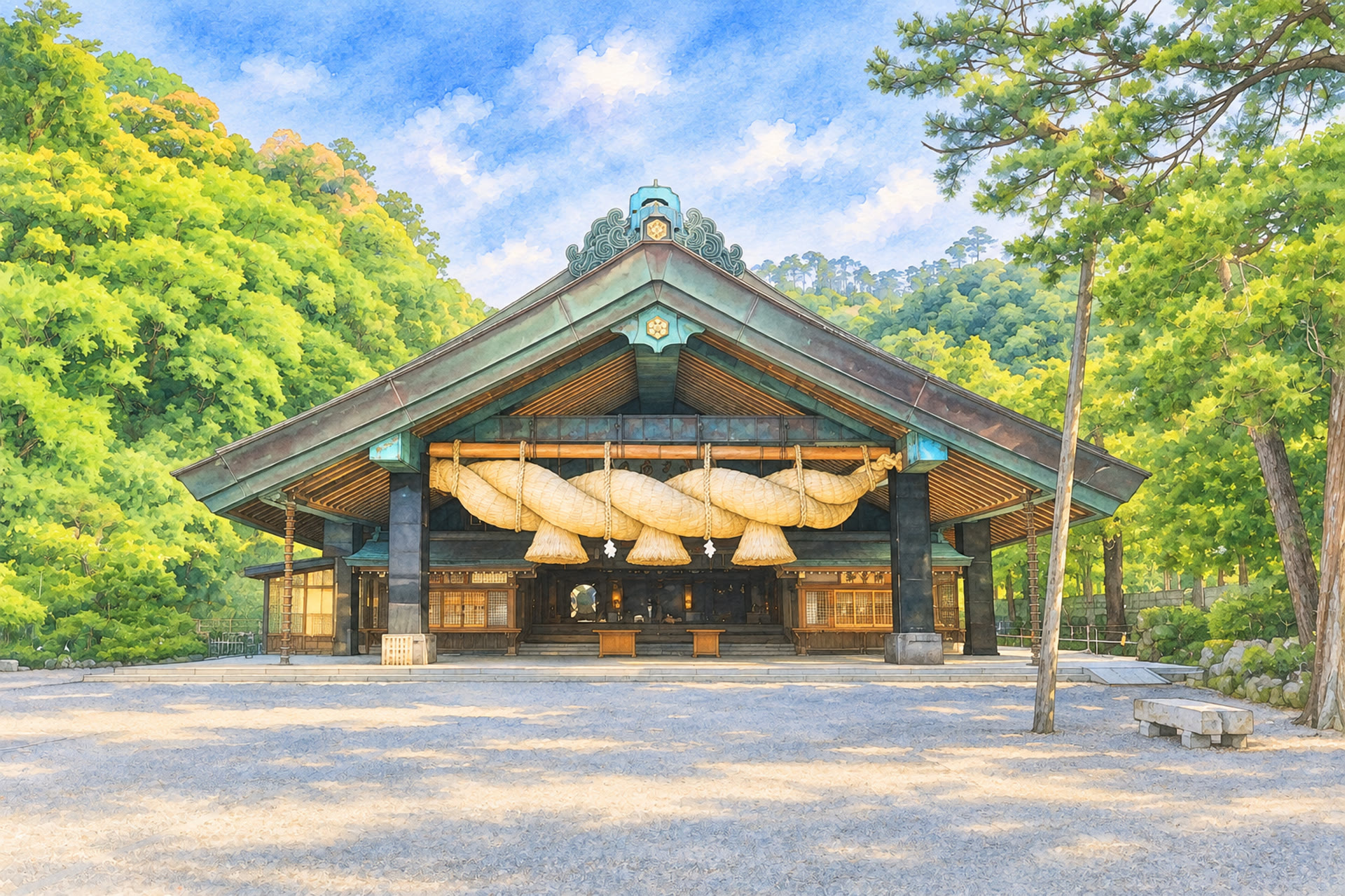
Izumo Taisha, officially read Izumo Ōyashiro, stands at the foot of Mount Yakumo in the Taisha district of Izumo City, Shimane Prefecture, a short walk from the Sea of Japan. It is dedicated to Ōkuninushi, the god who in Japanese myth built and ruled the land before handing it over to the heavenly line. Few shrines in Japan are older or more prestigious, and its main sanctuary is generally regarded as the tallest surviving shrine hall in the country, built in the taisha-zukuri style, one of the oldest forms of Shinto architecture.
01A shrine born in myth
Japan’s eighth-century chronicles, the Kojiki and the Nihon Shoki, tell of the "transfer of the land": Ōkuninushi yielded his realm to the descendants of the sun goddess Amaterasu on condition that he receive a palace whose pillars reached down to bedrock and whose roof touched the heavens. This is a myth, not a founding record, but together with the Izumo Fudoki gazetteer of 733 it shows that the shrine was already famous by the eighth century. Until 1871 it was usually called Kizuki Taisha.
The rites have been led for centuries by the Izumo kuni no miyatsuko (provincial chieftain) lineage, which traces itself to the god Ame-no-Hohi. In the mid-fourteenth century the line split into the Senge and Kitajima houses, both of which continue today.
02The legend of the giant hall
A children’s primer of 970, the Kuchizusami, ranked Izumo’s hall as the tallest building in Japan, ahead of the Great Buddha Hall of Tōdai-ji and the Great Hall of State in Kyoto. Shrine tradition puts the ancient hall at sixteen jō, about 48 meters, and records describe it collapsing and being rebuilt several times between the late Heian and Kamakura periods. From 2000, excavations between the worship hall and the inner gate uncovered pillars made of three huge cedar trunks bound together, generally dated to the hall completed in 1248. The finds gave real weight to the old stories.
03The shrine today
In the Middle Ages the shrine was closely tied to Buddhism and for a time its deity was identified as Susanoo. When the hall was rebuilt with shogunate funding in 1667, the Buddhist buildings were pulled down or given away and Ōkuninushi restored as the deity. The present main hall dates from 1744 and stands about 24 meters high; it was designated a National Treasure in 1952, and in 2004 the tower gate, inner gate, corridors, bronze torii and other structures built alongside it, 21 buildings and one torii in all, were designated Important Cultural Properties. Its cypress-bark roof was renewed between 2008 and 2013.
In the tenth lunar month, known elsewhere as Kannazuki, "the month without gods," Izumo calls it Kamiarizuki, "the month with gods," from the popular belief that the gods of Japan gather here; the shrine still welcomes and sends them off with festivals. Ōkuninushi is widely revered as a god of marriage and good relationships, and worshippers here clap four times rather than the usual two. The giant straw rope on the Kaguraden hall is one of the shrine’s best-known sights.
Izumo Taisha
01Whose shrine is this?
Izumo Taisha lies at the foot of Mount Yakumo in the Taisha district of Izumo City, Shimane Prefecture, on the Sea of Japan coast of western Honshū. Hills close in behind it to the north and east; less than two kilometers to the west is Inasa Beach and the open sea. To reach it you cross the flat Izumo Plain, which in ancient times was broken by lagoons and inlets, of which Lake Shinji and Lake Jinzai are the remnants.
The shrine’s official name is read Izumo Ōyashiro, "the Great Shrine of Izumo," though most people say Izumo Taisha. Before the Meiji era it was usually called Kizuki Taisha, after the old name of the locality. Its deity is Ōkuninushi, "Great Lord of the Land," the god who in Japanese mythology shaped and ruled the earthly realm before surrendering it to the descendants of the heavenly gods.
Almost every chapter of the shrine’s history is bound up with that story of surrender. The myth explains why the shrine exists, and generation after generation rebuilt the shrine according to their own reading of the myth. It helps, then, to keep three layers apart: the myths recorded in eighth-century chronicles; the shrine, its priestly family and its buildings as they appear in documents from the Heian period onward; and what you can actually see on the ground today.
02The myth of the transfer of the land
What follows is myth, not history, but it is the key to the place.
According to the Kojiki (Records of Ancient Matters), compiled in 712, Ōkuninushi descended from Susanoo, the storm god who was banished from heaven, came down to Izumo, slew the eight-headed serpent Yamata no Orochi and settled there. As a young god Ōkuninushi was bullied by his many brothers. On the way to Inaba he healed a white hare that had been stripped of its fur, survived repeated attempts by his brothers to kill him, passed a series of ordeals set by Susanoo in the underworld, and returned with Susanoo’s daughter as his wife. With the tiny god Sukunabikona he then set about developing the land.
In heaven, the sun goddess Amaterasu decided that the land below should be ruled by her own offspring and sent envoys down. The first, Ame-no-Hohi, went over to Ōkuninushi’s side and did not report back for three years. The last was the warrior god Takemikazuchi. In the Kojiki’s telling, he landed on the little beach of Inasa in Izumo, thrust his sword point-up into the crest of a wave, sat cross-legged on its tip, and demanded that Ōkuninushi hand over the land. Ōkuninushi deferred to his son Kotoshironushi, who agreed. Another son, Takeminakata, resisted, lost a trial of strength and fled all the way to Suwa in Shinano. Ōkuninushi then consented, on one condition: that a palace be built for him with pillars sunk deep into the bedrock and roof beams soaring into the high heavens. There he withdrew.
A variant quoted in the Nihon Shoki (Chronicles of Japan, 720) tells a similar story and adds that Ame-no-Hohi was appointed to conduct the god’s rites. The priestly house of Izumo later traced its descent from him on the strength of this passage.
Inasa Beach just west of the shrine is generally identified with the beach of the myth. The rock islet of Benten-jima stands on its sand, and the shrine’s autumn rite of welcoming the gods begins here.
Historians have read the myth in many ways. One influential view is that it reflects the relationship between the Yamato court and a powerful regional polity in Izumo, folded into the story of how the imperial line came to rule. Exactly which real events, if any, lie behind it remains open. What is clear is that to the early eighth-century court, the great god of Izumo was a power to be honored and placated with unusual care.
03The Izumo Fudoki and ancient Izumo
The Izumo Fudoki, a provincial gazetteer completed in 733, is the only one of the five surviving ancient gazetteers that is nearly complete. It was compiled under Izumo no Hiroshima, the provincial chieftain of Izumo, and it gives a local view that differs from the court chronicles.
In the Fudoki, Ōkuninushi is called "the great god who made the land under heaven," a god who travels around Izumo opening up land, not the one who retires after surrendering it. The gazetteer opens with the famous "land-pulling" myth: the god Yatsukamizu-omitsuno, finding Izumo too narrow, hooks pieces of land from across the sea with a rope and hauls them over, creating the Shimane Peninsula. The Fudoki explains the place name Kizuki as coming from the gods who gathered here to build (kizuku) the great god’s palace, another origin legend.
Archaeology confirms that ancient Izumo was home to a strong regional power. In 1984, at the Kōjindani site in what is now the Hikawa district of Izumo City, 358 bronze swords were found buried together, more than had been found in all of Japan until then, and bronze bells and spearheads turned up nearby the following year. In 1996 the Kamo Iwakura site in Unnan yielded 39 bronze bells, the largest number from any single site. The region also has distinctive burial mounds with projecting corners. None of this is directly connected with the shrine, but it suggests that the weight of "Izumo" in the myths was not invented from nothing. The bronzes are now displayed in the Shimane Museum of Ancient Izumo, right next to the shrine.
04The kuni no miyatsuko: a hereditary priesthood
From early times the rites of the shrine have been led by the Izumo kuni no miyatsuko. The title originally meant a regional chieftain. After the seventh-century reforms most such chieftains lost their real power and survived only as titles, but in Izumo the office continued as a hereditary priesthood serving the great god, something almost unique in Japan.
When a new chieftain took office he traveled to the capital to recite the Izumo no kuni no miyatsuko kamuyogoto, a congratulatory prayer for the emperor’s long life, and to present offerings. The text is preserved in the tenth-century Engishiki code of procedures, a sign of the special treatment the court gave Izumo.
The family’s original base was the Ou district in eastern Izumo, around the south of present-day Matsue. It later moved to Kizuki to devote itself to the shrine, probably in the late eighth or early ninth century, though the date is debated.
In the mid-fourteenth century, during the period of rival Northern and Southern courts, a succession dispute split the family into the Senge and Kitajima houses, which then shared the rites for centuries. Since the Meiji era the chief priest of Izumo Taisha has come from the Senge family, while the Kitajima family runs a separate religious body. Both lines continue today.
05"Izumo first, Yamato second, Kyoto third"
What most fires the imagination at Izumo is the height of its ancient hall.
In 970 the scholar Minamoto no Tamenori wrote the Kuchizusami, a primer for an aristocratic boy, which lists the largest buildings of the day in a jingle: Unta, Waji, Kyōsan. "Un" stands for Izumo’s Kizuki Taisha, "Wa" for the Great Buddha Hall of Tōdai-ji in Yamato, and "Kyō" for the Great Hall of State in the capital. The usual reading is that Izumo’s hall was the biggest of the three. The Great Buddha Hall of that time is thought to have stood more than 15 jō, over 45 meters, which would make the Izumo hall taller still.
Shrine tradition says the main hall stood 32 jō high in remote antiquity, 16 jō in a later age, and 8 jō afterwards. Thirty-two jō, about 96 meters, is generally treated as legend. Sixteen jō, about 48 meters, is astonishing but has long been argued over by scholars.
The documents do show that the old hall was extraordinary. From the late Heian period into the Kamakura period, records repeatedly report the main hall "toppling over," in some cases with no earthquake on record, which is generally taken to mean a structure tall enough to be unstable. Each time, the court and the provincial government mobilized labor and materials to rebuild it.
The Senge family preserved a plan called the Kanawa no gozōei sashizu. It shows nine pillars in a three-by-three grid, each made of three giant trunks bound with iron bands, and a long staircase in front said to have been one chō, about 109 meters, in length. For a long time historians disagreed about how far the plan could be trusted. Then, in 2000, the pillars themselves came out of the ground.
06The pillars found in 2000
In the spring of 2000, during construction of an underground facility between the worship hall and the Yatsuashi-mon inner gate, workers struck the base of an enormous pillar: three cedar trunks, each about 1.35 meters across, bound together into a column roughly 3 meters in diameter. It was the uzubashira, the central pillar of the hall’s front. The central "heart pillar" and a side pillar at the southeast corner were found in the year-long excavation that followed, also made of three trunks each. The other six of the hall’s nine pillars may still lie beneath the present enclosure.
The pillars match the Kanawa plan. Radiocarbon dating of the timber and the written record have led most scholars to assign them to the hall completed in 1248, the last hall known to have been built on the old, colossal scale.
The discovery does not prove that the hall was 48 meters tall, but it does show that halls far larger than the present one, standing on bundled pillars of giant trees, really existed at least as late as the Kamakura period. The uzubashira is now displayed at the Shimane Museum of Ancient Izumo, together with a full-size replica of the heart pillar and models of the tall hall built to different scholars’ reconstructions; the original heart pillar is kept in the shrine’s own treasure hall, and the side pillar was reburied where it lay. In front of the Yatsuashi-mon, circular markers in the paving show where the pillars were found.
07The Middle Ages: Buddhist halls, Susanoo and warlords
After the Kamakura period no hall of the old size was ever built again, and the buildings grew smaller. Like most shrines in medieval Japan, Izumo blended Shinto and Buddhist practice. The nearby temple of Gakuen-ji was closely tied to the shrine and its monks took part in its affairs, and a three-story pagoda, a hall for Dainichi Buddha and a bell tower rose within the precincts.
More surprising to modern visitors, the shrine’s deity came to be identified as Susanoo rather than Ōkuninushi. This view took hold in the Middle Ages, shaped by combinatory Shinto-Buddhist thought and by the strength of Susanoo worship in Izumo, and lasted for several centuries.
In the Warring States period the Amago family, who ruled Izumo, and later the Mōri supported the shrine’s building work; Buddhist facilities flourished under the Amago. In 1609 Toyotomi Hideyori paid for a rebuilding of the main hall, though again not on the ancient scale.
The shrine also has a link with theater history. Izumo no Okuni, the performer whose dances in Kyoto in the early seventeenth century are regarded as the origin of kabuki, claimed to be a shrine maiden of Izumo Taisha and is said to have toured to raise funds for it. There is no reliable record that she actually came from the shrine; the claim is best taken as her own publicity or later legend.
08The Kanbun rebuilding: back to the age of the gods
In the early Edo period the shrine was rebuilt in a way that set its course for the following centuries. In 1667 a new main hall was completed with 2,000 kan in funding from the Tokugawa shogunate; records indicate that the Matsue domain also helped manage the work. Its guiding idea was a return to the forms of the "age of the gods." The hall was restored to a height of 8 jō in the old taisha-zukuri manner; the pagoda, bell tower and other Buddhist buildings were pulled down or removed; and the deity was restored from Susanoo to Ōkuninushi. The three-story pagoda, donated in the Warring States period by Amago Tsunehisa, was moved in 1665 to Nagusa Shrine in Tajima, now Yabu in Hyōgo Prefecture, usually said to be in return for giant cedar timber that shrine supplied for the rebuilding; it still stands there as an Important Cultural Property. The bell from the bell tower ended up at Saikō-ji in present-day Fukuoka Prefecture.
This separation of Buddhism from the shrine came some two hundred years before the Meiji government ordered the same thing nationwide. It is generally thought to have been driven by the shrine’s priests together with the anti-Buddhist currents in Confucian thought of the day, and it is why you see almost no trace of Buddhism at Izumo today.
The present main hall was rebuilt in 1744, largely following the Kanbun design. It stands about 8 jō, some 24 meters, generally regarded as the tallest surviving shrine hall in Japan. Its plan is square, two bays by two, with nine pillars in a grid and the heart pillar at the center. The entrance is not centered but set to the right of the front, reached by a roofed staircase. Inside, the god’s seat faces west rather than south, which is unusual; many explanations have been proposed and none is settled. The roof is thatched with cypress bark, crowned by crossed chigi finials and horizontal katsuogi billets.
Taisha-zukuri is regarded as one of the oldest forms of shrine architecture, alongside the shinmei-zukuri of Ise Jingū and the sumiyoshi-zukuri of Sumiyoshi Taisha in Ōsaka. The main hall was designated a National Treasure in 1952.
09The month with gods, and a god of good matches
The tenth month of the old lunar calendar is generally called Kannazuki, "the month without gods." In Izumo it is called Kamiarizuki, "the month with gods," because popular belief holds that in that month the gods of all Japan leave their home shrines and gather at Izumo to settle the year’s affairs, above all who will be bound to whom. The belief spread from the Middle Ages onward. Most scholars now think the name Kannazuki originally meant "the month of the gods," with na an old possessive particle, and that the idea of absent gods is a later folk explanation.
The shrine still holds a sequence of rites in the tenth lunar month. Bonfires are lit on Inasa Beach to welcome the gods; while they stay, they lodge in the two long buildings called the Jūkusha that flank the main hall, and daily rites are held; at the end they are sent off. Local people traditionally kept quiet during this period, avoiding music and building work, out of respect for the gods’ deliberations.
Ōkuninushi’s image as a god of marriage and good relationships also spread in the Edo period, carried by itinerant shrine agents called oshi who distributed talismans around the country and told of the gods’ matchmaking council at Izumo. Because the characters for Ōkuni can also be read Daikoku, Ōkuninushi merged in popular faith with Daikokuten, one of the Seven Gods of Fortune. Together these turned a great regional shrine into a place of pilgrimage for ordinary people across Japan.
Worshippers at Izumo bow twice, clap four times and bow once, rather than the usual two claps; at the grand annual festival on May 14, attended by an imperial envoy, the priests clap eight times. The shrine’s own explanation is that eight stands for the infinite and is reserved for that festival, while everyday worship uses half that number; other explanations also circulate.
10Meiji and after: a new name, a doctrinal battle, and Senge Takatomi
After the Meiji Restoration, in 1871, Kizuki Taisha was officially renamed Izumo Ōyashiro and ranked among the highest grade of government shrines.
The central figure of this era was Senge Takatomi, the 80th kuni no miyatsuko. He threw himself into popular preaching, and in 1880–1881 he led the "Izumo faction" in a dispute over which gods should be enshrined in the hall of the new national Shinto bureau. Izumo argued that Ōkuninushi, ruler of the unseen world, should be honored alongside Amaterasu and the other gods; the Ise faction opposed it. The emperor’s decision effectively went against Izumo. The quarrel pushed the government to separate shrine ritual from religious preaching, defining shrines as rites of state rather than religion.
To keep preaching, Senge founded an independent religious organization in 1882, first called Shintō Taisha-ha, later Shintō Taishakyō, and since 1951 Izumo Ōyashiro-kyō. He later left the priesthood, served as governor of Saitama, Shizuoka and Tokyo, and became Minister of Justice in 1908, a rare passage from hereditary priest to cabinet minister.
After the Second World War shrines were separated from the state, and Izumo Taisha became a religious corporation. In May 1953 its old worship hall and neighboring buildings burned; the present worship hall was completed in 1959. Between 2008 and 2013 the main hall underwent a major renovation, sixty years after the previous one in 1953, with the cypress-bark roof completely renewed, and the deity was returned to the hall in May 2013. In 2014 the marriage of Princess Noriko of Takamado to the shrine’s priest Senge Kunimaro drew wide attention.
11A walk through the precincts
At the southern end of Shinmon-dōri, the street leading to the shrine, stands a huge concrete torii. At the shrine’s front, the Seidamari, a wooden torii marks the start of the precincts. Unusually, the approach runs downhill from here. On the right is the Haraenoyashiro, a small shrine for purification before going further. Then comes an avenue lined with old pines; the middle is traditionally left for the gods, and people walk along the sides.
At the end of the avenue stands a bronze torii, donated in 1666 by Mōri Tsunahiro, lord of Chōshū, and now an Important Cultural Property. Beyond it is the worship hall of 1959, and behind that the Yatsuashi-mon gate. Ordinary visitors pray in front of this gate; look down for the circular markers showing where the great pillars were found. Beyond the gate is the tower gate, and beyond that the main hall, enclosed by fences so that you see mostly its towering roof and chigi.
On either side of the main hall stand the long Jūkusha, the gods’ lodgings during Kamiarizuki. Directly behind the main hall, pressed against Mount Yakumo, is the small Soga-no-yashiro shrine dedicated to Susanoo. Because Ōkuninushi’s seat inside faces west, many visitors walk around to the western side of the enclosure and pray again there, facing the god directly.
On the west side of the precincts is the Kaguraden, a hall belonging to Izumo Ōyashiro-kyō. Hanging across its front is a giant straw rope which the shrine gives as about 13 meters long and 5.2 tonnes, replaced every few years; it is the most photographed sight at the shrine. The shrine also explains that its ropes are hung the opposite way round from most shrines, because Izumo has long treated the god’s left, not right, as the senior side.
From there it is a short walk to the Museum of Ancient Izumo to see the pillars and the models of the tall hall, and a slightly longer one west to Inasa Beach and Benten-jima. Standing on the sand, picturing Takemikazuchi seated on his sword point bargaining with Ōkuninushi, you can feel how myth, archaeology and faith meet at this one place.