
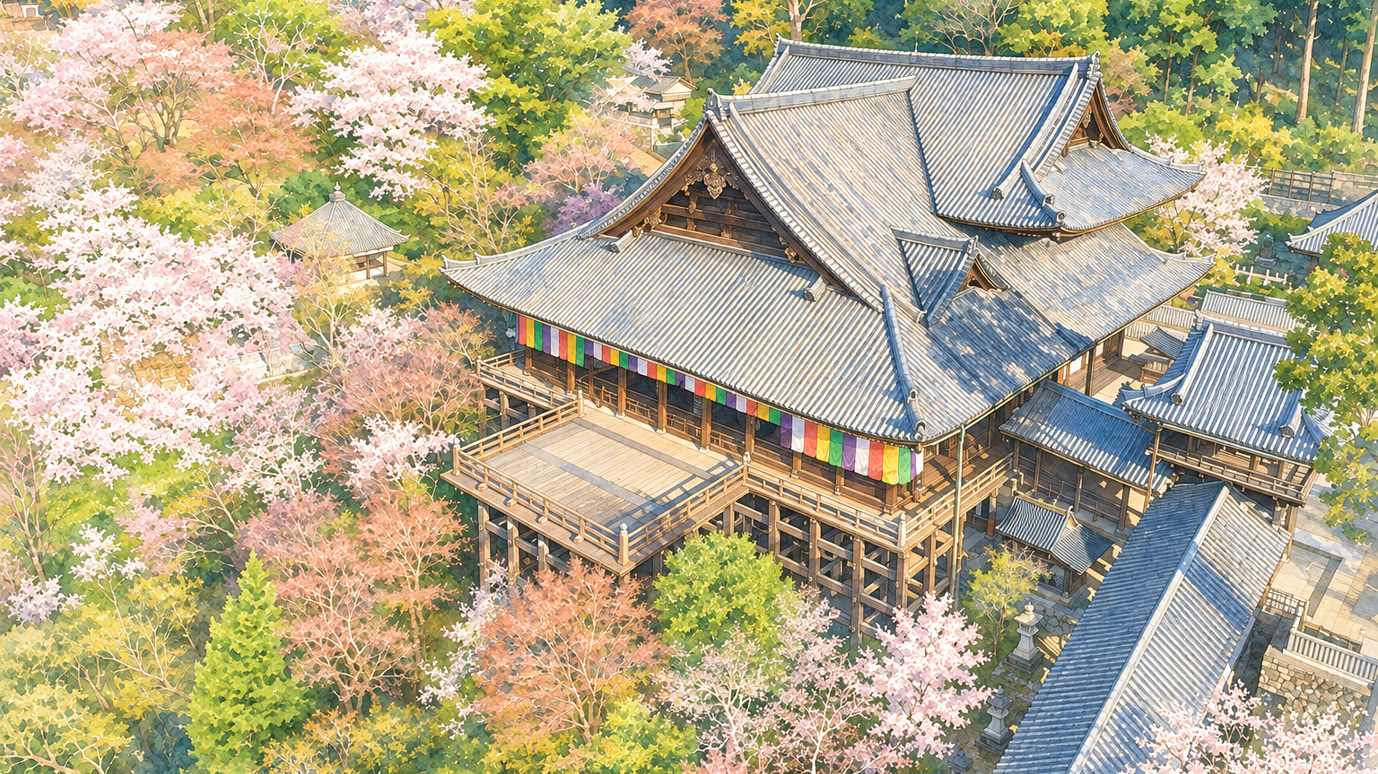
Hase-dera, formally Buzan Kagura-in Hase-dera, is the head temple of the Buzan school of Shingon Buddhism. It lies in a narrow valley at Hatsuse in Sakurai, Nara Prefecture. Its principal image, an Eleven-Headed Kannon about 10 meters tall, is among the largest wooden statues in Japan, and from the Heian period onward courtiers and commoners alike made the long journey to pray before it. Pilgrimages to Hatsuse appear again and again in classical poetry and tales. Its early-summer peonies have earned it the nickname "temple of flowers."
01Kannon on Mount Hatsuse
According to the temple’s tradition, in 686 the monk Dōmyō built a hall on the western ridge of Mount Hatsuse for Emperor Tenmu, the so-called original Hase-dera. A bronze plaque depicting a scene from the Lotus Sutra, which temple tradition assigns to this period, belongs to the temple and is a National Treasure; its inscribed date can be read as either 686 or 698, and many scholars prefer 698. Around 727 the monk Tokudō carved an Eleven-Headed Kannon and enshrined it on the eastern ridge with the support of Emperor Shōmu, and this is regarded as the beginning of the present temple. In the Heian period the Hase Kannon was famed for answering prayers, ranking with Kiyomizu-dera in Kyoto and Ishiyama-dera in Ōmi, and the trip from the capital took several days. Sei Shōnagon describes going to Hatsuse in The Pillow Book. In Murasaki Shikibu’s The Tale of Genji, Tamakazura, on her way to worship at Hatsuse, meets Ukon, a former servant of her mother, a turning point in her story. According to its headnote in the Kokinshū, Ki no Tsurayuki’s poem contrasting the uncertain human heart with the unchanging scent of the plum blossoms of his old haunts was also composed at Hatsuse.
02From Kōfuku-ji dependency to head temple
For much of the medieval period Hase-dera was a dependency of Kōfuku-ji in Nara. In 1585 Toyotomi Hideyoshi destroyed Negoro-ji in Kii Province, scattering the scholar-monks of the Shingi branch of Shingon. In 1588 one of them, Sen’yo, came to Hase-dera, generally said to be with the backing of Toyotomi Hidenaga, then lord of Yamato, and the temple became a leading center of Shingi Shingon, later the head temple of the Buzan school. In the Edo period it was famed as a center of learning. Hase-dera is also the eighth stop on the Saigoku pilgrimage of 33 Kannon temples.
03What can be seen today
The main hall stands on a steep slope, its front carried out over the hillside on wooden pillars to form a broad stage, a type of construction called kake-zukuri. The present hall was rebuilt in 1650 with funds from Tokugawa Iemitsu, the third Tokugawa shogun, and became a National Treasure in 2004. The principal Kannon was lost to fire several times in the medieval period; the present statue was remade in 1538 and, together with its two attendant figures, is an Important Cultural Property. From the gate to the main hall runs the Noborirō, a roofed stairway said to have 399 steps. It is traditionally said to have first been built in 1039 by Nakatomi no Nobukiyo, a priest of Kasuga Shrine; the present upper section was rebuilt in 1650 along with the main hall, the middle and lower sections in 1889, and the corridor is also an Important Cultural Property.