
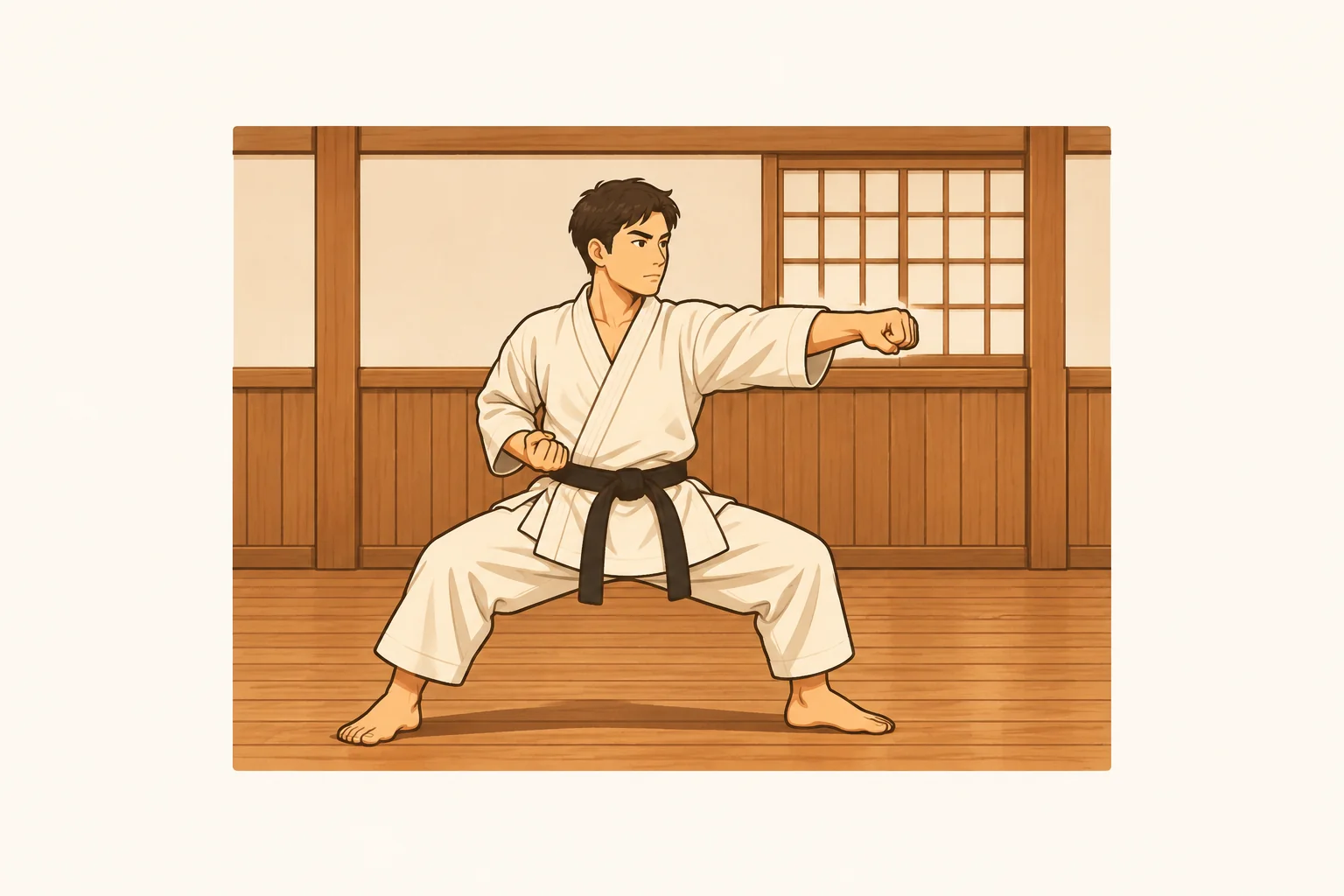
At a glance
Karate began as a secret art of Ryūkyū’s gentry, then schools, Tokyo universities and rival styles turned it into a global sport that reached the Olympics.
- Karate grew from the fighting arts of the Ryūkyū Kingdom, first called simply te, then tōdī, "Chinese hand."
- On October 25, 1936, Okinawan masters agreed on the characters meaning "empty hand"; the date is now Karate Day.
- Funakoshi Gichin demonstrated karate in Tokyo in 1922 and stayed on the mainland to teach.
- Shotokan, Gōjū-ryū, Shitō-ryū and Wadō-ryū are known as the four major styles of Japanese karate.
- Karate became an Olympic sport for the first time at Tokyo 2020, with kata and kumite events.
Karate is practiced in almost every country on earth, and most people who tie on a white belt assume it is as Japanese as sushi. Its roots, though, lie in Okinawa, once the capital island of an independent kingdom that traded with China and Japan and borrowed from both. What we now call karate was a quiet, private art of the Okinawan gentry until the early twentieth century, when it entered school playgrounds, crossed the sea to Tokyo, changed its name, and split into the styles found in dojos worldwide. This piece follows that journey, looks at what karateka actually practice and why, introduces the weapon arts of Okinawan kobudō that grew up alongside it, and suggests how a visitor to Okinawa can see the art at home.
01A Name That Tells a Story
The two characters of karate (空手) mean "empty hand": fighting without a weapon. That spelling is less than a century old. In Okinawa the art was first simply called tī, "hand". Later it was known as tōdī, "Tang hand" or "Chinese hand", because the Okinawans used "Tang" as a general word for China and recognized that much of the art had come from there.
When the art reached mainland Japan, the characters for "Chinese hand" were read in Japanese as karate. The syllable kara can also be written with the character for "empty". As relations between Japan and China worsened, it is generally thought, an art labeled "Chinese" became harder to promote on the mainland. Some teachers also liked the philosophical ring of "empty", with its Buddhist echo of emptying the mind of selfish thoughts. Tokyo moved first: in 1929 the karate club at Keio University switched to the new characters, and Funakoshi Gichin’s 1935 book used the name karate-dō, adding the suffix dō, "way", to place karate alongside judo and kendo. On October 25, 1936, senior Okinawan masters met in Naha at a round-table organized by the Ryūkyū Shinpō newspaper and agreed to adopt the new characters. In 2005 the Okinawa Prefectural Assembly declared October 25 Karate Day in memory of that meeting.
- 1Tī, "hand"the first name in Okinawa
- 2Tōdī, "Chinese hand"the art that came from China
- 3Read as karatethe Japanese reading on the mainland
- 4空手, "empty hand"1929, the Keio University club
- 5Karate-dō1935, Funakoshi Gichin’s book
- 6Okinawa adopts 空手October 25, 1936, round-table in Naha
- 7Karate Day2005, set on October 25 by the prefectural assembly
The spelling "empty hand" is less than a century old: Tokyo changed first, and Okinawan masters agreed to it in 1936.
The name carries both halves of karate’s identity: techniques with deep Chinese roots, and a final shape given by modern Japanese schools, universities and martial arts institutions.
02Fighting Arts in the Ryūkyū Kingdom
The Ryūkyū Kingdom unified Okinawa’s main island in the fifteenth century, ruled from Shuri Castle and sent tribute missions to Ming China. Its port of Naha was a busy hub of East Asian sea trade. Immigrants from Fujian settled in Kumemura, near Naha, bringing skills in navigation, diplomacy and writing, and, it is generally believed, southern Chinese boxing. Young Okinawan aristocrats studying in Fuzhou or traveling with tribute missions had further chances to learn.
A popular story holds that Okinawans developed unarmed fighting because weapons were banned, first by their own kings and then by the Satsuma domain, which invaded in 1609. Farmers, the legend goes, trained in secret and turned their tools into weapons. Historians now see this as a heavy simplification. Before the modern era the people who practiced tī were mostly members of the shizoku, the gentry class of Shuri and Naha. It was a discipline of self-cultivation for an elite rather than a peasant resistance movement. A teacher would train one or a handful of students, often at night in a private garden, with no uniforms, no belts and no public display.
By the nineteenth century Okinawan fighting arts are usually described as falling into three regional strands. Shuri-te, from the royal capital, associated with masters such as Matsumura Sōkon, favored quick, linear movement. Naha-te, from the port, carried stronger Fujianese influence, with an emphasis on breathing, rooted stances and circular close-range techniques; its great figure was Higaonna Kanryō, who spent years training in Fuzhou. Tomari-te, from the village between the two, shared features of both. These differences are still visible in the kata of today’s styles.
03Into the Schools and Across the Sea
In 1879 Japan abolished the Ryūkyū Kingdom and created Okinawa Prefecture. The gentry lost their status, and the private world in which the art had lived began to disappear. Its rescue came through education. Itosu Ankō, a leading Shuri-te master, argued that the art built strong bodies and steady character, and in the first years of the twentieth century he helped bring it into Okinawa’s schools, first elementary schools and then middle schools and the normal school, as part of physical education.
Teaching a class of boys is not the same as teaching one disciple in a garden, so Itosu simplified the old forms and composed five new beginner kata, the Pinan series (known in some styles as Heian), which are still the first kata many students learn. With that change, karate became something a whole class could perform together to a count. It was the essential step that made mass teaching possible.
The man who carried the art to mainland Japan was Funakoshi Gichin, an Okinawan schoolteacher who had trained under Itosu and Azato Ankō. In 1922 he demonstrated at a physical education exhibition in Tokyo sponsored by the Ministry of Education. Kanō Jigorō, the founder of judo, invited him to demonstrate at the Kōdōkan, and Funakoshi stayed on in Tokyo to teach. University clubs sprang up; Keio University’s, founded in 1924, is regarded as the first. Students became the backbone of mainland karate, and from judo they borrowed the white training uniform, the kyū and dan ranking system with its white and black belts, and the habit of reciting a short creed of moral principles. Funakoshi’s students later built a dojo named after his pen name, Shōtō, and his style became known as Shotokan.
| Style | Founder | Roots |
|---|---|---|
| Shotokan | Funakoshi Gichin’s students | Funakoshi trained under Itosu and Azato |
| Shitō-ryū | Mabuni Kenwa | Shuri and Naha traditions (Itosu, Higaonna) |
| Gōjū-ryū | Miyagi Chōjun | Naha-te of his teacher Higaonna |
| Wadō-ryū | Ōtsuka Hironori | Funakoshi’s karate plus jūjutsu |
All four styles trace back to Okinawan teachers; Shitō-ryū takes its name from Itosu and Higaonna.
Other Okinawan teachers arrived at about the same time. In Ōsaka, Mabuni Kenwa combined Shuri and Naha traditions into Shitō-ryū, its name drawn from the first characters of his teachers Itosu and Higaonna. Higaonna’s pupil Miyagi Chōjun organized Naha-te into Gōjū-ryū, "hard–soft style", taking the name, it is generally said, from a line in the Bubishi, a Chinese manual of martial techniques handed down in Okinawa. Ōtsuka Hironori, a jūjutsu expert who studied with Funakoshi, blended evasion and redirection from jūjutsu into his own Wadō-ryū, "way of harmony". Shotokan, Gōjū-ryū, Shitō-ryū and Wadō-ryū came to be called the four major styles of Japanese karate.
04Kata and Kumite: What Karateka Practice
Walk into any karate dojo and you will see two kinds of training. In kata, a single person performs a fixed sequence of blocks, punches, kicks and turns against imaginary opponents. In kumite, two people face each other, either following agreed attacks and defences or sparring freely.
Kata are the heart of the art and its oldest layer. Each has a name, many of Chinese or Okinawan origin: Sanchin ("three battles"), Seisan, Kūsankū (said to be named after a Chinese martial artist who visited Ryūkyū, by some accounts a military officer), and Naihanchi, which Shotokan calls Tekki. In an age without written manuals, a kata was a living textbook that stored techniques, breathing and ways of generating power in movement. Teachers made students repeat the same kata for months or years, not to memorize the steps but so the body would respond correctly under pressure. Students also study bunkai, the practical applications hidden inside each movement.
Kumite as a sport is a modern invention. From the 1930s mainland university students wanted to test themselves against one another, and prearranged drills grew into free sparring and competition. To limit injuries, mainstream tournaments adopted a "point" system in which strikes are controlled and stopped just short of, or lightly touching, the target, and referees award points for accurate technique, good form, spirit and timing.
Not everyone accepted this. In 1964 Ōyama Masutatsu, a Korean-born fighter who trained in Japan, founded the Kyokushin organization, which promoted full-contact karate: bare-knuckle punches to the body, kicks to the head, and victory by knockout. Kyokushin and the many full-contact groups it inspired have a large following in Japan and abroad, and they form a world quite separate from point karate.
Etiquette runs through all of it. Students bow when entering and leaving the training hall, kneel in seiza and bow to the front of the room and to the teacher at the start and end of class, and in some dojos recite the dojo creed together. Funakoshi’s saying karate ni sente nashi, "there is no first attack in karate", often hangs on the wall. The sharp shout heard during training is the kiai, which joins breath, intent and movement in a single instant.
05Okinawan Kobudō: Staff, Sai and Oar
Okinawa preserved not only empty-hand fighting but also a set of weapon arts known as Ryūkyū or Okinawan kobudō, "old martial ways". The two grew from the same soil; many teachers taught both, and the footwork and body mechanics of karate run through kobudō kata.
The foundation weapon is the bō, a hardwood staff about six feet (roughly 1.8 meters) long. The sai are a pair of metal truncheons with a long central prong and two curved side guards, used to strike, block and trap an opponent’s weapon; their design is clearly related to Chinese weapons. The tonfa, or tuifā, may derive from the handle of a millstone: held by its side grip, the long end lies along the forearm for blocking and swings out to strike, and the side-handle batons used by some police forces are modeled on it. The nunchaku, two short sticks joined by cord or chain, became world-famous through Bruce Lee’s films. The repertoire also includes the sickle-like kama, the ēku (a boat oar), and the tinbē and rōchin, a shield paired with a short spear.
- 1
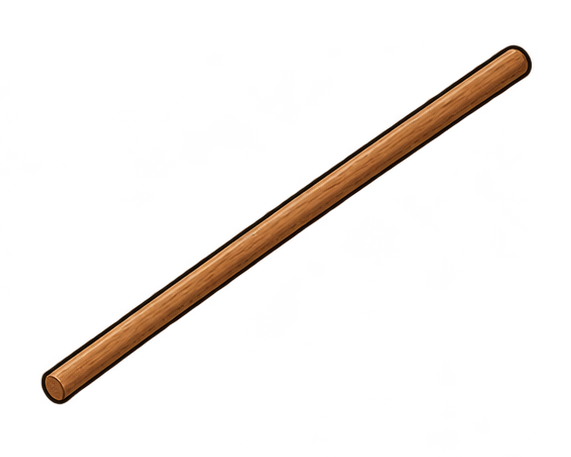 Bō: a hardwood staff about six feet long, the foundation weapon.
- 2
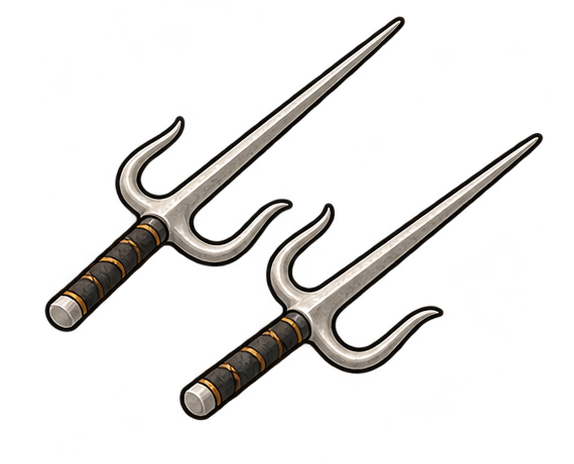 Sai: a pair of metal truncheons with a long central prong and two curved side guards.
- 3
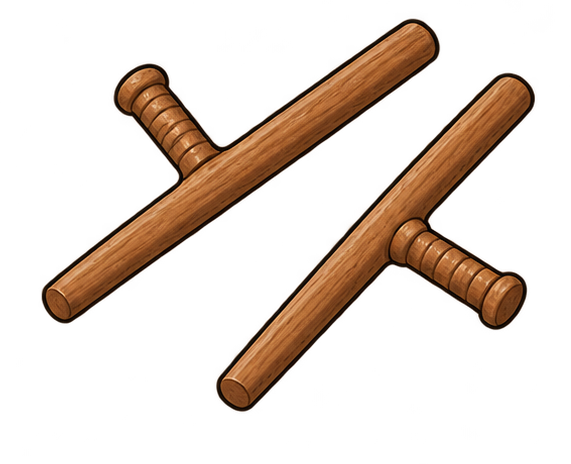 Tonfa: held by the side handle, with the long end along the forearm.
- 4
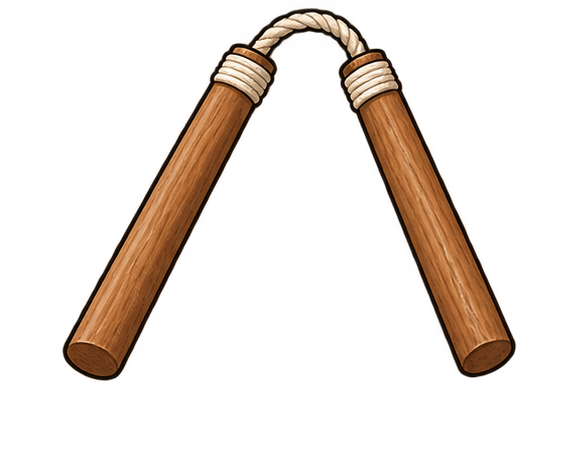 Nunchaku: two short sticks joined by a cord or chain.
- 5
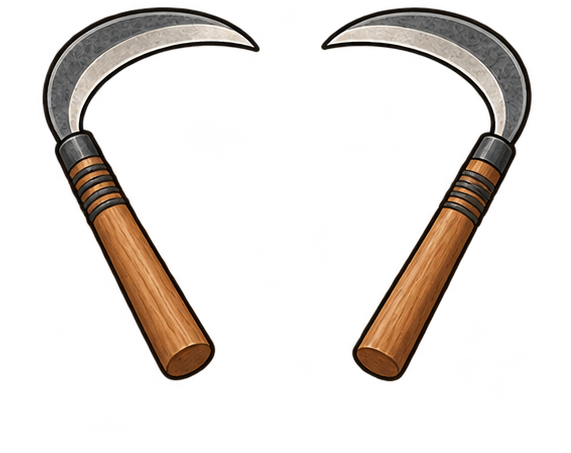 Kama: the sickle.
- 6
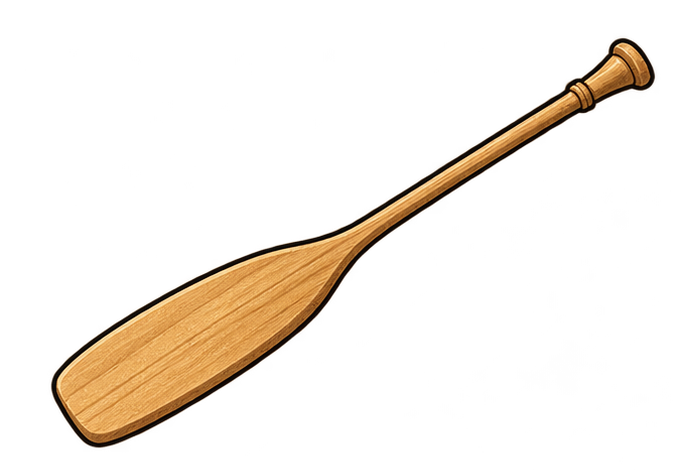 Ēku: the wooden oar of a fishing boat.
- 7
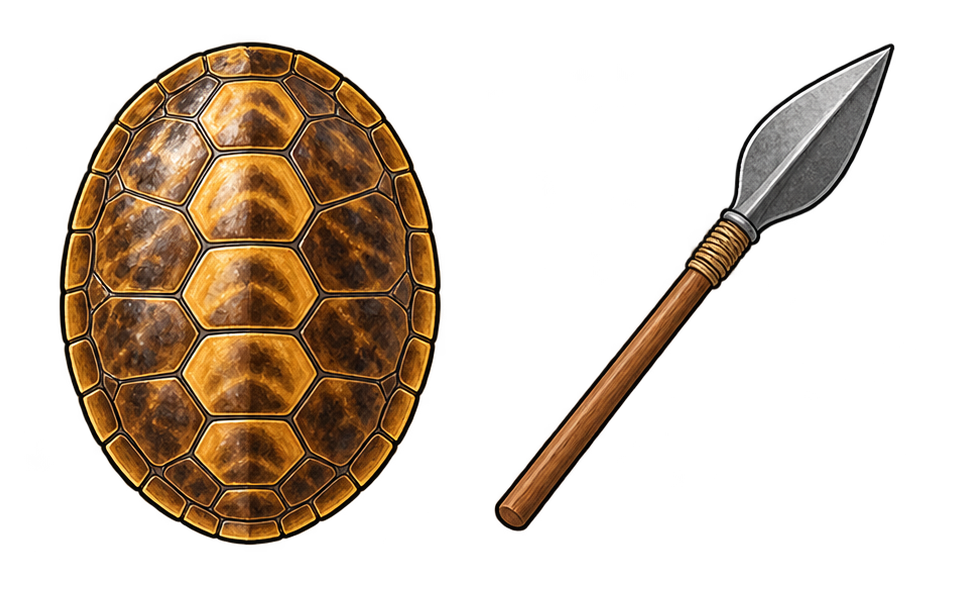 Tinbē and rōchin: a shield paired with a short spear.
These weapons are often explained with the same story as the weapons ban: farmers and fishermen turning everyday tools into arms. Some do resemble farm or fishing gear; others clearly descend from Chinese weapons; for many the true origin is hard to establish. What is certain is that before the modern era the techniques were scattered across families and villages, passed down by different teachers with different kata, so a single weapon often has several distinct lineages.
That kobudō survived at all owes much to twentieth-century collectors. Taira Shinken traveled around Okinawa seeking out elderly practitioners, gathered scattered weapon kata into a system and in 1955 founded an association for the preservation of Ryūkyū kobudō. The Matayoshi family preserved another lineage, Matayoshi kobudō. Today many Okinawan dojos teach kobudō alongside karate, and dedicated kobudō groups exist around the world.
06From Okinawa to the World
After the Second World War, American servicemen stationed in Okinawa and mainland Japan trained in local dojos and opened their own when they returned home. From the United States karate spread to Europe, Latin America and beyond, helped from the 1960s by instructors sent abroad by the major Japanese styles and by films and television. Estimates of karate practitioners worldwide run into the tens of millions, and in many countries children go to karate after school as routinely as they go to swimming lessons.
International point karate is governed by the World Karate Federation, and in Japan by the Japan Karate Federation. Karate made its Olympic debut at the Tokyo 2020 Games, held at the Nippon Budōkan, with events in kata and kumite. Kiyuna Ryō, from Okinawa, won the men’s kata gold, which Okinawans celebrated as the art coming home. Karate was not included in the Paris 2024 program, to the disappointment of many in the karate world.
In mainland Japan karate is an ordinary activity, found in neighborhood dojos, school clubs and university teams. In Okinawa it carries more weight. It is seen as part of Okinawan identity, a gift from a former kingdom to the world. The prefectural government and local associations promote the term "Okinawa karate" and emphasize older kata and training methods, inviting practitioners from abroad to come and trace their art to its source.
07Seeing and Training in Okinawa
For visitors, a good first stop is the Okinawa Karate Kaikan in Tomigusuku, a short drive from Naha Airport. Opened in 2017, it has a large training hall and an exhibition room on karate’s history, with old weapons, photographs of past masters and documents, and sometimes hosts demonstrations or seminars. Around Naha and Shuri there are a number of monuments linked to past masters, and a walk through the lanes near Shuri Castle gives some sense of the neighborhood where the gentry once trained at night.
If you want to train, many Okinawan dojos welcome foreign visitors, from a single trial class to several weeks of intensive practice, and a good number of teachers speak some English. Beginners can usually train in sports clothes; experienced students should bring their own uniform and belt and follow the customs of the dojo they visit.
Inside, take off your shoes, bow toward the front of the hall when you enter and leave, keep quiet while the teacher is speaking, and ask before taking photographs. A class might begin with a moment of kneeling meditation and move through basics, kata and partner drills at a brisk pace. Okinawan summers are hot and humid, so bring water and a towel. Around Karate Day on October 25, a commemorative demonstration usually fills Kokusai-dōri in Naha with thousands of karateka from Japan and abroad performing together; it was still being held as of 2025. In some years Okinawa also hosts large international tournaments and demonstrations, where you can watch masters of many styles in turn, from the heavy, controlled breathing of Sanchin to the whir of a spinning bō, and see the old contrast between Shuri and Naha traditions played out in front of you.