
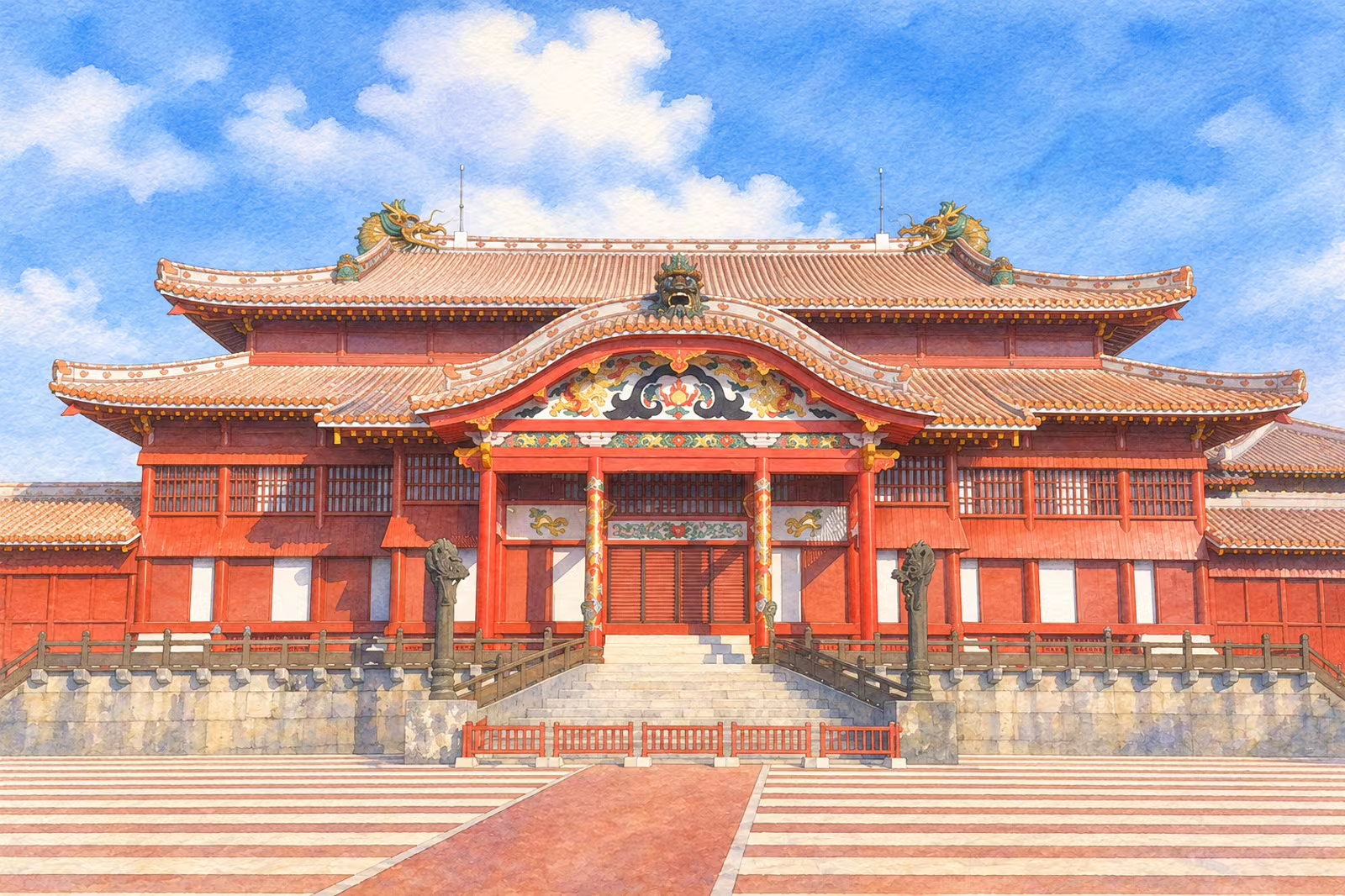
Shuri Castle (Shurijō) stands on a hill in the Shuri district of Naha, Okinawa Prefecture. For more than four centuries it was the royal castle of the Ryūkyū Kingdom: the king’s residence, the seat of royal government, and the stage for diplomatic ceremony and state ritual. Its red-lacquered main hall, the Seiden, combines Chinese and Japanese elements with forms of its own. The castle’s archaeological remains are part of the World Heritage property Gusuku Sites and Related Properties of the Kingdom of Ryūkyū.
01A royal castle takes shape
When Shuri was first fortified is not known, but it is generally thought to have existed as a gusuku (fortified site) by the fourteenth century. After Shō Hashi unified Okinawa’s three rival kingdoms in the early fifteenth century and founded the First Shō dynasty, Shuri became the capital of a single kingdom. From 1470 the Second Shō dynasty ruled from here until the end of the kingdom. The castle was greatly developed under King Shō Shin (r. 1477–1526): the Sonohyan-utaki stone gate dates from 1519, and the Shureimon gate was added in the sixteenth century. The Seiden faces a courtyard called the Una, where ceremonies such as the investiture of kings by Chinese imperial envoys and New Year audiences took place. The main hall burned several times during the kingdom’s history, and the form known in modern times derives from a rebuilding in the early eighteenth century.
02The end of the kingdom and the war
After the Shimazu of Satsuma invaded in 1609, Ryūkyū continued to send tribute to Ming and later Qing China while also living under Satsuma control, and Shuri remained the seat of the royal government. In 1879 the Meiji government abolished the kingdom in what is called the Ryūkyū Shobun, and the last king, Shō Tai, left the castle. The site was then used as army barracks and schools, and the Seiden served for a time as the worship hall of Okinawa Shrine; it was designated a National Treasure in 1925. During the Battle of Okinawa in 1945 the Japanese 32nd Army placed its headquarters in tunnels beneath the castle, and American bombardment destroyed almost everything above ground.
03Reconstruction and the castle today
After the war the University of the Ryūkyūs was built on the site, and the Shureimon was rebuilt first, in 1958. Once the university had moved away, the Seiden was reconstructed and completed in 1992. In 2000 the castle site was inscribed as part of the World Heritage property; the listing covers the archaeological remains, not the reconstructed buildings. A fire in October 2019 destroyed the Seiden, the North Hall, the South Hall and other main buildings, and a new reconstruction began, with the Seiden scheduled for completion around 2026. Most of the gates and halls seen today are reconstructions, but stone foundations of earlier main halls are preserved beneath the Seiden platform, and parts of the stone walls date from the kingdom.
Shuri Castle (Naha)
01A Palace, Not a Fortress
Shuri Castle (Shuri-jō) sits on a limestone ridge on the eastern side of Naha, the capital of Okinawa Prefecture. From its western walls you can see the city spread out toward the port and the East China Sea. For more than four centuries, until 1879, this hilltop was the seat of the kings of Ryūkyū, an independent island kingdom that stretched from the Amami Islands in the north to the Yaeyama Islands near Taiwan.
Visitors who come expecting a Japanese castle are often surprised. There is no white-walled keep, no moat, and no samurai residences. Instead, the walls of coral limestone curve in long, rounded lines that follow the ridge, and the main building is a broad, vermilion hall that looks as much Chinese as Japanese. Shuri was a gusuku, the Okinawan word for the walled strongholds that local chieftains built across the islands from around the twelfth century. Gusuku often enclosed sacred groves as well as living quarters, and Shuri was no exception: it was at once a royal residence, the headquarters of government, a stage for diplomacy, and a religious site.
Almost everything you see above the foundations has been rebuilt, much of it more than once. Fire destroyed the main hall several times under the kings, American shelling leveled the castle in 1945, and a fire in 2019 burned the reconstructed hall to the ground. What survives from the kingdom are stretches of stone wall, foundations, a few stone monuments, and the layout itself. The story of Shuri is therefore a story of repeated loss and rebuilding.
02Three Kingdoms and the First Envoys to China
In the fourteenth century Okinawa Island was divided among three rival polities: Hokuzan (the northern mountain), Chūzan (the central mountain), and Nanzan (the southern mountain). Historians call this the Sanzan, or Three Kingdoms, period.
In 1372 the founder of China’s Ming dynasty, the Hongwu Emperor, sent an envoy named Yang Zai to the islands, calling on their rulers to submit tribute. Satto, the king of Chūzan, responded by sending a mission to the Ming court that same year. The other two kingdoms soon followed. This began a relationship with China that would last five centuries. Ryūkyū rulers received investiture as kings from the Chinese emperor, used the Chinese calendar in official documents, and sent regular tribute missions to the Chinese coast.
The Ming court treated Ryūkyū generously. It supplied ocean-going ships and allowed communities of Chinese from Fujian to settle near the port of Naha, in a district called Kume. These settlers, traditionally remembered as the "thirty-six families from Min," served the kingdom as navigators, interpreters, and writers of diplomatic documents in classical Chinese.
At this time the capital of Chūzan was at Urasoe, a few kilometers north of Shuri. Excavations suggest that a sizable castle stood at Shuri by the late fourteenth century, but when exactly the royal court moved there is not clear from the written record.
03Shō Hashi and the Unified Kingdom
The unification of Okinawa Island was the work of Shō Hashi, a chieftain from Sashiki in the south of the island. In the early fifteenth century he overthrew Bunei, the son of Satto, and placed his own father, Shishō, on the Chūzan throne. He went on to conquer Hokuzan in 1416 and Nanzan in 1429, uniting the island under a single ruler. The line he founded is called the First Shō Dynasty. The surname Shō is said to have been granted by the Ming emperor.
Shō Hashi made Shuri the capital and developed the area around it. In 1427 a garden and an artificial pond were created on the north side of the castle, and a stone inscription, the Ankokuzan Jukakaboku no Ki (Record of Planting Trees and Flowers on Ankokuzan), was erected to commemorate the work. The pond is Ryūtan, the large pool you can still see below the castle’s northern walls.
The First Shō Dynasty was short and turbulent. In 1453 a succession dispute between Shiro, the son of the late King Shō Kinpuku, and Furi, the late king’s younger brother, ended in fighting that burned the castle and killed both claimants. Their successor, Shō Taikyū, was a devout Buddhist who founded temples and cast bronze bells. One bell, cast in 1458 and hung in the main hall of the castle, carries an inscription describing Ryūkyū as a kingdom that uses its ships as "a bridge between all nations." This Bankoku Shinryō bell (the "Bridge of Nations" bell) was scorched in 1945 but survived; it is now an Important Cultural Property in the Okinawa Prefectural Museum and Art Museum, and its words have become a kind of motto for Okinawa’s maritime past. A replica hangs at the castle.
04The Second Shō Dynasty and King Shō Shin
In 1469, after the death of King Shō Toku, court officials chose a senior minister named Kanemaru as king. Kanemaru, enthroned in 1470, took the name Shō En and founded the Second Shō Dynasty, which ruled until the end of the kingdom in 1879. By keeping the Shō surname and presenting himself to the Ming court as the legitimate heir, he preserved the kingdom’s valuable relationship with China.
His son Shō Shin ruled for fifty years, from 1477 to 1526, and gave the kingdom its mature form. He required the regional lords, the aji, to leave their own castles and live at Shuri, where they could be watched. He organized a hierarchy of court ranks marked by the color of officials’ hats and hairpins, and he brought the islands’ priestesses under a single hierarchy headed by the Kikoe-ōgimi, the chief priestess, a post held by a woman of the royal family. Religion in Ryūkyū was largely in the hands of women, and the castle contained sacred spaces that only priestesses could enter.
Two of the oldest structures in the Shuri area date from Shō Shin’s reign and survive today in restored form. The Sonohyan-utaki Ishimon, a stone gate built in 1519 in front of a sacred grove, was where the king prayed for safety before leaving the castle on journeys. Tamaudun, the royal mausoleum built in 1501, holds the remains of Shō Shin’s father and later kings of the dynasty.
05Investiture Envoys and the Tribute Trade
When a new king came to the throne, he did not become king in the full sense until an embassy from the Chinese emperor arrived to invest him. These envoys, called sappōshi (investiture envoys), sailed from Fuzhou in large ships known in Ryūkyū as kansen, "crown ships," because they brought the royal crown and robes. They lodged at a guesthouse in Naha and, on an appointed day, went up to Shuri.
The investiture ceremony took place in the Una, the great courtyard in front of the main hall. The courtyard’s paving of red and white stripes marked where officials of each rank stood, and a central raised path led the envoys toward the hall. Banquets, music, and dance followed over many weeks. The court dance-drama known as kumiodori, now recognized as one of Okinawa’s classic performing arts, was created by the court official Tamagusuku Chōkun to entertain the Chinese envoys and first performed in 1719.
For Ryūkyū, tribute was also trade. Ryūkyū ships sailed to Fuzhou, and missions traveled overland to Beijing, carrying goods that the kingdom had obtained from Japan and Southeast Asia, such as swords, sulfur, and spices. They returned with silk, porcelain, and other Chinese goods that Ryūkyū merchants sold onward. In the fifteenth and sixteenth centuries, Ryūkyū ships traded with Korea, Japan, Siam, Malacca, Java, and other ports. The arrival of Portuguese traders and the growth of Chinese private trade in the later sixteenth century gradually undermined this role.
Inside the main hall, above the king’s throne, hung wooden plaques with inscriptions written by Qing emperors. The best known, from the Kangxi Emperor, reads Chūzan seido, "the land of Chūzan for generations." The originals were lost in 1945; those in the hall were reconstructions.
06The Satsuma Invasion of 1609
By the end of the sixteenth century, Japan had been unified under Toyotomi Hideyoshi and then Tokugawa Ieyasu. Both demanded that Ryūkyū acknowledge their authority, and the court at Shuri responded evasively. The Shimazu family, lords of the domain of Satsuma in southern Kyūshū, saw an opportunity.
In 1609, with the shogunate’s approval, Shimazu Iehisa sent more than 3,000 soldiers under the command of Kabayama Hisataka. They took the Amami Islands, landed in northern Okinawa, captured Nakijin Castle, and marched south. Ryūkyū had little military experience, and its defenses collapsed within weeks. King Shō Nei surrendered, and Satsuma troops occupied and looted Shuri Castle.
Shō Nei was taken to Kagoshima and then to meet Ieyasu at Sunpu and the shogun Tokugawa Hidetada at Edo. He was allowed to return home in 1611 only after swearing an oath of loyalty to the Shimazu. One of his senior ministers, Jana Ueekata (also known by his Chinese-style name, Tei Dō), refused to sign and was executed. The Amami Islands were taken under Satsuma’s direct rule.
From then on, Ryūkyū lived a double life. It remained, in name, an independent kingdom that paid tribute to China and received investiture from Chinese envoys. In practice it was controlled by Satsuma, which posted officials in Naha and collected taxes. Both Satsuma and the shogunate wanted the lucrative China trade to continue, so the Japanese presence was kept out of sight when Chinese envoys visited. Ryūkyū also sent periodic missions to Edo.
The layout of the castle courtyard reflects this arrangement. On the south side of the Una stands the Nanden (South Hall), built in Japanese style and used to receive Satsuma officials. Facing it on the north side is the Hokuden (North Hall), the main government office, where Chinese envoys were entertained.
07The Main Hall
The Seiden, or main hall, burned in 1660 and again in 1709. The hall rebuilt after the 1709 fire, a project that ran from 1712 to 1715, survived until 1945 and became the model for every later reconstruction.
The Seiden has two stories on the outside and three inside. Its walls and pillars are lacquered vermilion, and its roof is covered with red tiles. The front is dominated by a large curved gable, or karahafu, decorated with dragons, and two large stone dragon pillars stand at the foot of the steps. Dragons, symbols of the king, appear throughout the building. The overall effect mixes Chinese palace architecture, Japanese construction techniques, and Ryūkyūan decoration.
The ground floor, the Shimo-ukui, was where the king conducted government business and ceremonies. The upper floor, the Ufu-ukui, was used for rituals involving the royal family and priestesses, and held the king’s throne. Behind the hall lay the Ouchibara, the inner quarters where the queen, royal women, and their attendants lived.
08The End of the Kingdom
In the nineteenth century Western ships began calling at Ryūkyū. In 1853 Commodore Matthew Perry of the United States Navy, on his way to Japan, stopped at Naha and marched to Shuri Castle with a detachment of marines and sailors, despite the court’s attempts to turn him away. A compact between the United States and Ryūkyū followed in 1854.
After the Meiji Restoration, the new Japanese government moved to absorb the kingdom. In 1872 it declared Ryūkyū a domain (han) and made King Shō Tai its "domain king." After Japan’s 1874 expedition to Taiwan, launched in response to the killing of shipwrecked Ryūkyūans there, Tokyo pressed harder. In 1875 the official Matsuda Michiyuki came to Shuri and ordered the court to end tribute missions to the Qing. The court resisted and secretly appealed to China for help.
On March 27, 1879, Matsuda returned with police and soldiers, announced the abolition of the domain, and ordered Shō Tai to leave Shuri Castle. The king moved to the Nakagusuku Udun, a royal residence beside Ryūtan pond, and on April 4 the government proclaimed the creation of Okinawa Prefecture. Shō Tai was taken to Tokyo and made a member of the Japanese peerage. Qing China protested, and the two governments negotiated over the islands without result. Japanese historians call this process the Ryūkyū Shobun, or "Disposition of Ryūkyū."
09Barracks, Schools, and a Shrine
After the king’s departure, a detachment of the Imperial Japanese Army garrisoned the castle. Later the grounds were used for schools. The main hall, unused and unmaintained, deteriorated, and in the 1920s local authorities considered tearing it down.
The hall was saved through the efforts of Kamakura Yoshitarō, an artist and researcher of Okinawan culture, and the architectural historian Itō Chūta. Because the protection law of the day covered shrines and temples, the building was registered as the worship hall of a newly founded Okinawa Shrine. In 1925 it was designated a Specially Protected Building under that name, and it became a National Treasure when a new law took effect in 1929. A major restoration followed in the late 1920s and early 1930s. Kamakura’s photographs and field notes from these years later proved essential to rebuilding the castle.
101945
During the Pacific War, the Japanese 32nd Army, responsible for the defense of Okinawa, dug its headquarters tunnels into the rock beneath Shuri Castle. When American forces landed on Okinawa in April 1945, Shuri became the center of the Japanese defensive line. Weeks of shelling followed. Over several days in late May the battleship USS Mississippi and other ships bombarded the castle, which burned around May 27, and at the end of the month the 32nd Army abandoned Shuri and withdrew to the south of the island.
The castle was destroyed. The main hall, the gates, and most of the walls were reduced to rubble, along with the old town of Shuri. The Battle of Okinawa killed about 122,000 people from Okinawa Prefecture, an estimated 94,000 of them civilians, and Shuri’s ruins became one of its most familiar images. The 32nd Army’s headquarters tunnels still lie beneath the castle grounds.
Under American administration after the war, the University of the Ryūkyūs opened on the castle site in 1950 and remained there for about thirty years. Shureimon, the ceremonial gate at the approach to the castle, was rebuilt in 1958, one of the first signs of postwar recovery.
11Rebuilding in 1992
Okinawa returned to Japanese administration in 1972. After the university moved to a new campus, the national government made the castle area part of the Okinawa Commemorative National Government Park and began reconstructing the main buildings. The work drew on Kamakura’s records, plans from the prewar restoration, royal government documents, old photographs, and archaeological excavation. Builders tried to recreate the castle as it looked after the eighteenth-century rebuilding, down to the lacquer and tiles.
The Seiden and surrounding buildings were opened to the public in November 1992. Reconstruction continued for more than two decades, adding halls, gates, and the inner quarters, and the project was declared complete at the beginning of 2019.
In 2000 the Gusuku Sites and Related Properties of the Kingdom of Ryūkyū were inscribed on UNESCO’s World Heritage List, with Shuri Castle among them. The listing covers the archaeological remains and the original foundations, not the reconstructed buildings above them. The same year, leaders attending the G8 summit in Okinawa were received at the castle, and Japan issued a 2,000-yen note bearing an image of Shureimon.
12The 2019 Fire and the New Reconstruction
In the early hours of October 31, 2019, fire broke out in the Seiden. It spread to the Hokuden, the Nanden, and other buildings around the courtyard and burned for about eleven hours; the Agency for Cultural Affairs counted nine buildings destroyed, though other tallies differ. Investigators were unable to identify a definite cause, though a fault in the Seiden’s electrical system was considered the most likely. Images of the burning hall shocked people across Japan, and donations poured in.
The national and prefectural governments quickly committed to rebuilding again. The new Seiden incorporates interior sprinklers and other fire safety measures, and it revises some details on the basis of historical records: the exterior is painted with a red pigment from Kushi in northern Okinawa named in royal building records, giving a deeper vermilion than the 1992 hall. Work was carried out inside a large temporary enclosure, and parts of the construction were opened to visitors, so that people could watch traditional carpentry and lacquer work in progress. The new Seiden was completed in the autumn of 2026, and the red hall once again stands at the head of the courtyard.
13Walking Through the Castle
Most visitors approach from the west, through Shureimon. This Chinese-style ceremonial gate, first built in the mid-sixteenth century and rebuilt in 1958, carries a plaque reading Shurei no Kuni, "a land of propriety." Just beyond it, on the left, is the stone gate of Sonohyan-utaki. It is not a passage but a place of worship; the grove behind it is sacred.
The first gate in the castle walls is Kankaimon, the "Gate of Welcome," flanked by stone lion-dogs; it dates from around 1500 and was rebuilt in 1974. Beyond it, on the right in front of Zuisenmon, is Ryūhi, a spring that flows from the mouth of a stone dragon brought from China in 1523; the water once supplied the palace, and Chinese envoys left stone tablets praising it, now reproduced from rubbings. Higher up are Zuisenmon, Rōkokumon (where a water clock kept the official time), and Kōfukumon. Each gate leads to a higher terrace. Hōshinmon, the last gate, opens onto the Una courtyard, with the Seiden ahead, the Hokuden to the right, and the Nanden to the left.
Behind the wall south of the lower courtyard outside Hōshinmon lies the Kyō-no-uchi, the castle’s largest ritual space and traditionally said to be its place of origin, where the chief priestess and others prayed for the royal house. At the western end of the walls is the Iri-no-Azana, a lookout with wide views over Naha. Looking down from the northern walls you can see Ryūtan pond, created in Shō Hashi’s time.
As you walk along the walls, look at the stones. The darker, weathered blocks low in the walls are often original masonry that survived the war; the cleaner, more regular stones above them were added during reconstruction.