
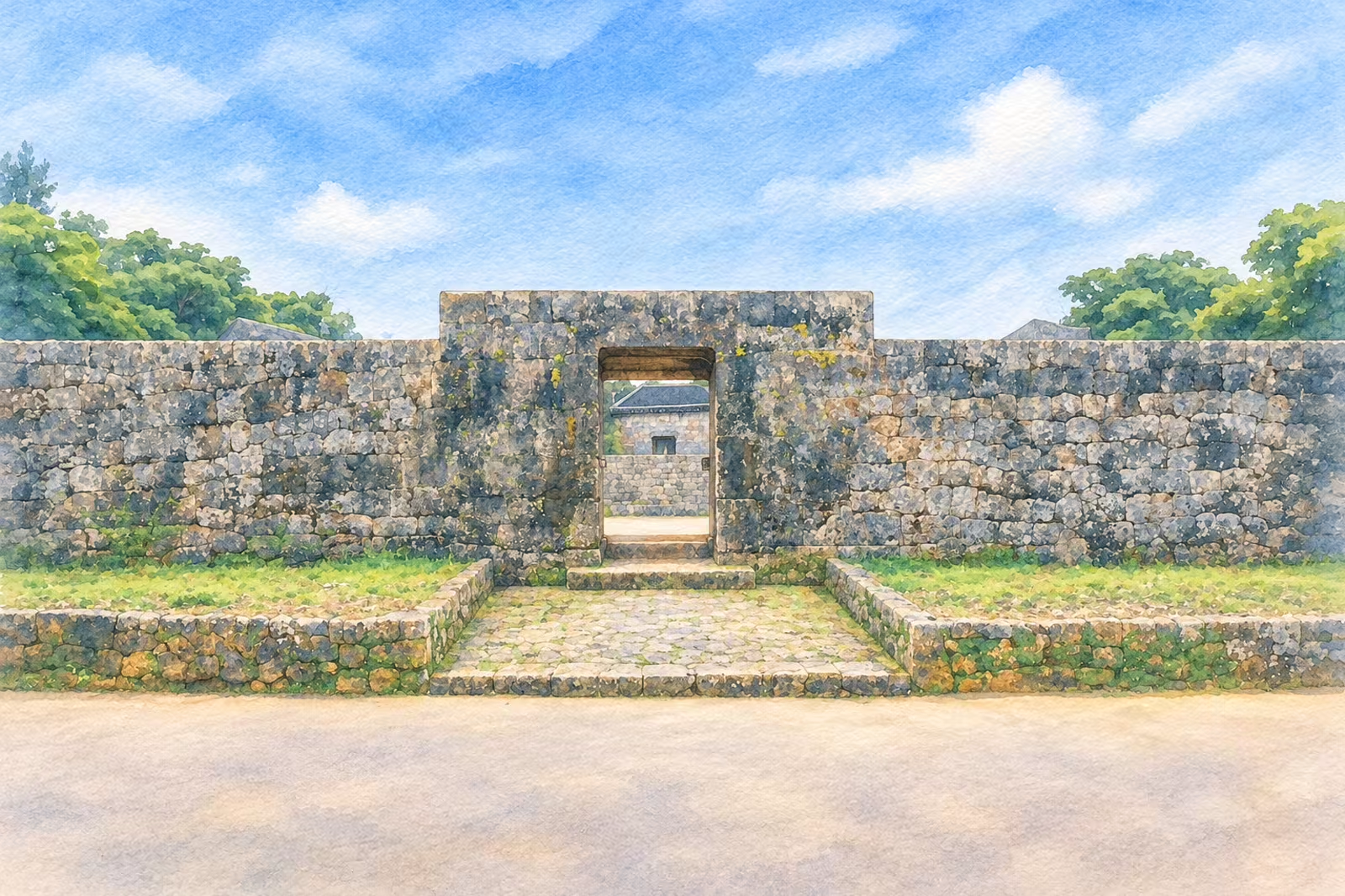
Tamaudun, in the Shuri district of Naha, Okinawa Prefecture, a short distance west of Shuri Castle, is the royal mausoleum of the Second Shō dynasty of the Ryūkyū Kingdom. Built of Ryūkyūan limestone, it consists of walled courtyards and three burial chambers side by side, their facades modeled on palace architecture. It is the largest gabled tomb in Okinawa, was inscribed in 2000 as part of the World Heritage property Gusuku Sites and Related Properties of the Kingdom of Ryūkyū, and was designated a National Treasure in 2018.
01Construction and burial practice
King Shō Shin built Tamaudun in 1501 to rebury his father, Shō En, founder of the Second Shō dynasty. It then became the resting place of later kings and members of the royal family; the last king, Shō Tai, who died in 1901, is generally said to have been buried here as well. Each chamber had its own function. According to records, the central chamber held the body for several years until the bones were washed in a ritual known as senkotsu. Afterward the remains of kings and queens were moved to the east chamber, and other eligible royals were placed in the west chamber. This sequence of temporary placement followed by bone washing was the royal form of a long-standing Ryūkyūan burial custom.
02The Tamaudun stele
In the courtyard stands a stele dated 1501. Its inscription names nine people, including Shō Shin himself and his mother, and declares that only they and their descendants may be buried in Tamaudun, calling down the punishment of heaven and earth on anyone who violates the rule. Those left out are generally thought to include the line of Shō Shin’s eldest son, Shō Ikō. Scholars often read the stele as evidence of succession tensions within the royal house in Shō Shin’s time, though accounts of what actually happened differ.
03War and restoration
Tamaudun was badly damaged in the Battle of Okinawa in 1945, and parts of the roofs over the east and west chambers collapsed. Restoration began in 1974 and was completed in 1977, with much of the stonework repaired or replaced. Today visitors can enter the outer and inner courtyards and see the chamber facades, the carved stone balustrades and the guardian lions perched on them, but the interiors of the chambers are closed. An underground exhibition facility near the entrance explains the interiors and the history of the mausoleum.