
At a glance
Why Okinawa feels unlike the rest of Japan: the Ryūkyū Kingdom and its fall, sacred groves and priestesses, ryūka and kumi odori, and a bowl of Okinawa soba.
- Okinawa was once the independent Ryūkyū Kingdom, unified in 1429 and turned into Okinawa Prefecture in 1879.
- An utaki is a sacred site where the gods descend, with no shrine building or torii; women lead the rites.
- Ryūka are fixed-form poems of 8-8-8-6, thirty syllables in all, written as lyrics for sanshin songs.
- Kumi odori was created by Tamagusuku Chōkun in 1719 to entertain Qing envoys, and joined UNESCO’s intangible heritage list in 2010.
- Okinawa soba is made from wheat flour, not buckwheat; the name "Okinawa soba" was approved on October 17, 1978.
Okinawa is part of Japan, but it does not feel like the rest of it. Roofs are red tile held down with white mortar, a pair of lion-dogs called shīsā guards the gate, and the noodle shop around the corner sells something called soba that contains no buckwheat at all. In the evening someone in a bar picks up a three-stringed instrument covered in snakeskin and sings in a language most people from Tokyo cannot follow. None of this is accidental. For roughly four and a half centuries these islands were an independent state, the Ryūkyū Kingdom, which paid tribute to the Chinese emperor, traded across East and Southeast Asia, and developed its own priestesses, sacred sites, court music and theater. This piece starts with that kingdom, then visits the sacred groves and the mud-covered gods of Miyako, listens to Ryūkyūan song and court drama, sits down to a bowl of Okinawa soba, and ends with some advice on seeing it all for yourself.
01A Kingdom Between Empires
Okinawa Prefecture is a scatter of more than 160 islands stretched over about a thousand kilometers of ocean between Kyūshū and Taiwan. There are three main groups: Okinawa Island itself, home to the capital Naha; the Miyako Islands to the southwest; and beyond them the Yaeyama Islands, the westernmost of which lies only a little over a hundred kilometers from Taiwan. The traditional speech of these islands belongs to the Ryūkyūan languages, which share an ancestor with Japanese but split from it well over a thousand years ago. Okinawan, Miyako and Yaeyama speech are not mutually intelligible with standard Japanese or, in most cases, with each other, and UNESCO lists several of them as endangered.
Around the twelfth century, local chieftains known as aji began building fortified hilltop enclosures with curving limestone walls. These are called gusuku, and their ruins are still scattered across the island. By the fourteenth century three rival kingdoms had emerged on Okinawa Island, Hokuzan in the north, Chūzan in the center and Nanzan in the south, and all three sent tribute missions to Ming China. In the early fifteenth century Shō Hashi of Chūzan conquered his rivals, completing unification in 1429. The Ryūkyū Kingdom was ruled from Shuri, on a hill above the port of Naha.
The kingdom lived by the sea. Ming China restricted private overseas trade, but tributary states were allowed to send missions, and Ryūkyū made the most of that privilege. Its ships sailed between Fujian, Korea, Japan, Siam, Malacca and Java, carrying Chinese porcelain and silk south and bringing back sappanwood and pepper. A bronze bell cast in 1458 and hung at Shuri Castle carries an inscription describing Ryūkyū as a "bridge between nations" built from ships and as a land filled with treasures from abroad. Scorched black in the Battle of Okinawa but otherwise intact, the bell is now in the Okinawa Prefectural Museum, and the phrase has become something like Okinawa’s motto. Each new king had to be formally invested by the Chinese emperor, and the investiture envoys arrived with hundreds of people and stayed for months. The court had to entertain them in style, and one of the most distinctive Ryūkyūan arts, the kumi odori, was created for exactly that purpose.
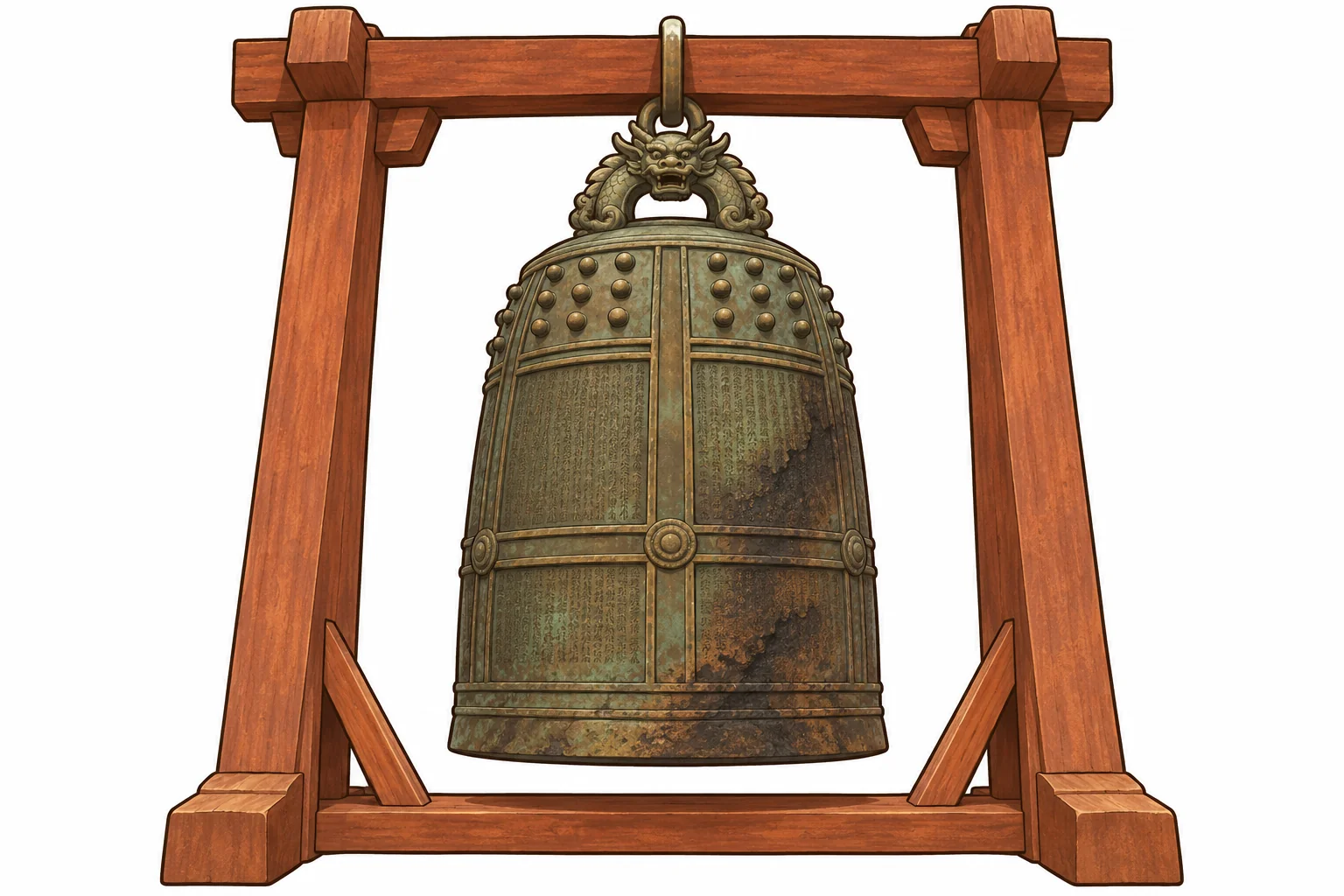
The 15th-century Ryūkyūan bronze Bankoku Shinryō bell hanging from a wooden frame (illustration).
In 1609 the Shimazu lords of Satsuma, in southern Kyūshū, invaded and captured Shuri, taking King Shō Nei back to Kagoshima. From then on Ryūkyū was in an odd double position: officially still a tributary kingdom of China, in practice controlled by Satsuma, which also annexed the Amami Islands to the north. This arrangement lasted more than two centuries. The new Meiji government ended it in stages. It declared Ryūkyū a domain in 1872, and in March 1879 the official Matsuda Michiyuki marched into Shuri Castle with more than five hundred officials, police and soldiers and read out the order abolishing the domain and creating Okinawa Prefecture. The last king, Shō Tai, was moved to Tokyo. Japanese histories call this the Ryūkyū Disposition.
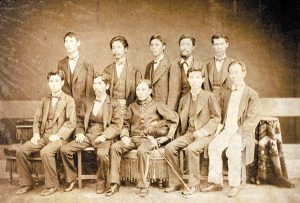
The officials of the 1879 Ryūkyū Disposition; Matsuda Michiyuki sits at the center of the front row.Okinawa Prefectural Archives, "The Ryūkyū Domain disposition officials" (item no. T00021952B) · Terms of use
What followed was a long program of assimilation. Schools pushed standard Japanese hard, and children caught speaking their home language could be made to wear a "dialect placard" around the neck as punishment. In the spring of 1945 American forces landed on Okinawa Island, and the battle that followed lasted nearly three months and killed more than 200,000 people, more than half of them from Okinawa itself, many of them civilians. Shuri Castle was destroyed. The United States governed Okinawa for twenty-seven years after the war, and it returned to Japan only on May 15, 1972. At reversion Okinawa held about 58.7 percent of the land used exclusively by U.S. forces in Japan. Because bases on the mainland were cut back faster, the figure as of 2025 is about 70 percent, in a prefecture that makes up about 0.6 percent of the country’s area.
- 1429Shō Hashi completes unification; the Ryukyu Kingdom
- 1458The "bridge between nations" bell is cast
- 1609Satsuma captures Shuri
- 1872Ryukyu declared a domain
- 1879Okinawa Prefecture created
- 1945Battle of Okinawa
- 1972Returned to Japan
Unified as a kingdom in 1429, controlled in practice by Satsuma from 1609, made Okinawa Prefecture in 1879; governed by the United States for 27 years after the war, returned in 1972.
So when Okinawans talk about Ryūkyū, the feeling is mixed. There is pride in the kingdom and in island ways; people call themselves Uchinānchu, Okinawans, as distinct from Yamatunchu, mainland Japanese. There is also the weight of the war and the bases. Okinawan culture as a visitor meets it today grew up between those two things.
02Utaki: The Sacred Groves
Walk to the edge of almost any old Okinawan village and you are likely to find a patch of forest that has been left noticeably alone. Inside there may be a cleared space, and at the far end a stone, an old tree or a small incense burner. There is no shrine building and no torii gate. This is an utaki, a place where the gods come down.
Traditional Ryūkyūan religion centers on ancestors and the powers of nature. Gods are believed to come from Nirai Kanai, a paradise across the sea, bringing fertility and life, and then return. The utaki is where they stop when they visit. Many are tied to the founding legends of a village and are thought of as the resting place of its first ancestors, so the grove is also the village’s guardian. The innermost part, called the ibi, was traditionally off limits to men, including village headmen.
Religious authority belonged to women. Okinawans held that sisters had a spiritual power to protect their brothers, a belief known as onari-gami. Village rites were led by priestesses called noro, who often came from particular families and inherited the role. Household rituals were run by senior women, and outside the formal system there were yuta, spirit mediums consulted for divination and contact with the dead. Around the late fifteenth century, under King Shō Shin, the kingdom organized the noro into a state hierarchy, and at its top placed the Kikoe-ōkimi, the chief priestess, usually a sister or close female relative of the king, whose role was to protect him and the realm.
Different utaki served different communities. A village utaki belonged to the village, honored its founding and local gods, and was tended by its own noro. Some belonged to a munchū, a patrilineal clan, and were visited only by clan members on the clan’s festival days. A few major sites were tied to the kingdom’s own rituals. The most important of these is Sēfa-utaki, in the south of Okinawa Island, one of seven utaki that the creator goddess Amamikyu is said to have made. Each new Kikoe-ōkimi was installed here in a ceremony called the oaraori. In the kingdom’s day only women connected to the court could pass beyond the entrance; everyone else prayed from the gate. A stone-paved path leads to six places of worship, including Ufuguī, the "great hall," a stone platform, and Yuinchi, whose name is taken to mean the place where abundance gathers. The best known is Sanguī: two enormous rocks lean together to form a triangular passage, and beyond it lies a small stone-floored space from which you can look out to Kudaka Island in the sea to the east.
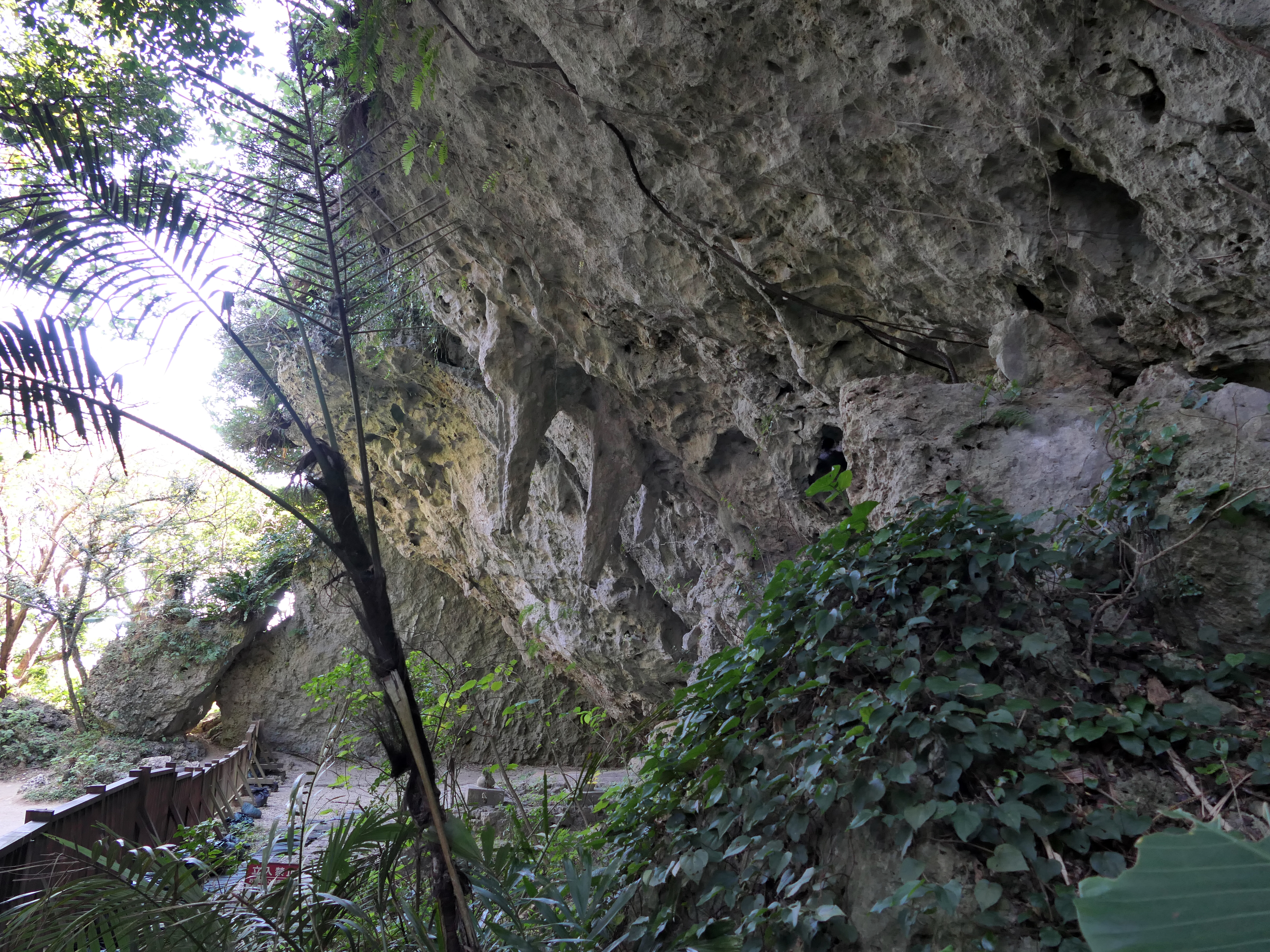
Around Sanguī at Sēfa-utaki: a stone path runs beneath huge rocks, with no shrine building anywhere.Hyppolyte de Saint-Rambert, "Okinawa Nanjo Sefa-utaki Gusuku site Sangui," CC BY 4.0 · CC BY
Kudaka is called the island of the gods. In legend it is where Amamikyu, the creator goddess of Ryūkyū, first came down, and kings once crossed to it to worship. Every twelve years, in the Year of the Horse, the island held the Izaihō, an initiation by which women between thirty and forty-one became priestesses. With the island’s population shrinking and no new initiates, it has not been held since 1978.
In 2000, Sēfa-utaki, the site of Shuri Castle, the Sonohyan-utaki stone gate and other places were inscribed together on the World Heritage list as the Gusuku Sites and Related Properties of the Kingdom of Ryūkyū. Sēfa-utaki remains a place of prayer, and you will often see local people arriving with incense and offerings.
03Paantu: The Mud Gods of Miyako
All over Japan there are customs in which masked visiting deities, raihōshin, come into a village on certain days to drive out evil and bring good fortune. The best known are the namahage of Akita. In 2018, ten of these were inscribed together on UNESCO’s intangible heritage list as "Raiho-shin, ritual visits of deities in masks and costumes." The paantu of Miyako Island is one of them.
Paantu means something like "demon-god" in the Miyako language, and two communities on the island keep the custom in quite different forms.
In Shimajiri, in the Hirara area, the event is called Paantu Punaha and falls around the ninth month of the lunar calendar. At about five in the afternoon three paantu emerge from an old well at the edge of the village called Nmarigā, once used for a newborn’s first bath and for washing the dead. They are local men, by some accounts usually young men, in carved wooden masks, wrapped in vines and smeared from head to foot with mud from the well. Their names are Uya, Naka and Ffa, roughly parent, middle and child. They first receive offerings at a ritual site called the Satu, then roam the village smearing mud on everyone they meet and on the walls of houses. Being muddied is meant to keep illness and misfortune away, and families with newborns are said to have their babies daubed too. The mud stinks. Children run away screaming and adults dodge, laughing. In recent years the crowds have sometimes outnumbered the villagers, and there have been tourists demanding compensation from the community association for muddied clothes and cameras, and even people hitting a paantu from behind. According to some reports, a muddied tourist once called the police, and the village has since stopped announcing the date in advance and asks outsiders not to come in good clothes. Villagers keep repeating that this is a sacred community rite, not a show put on for visitors.
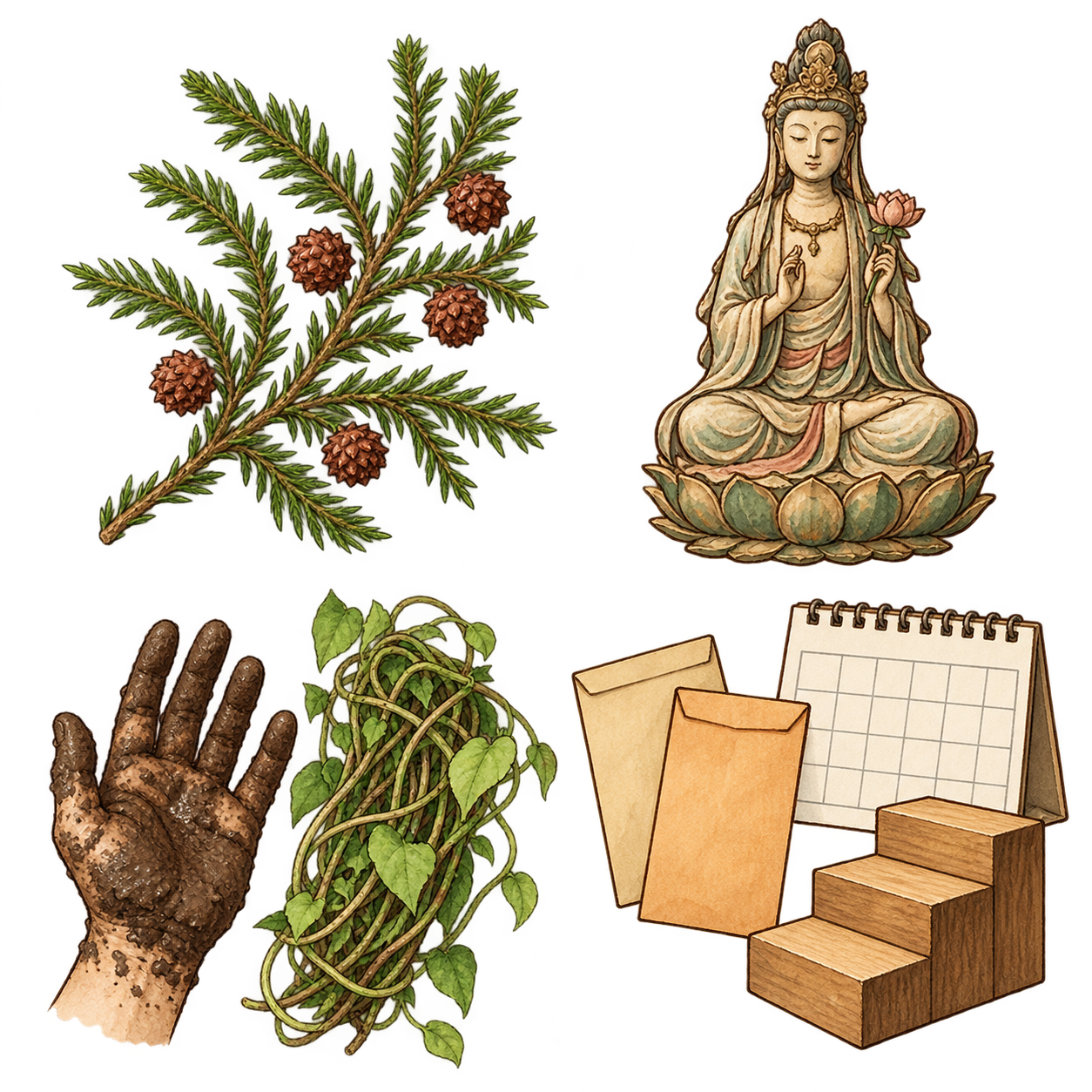
Shimajiri’s Paantu wrap themselves in vines and smear themselves with mud from the well, then daub it on anyone they meet.
In Nobaru, in the Ueno area, the event is called Satipārō, meaning roughly "driving out evil spirits," and is held on the last Ox day of the twelfth lunar month. Here there is a single paantu, a boy in a carved wooden mask who leads the way. Behind him come children and women in ritual roles, called tumu, dressed in palm fronds and vines and carrying branches of yabunikkei, a wild cinnamon. The plants are believed to draw misfortune into themselves. To the sound of drums and conch shells the procession chants "hōi hoi" as it winds through the village, and at crossroads, where bad luck is thought to collect, it stops and circles the paantu to drive evil away. There is no mud and no chasing. It feels more like a lively, orderly procession than a riot.
One island, one name, and two different rites: an autumn god who crawls out of a well to bless people with mud, and a year-end exorcism procession accompanied by women. That variety, village by village, is typical of Ryūkyūan belief.
04Sanshin and Ryūka: Poetry Made to Be Sung
Almost every Okinawan household has a sanshin. The body is covered with python skin, it has three strings, and it is played with a pick, the tsimi, worn over the index finger and usually said to be made of buffalo horn. It descends from the Chinese sanxian, which reached Ryūkyū around the fourteenth century; from Ryūkyū it later traveled to Sakai, near Ōsaka, where it became the mainland shamisen. In the kingdom’s time the sanshin was a mark of a cultivated gentleman, played by court musicians at Shuri and by everyone else for folk song. Sanshin music is written in a notation called kunkunshī, worked out in the eighteenth century by the musician Yakabi Chōki on the model of Chinese scores, in which characters such as 合, 乙 and 老 each indicate a string and a finger position, laid out in a grid.
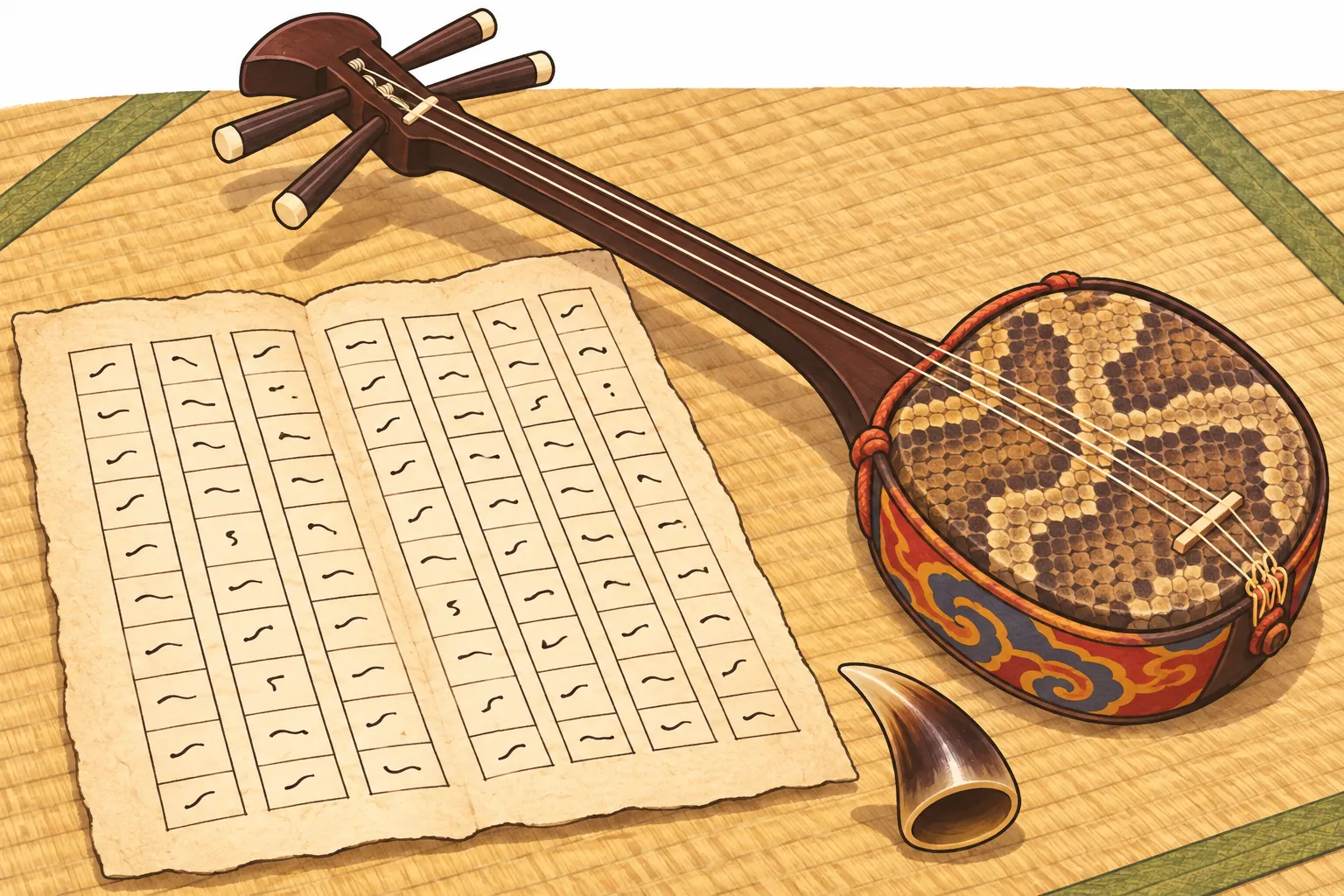
An open page of kunkunshi notation beside a sanshin and its finger-worn plectrum (illustration).
The words sung to the sanshin are often ryūka, Ryūkyūan verse. The standard ryūka form has four lines of eight, eight, eight and six syllables, thirty in all, against the five-seven-five-seven-seven of the Japanese waka. The key difference is that waka was recited and written, while ryūka was sung. It began as the lyric of sanshin song, and the same verse can be set to different melodies.
Ryūka poets include kings, aristocrats, farmers and courtesans. Two women are especially loved. One is Onna Nabe, who lived in the early eighteenth century in Onna village in the north of the island. Her best-known poem wishes she could push Mount Onna aside so that her lover’s village on the far side would come closer. The other is Yoshiya Chiru, said to have been sold into the Naha pleasure quarter as a child and to have died young, leaving sorrowful verses behind; much of her life story is legend, which often has her sold at eight and dead at eighteen. Many of the finest ryūka, though, are anonymous. Love poems far outnumber everything else, alongside verses on the seasons, celebrations, moral lessons and travel.
Ryūka were gathered in large collections. The oldest surviving one, the Ryūka hyakkō, was copied out in three books, each named for a group of sanshin melodies, between 1795 and 1802 and holds some six hundred poems arranged by the sanshin melody they belong to, a reminder that a ryūka was first of all the lyric of a tune. Twentieth-century collections such as the Ryūka Taikan each gather around three thousand. The best way to meet ryūka, though, is to hear them. Okinawan folk singers still perform verses that are centuries old. At a min’yō bar near Kokusai-dōri in Naha you can request a song such as "Tanchamē" or "Asadoya Yunta," and as the night goes on someone will jump up to dance kachāshī, hands raised overhead and swaying from side to side, and everyone else follows.
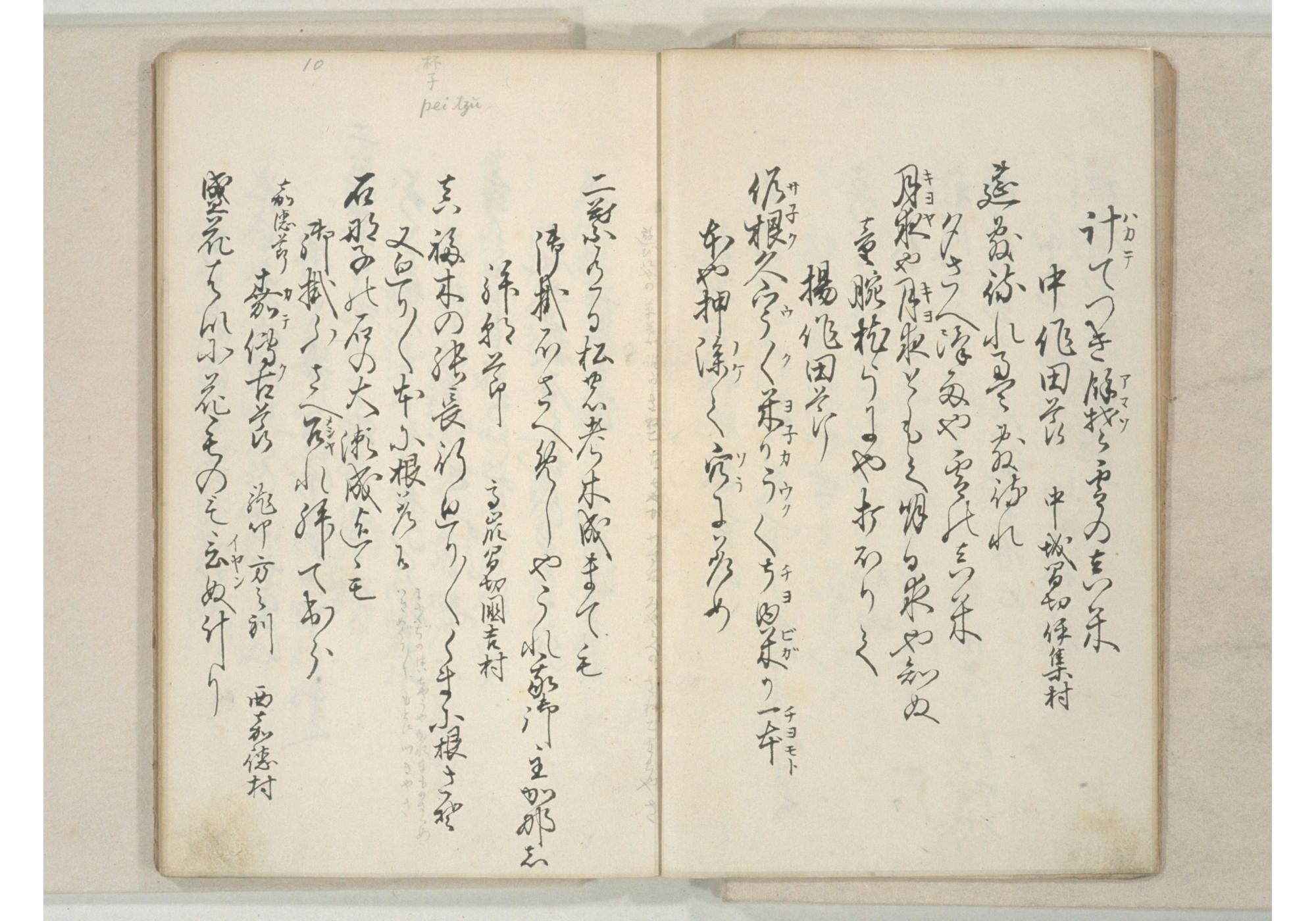
The oldest surviving ryūka collection groups its poems by sanshin melody, with the name of each tune written before the verses.University of the Ryukyus, Ryūka hyakkō manuscript (compiler unknown, compiled 1795–1802)
05Kumi Odori: Speech, Music and Dance as One Drama
In 1719 a Qing investiture mission arrived to invest King Shō Kei. Its chief envoy is recorded as Haibao; its deputy envoy, Xu Baoguang, went home to write the Zhongshan Chuanxin Lu, which became the standard account of Ryūkyū for readers in both China and Japan. The court put Tamagusuku Chōkun (1684–1734), its official in charge of dance, in charge of the banquets, and he wrote two new plays for the occasion, Nidō Tichiuchi (The Two Boys’ Revenge) and Shūshin Kane’iri (The Bell and the Obsessed Woman). They were performed for the envoys on a specially built stage at Shuri Castle at the Double Ninth banquet that followed the investiture. The new form was called kumi odori, roughly "combined dance," because it put dances together to tell a story.
Chōkun made seven long official journeys to Satsuma and Edo and saw noh and kabuki there. He fused what he saw with Ryūkyū’s old songs, court dances and legends. His five plays, Nidō Tichiuchi, Shūshin Kane’iri, Mekarushī, Onna Monogurui and Kōkō nu Maki, are known as the Chōkun Five and remain the core of the repertoire. Kumi odori has three elements. The first is the spoken part, called tonae: actors deliver their lines in classical Ryūkyūan with fixed pitch patterns and drawn-out phrases, somewhere between speech and chant, mostly in verse lines of eight syllables. The second is music. A group called the jiutai sits to one side with sanshin, koto, flute, the bowed kokyū and large and small drums, and the singers accompany themselves on sanshin, setting ryūka that express what the characters feel; the emotional peaks of a scene are often handed to the song. The third is dance. Movement is extremely slow and spare. Actors glide with the soles of their feet close to the floor, and a single turn or raised fan can carry a whole emotional beat.
Tonae: actors deliver lines in old Ryūkyūan, halfway between speech and song.
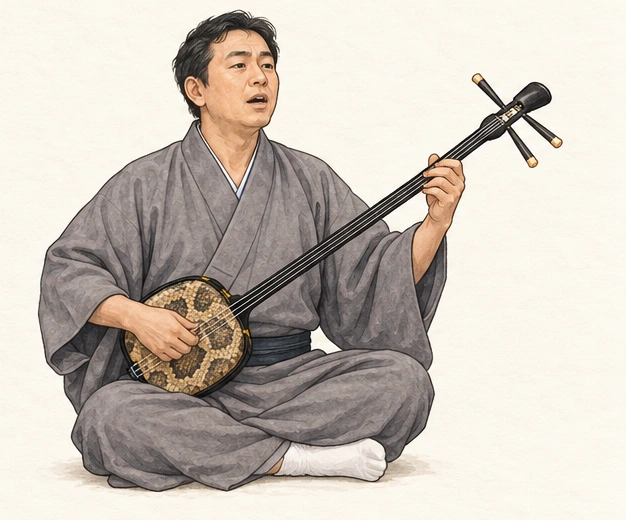
Music: the jiutai singer plays the sanshin and sings to carry the characters’ feelings.
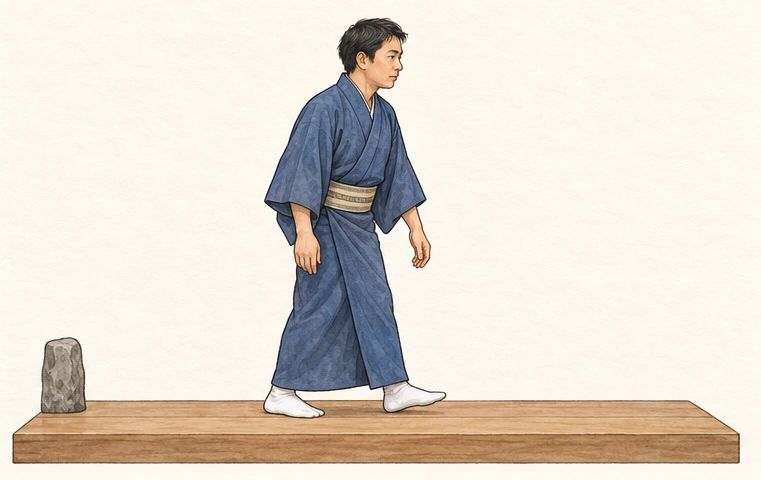
Dance: movement is very slow and spare, the soles kept close to the floor.
The performers were originally young men from Shuri’s aristocratic families, who played the women’s roles as well. The art was a form of diplomacy: it showed Chinese visitors that Ryūkyū was a civilized realm with proper ritual and music. When the kingdom ended, kumi odori lost its court stage. It survived in two ways: in the commercial theaters of Naha, kept alive by professional performers, and in the villages, where it became part of local festival programs, some still staged in the eighth lunar month. After the Battle of Okinawa, people in internment camps made sanshin from tin cans and parachute cord, and Ryūkyūan song and dance slowly came back out of the ruins; some performers are said to have restaged kumi odori in the camps. On May 15, 1972, the very day Okinawa returned to Japan, kumi odori was designated an Important Intangible Cultural Property, and in 2010 it was inscribed on UNESCO’s intangible heritage list. The National Theatre Okinawa, which opened in Urasoe in 2004, is its dedicated home.
06Shūshin Kane’iri: A Bell, a Chase and a Change of Voice
Shūshin Kane’iri is one of the most popular kumi odori and is often described as the most frequently staged. A handsome young man, Nakagusuku Wakamatsu, is traveling to Shuri to take up service at court. Night falls and he asks for lodging at a house where a young woman is alone. At first she refuses, saying there is no man at home, but when she recognizes Wakamatsu she lets him in and declares her love. He refuses her. She will not let go, and he flees to Sueyoshi temple in Shuri. The head priest, the zasu, hides him inside the temple bell and sets three young monks to guard it. The woman pursues him to the temple, where her obsession turns her into a demon who circles and strikes at the bell. The zasu confronts her with prayer and chanting until she is subdued.
Anyone who knows Japanese theater will recognize the Dōjōji story. In the Dōjōji legend a woman turns into a great serpent, coils around the temple bell in which a monk is hiding, and burns bell and monk together. The noh Dōjōji tells the sequel, in which her obsession returns as a dancer at the rededication of a new bell and reveals its serpent form. Chōkun had seen Dōjōji in Edo and borrowed the frame, but his play puts its weight elsewhere. The first half takes place almost entirely in one room. The woman pleads, line by line, and Wakamatsu refuses, line by line, their chanted speech going back and forth at a slow pace. Her lines grow more urgent as her feelings move from shyness to pleading to resentment, and this exchange is the great test of a kumi odori actor. When she follows him to the temple, the music from the jiutai swells, she appears in a demon mask, and her movement changes from small gliding steps to large lunges as she circles the bell at the center of the stage. The whole shift from stillness to violence, from woman to demon, is carried by the alternation of speech, song and dance.
Wakamatsu must be played upright and cold, the woman must travel from gentleness to terror, and the young monks have comic exchanges that let the audience breathe between moments of tension. The surtitles are in modern Japanese, but the story is simple enough that a visitor who reads a synopsis beforehand can follow it without trouble.
07Okinawa Soba: Why It Is "Soba" Without Buckwheat
The everyday food of Okinawa is Okinawa soba, or just sūba in local speech. It sits somewhere between udon and ramen. The noodles are made from wheat flour, thick, flat and slightly wavy, with a firm bite. The broth is made from pork bones and dried bonito together, clear and pale gold, with the depth of pork and the savor of katsuobushi. On top go a few slices of sanmainiku, pork belly braised sweet and salty, a slice of fish cake, chopped green onion and a little pickled red ginger. On the table sits a bottle of kōrēgusu, chili peppers steeped in awamori, the local distilled spirit; a few drops make the broth bright and hot.
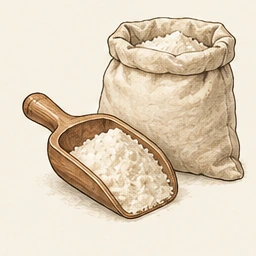
The noodles are thick, flat and made of wheat flour, not buckwheat.
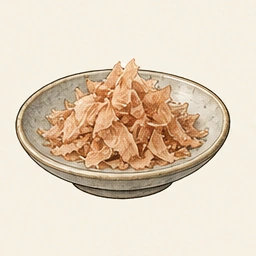
The broth is simmered from pork bones and bonito.
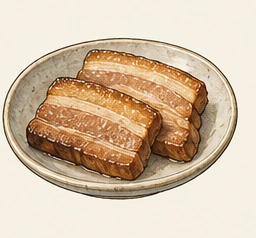
On top go slices of sweet-salty braised pork belly.
Why call it soba? On the mainland, soba means buckwheat noodles. In Okinawa the word long ago came to mean Chinese-style wheat noodles in general. Okinawa soba is usually traced to the Chinese-style noodle shops that appeared in Naha in the Meiji period; tradition says the first was opened by Chinese in Naha in the late Meiji years. Before the war the dough was made with lye leached from wood ash, burned from trees such as banyan and akagi, which gave the noodles a particular aroma, color and spring. After the war, as households switched to gas, ash became hard to collect, and most makers moved to the kansui alkaline salts used for ramen. Since 2007 local noodle makers and the prefectural technology center have worked on an alkaline mix that reproduces the wood-ash flavor, and they patented it in 2012; a few shops now advertise wood-ash noodles as a specialty.
After reversion, in 1976, Japan’s Fair Trade Commission ruled that noodles containing no buckwheat flour could not be labeled soba (the rule at the time is said to have required at least 30 percent buckwheat flour). Local noodle makers insisted this was a traditional regional name and, led by their cooperative, kept negotiating. On October 17, 1978, the name "Okinawa soba" was approved (some sources give the approved name as "Honba Okinawa soba," authentic Okinawa soba). In 1997 the cooperative declared that date Okinawa Soba Day.
There are many variations. Sōki soba, topped with tender stewed pork spare ribs on the bone, is the tourist favorite. Tebichi soba comes with pig’s trotters. Miyako soba traditionally hid its meat and fish cake under the noodles, though most shops now put them on top, and Yaeyama soba uses round noodles, by some accounts thin ones, with slivered pork and fish cake. Around Naha and Shuri there are shops that have been going for decades, where, as of 2026, a bowl costs around 700 or 800 yen and there is often a line at lunch.
08Going There
For most visitors the first stop is Shuri Castle. It was completely destroyed in the Battle of Okinawa, and its main hall and other buildings were reconstructed in 1992, the twentieth anniversary of reversion. In the early hours of October 31, 2019, a fire burned the main hall and several other major buildings again. Work on the new main hall began in November 2022; the exterior and lacquer are finished, a completion ceremony is scheduled for November 22, 2026, and the interior opens to the public from November 23. Throughout the rebuilding the site stayed open, and visitors could watch the timber frame, red tiles and painted decoration go up from viewing decks. Outside the castle, the Shureimon gate and the Sonohyan-utaki stone gate, where the king prayed for safety before traveling, can still be seen.
Sēfa-utaki is best in the morning, when it is quiet and the light in the trees is soft. Walk gently, do not touch the stones or the offerings, and stay out of roped-off areas. If local people are praying, do not photograph them. To reach Kudaka Island, take the ferry from Azama port in Nanjō city; the high-speed boat takes about fifteen minutes and the car ferry about twenty-five. Some parts of the island are still off limits, and signs mark them.
For kumi odori, check the program at the National Theatre Okinawa, which programs a dozen or so regular performances of kumi odori, Ryūkyūan dance and music each year; kumi odori is shown with modern Japanese surtitles at the sides of the stage. A kumi odori play is generally said to run about an hour. In summer, around the lunar Obon festival, youth groups across Okinawa perform eisā, a drum dance that moves through the streets to welcome and send off the spirits of the ancestors; it is the liveliest sight of an Okinawan summer night. Afterward, go to a min’yō bar, order a carafe of awamori and listen to the sanshin. When everyone stands up for kachāshī, raise your hands and join in.
Japan has one other culture that stands apart from the mainland in a similar way: that of the Ainu of Hokkaidō, who also have their own language, beliefs and modern history of assimilation. Seeing Okinawa and then Hokkaidō gives a broader sense of what the word "Japan" covers.