
At a glance
How the Ainu treated bears, fire and owls as kamuy to host and send home, their songs, patterns and instruments, the toll of assimilation, and where to learn more.
- In the Ainu language, ainu means "human", set against kamuy, the gods.
- Bears, owls, orcas, fire and even long-used tools can all be kamuy.
- What scholars call Ainu culture took shape around the 13th century, through long-distance trade.
- Chiri Yukie’s Ainu Shin’yōshū, published in 1923, contains thirteen songs of the gods.
- A 2019 law named the Ainu an indigenous people in statute; Upopoy opened in Shiraoi in 2020.
Look at a map of Hokkaidō and the place names start to sound strange for Japan: Sapporo, Otaru, Wakkanai, Shiretoko, Noboribetsu. They are Ainu words, left by the people who lived on this island long before it was called Hokkaidō. The Ainu fished salmon, hunted deer and bear, and believed that the world was full of kamuy, spirits or gods who visited the human world dressed as animals, fire, water and even tools. They had no writing, yet they kept epics that could take several nights to sing. This is an introduction to how the Ainu understood the world, what their songs, clothes and carvings look like, what happened to them in modern Japan, and where a visitor to Hokkaidō can meet their culture today.
01"Human" and "god"
The word ainu means "human being." It makes most sense when you set it beside its opposite, kamuy, which means a god or spirit. In the Ainu view the world has two sides. People live in Ainu Mosir, the land of humans; the gods live in Kamuy Mosir, the land of the gods. To call yourself simply "the humans" is to say that you share the world with beings who are not human, and who deserve respect.
Historically the Ainu lived across Hokkaidō, the southern half of Sakhalin, the Kuril Islands, and the northern tip of Honshū, where many place names in Aomori and Iwate can still be read as Ainu. Archaeologists trace a sequence on Hokkaidō from the Jōmon period through the Epi-Jōmon and the Satsumon cultures. Around the 13th century, as iron pots and lacquerware arrived through trade and the distinctive Satsumon pottery disappeared, the way of life that scholars call Ainu culture took shape. That timing matters. Ainu culture is not a Stone Age survival frozen in place. It formed inside a long trading network: salmon, furs, and eagle feathers went south to Japan and west to the Amur region of the mainland; iron, lacquer, rice, cotton, and sake came back.
Nobody knows how many Ainu there are today. As of the Hokkaidō government’s 2023 survey, municipalities in Hokkaidō knew of about 11,450 Ainu people (the 2017 survey had counted about 13,000), but such figures only include those who chose to identify themselves to local officials. After a century of discrimination many families hid their ancestry, many people of Ainu descent do not know it, and the substantial Ainu population around Tokyo was not counted. The real number is certainly larger. The Ainu language is in a far worse state: UNESCO classified it as critically endangered in 2009, and hardly anyone now speaks it as a first language, though the number of learners is growing.
02The kamuy: gods in animal clothing
The Ainu idea of kamuy is broader than the English word "god." Bears, foxes, salmon, and orcas are kamuy. So are fire, water, wind, and thunder, as well as mountains, lakes, and trees. A boat, a cooking pot, or a knife that has served a household well also has a kamuy. Anything with great power over human life, anything people cannot fully control, can be a kamuy, and that includes the dangerous ones. Smallpox had its own god, and villages put up guardians and fled when it was coming.
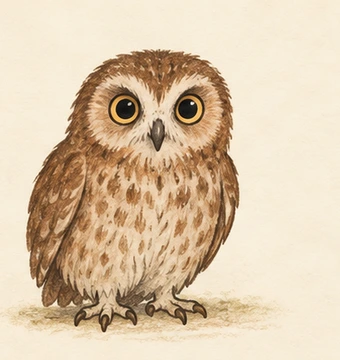
A handful of kamuy appear again and again in museums across Hokkaidō. The bear is Kimun Kamuy, the god of the mountains, and among the most honored. The Blakiston’s fish owl, a huge owl that watches over riverside villages at night, is Kotan Kor Kamuy, the god who protects the village. The orca is Repun Kamuy, the god of the sea, who was said to drive whales toward the shore as a gift for people. Closest of all is the fire goddess Ape Huchi Kamuy, "Grandmother Fire," who lives in every household’s hearth. When people pray to other gods, they often ask her to pass their words along.
The core of the system is an exchange. In their own land, the kamuy look and live like people. When they visit the human world, they put on a costume. The bear god wears a bearskin and carries bear meat as a present. A hunter who kills a bear has not taken anything by force; the god has chosen him and handed over its gifts. In return the hunter owes the god a proper send-off: sake, millet dumplings, and inaw, the carved offering sticks that the gods value because they cannot make them in their own world. Then the god’s spirit is sent home with prayers. Back among its kind, it describes the generous people it met, and more gods will want to visit. If people waste meat, leave bones lying around, or treat the gods rudely, the gods stop coming, and hunger follows.
The inaw is the object you will see most often in any Ainu display. It is a stick of willow or dogwood whose surface has been shaved with a knife into long curling strips that stay attached at one end, so that it looks like a tuft of white hair or feathers. It is both a gift and a messenger that carries human words to the gods. Outside a traditional house stands the nusa, an altar of inaw in a row, where the skulls of bears and other animals were placed after they had been sent back.
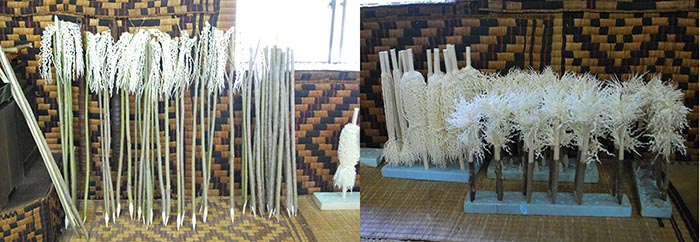
Rows of inaw prepared before a ceremony in Shiraoi, the curled shavings still attached to the sticks.
Prayer is called kamuynomi. A man sits by the hearth holding a lacquered cup of sake and a slender carved wooden spatula called an ikupasuy. He dips its tip in the sake and lets drops fall onto the fire or onto inaw while he speaks the prayer. The ikupasuy is often richly carved, and its job is to carry the speaker’s words accurately to the god. Kamuynomi ceremonies are still held today, at Upopoy in Shiraoi and at local festivals around Hokkaidō.
03Iomante: sending the bear home
The most famous and most misunderstood Ainu ritual is iomante, the sending-off of a bear. In late winter, hunters who found a mother bear in her den sometimes brought the cub back to the village. The cub was treated as the child of a god. Women might nurse it when it was very young, and it was then raised in a wooden cage on fish and porridge for a year or two.
The ceremony lasted several days. People brewed sake and made dumplings, and relatives came from other villages. Men prayed while women sang and danced in a circle. The young bear was led around the grounds while decorated arrows, hepere ay, were shot to play with it, and it was then killed, held down between two poles. For the Ainu, this was not slaughter. The god’s child was taking off its bear clothes and going home to its parents loaded with gifts. The meat was shared by the whole village, and the decorated skull was placed on the altar facing the land of the gods.
Outsiders found iomante hard to accept. After the Meiji period it was condemned as barbaric, and according to the record, in 1955 the Hokkaidō government issued a notice banning it as a barbaric ritual that killed a live bear, after which it was rarely held except for scholarly recording. The notice was only withdrawn in April 2007. A few communities have held iomante since as a way of reviving and recording the tradition, but it remains rare. What makes the ritual comprehensible is the idea behind it: hosting a god with the greatest possible hospitality and personally escorting it home was the highest honor a person could offer.
04Yukar: epics kept in the voice
With no writing system, the Ainu stored their knowledge, history, and imagination in spoken and sung performance. Their oral literature has several genres, and the best known is the yukar, the heroic epic.
A typical yukar follows a young hero, very often named Poiyaunpe, who has been raised by an older sister. When he learns who he is, he sets out to avenge his family and fights rival peoples and monsters through endless battles in which he is wounded, killed, and revived, until he returns in triumph with a bride. The hero tells the story in the first person, and a long yukar could be sung over several nights. The performer sits at the hearth beating time on the hearth frame with a short stick (called repni, by one account); listeners join in the rhythm and shout encouragement. The language of yukar is not everyday Ainu but an older, elevated register full of set phrases and formulas, the same kind of device that helps singers of oral epics around the world hold thousands of lines in memory.
The other major genre is the kamuy yukar, the song of a god. These are shorter, and the narrator is an animal or natural god describing its own visit to the human world, again in the first person. A kamuy yukar has a refrain called a sakehe that recurs every line or two. Each song has its own refrain, often imitating the god’s call or movements. There are also prose tales, uepeker, which usually concern human affairs.
The person who carried this literature into print was a young Ainu woman named Chiri Yukie. She was born in 1903 near Noboribetsu and grew up with her grandmother and her aunt, Kannari Matsu, a gifted reciter who worked for years with the linguist Kindaichi Kyōsuke, the leading Japanese scholar of the Ainu language. Kindaichi recognized Chiri Yukie’s ability and invited her to Tokyo. In 1922 she lived in his home, writing down kamuy yukar in Ainu using the Latin alphabet and translating them into Japanese. On the night she finished checking the manuscript that September, she died of heart failure. She was nineteen. The book, Ainu Shin’yōshū (Collection of Ainu Songs of the Gods), came out the next year.
It is a slim volume of thirteen songs. The first is told by the owl god, and its opening refrain has become the best-known line of Ainu poetry in Japan: Shirokanipe ranran piskan, konkanipe ranran piskan, "Silver drops fall, fall all around; golden drops fall, fall all around." Singing this, the owl flies over a village. The children of a rich family shoot at it with golden arrows, and it ignores them. It lets itself fall instead to the plain wooden arrow of a poor boy, is carried to his home, and during the night makes the family rich, then teaches the village to live in harmony. In her preface, Chiri Yukie wrote that this vast Hokkaidō was once the free land of her ancestors. The line is quoted often, because it reads as a quiet lament for a world that changed within her grandmother’s lifetime.
Her younger brother, Chiri Mashiho, became a linguist and taught at Hokkaido University. Another key figure is Kayano Shigeru, born in 1926 in Nibutani, in the town of Biratori. Over decades, by some accounts from the 1950s, he recorded elders’ songs and stories on tape, compiled an Ainu dictionary, and in 1994 became the first Ainu member of the National Diet, where he spoke Ainu in a committee session of the House of Councillors. The recordings made by Kayano and others are now among the most important resources for people learning the language.
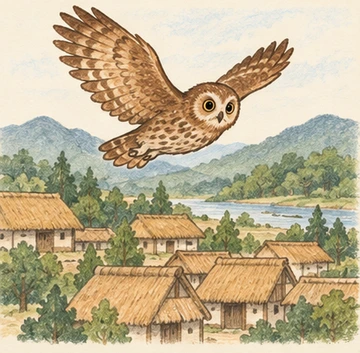
Singing "silver drops fall all around", the owl god flies over a human village.
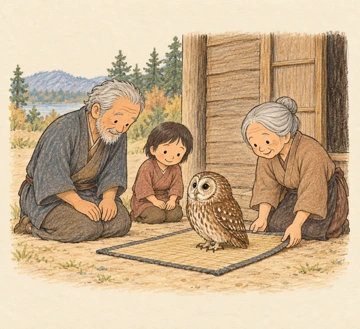
It falls to a poor child’s wooden arrow and is carried home and welcomed.
05Patterns, clothing, and carving
What strikes most visitors first is Ainu design. Its basic motifs are symmetrical spirals and hooked curves, the moreu ("gently turning"), and sharp thorn-like shapes, the aiushi. The lines spread across cloth or wood until they fill the space, while keeping a strict mirror symmetry. The patterns were believed to keep evil away, and they are densest around the collar, cuffs, and hem, the openings through which harmful spirits might slip in.
The signature garment is the attush, cloth woven from tree bark. In early summer, people stripped bark from the elm known in Japanese as ohyō, soaked it in ponds or hot springs until the inner layer separated, dried the fibers, split them into thread, and wove the cloth on a backstrap loom. Attush is strong, breathable, and water-resistant, with a pale tan color. Women then appliquéd pieces of dark blue and black cotton obtained through trade and embroidered over them. Because cotton was precious in the north, they assembled it from whatever scraps they had, and several regional styles grew out of this: ruunpe, built up from strips of appliqué; kaparamip, with large patterns cut from white cloth; chikarkarpe, dominated by embroidery. Specialists can often tell roughly where a robe came from by its pattern.
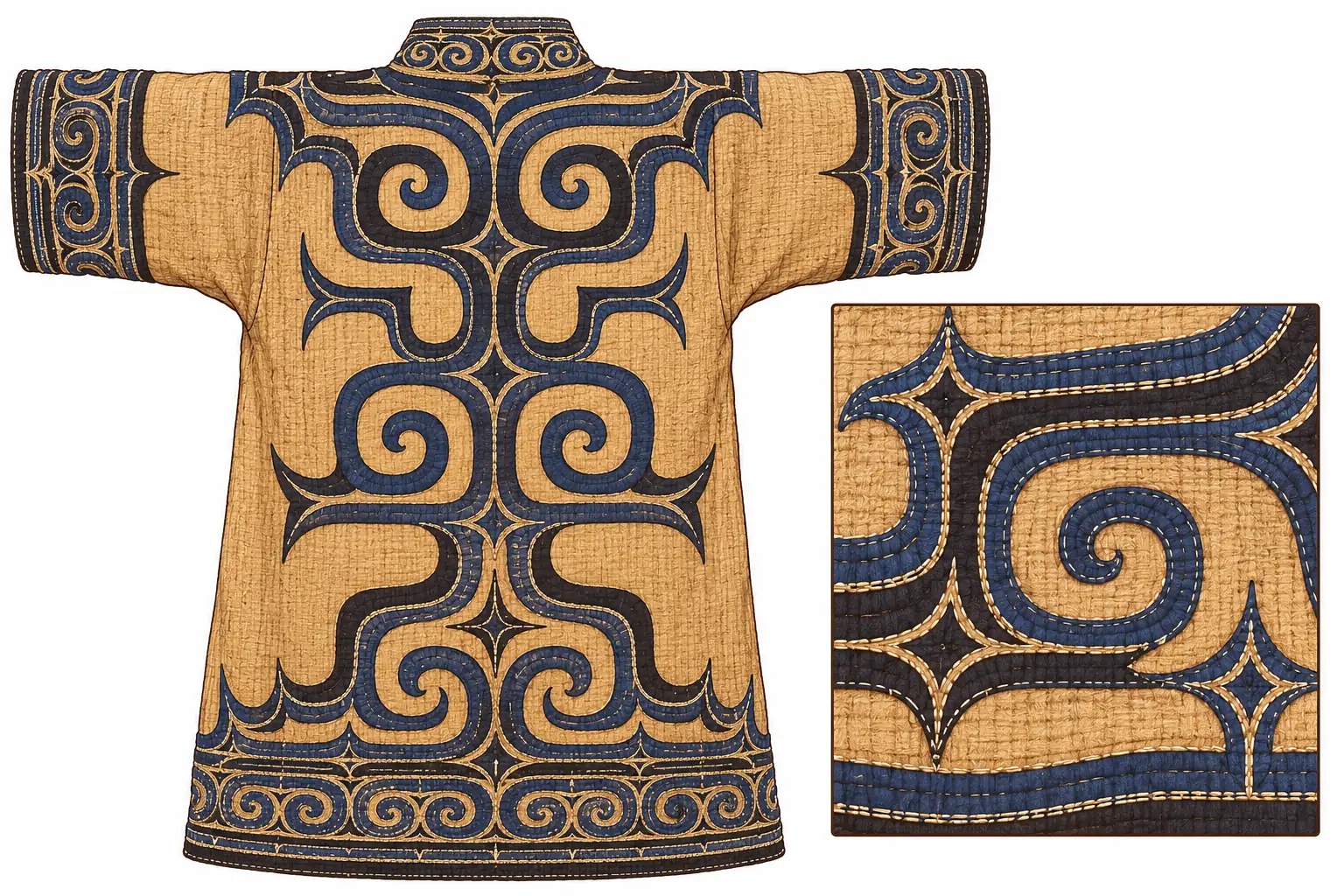
The back of an Ainu attus bark-fibre robe with appliquéd, embroidered cotton strips, beside part of a ruunpe (illustration).
Women wore tamasay, necklaces of colored glass beads, many traded from Honshū or the Asian mainland, often with a round metal plate at the center. Adult women were also traditionally tattooed around the mouth and on the forearms, a mark of maturity and readiness for marriage that was also thought to ward off evil. The Meiji government banned the practice in 1871, and today it can only be seen in old photographs.
Men’s craft was carving. Every man carried a small knife, the makiri, with a handle and sheath covered in relief patterns. Trays called ita, carved with scale motifs and spirals, were made by men and given as gifts to the women they wished to marry. In 2013 the Nibutani ita and Nibutani attush were designated Traditional Crafts of Japan, the first from Hokkaidō to receive the label. The carved bear with a salmon in its mouth, Hokkaidō’s most familiar souvenir, is not traditionally Ainu at all. It began in the early 1920s at Yakumo, where Tokugawa Yoshichika, head of the former Owari Tokugawa house and owner of a large farm there, brought back a carved bear from Switzerland and encouraged farmers to copy it as winter work, and Ainu carvers in Asahikawa and Akan later made it their own, turning it into an important source of income.
A traditional house, the chise, has a timber frame covered with thatch, bamboo grass, or bark. A rectangular hearth sits in the center; this is where Grandmother Fire lives. In the wall facing the sunrise (usually said to be the east wall) is a sacred window, the rorunpuyar, through which the gods enter and leave. Traditionally no one was supposed to look in through this window, and peering into a house through a window from outside was considered rude. Bear skulls and other sacred things pass in and out through it.
Salmon and deer were the staples. The Ainu call salmon kamuychep, "the gods’ fish," and the autumn run up the rivers was the most important season of the year, opened with a ceremony to welcome the first fish. In winter, frozen salmon was sliced and eaten raw as ruibe, a dish still served in Hokkaidō izakaya. The everyday soup, ohaw, simmered fish or meat with wild greens and roots. Chitatap is fish meat, heads, or innards chopped again and again on a board with a knife and mixed with wild onion and salt; it has become famous among Japanese readers through the manga Golden Kamuy.
06Mukkur and tonkori: the sound of Ainu music
The best-known Ainu instrument is the mukkur, a mouth harp made from a thin strip of bamboo with a tongue cut into the middle. The player holds it against the lips and tugs a string tied to one end. The tongue vibrates, and the mouth acts as a resonating chamber, shaping a buzzing, twanging sound that can imitate wind, rain, or animal cries. At Upopoy or Akan you can usually try playing one, and sometimes make your own.
The tonkori is a long, narrow five-stringed zither, traditionally played by the Sakhalin Ainu. It is held upright against the chest, and the open strings are plucked without being stopped, so that the five notes weave into a circling pattern that sounds like running water. The tonkori almost died out in the 20th century. By one account, efforts to revive it began in the 1970s; in recent decades musicians, above all OKI, have revived it with new compositions, and it now turns up in contemporary concerts in Hokkaidō and beyond.
Song and dance are the most immediately moving parts of Ainu culture. In upopo, women sit in a circle singing in rounds and beating time on the lid of a lacquered container. Some dances imitate animals and birds, such as the crane dance, sarorun rimse; sword and bow dances are ritual; others are improvised for fun. Some are solemn, some playful. In 2009 Traditional Ainu Dance was inscribed on UNESCO’s Representative List of the Intangible Cultural Heritage of Humanity.
07Colonization and assimilation
For centuries Ainu relations with the Wajin, the ethnic Japanese, centered on trade, but conflict grew from the medieval period. In 1457, the Ainu leader Koshamain led an uprising in southern Hokkaidō. In the Edo period, the Matsumae domain held a monopoly on trade with the Ainu, and the terms turned steadily against them. In 1669 the chieftain Shakushain rose in revolt and was killed at a peace banquet. In the 18th century trading posts were handed to merchant contractors who forced Ainu to labor in fisheries, and in 1789 another revolt broke out in Kunashiri and Menashi.
The greatest change came after the Meiji Restoration. In 1869 the new government set up the Hokkaidō Development Commission (Kaitakushi) and officially named the island Hokkaidō. The name came from a proposal by the explorer Matsuura Takeshirō, who had traveled the island extensively and lived among the Ainu. One of his suggestions was Hokkaidō written with the syllables kai, which, he recorded, an Ainu elder had told him meant a person born in this land; the government replaced kai with the character for "sea." Japanese settlers poured in. Land was declared state property and handed to settlers; deer hunting and salmon fishing, the base of Ainu life, were banned or restricted; customs were prohibited and Japanese-language schooling was imposed. The Hokkaidō Former Aborigines Protection Act of 1899 gave Ainu families plots of farmland, often poor land, in the name of protection while pushing assimilation. It was not repealed until 1997.
Through the 20th century, Ainu people faced discrimination in school, marriage, and work, and many parents chose not to teach their children Ainu or to tell them about their background. The turn came slowly after the war, through people like Kayano Shigeru and a broader movement to record and revive the culture. In 1997 the Sapporo District Court, ruling on the Nibutani Dam case, recognized the Ainu as an indigenous people for the first time in a Japanese court. The same year the Ainu Culture Promotion Act replaced the 1899 law. In 2008 the National Diet passed a resolution calling on the government to recognize the Ainu as an indigenous people, and in 2019 a new law, the Ainu Policy Promotion Act, named them as indigenous in statute for the first time and provided for a national cultural center.
08Where to meet Ainu culture today
That center is Upopoy, the National Ainu Museum and Park, which opened in July 2020 in Shiraoi. Its official Japanese name means "Symbolic Space for Ethnic Harmony," and upopoy means "singing together" in Ainu. It sits beside Lake Poroto. The museum presents Ainu culture from an Ainu point of view, in six themes: language, world, lifestyle, history, work, and exchange. In the park there is a reconstructed village of chise where you can see traditional dance, hear mukkur and tonkori, and join workshops in carving, embroidery, and cooking. Shiraoi is about an hour from Sapporo by JR limited express, and the site deserves most of a day.
To see Ainu culture in a living community, go to Nibutani in Biratori, Kayano Shigeru’s home village, where many Ainu still live. It has the Nibutani Ainu Culture Museum and the Kayano Shigeru Nibutani Ainu Museum, and craftspeople’s workshops nearby where you may see ita being carved and attush being woven. In eastern Hokkaidō, Akan Ainu Kotan at Lake Akan is billed as the largest Ainu community in Hokkaidō: a sloping street lined with carving and craft shops, and a theater where evening performances combine tradition with contemporary staging. In Asahikawa, the Kawamura Kaneto Ainu Memorial Museum was founded in 1916 by an Ainu family. Near Sapporo, the Historical Museum of Hokkaidō and the Sapporo Pirka Kotan Ainu culture center also have good displays.
A few things are worth remembering. The Ainu are not a vanished people; many of the guides, performers, and artisans you meet are Ainu themselves. Altars and inaw are sacred, so do not touch or step over them. Follow staff instructions on photography at ceremonies. If you buy a carving or a piece of embroidery, buying it directly from an Ainu artisan’s shop supports the people who keep the craft alive.
In the past decade Ainu culture has reached a far larger audience in Japan, largely thanks to Noda Satoru’s manga Golden Kamuy. Set in Hokkaidō after the Russo-Japanese War, it follows an Ainu girl, Asirpa, and a veteran soldier hunting for hidden gold. The Ainu linguist Nakagawa Hiroshi supervised its Ainu content, and its detailed scenes of hunting, cooking, myth, and language introduced millions of readers to chitatap and the kamuy, and gave Ainu people themselves more room to be heard.
Finally, return to the place names. Sapporo is usually explained as sat poro pet, "the great dry river," though another reading makes it "the great river of the reed beds." Wakkanai is commonly glossed as "cold water stream," and Shiretoko, from sir etok, as "the end of the land." Okinawa, at the other end of the archipelago, keeps a distinct Ryūkyūan culture with its own kingdom, its own three-stringed sanshin and its Eisa dance. In the north, once you know what the names mean, the road signs of Hokkaidō begin to speak in an older voice.