
At a glance
Okinawa’s Obon drum dance, from Buddhist chanters and village youth groups to Koza’s postwar contest and creative troupes, with advice on watching a procession.
- Eisa is Okinawa’s Obon dance, originally a Buddhist chant-dance for welcoming and sending off the ancestors.
- Okinawa keeps Obon by the lunar calendar, days 13 to 15 of the seventh month, when youth associations parade house to house at night.
- A troupe combines the ōdaiko, shimedaiko and pārankū drums, hand dancers, and jikata singers with sanshin.
- The usual account traces it to the nenbutsu taught in Ryūkyū by the Pure Land monk Taichū in the early 1600s.
- Koza’s first island-wide eisa competition in 1956 took eisa out of the villages.
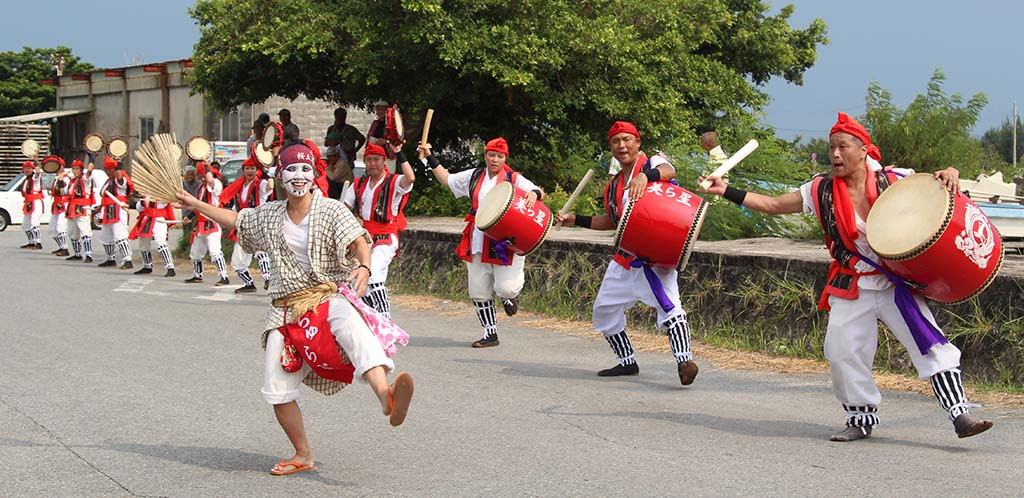
On summer nights during Obon, the Buddhist festival of the dead, the residential lanes of central Okinawa fill with drumming. Young men and women from the neighborhood youth association march from house to house, swinging big barrel drums and small hand drums, while a singer with a three-stringed sanshin keeps the tune and a white-faced clown darts in and out of the line. This is eisa, Okinawa’s Obon dance. It began as a Buddhist chant for the dead and became, over the twentieth century, the most recognizable sound and image of Okinawan identity. Here is what eisa is, where it came from, and how to see it.
01Three Nights for the Ancestors
Eisa only makes sense inside Okinawan Obon. Mainland Japan mostly moved Obon to mid-August of the solar calendar, but Okinawa still keeps it by the old lunar calendar, on the 13th to 15th days of the seventh lunar month. That puts it somewhere in August or early September, on different dates each year.
The three days follow a set rhythm. On the first, called unkē (welcoming), families set out offerings at the household altar and welcome the spirits of their ancestors home; by some accounts, some households also light a fire at the gate to greet them. The middle day is for visiting relatives and paying respects at their altars. On the last night, ukui (sending off), the family burns paper money for the ancestors’ use in the other world and sends them back, usually late at night. Ancestor veneration runs deep in Okinawa, and Obon is a time when people who have moved away come home, supermarkets stack up ready-made offering boxes, and whole families crowd into the family home.
Eisa fits into those nights. Traditionally, the young people of each village or urban district, organized through their seinenkai (youth association), parade through the neighborhood after dark. They stop in front of houses, dance and sing for the household’s ancestors, and receive drinks, snacks, or a small cash gift in return. The procession is called michijunē, roughly "going along the road." The send-off night is the loudest and longest. The idea is to see the ancestors off in good spirits, and also to comfort the wandering spirits who have no family to remember them, so they will move on rather than linger.
For the dancers, eisa is also the social core of summer. Practice starts weeks before Obon, in the evenings after work or school, on the lot outside the community hall. Older members teach the younger ones, roles get assigned, and friendships and rivalries form. Ask Okinawans of almost any generation about their youth and eisa practice comes up quickly.
02Drums, Song, and the Shape of the Line
An eisa troupe has distinct parts, and once you know them the performance becomes much easier to read.
The heaviest role belongs to the ōdaiko, a large barrel drum slung at the hip on a strap. The drummer strikes it with a single stick while spinning, crouching, and leaping, which takes real strength. Next come the shimedaiko, smaller double-headed drums with their skins laced tight, giving a sharp crack. Then there is the pārankū, a small single-headed frame drum about the size of a wide bowl, held in one hand and struck with a stick in the other. Because it is light, pārankū players make the biggest, most acrobatic movements.
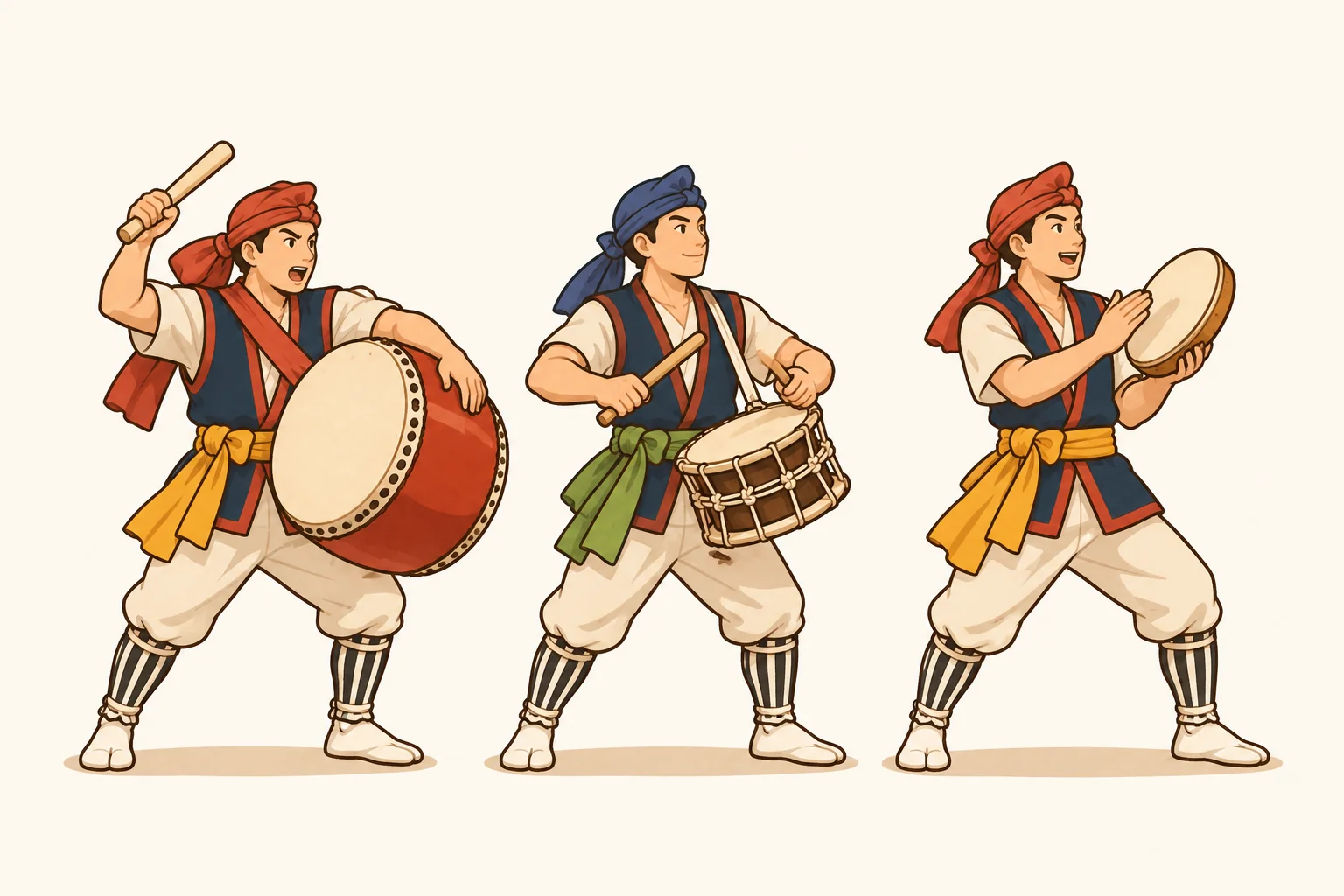
The three eisa drums: the ōdaiko, the shimedaiko and the pārankū.
Dancers without drums perform teodori, hand dances drawn from Okinawan folk dance, with turning wrists and open fingers. In older eisa the division was clear: men drummed and women danced with empty hands. Many troupes today mix it up.
The music comes from the jikata, the singer-musicians who play sanshin, Okinawa’s snakeskin-covered three-stringed lute, usually with a microphone and portable speakers at the side of the line. The repertoire is Okinawan folk song. One of the most common pieces, "Chunjun Nagari," named for the village of Chunjun in Kitanakagusuku and by one account often used as the opening number, is usually described as a slow song about filial duty and remembering parents, close in mood to the Buddhist chants eisa grew from. Later the tempo picks up with lively songs such as "Tōshin Dōi," and the crowd starts clapping and waving. Many songs carry the refrain "eisā, eisā, hiyarugā eisā," and one theory holds that the dance takes its name from shouts like this, though the origin of the word is still unsettled.
Up close, what hits you first is the unison. Dozens of drums land on the same beat, loud enough to feel in your chest. Between strikes the drummers turn, kick, and drop low together, sticks raised overhead, so the whole line rises and falls like a wave. The troupe shouts calls such as "iyasasa!" and "haiya!", and people in the crowd put fingers in their mouths and answer with piercing whistles, the Okinawan way of cheering.
Then there is the chondarā, a clown with a whitened face and a deliberately ridiculous costume. He runs ahead to clear the road, teases the onlookers, mocks the dancers, and keeps the line in order. He is funny, but he is also a living memory of eisa’s origins.
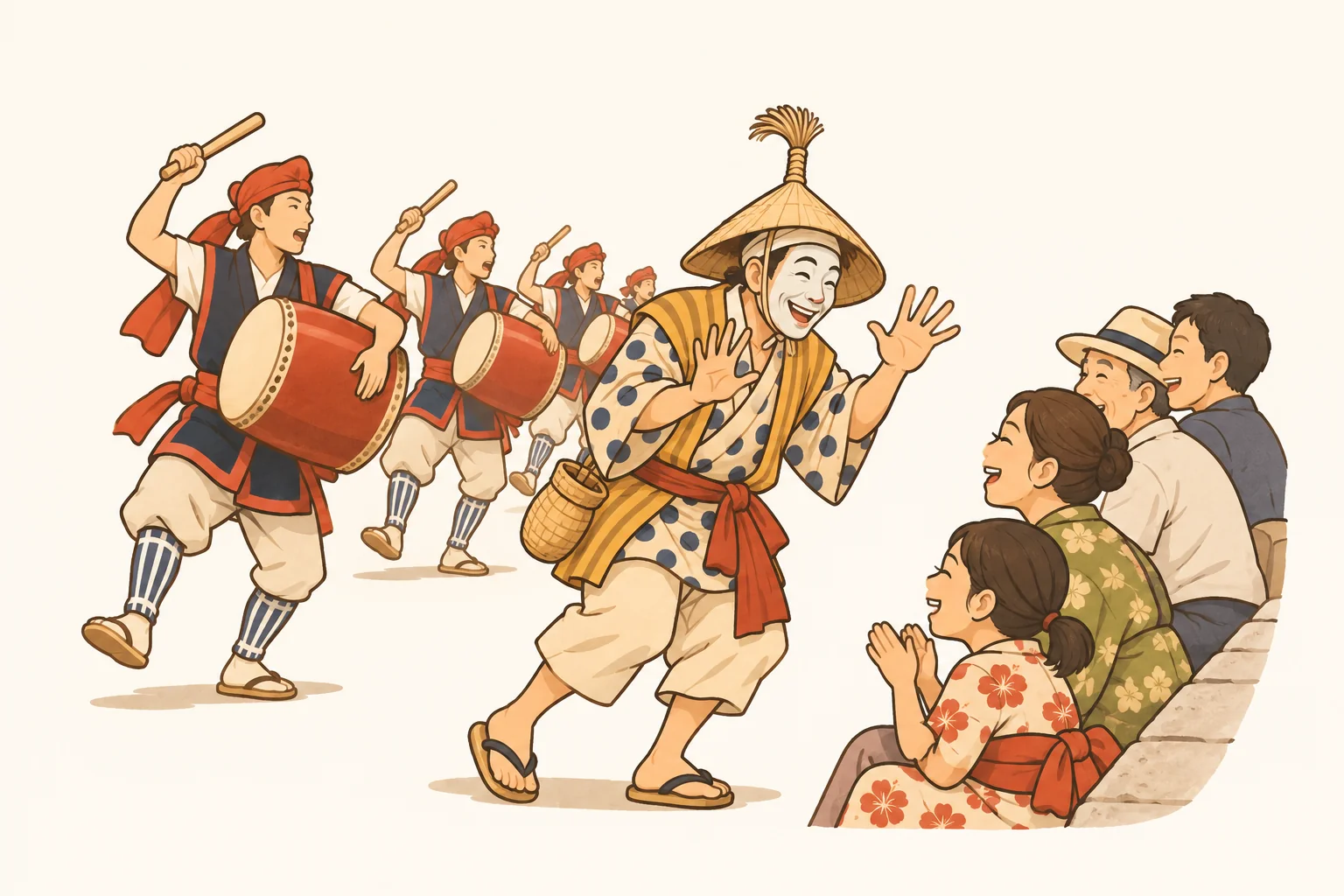
The chondarā, a white-faced clown, teases the onlookers beside the eisa troupe.
Costumes vary by troupe and are part of each neighborhood’s identity. Drummers typically wear a cloth wrapped around the head, a short jacket or vest, a broad sash in the troupe’s colors, leggings, and straw sandals or split-toe socks. Women often wear indigo kimono-style garments with a hat or headcloth. Regular spectators can tell which district a troupe comes from just by its colors.
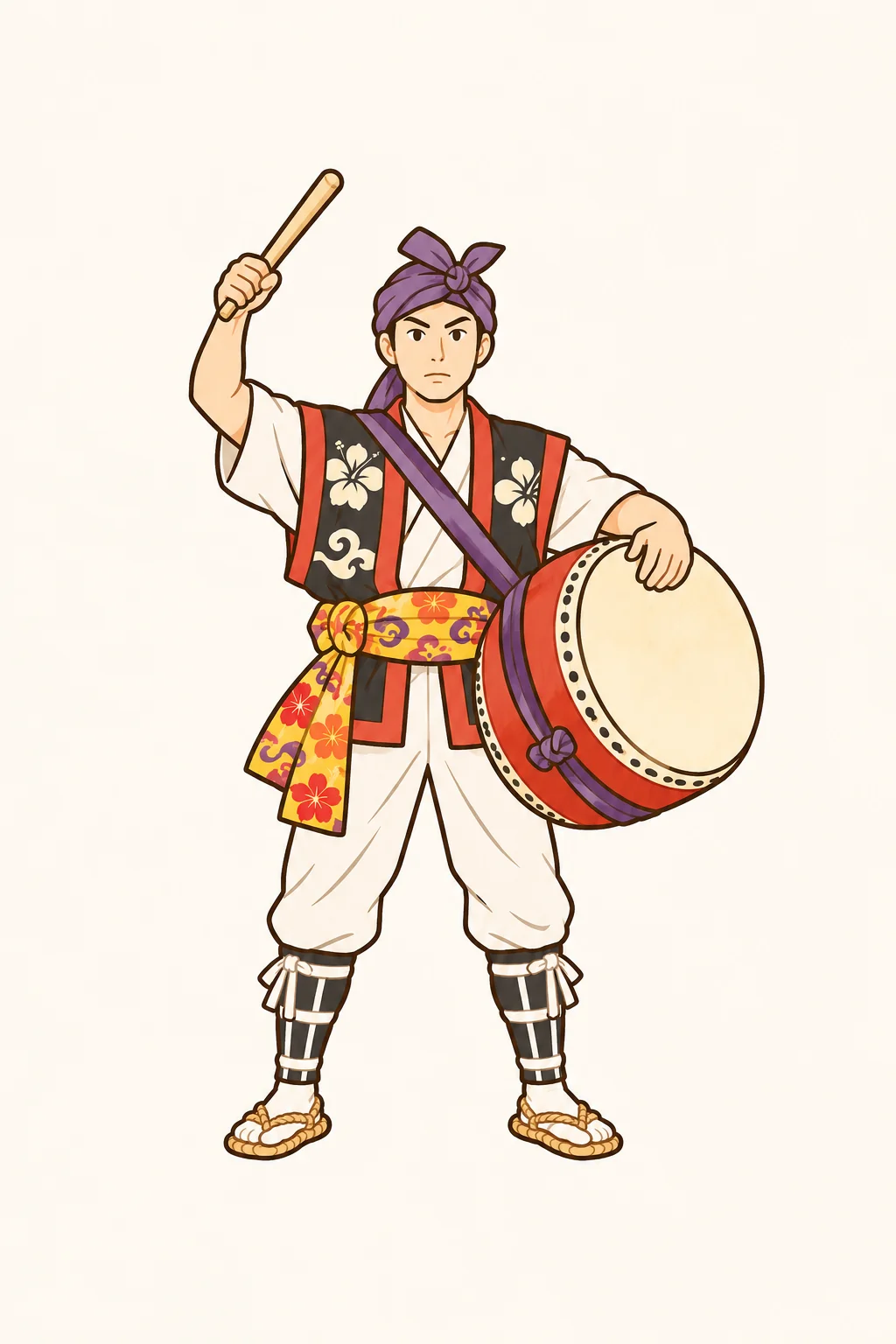
A drummer with an ōdaiko typically wears a head cloth, short jacket, broad sash and leggings.
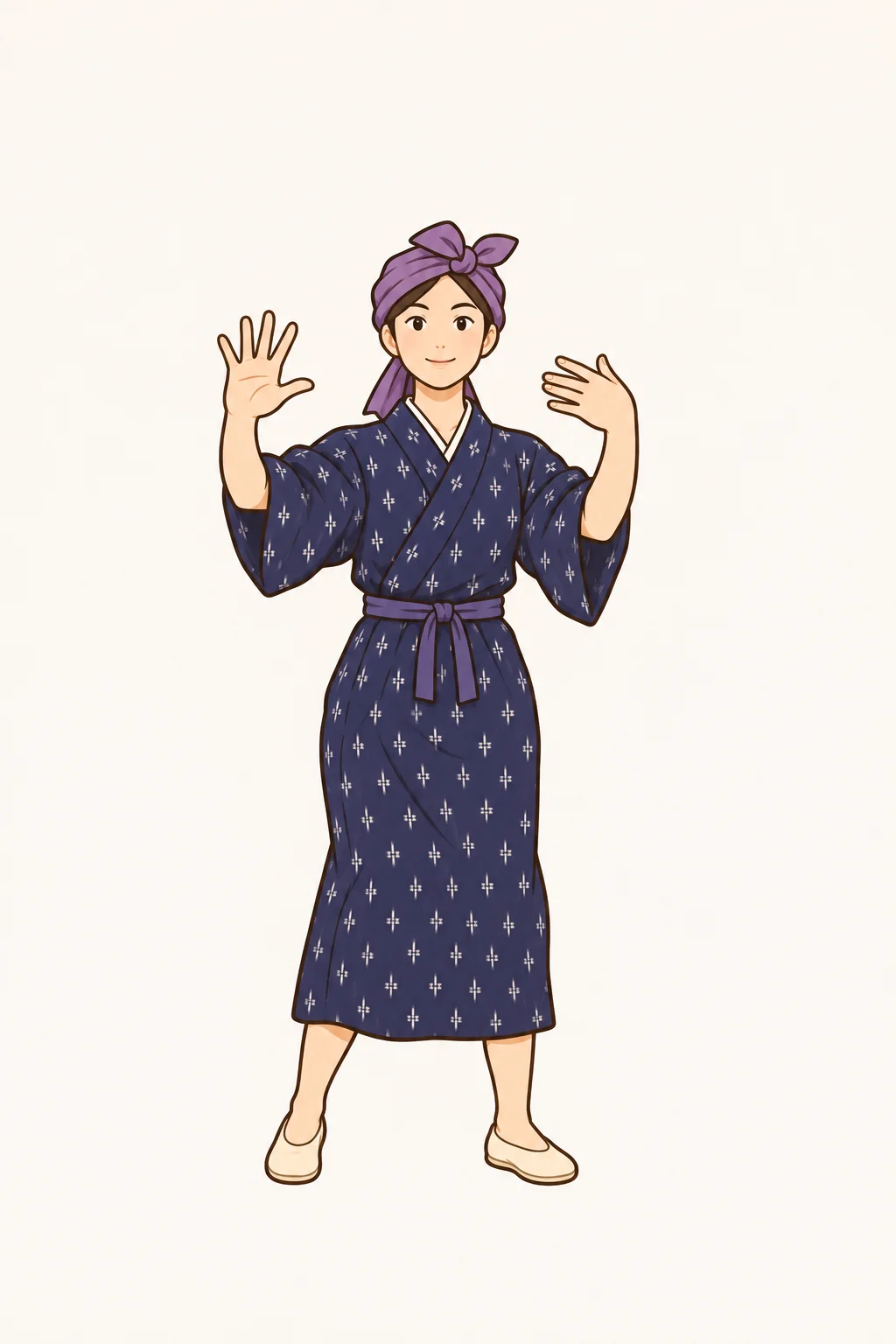
Women hand dancers often wear an indigo kimono-style garment and a headcloth, and carry nothing.
03From Buddhist Chant to Youth Dance
The usual account traces eisa back to a Buddhist monk from mainland Japan named Taichū, of the Pure Land school, who traveled to the Ryūkyū Kingdom in the early 1600s and spent a few years in Naha teaching the nenbutsu, the chanted invocation of Amida Buddha. After him, a class of professional chanters known in Okinawan as ninbuchā appeared. They sang nenbutsu songs at funerals and memorial rites and went door to door during Obon. They overlapped with the chondarā (written 京太郎, "Kyoto Tarō"), itinerant entertainers who performed puppet plays and street arts alongside their chanting. In the kingdom they were a low-status group, said to have lived on the edges of the capital, Shuri.
From these chanters, the nenbutsu songs spread into farming villages, where young people took them up, added local songs and dance, and eventually drums. The shift from professional chanting to a village youth dance probably happened gradually around the late nineteenth and early twentieth centuries, the period when Japan annexed Ryūkyū as Okinawa Prefecture in 1879. In many places early eisa had only singing and hand dancing; the drums that now define it became central later. The clown, meanwhile, stayed in the line as a trace of the dance’s older history.
By the early twentieth century eisa was danced across much of Okinawa Island, each village with its own style. It was still a strictly local affair. Then the Battle of Okinawa in 1945 destroyed many communities outright, and eisa stopped in many places for years.
04Koza and the Postwar Revival
Eisa left the village because of a contest. After the war, the town of Koza, today Okinawa City, grew up beside Kadena Air Base as a bustling base town of bars, neon, and American servicemen. In 1956 Koza held its first island-wide eisa competition, inviting youth associations from around Okinawa to perform on one field. Competition changed the dance. Troupes grew bigger, added more drums, sharpened their formations, and aimed for visual and sonic impact. The contest later dropped its rankings and became the All-Island Eisa Festival, still held every year in Okinawa City on the weekend after Obon and still the largest eisa event anywhere.
The festival also fixed a vocabulary that spectators still use. Troupes are judged, informally now, on the depth and togetherness of the drumming, the sharpness of the formations as the line coils and splits, the strength of the singing, and the energy the dancers keep up across a long set. Neighborhood pride rides on it, and a troupe that makes its name at the festival gets invited to perform all over the island.
Okinawa stayed under US administration until 1972, and in those years eisa meant more than a festival. Rebuilding a troupe meant rebuilding a neighborhood. Dancing eisa was a way for Okinawans to assert a culture that was neither American nor simply Japanese. Young people who left to work in mainland cities carried it with them. The Okinawan community in Taishō Ward, Ōsaka, started its own eisa festival in the 1970s, and the drums can also be heard in Okinawan emigrant communities in Hawaii, Brazil, and Peru.
Okinawa City now calls itself the "City of Eisa," and central Okinawa is where the dance is most famous. The Sonda youth association in Okinawa City is known for powerful, flamboyant drumming. Heshikiya, in Uruma City, is famous for the opposite: dancers in plain, old-fashioned costume, known for the pārankū hand drum (by one account the men carry only pārankū and dress all in white), moving with a restrained, almost severe elegance. In parts of northern Okinawa eisa centers on women’s hand dances with few drums. Farther south, in the Miyako and Yaeyama islands, eisa is not the main Obon tradition at all; Yaeyama has angama, in which masked figures representing ancestors visit homes and joke with the living.
05Creative Eisa
In 1982 a group called Ryukyukoku Matsuri Daiko was founded, and it changed what eisa could be. It was not tied to any village or to Obon. Its members came from all over, it built new choreography around massed big drums, and it performed year-round on stages and at events. This style is called sōsaku eisa (creative eisa), and the village tradition danced during Obon came to be called shichigatsu eisa, "seventh-month eisa," to distinguish it.
Creative eisa took the dance into school sports days, corporate events, theme parks, and stages abroad. Most Okinawan schoolchildren now learn some eisa, and plenty of them first pick up a pārankū for a school sports festival. Some older Okinawans worry that the Buddhist purpose gets lost in the spectacle. Still, this open form is a big reason eisa became what Okinawans reach for when they want to show who they are, and there are now eisa clubs at universities in Tokyo and overseas run by people with no Okinawan roots at all.
06Seeing Eisa in Okinawa
The most authentic experience is a neighborhood procession during lunar Obon in central Okinawa. Look up that year’s Obon dates first, then after dark wander the residential streets of Okinawa City, Uruma, or Kitanakagusuku and follow the sound of drums. When a troupe is moving, step aside and let it pass; when it stops to dance in front of a house, watch from the edge. This is a family’s ritual for its ancestors, so do not push into the line, and avoid firing a flash into drummers’ faces. On the send-off night, troupes can still be on the road well after midnight.
If your trip misses Obon, there are big set-piece events. Naha holds the Ten Thousand Eisa Dancers Parade along Kokusai-dōri, the main shopping street, with troupe after troupe dancing down the road; it is the easiest introduction for a first-time visitor. It was long held on the first Sunday of August, but since 2024 it has moved to October to spare dancers the heat, and it was still held in October as of 2026. The All-Island Eisa Festival runs for three days in Okinawa City after Obon, with famous village troupes performing in turn before a stadium crowd. Koza also has a small eisa museum where you can see costumes and drums and try striking one. The rest of the year, resort hotels, theme parks, and folk-music bars often stage creative eisa.
Most performances end with kachāshī. The musicians shift into a fast song, and dancers and spectators raise their hands above their heads and twist their wrists back and forth, dancing however they like. Onlookers often get pulled in at this point. The right response is to raise your hands and join.