
At a glance
How a python-skin lute moved from the Ryūkyūan court to villages and tin-can camps, fathered the shamisen, and how visitors can hear and play it.
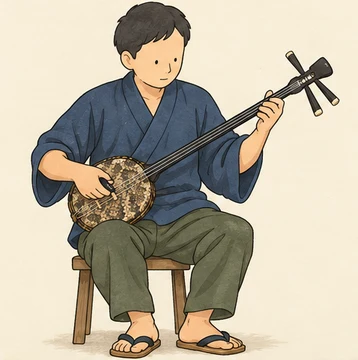
- The sanshin is a three-stringed lute with a python-skin drum, plucked with a horn pick worn on the right index finger.
- It is usually thought to have come from the Chinese sanxian in the late 14th or 15th century, through Ryūkyū’s ties with Ming China.
- In the late 16th century it reached the port of Sakai, where biwa players reworked it into the shamisen.
- Sanshin music is written in kunkunshi, a vertical grid of Chinese characters that learners still use today.
- Since 1993, March 4 has been Sanshin Day, when people play "Kajadifū" together at each hourly time signal.
Spend an evening in Naha and you will hear it: a bright, slightly buzzy plucked tone drifting out of a bar, a souvenir shop, a wedding hall. That is the sanshin, a three-stringed lute with a body covered in python skin. It arrived in the Ryūkyū Kingdom from China, became a mark of refinement among the court aristocracy, spread to farming villages, survived the devastation of 1945 in versions made from tin cans, and in the 1990s carried Okinawan music into the Japanese mainstream. Along the way it also gave birth to the mainland shamisen. This is an introduction to what the instrument is, why it sounds the way it does, how it got here, and how a visitor can hear it, hold it, and even play a few phrases.
01Anatomy of a Sanshin
A sanshin has three main parts: a long neck, a small rounded-square drum body, and a head that curls gently backward at the top. Okinawans judge an instrument first by its neck. The prized wood is kuruchi, the dense black ebony of the Yaeyama Islands, which polishes to a lacquer-like gloss and resists warping. Island-grown kuruchi is now scarce, so many necks today are made from imported ebony from Southeast Asia or from lighter, cheaper hardwoods.
The drum is a wooden frame covered on both faces with skin, traditionally Burmese python. The scale pattern is the instrument’s visual signature, and the skin is a large part of its voice. The strings press down on a small bridge resting on the skin, and when a string is plucked the skin vibrates like a drumhead. Because wild python is regulated under the international convention on trade in endangered species, three kinds of covering are now common: honbari, a single natural skin; kyōka-bari, natural skin stretched over a nylon backing; and synthetic skin printed with a scale pattern. Beginners usually choose synthetic, which shrugs off humidity and will not split. Players who care about tone still insist on honbari, and in Okinawa’s damp climate a natural skin tightens and slackens with the seasons. An experienced player can tell the weather from the first note.
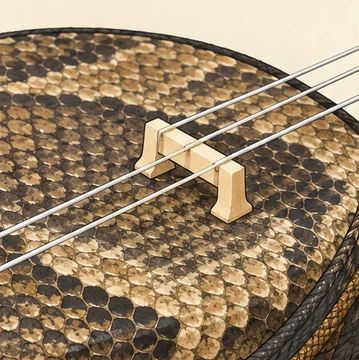
The three strings press on a small bridge resting on the python skin, which vibrates when a string is plucked.
Around the drum many players wrap a decorative cloth band called a tiigaa, woven in red, gold, or black patterns. Three tuning pegs, called karakui, stick out sideways below the head. The strings run from thick to thin and are named the male string (ūjiru), the middle string (nakajiru), and the female string (mījiru).
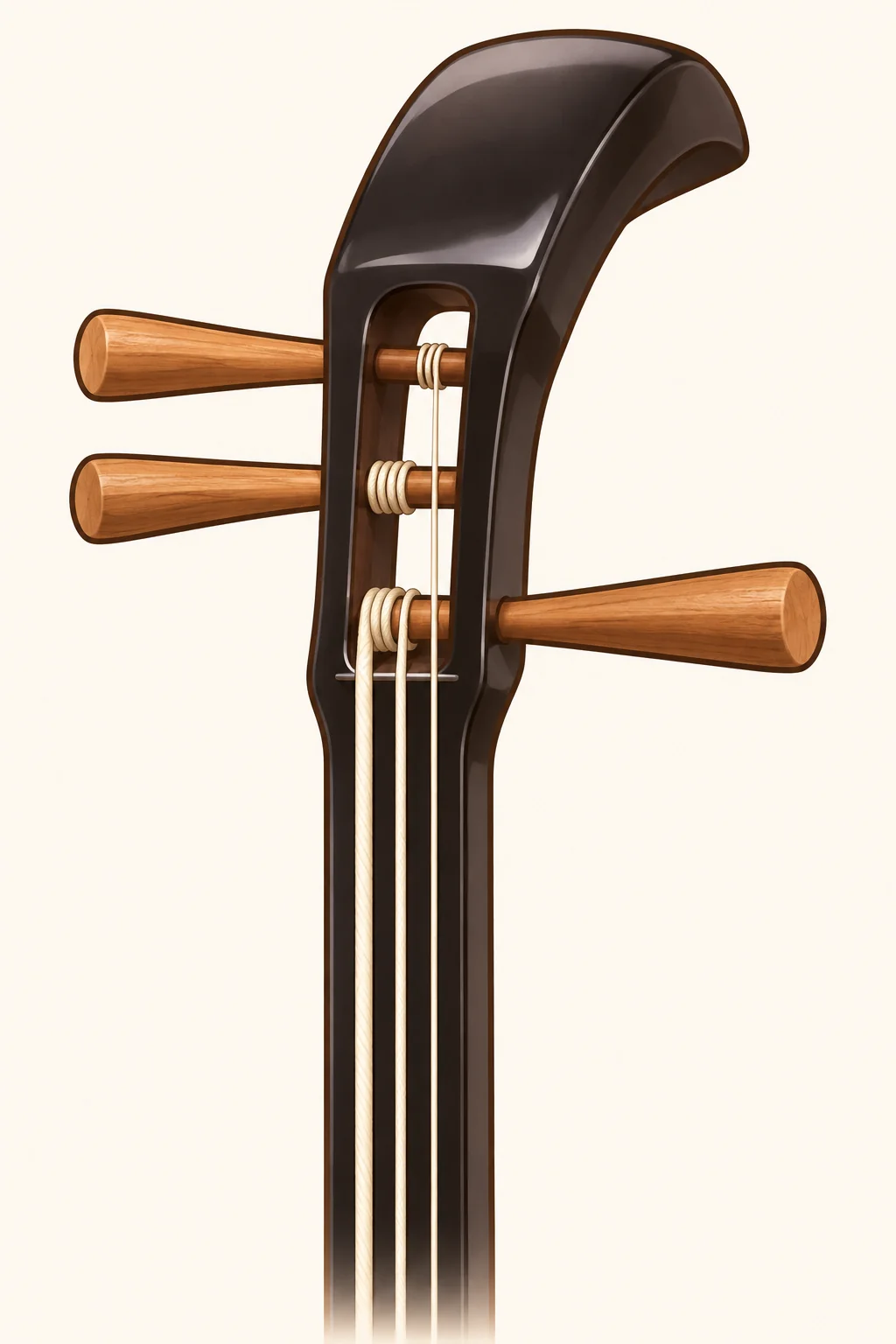
Three tuning pegs, called karakui, stick out sideways below the sanshin’s head, one for each string.
The sanshin is not plucked with the bare fingers. The player slips a pick called a tsume, usually carved from water buffalo horn, over the right index finger like a long curved fingernail, and strikes downward or hooks the string back up. The neck has no frets; the left hand finds its positions by ear and memory.
- 1Headcurls gently backward at the top
- 2Karakuithree tuning pegs below the head
- 3Neckprized wood is kuruchi; no frets
- 4Drumrounded-square frame, skin on both faces, traditionally python
- 5Tiigaadecorative cloth band around the drum
- 6Three stringsthick to thin: male, middle, female
- 7Tsumewater buffalo horn, on the right index finger
From the head downward, plus the pick worn on the right index finger.
Okinawans classify necks with remarkable precision. Depending on the shape of the neck and head, an instrument belongs to one of seven named styles that had taken shape by the end of the kingdom: Haebaru, Chinen Dēku, Kuba Shunden, Kuba no Hone (a second Kuba Shunden pattern), Mabiji, Hiranaka Chinen, and Yunagusuku, each named after a master maker of the royal period. Mabiji and Yunagusuku have long been the favorites; a common saying holds that Mabiji, with its clean lines, is the orthodox form, while the thick-necked Yunagusuku is the most widespread. A handful of celebrated Mabiji instruments surviving from the kingdom carry the honorific kējō, usually explained as a sound as clear and far-carrying as a temple bell at dawn. Another telling has it that a kējō played at daybreak could be heard far off, announcing the morning. In 1955 three kējō and eight other fine old instruments were designated cultural properties (today they are Okinawa Prefecture designations), and most remain family heirlooms, though some are said to be kept on deposit in museums.
02Why It Sounds the Way It Does
Listeners hearing the sanshin for the first time often say it is brighter than the shamisen and softer than the Chinese sanxian. The mainland shamisen is struck with a large ginkgo-leaf plectrum against cat or dog skin, so its tone has a percussive snap. The sanshin’s horn pick produces something gentler, with a short, warm decay off the python skin. It sounds less like a drum and more like a voice speaking quietly.
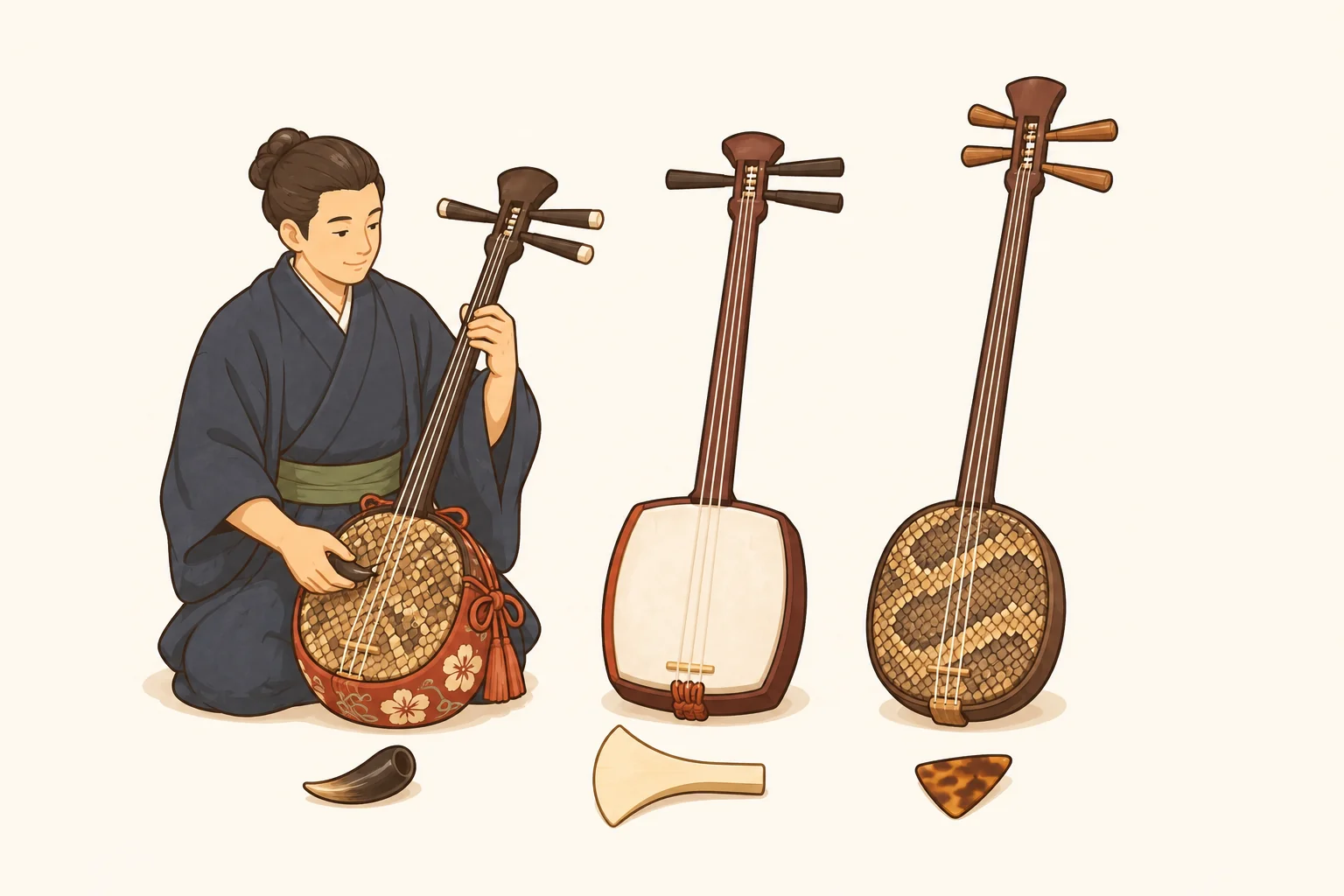
The Okinawan sanshin, the mainland shamisen and the Chinese sanxian, each with its pick.
That suits its job. The sanshin is above all an instrument for accompanying song. Almost all Okinawan classical music is vocal, and the person playing the sanshin is usually the person singing. The instrument shadows the voice, doubling the melody, filling the pause between phrases, giving the singer a place to breathe. In the classical repertoire a single syllable can stretch for many seconds while the sanshin walks beneath it note by note at a stately pace.
Okinawan scales give the sound its particular color. Folk songs from the main island lean on what is called the Ryūkyū scale, a five-note scale that drops the second and sixth degrees, leaving roughly do, mi, fa, sol, ti. It has neither the dusky melancholy of mainland Japanese folk song nor the squareness of a Western major scale. It is sunny with an undertone of longing, and for many Japanese listeners those few intervals alone summon an image of Okinawan sea and light.
Tuning is simple and expressive. The basic honchōshi tuning sets the strings in fourths and fifths. Raising the middle string a whole step gives niage, often used for lyrical songs, and by some accounts especially for sad ones; lowering the female string a whole step gives sansage, darker and heavier. The same instrument can change mood completely with a twist of a peg.
03From Chinese Sanxian to the Ryūkyūan Court
The sanshin descends from the Chinese sanxian, but exactly when it reached Ryūkyū is not recorded. The usual view is that it arrived in the late fourteenth or fifteenth century, after the islands entered into tributary relations with Ming China, carried by envoys, traders, and the Fujianese families who settled in Kume Village in Naha. Okinawan tradition offers its own founding figure, Akainko, said to have been a poet-singer from Yomitan who wandered the islands with his sanshin and gave Okinawa its songs. A shrine to him still stands at Sobe in Yomitan, and on Sanshin Day each March villagers gather there to offer sanshin music and dance; the shrine is also said to hold an annual festival of its own. The story is legend rather than history, but it shows how deeply Okinawans regard the instrument as their own.
In the Ryūkyū Kingdom the sanshin carried real prestige. The royal government employed official sanshin makers, called sanshin-uchi, in its Kaizuri bugyōsho, the workshop office for lacquer and crafts. Some accounts add that King Shō Eki created a post called sanshin nushidui in 1710 to oversee the making of fine instruments. The kingdom’s most important diplomatic occasions were the visits of the sappōshi, Chinese envoys sent to invest each new Ryūkyūan king. They stayed in Ryūkyū for months, and the court entertained them with banquets, dance, and music in which the sanshin played its part. In 1719 the court official Tamagusuku Chōkun created kumiodori, a form of musical drama combining song, dance, and chanted dialogue, to entertain these envoys. The sanshin was the backbone of its accompaniment. Kumiodori was designated an Important Intangible Cultural Property of Japan in 1972 and inscribed on UNESCO’s intangible heritage list in 2010.
For the Ryūkyūan aristocracy the sanshin was an essential accomplishment, ranked alongside reading and calligraphy. A saying often repeated in Okinawa holds that where a mainland samurai displayed a sword in the alcove of his main room, a Ryūkyūan gentleman displayed a sanshin. The line has some later romance in it, but a fine sanshin really was a family’s pride, handed down through generations.
Classical music developed schools. Tansui Ueekata, a seventeenth-century official, is honored as the fountainhead of the classical tradition, and his style survives as the Tansui school. In the eighteenth century Yakabi Chōki codified a notation called kunkunshi: Chinese characters such as 合, 乙, 老, 四, 上, 中, 尺, 工 mark finger positions (some scores also use 八 and 九), written in vertical columns in a grid that looks like a sheet of manuscript paper. Students still learn from kunkunshi rather than Western staff notation. In the nineteenth century the classical tradition divided into two main schools, Afuso and Nomura, and the kunkunshi compiled by Nomura Anchō became the standard text of the Nomura school. The two share most of their repertoire but differ in vocal technique and rhythm, and both have large followings today.
04North to Japan: The Birth of the Shamisen
In the second half of the sixteenth century, around the Eiroku era (1558–1570), the sanshin traveled north from Ryūkyū to the port of Sakai near Ōsaka. There it was first taken up by blind biwa players, who reworked it for local materials and tastes. They replaced the snakeskin with animal hide, eventually settling on cat or dog skin, and borrowed the biwa’s big plectrum in place of the horn finger pick. One account adds that, since python skin was hard to obtain on the mainland, they also lengthened the neck and enlarged the body. The result was the shamisen, which went on to become the voice of kabuki, the bunraku puppet theater, and the music of the pleasure quarters. Okinawans like to point out, with some satisfaction, that the most quintessentially "Japanese" stringed instrument of the Edo period has a Ryūkyūan parent.
05Villages, War, and Tin Cans
Under the kingdom, the sanshin belonged mainly to the gentry of Shuri and Naha. That changed after Japan annexed Ryūkyū in 1879 and turned it into Okinawa Prefecture. The royal government was dissolved, many aristocratic families lost their stipends, and some moved to the countryside to farm. By the usual account, they took their instruments and their court repertoire with them, and the sanshin spread through the villages and fused with local songs, giving rise to a rich folk tradition. The songs of the main island, of Miyako, and of Yaeyama each have their own character: Yaeyama songs are long and unhurried, many of them narrative ballads of work and love, while Miyako songs have a stronger, earthier pulse.
Village youth used to gather on moonlit nights at the beach or a crossroads for mōashibi, "field play," singing to the sanshin, dancing, and courting through song. Modern authorities considered these gatherings immoral and repeatedly banned them, but the instrument had put down roots too deep to pull out. It is also indispensable to Eisa, the summer Bon dance in which young people parade through the streets beating drums. Behind the dancers walk the jikata, the singers and sanshin players whose music sets the pace for the entire troupe.
The Battle of Okinawa in 1945 destroyed nearly everything, including many fine old instruments. In the internment camps after the battle, survivors built sanshin out of whatever the US military left behind: a tin can for the body, scrap wood for the neck (some, it is said, pulled boards from their beds), parachute cord for strings. These kankara sanshin, "tin-can sanshin," let people sing together through months of loss and displacement. They became an emblem of postwar Okinawa, and people still make and play them today.
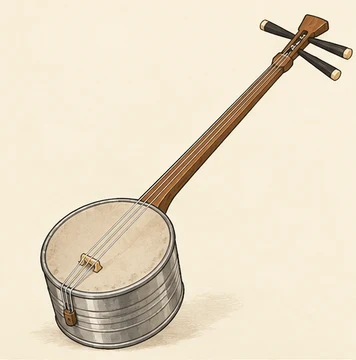
In the postwar camps a tin can served as the drum and scrap wood as the neck (general illustration).
06Okinawan Music Goes National
In the decades after the war, Okinawan folk song flourished on local record labels and radio. Kadekaru Rinshō, often called the god of shima-uta (island song) and dubbed the god of folk song in the press, influenced generations with his free, improvisatory singing. Noborikawa Seijin was celebrated for his fast, nimble playing. In the 1970s Kina Shōkichi and his band Champloose mixed the sanshin with rock rhythms in "Haisai Ojisan" ("Hey, Uncle"), which became a hit in Okinawa and later spread to the mainland. After Okinawa reverted from US administration to Japan in 1972, mainland curiosity about the islands grew steadily.
The sound truly went national during the Okinawa boom of the 1990s. Teruya Rinken’s Rinken Band and the female vocal group Nenes brought Okinawan scales into popular music. In 1992 THE BOOM, a rock band from Yamanashi Prefecture, released "Shima Uta" ("Island Song"). Its singer, Miyazawa Kazufumi, had been moved by what he learned of the Battle of Okinawa at the Himeyuri Peace Museum and wrote the song with sanshin and the Ryūkyū scale. It became a national hit and was later covered abroad, especially in Argentina. The Okinawan band BEGIN wrote "Shimanchu nu Takara" ("Treasure of the Islanders"), Natsukawa Rimi made a hit of "Nada Sōsō" ("Tears Flowing"), and in 2001 the NHK morning drama Churasan put sanshin music into living rooms across Japan every day. Sanshin classes opened throughout the mainland, and learning the instrument became a popular hobby.
In Okinawa itself the sanshin is simply part of life. Since 1993, March 4 has been Sanshin Day, a pun on san (three) and shi (four). Ryukyu Broadcasting runs a long live radio program, and at each hourly time signal from around noon until 8 p.m., people across the prefecture and in Okinawan communities in Hawaii, Brazil and elsewhere play and sing "Kajadifū" together. Kajadifū is the auspicious opening piece for weddings, longevity celebrations, and shop openings, and nearly every Okinawan can hum some of it.
The craft has also won official recognition: in 2018 the sanshin was designated a national Traditional Craft Product by the Minister of Economy, Trade and Industry, giving workshops and young makers a measure of security. Emigrant communities in Hawaii, South America, and the continental United States keep the tradition alive, and for them the sanshin is a badge of Okinawan identity.
07Hearing, Holding, and Playing One
The easiest way to hear the sanshin is at a min’yō bar in Naha, a pub with live folk music. Around Kokusai-dōri and the surrounding streets are many such places, where one to three singers perform each evening, moving from classical celebratory pieces to "Shima Uta" and "Nada Sōsō." Late in the set the musicians usually break into a fast kachāshī, and the whole room stands up to dance with hands raised, wrists turning side to side. Locals will wave you in. Don’t be shy; just copy the hands.
For the classical repertoire, check the program at the National Theatre Okinawa in Urasoe, which regularly stages kumiodori and Ryūkyūan dance. A row of musicians called the jiutai sits at the side of the stage, sanshin joined by koto, flute, a bowed fiddle called kūchō, and drum, while singers stretch each syllable at a stately pace. It requires some patience and rewards it. Shuri Castle and some festivals also host public performances of Ryūkyūan classical dance.
To hold one, visit a sanshin shop. Naha has many specialist stores and workshops around Makishi, Kokusai-dōri, and Shuri, and owners generally welcome customers who want to try an instrument. Look first at the neck: the color of the wood, whether it runs straight, how cleanly it meets the body. A beginner’s sanshin with synthetic skin generally costs a few tens of thousands of yen, typically around 30,000 to 50,000 yen as of about 2025; a proper honbari instrument with an ebony neck often runs from over 100,000 yen to several hundred thousand, and old instruments with a pedigree cost more still. If you plan to take a python-skin sanshin home, check your country’s rules on wildlife products; a synthetic-skin instrument avoids the problem.
Best of all, take a lesson. Naha and most tourist areas offer hour-long sanshin experiences. The teacher shows you how to wear the tsume, explains how to read kunkunshi, and has you practice the opening lines of "Asadoya Yunta" or "Shima Uta." Because each character in the grid corresponds to a finger position, kunkunshi is far easier for a beginner than staff notation, and many people can play a complete phrase within the hour. When that first phrase comes out of the instrument in your hands, bright and slightly buzzing, you begin to understand why Okinawans never put it down.