
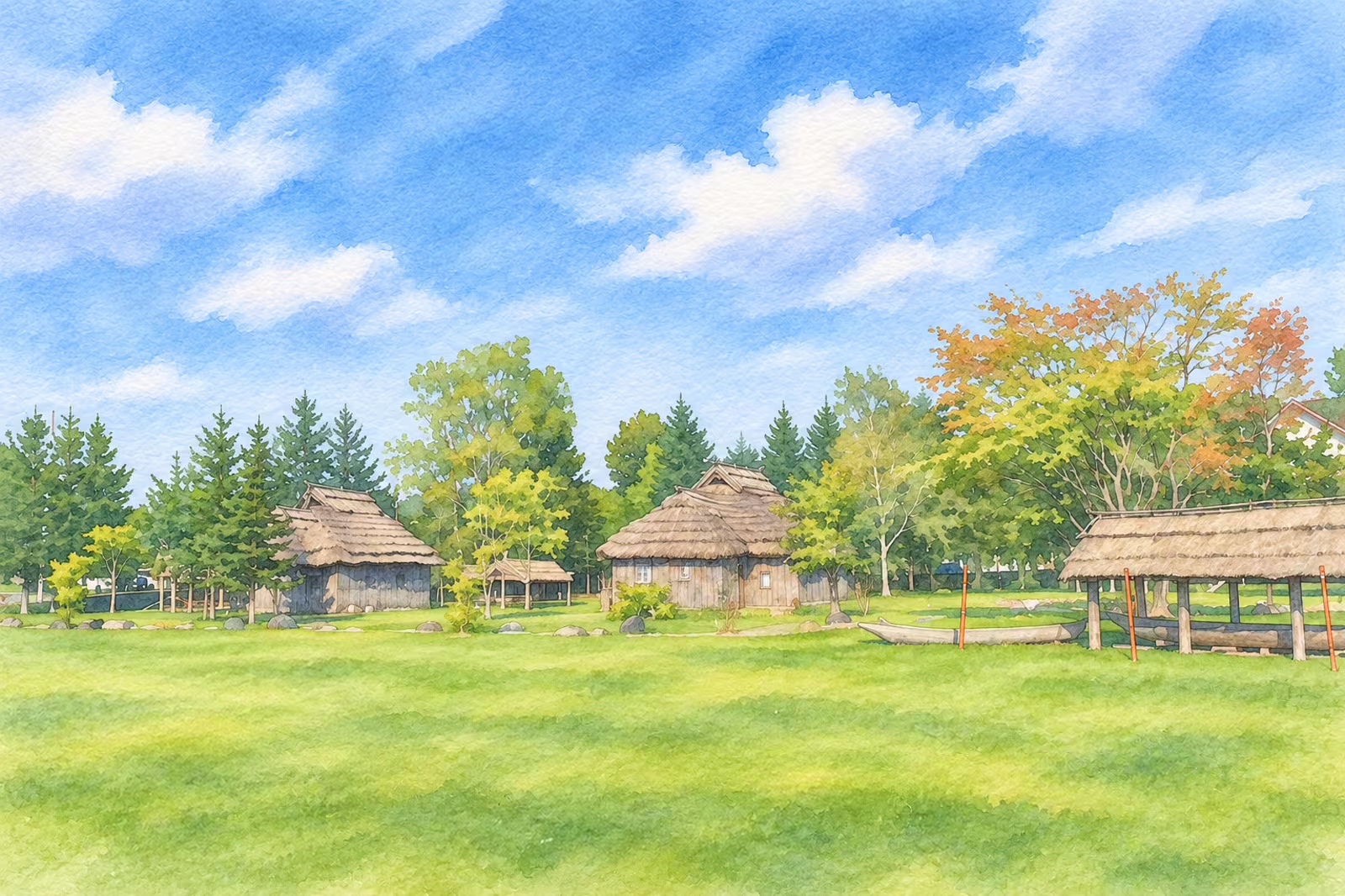
Nibutani lies on the middle reaches of the Saru River in Biratori, a town in the Hidaka region of Hokkaidō. It has one of the highest proportions of Ainu residents of any community in Japan, and its language, oral literature and crafts have been passed down more fully than in most places, making it a leading center of Ainu culture today. In 2007 the "Cultural Landscape of the Saru River Basin Shaped by Ainu Tradition and Modern Settlement" was selected as an Important Cultural Landscape, with Nibutani at its core.
01The Saru River and Ainu villages
The Saru basin has long been home to the Ainu. Villages (kotan) stood along the river; people caught salmon, hunted and gathered in the forests, and wove cloth from elm-bark fiber. Most place names in the valley come from Ainu. In oral tradition, the culture hero Okikurmi is generally said to have come down to this river to teach people how to live. In the late Edo period, the explorer Matsuura Takeshirō and others recorded Ainu villages and their populations here.
After the Meiji government created the Hokkaidō Development Commission, Japanese settlers moved into the valley, clearing farmland, logging forests and building roads. Ainu fishing and hunting were restricted, families were pushed into farming, and assimilation policies badly damaged the transmission of language and custom. The name of the cultural landscape includes both "Ainu tradition" and "modern settlement" because today’s landscape was shaped by both histories.
02Kayano Shigeru and the Nibutani Dam case
Kayano Shigeru (1926–2006), a native of Nibutani, spent decades collecting everyday objects, recording the Ainu language and oral stories, compiling an Ainu dictionary, and founding a museum for his collection. In 1994 he took up a vacated seat in the House of Councillors, becoming the first Ainu member of the National Diet.
From the 1980s the state built the Nibutani Dam on the Saru River, flooding land that included traditional ceremonial sites. Kayano and Kaizawa Tadashi, among other landowners, refused expropriation and went to court. In 1997 the Sapporo District Court recognized the Ainu as an indigenous people of Japan and found the expropriation unlawful, but did not annul it because the dam was already complete. The same year, the Ainu Culture Promotion Act took effect, replacing the Meiji-era Hokkaidō Former Aborigines Protection Act.
03What can be seen today
The two main museums are the Biratori Town Nibutani Ainu Culture Museum and the Kayano Shigeru Nibutani Ainu Museum, which hold tools, ritual objects and recordings of oral literature; part of the town museum’s folk collection is designated an Important Tangible Folk Cultural Property. Nearby stand several reconstructed chise, thatched traditional houses used for display and teaching, all of modern construction, along with woodcarving and weaving workshops. In 2013 Nibutani ita (carved trays) and Nibutani attus (bark cloth) became the first crafts in Hokkaidō designated Traditional Crafts of Japan. The dam and its reservoir sit beside the village, part of the same layered landscape of settlement, farmland and forest.