
At a glance
Explains how Japanese names are read and registered, where surnames came from, how the family register differs from the resident record, and why married couples must still share one surname.
- Japanese names put the surname first, and the same kanji often have several readings, so forms ask for the kana reading.
- Since May 26, 2025, the reading of surnames and given names must be recorded in the family register.
- From 1875, every Japanese person was required to have a surname.
- The koseki records family relationships; the residence record and the setai record address and who lives together.
- Married couples must take one spouse’s surname; about 94 percent choose the husband’s (2024).
Spend any time in Japan and names start to feel weighty. Business cards are exchanged with both hands, documents are stamped with a personal seal rather than signed, colleagues call each other by surname for decades, and at marriage one partner, almost always the wife, gives up the name they have used all their life. Behind these habits lies a system built in the late nineteenth century: every Japanese citizen has a surname, a married couple shares one, and each person’s birth, marriage, parentage and death are entered in a family register called the koseki. Where people actually live, and with whom, is recorded separately. This article explains how Japanese names work, where the country’s enormous variety of surnames came from, what the family register is and why it is not an address book, and why the rule that married couples must share a surname is still argued over today.
01Reading a Japanese Name
Japanese names put the family name first and the given name second, the way they have always been said in Japanese. Since January 2020 government ministries have, as a rule, kept this order when writing Japanese names in roman letters, so official English documents write "Abe Shinzō" rather than "Shinzō Abe," though many media outlets and individuals still use the given name first, and by most accounts many Japanese living abroad still reverse the order in daily use. Both parts are usually written in kanji, the Chinese characters used in Japanese. Among the most common surnames are Satō, Suzuki, Takahashi, Tanaka and Watanabe, and between them they cover several million people.
The catch is that kanji can be read in more than one way. The surname 中田 might be Nakata or Nakada. The girl’s name 和子 might be Kazuko or Wako. The boy’s name 翔 can be Shō, Kakeru or Tsubasa. Japanese people often cannot be sure how to read a stranger’s name, which is why almost every form in the country has a line for furigana, the phonetic kana spelling, and why business cards often print the reading in small type beside the characters.
Parents must register a birth at the local municipal office within fourteen days, and the name can only use characters from two official lists, the "common use" kanji and the supplementary "name kanji," plus the two kana syllabaries. Together they allow roughly three thousand characters. The lists have grown over the decades, often after parents went to court over a single character. Some limits have nothing to do with the character lists: in 1993 a couple in Akishima, west of Tokyo, tried to name their son Akuma, written with two common characters meaning "devil." After consulting the Ministry of Justice, the city declined to complete the registration, the father took the dispute to family court, the case became a national talking point, and the parents eventually withdrew and registered another name.
- 1
 The municipal office mails each person the reading it plans to enter
- 2
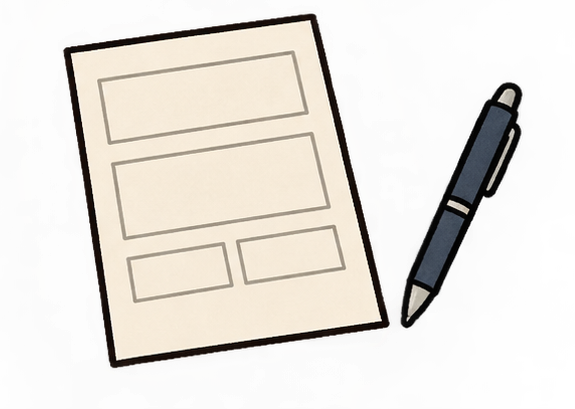 Wrong readings could be corrected by May 25, 2026
- 3
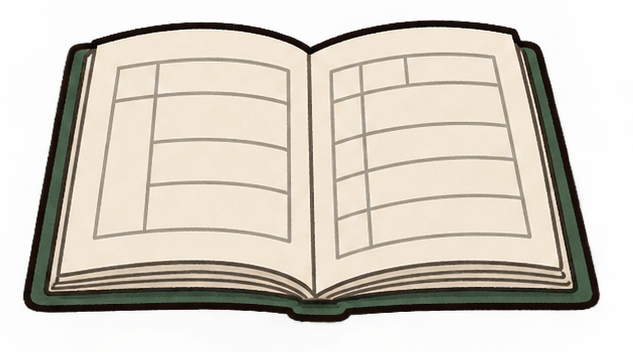 After that, the notified readings were entered on the register
For most of modern history, though, the reading of a name was not regulated at all. Over the last few decades so-called kira-kira ("sparkly") names became common, where familiar characters are given borrowed or invented readings, such as 月 ("moon") read as Runa, or 大空 ("big sky") read as Sukai. A revision of the Family Register Act that took effect on 26 May 2025 requires the reading of every surname and given name to be recorded in the register, and the reading must be one generally accepted for the characters used in names; reading 太郎 (Tarō) as "Jōji," for example, would not be accepted. Municipalities mailed each registered person the reading they planned to enter. Corrections could be filed until 25 May 2026, after which the notified readings were entered on the register.
Names also carry a generation. A woman named Yoshiko, Kazuko or Michiko was very likely born before the 1970s. From the 1920s through the 1950s, names ending in -ko ("child") filled nearly every place in the annual top ten for girls; they declined steadily from the late 1950s and had dropped out of the top ten entirely by 1986. Older men tend to have names like Ichirō ("first son") or Masao, while boys today are more likely to be Ren, Haruto or Minato, names chosen for sound and image rather than birth order.
02Where All the Surnames Came From
Japan has an extraordinary number of surnames. Estimates run from over one hundred thousand to around three hundred thousand, far more than in China or Korea, where by common estimates the surnames in use number in the thousands. The reason lies in history.
In ancient Japan, aristocrats belonged to clans known as uji, such as Minamoto, Taira, Fujiwara and Tachibana, and held hereditary ranks. As these clans branched out over centuries, so many families shared the same clan name that it stopped being useful. Branch families began calling themselves after the place they lived or the land they held. These working names were called myōji. The great court families of Kyoto took names like Konoe and Kujō from the streets and districts of their residences; warrior houses such as the Ashikaga, Tokugawa and Hōjō took theirs from their domains.
That is why so many Japanese surnames read like descriptions of landscape. Tanaka means "in the rice fields," Yamamoto "at the foot of the mountain," Matsushita "under the pine," Inoue "by the well," Kobayashi "small wood." Read aloud, a list of Japanese colleagues can sound like a walk through the countryside.
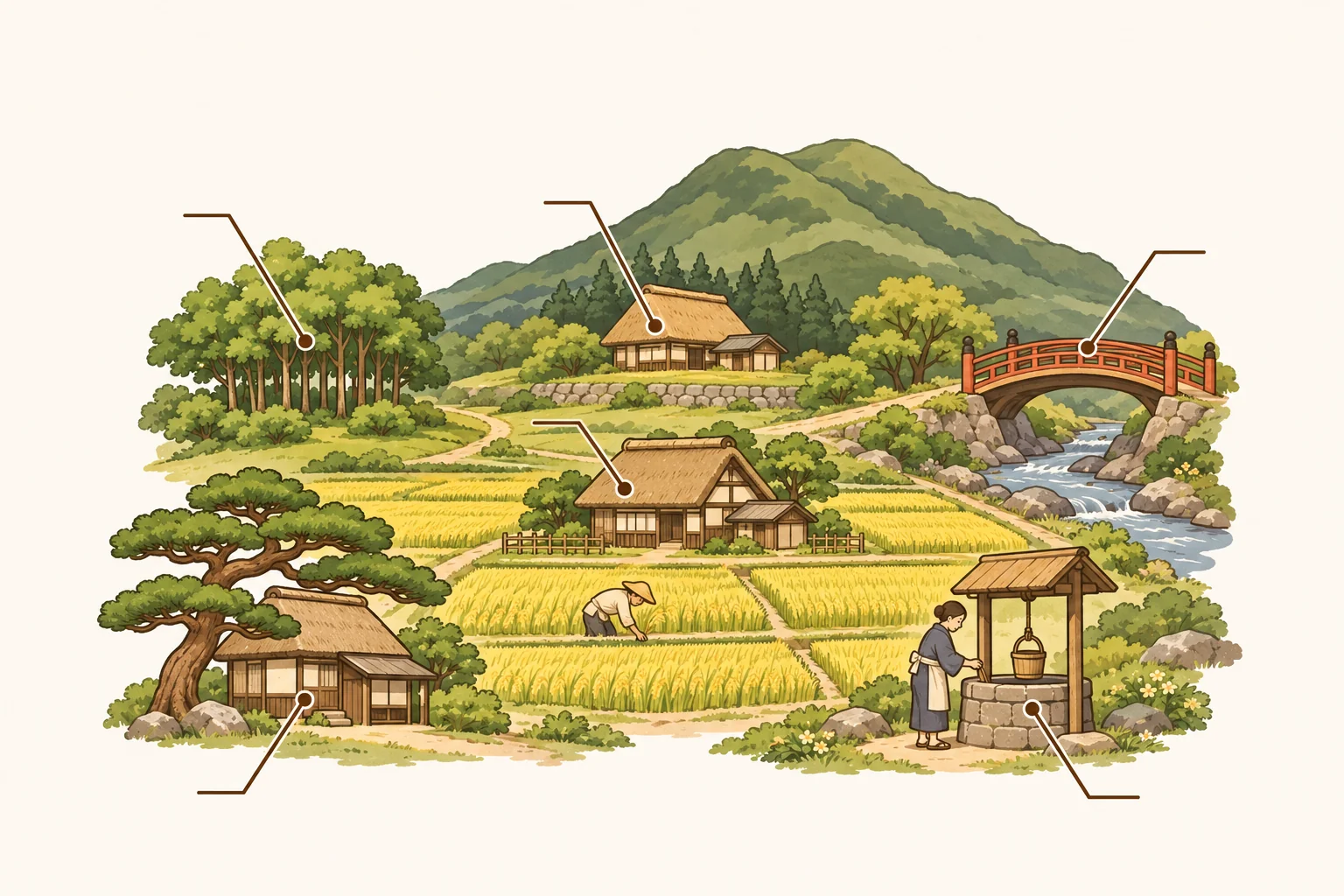
Surnames as landscape: Tanaka, Yamamoto, Matsushita, Inoue, Takahashi and Kobayashi.
During the Edo period (1603–1868), the public use of a surname was, like the right to wear two swords, a privilege of the samurai class. Commoners could be granted it as an honor, and many farming and merchant families in fact had surnames that they used informally in temple records and village documents. After the Meiji Restoration, the new government wanted a uniform national population register. In 1870 commoners were allowed to use surnames publicly; when few bothered, a decree of 1875 required everyone to have one, a step often linked to the army’s need for conscription rolls and, some say, to taxation. Many families simply registered a name they had long used privately. Others asked the village head or a priest to choose one, or took the name of a nearby hill, river or landmark. The explosion of place-based surnames dates largely from those few years.
03The Koseki: A Register of Relationships
To English speakers, a "family register" might sound like a census list or an address directory. The koseki is neither. It records who a person is in relation to other people: whose child, whose spouse, whose adopted parent.
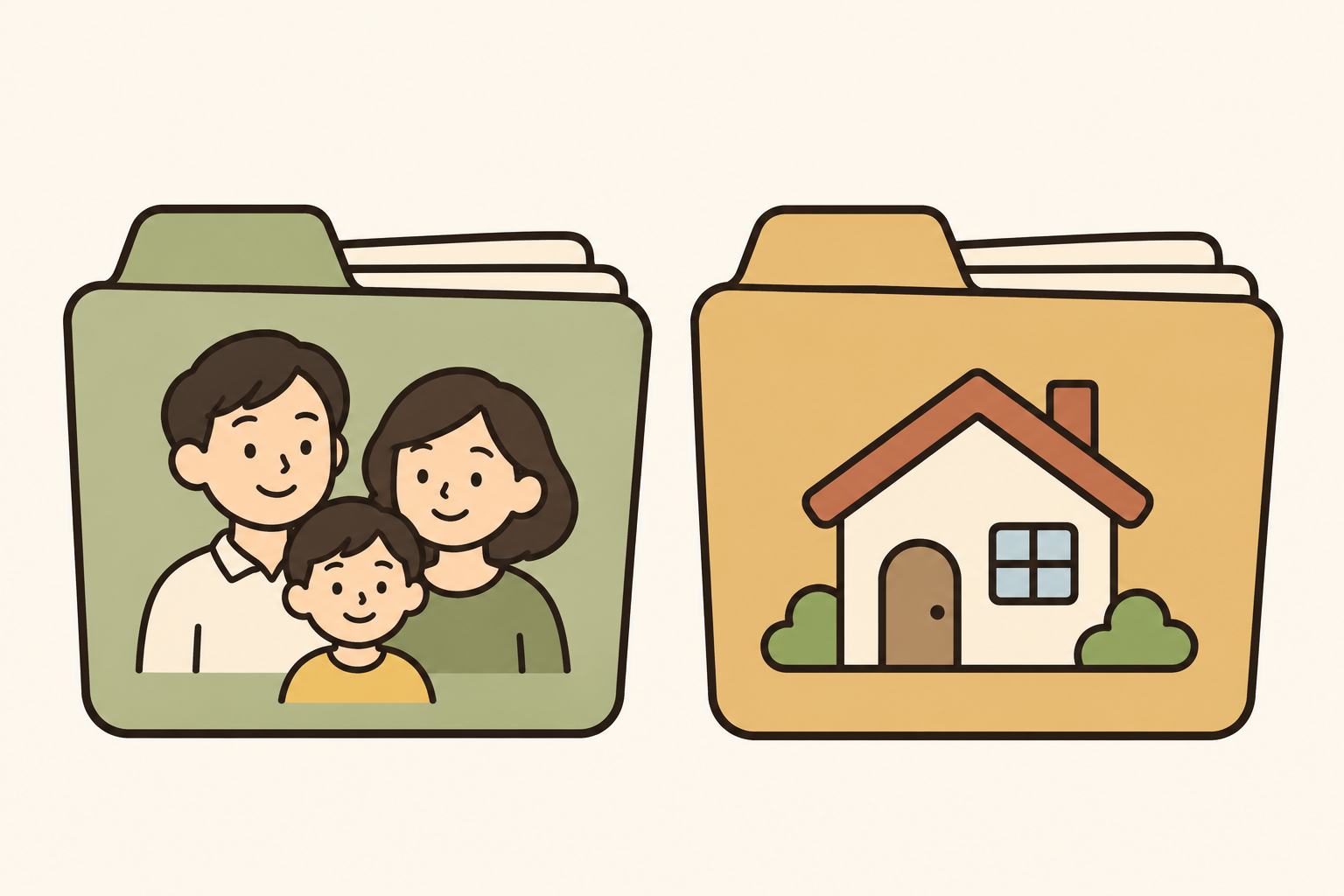
The koseki records who is family; the residence record records where people live (illustration)
Each koseki covers a married couple and their unmarried children who share the couple’s surname. It lists a "registered domicile" (honseki), a head of the register (hittōsha, the person listed first), and for every member their date of birth, parents’ names, relationship to the head, and the history of their status: birth, marriage, divorce, adoption, legal recognition of a child, and death. When a child marries, they leave their parents’ register and the couple starts a new one. When a couple divorces, the partner who changed their name can return to their parents’ register or open a register of their own. A koseki never holds more than two generations, so grandparents and grandchildren are never on the same one.
The clearest sign that the koseki is not about where you live is the honseki. It can be any real address in Japan, chosen freely, and it has nothing to do with residence. Plenty of people keep the honseki at a grandparent’s house in a village they have never lived in. A few choose an address for its symbolism, such as the Imperial Palace in Tokyo; according to press reports, some have even placed theirs at the summit of Mount Fuji. Until recently, getting a copy of your koseki meant applying to the office of the town where it was held, often by mail. Since March 2024, a person, their spouse, and their direct ascendants and descendants (parents, grandparents, children, grandchildren) can request it in person at any municipal office in the country.
The modern register goes back to the Jinshin Koseki of 1872, the first national register compiled under the Meiji government. The Meiji Civil Code of 1898 then built Japanese family law around the ie, the "house." Each register was a house, headed by a koshu who had legal authority over its members, approved their marriages, decided where they lived, and passed the headship and property, normally to the eldest son. A single register could hold the head, his parents, his wife, unmarried children and a married younger brother’s family, a dozen or more people in all. The postwar Civil Code of 1947 abolished the house system and the head’s authority, and the koseki shrank to its present form of a couple and their children. Traces of the old ie survive in speech and custom: Japanese people still say nyūseki ("entering the register") to mean getting married, and gravestones and funeral notices are still inscribed with the name of "the X family."
Prewar ie register (1898 Civil Code)
- Head (koshu)
- His parents
- His wife
- Unmarried children
- A married younger brother’s family
- A dozen or more in all
Postwar register (1947 Civil Code)
- A married couple
- Unmarried children sharing the surname
- Never more than two generations
- A child who marries starts a new one
Under the 1898 house system one register could hold a dozen or more; after 1947 it shrank to a couple and their children, two generations at most.
Only Japanese citizens have a koseki. A foreigner who marries a Japanese citizen is not entered on their spouse’s register; a line is added to the Japanese partner’s entry noting the marriage, and the foreign spouse’s name appears there. A foreigner who naturalizes receives a koseki of their own. The emperor and the imperial family have no koseki at all. They are recorded in a separate genealogy, the Kōtōfu, and they have no surname.
04Residence Records and the "Setai" Household
Where people live is handled by a different system, the Basic Resident Register. Each person’s entry is commonly called their jūminhyō, or resident record. When someone moves, they must register at the new municipal office within fourteen days. Health insurance, school enrollment notices for children, tax bills and voting cards are all sent according to this record. Since 2012, foreign residents staying in Japan for the medium or long term have also been included.
The jūminhyō is organized by setai, usually translated as "household." A setai means the people who live together and share living expenses, and each one has a setai-nushi, the head of household. Other members are listed by their relation to that person: wife, child, mother of the head, or simply "cohabitant."
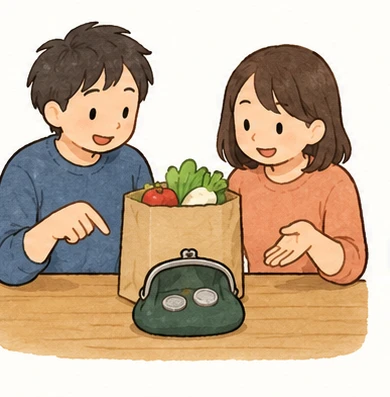
People who live together and share expenses form one setai
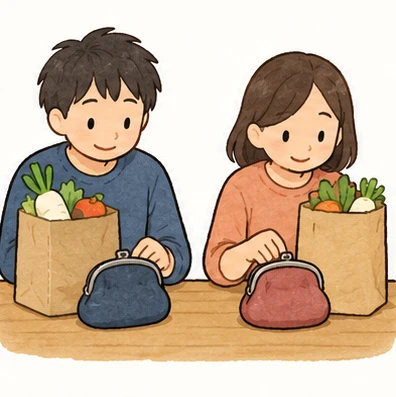
People under one roof can also split into separate setai
The setai and the koseki can look completely different. A university student from Kyūshū studying in Tokyo remains on her parents’ koseki but is a one-person setai in her Tokyo apartment. An unmarried couple can share a setai and will never share a koseki. Two generations under one roof can choose to register as separate setai, which can affect how insurance premiums and benefits are calculated. The koseki answers the question "who is family to whom"; the setai answers "who shares a kitchen with whom."
Japan’s national census counts setai, and the largest change in recent decades has been the rise of single-person households, which made up close to 40 percent of all households in 2020. Many of them are elderly people living alone. The figures make plain what an aging society looks like at the level of the front door.
05One Name for Two People
Article 750 of the Civil Code requires a married couple to adopt the surname of either the husband or the wife. The law is neutral; practice is not. About 94 percent of couples (2024 figures) choose the husband’s name. For the spouse who changes it, marriage means updating bank accounts, passports, licenses and professional records, and for many women, losing the name under which they built a career.
The rule is not as old as it may seem. Wives of samurai families in the Edo period are generally thought to have been identified by the name of the family they were born into, and in 1876 the Meiji government instructed married women to keep their birth surnames, though the custom of taking the husband’s name spread regardless. It was the 1898 Civil Code, with its house system, that made a wife enter her husband’s house and take its name. When the house system was abolished after the war, the shared surname survived, rewritten so that either partner’s name could be chosen.
A campaign for sentakuteki fūfu bessei, an optional system that would let spouses keep separate surnames, has been running since the 1990s. The Legislative Council, which advises the Minister of Justice, recommended it in February 1996, and the ministry drafted bills in 1996 and 2010, but neither went to the Diet because opinion was divided. Opposition parties have submitted their own bills; in June 2025 a lower-house committee debated such bills for the first time in 28 years, without a vote. The Supreme Court upheld the current law in 2015 and again in 2021, while saying the design of the system was for the Diet to decide.
In the meantime, many employers allow staff to keep working under their maiden names, resident records, My Number cards and driver’s licenses have been able to show a former surname alongside the legal one since 2019, and passports can note it too. Keidanren, the main business federation, called for optional separate surnames in June 2024, and the Japan Federation of Bar Associations has repeatedly done the same. In a 2021 government survey, about 29 percent favored introducing separate surnames, while about 42 percent preferred keeping a shared surname but giving the use of former names a legal basis; some reports say support for separate surnames has been rising in newspaper and other private polls. The government of Takaichi Sanae, which took office in October 2025, has taken the second route: its coalition agreement with the Japan Innovation Party (Nippon Ishin no Kai) called for legislation on former-name use, and the gender equality basic plan approved by the cabinet in March 2026 commits to studying it. The bill was expected in 2026, but in May the government postponed it to a later Diet session, and in October it was reported that the government would not submit it to the autumn extraordinary session either, aiming instead for the 2027 ordinary session or later. The opposition Sanseitō submitted its own bill on listing former names in the upper house that October. As of November 2026 the government bill has not been submitted, and optional separate surnames have not been adopted; the legal name remains one name per couple.
After divorce, the partner who changed their name reverts to their previous surname by default, but may file within three months to keep the married name. Many mothers do this so that their children’s surnames do not change. A Japanese citizen who marries a foreigner keeps their own surname; to take the spouse’s surname they can simply file at the municipal office within six months of the marriage, after which family court permission is needed.
06Names in Everyday Life
The visitor’s first encounter with this world is the everyday use of surnames. In schools, offices and shops, people address each other by family name plus -san, or by surname and title: Tanaka-sensei for a teacher or doctor, Suzuki-buchō for a department manager. First names are for family, partners and close friends. Teachers take roll by surname, and in a company with two Satōs in one section, people improvise, calling them "big Satō" and "little Satō," or falling back on first names.
The personal seal, or hanko, is tied closely to the surname. Most everyday seals carry only the family name, and stationery shops sell racks of ready-made seals arranged in kana order, from Aoki to Watanabe. A seal registered with the municipal office, the jitsuin, is used for buying property or a car; a cheap mitomein is enough for signing for a parcel or approving a memo. Government and business have been trying to reduce reliance on seals for years, but they remain part of daily life.
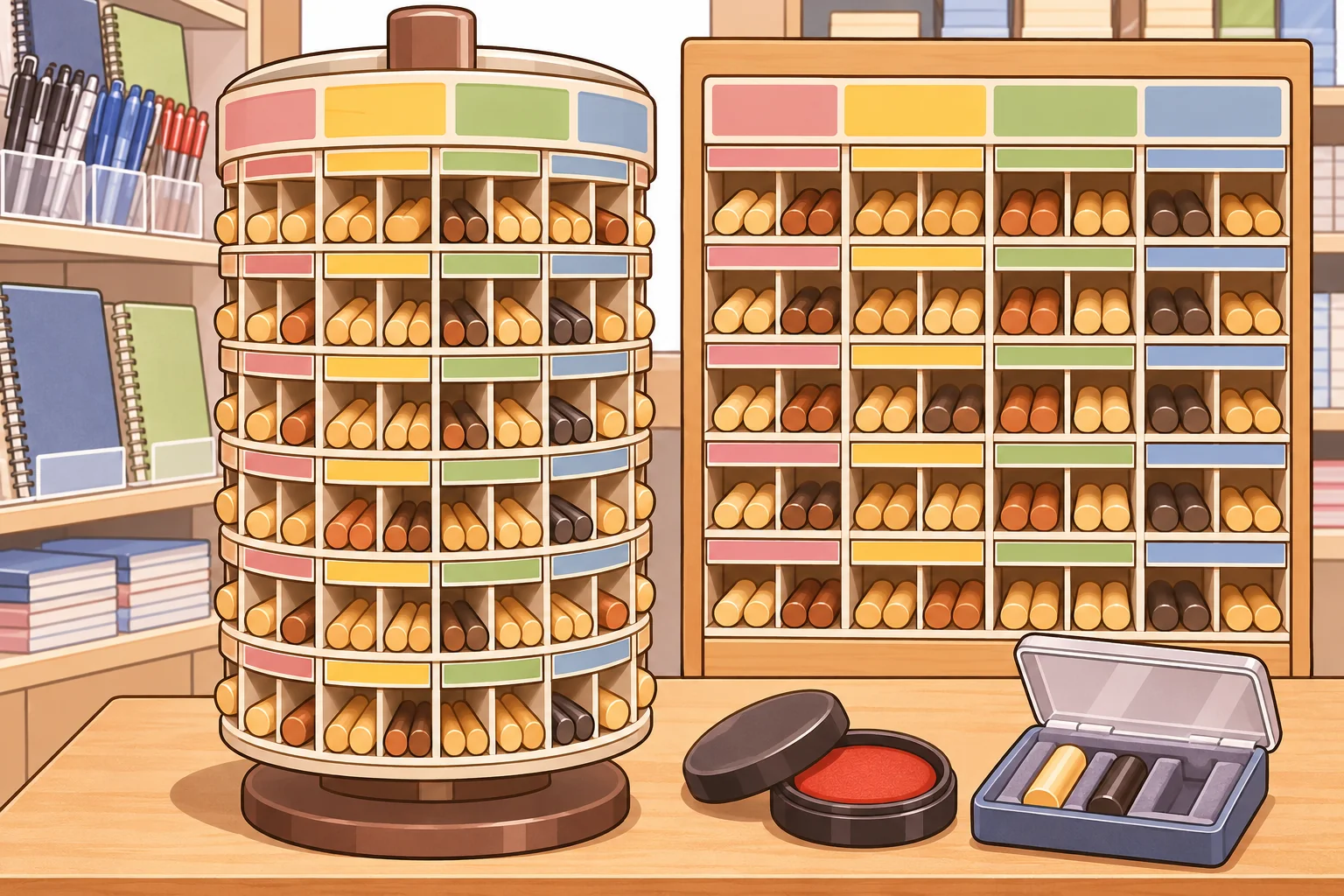
A stationery-shop rack densely packed with ready-made seals carved with surnames (illustration).
Anyone who settles in Japan meets the rest of the system directly. A foreign resident registers at the local office after arriving, gets a jūminhyō and an individual number, and later submits notifications for marriage or a child’s birth, which add new lines to a Japanese spouse’s koseki. For most Japanese people, a copy of the koseki is something pulled out only when marrying, applying for a first passport or settling an inheritance. The jūminhyō turns up far more often: renting an apartment, starting a job, opening a phone contract. One document says who your family is, the other says where you live, and Japanese administration needs both.