
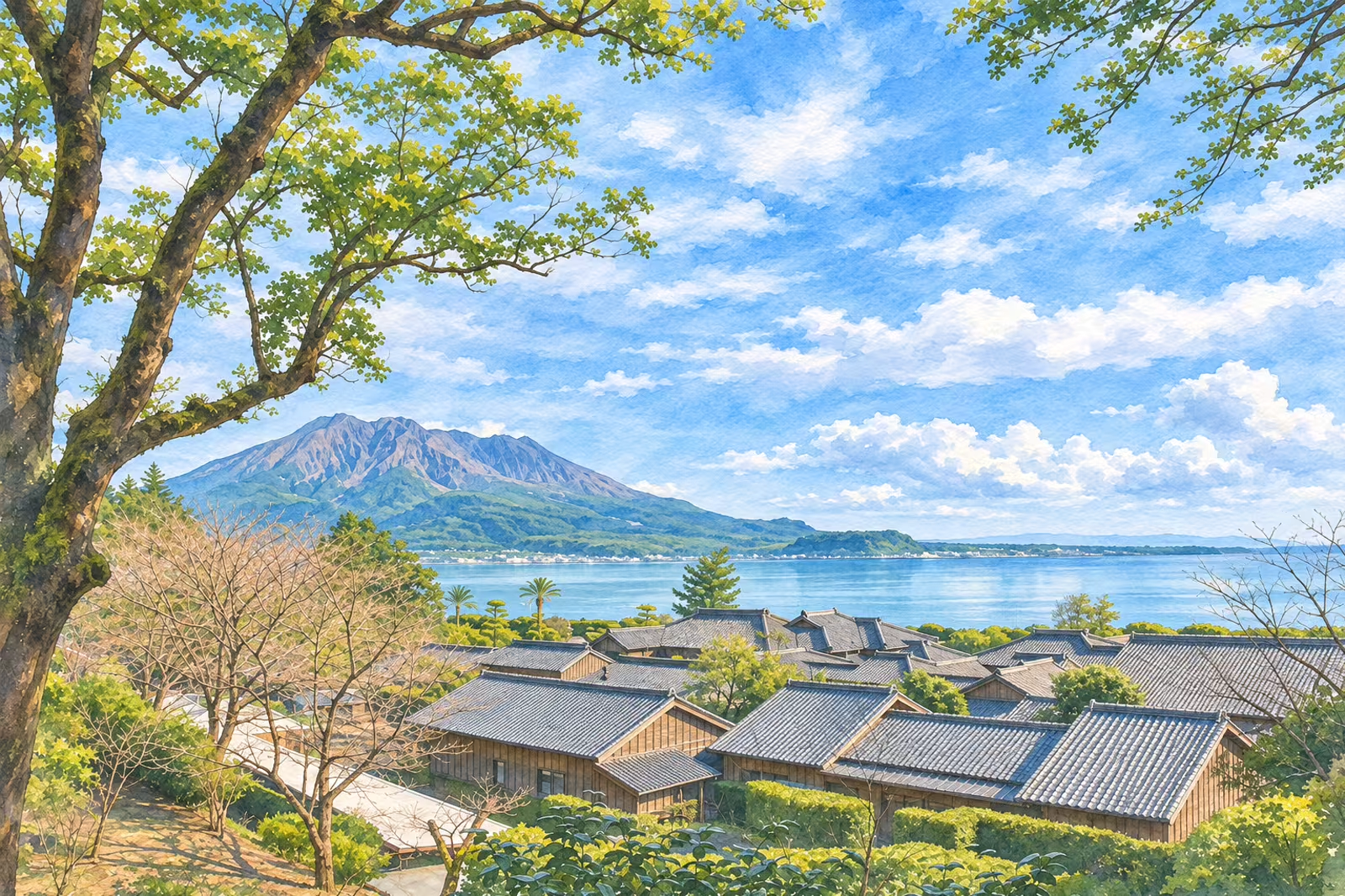
Sengan-en is the seaside villa garden of the Shimazu, lords of the Satsuma domain, in the Iso district of northern Kagoshima City, Kagoshima Prefecture. It borrows Sakurajima as its artificial hill and Kinkō Bay as its pond. Beside it lie the remains of the Shūseikan, the industrial works launched by the late-Edo lord Shimazu Nariakira. Garden, residence and industrial heritage share one site, so a visit shows both daimyo life and Japan’s early industrialization.
01A Shimazu villa
In 1658 Shimazu Mitsuhisa, the second lord of Satsuma, built a villa here. The name is said to come from the resemblance of a rocky hill in the grounds to Xianyan, a scenic spot in Jiangxi, China. Later lords kept adding to it; the grounds include a garden for kyokusui poetry banquets, the Suzumon (Tin Gate) from the late Edo period, and a small shrine to cats. The main building, Iso Gotei, was where the lords received guests and rested. After the Meiji Restoration it became the main Shimazu residence, home to Shimazu Tadayoshi, and imperial family members and foreign guests, among them the Russian crown prince Nicholas, visited.
02Shimazu Nariakira and the Shūseikan
Nariakira, who became lord in 1851, responded to the arrival of Western ships by founding a cluster of works next to Sengan-en centered on cannon and shipbuilding, and around 1857 the factories were named the Shūseikan. Working only from diagrams in Dutch technical books combined with traditional Japanese craft skills, Satsuma engineers built a reverberatory furnace for casting cannon after repeated failures. The Shūseikan also produced glass (Satsuma kiriko), ceramics and farm tools, and a stone lantern in the garden is said to have been used to test gas lighting.
After Nariakira’s death in 1858 the works were scaled back, and in 1863 the British fleet bombarded them during the Anglo-Satsuma War. The domain rebuilt, completing a stone machine factory in 1865, and in 1867 opened a spinning mill nearby, with a residence for the British engineers it hired.
03What can be seen today
The garden, parts of Iso Gotei and structures such as the Suzumon survive, and Sengan-en was designated a national Place of Scenic Beauty in 2015. The base of the reverberatory furnace remains. The former Shūseikan Machine Factory, one of Japan’s earliest surviving Western-style factory buildings, is an Important Cultural Property and now houses the Shōko Shūseikan museum, which displays Shimazu family collections and Shūseikan artifacts. In 2015 the furnace site, the machine factory and the former Kagoshima Spinning Mill engineers’ residence were inscribed as components of the World Heritage Site "Sites of Japan’s Meiji Industrial Revolution."
Sengan-en (Kagoshima)
01A Garden That Borrows a Volcano
Stand on the veranda of the main house at Sengan-en and look east. In front of you is a stretch of open water, and across it rises Sakurajima, an active volcano that often trails a plume of ash. The water is Kinkō Bay, the inner part of Kagoshima Bay. The people who laid out this garden did not dig a large pond or build an artificial hill. They let the bay serve as the pond and the volcano as the hill. Japanese garden designers call this technique shakkei, "borrowed scenery," and Sengan-en is one of its boldest examples.
The garden sits in the Iso district, a narrow strip of land squeezed between steep cliffs and the sea a few kilometers north of central Kagoshima. Locals have long called it Iso Teien, the Iso Garden. For more than two centuries it was a private villa of the Shimazu, the warrior family that ruled the Satsuma domain in southern Kyūshū.
Sengan-en is also something else. In the 1850s the Satsuma lord Shimazu Nariakira built a cluster of furnaces, workshops and factories next to the villa and named the complex Shūseikan. It was one of the first serious attempts in Japan to master Western industrial technology. In 2015 the remains of the Shūseikan became part of a UNESCO World Heritage Site, the Sites of Japan’s Meiji Industrial Revolution. A walk through Sengan-en takes you through two stories at once: the leisured life of a great daimyo (feudal lord) family, and the anxious race of a remote domain to catch up with the West.
02The Shimazu: Seven Centuries in the South
The Shimazu were one of the longest-lasting ruling houses in Japanese history. The founder, Koremune (later Shimazu) Tadahisa, was appointed by Minamoto no Yoritomo, the first Kamakura shogun, as steward of the vast Shimazu estate in southern Kyūshū in the late twelfth century. The family took its name from that estate. A later family tradition held that Tadahisa was an illegitimate son of Yoritomo himself; historians generally treat this as legend.
From then until the Meiji Restoration the Shimazu held southern Kyūshū without interruption. In the sixteenth century the brothers Shimazu Yoshihisa and Yoshihiro came close to conquering the whole island before submitting to Toyotomi Hideyoshi in 1587. At the Battle of Sekigahara in 1600, Yoshihiro fought on the losing Western side and famously broke out through the victorious Tokugawa lines with a small band of survivors. Remarkably, the family kept its lands. Under the Tokugawa shogunate, Satsuma was assessed at more than 700,000 koku (a measure of rice yield), second only to the Maeda domain of Kaga.
In 1609 Satsuma invaded the Ryūkyū Kingdom, today’s Okinawa, and brought it under its control while leaving the Ryūkyū king on his throne. Through Ryūkyū, Satsuma had indirect access to trade with China. That position at the southwestern edge of Japan, facing the sea and the wider world, shaped much of what you see at Sengan-en.
03Mitsuhisa’s Seaside Villa
Sengan-en was founded in 1658 by Shimazu Mitsuhisa, the second lord of the Satsuma domain and the nineteenth head of the Shimazu family. He chose a site with a view of Sakurajima that no flatland garden could match, and later lords added buildings, rocks, lanterns and plantings over the following two centuries.
The name is usually explained as a borrowing from Sengan, a rock formation on Mount Longhu in Jiangxi, China, which the crags behind the garden were thought to resemble.
One of the oldest features is the Suzumon, or Tin Gate, the main gate of the villa in the Edo period. Its roof is covered with tin, a metal mined in Satsuma, and the gate is painted vermilion. Only the lord and his heir were allowed to pass through it.
04Additions by Later Lords
The fourth lord, Shimazu Yoshitaka (the twenty-first head of the family), took a particular interest in the garden. The Kyokusui garden, a winding stream where guests once floated wine cups and composed poems before a cup drifted past them, is traditionally attributed to his time. It imitates the famous gathering held by the Chinese calligrapher Wang Xizhi at the Orchid Pavilion in 353.
Yoshitaka is also credited with importing mōsōchiku, the giant bamboo now common across Japan, from China by way of Ryūkyū and planting it at Sengan-en. The grove near the back of the garden, called the Kōnan Chikurin, is presented as the place where this bamboo first took root in Japan.
A small pavilion called Bōgakurō, its floor laid with square paving tiles, is said to have been a gift from the king of Ryūkyū in the early Edo period. In the 1860s Satsuma entertained the shogunate official Katsu Kaishū there.
The tenth lord, Shimazu Narioki, reclaimed land from the shore in 1848, giving the garden roughly the stroll-garden layout it has today. In his time, too, three huge characters reading Senjin-iwa, "thousand-fathom rock," were carved into the cliff behind the garden. The inscription is about eleven meters long, and according to the garden, the work took some 3,900 laborers three months.
05Shimazu Nariakira
In 1851 Shimazu Nariakira finally became lord of Satsuma at the age of forty-one. He was Narioki’s eldest son, raised in the domain’s Edo residence, and had absorbed an enthusiasm for Western learning from his great-grandfather Shimazu Shigehide, a lord famous for his love of Dutch books and curiosities.
His succession had not been smooth. Narioki favored Hisamitsu, a son by his concubine Yura, and a bitter faction struggle known as the Oyura Disturbance led to the punishment of many of Nariakira’s supporters. Only the intervention of the shogunate’s senior councillor Abe Masahiro forced Narioki into retirement.
By then the danger from the West was obvious. News of China’s defeat in the Opium War had reached Japan, and British and French ships had begun calling at Ryūkyū, which Satsuma controlled. Nariakira concluded that Japan needed Western military and industrial technology quickly, and he turned the land around the Iso villa into his workshop.
06The Reverberatory Furnace
Nariakira’s program began with cannon. Western iron guns were stronger and cheaper than traditional bronze ones, but casting them required a furnace hot enough to melt pig iron. The answer was the reverberatory furnace, in which flame and heat are reflected off a low roof onto the metal without the fuel touching it.
Satsuma had no Western engineers. It had a Japanese translation of a Dutch manual on iron cannon founding, the same book the Saga domain had used to build Japan’s first working reverberatory furnace a few years earlier. Work on Satsuma’s first furnace began in 1852 inside the Iso villa grounds, but poor firebricks caused repeated trouble, and a rebuilt furnace was not finished until 1856. According to a well-known story, Nariakira encouraged his discouraged retainers by saying that Westerners were human, the people of Saga were human, and the people of Satsuma were human too. The story comes from later accounts.
A second furnace was added in 1857. What you see at Sengan-en today is the stone base of one of these furnaces; which one is not certain. A furnace and chimney about sixteen meters tall once stood on it. That superstructure is gone, but the base and its underground drains show the skill of Satsuma’s stonemasons, who adapted their traditional methods to a foreign design. Local potters are said to have helped make the firebricks, another case of Western ideas carried out with Japanese craft.
07The Shūseikan
The furnace was only a beginning. Nariakira added a blast furnace, a cannon-boring mill, glassworks, kilns, a pharmaceutical workshop and smithies, and in 1857 he named the whole complex Shūseikan, roughly "hall of gathered accomplishments." At its height it is said to have employed about 1,200 people.
The products were remarkably varied: cannon and ammunition, farm tools, swords, ceramics, cotton cloth, medicines and foodstuffs. The most famous today is Satsuma kiriko, cut glass in which layers of colored glass are carved to reveal graded shades. Nariakira also experimented with gas lighting, the telegraph and photography. In 1857 he used the Tsuru-dōrō, a stone lantern in the garden shaped like a crane, to test gas lighting.
In 1857 retainers took a daguerreotype portrait of Nariakira inside Kagoshima Castle. It is regarded as the oldest surviving photograph successfully taken by a Japanese, and in 1999 it became the first photograph designated an Important Cultural Property.
Satsuma also built ships. The Western-style sailing vessel Shōheimaru was launched in the 1850s, and the domain built a small experimental steamship, the Unkōmaru, from Dutch descriptions. To tell Japanese ships from foreign ones, Nariakira and others proposed a white flag with a red sun as a common emblem, and the shogunate adopted it in 1854. That flag, the Hinomaru, later became Japan’s national flag.
08Death of a Reformer and War with Britain
Nariakira ruled for just over seven years. In the summer of 1858, after reviewing troops in Kagoshima, he fell suddenly ill and died within days, at forty-nine. Cholera or some acute illness is the usual explanation; rumors of poisoning circulated but have never been proven.
He had been active on the national stage too. He arranged for his adopted daughter Atsuhime to marry the thirteenth shogun, Tokugawa Iesada, and backed Hitotsubashi Yoshinobu in the dispute over the shogunal succession. He also promoted a low-ranking samurai named Saigō Takamori, who would become one of the leaders of the Meiji Restoration.
After his death the domain passed to Hisamitsu’s son Shimazu Tadayoshi, with Hisamitsu holding real power. The Shūseikan was cut back sharply. Then, in 1863, a British squadron sailed into Kinkō Bay to demand redress for the Namamugi Incident of the previous year, in which Satsuma retainers had killed a British merchant. In the resulting Anglo-Satsuma War, British guns shelled Kagoshima and destroyed most of the Shūseikan, though the reverberatory furnace survived.
The war convinced Satsuma that it needed Britain as a partner rather than as an enemy. In 1865 the domain secretly sent nineteen young men to study in Britain, among them Godai Tomoatsu and Mori Arinori.
09Rebuilding: The Machine Factory and the Spinning Mill
Satsuma rebuilt quickly. Work on a stone Machine Factory began in 1864, and by 1865 it was equipped with Dutch steam engines and machine tools, used to repair ships and make parts. Built of Ono stone, a local welded tuff, it is about seventy-seven meters long with arched windows, and it is the oldest surviving stone Western-style machine factory in Japan.
In 1867 the domain opened the Kagoshima Spinning Mill, equipped with British machinery and run with the help of seven British engineers. It was Japan’s first Western-style mechanized cotton mill. For the engineers the domain built a two-story wooden Western-style house, the Engineers’ Residence, which locals call the Ijinkan, the "foreigners’ house." In 1882 it was moved to the site of Kagoshima Castle to serve a school, and it was brought back to its original site in 1936.
The Shūseikan enterprise ended in 1869, but the Machine Factory stayed in use as a factory until 1915. In 1923 it became the Shōko Shūseikan, a museum of the Shimazu family and the Shūseikan enterprise, which it remains today.
10Sengan-en after the Restoration
After the abolition of the domains, Kagoshima Castle passed to the government, and the last lord, Shimazu Tadayoshi, for a time made Sengan-en his main residence. He spent most of his day in the Oima, the living room, signing papers and taking lunch there. The main house you see today is usually described as centered on a remodeling of 1884 and only about a third of its former size. Tadayoshi also built the present main gate, over seven meters tall, to face a new road.
From the 1860s on, the villa served as the family’s guesthouse for distinguished visitors. The British minister Harry Parkes was entertained here in 1866. In May 1891 the Russian crown prince Nicholas, the future Tsar Nicholas II, visited Kagoshima, was hosted by Tadayoshi and came to Sengan-en. A few days later, at Ōtsu near Kyoto, he was attacked and wounded by a Japanese policeman. In 1922 the British Prince of Wales, the future Edward VIII, also visited.
Tadayoshi died in 1897. Later heads of the family lived mainly in Tokyo. After the Second World War the garden was for a time run by Kagoshima City as Iso Park before returning to the Shimazu, whose company operates it today. A small Cat Shrine in the grounds honors cats that, according to legend, Shimazu Yoshihiro took on his campaign in Korea in the 1590s to tell the time by the size of their pupils.
Sengan-en was designated a national Place of Scenic Beauty in 1958, and the Shūseikan site a national Historic Site in 1959, with the Terayama charcoal kiln and Sekiyoshi sluice added in 2013. The Machine Factory and the Engineers’ Residence were designated Important Cultural Properties in 1962.
11World Heritage
On July 5, 2015, at its meeting in Bonn, the UNESCO World Heritage Committee inscribed the Sites of Japan’s Meiji Industrial Revolution: Iron and Steel, Shipbuilding and Coal Mining. The property consists of twenty-three components in eight prefectures. Three are in Kagoshima. The Shūseikan, comprising the reverberatory furnace site, the Machine Factory and the Engineers’ Residence, takes in Sengan-en as well. The other two are the Terayama charcoal kiln, built in the hills about five kilometers away in 1858 to make charcoal for the furnaces, and the Sekiyoshi sluice, an eighteenth-century channel first dug for irrigation and to supply the villa, later used to power the Shūseikan’s machinery.
The story the listing tells is of a country that moved from trial-and-error experiments in the 1850s to a modern heavy industrial base within about half a century. The Shūseikan stands at the very beginning of that story, built by samurai and craftsmen working from translated books rather than by foreign experts.
The inscription was controversial. South Korea objected that Koreans had been forced to work at some of the sites during the Second World War, and Japan made a statement on the matter at the committee meeting. The dispute concerns mainly coal mines and shipyards in Nagasaki and Fukuoka rather than Kagoshima, but visitors may well hear about it.
12A Walk Through the Grounds
Near the entrance is the stone base of the reverberatory furnace, original masonry from the 1850s. Beside it, the World Heritage orientation center explains how the furnace worked.
Pass through Tadayoshi’s main gate and follow the path to the vermilion Tin Gate, then the main house. Inside you can see the audience room where guests were received and Tadayoshi’s private rooms. From the rooms and veranda, Sakurajima sits squarely at the center of the view, the classic image of Sengan-en.
In front of the house stands the Shishi-nori Ōishi-dōrō, a massive stone lantern topped by a lion. Look for the crane-shaped Tsuru-dōrō too, the lantern of Nariakira’s gaslight experiment.
Deeper in the garden lie the Bōgakurō pavilion, the Kyokusui stream and the Kōnan bamboo grove, the quietest corner of the grounds. From the Bōgakurō, look up at the cliff to see the Senjin-iwa characters. If you have time, a path climbs the hillside behind the garden for a view down over the house, the bay and the volcano.
After leaving, walk a short way south along the coast road to the Shōko Shūseikan, the original 1865 stone Machine Factory, now filled with Shimazu treasures, Satsuma kiriko and objects made at the works. A little farther on is the white wooden Ijinkan, back on its original site. Together the three places trace a path from a daimyo’s garden to a modern factory.