
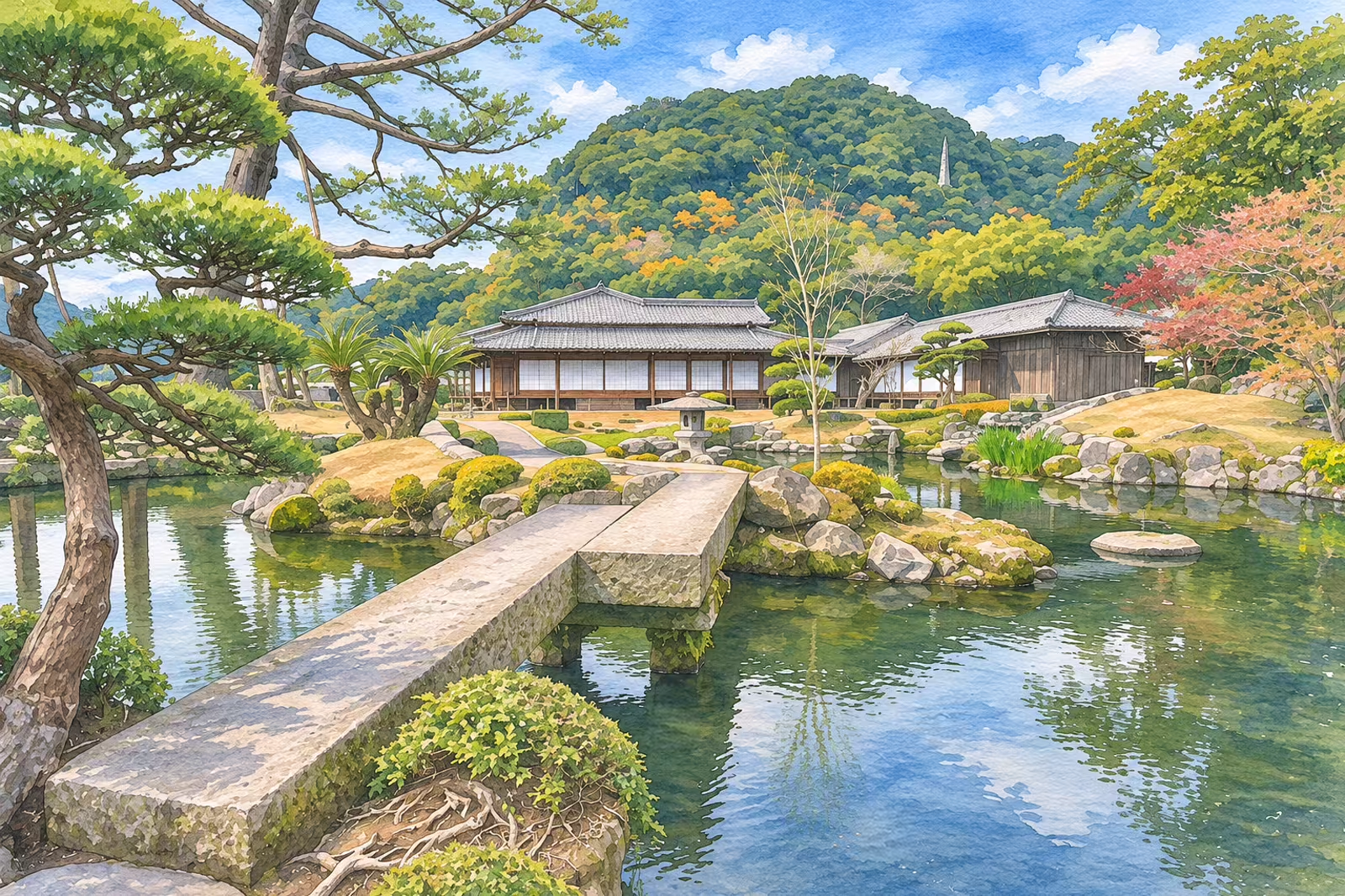
Shiroyama is a small, wooded hill about 107 meters high in the middle of Kagoshima City. At its foot lies Tsurumaru Castle, formally Kagoshima Castle, the seat of the Shimazu lords of Satsuma. Together the two places frame Satsuma’s story from both ends: for about 270 years of the Edo period the castle was the domain’s seat of government, and in 1877 the hill above it became the last battlefield of the Satsuma Rebellion, where Saigō Takamori died.
01The Shimazu Seat
After the Battle of Sekigahara, Shimazu Iehisa (first known as Tadatsune) began building a new castle at the eastern foot of Shiroyama around 1601, and it was largely complete within a few years. Tsurumaru had no keep and no towering stone fortifications. Instead, the hill served as a rear defense, while moats and stone walls enclosed the residences and offices of the inner and second baileys. The plain design is often linked to a Satsuma saying that people, not walls, are the true castle. The name "Tsurumaru" is said to come from the hill’s resemblance to a crane with outstretched wings. Generations of Shimazu lords governed from here, and under Shimazu Nariakira and Shimazu Hisamitsu in the late Edo period, Satsuma moved from this base into the Anglo-Satsuma War of 1863 and the campaign to overthrow the shogunate.
02Shiroyama, 1877
The buildings of the inner bailey burned in 1873. In 1877 Saigō Takamori, who had left the Meiji government and returned home, rose in revolt with the samurai of his private schools. After defeats at Kumamoto Castle and Tabaruzaka, the rebel army fought its way around Kyūshū and in September broke back into Kagoshima, where the survivors dug in on Shiroyama. Government troops surrounded the hill and launched their final assault on September 24. Saigō was wounded and took his own life (some accounts say a follower beheaded him at his request). He was 49 years old (51 by the traditional count).
03What Remains
The moats and stone walls survive well, and marks on the walls are said to be bullet scars from 1877. The main Goromon gate, lost in the early Meiji years, was rebuilt from historical records in 2020. The Reimeikan, Kagoshima Prefecture’s history museum, stands on the site of the inner bailey, and the second bailey is occupied by a library and other public buildings. On the hill, an observation point looks out over the city to Sakurajima, and memorial sites mark the cave where Saigō spent his last days and the place where he died. A bronze statue of Saigō stands nearby at the hill’s foot. Shiroyama is generally understood to be a national historic site and natural monument, while the castle site is a prefectural historic site.
Shiroyama and Tsurumaru Castle (Kagoshima)
01A Hill and a Wall
In the middle of Kagoshima, a green hill about a hundred meters high rises behind the city’s government quarter. This is Shiroyama, "Castle Hill." Its eastern foot is ringed by a moat full of lotus and a long stone rampart, and behind that rampart stand a museum, a library and an art gallery. These buildings occupy the grounds of Kagoshima Castle, better known as Tsurumaru Castle, the residence of the Shimazu lords of Satsuma for more than two and a half centuries.
Most visitors come for one of two stories. The first is the castle itself, the seat of one of the largest and most independent domains of the Edo period, and the place from which Satsuma’s leaders steered the domain toward the overthrow of the Tokugawa shogunate. The second is the hill. In September 1877, Saigō Takamori and a few hundred surviving followers retreated to Shiroyama and were destroyed there, bringing the Satsuma Rebellion, Japan’s last major civil war, to an end. The two sites are a few hundred meters apart, and between them they frame the rise and fall of the samurai world that Satsuma did so much to dismantle.
02The Shimazu and the Choice of Site
The Shimazu family had ruled in southern Kyūshū since the Kamakura period (1185–1333). In the late sixteenth century, under the brothers Shimazu Yoshihisa and Shimazu Yoshihiro, they came close to conquering all of Kyūshū before Toyotomi Hideyoshi’s invasion forced their submission in 1587. At the Battle of Sekigahara in 1600, Yoshihiro fought on the losing Western side and famously cut his way out through the enemy lines to escape home. Remarkably, after long negotiations with Tokugawa Ieyasu, the Shimazu kept their lands.
Soon afterward, Yoshihiro’s son Shimazu Tadatsune, who later took the name Iehisa, began building a new residence at the eastern foot of Shiroyama, usually dated to around 1601. Earlier Shimazu headquarters had been elsewhere in Kagoshima, and the hill itself had carried a medieval mountain fort. According to tradition, Yoshihiro disapproved of the new site, judging it too exposed with the sea in front and only a small hill behind, but Iehisa went ahead.
The result was an unusual castle. Tsurumaru never had a keep (tenshu, the tall central tower familiar from Himeji or Matsumoto). It was essentially a fortified palace: a walled compound of low residential and administrative buildings in the main enclosure (honmaru) and the second enclosure (ninomaru), with the wooded hill behind serving as a last refuge. Writers often explain this with a phrase associated with Satsuma: "people, not walls, are the castle." The domain spread its samurai across the countryside in more than a hundred fortified districts known as tojō, "outer castles," where rural samurai farmed and stayed under arms. The real defense of Satsuma was this dense network of warriors, so the lord’s residence did not need to be a fortress.
The nickname Tsurumaru, "Crane Castle," is explained by the prefecture as coming from Shiroyama itself, whose outline seen from the west resembles a crane with outspread wings; another tradition credits the roofline of the lord’s residence. The official name was always Kagoshima Castle.
03A Domain Apart
Through the Edo period (1603–1868) Satsuma was one of the wealthiest and most self-contained domains in Japan. It held the provinces of Satsuma and Ōsumi and part of Hyūga, and from 1609 it also controlled the Ryūkyū Kingdom in what is now Okinawa, through which it profited from trade with China. Samurai made up an unusually large share of Satsuma’s population.
Senior retainers lived close to the castle, while lower-ranking samurai lived farther out, in districts such as Kajiya-chō along the Kōtsuki River. Both Saigō Takamori and his lifelong partner and eventual rival Ōkubo Toshimichi grew up there, in modest households a short walk apart.
By the early nineteenth century the domain was crushed by debt. The retainer Zusho Hirosato carried out a harsh reform in the 1830s, effectively repudiating much of the debt and rebuilding revenue through a monopoly on black sugar from the southern islands and through Ryūkyū trade. Those reserves later paid for Satsuma’s ships, guns and industrial experiments.
In 1851 Shimazu Nariakira became lord. At the Iso villa north of the castle he founded the Shūseikan, a complex of reflecting furnaces, a blast furnace, glassworks and workshops that made Western-style cannon and ships. Nariakira also noticed Saigō, a junior samurai, and took him to Edo as a confidant in national politics. Nariakira’s sudden death in 1858 left power in the hands of his half-brother Shimazu Hisamitsu, whose son Tadayoshi became the nominal lord.
04Bombardment and Revolution
In 1862 Hisamitsu’s retinue, returning from Edo, cut down British merchants who had ridden into their procession at Namamugi near Yokohama. The British demanded compensation, and in August 1863 a Royal Navy squadron sailed into Kagoshima Bay. Fighting broke out between the British ships and Satsuma’s shore batteries; parts of the castle town burned, and both sides took casualties. This was the Anglo-Satsuma War. Its lesson was clear to Satsuma’s leaders, who soon opened ties with Britain and secretly sent students to study there.
From the mid-1860s Satsuma moved to the center of national politics. In 1866 it formed a secret alliance with Chōshū, and in the civil war of 1868–69, the Boshin War, Satsuma troops formed the core of the new imperial army. Saigō negotiated the peaceful surrender of Edo Castle with the shogunate’s Katsu Kaishū in 1868.
The domains were abolished in 1871 and replaced by prefectures. Tsurumaru ceased to be a lord’s seat. The Meiji Emperor visited Kagoshima on his 1872 tour of Kyūshū, and a handful of early Meiji photographs are the main record of what the castle looked like. In 1873 the main enclosure burned, and the great gate called the Gorōmon went with it; the second enclosure burned in the war of 1877.
05Saigō’s Withdrawal and the Private Schools
In 1873 the new government split over whether to force open relations with Korea. Saigō proposed to go to Korea himself as envoy; Ōkubo and Iwakura Tomomi, newly returned from their mission to the West, blocked the plan. Saigō resigned from the government and returned to Kagoshima, and hundreds of Satsuma officers and officials followed him home.
In 1874 Saigō’s followers founded the Shigakkō, the "private schools," with infantry and artillery schools in Kagoshima and branches throughout the prefecture. Officially they trained young men; in practice they became the dominant political force in Kagoshima, and the prefectural governor Ōyama Tsunayoshi filled local offices with their members. Meanwhile the government was stripping the former samurai of their privileges, banning the wearing of swords in 1876 and converting their stipends into bonds. Samurai uprisings broke out in Kumamoto, Akizuki and Hagi that same year.
The site of the main private school lies just east of the castle. Its stone wall still carries bullet marks from 1877.
06The Satsuma Rebellion
In January 1877 the government quietly began removing weapons and ammunition from arsenals in Kagoshima. Private school students raided the arsenals and seized the munitions. At about the same time, the schools arrested a group of police officers sent from Tokyo, led by Nakahara Hisao, and extracted a confession that they had come to assassinate Saigō.
In mid-February, amid unusually heavy snow, Saigō marched north with roughly 13,000 men, saying he intended to question the government. The rebels laid siege to Kumamoto Castle, held by government troops under Tani Tateki, but could not take it. In March government relief columns fought their way through at Tabaruzaka in some of the hardest fighting of the war, and the siege collapsed.
For the next five months the Satsuma army fell back through Hitoyoshi, Miyazaki and Nobeoka, shrinking all the while. In mid-August it was defeated at Wadagoe near Nobeoka and surrounded at the village of Nagai. Saigō dissolved his army, burned his general’s uniform and papers, and with a few hundred men who chose to stay, slipped out by night over Mount Enodake.
07Return to Shiroyama
The survivors marched south through the Kyūshū mountains and on September 1, 1877 burst back into Kagoshima, briefly retaking the private school grounds before occupying Shiroyama. Saigō now had only some three to four hundred fighters.
The government army, tens of thousands strong and backed by warships in the bay, sealed the hill with trenches and palisades, determined not to let Saigō escape again. The rebels dug shelters into the hillside. Saigō spent his last five days or so, from about September 19, in one of these, now known as Saigō’s Cave. Attempts were made to negotiate for Saigō’s life without result. Yamagata Aritomo, commanding the government forces, is said to have written to Saigō urging him to end the fighting by taking his own life.
08The Morning of September 24
Before dawn on September 24, 1877, the government army launched its final assault. Saigō, with Kirino Toshiaki, Murata Shinpachi, Beppu Shinsuke and others, left the cave and moved down toward the Iwasakidani valley. On the way Saigō was struck in the hip or thigh by a bullet and could go no farther. According to the well-known account, he said to Beppu, "Shin-don, this is far enough," and Beppu beheaded him as his second. Saigō was forty-nine by Western reckoning. The famous last words come from later accounts and cannot be confirmed.
Kirino, Murata, Beppu and the others died within hours, and the fighting was over by mid-morning. Saigō’s head was hidden by his followers but later found, and tradition says Yamagata inspected it himself with a show of respect.
A stone marks the place of Saigō’s death near Iwasakidani at the southern foot of the hill. He and over two thousand Satsuma dead, in some seven hundred graves, were buried north of the city in what became the Nanshū Cemetery, beside which stand Nanshū Shrine and the Saigō Nanshū Memorial Museum.
09Rebel to Hero
Saigō died a rebel stripped of rank, but his popularity only grew. In 1889, with the promulgation of the Meiji Constitution, he was pardoned and posthumously restored to court rank. In 1898 a bronze statue by Takamura Kōun was unveiled in Ueno Park in Tokyo, showing Saigō in a plain kimono walking his dog; his widow is said to have objected that it did not look like him.
Kagoshima chose a different image. In 1937 the city erected a bronze by Andō Teru at the foot of Shiroyama showing Saigō in full army uniform, standing stiff and massive. It remains the most photographed monument in the city.
Ōkubo Toshimichi did not long outlive his old friend. He was assassinated at Kioizaka in Tokyo in May 1878 by a band of former samurai led by Shimada Ichirō of Ishikawa. Feelings about him in Kagoshima stayed mixed for a century, and his statue by Nakamura Shinya, beside the Kōtsuki River, was not erected until 1979, a century after his death.
10After the Castle
After the fire the castle grounds were used by the army and then by schools. From 1901 the Seventh Higher School, called Zōshikan after the old domain academy, occupied the main enclosure. After the Second World War it was absorbed into Kagoshima University and moved away.
In 1983 the Kagoshima Prefectural Museum of Culture Reimeikan opened on the site of the main enclosure. Its name, "dawn," refers to the Meiji Restoration as the dawn of modern Japan, and it was planned as part of the Meiji centenary commemorations. It took its present name, Kagoshima Prefectural Center for History and Art, in 2020. Its galleries cover Kagoshima from prehistory onward, with substantial sections on the Shimazu, the domain and the war of 1877. The second enclosure now holds the prefectural library and the city art museum.
In the 2010s the prefecture and a citizens’ council raised funds to rebuild the Gorōmon, the main gate. Using early Meiji photographs, documents, excavation results and traditional timber methods, the work was completed in March 2020. The two-story gatehouse is about twenty meters tall and twenty wide, and is billed as the largest castle gate in Japan.
11Walking the Site
Begin at the moat. The rampart and moat date from the Edo period. Look closely at the stones beside the gate and you will see pockmarks, some still holding fragments of bullets or shells; excavated rounds show that most date from the fighting of 1877. The gate in front of you is the 2020 reconstruction; the Reimeikan lies just behind it.
Walk north past the library and the art museum and you reach the Saigō statue. Beyond, paths climb Shiroyama, whose evergreen forest has been protected as a national historic site and natural monument since 1931; in 2023 the designation was extended to the castle grounds and renamed Kagoshima Castle Site. Partway up is Saigō’s Cave, a shallow hollow in the rock with an explanatory sign; farther on, toward Iwasakidani, is the stone marking where he died. At the top, the observation deck looks out over the city to Sakurajima, the smoking volcano across the bay.
With more time, walk east to the private school wall to see its bullet scars, then take a bus or taxi north to the Nanshū Cemetery and Shrine, where Saigō lies among his men.