
At a glance
How Japanese gardens compress mountains and sea into a walled space, from Heian ponds and Zen dry gardens to tea paths, daimyo strolls and borrowed scenery.
- Japanese gardens are made mainly of stone, water and plants; garden-making was once simply called “setting stones,” and stones decide a garden’s character.
- Heian aristocrats built pond gardens, Muromachi Zen temples developed dry gardens, the Momoyama tea masters made the roji, and Edo daimyo built stroll gardens.
- A dry garden uses stones for mountains and islands and white gravel for water; the fifteen stones at Ryōan-ji lie in five groups.
- The roji is the path to a tea room: guests walk on stepping stones, wash at the tsukubai basin and enter through the low nijiriguchi.
- Borrowed scenery pulls distant hills into the garden; the garden at Entsū-ji in Kyoto is designed around Mount Hiei.
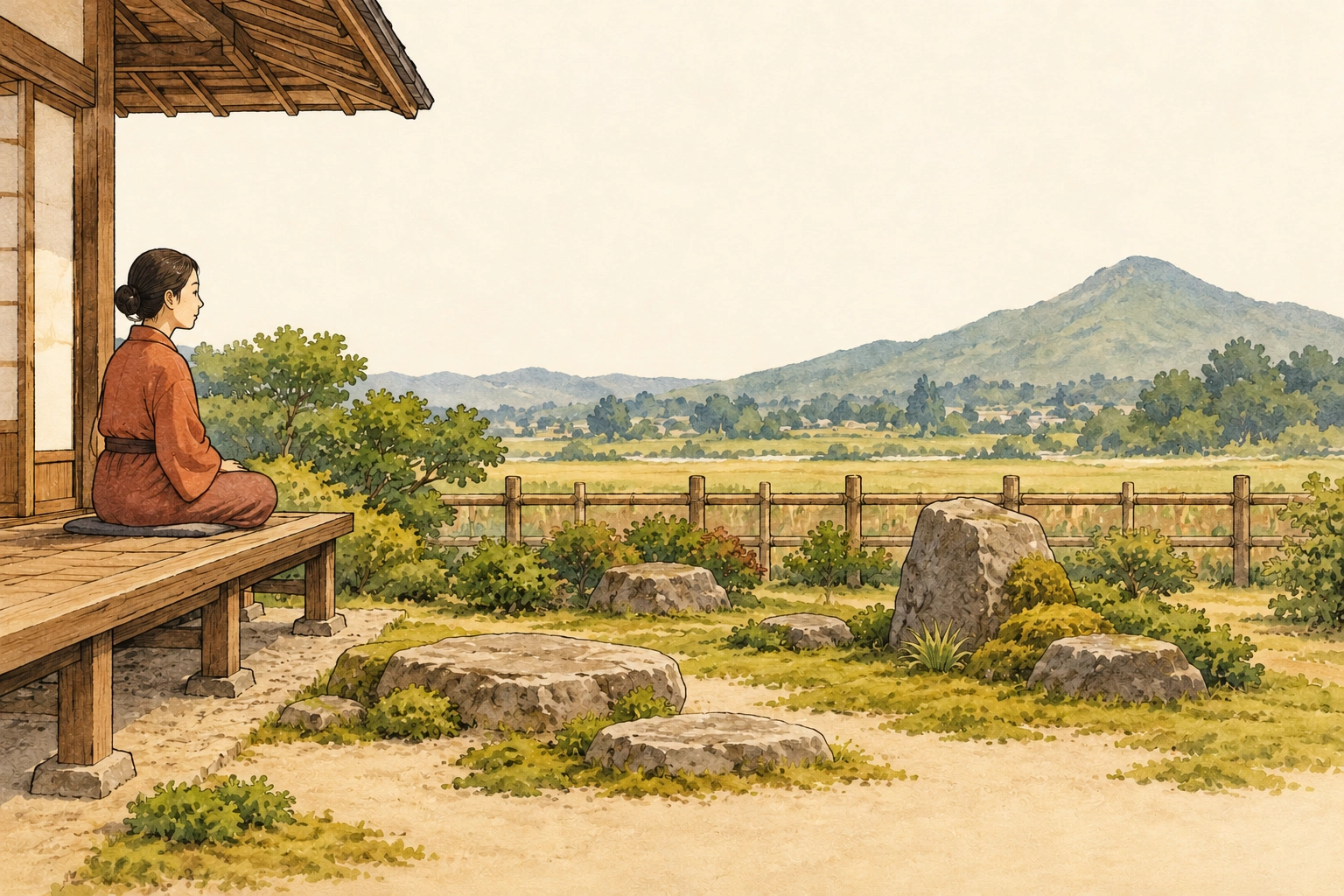
Most first-time visitors to Kyoto end up on the same wooden veranda at Ryōan-ji, sitting shoulder to shoulder in front of a rectangle of raked gravel and fifteen rocks. Nothing moves, nothing blooms, and there is nowhere to walk. Yet people stay, sometimes for half an hour. A Japanese garden is less a place to stroll through than a composed view, a landscape condensed into a small space and arranged to be seen from particular spots. This piece explains what goes into a Japanese garden and why, how the form changed from aristocratic ponds to Zen gravel, tea paths and the great parks of the samurai lords, how dry gardens and "borrowed scenery" work, and how to look at one when you are standing in front of it.
01Stones First
The oldest Japanese word for garden-making is ishi wo tateru, "setting stones upright." That phrase tells you where a Japanese gardener’s attention goes. Before trees, before water, there is the question of which rock to use, which face to turn outward, how deeply to sink it, and how it should lean. A well-set stone looks as though it has always been there and the garden grew around it. A badly set one looks delivered.
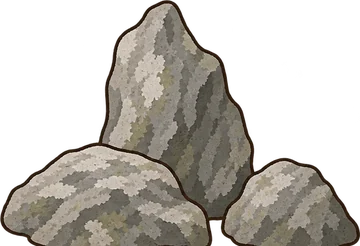
Stones of different heights and sizes are set together as a group.
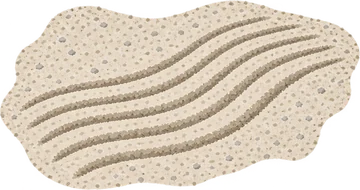
Lines raked into gravel stand for moving water.
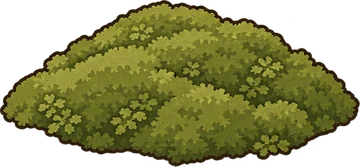
Instead of lawn, the ground is covered with moss.
Stones are almost always placed in groups, usually in odd numbers, three, five or seven, and never in neat rows. A tall upright stone might be flanked by a lower, broader one and a flat one at its foot, so that together they read as a mountain, a cliff, a waterfall, or a Buddhist triad. Certain arrangements recur across centuries: a "crane island" with a stone like an outstretched wing, a "turtle island" with a head stone and flipper stones, both symbols of long life borrowed from Chinese legend. The idea of the mythical island of Hōrai (Penglai in Chinese), where immortals lived in the eastern sea, sits behind a great many pond islands topped with a single gnarled pine.
Water comes next. Pond edges are never geometric. They curve in and out, form little bays and promontories, and are laid out so that you can never see the whole shoreline at once. Where there is a waterfall, even one only a meter high, the gardener names and places each stone: the one water falls over, the one it lands on, the ones that guard it on either side.
Plants are mostly evergreen. Pines are trained over decades into low, layered, windswept shapes. Azaleas are clipped into tight mounds that stand in for distant hills. Maples and cherries supply the seasons. Instead of lawn there is moss, which thrives in Kyoto’s humid summers. Flowers are used sparingly, a cherry tree here, a stand of irises there; there are no flower beds.
What holds all this together is asymmetry. There is no central axis, no mirror-image layout like a French formal garden. The aim is not to impose order on nature but to compress it, so that in thirty steps you pass mountains, rivers and sea. Japanese gardeners call this shukkei, the miniature landscape, and it explains why the gardens feel so much larger than they are.
02Ponds for Aristocrats and Paradise on Earth
Japan’s earliest gardens were ponds. Excavations at seventh-century palace sites in Asuka have uncovered stone-lined pools, and the eighth-century chronicle Nihon shoki records that the statesman Soga no Umako dug a pond with a small island at his residence, earning him the nickname "the Minister of the Island." In the Nara period, palace gardens included winding streams for kyokusui no utage, banquets at which guests had to compose a poem before a floating wine cup drifted past them.
In the Heian period (794–1185), aristocrats lived in shinden-zukuri mansions: a main hall facing south onto a courtyard of white sand used for ceremonies, and beyond it a large pond with islands linked by arched vermilion bridges. Courtiers drifted across these ponds in boats with dragon-headed prows, playing music, scenes that turn up repeatedly in The Tale of Genji.
The period also produced the Sakuteiki, an eleventh-century manual usually attributed to the nobleman Tachibana no Toshitsuna. It is one of the oldest surviving treatises on garden design anywhere. Its advice is practical and surprisingly modern: study real landscapes, follow the lie of the land, learn from good gardens made by earlier masters. It is also full of taboos, warnings that certain stone placements will bring misfortune to the household, a reminder that gardens were tied up with geomancy and belief.
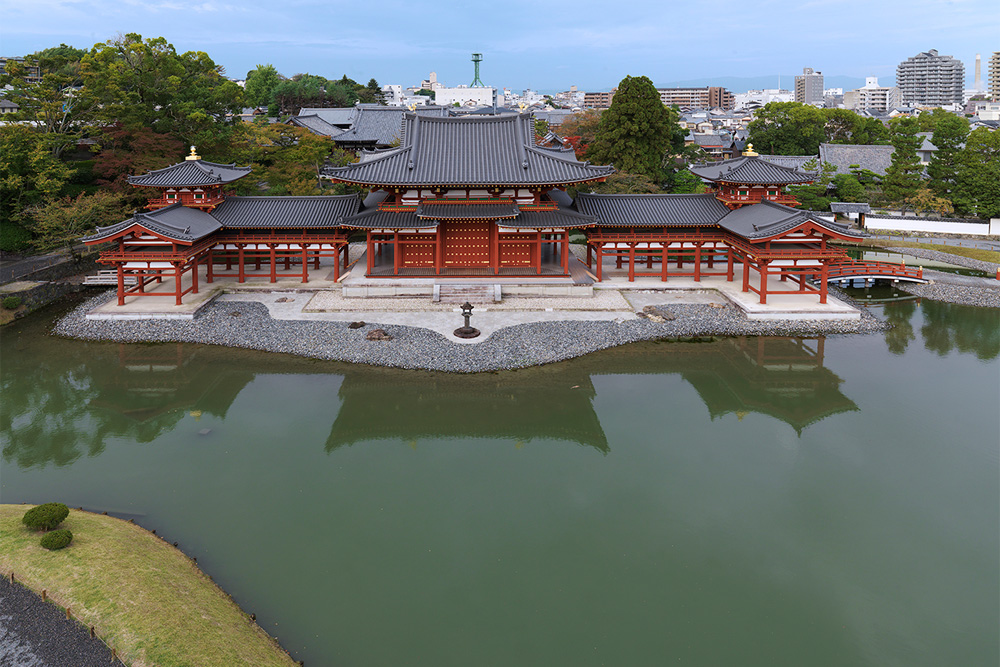
The Phoenix Hall of Byōdō-in seen across its pond, reflected in the water.
In the late Heian period, many believed the world had entered mappō, the age of the decline of Buddhist law, and longed to be reborn in the Western Paradise of Amida Buddha. Aristocrats responded by building paradise gardens. A hall containing an image of Amida stood on the far side of a pond; you looked at it across the water from the east, as if gazing across the jeweled lakes of the Pure Land. The finest survivor is the Phoenix Hall of Byōdō-in in Uji, completed in 1053, whose reflection still floats in its pond and whose image appears on the front of the ten-yen coin. At Mōtsū-ji in Hiraizumi, in northern Japan, the great pond and its shoreline stones survive from the twelfth century.
03Zen Monks and the Garden of Stones
From the Kamakura period onward, Zen Buddhism arrived from China and found favor with the warrior class, and monks began to take over the role of garden designer. The most famous was Musō Soseki (1275–1351), a revered abbot who advised the first Ashikaga shogun and is remembered as one of the great figures in Japanese garden history.
In 1339 Musō restored Saihō-ji, on the western edge of Kyoto, and became founding abbot of Tenryū-ji in Arashiyama. Saihō-ji is now known as Koke-dera, the Moss Temple, for the carpet of moss that covers its grounds, but the moss came later. Over the centuries the temple’s pond flooded repeatedly, silt was heaped onto the banks and islands, and moss slowly took over; the moss garden as we know it is generally thought to have taken shape gradually during the Edo period, by some accounts not until its final decades. Some 120 kinds are said to grow there now. In Musō’s day the attraction was the design itself, including an upper garden with a stacked stone arrangement that looks like a dry waterfall, often cited as a forerunner of the dry garden. At Tenryū-ji, the Sōgenchi pond lies in front of the abbot’s quarters, with the hills of Arashiyama rising behind. At the back of the pond stands a vertical group of stones called the Dragon Gate Waterfall, after the Chinese legend of a carp that leaps a waterfall and becomes a dragon, a metaphor for a monk’s struggle toward enlightenment.
The Ashikaga shoguns built villas on the edges of Kyoto that became temples after their deaths. Ashikaga Yoshimitsu’s northern retreat is Kinkaku-ji, the Golden Pavilion, mirrored in its pond. His grandson Ashikaga Yoshimasa’s eastern villa is Ginkaku-ji, the Silver Pavilion, where a flat plateau of sand called the Ginshadan, "Sea of Silver Sand," and a truncated cone called the Kōgetsudai, "Moon-Viewing Platform," sit beside the pond; most historians think those sand forms took their present shape in the Edo period.
Much of the actual work for these patrons was done by men called sansui kawaramono, "riverbank people of mountains and water," laborers from outcast communities who became skilled gardeners. One of them, Zen’ami, was a favorite of Yoshimasa. The craft of the Japanese garden owes a great deal to people whose names were rarely recorded.
04Karesansui: Rivers Without Water
The great innovation of the Muromachi period was karesansui, literally "dry mountain-water," the dry landscape garden. Rocks become mountains and islands; white gravel becomes water; lines raked into the gravel become currents and waves. Zen temples often had only a narrow strip of ground in front of the abbot’s hall, too small for a pond, and Zen thought valued suggestion over statement. The garden turned into something like an ink painting laid flat on the ground.
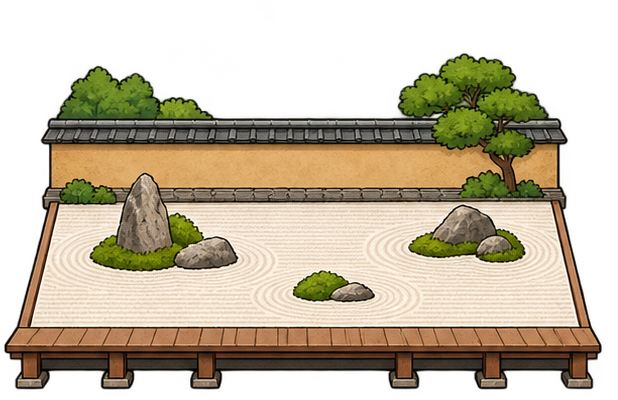
Stones stand for mountains and islands, white gravel for water, raked lines for waves; the garden is viewed from the veranda.
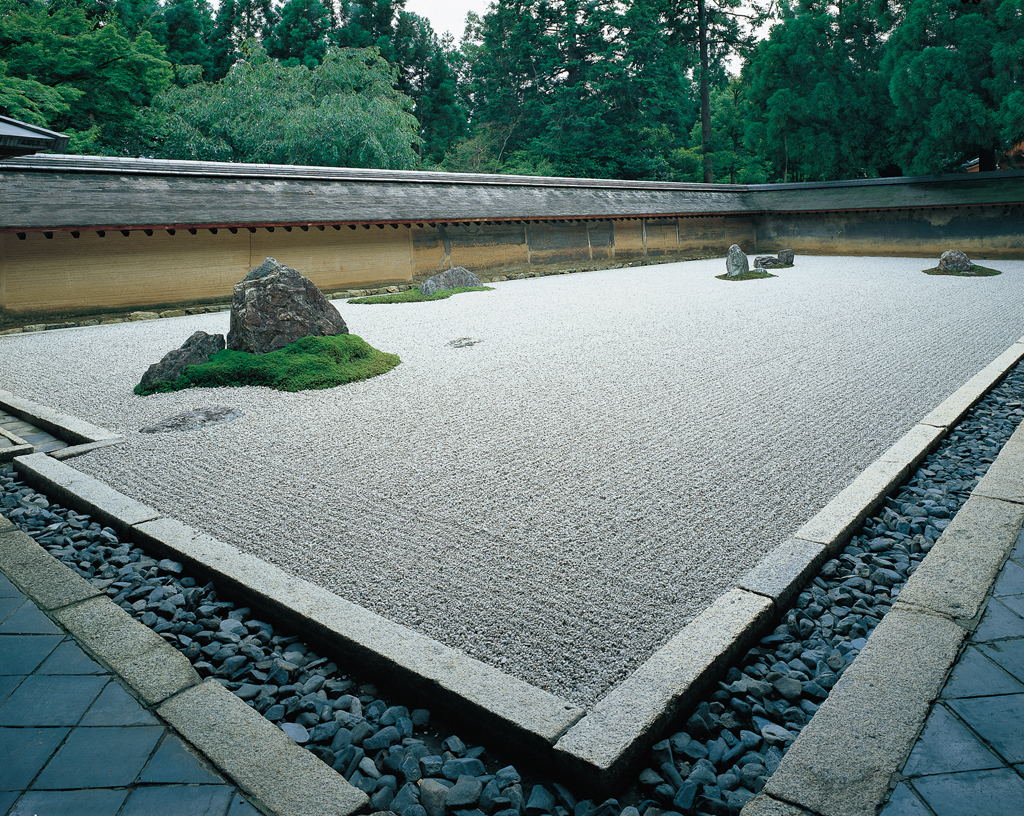
The Ryōan-ji rock garden: stone groups on white gravel, enclosed on three sides by a weathered clay wall.
At Daisen-in, a subtemple of Daitoku-ji in northern Kyoto, a garden from the early sixteenth century wraps around the abbot’s quarters. The subtemple was founded in 1509 by the monk Kogaku Sōkō; the garden was long attributed to the artist Sōami, but many scholars now credit Kogaku himself. In the northeast corner, tall rocks stand for a mountain range, and a "river" of white gravel tumbles from them, passes under a stone bridge, flows around a rock shaped like a boat, widens, and finally empties into a broad, almost empty "sea" of raked gravel on the south side. Within the narrow strip around the hall you follow a river from its source to the ocean, and many visitors read it as a life moving from turbulence toward stillness.
- 1Mountainsnortheast corner; tall rocks
- 2Gravel river tumbles down
- 3Stone bridge
- 4Boat-shaped rock
- 5The river widens
- 6The “sea”on the south side
Within the narrow strip around the hall, a river of white gravel runs from its source to the sea.
Ryōan-ji goes further into abstraction. Its garden is a rectangle roughly 25 meters wide and 10 meters deep, enclosed on three sides by a wall about 1.8 meters high, made of clay mixed with oil, whose surface has weathered into soft browns and ochres. On the white gravel lie fifteen stones in five groups, ringed with moss. There are no trees and no clue as to what it represents. Over the centuries people have suggested a tigress carrying her cubs across a river, islands in the sea, mountain peaks above clouds, or the Chinese character for "heart." The best-known observation is that from no point on the veranda can you see all fifteen stones at once; one is always hidden behind another.
Nobody knows exactly who made the garden or when. The temple says it was laid out when the abbot’s hall was built in 1499; older tradition credits Sōami; neither is proven. A large, half-buried stone at the back bears two carved names, Kotarō and one usually read as Hikojirō, probably the stoneworkers who set it. That uncertainty is part of its appeal: there is no official meaning to look up, so you are left with the stones themselves.
Dry gardens need daily care. Monks rake the gravel with wooden rakes into straight lines for calm water and concentric rings around rocks, the ripples where water meets an island. Rain, leaves and animals disturb the pattern, so raking becomes a daily discipline in its own right. Early in the morning at some Kyoto temples you can watch a monk walking backward across the gravel, smoothing out his own footprints as he goes.
The form did not stop evolving. In 1939 the designer Shigemori Mirei created a new garden for the abbot’s hall at Tōfuku-ji in Kyoto, with towering upright stones, bold raked swirls and a checkerboard of moss and square paving stones on the north side. It was a dry garden reimagined in the language of modern art, and it is one of the most photographed gardens in Japan. Nearly every "Zen garden" built abroad since then traces its idea back to karesansui.
05The Tea Garden: A Path, Not a Picture
In the late sixteenth century, as the tea ceremony matured under Sen no Rikyū and his circle, a different kind of garden appeared: the roji, or "dewy path," the garden that leads to a tea room. A roji is not designed to be looked at from a veranda. It is designed to be walked through, slowly, as a transition from the everyday world into the world of tea.
Guests wait on a bench in the outer garden, then follow a line of stepping stones, tobi-ishi, set at intervals that force you to slow down and watch your feet. A saying handed down among tea people holds that Rikyū set stepping stones "six parts walking, four parts view," while his pupil Furuta Oribe is said to have reversed the ratio in favor of looks. At a middle gate the host appears and the two bow without speaking. Farther in sits a low stone basin called a tsukubai, from the verb "to crouch," because you must crouch to use it: you ladle water with a bamboo dipper, rinse your hands and mouth, and leave the dust of the road behind. A stone lantern, originally a votive object at temples and shrines, lights the path for evening gatherings. Finally you enter the tea room through the nijiriguchi, a crawl-through doorway, usually said to be only 60 to 70 centimeters high, so low that everyone, whatever their rank, has to bow and crawl in.
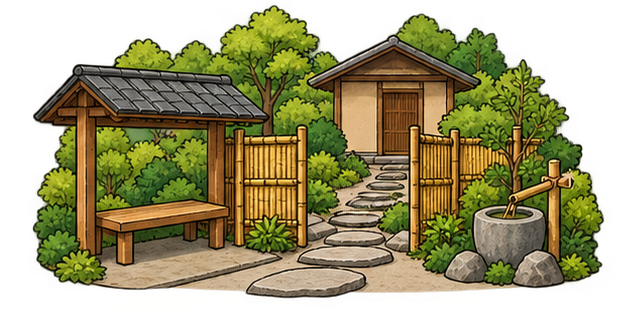
Guests wait in the arbor, then follow stepping stones through the middle gate toward the tea room, past the stone basin.
The roji is planted with evergreens and deliberately free of showy flowers. The host sprinkles water on the stones before guests arrive so that everything glistens as if after rain, giving the feel of a mountain path. Tea masters turned the garden from something to admire into something to experience. The stepping stones, lanterns and water basins you see in ordinary Japanese houses today come mostly from the roji.
06Stroll Gardens of the Feudal Lords
The long peace of the Edo period (1603–1868) gave the daimyo, the regional lords, the money and leisure to build huge gardens, both at their mansions in Edo and in their home domains. These are stroll gardens, kaiyū-shiki teien. A large pond sits at the center, a path loops around it, and the view changes every few steps: round a hill and a bridge appears, cross the bridge and a teahouse comes into sight. These gardens absorbed everything that came before them, the Heian pond and islands, the Zen stone groupings, the tea garden’s stepping stones and lanterns.
- 1
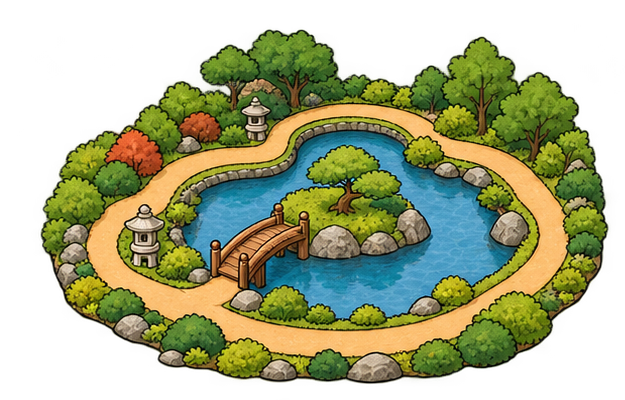 A path circles the pond, with an island in the middle and a bridge and lanterns on the shore.
- 2
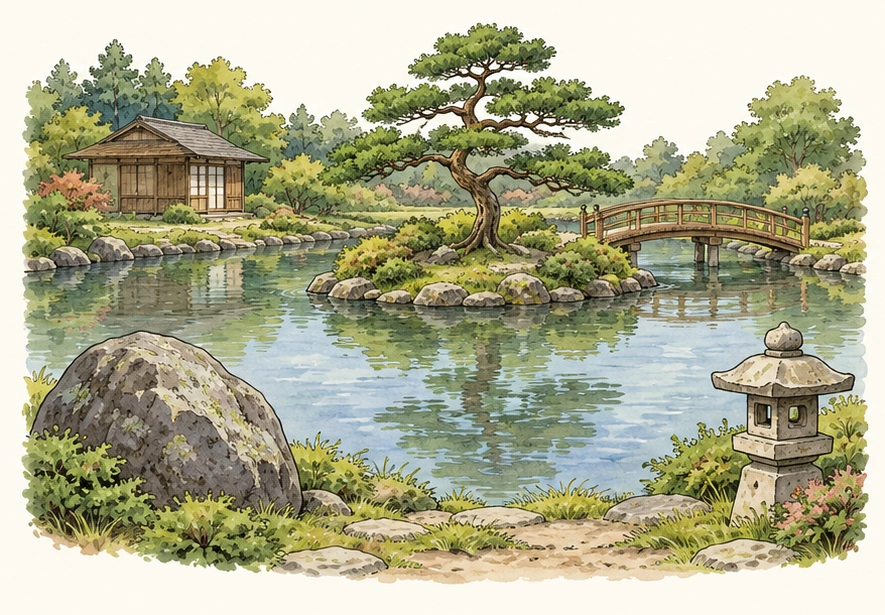 From the south, the pine island is straight ahead and the bridge far off.
- 3
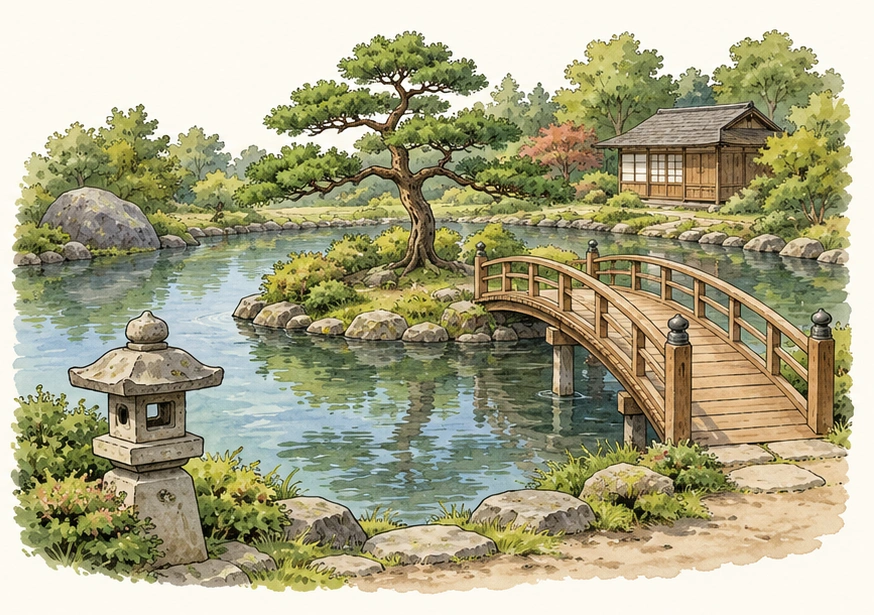 From the southeast, the same island turns and the bridge comes close.
The lords loved miniature versions of famous places. Koishikawa Kōrakuen in Tokyo, built by the Mito branch of the Tokugawa family, contains a causeway modeled on the one at West Lake in Hangzhou and a small version of Kyoto’s Togetsukyō bridge. Rikugien, also in Tokyo, was completed around 1702 by Yanagisawa Yoshiyasu, a favorite of the fifth shogun; its scenes recreate places celebrated in classical Japanese poetry.
Three daimyo gardens are traditionally ranked as the "Three Great Gardens of Japan." Kenroku-en in Kanazawa grew from a villa garden laid out in the 1670s by Maeda Tsunanori, lord of Kaga, and was expanded by his successors. Its name, said to have been chosen by Matsudaira Sadanobu, means "garden combining six qualities," taken from a Song-dynasty Chinese text on the gardens of Luoyang that lists six virtues rarely found together: spaciousness and seclusion, artifice and antiquity, watercourses and panoramic views. Before winter, gardeners raise a tall pole beside each prized pine and run dozens of ropes from its top to the branches, so heavy snow cannot snap them. These yukitsuri, rope supports shaped like open umbrellas, have become a symbol of Kanazawa in winter.
Kōraku-en in Okayama was completed around 1700 for the lord Ikeda Tsunamasa. Unusually for a Japanese garden, it has wide lawns, and from inside you can see the black keep of Okayama Castle. Kairaku-en in Mito was opened in 1842 by the lord Tokugawa Nariaki; today it holds some 3,000 plum trees, and Nariaki named it for the idea of "enjoying it together with the people" of his domain, and opened it to them from the start, reportedly on regular days. The spirit stuck: for a long time the garden was free to enter, and only in 2019 did it begin charging visitors from outside the prefecture.
The imperial villas of Katsura and Shūgaku-in in Kyoto belong to this tradition as well. Katsura in particular is so admired for the way its buildings and garden work together that it is a subject in itself (see also: Katsura Imperial Villa: The Princely Retreat That Became Japan’s Model of Beauty).
07Shakkei: Borrowing the Mountains
One of the cleverest ideas in Japanese garden design is shakkei, "borrowed scenery": treating a mountain, a pagoda or a stand of trees outside the garden as part of the composition. The designer lowers the hedge at just the right height, or places a wall to hide the houses in the middle distance, so that only the far-off peak shows above it. A garden of a few hundred square meters suddenly has a whole mountain as its backdrop.
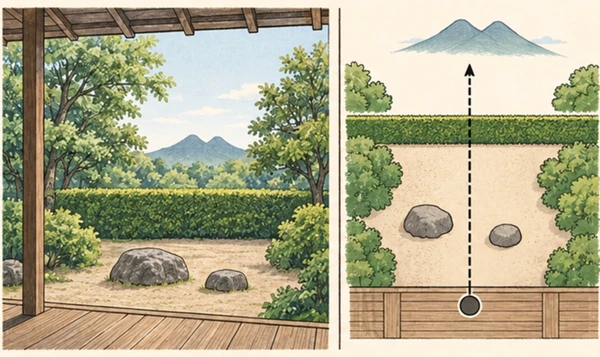
With the hedge kept low, the distant mountain seems to hang behind the garden when seen from the veranda.
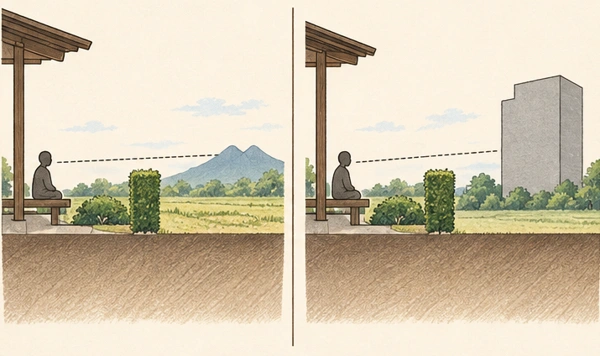
Once a tall building goes up outside, the borrowed view is gone.
The textbook example is Entsū-ji in Iwakura, northern Kyoto, originally a villa of the retired emperor Go-Mizunoo that became a temple in 1678. In front of the main hall lies a flat moss garden scattered with some forty low stones and clipped azaleas. Beyond it runs a clipped hedge, and beyond that a row of cedar and cypress trunks that act like the sides of a picture frame. Inside the frame, far to the east, floats Mount Hiei. The entire garden exists for that one view. Standing on the veranda you cannot quite tell where the garden ends and the mountain begins. Once a tall building blocks borrowed scenery, there is nothing left to borrow, which is why the temple is said to have fought hard against development around it, and why Kyoto’s view-protection ordinance, in force since 2007, lists the sightline from Entsū-ji to Mount Hiei and restricts the height and roof shapes of buildings in between.
Shūgaku-in Imperial Villa, built by Go-Mizunoo in the mid-seventeenth century on the slopes of northeastern Kyoto, uses borrowing on the grandest scale. From the upper teahouse you look down over a large pond and out across the mountains and the city. At Tenryū-ji, Arashiyama forms the backdrop of the pond. In the Meiji era, the statesman Yamagata Aritomo built a villa called Murin-an, completed in 1896, at the foot of Kyoto’s Higashiyama hills. Its garden, made by the seventh-generation master Ogawa Jihei, draws water from the Lake Biwa Canal and frames the eastern hills as its main view; it also uses open lawn, giving the old form a bright, modern feel. In Kagoshima, Sengan-en borrows the active volcano Sakurajima as its "hill" and Kinkō Bay as its "pond," which may make it the only garden whose borrowed scenery occasionally erupts.
Borrowed scenery reveals something basic about the Japanese garden. It is not a sealed enclosure but a frame, a way of connecting a small space to the larger landscape around it.
08The Hands You Do Not See
Japanese gardens look natural, but almost nothing in them is left alone. The people who maintain them, niwashi or gardeners, prune pines twice a year: in spring they pinch back the new candles, and in autumn and winter they pull out old needles by hand, one cluster at a time, so that light reaches the inner branches and the layered shape stays clear. A single large pine can occupy a team for days. Moss must be weeded, watered and swept daily in autumn with soft bamboo brooms that will not tear it.
Japanese visitors judge a garden partly by how it is cared for. The ideal is a garden with no visible sign of human effort that is nonetheless spotless. A well-known story has Sen no Rikyū looking over a tea garden swept spotless, in some versions by his son, then shaking a tree so that a few leaves fell onto the path. It is a later anecdote rather than a documented event, but it captures the aesthetic exactly.
Many gardens are still looked after by family firms that have passed down the trade for generations. Ueji, the firm of Ogawa Jihei, has continued in Kyoto since the Edo period. Japanese gardens have also spread worldwide, from Portland, Oregon, to Cowra in Australia. In Shimane Prefecture, the Adachi Museum of Art has been ranked first every year since 2003 in an annual survey by an American journal devoted to Japanese gardens; the 2025 ranking, announced in 2026, made it 23 years in a row. Its garden is meant to be viewed through the museum’s windows, like a living painting; visitors cannot walk into it.
09How to Look at a Japanese Garden
The best way to see a Japanese garden is to find the spot it was designed to be seen from and sit down. Dry gardens and many temple gardens are viewed from the veranda of the abbot’s quarters or a study hall. Take off your shoes at the entrance, walk the polished wooden corridors to the edge of the veranda, and sit. Resist the urge to photograph immediately. Move a few meters along and the relationships between the stones change. After ten minutes your eyes settle and you start to notice the direction of the raked lines, the shades of green in the moss, the way light moves across the wall. Many gardens are also meant to be seen from inside the building, framed by pillars and sliding doors. Step back into the room and look again: the opening becomes a hanging scroll.
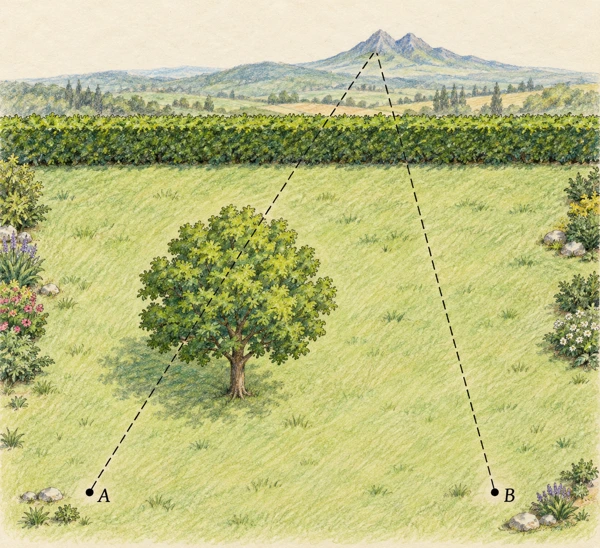
From point A or point B, the near tree and the far mountain line up differently.
Stroll gardens ask you to walk. A full circuit takes thirty minutes to an hour. Pause at bridges, teahouses and high points, and look back at where you have just been. The designs deliberately prevent you from seeing everything at once, so the garden reveals itself in stages.
The seasons transform these places. Spring brings cherries and azaleas; the rainy season makes moss its greenest; autumn brings maples; winter brings Kenroku-en’s rope supports and, on rare mornings in Kyoto, snow on a dry garden. Rain is a gift rather than a problem: wet stone and wet moss show their deepest colors, and the crowds thin out. In cherry-blossom and autumn-leaf seasons, famous Kyoto gardens are packed by midmorning. Arrive at opening time: the garden early in the morning is a different place from the garden at noon.
Saihō-ji, the Moss Temple, asks visitors to take part in sutra copying or a short service before seeing the garden. The imperial villas of Katsura and Shūgaku-in are managed by the Imperial Household Agency. Inside any garden, do not step on the moss, do not walk on the gravel, and do not touch the stones. Keep your voice down on the veranda. Many temples prohibit tripods indoors.
If you only have time for a few: in Kyoto, see Ryōan-ji or Daisen-in for the dry garden, Tenryū-ji for the pond against Arashiyama, and Entsū-ji for borrowed scenery. Go to Kanazawa for Kenroku-en. In Tokyo, spend an afternoon in Rikugien or Koishikawa Kōrakuen. After a few gardens you will notice they are all doing the same thing: taking a small enclosed space and making your gaze travel far beyond it.